When The Americans
p. 63 · Read in the full issue
Had It Taped
By a Staff Writer
It was many years ago in Sydney. The small man found his way into the office of the Islands trading firm of W. S.
Tait and Company, and told the first employee he met that he wanted to place a big order.
THE employee happened to be the office boy, who observed that the customer obviously had been in a festive mood. So when the man announced that he wanted to buy a hotel and have it shipped to an Islands port by the next vessel there was not immediately much interest. The gentleman was finally persuaded to come back the following day.
The next day the client was sober when he told one of the executives he wanted “the usual type of pub”, and it had to be fully furnished, including the cutlery and linen, and fully stocked, including wines, beer and spirits. And he also wanted a barmaid.
He Got It!
The Tail company obliged.
Although the pub never arrived in the Islands on the very next vessel it did get there in due course, and the building—added to over the years—still exists today.
For Tail’s, the sequel came when the client married the bar maid that had been supplied, and thus began a family which is still esteemed in the Islands.
W. S. Tail and Company re called this story of one of its early customers when it celebrated in Sydney in March, the 75th anniversary of the company’s founding. The company still serves the families of some of its original clients.
Another early customer was an Islands man who lost his nose in a fight and asked Tail to send a new one. He forgot to state what colour nose he wanted and in his particular territory noses came in all races, colours and creeds.
But Tail found an artificial nose attached to spectacles which could be painted in the colour required and another customer was happy.
Tail’s have supplied jockeys for Islands race meetings, and race horses too —some of them very successful. Their success may or may not have been due to the fact that “Honest John” Tail, who was the father of William S. Tail, founder of the firm in 1890, owned horses which won the Melbourne Cup four times—still a record.
What Tails refer to as the “red tape episode” occurred during World War 11, when the com pany received this radio message from New Caledonia: SEND BY
First Plane 32,000 Yards
2* Inches Red Tape Signed
Patch.
Tails didn’t have any clients called Patch although they had plenty of business in New Cale donia. When they learned that the American officer in command in New Caledonia was a General Patch their first reaction was to put the matter aside as a rather poor joke by one of their New Caledonian friends.
But some judicious inquiries
revealed the American Army in New Caledonia did require 32,000 yards of red tape to be forwarded on an Army plane scheduled to leave Sydney two days later.
Then began a hurried search for sources of supply, which ended by Tails locating a factory which was making webbing for Australian Army machine-gun belting. The factory owner said he could do the job if he had the authority of the Australian Army which had him under contract.
The Australian Army, when approached by Tails, agreed to suspend its machine-gun webbing orders long enough for the Americans to have their red tape.
And the Americans got it.
The Answer But it was another two years before Tails learned why it was that the Americans had to have their red tape so urgently that the Australian Army had had to forgo its supplies of machine-gun belting. It turned out that the US Army had found it difficult to recruit New Caledonian native labour and it had hit upon the idea of offering them bright coloured uniforms as an induce ment to join. The red tape had been used to put red stripes down the legs of their uniform shorts!
“Needless to say,” commented one of Tail’s directors at the 75th anniversary celebrations in March, “we were never courageous enough to tell the Australian Army about this.”
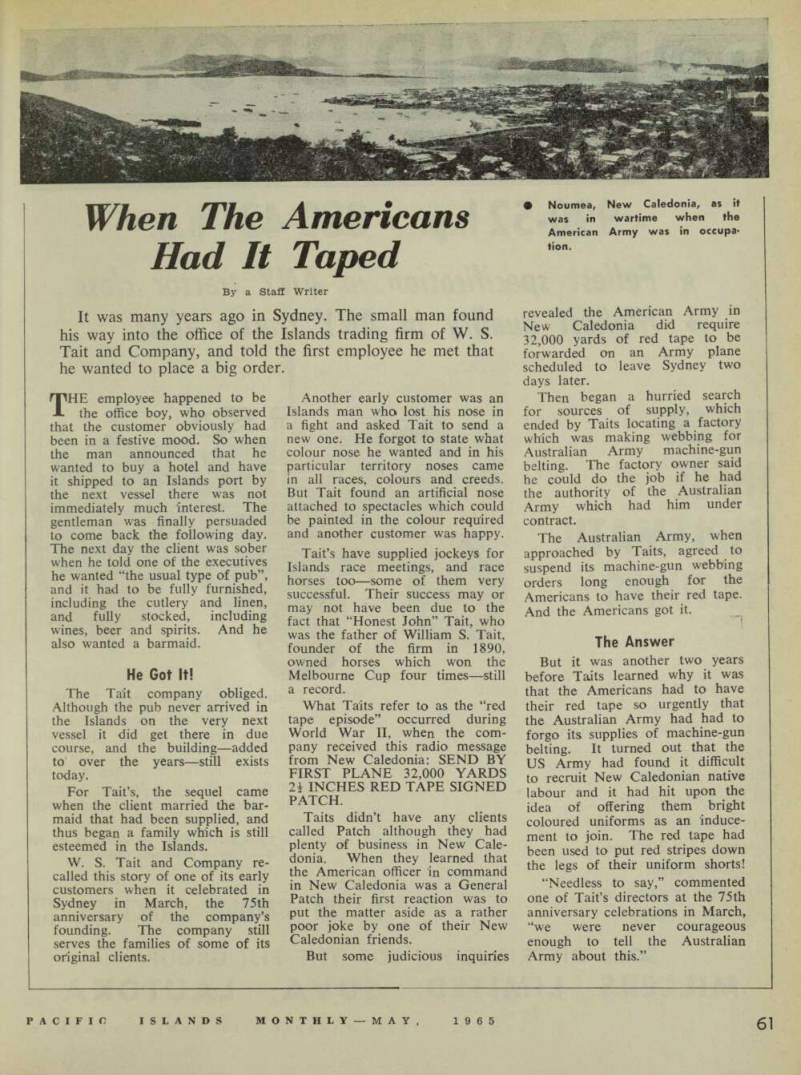
• Noumea, New Caledonia, as it was in wartime when the American Army was in occupa tion.