Fijian Politicians Are
pp. 59-61 · Read in the full issue
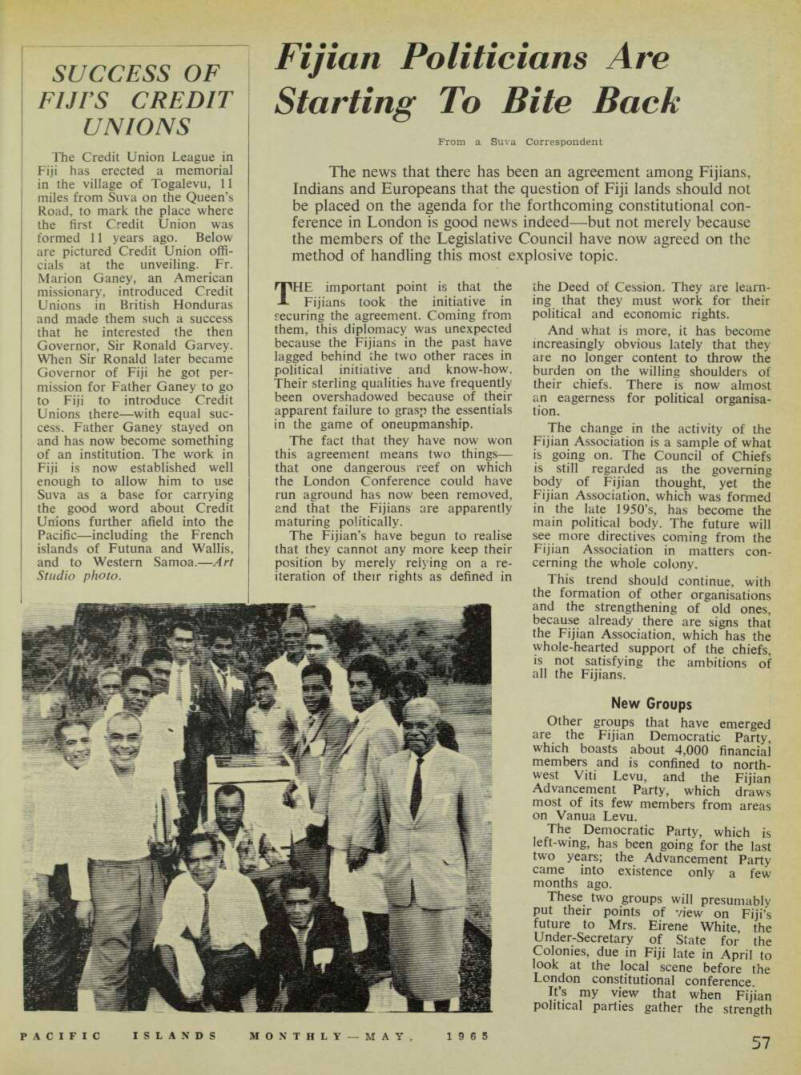

Starting To Bite Back
From a Suva Correspondent The news that there has been an agreement among Fijians, Indians and Europeans that the question of Fiji lands should not be placed on the agenda for the forthcoming constitutional con ference in London is good news indeed—but not merely because the members of the Legislative Council have now agreed on the method of handling this most explosive topic.
THE important point is that the Fijians took the initiative in securing the agreement. Coming from them, this diplomacy was unexpected because the Fijians in the past have lagged behind the two other races in political initiative and know-how.
Their sterling qualities have frequently been overshadowed because of their apparent failure to grasp the essentials in the game of oneupmanship.
The fact that they have now won this agreement means two things— that one dangerous reef on which the London Conference could have run aground has now been removed, and that the Fijians are apparently maturing politically.
The Fijian’s have begun to realise that they cannot any more keep their position by merely relying on a re iteration of their rights as defined in
the Deed of Cession, They are learn ing that they must work for their political and economic rights.
And what is more, it has become increasingly obvious lately that they are no longer content to throw the burden on the willing shoulders of their chiefs. There is now almost an eagerness for political organisa tion.
The change in the activity of the Fijian Association is a sample of what is going on. The Council of Chiefs is still regarded as the governing body of Fijian thought, yet the Fijian Association, which was formed in the late 1950’5, has become the main political body. The future will see more directives coming from the Fijian Association in matters con cerning the whole colony.
This trend should continue, with the formation of other organisations and the strengthening of old ones, because already there are signs that the Fijian Association, which has the whole-hearted support of the chiefs, is not satisfying the ambitions of all the Fijians.
New Groups
Other groups that have emerged are the Fijian Democratic Party, which boasts about 4,000 financial members and is confined to north west Viti Levu, and the Fijian Advancement Party, which draws most of its few members from areas on Vanua Levu.
The Democratic Party, which is left-wing, has been going for the last two years; the Advancement Party came into existence only a few months ago.
These two groups will presumably put their points of view on Fiji’s future to Mrs. Eirene White, the Under-Secretary of State for the Colonies, due in Fiji late in April to look at the local scene before the London constitutional conference It’s my view that when Fijian political parties gather the strength
that will be given them by internal self-government that there will be a veering to the left—probably to the left-centre as with the UK Labour Party. Several Fijians who have studied abroad have ideas in that direction, although at the moment they keep them to themselves.
The London conference will be the watershed. The ideas will develop after that, for not until then will it be possible to see the courses that can be taken. Everybody—and every thing—is waiting for that.
Even the matter of land will be come a hot subject again after the conference, for it is too important a subject to let lie for long. Some people predict that it will come up at the conference, despite the recent agreement between the races.
And it is on this matter of land that the new Fijian political parties have had the most to say.
The Advancement Party The embryonic Fijian Advance ment Party has the land chip on its shoulder and is likely to keep it there.
In a “Review of Fijian Progress”, which it sent at the end of March to the Governor, there are several acidulous remarks on land.
“Although most of the total land area in the Colony is Fijian-owned, much of it is uneconomic,” said the party’s review.
“The greater part of good land in the Colony is owned by Government and foreign settlers as Crown lands and freehold respectively. Most of the land which is now owned by foreigners as freehold has been either un lawfully acquired or has been bought with guns, axes, knives, clothes or smoking pipes by cunning white settlers who came here before Cession.
Even after Cession, when the two sets of Administrations had been operating, the practice of unfair acquisition of Fijian land was still going on.”
The review continues in that strain, quoting what it says are examples, and then continues, “There are other complaints among the Fijian people concerning the work of the Native Land Commission, but the authorities have been satisfied with its present record. On the other hand, no work has been done to decide the position of Fijian lands, which had been owned as freehold by foreign settlers since and before Cession.”
This is a surprisingly explosive statement to come from Fijians, Although the Advancement Party is of little account at the moment, its views are an indication of what some Fijians are thinking.
Although members of the Fijian Association, at a recent meeting, have supported the Fijian action in neutralising the land question at the London conference, there were Fijian speakers at that meeting who took a somewhat similar line to the Fijian Advancement Party’s message. Their view seemed to be that all alienated land should revert to the Fijians.
It’s all controversial and there fore valuable comment because it illustrates how the Fijians are be ginning to think for themselves, and to move with the times instead of letting the chiefs follow time-worn ruts.
What, meanwhile, are the Indians saying about the joint agreement on the land question? Perhaps a guide to what a community is thinking may be more reliably found not in the utterances of their leaders but in the writings for home consumption.
An article in a newspaper regarded as the mouthpiece of Mr. A. D. Patel and his Federation Party said on April 1, several days after the joint statement: “In view of this com promise [the joint statement] it is hoped that special consideration will be given to security of tenure. To let any land lie vacant or unused will be a hindrance to the economic pro gress of the country.
“Therefore, reserved lands which are not being continuously and pro perly used should be returned to the farmers. In return for their reserved lands, the farmers should receive compensation and full provision should be made for their rehabilita tion.
Sting In The Tail “Some people are being resettled under the Government Development Plan, but this work can be done with greater speed and the problem can be solved to a great extent if, in the first instance, lands are not reserved at all.”
It sounds innocuous but the sting is in the tail. The last sentence hits at Fijian land regulations and customs, and seems to run contrary to the joint agreement.
The Kisan Sangh union of the cane farmers under the new Moses, Ayodhya Prasad, who threatened the Fiji Government that he would lead 80,000 farmers and their families out of Fiji, has said in a recent issue of its organ that the farmers want to see their land problem solved first —before the conference.
With these views being expressed by sections of the Indian community the new Fijian approach to politics has obviously developed not before its time!