Monthly
Pacific Islands Monthly
May, 1965
3/- 60 US cents 50 French Pac. frcs.
he New/s Magazine Of The South Pacific
Established 1930
t
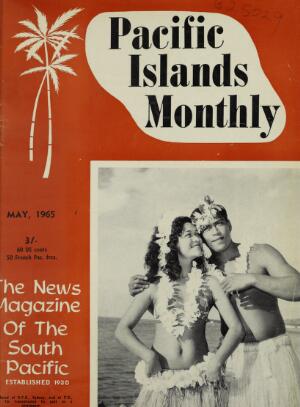
OUR COVER: "Tahiti has changed," says a disillusioned friend of ours who has just revisited the island after an absence of two years, "and they have finally managed to commercialise it and spoil it altogether." We, however, are inclined to think he's exaggerating, because we know there are still Tahitians who look like our cover girl (and boy). And Captain Bligh, we remember, took our friend's view 175 years ago!
Photo: Studio Mackenzie.
Advertisements & other items, pp. 2-6 (1 item)
Australia Is A Big Country
3E3 W l - -t 3 W -
Big and generous in everything unusual, Australia has much to offer holiday visitors.
For example, the wonders of the Great Barrier Reef that stretches for over 1000 miles. The gaiety of the sun, sand and surf on Queensland’s Gold Coast. The awesome, colourful beauty of the Red Heart of Australia; and the quiet tranquillity of Tasmania, or the tropic wonders of Papua/New Guinea.
All this is yours to enjoy through Trans- Australia Airlines.
TAA can offer a huge range of low-cost, packaged ‘Fly-Away Holidays’ to any of the above areas and TAA will take care of everything. Travel, bookings by air, road, rail or sea, accommodation, sight-seeing trips—even theatre bookings and restaurant reservations!
You have nothing to do but enjoy yourself.
Trans-Australia Airlines serves 140 ports throughout Australia and Papua/New Guinea.
Do more —see more, on a TAA ‘Fly-Away Holiday’.
Contact your nearest travel agent or Trans- Australia Airlines office.
PLY
THE FRIENDLY WAY
Trans-Australia Airlines
TAABI2v./65
AUSTRALIA’S
LARGEST
MANUFACTURER OF
RADIO
COMMUNICATION
EQUIPMENT
I I sa ,r~ m i «r 11 i w te
A.W.A. PRODUCTS AND SERVICES
Aviation H.F. and V.H.F. Communication Equipment; V.H.F. Navigation Systems; Distance Measuring Equipment, etc.
Broadcasting M.F. and H.F. Transmitters; Monitors and Studio Equipment; Outside broadcast amplifiers; recordings and transcriptions; crystals, test instruments: Television transmitters; aerial systems; links and ancillary equipment.
Components Capacitors; switches; loudspeakers; modules including television tuners and deflection components; coil winding.
Consumer Products Radio and television receivers; radiograms; domestic appliances; sound amplifying and paging equipment A.W.A. Radio Electric Works, Sydney.
Australia's largest manufacturer of radio communication equipment.
To supply Australian-made equipment to overseas markets means more than a growing public acceptance of AWA products. It implies a demand for research and development, the employment of engineers and technicians and an enhanced prosperity for the nation. Fifty years of experience in the design and manufacture of radio communication equipment stands AWA in good stead to embrace the opportunity of expanding Australia’s export trade,
AMALGAMATED WIRELESS (AUSTRALASIA) LIMITED
HEAD OFFICE: 47 YORK STREET, SYDNEY, AUSTRALIA Branches throughout Australia and New Zealand Distributors in principal overseas’ centres Marine Coastal radio stations; ship-board inter-communications equipment; emergency transmitters; automatic alarms; passenger and crew broadcasting; sound reproducing and paging equipment.
Telecommunications M.F., H.F., V.H.F., U.H.F. transmitting, receiving and link equipment; mobile radio telephone installations; monitoring and test equipment; aerial systems; crystals.
Training Aviation, Marine, Broadcasting and Telecommunications technicians; television and broadcast receiver servicing.
Services Installation, operation and maintenance of radio communication systems of all types.
Transmitting and receiving valves; transistors; TV picture tubes.
SIMPLE! SAFE! SILENT! FOOLPROOF!
r * s
AGENTS
WANTED!
We are very pleased to invite enquiries 'from established houses for the representation of this popular and fast-selling range.
All enquiries will be received without commitment, and in confidence.
mono
PUMPS & AUTOMATIC
WATER PRESSURE SYSTEMS
★ MONO — the simplest and most efficient positive displacement pump your money can buy. GUARANTEED SELF-PRIMING, with positive and powerful suction lifts of up to 27 ft.!
Only one moving part: no valves or gears to cause stoppages or delays.
Handles all liquids, sludges, wastes and solids in suspension. No trouble when sand, silt, light weed, etc., enters the line. Special types for edible fluids, syrups, pastes, etc. The range covers industrial, food processing, agricultural, domestic, marine and mining applications. Details, prices,
etc. free on application.
r«
MONO “M” SERIES PUMP,
165 to 860 g.p.h.
RIGHT — Mono “M"
Series Pressure System. 150 to 300 g.p.h.; 30 p.s.i.
EXTREME RIGHT—Mono
“D” Series Pressure System. 450 to 3000 g.p.h.; 50 to 100 p.s.i.
Up to 8000 g.p.h. to special order.
MONO “0” SERIES PUMP, 100 to 8000 g.p.h.
MONO PUMPS (Australia) PTY. LTD.
HEAD OFFICE: Lower Dandenong Road, Mordialloc, Victoria. CABLES & TELEGRAMS: “Monoaust” Melbourne.
Branches and Agencies throughout Australia, New Zealand, Papua and New Guinea.
MPA4/14R
pillllllllllllllllllllllllllllllllllllllllllllllinilllllllllllllllllllllllllln Ilium BURNS PHILP (SOUTH SEA) CO. LTD.
GENERAL MERCHANTS AND SHIPOWNERS
I SHIPPING, CUSTOMS AND FORWARDING AGENTS
== m* • • •
I Fiji:
SUVA.
LEVUKA.
LAUTOKA.
LABASA.
SAVU SAVU.
BA.
SIGATOKA.
TAVUA.
ROTUMA ISLAND.
TAVEUNI,
BRANCHES
Samoa:
APIA.
PAGO PAGO.
AGENTS FOR:
QUEENSLAND INSURANCE CO. LTD.
BURNS PHILP TRUST CO. LTD.
SHELL COMPANY (P. 1.) LTD.
Tonga:
NUKUALOFA.
HAAPAI.
VAVAU.
NORFOLK ISLAND.
NIUE ISLAND.
OVERSEAS AGENTS
BURNS, PHILP Cr CO. LTD., Sydney.
BURNS, PHILP Cr CO. LTD., London.
BURNS PHILP CO. OF SAN FRANCISCO
SHIPPING AGENCIES
• The New Zealand Shipping Co. Ltd. • Shaw Savill & Albion Co. Ltd. • Port Line Ltd. • Bank Line Ltd. • General Steamship Corporation Ltd. • Blue Star Line • Cunard Line • Compagnle des Messageries Maritimes • British India Steam Navigation Co. Ltd. • Royal Interocean Lines • Nederland Line Royal Dutch Mail/Royal Rotterdam Lloyd.
EXCLUSIVE DISTRIBUTORSHIPS INCLUDE
• AKAI TAPERECORDERS
• DUNLOP PRODUCTS
• EPIGLASS PRODUCTS
• FERGUSON TRACTORS
HELENA RUBENSTEIN
HITACHI ELECTRONICS
HOLDEN VEHICLES
JOHNSON'S WAXES
ROLEX WATCHES
REVLON COSMETICS
PENTAX CAMERAS
SUNBEAM APPLIANCES
INTERNATIONAL AIR TRANSPORT ASSOCIATION REPRESENTATIVES for
QANTAS EMPIRE AIRWAYS LTD. :: TASMAN EMPIRE AIRWAYS LTD.
UNION DE TRANSPORTS AERIENS ALITALIA PAN AMERICAN AIRWAYS
ASSOCIATED COMPANIES
BURNS PHILP (NEW HEBRIDES) LTD.
AUTOMOTIVE SUPPLIES CO. LTD.
CORRIE & CO. LTD. • NARAIN FURNITURE CO. LTD.
SPECIALISED SERVICES
EXPERT ADVICE ON WORLD AND LOCAL TOURS
TRAVEL SHIPPING FORWARDING CUSTOMS
FORMALITIES INSURANCE.
REGISTERED OFFICE: SUVA, FIJI
Code Address: "BURNSOUTH" iiiiiiiiiiiiiiiiiiiiiiiiiiiiiiiiiiiiiiiiiiiiiiiiiiiiiiiiiiiiiiiiiiiiiiiiiiiiiiiiiiiiiiiiiiiiiiiiiiiiiiiiijriiiiiiiiiiiiiiiiiiiiiiiiiiiiiiiiiiiiiiiiiiiiiiiiiiiiiiiiiiiiiiiiiiiiiiiiiiiiiiiiiiiiiiiiiiiiiiiiiiiiiiiiiiiiiiiiiiiiiiiiiiiiiiiiiiiiiiiiiiiiiiiiiiiiH
HAVE YOU
NOTICED
HOW MUCH
BETTER
GILBEY’S
r GIN
IS!
So why mix with others?
GILBEY’S
GINA
to*/*
Pacific Islands
Monthly
Owned And Published By Pacific
Publications Pty. Ltd., 29 Alberta
St. (Box 3408, G.P.0.), Sydney.
Telephones: 61-9197, 61-7101, 61-4369.
Telegraphic Address: PACPUB, Sydney.
Chief Executives
Managing Director: R. W. Robson.
General Manager: Selwyn Hughes.
Book Publishing Division
Editor; Judy Tudor.
Pacific Islands Monthly
Editor: Stuart Inder.
Assistant Editor: Robert Langdon.
Branch Offices
Melbourne: Newspaper House, 247 Collins St.
Tel.: 63-7053.
Fiji: Pacific Publications (Fiji) Ltd., Fiji Times Building, 20 Gordon Street, SUVA. Tel.: 5601.
Fiji Times Office, Vidilo Street, LAUTOKA.
Tel.; 420.
Representatives
New Zealand: J. D. Whitcombe, C.P.O. Box 2229, Queen Street, Auckland. Tel.: 70409.
Hawaii: C. C. Spencer, 203 Yap Bldg., 3465 Waialae Ave., Honolulu. Tel.: 775538.
United States: R. G. Craib, 153 Laidley St., San Francisco 31, California. Tel.: Mission 8-1075.
United Kingdom: S. R. Warman, 73 Cheapside, London, E.C.2. Tel.: City 2355.
H. A. Mackenzie, 4A Bloomsbury Square, London, W.C.I. Tel.: Holborn 3779.
Agents
All main trading firms and stores in the Pacific Islands.
Pacific Publications Pty. Ltd. is the Australian agent for THE FIJI TIMES.
Subscription Rates:
Australia, New Zealand, all British Common wealth South Pacific Territories, Tonga, New Hebrides and Western Samoa: 3/- local currency (36/- local currency for 12 months).
Elsewhere in the South Pacific: 50 French Pacific francs or 60 US cents (600 French Pacific francs or $7.00 US posted for 12 months). Posted to the UK, US and all other countries: £Stg.2 or $7.00 US.
"Pacific Islands Monthly" is air-freighted to all subscribers and agents in the South Pacific; copies to other areas go by surface mail.
In This Issue
General
Missing Yacht Turns Up 15 Bligh Emulator's Boat Voyage Delayed 16 75th Anniversary of W. S. Tait & Co. 61 Captain Cook Medallions 93 More Pacific Calls for Cruise Ships ... 133 Cocoa Prices Fall Sharply 135 "Sletholm" Trade Drive 138 Copra Up, Maybe to Stay 139
American Samoa
Much Ado About Pigs 16 Big Future Seen for Tourism 129 More Goods on Duty Free List 131
Cook Islands
Election Victory for Albert Henry ... 7 Solar Eclipse 15 Rarotonga's Historian, Charlie Cowan 91 "Yankee" Still on Reef 115 Internal Air Service Proposed 131
Fiji
Patel and Co. Demand Common Roll 11 What the Governor Said 25 Suva's Drinkers Pose Growing Prob lem 41 Credit Unions Successful 57 Fijian Politicians Bite Back 57 Legislation Streamlined 63 Response to SPSM Share Offer 135
French Polynesia
Yacht "Buzzed" by A-Base Helicopters 21 Air-freighted Eggs from Australia ... 23 US Consulate to Close; Fuss Over Visas 123
Gilbert And Ellice Islands Colony
Big New Church at Bikenibeu 53 Plan for Internal Air Services 145
Nauru
Showdown Soon on Future 13 Plan for Broadcasting Station 15 UN Mission Returns 21 Nauruans Ask for Independence 27 £losm. for Soil Imports 27
New Caledonia
1966 Games Developments 39 Census Figures for Foreigners 76 Welcome Mat Out for Tourists 127 First Book of Photographs 127 Nickel Contract with Red China 137
New Hebrides
Castaways Saved by "Radesthesia" .. 23 New French Resident Commissioner 27 Mr. Delauney Farewelled 37 New Ship for Captain Rusden 107 First New Hebridean Matriculates 145 Representatives for Lae Conference 146
Norfolk Island
Link with Eskimo Land 25 Tourist Industry Booming 125 Weekly Paper Planned 127
Papua-New Guinea
Pressure On 9 Administrator Not Resigning 10 Soekarno Drops A Hint 15 UN Mission Says Nothing 21 Bodies of Wartime Fliers Found 29 Post-Mortem on New Ireland In vasion 29, 31
Triplets Born in Rabaul 43 Famous Hagen Axe for Tokyo 67 New Britain's Nature Man 89 New Journal on New Guinea 96 Tough Action Against Ships' Masters 105 Tariff Inquiry on Coffee 137 Star Mountains Crossed 145 "Papua Should Be Seventh State" 145
Pitcairn Island
First Motorised Vehicles 73
Solomon Islands
First Woman in Legislative Council 12 Strike in Honiara 15 First Elected Legislature 45 Exciting Times for Tikopians 69 New Type of Copra Drier 75 Battle of Binisokio 85 New Ships for Government 107 "Arthur Rogers" Wrecked 11l Ship Rammed by Swordfish 111
Tokelaus
Blasting Job at Fakaofo 115
Tonga
Effects of Economic Restrictions 15 Tobacco Industry 63 Action Soon on Nukualofa Wharf 111
United States Trust Territory
Saipan's Tourism Plans 131
West New Guinea
Refugees Cross Border 15 Sharks, Butterflies, Giant Rats 87
Western Samoa
More Earthquakes 43 Negotiations on Bananas 49 Royal Tupua Title 49 Annandale-Betts Wedding 49 Dismissal of Captain Moors 51 Control of Public Service 51 Chief Auditor Censured 53
DEPARTMENTS: Tropicalities, 21; Territories Talk-Talk, 31; From the Islands Press, 73; Pacific Planters' Digest, 75; Magazine Section, 85; New Books, 95; Shipping, 105; Cruising Yachts, 117; Travel, 123; Schedules for Cruise Ships, 133; Commerce, 135; People, 145; Shipping, Airways Timetables, 147; Deaths of Islands People, 157.
Advertisements & other items, p. 8 (1 item)
Carry a Ronson and people notice
■Hi m m m m % y ■ I; ps^ ■A s i i ' ■‘W *■.. /»?*/& / sMS&s ,
ft "T :^n *Srs&
The Ronson Varaflame Premier gives 3.000 lights on one filling of butane gas.
Carry a Ronson and people notice
( The 3J+2 steps we took to build it show at once) In your hand, a Ronson not only feels right, it looks right. Because it has been built to be admired all its long life. You sense this the first time you handle a Ronson. Sense it in the confident way it clicks alight without fumbling. In the silky feel of its finish. This is the reward of workmanship, of 342 different steps each taken with the same end in view: to make the finest lighter possible.
That’s why we inspect every single Ronson 115 times. Why we use only top-grade cartridge brass. Nickel plate it. Then put on just a little more chromium finish than is really needed. And why it takes seven weeks to build a Ronson.
When you twist the control wheel of the exclusive Varaflame system on your Ronson and watch the flame go up or down obediently, when you see it light first click, or notice a friend glance at it in your hand, then you’ll be glad you chose a Ronson. You’ll find there are many elegant styles to choose from. recognised round the world for quality lighters and electrical products
Albert Henry Sweeps
To Victory In
Cook Islands Poll
From W. H. Percival on Rarotonga and AAP Elections on April 20 for a new Cook Islands Legislative Assembly, heralding internal self-government for the 20,000 Cook Islanders, ended in a sweeping victory for the Cook Islands Party (CIP) founded last June by Mr. Albert Henry.
THE CIP won 14 of the 22 seats at stake. The others went to in-
dependent candidates. .
The Leader of Government Business in the old Legislative Assembly, Mr D. C. Brown, who had been tipped as Prime Minister material, * t Other members of the old Legislative Assembly who lost their seats were Napa T. Napa, a Minister; Teariki Tuavera, the Speaker; David Hosking, Areora Ira and Richard Rapley, of Rarotonga; Mataio Kea and Vaine Rere, of Atiu; and Tiki Tetava, of Mitiaro.
The CIP victory seems certain to result in an amendment to the pro- Posed 88-clause constitution for the Cook Islands which was drawn up by the New Zealand Government m con sultation with Cook Islands represen tatives and passed by the NZ House of Representatives last October. (PIM, Nov. 1964, p. 21.) The constitution, as it stands, con tains a clause stating that no Cook Islander may be nominated for elec tion to the Legislative Assembly until he has lived in the Group for three years.
The CIP president, Mr. Albert
Henry, is primarily affected by this clause, as he was permanently resi dent in New Zealand for many years until he returned to Rarotonga last year. A similar clause in the existing regulations debarred him from stand ing in the April 20 elections.
The CIP made it clear earlier this year that if it won the elections, it would not accept the proposed con stitution until the residence clause had been altered, allowing Mr. Henry to stand in a by-election.
A spokesman for the NZ Depart ment of Island Territories said after the elections: “The NZ Government gave an undertaking when it passed the legislation that the clause would be amended if necessary. We now ex pect the CIP to refuse to adopt the constitution until the clause has been amended.”
First Sitting
The new Assembly is scheduled to hold its first sitting on June 7 when a Leader of Government Business and an Executive Committee will be chosen, and when the first moves are expected to be made to enable Mr.
Henry to head the Government.
AAP reports that this is likely to be achieved in a by-election fol lowing the resignation of Mrs.
Marguerite Story, Mr. Henry’s sister, who was the only successful woman candidate.
On Rarotonga, the day of the poll was one of heavy rain, but voters made their way to the polling booths in a steady stream throughout the day.
The voting was carried out in a quiet, almost reverent manner. There were no fights, no abusive voices, no noise.
The previous evening, members of
Keen Interest
In Results
Results of the election on Raro tonga were chalked up on a big result board erected in front of the Resident Commissioner's office in Avarua. They were followed by a keenly interested crowd which turned out despite the wetness of the night. Bursts of applause greeted the figures whenever a CIP candidate made a substantial addition to his score. — Photo: Van Eijk and Meers; others on pp. 7 and 8 are by W. H. Per cival.
Mr. Albert Henry.
one of the island’s youth clubs prac tised a new drum dance to celebrate the expected victory of the Cook Islands Party.
Sixty-six candidates contested the 22 seats. Of these, 33 candidates con tested the nine seats (in three consti tuencies) on Rarotonga, all of which were won by members of the Cook Islands Party.
The successful candidates in Raro tonga’s Te-au-o-Tonga constituency were Dr. Manea Tamarua, deputy leader of the CIP who got 1,377 votes —the highest number for any candi date; Mr. Mana Strickland, the CIP secretary (1,290 votes); Mrs. Mar guerite Story (1,198); and Teaukura Roi (1,128).
The two seats in the Puaikura elec torate on Rarotonga were won by Pera Maurangi and Taru Moana: while the three Takitumu electorate seats went to Tiakana Numanga, Samuela Samuela and Apenera Short.
Outer Islands Results On Mauke, Mr. Julian Dashwood, CIP, and a former Minister in the old Legislative Assembly, romped home with 197 votes against his opponent’s 43.
On Mitiaro, CIP man Raui Pokoati, polled three times as many votes as his rival.
On Manihiki, CIP member Nato Temu won 133 votes—his closest opponent obtaining only 46.
John Tariau, of the Pukapuka and Nassau constituency, with 137 votes, easily won another seat for the Cook Islands Party; while on Atiu, CIP member Mariri Paratainga won one
of the two seats in that constituency with 186 votes —the second highest total.
Although two other political parties —the Cook Islands Labour Party and United Political Party—fielded candi dates, the only real opposition to the CIP came from the large number of independents scattered throughout the Group.
Independent Candidates
In the Aitutaki-Manuae electorate, nine candidates fought for the three available seats. Three of them were CIP members, but all were beaten by independents—William Estall, the Deputy Leader of Government Busi ness in the old Assembly; Geoffrey Henry, a nephew of Albert Henry, who is reported to disagree with his uncle’s policies; and Matai Simiona.
The other successful independents were Pokino Aberahama and Ngatu puna Matepi (Mangaia); Tangata Simiona, who won the second Atiu seat with 293 votes; and two candi dates who got in unopposed—Tan garoa Tangaroa (Penrhyn) who was a Minister in the old Assembly, and Dr. Pupuke Robati (Rakahanga).
The importance of the elections was underlined by the presence of a United Nations team of observers which arrived in Rarotonga on April 8 led by Mr. Omar Abdel Hamid Adeel, of the Sudan.
Three of the observers went to the outer islands —Mr. Felipe A. Pradas, of Spain, to Aitutaki; Mr. Bernard D. Dorkenoo, of Togo, to Atiu; and
Mr. T. Tanaka, of Japan, to Man gaia.
Mr. Adeel, with Mr. J. J. Lewis, of the US, and Mr. C. Sivasankar, of India, assisted by secretary Miss Alicia Ferral, of Cuba, were stationed on Rarotonga for the elections.
The observers acted as scrutineers and were present at the preliminary and final counts of the votes.
The triumph of the Cook Islands Party was a tribute to the hard work and organising ability of Mr. Albert Henry, who founded his party in Rarotonga last June.
The CIP held many meetings in Rarotonga’s villages, discussing with the people ways in which increased prosperity for all could be achieved under self-government. The meetings were well attended and the CIP soon won a large following.
Henry also spoke in some of the outer islands, but of necessity his visits had to be brief.
The CIP was the first political party to be formed in the Cook Group. Its policy, among other things, is to maintain existing ties with New Zealand, provide greater opportunities for economic develop ment in the other islands, and restore recognition to holders of traditional titles.
The other political parties in the Cooks—the Labour Party, established last November, and the United Poli tical Party, which emerged only a few weeks ago—were established too late to make much impression.
The Labour Party seems to have based its platform on that of the CIP; while the UPP. headed by Mr.
D. C. Brown, urged electors to vote for men who had “proven themselves by action, not talk”.
Mrs. Marguerite Story, wife of Mr. Fred Story, who is known as Rarotonga's "Mechanical Genius", was the only woman candidate in the elections, and an easy seat winner. She may later stand down to enable Albert Henry to contest a by election.
Dr. Manea Tamarua, deputy leader of the Cook Islands Party, who topped the poll.
He is a graduate of the Fiji School of Medicine, and has been in charge of the Cook Islands' Sanitorium at Aorangi, Rarotonga, since 1951.
Mana Strickland, a headmaster and secre tary of the Cook Islands Party, was one of the nine successful CIP candidates on Rarotonga.
Everybody, But Just
Everybody, Knows What's Best For New Guinea
From Correspondents in New Guinea and Canberra April was a month of pressure on the big territory of Papua-New Guinea — three-pronged pressure from sabre-rattling Soekarno, from a visiting UN Mission and from within. When all the incidents were put together the indications were that the big squeeze had begun to get the territory to accept what other people thought was good for it.
PRESIDENT Soekarno’s views had the biggest impact on the New Guineans themselves. Speaking in Djakarta the president confirmed what had been said a week or two earlier by his Foreign Minister, Dr.
Subandrio—that there would be no plebiscite by 1969 for self determination in West New Guinea.
“Why should we have a plebiscite in West Irian?” President Soekarno asked. “The whole world recognises West Irian is Indonesian territory.
There is no need to hold a plebiscite because we are no longer members of UN.”
In the same speech Soekarno poked his nose into Pacific affairs (see panel, p. 10), and appeared to in dicate he thought he knew what was best for P-NG too.
Soekarno’s announcement brought no comment from Australia, but earlier the Australian Minister for External Affairs, Mr. Paul Hasluck, had replied to an announcement by Dr. Subandrio that “the plebiscite does not exist”. Dr. Subandrio said West New Guinea was the last Indo nesian territory to be liberated.
Mr. Hasluck said it was true that under Article 18 of the Indonesian- Dutch Agreement of August, 1962, there was no specific mention of a plebiscite but a reference to “the exercise of free choice”.
Mr. Hasluck said the document was “not as strong as we in Australia would like it”, but it was plain that Indonesia had an obligation, with the help of the UN, to give the people of West New Guinea the opportunity to exercise freedom of choice. Aus tralia would “use any and every opportunity that arises in association with other nations and in repre sentations to Indonesia to try to ensure that this obligation is honoured”.
Mr. Hasluck added that Australia’s view was that Indonesia’s recent with drawal from the UN did not alter Indonesia’s obligations.
Unfortunately, as other observers pointed out in April, Australia’s attitude is useless if it does not get support from the Netherlands, the US and the UN—and so far none of these has shown any alarm or any real interest in Indonesia’s bare faced dishonesty.
The attitude of the New Guineans in P-NG, who are extraordinarly sensitive about goings-on affecting their neighbours under Indonesian domination, was more blunt.
Leading Papuan Gala Gala Rarua told the UN Mission in Port Moresby that the UN had made a mistake in handing over West New Guinea to Indonesia. Territory people, he said, were very worried about whether the plebiscite was to be held there because it was impor tant to the future of the Territory to know what kind of neighbours P-NG would have—friendly or not.
S'imogun Pita, a Parliamentary
This New Guinean Shows
HOW: Taina Dai, supervisor. Educa tion Department, Port Moresby, with a young pupil at the Papakura Normal School, near Auckland, New Zealand. Dai is a member of a group of 17 Commonwealth teachers attending a special course in multiple-class teaching at Ard more Teachers College, Auckland.
It finishes in May.
Under-secretary, said the people were concerned about Indonesia’s inten tions and about the plebiscite. He said he would like to see Australia establish arms factories in the Territory.
In Rabaul a student said West New Guinea had been given to Indonesia because of appeasement and he asked the UN Mission whether the same thing would happen again if Indonesia wanted the rest of New Guinea.
Similar questions popped up all over New Guinea, but the best answer that any of the questioners could get was that West New Guinea was “outside the terms of reference”.
New Guinean fears about Indo nesia’s intentions were not improved during the month by news of a complaint by Garuda Indonesian Airways, Djakarta, claiming that Australian officials at Lae were “harassing” crews and passengers of the fortnightly Indonesian DC3 service between West New Guinea and P-NG.
The Garuda officials sa i d passengers had been kept waiting in the aircraft at Lae while it was sprayed with disinfectant and baggage examined. Officials treated them discourteously. Garuda threatened reprisals.
Few Passengers
In fact the Indonesian airline carries very few passengers to P-NG, and senior Administration in Port Moresby see the Indonesian action as a possible preliminary to withdrawal of the service. The withdrawal would be for economic reasons but the Indonesians would make political capital out of it.
“It could be the first shot in a war of nerves between the two countries over the fate of New Guinea as a whole,” said an official.
The tour of the UN Mission gave the New Guineans a chance to let off steam, but to the apparent surprise of the Mission members the cry was not “independence!’ but “prepare us properly for self-rule and don’t push too fast!” All over the Territory the Mission heard the same thing.
In Finschhafen towards the end of the tour, Mr, Nathanial Eastman (Liberia), apparently stung by all this togetherness, asked a New Guinean whether he was not aware of a UN resolution that lack of educational or social development should not be used by an administer ing power as a pretext to delay self government for a trust territory.
Trouble was that Mr. Eastman didn’t make it quite clear that the
full resolution has a limiting para graph which says that if the people want self-government then lack of educational, social and economic development shouldn’t be used as a delaying pretext. But colleague Mr.
D. J. Swan (UK) put the record straight immediately after Mr.
Eastman had spoken.
More than one New Guinean told the Mission he was worried about the number of Australian public servants who were resigning because of the uncertainty over their future.
Talk of premature independence was causing this.
But the Mission meanwhile did not let pass unnoticed the fact that New Guinean public servants, on salaries considerably lower than those paid Australians, were not happy at the rates. The difference between the two pay scales, some Mission members hinted, could be regarded
as a kind of discrimination ... a point many New Guineans agreed with.
On April 14 the Public Service Association sought to remedy the matter by filing a memorial with the Public Service Arbitrator requesting a complete review of all Local Officers’ salaries, claiming they were too low to meet living expenses.
The Visiting Mission members were not the only UN men in the Territory in April. Mr, G. K, J.
Amachree, UN Under-secretary for Trusteeship, and Mr. C. Coleridge- Taylor, UN representative of Sierra Leone, after a 10-day tour, said that if Australia wanted to approach the UN, aid could be given to P-NG.
At the same time, Dr. M. S.
Adiseshiah, Deputy Director-General of UNESCO, in Port Moresby to deliver the Camilla Wedgwood Memorial Lecture, said he would recommend that P-NG get £2 million in aid in the next five years to help her education.
In Canberra, the Territories Minister, Mr. Barnes, said the UN aid mentioned by Dr. Adiseshiah would be of great assistance provid ing it was carefully dovetailed into the Territory’s overall programme.
In Port Moresby, some visiting Australian MPs went on record as saying they wouldn’t like UN funds in the Territory, because they “had strings”.
In Goroka, at a seminar on the World Bank Report organised by the Council on New Guinea Affairs, Territorians and visitors got down to a widely publicised discussion lasting several days, which was one long political debate.
Papuan John Guise, leader of the Elected Members in the House of Assembly, told the seminar what he wanted, in a speech that was a basic political manifesto.
Disbelief He said European commercial and agricultural companies should not possess leases of property for a period longer than 20 years; all European companies must employ as many New Guinean workers as possible and train them; New Guinean workers should receive shares in the company they worked for; and at the end of 20 years the company would revert to the people of P-NG, “to be enjoyed by them all”.
You could almost hear the assembled Territorians draw in their breath in disbelief, but there was no
(Continued p. 157)
doubt that Mr. Guise meant what he said.
Deputy Leader of the Australian Parliamentary Opposition, Mr. Gough Whitlam, made a major statement of personal policy: “I think it would not be to Australia’s or New Guinea’s advantage to prolong political control beyond 1970”.
It was then left to planter and Assembly member lan Downs to go one better. “We are appalled that independence will not take place sooner”, he shouted into the micro phone. It was a rash statement in timing. The body of Territorians froze in horror, and after intense discussion among members of Mr.
Downs’ own organisation, the High lands Farmers and Settlers Associa tion, Mr. Downs retracted next morning. He had meant self government, not independence, ministerial government and control of the Budget.
Last Word Territories Minister Barnes had the last word, in Canberra. Com menting on the Goroka statements and on the UN tour, he said that the Government was determined to ensure that the time for self government or independence was chosen by the people of the Territory and not by people outside it. From the opinions expressed to the UN Mission it was apparent that the people thought at this stage that they were not ready for self-government.
It was not part of the Govern ment’s thinking that the Territory must wait until it was economically viable or had trained people before it could have self-government.
But the present degree of economic dependence, with Australia contri buting £2B million out of a budget of £45 million, was extreme, and the Government could not escape that fact. The New Guineans had shown they too were aware of it.
Mr. Barnes added, with suc cinctness admirable in a politician, that he “had a strong impression that the people of the Territory were becoming rather tired of being told constantly that they ought to be agitating for independence”.
It was the best quote of the month and easily the most intelligent.
Not Resigning, Says
Sir Donald
Sir Donald Cleland, Administartor of Papua-New Guinea since 1953, denied in April an Australian news paper report that he was resigning his post, and that he had asked Can berra to find a replacement.
Although denials from the politically trained Sir Donald do not necessarily mean that there is no truth in a re port , senior Administration officers would be surprised if this one is correct. Sir Donald and Lady Cleland have two sons in the Territory and he has had it in mind to retire there.
He will be 65 in June, 1966, but he has given no hint to his associates whether he plans to retire then. He has always kept very close counsel on his plans—to the annoyance of some of his staff.
It is quite likely that he has in dicated to Canberra that he would like to retire next year, so that Cabinet can think about a successor, and that this has been the basis of the report of his imminent resigna tion.
Soekarno Eyes
The Pacific
In Djakarta, in April, speaking to delegates from 37 nations gathered for the 10th anniversary of the first Afro-Asian Confer ence, President Soekarno said the Pacific would not always remain pacific.
Independence movements would rise in Pacific nations, he said, and Indonesia “was prepared to give help at any time to anyone, including weapons and personnel, to the cause of helping independ ence.”
What nations was he referring to? He didn’t say, but a look at the map would indicate that he must have in mind the island territories of the South Pacific.
The nations bordering the Pacific basin have no independence problems. These are Australia, the Philippines, Japan, Russia, Canada, the US, Mexico and the west coast of Latin America.
Hawaii is an American State.
Western Samoa is independent and Tonga is virtually so. But the US Trust Territory of the Pacific Islands (Micronesia) has a growing political problem, and so have Nauru, New Guinea, the Solomons, New Hebrides and Fiji, The Cook Islands will shortly be getting internal self-govern ment. New Caledonia and French Polynesia are parts of France.
New Guinea and Fiji probably present the greatest opportunity for outside intervention.
Mr. Patel And Friends Say:
" We Don't Wanna Play !"
From a Suva Correspondent Mr. A. D. Patel, Indian political leader and stormy petrel of Fiji politics, in Suva in April touched off an explosion whose reverberations have rocked the foundations of racial harmony in the British Colony.
HE told about 600 supporters gathered in the Century Theatre that, in effect, there was no hope for Fiji until they got rid of the Euro peans.
He followed up this bombshell some days later by announcing that he would not discuss his views on Fiji’s political future with his fellow members of the Legislative Council until he got to the London consti tutional conference on Fiji, which is set down for July. What he had to say he would say at the conference.
The reaction to these events have been such that the London confer ence may well have little hope of suc cess. There has been a split between Patel’s Indian forces on the one hand and the Fijians, Europeans and anti- Patel Indian forces on the other. And this makes it very difficult for unanimity to be achieved at the con ference.
Translations Challenged
Ambalai Dahyabhai Patel is the member for Social Services in the Fiji Government (a sort of shadow Cabinet Minister) and president of the Indian Federation Party, which has support in the canefields. His views can hardly be overlooked.
It is possible he meant his words on the Europeans to be heard by his friends only and was surprised at their wide circulation. Certainly he has at tempted to challenge the published translations, although in vain, be cause the reports were clear enough.
They were published first in his own mouthpiece, Jagriti.
According to the translation of the speech, Mr, Patel said that “until Fiji is in the hands of only the two major races, Fijians and Indians, the situa tion in the Colony will remain as it is”. He added: “Under the present circumstances, these two races will have to break whatever barriers there are between them and draw closer together. This is not an easy thing to achieve as there is another race trying to sep arate the two for its own ends.”
His words were hardly conducive
to encouraging the European mem bers of the Legislative Council to work with him in the search, with the Fijians, to find a formula to be taken to London for Fiji’s future peace. But worse was to come.
Up to this time there seemed to be a bright hope that the 18 unofficial members of the Legislative Council (six Indians, six Fijians, six Euro peans), all of whom are going to London, would beforehand reach general unanimity on what should be sought from the Colonial Office. The Fijians had achieved a notable suc cess by having the question of land divorced from the London proceedings (see p. 57) and the European mem bers had finally come out with a lengthy, restrained statement on where they stood. (Basically, they want as much of the status quo as is needed to protect the Fijian and European rights against extremist demands of the ever-growing Indian community—see panel, next page.) All unofficial Legco members were due to have another meeting in Suva on April 26 to discuss constitutional matters. This was the day of the arrival from London of Mrs. Eirene White, Parliamentary Under-Secretary of State for the Colonies, who came to Fiji for a week to learn the views of unrepresented groups on consti tutional matters.
Annual Meeting
But on April 25 the Federation Party held its annual meeting at Lautoka, after which it was unex pectedly announced that the four un official Indian members of the Legis lative Council who are in the Federa tion group—Messrs, Patel, S. M.
Koya, J. Madhavan and C. A. Shah —should not hold any discussions on constitutional matters with other members of the Legislative Council, but should present their views in London. The meeting re-elected Mr.
Patel as president, and elected the others to various positions.
One of the resolutions passed at the conference said it was “inconceivable” that any good purpose would be
served by holding any further dis cussions in Fiji.
The meeting resolved, among other things, that “certain vested interests and organisations in Fiji, in particular The Fiji Times, the Government Public Relations Office and the Fiji Broadcasting Commission, have in the past deliberately published distorted news concerning the proposed consti tutional changes for Fiji, concerning inter-racial harmony in Fiji and con cerning the political rights and views of the Indians in Fiji.”
Other resolutions in the same vein attacked those groups for having “deliberately created animosity and an atmosphere of mistrust.” The PRO was accused of having “intentionally and deliberately” distorted Mr, Patel’s Century Theatre address.
The meeting said it had the fullest confidence in Messrs. Patel, Shah, Madhavan and Koya to present the
Miss Eirene White, the British Parliamentary Under-Secretary of State for the Colonies, is seen here on her arrival in Fiji from Britain in April to gather views from minority groups on the Colony's political future. She was accompanied by the Deputy Under-Secretary, Mr. A. N. Gals
worthy.—Photo: Stinson's.
Indian community’s case in London and empowered them “to make all such representations and submissions which they may think fit and proper in their absolute discretion”.
In other words, they were issued with a blank cheque to speak for “all” the Indians of Fiji. The next day Mr.
Patel began writing on the cheque.
He turned up at the meeting of the unofficial members of the Legislative Council, together with his three sup porters, and read a statement advocat ing introduction of a common roll.
He said a common roll would “encourage citizens to form political parties along national lines,” but a communal roll stood for divided loyalties.
The four members then confirmed that they had been “directed” by tJie annual meeting of the Federation Party not to hold any further dis cussions in Fiji, and they left.
The remaining Legco members, now irate, decided that further meet ings should be held in future by the six Fijians, the six Europeans and the two Indian members who are not Federation supporters—Messrs. A. I.
N. Deoki and C. P. Singh.
They would attempt to prepare a considered policy for London.
There is an uneasy feeling in Suva that malign influences. are at work, and that trouble has been deliberately created, based on racial grounds, while Mrs. White is in Fiji so that political advantage can be reaped from the publicity.
There is also a feeling that too many high officials have been bend ing over backwards to let Mr. Patel have the reins, on the assumption that he is just a poor, misunderstood fellow who can’t get a fair go.
There are those who believe that from the very first Mr. Patel has had no intentions of reaching agreement with the British Government and with other Fiji representatives on the Colony’s constitution.
He knows, of course, that neither the Fijians nor the Europeans would agree to a common roll, because this would give political control to the Indians, who are half the population.
There are those who believe that Mr. Patel will never be satisfied with any plan which does not give com plete independence to Fiji, with him self heading the independent Govern ment as the South Pacific lagan.
How many Indians will go along with Mr. Patel in the sentiments ex pressed on the stage at the Century Theatre? The Indian community is hopelessly divided, and whatever Mr.
Patel and his propagandists may claim, the majority of Indians in Fiji do not support the Federation Party.
The Indian Association of Fiji, the farmers’ associations of the Kisan Maha Sangh and the Kisan Sangh, which embrace the greatest number of farmers, are all uncompromisingly opposed to Mr. Patel and his party.
The Muslims also are now campaign ing for separate representation.
Mr. Patel, born at Mahij, India, 60 years ago, was interned in Fiji under the defence regulations between 1942 and 1944. Many Indians have not forgiven him—let alone the Fijians— for his leadership of the disastrous strike in the canefields in 1960, out of the welter and skullduggery of which the Federation Party was born.
But what will London know of this?
Mr. A. D. Patel.
"No Change For
Change's Sake"
Jobs and an income for Fiji’s growing population are more important to Fiji than political change for the sake of change, or because of outside pressure.
This is one of the main points made in a memorandum released in Suva in April by the European members of the Fiji Legislative Council. The memorandum, drawn up after wide-ranging discussions among the European electorate, puts the European point of view on constitutional changes for Fiji.
Its contents can be regarded as an indication of the kind of submissions to be made by the Europeans at the London con ference in July.
The memorandum says there is a danger that constitutional change may be sought by the Government or Colonial Office merely for the sake of change.
It should be insisted that any major change should be decided on only in the light of Fiji’s special requirements. There should be as little disturbance of the present situation as pos sible.
“If change is gradual and made following full considera tion and explanation to the people of Fiji it is possible for successive positions acceptable to all sections to be reached,” the memorandum says.
Nothing should be done to
discourage overseas investment in Fiji or to discourage avail ability of skilled knowledge in agriculture, industry or market ing. The greatest investment in agriculture, mining and in dustry is European, and Euro peans and European companies form the largest tax-paying group.
It says, “Europeans who come to live in Fiji are gener ally easily and willingly as similated, and are active in community affairs, and have sincerity of purpose in seeking to further the welfare of Fiji through stability, economic de velopment and opportunity, and the application of principles and standards based on the Christian tradition.”
The memorandum says there is no evidence of demand for great change (other than more adequate representation of minorities) except from a section of Indians, mainly politicians. “The aim of these politician s,” it adds, ‘is widely feared to be to obtain legislative control of Fiji. The bitter effects of attempted political domination based on race have been made clear in British Guiana.”
The memorandum supports the present system of communal representation in Fiji, rather than a common roll, and says the communal system works well because the three groups are the same size, when it is taken into account that num bers are not the only criterion to be applied.
Showdown
Soon On
Nauru’S
Future
By Stuart Inder.
A new phase—a phase close to being a showdown— has been reached in the growing problem of the diminishing phosphate island of Nauru. A series of talks, expected to con tinue in June, should result in a course to be followed by the 2,700 islanders who live on Nauru, which is administered by Australia under a UN trusteeship.
THE series began in Canberra in April when members of the UK, NZ and Australian Governments met in an effort to get their ideas straight on future political and economic moves on Nauru. The trusteeship is shared by the three countries which between them market Nauru s phosphate through the British Phosphate Commissioners.
Following this April meeting a UN Mission headed by Mr. Andre Naudy, of France, visited Nauru, and the Mission will present a report to the UN at the end of May, which will be discussed by the Trusteeship Council in June.
Following this UN discussion there will be a full meeting in Canberra between the Australian Government and the Nauruans, led by Head Chief Hammer Deßoburt.
This will be the showdown meeting. The agenda includes a discussion on the future political status of Nauru, including the possibility of independence; phosphate royalties; and the ownership of the rich deposits.
The Nauruans will be supported at this vital meeting by a Sydney firm of economic advisers, who have prepared a detailed case for a greater Nauruan share of the phosphate wealth.
The whole operations of the BPC monopoly will be under strong attack, and the Nauruans appear determined to achieve their demands.
Unless something is worked out in
June the whole Nauruan question will develop quickly into an inter national rumpus, with strong pressure being brought to bear by the Asian bloc, and with the UN Committee on Colonialism becoming involved, Alread the Nauruans have asked the UN thro h the visiting Mission in April> for UN i nterve ntion to (a) examine the whole problem of re habilitating the island and to (b) send to the island “competent experts” to work on problems con nected with “the wish of the Nauruan people to achieve independence”, ...
B,tter A,,e g atlons Thus, what started out 15 years ago as an unhurried search by the Australian Government for a new home for the Nauruans has now de yeloped into a Nauruan demand for '"dependence, and bitter allegations
colonialism and. exploitation .
ee re P° rt on UN visit p. 27.) The Australian Government’s view is that it does not intend to be panicked into any hasty decisions be cause of this new change of pace, At the same time Australia is going to have to be very careful in deed if it is to avoid allegations that its only real concern is to protect the interests of the BPC. Already there are indications that Australia persists in taking a much harder line than either the UK or NZ and that at their April meeting the three Powers
were not by any means in full agree ment about what should be done to meet the Nauruan demands.
It’s all a far cry from those early stages of the search for a new home, when the Australian Government thought the problem of dealing with 2,700 Nauruans wasn’t very difficult!
Time has shown clearly that the Nauruan views are dictated by much stronger feelings of nationalism than most people gave the Nauruans credit for.
This insistence on maintaining their identity resulted in their rejection of the £ll million resettlement scheme on Curtis Island, a stone’s throw from the Queensland coast, with their own commercial fishing industry. The flaws were that the scheme did not give them sovereign rights, and they would have had to become Australian citizens (at present they are Aus tralian Protected Persons).
After their final rejection of the scheme last August the Nauruans said they had decided to remain on Nauru, and they asked that a Legislative Council be established in 1965 and that they be given independence by 1967. They also asked for increased phosphate royalties and for transfer of the industry to them.
The Government remained hopeful that the Nauruans would change their minds, but on April 1 this year, in Federal Parliament, the Australian Minister for Territories, Mr. C. E.
Barnes, announced that since the
• Typical of the pleasant Nauruans now working in Australia are these at tractive girls—teachers and nurses— photographed during an airlift be tween Melbourne and Nauru recently.
Nauruans were maintaining their attitude the Curtis Island scheme would be dropped.
He said the Government had no other specific resettlement proposals before it, but added that he thought resettlement was best, in view of the “inevitable growth in Nauru’s popu lation, the high standard of living enjoyed by the Nauruan people, the small size of Nauru and the limita tions of its natural resources other than phosphate”.
This, too, was the view of the 1962 UN Mission to Nauru led by Sir Hugh Foot, although what the Naudy Mission thinks remains to be seen.
Single Community
The Foot report said, “It must be finally accepted that the Nauruan community cannot continue on Nauru when the phosphate deposits are exhausted”. But the Mission doubted whether an island home offered the best solution, as the Nauruans were neither farmers nor fishermen, and it was more than doubtful “whether they could happily survive even on an island of tropical fertility”.
The Foot Mission therefore pro posed that Australia establish the Nauruans in a single community in Australia, within easy reach of some main centre. This in fact is what Australia attempted to do with the Curtis Island scheme—now rejected by the Nauruans for reasons ap parently not foreseen by the Foot Mission.
An important consideration, to the Nauruan mind, which is operating now and which wasn’t so vital in 1962 when the Foot Mission made its survey, is the question of time.
The Nauruans in 1962 certainly felt that there had been too much delay by Australia in attempting to solve their problems, but today they have almost convinced themselves that the delay is deliberate and that Australia is attempting to hold up a solution in its own interests.
The Nauruans know very well— it was one of the main points made in April to the Naudy Mission—that phosphate is their only card to bar gain with. With that gone they lose their present position of strength, and therefore they have no intention of letting the situation drift on while the BPC continues to remove phosphate at the rate of more than 1,600,000 tons a year.
Which is one of the main reasons why the Nauru Council wants to make the Canberra meeting in June something of a showdown.
Advertisements & other items, p. 16 (1 item)
Morris
HEDSTROM
LIMITED
HEAD OFFICE: SUVA, FIJI
LONDON OFFICE
Morris Hedstrom Limited Barclay's Bank Buildings, 73 Cheapside,
LONDON, E.C.2.
AUSTRALIAN REPRESENTATIVE
Morris Hedstrom (Aust.) Pty. Limited Wales House, 27 O'Connell Street,
SYDNEY
REGISTERED CABLE ADDRESS:
DEUMBA—SUVA, MORRISHED—LEVUKA, MORSTROM
SYDNEY, SUVAMARK—LONDON, MORRISCO
NUKUALOFA, DEUBA—APIA, CODES: ALL
For Friendly Service and complete satisfaction it's Morris Hedstrom Ltd. in
General Merchants
Produce Buyers
Importers and Exporters
Ship Owners
Plantation Owners Commission and Insurance Agents
AGENTS & DISTRIBUTORS FOR:
Adhesive Tapes, Ltd.
Bush Radios, Ltd.
Bowater—Scott Corporation, Ltd China Navigation Co.
John Dewar £r Sons, Ltd.
Electrolux Limited.
Evinrude Outboard Motors.
Ford Motor Co.
General Electric Co. Ltd.
Goodyear Tyre & Rubber Co.
Guinness Exports, Ltd.
Medley, Thomas & Co. Ltd.
Imperial Chemical Industries, Ltd Matson Navigation Company.
Mobil Oil Australia Pty. Ltd.
Max Factor & Co. Inc.
Napier Bros. Ltd.
Parker Pen Company Ransomes, Simms & Jefferies, Ltd.
Rootes, Ltd.
Smiths English Clocks, Ltd.
Tanqueray Gordon & Co. Ltd.
Taubmans, Ltd.
Yorkshire Imperial Metals Ltd.
Morris Hedstrom Limited are
LLOYD'S AGENTS
in Fiji and Samoa
FIJI SAMOA TONGA
Nutshell
In A Nutshell
Tear-Gas Used
In Honiara
TEAR-GAS was used in Honiara on April 1 to break up a demon strating crowd of Melanesian workers who went on strike for higher pay.
In March the Building and General Workers’ Union negotiated a new agreement with the Government for Government labourers and classified workers, but the agreement was not accepted by all workers. About 800 went on strike, many marching into the main town area from China town. Men who were still working were intimidated en route.
One of the demonstrators, bran dishing a Malaita war club, was arrested after a scuffle with police.
Later a crowd of about 300 con verger on the Central Police Station, demanding the release of the arrested man. Police, led by the Police Chief, Mr. D, Morgan, warned the crowd to disperse.
The crowd disobeyed and became ugly. Stones were being thrown at the police when the Chief ordered tear-gas to be used. The crowd ran.
The original demonstrator was sentenced to two months gaol, and 14 others arrested later were given sentences of from six weeks to three months.
The strike collapsed when the Government ordered the strikers back to their villrges if they did not work. • “It was a lot of fuss over a small matter,” said Captain Jack Thomsen, master of the US research schooner Te Vega, when the vessel turned up in Suva in April after having been “missing” for a week.
A search was begun for Te Vega when she lost radio contact —the result, it turned out, of transmitter trouble. • Teams of scientists from eight countries—New Zealand, the United Kingdom, Australia, Germany, USSR, Japan, the United States and Canada —will begin arriving at tiny Manuae Atoll in the Cook Islands early in May to prepare to observe the total
eclipse that will be visible from that island on May 30, Other scientists will probably go to Aitutaki, and to Fenua-Ura and Bellingshausen Islands in the Society Group for observations. • The establishment of the first radio broadcasting station on Nauru at an estimated capital cost of £25,000 has been approved by the Australian Minister of Territories, Mr. C. E. Barnes. • The Australia-West Pacific Line has introduced a new cargo service from Australia to Papua-New Guinea with the Tenos to take in Port Moresby. (See timetables, p. 148).
Gloomy Picture
In Tonga
Tonga’s serious financial troubles, which have resulted in exchange controls for the King dom, have cast gloom over com mercial interests there. The im mediate future for Tonga doesn’t look at all bright, according to those people outside Govern ment who are capable of making an estimate.
Under the new controls ( PIM, April, p. 11) it is virtually now impossible to import a wide range of goods including cigarettes, tobacco, tinned meats, flour and electrical equipment.
Local business houses had al ready been feeling a recession because of the copra export drop, due to two hurricanes and a drought since 1963.
There has been an unfavour able trade balance over the last four years.
Meanwhile the Government has been spending money on other ventures giving no return.
A joint scheme with American interests to set up a coconut pro cessing plant in Pago has so far come to nothing—although the factory was to have been operat ing by February, 1964. It was officially opened in August, 1963.
The factory still has no mach inery.
A big increase in copra and banana exports is seen locally as the only hope of quick financial recovery for Tonga. Tourism is now being developed but it is a long-term investment.
Shooting Squabble
American Samoans
Not Amused At Pig
Long before Europeans en
tered the Pacific 450 years ago, the Polynesians were keepers of
pigs. Apart from dogs, pigs were
the only domestic animals they
had. Generally speaking, they
still are.
PIGS, therefore, are much more important to the Polynesians than any animal is to a European or an American.
So when, early this year, two Americans roamed across American Samoa’s main island of Tutuila shooting the villagers’ pigs with high powered rifles, the villagers took a decidely dim view of the affair.
The two Americans were Govern ment officials—one, James Sinks, being the Chief Sanitation Officer; the other, Dan Eastman, being Public Safety Commissioner.
Sinks and Eastman shot the villagers’ pigs after pleading with them to put the pigs in pens.
“Nobody wants to shoot pigs,”
Sinks told the Press in late February, “but you have to look at it the other way, too. You have to prevent diseases. There were at least 2,000 cases of scabies in the last few years.”
The villagers protested to the Government, but the Government did nothing and the shootings went on.
About 200 pigs had been shot before news of the massacred pigs reached Washington—and, in par
ticular, the ears of Mr. George A.
Wray, an attorney, who won the respect of Samoans in Pago Pago last year for defending a man who allegedly threatened to shoot Gov ernor H. Rex Lee.
Mr. Wray, who had also been hired to go to Pago in March to act as counsel to majority members of the territory’s legislature, sent word to Pago that, in his opinion, the pig shooting was unlawful, unless it had been legally determined that the animals had been allowed to run loose.
At the same time, Messrs. Sinks and Eastman were warned that moves would be made for their arrest if they continued shooting pigs.
Mr. Eastman resigned from his job soon after this, but Mr. Sinks stayed on.
It was not long before American Samoa’s Senate demanded his resignation, too.
With the help of Attorney Wray, who was now in Pago, the Senate prepared a long, legalistic resolution calling on Governor Lee to ask Mr.
Sinks to resign at once, otherwise the Senate’s confidence in the Ad ministration would be at stake.
The Senate also resolved to use the full extent of its powers to pro vide “reparation in money” for those villagers who had been “un lawfully deprived of their property by acts of their Government”.
Later, majority members in the House of Representatives introduced an amendment to an Administration bill to increase customs duties on luxury items so that the first $6,000 collected by the Government could be set aside as a special reparations fund for the affected villagers.
Amendment Disappears
The amendment was translated and stencilled, but when members next asked to see it, they were told it had disappeared.
However, a few days later —much to their amazement —Speaker Ma’o introduced a bill which appeared to be the same as their amendment— except that it proposed that money for pig reparations should be raised by an amusement tax rather than by customs duties.
Specifically, Speaker Ma’o wanted an additional five-cent tax on all theatre tickets until the money was raised.
In subsequent discussions, mem bers rejected the idea of an amuse ment tax because, they said, the children of the territory—in going to the movies—should not have to pay for the government’s folly over the pigs.
As for their own proposal to in crease customs duties to pay for the pigs, this finally lapsed through lack of time to consider it.
So the owners of the 200 pigs killed by Messrs. Sinks and Eastman are still awaiting reparations; Mr.
Sinks is still Chief Sanitation Officer; and the Senate, presumably, has lost confidence in the Administration.
First Of Her Kind
Miss Lily Ogatina became the first woman member of the BSIP Legislative Council when she was elected unanimously by the Central Solomons Elec toral College in April (see p. 45). She is a teacher at the Melanesian Mission School at Bungana, Gela. From Santa Isabel, she received her secon dary education and teacher training in New Zealand.
Miss Ogatina is one of eight elected unofficial members in the BSIP’s new Legco.
There are also two nomi nated unofficial members—the Rt. Rev. Leonard Alufurai, Assistant Bishop in the Diocese of Melanesia, and the Rev.
Father J. M. Wall.
Father Wall is also an un official member of the new Executive Council appointed on April 20. Other unofficial members are Messrs. E. V.
Lawson, M. Rapasia, M. Kelesi and J. Campbell (see p. 45).
Photo: Ted Marriott.
'Bligh' Voyage Delayed
Douglas Olifent, the former ship's officer who plans to emulate Captain Bligh's open boat voyage in 1789 from Tonga to Timor (PIM, April p. 101) left Brisbane for Surfers Para dise on April 30 for the final testing of his boat and equipment.
Olifent had planned to begin his voyage off Tofua Island, Tonga, on April 28 (the 176th anniversary of the mutiny in the "Bounty"), but he suffered "annoying and frustrating delays" in getting his boat finished.
A Brisbane report says Olifent plans to sail to Tonga by way of the north Queensland coast.
Advertisements & other items, pp. 19-22 (1 item)
Suns
SUNSHINE FULL CREAM POWDERED MILK
gives you fresh, full cream milk! for cooking! for cereals! ii
■ P; ; & J. * S m \
Electrolux
Kerosene
Deep Freezer
Electrolux kerosene-operated deep freezer conserves up to 100 lb. dry weight of pre-frozen packaged foods for many weeks in tropical ambient temperatures as high as 100 deg. Fahr. (38 deg. Cent.) or even higher, provided there is a drop at night. Even fresh foods (meat, game, fish, vegetables, butter, etc.) may be kept for several weeks or many times longer in C 80 than in an ordinary refrigerator.
Uses no ice or electricity. The Electrolux C 80 operates anywhere by kerosene, economically and with high efficiency.
Anywhere
in the Tropics . . .
I n /!
'•A'*"''-'' I i se I m NEW GUINEA CO. LTD. ISLAND PRODUCTS LTD Rabaul, Madang, Lae, Kavieng, Koko P° Port Moresby 5.C.1.E., Noumea BURNS PHILP (N.H.) LTD., E - V IAWSON ITD "
Vila, Santo Honiara
w & V# o 6 O' 0 $\ 6 \0 &
rAfc
f ?* V4^ $\ 6 >H EC mi \?^ * nH C-O^ d e ★ Length sorted bundles save tallying costs ★ Monthly deliveries v \ v^ct?
V * £4 =ra *6 SI
- ■ r/e// 20
FILTER
Wk y m m 1672 1592
RICH CHOICE TOBACCOS
KING SIZE
Topicalities
What the members of the United Nations visiting mission to Papua-New Guinea and Nauru had to say to reporters at a Sydney Press conference on April 23 might have been anticipated by all those present. It added up to exactly nothing.
THE team of four (Mr. Andre Naudy, of France; Mr. Nathaniel Eastman, of Liberia: Mr. Dwight Dickinson, of the US, and Mr.
Dermot J. Swan, of the UK), had just arrived in Sydney from New Guinea by Ansett-ANA. They had spent about six weeks in New Guinea and a few days in Nauru.
The Press conference was, in fact, conducted by Mr. Naudy, the leader of the Mission, the other three mem bers having apparently got caught up m the works of the Customs Dept, at Sydney’s international terminal.
They appeared only towards the end of the session and stayed in the background as one short, thickset black shadow and two long white ones. Few reporters seemed to know who they were.
Mr. Swan, however, did interrupt Mr. Naudy at one point to say in an aside “I think we should make it clear that. . .” But whatever it was that should be made clear was ignored by Mr. Naudy.
His opening gambit was to the effect that here he was, quite well, tanned and fit after weeks in the Territory. This seemed to surprise him. New Guinea, he said, was a very healthy place.
None of the team, and certainly not Mr. Naudy, obviously had the slightest intention of giving away what they would ultimately report to the UN on conditions in either New Guinea or Nauru. This would not be fair, he said. However, he was grateful for the hearty welcome and all the attention paid to the team in the two Territories where they had seen everything they wanted to see.
But they were sorry that no meet ing of the House of Assembly had been in session during their visit.
Mr. Naudy was “impressed” by the development of New Guinea under Australia and he was glad to see a ‘ growing feeling of national identity among the native people.” This he attributed to the House of Assembly which had been set up on the recom mendation of the previous UN visit ing mission to the Territory, under Sir Hugh Foot.
National Identity
In reply to a direct question as to whether it was not true that New Guineans generally did not want an accelerated movement toward self government, he admitted that some seemed to have a certain fear of the future and “lack of confidence”.
Lack of confidence in what?
Just lack of confidence—he couldn’t go into details other than that.
Lack of confidence in the political field. Well—perhaps it could be put like that.
On the subject of the Nauru visit he said that they had unfortunately been there between the two sets of negotiations between the Nauruans and the Australian Government—the talks that failed last year and those about to begin in June.
He did not say why these negotia tions should affect the UN assessment of the situations.
The question asked the Mission by one of the Nauru leaders as to whether some other country could take over administration from Aus tralia (this had had considerable publicity in Australia), he dismissed
as of no consequence. It was just something that “came up at a meet ing”.
Mr. Naudy who by nature seems to be bouncy has added high-official dom testiness to it. But he speaks English very well—quite as well as the interpreter who was provided and of whose services he availed himself only a couple of times by way of a smoke-screen.
Mr. Naudy.
Yachtsman Joe Pachernegg (left) and his wife Benita (right) have recently sailed through France's proposed A-test area in the Tuamotus, which has prompted Joe to do a little philosophising (see below).
Also seen in this picture is William Gasson, a companion of the Pacherneggs on an earlier voyage.
Polynesia Next?
What Can We Offer Polynesia Next?
WANDERING yachtsman Joe Pachernegg and his wife Benita, who have frequently figured in PlM’s pages during the last four or five years, had several memorable adventures on their latest trip—from the Galapagos to Tahiti—in their 39 ft staysail schooner Okeanos.
One was a visit to Pitcairn where half a dozen husky Pitcairners came out in a long boat (motorised) and showed them the best anchorage, despite the fact that the weather was “up a bit” and there was a big sea running.
The second adventure involved the captain of the Union SSC liner Waiwera, out of Southampton, who, after making a couple of turns round the tiny Okeanos, turned back and
asked the Pacherneggs if they wanted anything.
When the Pacherneggs said, “No”, one of the mates dropped a crated bottle of Scotch over the side for them, anyway.
“That evening,” Joe tells us in a note from Papeete, “we had a ‘stiff’ one to the health of the captain of the good ship Waiwera —a gentleman of the old sort, and a breed that seems to be disappearing in this hurrying world.”
Joe adds: “Over these last years, after having put several 10,000 miles behind us, this was the first time a ship’s captain went out of his way to inquire about the state of things. . . .”
The Pacherneggs’ third adventure took place as they were passing be tween Tematangi Atoll and Mururoa Atoll, which is the place where the French are to let off their A-bombs next year.
“Joe, quick, put on your clothes and come up—there’s a helicopter coming at us!” Benita called down the hatch to Joe one afternoon.
Joe came up, and beheld first one helicopter and then another. They circled the Okeanos for a while, then headed off towards Mururoa just beyond the horizon.
“Next day,” Joe says, “we passed within a few miles of Mururoa.
Beyond the reef, inside the lagoon, a fair-sized passenger ship was glid ing slowly towards the west.
“Where on several of the larger rnotus there was considerable evidence of large-scale construction work and several housing projects, a collection of Navy ships lay also.
“ ‘There we go,’ I said to Benita. ‘First our religion, then our diseases, and now the atomic bomb. I sure wonder what we’ve got to offer the Polynesians next.’ ”
"Radesthesia" To
The Rescue
WHATEVER happened to Sir George Joy, British Resident Commissioner in the New Hebrides m the 1930’5? We had reason to get in touch with him the other day and received in reply, from London, one of his typically friendly letters, show ing his usual sense of humour.
After his long career with the British Colonial Service, during which he reached the top, he is now honorary secretary and treasurer of the Society for Psychical Research in London. This, he informs us, is entirely a scientific body, with the best brains of the universities. It deals with such things as telepathy, pre-cognition, and retro-cognition.
His present interests apparently remind him of the story of some peculiar goings-on in the New Hebrides around 1932, which we now let him tell in his own words: There was a fairly severe hurricane and one of the small copra-collecting vessels, with some 15 souls on board, did not return to Vila. After a wait of up to a fortnight it was presumed lost with all hands.
It was a French vessel, and as all were related to those living in Vila or in the islands, there was a great emotional upset. My French colleague (Mr. Sautot, of other fame) decided that there should be * Mass for the dead at the French Catholic Church.
Thither the whole community went, including myself and colleague in full regalia, trappings and all (the French love uniforms and ceremony). After much tear-shedding, ail went home.
There was an old hag in the bazaar of Vila who dealt in what is known as “radesthesia”, though she called it by another name. She had a map of the Group and a pendulum. This she held over the map with incanta tions: the pendulum swung backwards and forwards across the map, but always pointed to a small coral atoll far away on the south-west side of the Group.
There, said she with conviction, were the 15 or so occupants of the supposedly lost vessel.
She persisted with such vigour that they were not lost that eventually the master of one of the Burns Philp Islands’ vessels decided to “go look see”, although it took him well out of his usual course. And there on the atoll were the survivors, whom we had decently buried, all alive and kicking and not much the worse for
their experience, although their vessel was wrecked.
The master look them aboard and wirelessed Vila. You can well imagine the scene and commotion the news caused.
On the appointed hour my colleague and I, with the whole of the Vila community, went down to the wharf to welcome the survivors, together with the local brass band. Tricolours and Union Jacks were everywhere, and there was much champagne (at six shillings or so a bottle).
As they came ashore the band played the two national anthems, Sautot and I stood at the salute, everyone kissed everyone else, the lost-ones were reunited with their families and a collection was made there and then for the old hag!
Whether they undid the Mass for the dead I do not know!
Something To
Cackle About
r O hundred years ago when the first European ships arrived in Tahiti, they were immediately sur rounded by numerous canoes bearing coconuts, fruit, pigs and fowls which the Tahitians brought off to trade.
Tahiti still produces plenty of coconuts, fruit, pigs and fowls. But the fowls are no longer traded with anybody. They are too valuable as egg producers.
However, even in top gear, Tahiti’s fowls do not produce enough eggs for the island’s population, which, in the last two or three years, has been greatly swelled by the advent of air borne tourists and many troops and scientists connected with the Mururoa atomic testing base.
Tahiti has therefore been reduced to importing eggs from abroad—a sorry state of affairs, which, if Captain Cook and others of his era could hear about it, would sound rather like carrying coals to Newcastle.
The latest country to send eggs to Tahiti is Australia, which air-freighted 100 cartons of them from Melbourne early in April.
The eggs were virtually straight from the production line, and the Victorian Egg Board claimed proudly that they would be no more than three days old on reaching their destination.
The Australian eggs will compete on the Tahiti market with supplies of chilled eggs from America, which may be up to three months old.
And they will sell for about 9/-
Sir George Joy as he was in the late 1930's.
a dozen compared with 12/- a dozen for local eggs.
At this price, one would think, Tahiti’s fowls should either be shamed into improving their produc tion, or they will become so down hearted that they will give up laying altogether.
Norfolk Island Link
With Eskimo Land
WHEN Mr. Fred Garner, of Nor folk Island, left Norfolk on March 31 to go to Point Barrow, Alaska, to take charge of the electrical installation of a hospital for Eskimos, he probably had little idea that there was any sort of con nection between the two places.
And not surprisingly! Point Bar row, the northernmost point of the American continent, is within the Arctic Circle and some 10,000 miles from Norfolk, which is just about as far away as you can get.
The connection between the two places—admittedly a somewhat tenuous one—is that Point Barrow was named after Sir John Barrow, Secretary of the British Admiralty in the early part of the 19th century, who was largely responsible for Nor folk Island being settled by the descendants of the Bounty mutineers.
Barrow was Admiralty Secretary when the Bounty mutineers’ hideout on Pitcairn was discovered. He wrote one of the first books on the Bounty- Pitcairn affair, and he took a close interest in the welfare of the Pit cairners.
When, in the mid-1820’s, it was reported that the Pitcairners were increasing so fast that they were likely to outstrip their island’s re sources, he began using his influence to have them moved elsewhere. In a letter to the Colonial Office in 1826, he suggested that a suitable place for them would be “some Settlement on the eastern coast of New South Wales ... or on Bathurst’s Island opposite to our Establishment on Melville Island” (i.e., near the pre sent Australian town of Darwin), Although Barrow later grew cold on the idea of shifting the Pitcairners, the notion that they should be trans ferred elsewhere persisted. In 1831, they were shifted holus bolus to Tahiti, but the move was not a success, and within 12 months, they were returned to their home island.
Twenty-five years later, a second attempt was made to resettle them, when the entire population was trans ferred to Norfolk Island, where many of their descendants still live today.
Advertisements & other items, pp. 24-26 (1 item)
Now! 3 steps
to cut down saturated fats
in your family's diet
miracle
Pf^AlSfc
A L ? / M C ' Ml s*t rtf
Stepl
(miracle)
poly-unsaturated spread
on bread, in your cooking; natural tasting, spreads straight from the ’fridge.
Step 2
(miracle)
poly-unsaturated
Safflower Oil for deep frying, pan frying, and tossed salads.
Step 3
PRAISE
poly- unsaturated Mayonnaise for dressings on cold dishes and a garnish on savouries and sandwiches. f medical advice says “cut down on satuated fats,” this no longer means cutting own on good eating. Here are three steps o let you eat as well as you’ve ever done ind cut down on saturated fats as you lo it. How does it work? By substituting poly-unsaturated fats for the saturated fats in all your present eating and cooking: So, for good health’s sake, and good eating, too, start the whole family enjoying the benefits of poly-unsaturated ** M iracle’ ’and ‘ ‘Praise’ ’ri ght away.
W. S. TAIT &
Established 1890
22 JAMISON ST., SYDNEY
G.P.O. Box 5315, Sydney Telegraphic: "Success", Sydney.
FOR PROMPT, CAREFUL AND EXPERT ATTENTION
TO REQUIREMENTS OF MERCHANTS AND TRADERS
THROUGHOUT THE PACIFIC
SOLE DISTRIBUTORS IN THE PACIFIC
'NOBEL" Intercom Telephones 'SEBEL" Steel Furniture 'FAIRWAY" Fibreglass, Lifebuoys etc.
'PLASTEVIC" Vinyl Antifouling Paint.
"BREVILLE" Elec. Hair Clippers & Curlers, etc.
"WALTER GREGORY" Aerosol
Insecticidal toiletry, etc.
"SAWMASTER" Woodworking Machinery "FULDA" Tyres Canned Fish Biscuits Groceries Sacks S.S. Sinks Lawn mowers Cookers all types Fish Lines
AND
Torches Paper Products Pharmaceuticals Furniture Toys Textiles Blankets
WE SELL ON WORLD MARKETS
Coffee Cocoa Shell Copra etc.
Address
22, JAMISON STREET, SYDNEY
G.P.O. Box 5315, Sydney.
Telegraphic: "TAITCO" Sydney.
Specialists in
S PTY. LTD
Hong Kong Clothing
Mr. Greenwood?
How’S Your Shorthand,
OPEN LETTER TO MR. ANTHONY GREENWOOD, SECRETARY
Of State For The Colonies, London
Dear Mr. Greenwood, How is your knowledge of Pitman’s shorthand, particularly the advanced variety?
I ask this question because (although my name was not men tioned), you have accused me, through the Fiji Colonial Secretary, Mr.
P. D. Macdonald, of having misreported certain remarks made by Fiji’s Governor, Sir Derek Jakeway, at a Press conference in Sydney in February.
A letter to this effect from Mr. Macdonald, addressed to Mr. C.
A. Patel, secretary-general of the Indian Federation Party in Fiji, has been given wide publicity in the Colony.
The letter said you were “satisfied” that Sir Derek had been “mis reported in his comments on the question of self-government in Fiji. . ”
As I am the reporter who you say misreported Sir Derek, and as I have already said in print (PIM, March, p. 10) that Sir Derek was NOT misreported, your statement vexes me, to say the least!
No doubt you are a just man, so I am curious to know how you satisfied yourself that I did, in fact, misreport Sir Derek. You were not at the Sydney Press conference yourself; no other journalist present reported Sir Derek’s remarks on the topic in dispute; and no one from your office has asked me to produce the notes I took at the time.
Would you like jo see them? Here they are.
Yours, etc.
Robert Langdon
Assistant Editor, Pacific Islands Monthly, Sydney.
The notes read: "external affairs and the Queen continuing to give assent to legislation. The Indians do not want self-government because they know that this would immediately create racial strife." The notes thus show that Sir Derek DID use the word "self-government" where he claimed he had said "indepen dence"—the tell-tale shorthand outlines being the small circle surmounting a horizontal stroke joined to a downward curve in the third line. (Note: In writing racial, I made a mistake and put "ray-shn-l" rather than "ray-shl". Realising my error, I crossed it out and wrote it in longhand. I hope this was all right, Mr. Greenwood!)
Advertisements & other items, p. 28 (1 item)
Braybon - Power Plants
AVAILABLE WITH HEAVY DUTY DIESEL ENGINES OR LIGHT WEIGHT
PETROL ENGINES WRITE FOR QUOTATIONS
iM mm wm m 1,000 Watt 240 Volt Petrol Set. £ll5 (74 lbs.) 2,000 Watt 240 Volt Petrol Set. £175 (126 lbs.) 3,750 Watt 240 Volt Petrol Set. £235 (226 lbs.) m ,V ... 1,650 Watt 240 Volt Diesel Set. £265 2,000 Watt 240 Volt Diesel Set. £367 Manufactured by: BRAYBON BROS. PTY. LTD. 27-33 Washington st„ Sydney. Phone No. 61-6853 DISTRIBUTED BY; STEAMSHIPS TRADING COY. LTD.; COLYER WATSON (NG) LTD.; TUTT BRYANT (PACIFIC) LTD
Nauruans Tell U.N.
"We Want Independence"
The Nauru Council in April asked a UN Visiting Mission for independence for the island. It said the Nauruans were con vinced they would be happier with independence than ‘‘some people of the bigger nations who seem to be finding it difficult to achieve peace in their time”.
THE Council said Nauruans had had advisory powers for 37 years and now wanted a Legislative Council “with all possible speed”, to be followed, at the end of two years, with a review aimed at establishing independence.
It asked that meanwhile the UN organisation should advise on the whole problem of rehabilitating the island, and that it should send to the island experts to work in con junction with Australia on the problems of independence.
The UN Mission, led by Mr.
Andre Naudy, of France, was the same Mission that has been visiting New Guinea (see p. 21). It visited Nauru by air.
The Council supplied the Mission with a lengthy document outlining its views on resettlement, a Legisla tive Council, independence, re habilitation of worked out phosphate lands, and ownership of the phos phate deposits.
On the resettlement question it presented the entire history of negotiations, and complained that the phosphate industry owners (UK, NZ and Australia) “did not much care” about anything except the exploita tion of supplies for the benefit of their own agriculture.
Government Propaganda
On the breakdown of resettlement proposals, the Council said, “No doubt the Australian Government will say it is entirely our fault, and no doubt with their clever public relations no doubt people will believe them.”
The Nauruans said that “despite Government propaganda”, the main cause of the Nauruan problem was the destruction of the island by exploitation of the phosphate in dustry.
On the Legislative Council, the Nauruan submissions said there were 11 Trust territories when the Trusteeship Council started work and now there were only three, in cluding Nauru. The other eight had “now taken their places with the independent nations of the world” and the other two had attained legislative status.
“Only little Nauru is still being considered unsuitable and unfit yet for such level of government,” the Council added.
The Nauruans suggested a Legisla tive Council with the Administrator as chairman and a Nauruan majority, but with resettlement and phosphate matters to lie outside the Council’s jurisdiction.
The Council said the idea of independence for Nauru was not too “ridiculous, irrelevant or ambitious”.
It could be achieved with the UN’s help, with Australia’s, and “with assistance from nations willing to
afford us a friendly hand, preferably those countries near us, if they are so willing”.
The Nauru Council told the UN Mission that after 50 years half Nauru’s phosphate wealth had been carried away, with only slightly more than £AS 00,000 received in return. Had the Nauruans been “more kindly treated”, and given a more substantial return for their only national asset, the problems of the future would not be so frighten ing.
The Nauruans said they wanted complete ownership of the asset, so that “we might be enabled to obtain the best possible terms for our needs”.
They asked that meanwhile there be a slowing down of the rate of extraction (the BPC has proposed increasing the extraction rate to 2.5 million tons a year) or maintenance of it at its present rate of 1.6 million tons. This would have to be ac companied by a big increase in royalty payments to the Nauruans.
The Nauruans’ final submission was that Nauru must be fully rehabilitated with new soil shipped in, and the Council added: “We fully admit the fact that life will not be as good and as Western as it would have been had our proposal to resettle on a suitable island close to Australia not been rejected by that Government. We are prepared to suffer some in convenience to preserve our national identity.
“We are encouraged in this by the fact that neighbouring islands and peoples are managing to preserve theirs under other governments. The United Kingdom and the United States, who look after these peoples, have no designs to create situations for those peoples in which they will eventually be found unable to pre serve their national and racial identities,”
New Man In Vila
Mr. Jacques Mouradian (pictured) ar rived in Vila from Paris on April 24 to take up the post of French Resident Com missioner in the New Hebrides. He re places Mr. Maurice Delauney who left Vila at the end of March to become French Ambassador to the Gabon (see p. 37). Mr. Mouradian, who is 55, was
formerly Secretary-General in Senegal.
Photo: Reece Discombe.
High Cost Of A New Nauru
New Nauru
Early estimates of the cost of replacing Nauru’s worked-out phosphate areas with soil shipped in from overseas put the figure at about £l5O million.
It would cost about £6s m. to ship in 22,500,000 tons of soil and a further £4o m. to get it to the phosphate workings and level it off. The estimates were given to the Australian Government by the BPC.
Advertisements & other items, p. 30 (1 item)
happened to
Whatever’s
shaving?
Something wonderful - the ’Philishave’ De Luxe! It has the superb combination of ’Philishave’
Rotary Action and unique Floating Heads. The ’Philishave’ De Luxe, in fact, is the finest shaver ever. =A
f\oat/ n
He& 9 You’re ahead of the others with the Philips Philishave Standard SC 7920. Built for speed and efficiency.
Two large rotary action shaving heads.
Philips Philishave Battery Shaver SC 7970 means shaving comfort everywhere. Four simple pen light batteries give a whole month of shaving.
H PHILIPS PHILISHAVE for modern shaving
For Philip's Agents/Distributors, see page 53.
Up Its Dead
New Guinea Gives Up Its Dead
NEW GUINEA still gives up its war dead. In the photo below, troops of the Pacific Islands Regiment are seen at the funeral at the Bomana War Cemetery, Port Moresby, in March, of Group-C apt a i n Frederick Wight and Wing- Commander Walter Hammond, two RAAF officers killed when their plane crashed in January, 1944, on a flight between Port Moresby and Nadzab.
The wreckage was discovered the previous month at about 10,000 ft near the top of Mt.
Kenevi. The search party which recovered the bodies had to operate under hazardous conditions, including heavy rain, poor visibility and at times lack of oxygen. The wreckage was on the lip of a 3,000 ft cliff face. An RAAF Iroquois helicopter finally air lifted the remains to Port Moresby after their recovery.
The RAAF search party was led by Wing-Commander K. M.
Rundle, of Townsville, who has been active in numerous similar searches in New Guinea in recent years.
Photo: “South Pacific Post”
New Ireland Invasion
Painful Post-Mortem On New Ireland Invasion
From a Rabaul Correspondent New light on the dark days of the Japanese invasion of New Guinea in 1942 has been shed by the publication of a book by a former New Ireland resident, Mary Murray. The book, Escape : A Thousand Miles to Freedom, is likely to set off a new controversy and open up new wounds.
P SCAPE deals with the escape from New Ireland of planter Harry Murray, of Kavieng, and 16 other civilians, with the Japs at their heels. The party included District Officer J. H. McDonald.
The book, published by Rigby Ltd., of Adelaide, at 35/-, won’t be listed as one of the great war books because although the story is full of adventure the writing is pedestrian.
Its main value is as a record to be read in conjunction with Eric Feldt’s The Coast Watchers and with the Australian war histories which touch on early events in New Ireland and New Britain.
Relatives and those few surviving members of the main body of the Ist Independent Company (an Aus tralian commando unit) stationed in New Ireland, won’t like what Mary Murray has to say about that unit.
Nor will some New Guinea people be happy to read her comments on
the attitude of many New Ireland civilians during the Jap invasion.
Although she herself wasn’t there at that time (she first went to New Ireland in 1948 and married Harry Murray in 1950—and both now are living in Queensland) she checked her facts with the survivors of the escape.
Her published story, she says, answers a question that has been left unanswered for 22 years—the question asked by the wives of many civilian men who were left behind on New Ireland after Murray and his party arrived in Sydney in June, 1942. The question is, why did they escape and not the others?
Plenty Of Names But Murray at that time, says Mrs. Murray, “couldn’t very well tell the women that their husbands had not made any attempt to escape; that rather than organise themselves into escape parties they had preferred to sit down in their comfortable homes and await the enemy”.
This book names names. It tells how whole groups of planters simply refused to escape because they thought the war would be over soon, or that the Japs would treat them as the Australians had treated the Germans in New Guinea in 1914.
It tells how rifles issued to civilians as a local defence measure were simply abandoned to the enemy; how one select group of civilians which did decide to escape set off in style aboard five copra vessels loaded with goods taken from abandoned Kavieng stores—when the space could have been better occupied by additional passengers.
It tells of lack of initiative and/or panic in leaving large supplies of food and fuel in the town for the Japs; and of how some civilians re fused to assist the Murray party when it needed help or supplies dur ing its long escape trek.
Mrs. Murray’s book underlines again the particular tragedy of the
Chinese in World War ll—whose wives and children were not evacua ted with the white women and children but left, as if they were natives. Understandably, there is still a legacy of resentment in New Guinea over this discrimination by the Administration.
Administration errors, however, were not confined to the Chinese question, and Escape recalls the lack of preparedness of those days, the lack of instructions, the lack of action, the lack of initiative by those in authority. Here was one of those
rare occasions when advice and aid were needed from a government, yet the answer was silence.
It was the same story, too, in nearby Rabaul—where the results were even more tragic. Lack of instruction when instructions were requested resulted in the capture of hundreds of civilians who, with hundreds of soldiers including most of the commando unit from New Ireland, later were drowned in the Montivideo Maru sinking (see Tolala’s report opposite).
It is what Escape has to say about
the Ist Commandos that will re awaken the worst of the old con troversies. Eric Feldt in his book bought himself into a bitter fight when he accused the Kavieng detachment of running away, and of surrendering without a shot being fired or sustaining a casualty.
Officers, relatives and the RSL fiercely attacked Feldt and he later apologised publicly.
According to Murray’s testimony no apology was needed for Feldt’s main charge—that the commandos had run—although Feldt was wrong in his information on how the men had surrendered; and they certainly had suffered some severe casualties.
According to Murray, the com mandos had gone off in the last re maining vessel, the Indiana Star, with out giving the civilians the oppor tunity of travelling with them, and despite a specific radio signal to them from Port Moresby to remain and do as much damage to the enemy as possible. Their behaviour was not in the tradition of the men on Bougain ville, nor of the Australian indepen dent company cut off on Timor and which harassed the Japs for months.
These men had worse odds to face.
"Disgraceful Act"
On this aspect of the book, F. A. (Snowy) Rhoades, a former Coast watcher and Lt./Cdr. RANVR, now of Rabaul, says: “The surreptitious departure of the independent com pany was a disgraceful act . . . it savoured of panic. And Harry Murray’s party with their long ex perience of the island and knowledge of the west coast anchorages could possibly have piloted the Induna Star to safety had they been allowed.”
There is, naturally, a lot of what might-have-been in this account of a tragic time in New Guinea history.
Hindsight is always easier.
But the adventures that befell Harry Murray and his party leave no doubt that Murray was one man who knew what he had to do, and who did it with initiative and guts.
It was Murray’s leadership which got the party through despite what often looked like overwhelming odds.
This book gives him full credit for his work and clears up a lot of the confusion on just who did what. It makes it clear, for instance, that it was Murray and not somebody else who made the dangerous voyage to the Tanga Islands to obtain the vessel in which the party finally escaped more than three months after Kavieng was attacked.
Advertisements & other items, p. 32 (1 item)
Milk Powders
See and Try Them for Yourself!
THE NEW, IMPROVED
ANCHOR
MILK POWDERS
i <J p
NEW
CT OF NEW Z
i
i* 'NFAMT food ONLY WHEN MEDICAL'
HI I
Pr °duct of NEW ZE These new Anchor milk powders in the attractive, NEW containers are now available. Try them and you will agree they are easier, quicker, better!
NEW ANCHOR FULL CREAM MILK POWDER
and NEW ANCHOR SKIM MILK POWDER
SOLE DISTRIBUTORS AMALGAMATED DAIRIES LTD., AUCKLAND, N.Z.
Amidst Death And Chaos, There
Was No Rule Book To Follow
The appearance of Mary Murray’s book, Escape, which deals with the wartime escape exploits of her husband, New Ireland planter Harry Murray, and his friends, rang a bell in my mind.
THE book has been given wide publicity in some Australian newspapers —most of it summed up in the headline of the Sydney Sunday Telegraph “Army Commandos ‘Deserted Australian Civilians’
Bitter Wife’s Attack”. Criticism of that New Ireland commando unit has been made before, in Eric Feldt’s fine book. The Coast Watchers, pub lished in 1946. But Eric made a subsequent published apology.
Perhaps the ice was thin in Eric Feldt’s time, and it may have thickened in this year of 1965.
Harry, who owned Lakuramau Plantation down the east coast of New Ireland, was a most likable lad, personality-plus and efficient; a World War I digger with a DCM. He be came a Coastwatcher after his escape from New Ireland and, as Eric Feldt records in The Coast Watchers, he successfully carried out several im portant landings in the New Ireland area; for the very good reason, one assumes, of giving US naval head quarters the low-down, for it was Admiral Halsey who wanted to estab lish a base in north New Ireland, but MacArthur beat him to it with the Manus landing. Harry Murray collected an MC and a US Silver Star for his work with Coast Watchers.
But that, as I said, was after Harry’s escape from New Ireland, and after the controversial com mando incident.
Well do I remember the time when the commando crowd and the civilian passengers in Induna Star arrived in the POW camp at Rabaul.
The military were kept separate from the civilians at the time and from the Kavieng civilians I heard their tale of the departure of the commandos from Kavieng and the
Territories
Talk-Talk
With Tolala
impression I received when I first read Eric Feldt’s remarks was that it was an exceedingly charitable ac count of a regrettable incident, based on my knowledge of events as re tailed to me by Induna Star civilan passengers.
It is easy enough to dispassionately evaluate a given position and its cir cumstances after an event and voice an opinion as to what should or should not have been done. I fully realised this as I listened to the opinions expressed by these Kavieng civilians.
But I also realised that the ex periences of Kavieng had been very similar to those of Rabaul: An enemy had occupied the country; the military defending it had retired; there was no government, no law, no order; no organised plan.
One stood there alone amidst death and chaos, faced with the task of making the most momentous de cision of one’s life, well-knowing that one’s whole future depended on one’s decision.
Never were more applicable those words of poet W. E. Henley: I am the master of my fate: I am the captain of my soul.
The position was unique. There was no precedent to follow; no book of rules. You, alone, were respon sible.
Was it any wonder there were a variety of decisions made when the time to act arrived? Each different personality became evident ... To make a dash for it down the coast? . . . Stay and see it out (our own counter-attack must come soon. They —whoever “they” were, some mythical army in Australia?—would soon rescue us. Or were we really expendable?) Get aboard the last outgoing boat? (Only to be tor pedoed, or bombed at sea?) And so . . . some made a dash for it down the coast and some got away. Some did not.
Some went by sea and got away; some didn’t.
And those who stayed in Rabaul? . . . Well, it was a tragic accident that, after being embarked on Monte video Maru, the 7,267-ton vessel bound for Hainan Island, the ship should have been torpedoed at 2.30 a.m. on July 1, 1942, by US Sub marine Sturgeon in the South China Sea.
Little wonder that there were dif-
The late Harold Page, Deputy Adminis trator of New Guinea, who told Tolala of his repeated requests to send the civilians out of Rabaul.
The "Herstein", which could have got the Rabaul civilians to safety, after being sal vaged from Rabaul harbour in 1957.
ferent versions from the Kavieng crowd of what happened during and immediately after the occupation.
They also described some of the booby traps set by the commandos on the aerodrome and other strategic spots. These, unfortunately—so I learned later—were indirectly the cause of the savage treatment meted out to our men by the Japs when captured in or around Kavieng. The booby traps had accounted for a number of Japanese casualties, so I was told.
One of my informants was an in teresting Jap VIP visitor whom I met in the Rabaul freezer (where I worked) some time in 1943 (T think it was). He was Hiroshi Hamamoto and he gave me his card with his Tokyo telephone number. (“After the war you must visit me and we will look at the world from a dif ferent angle,” he had said.) He was an author-journalist of some repute, according to some Jap officers. Anyway, he made no secret of the damage done by the booby traps and the reprisals which fol lowed. He was the most neutral Jap I met during my boob days.
This is what Eric Feldt had to say about the commandos in his book (p. 45): Months later we heard the story of Kavieng ... the officer in charge of the commandos decided that it was useless to fight, and em barked his small force in a small motor vessel. He set off down the coast by night and put into a bay at dawn to hide, but found himself under the guns of a destroyer. He surrendered. It is not a bright paragraph in our history, but these men had been placed in a position where only the best of troops under inspiring leadership would have fought. Both leadership and men
were no more than ordinary, resulting in a surrender without a shot fired and without a casualty.
This somewhat innocuous reference to a “not bright paragraph in our history” nevertheless must have got into the hair of two people, judging by the apology which Eric published in the Sydney Sun of February 15, 1949, which read, in part: “Since I wrote my book The Coast Watchers, my attention has been specially drawn to the fact that I have done a grave injustice to Major Edmonds-Wilson and the Commando
Unit which was at Kavieng ... I have perused the war diary of Major Edmonds-Wilson I have read Lieut.-General Sturdee’s notes of the instructions which were issued to Major Edmonds-Wilson in his capacity of Officer Commanding First Australian Independent Company. I am now completely satisfied that the men of that company and its officers carried out the instructions in both the spirit and the letter and, in cir cumstances of great difficulty, acted with commendable courage, initiative and discretion. I regret that, in my
BACK FROM EAST: Mr. and Mrs. Ping Hui, well-known identities, returned to Rabaul recently from an eight-week holiday in Bangkok, Singapore, Hong Kong, Taiwan and Japan. — Photo: C. H. Meen.
book, I have unwittingly done an injustice to the officers and men of the Independent Company ...”
Both the major and the general, who was Chief of the Australian General Staff at the time, should have felt better after reading such a contrite expression from a man of Eric Feldt’s calibre.
It is unlikely, I suppose, that in reading the general’s notes Eric came across any reference to the orders issued concerning the evacu ation of Rabaul’s civilians as re peatedly requested by Deputy Ad ministrator Harold Page, when the Japs were on the door-step and Herstein in the harbour. Finally, as we know, Herstein was bombed and sank and there was no escape that way.
It was Harold Page himself who told me of his repeated requests for permission to send the European civilians out from Rabaul in Hoer sten.
Many of the captured civilians were, quite unjustly, blaming Harold for their present situation.
“Why didn’t Page commandeer the Herstein ? Why didn’t Territories De partment do something?” There were some unkind remarks made by those who did not stop to realise that neither Page nor the Territories De partment had command in a war zone. And Page lost his life like all the others.
Full Circle
IT would seem that the political leaders of the P-NG House of Assembly are not taking long to pick up the finer points of their duties and, furthermore, to implement them.
Sydney morning newspapers in the last days of March carried a story which was embarrasisng Government officials “because many NG natives are asking to be sent to Queensland”, It appears scores of natives ap proached the Government officials “demanding it lives up to its promise and send them to Queensland to cut cane”.
Eventually it was discovered that, while attending the Parliamentary Association’s conference in Hobart, an NG Parliamentary Under-Secretary, Sinake Giregire, had suggested to the conference that New Guineans be sent to Queensland canefields and allowed to work there as labourers.
When his remarks were broadcast to village listeners they were mis understood and people thought the Government would send them to Queensland.
Times change all right. There are still a few who remember the days
when Pacific Islanders were “black birded” to the Queensland canefields, and their lot was not a happy one, although a number of them re mained.
The “misunderstanding” was prob ably due to careless handling in the
translation into—presumably—pidgin.
"Ineffective Education"
HAVE you ever noticed that the popular game of Controversial Topics does, at times, over-reach it self? In Australia at present the topics consist mainly of NSW political prophecies for the State elections; when Dubbo may get a
direct air service; Christian unity; the moral rectitude or degeneracy of a certain TV programme; and, of course, that hardy annual, education and when, how and what to teach.
It would seem as though the world is rushing recklessly forward and politicians, moralists, churchmen and educationists are vainly trying to keep up Wlth the global tem P°- .
Be that as it may . ttie f ac t remains that educational planning appears to be as indeterminable as ever, while the teachers themselves appear to be anything but a happy lot.
And this brings us to Dr. M. S.
Adiseshiah, the Deputy Director- General of UNESCO, who delivered
the Camilla Wedgwood Memorial Lecture (in Port Moresby, of course) at the beginning of April.
Dr. A. hails from India and has made a study of the educational needs for “newly emerging nations”.
His comments on P-NG educational requirements are therefore well worth regarding. His yard-stick for measuring these needs is one which has had much work in other Asian, African and Latin American countries.
In short, the Deputy Director- General should have a pretty good idea of the needs of a people in that difficult “transition” period as are our New Guineans. Let us hope that the Canberra experts closely study the doctor’s comments.
I particularly favoured his re mark: “Speaking as an economist I feel that the Territory should now concentrate on quality and not quantity in education. The miracle of the last 10 years in introducing edu cation to so many now produces the problem of ‘What do you do with them’?” (He could have added: If you have such a problem over your primary and secondary graduates, what will happen to the tertiary?) In two or three years, he reckoned, it would be time enough to establish a university and then, he suggested, it should be a college of education to train teachers to a standard for local requirements. It should not try to match the standards of metro politan universities of Australian cities.
Any "Clara-Isms"?
I HAD a note the other day from Noelle Mason (Mrs. Paul Mason, of Inus, down in Bougainville) telling me she is putting together some reminiscences about Clara Scott, of the Solomons, who must be the white woman who has lived the longest in those parts. Noelle care fully refrains from calling it a biography.
It was in late 1915 that I first met Clara and experienced her wonderful hospitality at the Scott home on Orlofe Island.
Mrs. Mason is asking for any anecdotes in connection with Clara or the general locale of the Short land group, and from any Fiji readers tales of Clara’s forebears, Capt. John McDonald, Uncle Billy (Capt.
William McDonald) and of the Mc- Donald Hotel.
Get cracking now, you old-timers!
Send anything you may have direct to Mrs. Paul Mason, Inus Plantation, Bougainville, New Guinea.
Advertisements & other items, pp. 34-38 (2 items)
Paints?
what’s the differen
WALPAMUR
Ui WP 2*3
and other
GLOSS
PAINTS?
The fact that it’s MADE in the Territory makes all the difference. Walpamur has developed its paints in the Territory especially for Territory conditions with a powerful mould-resisting fungicide additive which ensures troublefree finish and outstanding durability.
WALPAMUR QUALITY PAINTS INCLUDE
Walpamur Coloramic Gloss Enamel Walpamur Coloramic Satin Enamel Walpamur Latex Flat Wall Finish Quick-drying Treadwell Floor and Paving Paint Nevarust Roof and Structural Paint Exterior and Interior Undercoats Sealers Primers for Wood and Metal Anti Fouling Paint.
Made in New Guinea by
THE WALPAMUR CO. (N.G.) LTD.
LAWES ROAD, KONEDOBU, PORT MORESBY Phone 4420. P.O. Box 106, Port Moresby i =
R-E-L-A-X
in Big City Comfort
( Wherever you are in the )
IN INVITING FOAM-RUBBER UPHOLSTERED
LOUNGE CHAIRS FROM
MILLERS LIMITED
From their headquarters in Suva Millers are constantly shipping to islands in the Pacific, items of furniture ranging from expertly - sewn cushions to luxurious lounge suites. Convertible divans, cupboard units . . . whatever you require can be made to order by Millers 7 experienced craftsmen. And don't forget MILLERS stock a delightful range of Fijian raintree in tables, trays, bowls and novelties.
G.P.O. Box 296, Suva.
Advertisement
NEW HAIR BEAUTY
WITH THE
PEEK IN' GLOW
Hair that is as soft as a whisper, more youthful, cleaner and radiant with rich glowing highlights comes from the modern ‘Peek-In’ Glow shampoo by Delph.
A new, easier way
to clean your shoes ...
t »h jm
You can’t make a mess with
PADAWAX
There's nothing to spill, splash or splatter and you can shoe-shine anywhere, anytime with PADAWAX. It's a bright-shining, scuff-covering and water-proofing fifty real wax-polish shines in every pad.
Black, Dark Tan, Light Tan, Mahogany, Neutral For Trade Enquiries: Reckitt & Colman Pty. Limited, Wharf Road, Ermington, N.S.W., Australia
A RECKITT & COLMAN PRODUCT
HP47B
WHITES PICTORIAL REFERENCE
OF NEW ZEALAND
A superb complete visual reference of New Zealand of over 400 pages of whole page representative aerial views of cities, towns and counties, with informative and useful text and
maps. DE LUXE PRESENTATION
BINDING £NZ7/7/-.
Coloured enlargements of New Zealand views available in all sizes —send for full price list.
WHITES AVIATION LTD.
C.P.O. Box 2040, AUCKLAND,
New Zealand.
SURVEYORS
ANGEL & WEATHERLEY
Registered and Authorised Surveyors
N.S.W., QLD., PACIFIC ISLANDS
Land, mining and engineering surveys Box 376, P. 0., 'Phones:
INVERELL, N.S.W. 786 and 1774.
Cables: ANGSURVEY, In erell, N.S.W.
NEW GUINEA;
P.O. Box 93, Mt. Hagen.
Turn grass into lawn easier with a ’65
CTM
Obtainable from: SUVA MOTORS LTD., Suva, Lautoka.
ISLANDS PRODUCTS LTD., Port Moresby.
NEW GUINEA CO. LTD., Rabaul, Madang, Lae, Kavieng, Kokopo
W. H. GROVE & SONS LTD.
Established 1896
Island Merchants
16-18 FANSHAWE STREET, AUCKLAND
Telegraphic and Cable Address: “Grove”, Auckland. P.O. Box 490, Auckland, New Zealand Entrust your requirements to the firm with more than 60 years' practical experience in the Island trade.
REPRESENTING MANUFACTURERS
THROUGHOUT FIJI, SAMOA, TONGA, NEW HEBRIDES, NEW CALEDONIA, SOLOMON ISLANDS, SOCIETY ISLANDS, COOK ISLANDS, NIUE, PAPUA,
NEW GUINEA, ETC.
SHIPPERS OF ALL CLASSES OF NEW ZEALAND MANUFACTURES AND PRODUCE SPECIALLY PREPARED FOR THE ISLAND TRADE WE HANDLE ALL KINDS OF ISLAND PRODUCE IN FIJI as: W. H. GROVE & SONS (FIJI) LIMITED
jvavm
EEL
This wonderful new residual
pest killer is available now from
all Flick Agents.
Contact Flick Pest Control for expert personal attention. Inspections are free, treatments guaranteed. For your nearest RESIDENT Flick Man enquire through: NEW GUlNEA—Steamships Trading Co.; P. L. James & Co., Rabaul; A. Woodward, Wewak; New Guinea Co., Lae and Madang. FIJI—W. A. Flick & Co., Bank of N.S.W. Building, Phone 3425. NEW CALEDONIA —Societe Havraise Caledonienne, Noumea. And BURNS PHILP BRANCHES everywhere.
Remember —one Flick and they’re gone!
smi w * mmm £ A K H-
34
MAY, 1965 PACIFIC ISLANDS MONTHL
Hearty, But Damp Farewell For Popular French Commissioner
Popular French Commissioner
AFTER 4\ years in the New Hebrides as a highly popular French Resident Commissioner, Mr. Maurice Delauney left Vila by air for Paris on March 30 to take up the post of French Ambassador to the Gabon, a republic that used to be part of French Equatorial Africa.
Despite heavy rain, he was given a hearty farewell by a large crowd representing all communities at Vila’s Bauerfield airport.
Because of the rain, Bauerfield was closed to the DC4 aircraft of UTA in which Mr. Delauney and family were due to fly to Noumea, and Hebridair’s smaller Dornier was pressed into service for the flight.
The rain also shortened a kava ceremony held in Mr, Delauney’s honour by the Fijian and Wallisian communities.
Mr. Delauney said in a farewell speech that he believed there was every chance of establishing a well-integrated and balanced society in the New Hebrides.
In another farewell message broadcast from Radio Noumea, Mr.
Delauney said that, in his opinion, the New Hebrides constituted a factor of stability in the South Pacific “firstly because they form a meeting point, and generally a positive one, between the Anglo-Saxon and French worlds, and secondly because they enable people of diverse origins to find an acceptable way of living together politically and economically.”
• Pictures show (top) Hebridair’s Dornier aircraft ready to take off from Bauerfield with Mr. Delauney and family, watched by a crowd under unbrellas, and (below) Mr. Delauney drinks a bowl of kava at the airport ceremony arranged by the Fijian and Wallisian communities. The British Resident Commissioner, Mr. A. M. Wilkie, is on the left.
Photos: Reece Discombe.
Advertisements & other items, p. 40 (1 item)
Caterpillar
LAE : PORT MORESBY
REGD. TRADE MARK
SALES • PARTS • SERVICE
TRAXCAVATOR
Regd. Trade Mark Also available Caterpillar 933 & 977 Traxcavator
HASTINGS PEERING (NEW GUINEA) PTY. LTD.
Are You a Regular Subscriber?
PACIFIC ISLANDS MONTHLY
. . . keeps you abreast of news and developments in all the Islands Territories. Recognised as THE News-Magazine of the South Seas, RIM provides a complete coverage of affairs and events, and presents their significance against the wider back-
ground of the entire Pacific scene.
Place your order with:
SUBSCRIPTION RATES;
Australia, New Zealand, all British Commonwealth South Pacific Territories, Tonga, New Hebrides and Western Samoa: 3/- local currency (36/- local currency for 12 months). Elsewhere in the South Pacific; 50 French Pacific francs or 60 US cents (600 French Pacific francs or $7.00 US posted for 12 months). Posted to the UK, US and all other countries: £Stg.2 or $7.00 US.
"Pacific Islands Monthly" is air-freighted to all subscribers and agents in the South Pacific; copies to other areas by surface mail.
PACIFIC PUBLICATIONS PTY LTD.
Technipress House, 29 Alberta St., Sydney, Australia, G.P.O. Box 3408, Sydney
Emblem Chosen,
But Noumea Lags Over Games Plans
From Fred Dunn in Noumea The executive committee of the Second South Pacific Games, to be held in Noumea in Decem ber next year, has decided on an emblem for the Games. But other preparations for the
Games, particularly the building
of the sports arenas, do not seem to be progressing well.
THE emblem which the committee has fixed on for the Games was one of 132 designs submitted in a competition which closed on March 1. The entries came from all terri tories in the South Pacific. Many were from schoolchildren. There were also entries from Australia, but these were not eligible.
The winning entry was submitted by Mr. Andre Henry, a metropoli tan Frenchman, who heads a pub licity agency in Noumea. It depicts a tri-coloured pennant attached to a native totem. The pennant’s end sweeps round to form an athletic track.
Many of the other designs, includ ing those submitted by young ama teurs, would have seriously chal lenged the winning entry if they had been polished up.
This is apparent from an examination of the designs which are now on display in a Noumea store.
It therefore seems a shame that the contest was not closed to professional artists, as these artists certainly had the edge over amateurs even though it was stipulated that artistic merit counted for little in the contest.
The winning design is now the property of the organising committee.
It will be used on posters and pos sibly postage stamps and medals, and it will be made available to com mercial bodies interested in using it ?s a motif in souvenirs The organ lsinB committee will claim a per centage of the profits on such souvenirs.
The main reason for the slowness of progress over the building of the s P° rts arenas tor ,he Games is mone >'- According to a weekly Noumea
The winning Games emblem design.
paper, only 160 million Pacific francs (£800,000) are available for this work, whereas the only two tenders that are apparently worth consider ing are for 300 million francs (£H million) and 500 million francs (£2i million).
The tender for 300 million francs was made by a French firm in asso ciation with two New Caledonian firms, and the other came from a French firm which is now engaged on the Papeete harbour project.
The tenders are for seating accom modation and other buildings on the partly-constructed sports ground that was bought from a Noumea sports club as a Games venue, a swimming pool, and “mammoth” sports hall and gymnasium.
Plans for these facilities were pre pared by three architects after the Under-Secretary of the French Ministry for Youth and Sports, Mr.
Maurice Herzog, had counselled that they should be “built big” so that they would be “a reflection of the image of France in the Pacific”.
The architects’ plans were approved in principle by the authorities in Paris, and the tenders were then called. But because of certain guarantees required, no single con struction firm in New Caledonia sub mitted a tender, and not many came from France either.
Now, according to the article in the Noumea paper, there are two ways out of the present difficulty.
Either France must shell out more money for the Games projects (which cannot be hoped for), or the gran diose schemes must be whittled down to something that the available funds will cover.
All this, as the article points out, takes time. So if Noumea is to be ready for the Games in less than 18 months, the whittling of plans had better be done immediately and with not too many scruples about the per fection of the final result.
W. Samoa's Plans The Western Samoa Amateur Sports Federation has notified the organising committee of the Games that it hopes to send a contingent of 60 competitors and eight officials.
The team will be made up of five men, two women and one official in athletics; four men and four women (table tennis); four men and four women (tennis); eight men, eight women, one official (basketball); five men, one official (boxing).
The Federation will also send two delegates to the Games meeting to be held in Noumea at the same time as the games. The Western Samoan Government will send one delegate.
Advertisements & other items, pp. 41-42 (1 item)
fils
2-4 HOUR
r
SUPER
GLOSS
WHITE
USE U/C NO 32
NEW VALSPAR SUPER GLOSS
Gives you foster, easier painting-for a tougher, brighter finish Here's the famous paint that's so easy and smooth to use-so quick to dry.
Valspar Super Gloss is ideal for everything you paint and its tough brilliant finish lasts and lasts in all weathers. Order Valspar Super Gloss today. Other fine Valspar products: Valspar High Gloss Wood Stain, Valspar Clear Varnish, Valspar Yacht Varnish.
Pacific Agents: Morris Hedstrom Ltd., Fiji—Tonga—West Samoa British Solomons Trading Co. Ltd., Solomon Islands Gilbert & Ellice Islands Colony Wholesale Society, Gilbert & Ellice Islands.
Appetising Cheese Grill
A quick, nourishing light meal —with the extra goodness of KRAFT* Cheddar Here’s the simple way to serve appetising, light meals or a nourishing breakfast, and know you’re giving the family the goodness they need. Cheese Grills with KRAFT Cheddar are rich in proteins and vitamins. For each serving: Lightly butter a piece of toast.
Cover with slices of KRAFT Cheddar Cheese, and grill until melted. Top with grilled tomato and bacon.
kraft:
for good food and good food ideas *Reg’d. Trade Mark.
KRAFT
KRAFT Cheddar is rich in protein, vitamins and minerals because it takes a whole gallon of creamy milk to make every pound of this fine cheese. Available in the familiar blue 8 oz. and 1 lb. cartons.
KRI2OA
Growing Problem
Suva’S Drinkers Are A
From a Suva Correspondent There is increasing concern in Suva over the drinking habits of the Fijians. Admirers and friends of that fine race are worried about the inroads John Barleycorn is making into the lives of the people at three levels—health, standard of living and character.
RECENTLY The Fiji Times called attention to the problem, underlining the fact that there was a preponderance of Fijians among those who appear in court on drink charges.
Hardly a day passes without a Fijian appearing in the Magistrate’s Court at Suva on a charge associated with drink. Too often, reports appear of persons being assaulted and battered, and invariably the miscreant is a Fijian, who pleads “I was drunk, I didn’t know what I was doing”.
Sober, the Fijian is one of nature’s gentlemen. Drunk, he is either over-loquacious and over-friendly or the opposite. There appears to be no half-way house.
A recent example is of the Suva Chinese businessman who parked his car outside his premises. No sooner had he got out of the car than three Fijians approached and one began to play with the car’s radio aerial. Politely, the Chinese asked the Fijian to be careful or he
might damage the aerial. It took him weeks to recover from the bashing that followed.
A visit to a public bar at Suva or in any of the centres of popula tion is an education, and beggars anything to be seen in the swill palaces of New Zealand or the Australian hotels, The Fijian’s method of drinking is to order several glasses of beer and polish them off rapidly one after another. This might be all right if one is thirsty and knows when to stop. Many Fijians stop only when they are no longer capable of lifting a glass, or when their money has gone.
Friday and Saturday sees bedlam in the Suva bars, and the Court on Saturdays and Mondays sees a pro cession of drunks through the dock, Although it is illegal to serve drink to anyone who shows signs of being under the influence of alcohol, in Fiji’s bars frequently the only requirements a drinker needs are the ability to pay for the drink and to
Everything in this Suva bar was peaceful and civilised when this picture was taken, but a few minutes afterwards three drunks collapsed outside.— Photo: Stan Whippy.
be standing up when the order is delivered.
It is a common sight to see a barman serve more drink to a man who is already “out” on his feet.
The history of legalised drinking in Fiji begins in 1875 when legisla tion restricting consumption of alcohol by race was introduced. It was made an offence to supply in toxicating liquor to a native or Polynesian immigrant.
In 1879 the prohibition was extended to Indian immigrants, and in 1881 to persons of mixed descent.
The permit system was introduced in 1892.
On February 3, 1958, beer was de-restricted for all males; on January 1, 1963, spirits were also de-restricted for males. The old restriction on Indian, Melanesian and Polynesian women still obtains, and they need permits to drink.
A Liquor Committee set up in I96o—its report formed the basis for changes in the Liquor Ordinance in 1962 and 1963—recommended, with only one member dissenting, that women should have the same right to drink as men, but should not be permitted to enter the public bars.
The Government agreed with the recommendation, but, faced with unanimous opposition from the Fijian and Indian members of the Legislative Council, it withdrew
from the Liquor Bill the clause permitting Indian and Fijian women to drink without permits.
Perhaps this decision was wrong.
Many a hardened drinker from European countries knows the brake on his drinking the presence of his wife can apply.
With the removal of restrictions in 1958, beer consumption in Fiji spiralled and has continued to increase every year since. When the floodgates for spirits were opened in 1963 a similar increase in the import of spirits followed.
The Fijian, in the main, sticks to beer. As the Liquor Committee observed: “An 8 oz glass of Australian or locally-brewed beer contains the same amount of alcohol as an hotel ‘tot’ of whisky or gin, and costs much less.”
There are no figures readily available for the output of locally brewed beer but excise dues on the product produced £86,055 in 1960. There was an increase of 1/6 a gallon in the excise at the end of 1961 so that the increase to a figure of £118,434 in 1963 was partly the result of the increase in dues. However, in 1964, the figure had risen to £153,498, and since there was also an increase in the amount of imported beer, two things were demonstrated. There was increased drinking and increased prosperity.
In 1959, 290,006 gallons of beer were imported. In 1960 when de restriction had got into its stride, the figure was 327,204 gallons.
That was the peak year, however, for imported beer. There were only 196,693 gallons in 1963, but the figure rose again in 1964 to 263,401.
There was no drop in overall con sumption, proving that the local brew was finding more favour, RJ«p areep Kise The import of spirits showed a steep rise after de-restriction in 19 t 6 - Figures for 1958 were 66,691 ’ 9 |?’ 153 gallons and 1964, 122,351 gallons, Fiji is not a wine-drinking country, however. Total imports in 1964 were a mere 13,330 gallons, A surprising fact arises, when one rummages through the police reports, anticipating a spectacular rise in drunkenness figures to colour the concern expressed for the Fijians future in drink. In 1957, 764 persons were convicted of drunkenness In 1958 the figure was 799, m 1962. ™3 and in 1963, 612.
Figures, it is argued, can be made to prove anything, and these might indicate that drinking habits are improving.
The Suva citizen, however, is forced to believe his eyes and his ears.
THRIVING THREESOME: Triplets recently born to a New Ireland woman, Pandi Kalima, at Rabaul's Nonga Base Hospital, have been named after two doctors and a nursing sister. Their names are Lorraine (after Dr. O'Brien), Joy (after Dr. Rennie) and Margaret (after Sister Budd). Triplets are rarely seen among New Guineans. These are thriving.
Advertisements & other items, p. 44 (2 items)
42
MAY, 1965-PACIFIC ISLANDS MONTHL
To W. Kopsen & Co. Pty. Ltd. Cab,Cs Ut En
W.KOPSEN
FOR YACHTS AND POWER BOATS
36 n r & 55 XV 6 i 25 V C Wr ©
Regatta
Y AQiT PW^
A M <1 wow HflsrißOtf f 16 17 14 15 20 / '■'tV. 22 o 1
v OLCATt^
"TRITON" AGENCY LINES TRADE INQUIRIES INVITED
(1) Stainless steel Marlin spike & pouch; (2) Kopsen Foot pump; (3) "Vortex" pump; (4) "Babcock" Controls; (5) Wall plaques & class models; (6) Riggers vice; (7) "Sveinco" pump & Nylon boat fittings; (8) "Ansell Jones" lifting blocks; (9) Double action Mooring swivel; (10) "R.W.0." stainless steel dinghy fittings; (11) Nylon covered boathook head; (12) "Murray" yacht winches & equipment; (13) Alloy Boathook heads; (14) "Regatta" anti-fouling, paints and varnish; (15) Dekol preserver for wood and canvas; (16) "Plastibond" sealing material; (17) "Rylards" yacht varnish; (18) "Pains" distress signals, new yacht set; (19) "Vulcatex" caulking compound; (20) British Ropes; (21) Mooring Magic Cleat; (22) "C.Q.R." Anchors; (23) S.A.V. Anchors; (24) New "Digger" stainless steel anchors; (25) Racing pennants; (26) "Bonum"scrapers; (27) Alloy pennant staffs & holders; (28) "Pioneer" brand Oars; (29) "Pioneer" Sculls & Paddles; (30) Alloy Boathooks, 4 ft, 6 ft & 8 ft; (31) Rubber oar stops; (32) Wind sock inc. fitting to attach to staff; (33) Small & large wind sock separate; (34) "Henderson" bilge pump; (35) Alloy drop rowlocks; (36) Rubber oar protection tip; (37) "Kent" dear-view screen; (38) "Ball-Hed" lightweight marine toilet, U.S.A.; (39) "Sekura" Lifebuoys-German (sizes) 24 in. and 28 in.; (40) "Gibbon" alloy track & slide; (41) "Taft" ski belt; (42) "Sekura" new horseshoe shape lifebuoy (sizes) 26 in. and 31 in.; (43) "Taft" nylon boating caps; (44) "Skarsten" scrapers full range; (45) "Taft" wet weather clothing—jackets, etc.; (46) "Taft" buoyancy life jackets; (47) Polva fender (small); (48) "Ryprene" wet mufflers (large)—sizes; (49) "Polva" fender —large; (50) "Ryprene" muffler —small; (51) Steermaster steering set; (52) "Vire" 6 h.p. marine engines; (53) "Volvo" inboard-outboards; (54) "Seagull" outboards, 1-5 h.p.; (55) Aquapower motor outdrive; (56) "Volvo-Penta" 6 h.p. MD! diesel plus a full rrange of petrol and diesel engines; (57) "Cheetah' propellers.
PLUS THE FINEST SELECTION OF MARINE EQUIPMENT IN AUSTRALASIA. • WRITE FOR FURTHER DETAILS AND PRICES (give name and number of line) * Australia's Leading Marine Specialists Since 1878 TO W. KOPSEN & CO. PTY. LTD. Cab,cs UT EN
376-382 Kent Street, Sydney. 29-6331.
It’s Quakier In Samoa Now
Samoa Now
An earthquake felt in Western Samoa at 12.54 p.m. on March 23—one of three jolts felt that day—jammed three of the six seismographs installed at the Afiamalu Observatory two years ago as part of a world-wide
earthquake-recording system.
“It was the severest jolt re corded on these instruments since they were installed,” said John Milne, the observer in charge.
He added that greatly increased seismic activity in the Samoa area recently could mean that a larger earthquake was in store.
Recent figures for earthquakes originating near Samoa are 1960 (10), 1961 (6), 1962 (10), 1963 (9) and 1964 (11).
In the first 12 weeks of this year there were nine.
In mid-April, villagers on Savai’i reported tremors and rumblings from Mt. Maugatoa (2,850 ft), which is about three miles from the scene of Samoa’s last eruption—in 1907.
Advertisements & other items, p. 46 (1 item)
■■
r m i Here is a truck that’s practically custom built to meet your persona/ needs in a 2-ton carrier. Cab-over-engine not only makes optimum use of space but provides maximum driving visibility for easy handling and safety.
Nimble in tight places with its small turning radius of only 5.3 m, the Nissan Cabaii will add many more payload trips to your hauling operations in downtown traffic. And your loads are given the gentlest treatment with iong-span leaf springs , torsion bar stabilizers and hydraulic shock absorbers. As in all Nissan Carriers, toughness is a built-in feature of body, frame and |KJ[ the all steel corrugated load deck. A sturdy 1900 cc, - 92 HP engine powers it with fuel saving economy and stamina.
[NISSAN!
Japan's Largest Exporter of Automobiles NISSAN MOTOR CO., LTD./Tokyo, Japan DISTRIBUTORS: Territory of New Guinea; Rabaul Garage Ltd., P.O. Box 63, Rabaul. Fiji: Niranjans Auto Port Limited, P.O. Box 450, Suva. American Samoa; B.F. Kneubuhl, Pago Pago, Tutuila. Western Samoa: H. & J. Retzlaff, P.O. Box 195, Apia. New Zealand; Wilton Motor Body Co., Ltd., P.O. Box 1072, Auckland.
British Solomons Get Their
First Elected Legislature
From a Honiara Correspondent West Australian Eric Lawson in April became the first man to be elected to a Solomons Legislative Council by direct vote. He is one of eight non-official members of the Council elected under the BSIP’s new Constitution. The other seven all won their seats through the electoral college method of voting. Mr. Lawson won the Honiara seat.
r FLOWING the April elections there is, as before, a Council of 11 officials and 10 non-officials. Two of the non-officials are to be nomin ated by the Government.
The old Council, which ceased functioning last year, was a fully nom inated one. That Council had been inaugurated in 1960 in place of the Advisory Council which had been in operation in the Solomons since 1921.
The first meeting of the new partly elected Legislative Council will be held in Honiara in May.
A total of 43 men and one woman stood for the eight elected seats ( PIM , April, p. 8). There were two standing for the Guadalcanal seat, five for the seat in the Central Solomons, 16 candidates for the three seats on Malaita. eight candi dates for the one seat in the Western Solomons, and 10 for the Eastern Solomons. Two candidates stood for the fully-elected Honiara seat.
The sole woman candidate among the 43, schoolteacher Miss Lily
Ogatina, made history by capturing the Central Solomons seat. She thus becomes the first woman member of any Solomons Legislative Council.
Miss Ogatina is young, alert, and well-educated. The vote for her in the electoral college was unanimous.
This was a surpise because although most people knew she had all the qualifications, she was not given much of a chance because of her sex.
Miss Ogatina was educated at the Pamua Mission Girls’ School, and from there went to the Queen Vic toria School, Auckland, and to the Auckland Teachers Training College.
Won From Chinese Mr. Lawson captured the Honiara seat—the only one in which there was full adult franchise—from fellow Honiara businessman Mr. C. H.
Cheng, a Chinese. Both men are pro minent in the Chamber of Commerce.
Mr. Lawson is managing director of E. V. Lawson Ltd., and director of a number of small Islands com panies. He has been a member of the Legislative Council since its formation in 1960.
He is well known in the South Pacific, having served with W. R.
Carpenters in Rotuma, Tonga and Fiji. He enlisted in the Fiji Defence Force in 1939.
Polling day in Honiara was quiet, but police were on the alert for trouble because of a local strike (see elsewhere).
About 1,100 people had enrolled for the Honiara eleciorate —about half of those eligible. Many Solomon Islanders apparently did not under stand what the elections were about and many of them registered only be cause they had heard over the local news that it was something they had to do, like paying their tax. Only about half of those who registered finally went to the polls.
One of the reasons for this poor response in Honiara was given as the
Mr. Eric Lawson.
Photo: Ted Marriott
short time between the final date of registration—March 9 —and polling day on April 7. Many potential voters apparently did not realise until it was too late that they could not vote in April if they had not registered by March 9.
There also seemed to be need for provision for absentee votes, and for people who returned to the Solomons from leave after registration had closed.
Undoubtedly there will be requests made to the new Council to have procedure changed.
In Honiara there was also con fusion over voting for the three separate wards. Voters were obliged to cast their votes in their own ward, and some who turned up at the wrong booths gave up the idea of voting when told they would have to go to another part of town to do it.
The number of Chinese registered was small, but this wa. perhaps be cause the Chinese community had not previously been represented in the Council and Mr. Cheng’s nomination came in at the last moment.
Both Mr. Lawson and Mr. Cheng conducted many election meetings and it was obvious that election would depend on the Melanesian vote. Both candidates coupled their names with a symbol for easier identification. Mr. Lawson used a palm tree and Mr, Cheng an Islands cutter.
Outside of Honiara probably the most interesting result was in the Western Solomons, where eight candidates stood for the single seat available. Two of these, W. G. Paia and Roy Kimisi, are former members of the Council. Paia was in London
for the Coronation of Queen Elizabeth. The seat was won by a part-European planter from the Shortlands, Mr. J. MacDonald. The loss of Roy Kimisi from the political scene is regrettable. (See picture, left.) The Western Solomons voters thought they were hard done by at having only one member, as against Malaita’s three, and there has been SLSJ'Sl'.'S'Sfcy 1 ”
In the Guadalcanal electoral college Mr. Michael Rapasia won from Mr. Joe Byron, planter, by 18 votes to three. He is a former nominated member of Legco.
Mr. Jack Campbell won the Eastern Solomons seat. He is part European and carries on the planta tion left to him and his brother by the late Mr. F. M. Campbell of San Cristobal.
Mr, Mariano Kelesi, a sitting mem goes b ac k again. He is an ex cellent speaker, forceful and has gained a lot of experience from his term as a nominated member.
'• • p ™”e Minister material, From Central Malaita the vote was for Lucius Noi, a local council mem ber, and from South Malaita David Kausamae, a council clerk.
VISITORS TO AUSTRALIA: Two prominent Islanders, Michael Ala (left) of Aoba, New Hebrides, and Roy Kimisi, of the Short land Islands, BSIP, visited Australia in March and April as guests of the Com monwealth Government. Ala is a member of the New Hebrides Advisory Council and is president of the Aoba Local Gov ernment Council. Kimisi is president of the Shortland Islands Local Council and was one of the seven unsuccessful candi dates for the Western Solomons seat in the recent BSIP Legislative Council election.
Advertisements & other items, pp. 47-50 (1 item)
Filmo Depot
Prices are cheapest
in Hong Kong
NEW!! BELL & HOWELL
"ELECTRIC EYE"
Cameras available in 8 m.m. and 16 m.m. Cine AND Photo Modelsl BELL & HOWELL q m .m. and 16 m.m.
Silent and Sound Projectors and latest models.
Slide-projectors, etc.
GAMI 16 m.m. Subminiature Cameras.
RADIANT PROJECTION SCREENS
CASTLE— Home Movie Films.
Please write for catalogue and prices.
Sole Agents
FILMO DEPOT
818 Marina House, Hong Kong.
Advertisement THE woman in her mid-thirties starts on the most important age of beauty—the time of greatest accomplishment when she can be superbly lovely, poised and vital. Now your complexion needs the added benefits of corrective massage each night, so cosset your skin generously with ulan vitalizing night cream applied to the face and neck with spiralling upward and outward movements of the finger-tips. The rich oils revitalise and beautify the skin tissue and banish tiny lines and wrinkles. During the day always smooth on a film of oil of ulan before applying make-up, to provide constant nourishment and ensure a youthful, line-free complexion.
. . . Margaret Merril.
PLOUGH AHD
CULTIVATE
your
hardest
ground
IN ONE
OPERATION
AD An all-purpose disc implement that is particularly suitable for ploughing, stubble mulching and quick soil conditioning. The AD has maximum underframe clearance and a solid 2 in. square steel frame designed for endurance under all conditions. 16-28 plate models with 22 in. and 24 in. dia. discs spaced 9 in. apart.
NAPIER
Sss&>
AC This versatile offset disc harrow is available with 12, 14, 16 or 18 discs of 20 inch or 22 inch diameter and with precision sealed ball bearings or for limited acreage or economy—plain cast bearings. The overhead gang frames have a high degree of strength and feature ease of adjustment and extra trash clearance. /// piements V- „ v -j- - "
CO A wheeled offset disc implement with parallel lift action. Suitable for all types of tillage work, quick soil conditioning, ploughing, stubble-mulching, etc. 16, 18 and 20 plate models can be operated by a 3-point Linkage attachment.
FOR REALLY TOUGH CONDITIONS the Napier
"BS" Offset Disc Plough is the one for you.
It has 23 inch discs in plain or scalloped gangs with 14, 16 or 18 plate models. m iiiilii
DISTRIBUTORS IN THE PACIFIC ISLANDS
MORRIS HEDSTROM LIMITED, SUVA.
ISLANDS PRODUCTS LIMITED, PORT MORESBY.
NEW GUINEA CO. LTD..—ALL BRANCHES.
Established Cable Address:
18 J0 “ WEYSEAS, SYDNEY ”
Place yourselves in the hands of Specialists tor your requirements in
FRESH FRUIT & VEGETABLES
POTATOES & ONIONS
★ We invite your inquiries
WEYMARK & SON (Overseas) Pty. ltd.
14-18 STEAMMILL STREET, SYDNEY, N.S.W.
Make your name stick
No matter what you make, we can put your name on it. We make nameplates for everything, from heavy machinery to household appliances, in anodised aluminium, stainless steel, brass, copper or plastic, etched or printed. Our brightly coloured self-adhesive “Aligrip” aluminium foil nameplates identify hundreds of well known products in everyday use. “Aligrip” makes your name stick to any surface, permanently, economically.
You make it .. . we'll name it!
Tfantefdates £r Sty™*
(N.Z.) LIMITED
13 McKelvie Street, Auckland, New Zealand.
C.P.O. Box 5971. Telephone 16-573
wivcnjivn iu ruiLnto //v mt r Unto I 11 :.? self-contained unit powered by an air cooled engine and fitted with 16 in. horizontal and 30 in. vertical inserted toothtype Sawblades. Cutting capacity for the standard machine is 30 f.p.m. when cutting a flitch 12 in. x 6 in. and up to 16 ft. long.
ANY SIZE TIMBER TO 12 IN. x 6 IN. CAN BE CUT. The unit is ideal for sleeper cutting.
It is now possible to economically cut actual timber requirements without resawing. Waste is reduced as timber produced is accurate. ui
FORESTMIL” PORTABLE SAW
Manufactured by . . .
MACQUARRIE BOUNDY PTY. LTD.
111-115 BAKERS ROAD, COBURG, VICTORIA, AUSTRALIA. Telegrams and Cables: Macbound, Melb. r mm he horizontal and vertical blades starting to cut the flitch.
The operator winding the motor and saw unit with a chain and sprocket along the boom, parallel with the log.
The simple device used for clamping the boom to the rail at each end of the boom.
A quick release of the handle allows the boom to move sideways along the rail in position for cutting the next flitch.
FLITCHES CUT FROM LOGS ANY DIAMETER UP TO 16 FEET LONG '»■ S ■■ m LM - * Space left after the freshly cut flitch has been removed. Next procedure Cut flitches in the foreground. Note overhead chain block is to slide the boom along the end rail in position for cutting the next with grabs for removing cut flitches from the log. flitch.
'FORESTMILS" ARE USED IN EAST AFRICA, SOUTH AMERICA, U.S.A., CANADA, CAMBODIA, FIJI, NEW GUINEA, NEW ZEALAND,
SAMOA AND THE PHILIPPINES.
Of Public Controversy
Western Samoa In The Thick Of Public Controversy
From R. F. Rankin, in Apia If public controversy is evidence of democracy’s good health then rarely has Western Samoa been in such fine fettle as in recent weeks.
AMONG the matters that have come up for public discussion are: • Negotiations between the Gov ernment and Fruit Distributors for a better banana price on the New Zea land market. These negotiations have not been going very well from Samoa’s point of view and have led to some hard words. • The royal Tupua title, which, after two years of fruitless discussion between rival family factions, has finally been awarded to Samoan medical practitioner, Dr. Lealofi Tamesese, by the Lands and Titles Court under Chief Judge P. L.
Molineaux. • A decision by Cabinet and the Public Service Commissioner, Tufuga S. Atoa, to follow' a recommendation by a commission of inquiry to dis miss Apia harbour master, Captain Harry Moors, Jr. This decision has incensed a large section of the public. • A fight by Cabinet, supported by a number of MP’s, for greater political control over the public ser vice. • A public altercation between a Cabinet Minister and his own depart ment. • The censure of the Chief Auditor by the Public Accounts Committee of the Legislative Assembly for the “unlawful removal of confidential papers” and the calling of a vote of no confidence against him from Par liament.
Banana Negotiations
With banana growers in Samoa netting less than 2d a lb for bananas sold in New Zealand at a maximum of 1/3 a lb, there is inevitable suspicion among Samoans that they are not getting a fair deal, and that Samoan growers are being exploited to supply the New Zealand housewife with a cheap but useful food.
Such suspicions have been openly voiced by the Minister of Finance, Mr. G. F. D. Betham, and Prime Minister Mataafa.
It is common knowledge around
Apia that during discussions with Fruit Distributors’ representative in Apia early March, Mataafa was angered at the uncompromising at titude displayed by the New Zealand businessmen towards Samoan de mands for a better deal.
Background data for the Samoan case filled 17 pages. It was prepared by a committee, including A.
Gerakas, UN development economist; a NZ Volunteer for Service Abroad, David Ashby, who is an agricultural marketing officer; and P. Heller, the Financial Secretary. It asked for; • A penny a lb increase in the net FOB price of all cases exported to be met by a similar rise in the NZ retail selling price. • A further 3/- a case FOB in crease for bananas produced from district packing stations, contract plantations, and rehabilitation (from disease) schemes. • A four-year minimum supply contract. • A 1/- per case subsidy on shook costs or, alternatively, accept ance of containers made from local timber or cardboard. • The right to experiment with the supply of wrapped, cartoned, specially-selected, premium-p ric e d, hand bananas to one of the large chains of supermarkets in New Zea land.
Fruit Distributors gave no answer while in Apia, stating that in view of the comprehensive demands, a full meeting of the board of directors would have to be called in Welling ton.
Three weeks later their answer was made known in Apia. They offered an increase from January to July of 1/- a case (about 72 lb) to 25/- a case; a grant of £lO,OOO towards the eradication of banana diseases; and an extra 2/- a case from district pack ing stations.
Not good enough, said Mataafa, who deferred making any decisions until another round table discussion could be arranged.
The Tupua Case When the joint Head of State, Tupua Tamasese Mea’ole, died from lung cancer in 1962 a few months after the achievement of independence (for which many give him main credit), his place in the four-man Council of Deputies made up of the four heads of Samoa became vacant.
There were two claimants for the vacant title and there was dispute as to whether the Tupua title, the Tamasese title, or the joint Tupua Tamasese title was the royal one.
The first public announcement on the title came from the Minister of Justice, Tuatagaloa Leutele Te’o, chief spokesman of the Safenuinuivao family of Falefa and Salani, who claimed the hereditary right to bestow the Tupua title. He announced that the family’s choice was Dr. Lealofi Tamasese, son of the Tupua Tamasese Lealofi, who was shot and killed by New Zealand constabulary during the Mau in 1929, and nephew of the late Mea’ole.
Hard on the heels of this an nouncement came a counter-claim from the Sa Tuala and other con nected families supporting Tufuga
Apia Wedding
Samoan ties with Australia were further strengthened recently when Miss Calmar Annandale, daughter of Mr. and Mrs. E.
A. Annandale, a well-known Apia couple, married Mr. Michael Betts, of Beecroft, Sydney. The wedding took place at the Apia Protestant Church at Tamaligi and was conducted by Rev. C. Norwood. The groom's mother and sister came to Apia for the wedding. Maid of honour was Teuila Annandale and bridesmaids were Robin Betts and Leone Betham. Best man, also from Sydney, was Ivan Nelson and groomsmen were Edward Annandale and Michael von Reiche. Young Herman (Foni) Retzlaff and Sose Annandale were also in the bridal party. The couple are mak ing their home in Apia.
Photo: Hans Straube.
Efi Tamasese, son of Mea’ole, for the royal title.
To the man in the street with no family connections with either claim ant, both Efi and Lealofi seemed to have the qualifications to become a member of the Council of Deputies and thus become eligible for selection as Head of State on the death of the present holder of that position, Malietoa Tanumafili 11.
Both Efi and Lealofi are personable, well-educated, and cultured. Efi is a good speaker and debater but appears more volatile than the calmer and perhaps more stable Lealofi.
Lealofi, for his part, has impressed WHO officials and has been picked out for special training in psychiatric medicine overseas to deal with Samoa’s growing number of mental patients.
Before the case finally came before the Lands and Titles Court, there appeared to be more active political support for Efi, with a number of prominent MP’s working on his be half.
In a reserved decision after four days of hearings, the court stated in a brief finding that the title Tupua, formerly held by late Head of State, Tupua Tamasese Mea’ole, is a royal title of the Tama-a-aiga; that the right to confer this title lay with the Sa Fenuinuivao family; and that Lealofi Tupua Tamasese was there fore the rightful holder of the title.
Two results of the court’s decision are that Efi is now expected to make a bid for a seat in the Legislative Assembly, and the Tamasese title is now in dispute. However the new dispute will not affect the royalty of the Tupua title.
S Captain Moors' Dismissal At the end of March the saga of Cabinet versus Captain Moors reached a finale when three months’ notice of dismissal was served on him by the Public Service Commissioner, Tufuga S. Atoa.
“I am bound to follow Govern ment policy,” said the PSC.
Cabinet suggested to the PSC that Captain Moors should be dismissed following a commission of inquiry into certain aspects of the admini stration of the Marine Department by retired NZ magistrate Felix Reid.
As a tail end to his findings, Com missioner Reid, while agreeing that Captain Moors was a competent master mariner and harbour master, stated that he lacked the integrity and administrative ability necessary for a departmental head and recom-
mended that he be dismissed from the Public Service.
Prime Minister Mataafa said later in Parliament that Cabinet had made its decision for dismissal in line with this recommendation.
The decision was not popular with many people. They felt there was not enough proof of misdeeds by the harbour master to warrant dismissal; that Captain Moors had already been persecuted enough; that the com mission of inquiry was far too re stricted in scope for the Commis sioner to have made such sweeping allegations against Captain Moors; and that in making the recommenda tions the Commissioner was going beyond his terms of reference, which sought no recommendations.
No one has ever questioned the competence of Captain Moors as a harbour master. To replace him with an expatriate will cost the Govern ment an extra £5OO or more a year plus housing, travel expenses and furlough.
A lot of people think that if politics had not played such a major part throughout this case a different solution would have been found.
Public Service Control “We had to set up a commission of inquiry to get rid of Captain Moors and even then the Public Service Commissioner could have refused to obey our instructions in this matter,”
Prime Minister Mataafa said in an appeal to Parliament to amend the Constitution to give more power to Cabinet over the Public Service Com missioner.
In similar vein, the Minister of Health, Talamaivao Ulualofaiga, told the Assembly that he lacked the ne cessary authority to run the Health
Dr. Lealofi Tamasese.
Department in accordance with Samoan custom and tradition.
His remarks caused an uproar in the Health Department.
The Minister said he had received many complaints about patients not being able to find a doctor at the outpatients department at night and that if he had had the power to sack doctors who did not properly attend the public he would have done so.
“I don’t know what is going on in my department and am not con sulted—all on instructions from the Public Service Commissioner,” he said.
To top it all, Talamaivao claimed that the Director of Health might tell him lies regarding certain matters.
He said the Samoan Government was founded on custom and tradition, but as a Minister he was powerless to implement things he thought fit within the department.
“If a matai can control his family, a Minister can also control his de partment,” he said.
The doctors did not take the Min ister’s words lying down. Medical Superintendent Dr. J. B. Shiels wrote a scathing letter to Talamaivao claiming that the Minister’s remarks were “unethical, unfounded and for the most part, untrue.”
Relations between the Minister and his department were not improved when, without the approval of Dr.
Shiels, a copy of his letter appeared in Samoana.
“Talk about sparks flying. There was smoke coming out of every window,” surgeon specialist Mr. L.
Goodman said afterwards.
Chief Auditor Censured Early in April a special report from the Public Accounts Committee was tabled in Parliament. It recom mended that a vote of censure and no confidence be passed against Chief Auditor R. J. Campagnolo.
It was alleged that Mr. Campag nolo had unlawfully removed con fidential papers belonging to the Public Accounts Committee, and had possibly leaked information concern ing committee deliberations to a local newspaper. [ln its issue of April 9 the Samoa Bulletin said the “leakage” referred to was in the Bulletin of November 13, 1964. It added: “This newspaper denies that any confidential informa tion was either sought or obtained, and invites the Public Accounts Com mittee to prove otherwise.”] • A new Protestant Church of grand proportions is reported to be almost completed at Bikenibeu, Tarawa, GEIC.
Advertisements & other items, pp. 52-58 (1 item)
Delivered in a ■ftwvvj
Safe Mosquito Spray
.TO* ,C ,
hoH .V:v m Non-Toxic Hadabug Hadabug kills mosquitoes, flies all insects, yet is safe to use around children, food, and pets. Pleasantly scented, it is perfect for the bedroom.
JOHNSTON’S HADABUG
BURNS PHILP CO. LTD.
Madang, Pt. Moresby, San Francisco.
Delivered in a ■ftwvvj
Yes! All orders are given top priority at ACM. Naturally, we don't use our trade mark as a means of transport, but it is readily accepted by all industry as the symbol of
speedy service.
Over 24 years of research and manufacturing techn que are your guarantee that all ACM products are made from only first quality raw materials. You'll find the quality of ACM products is equally matched by their ability to always deliver on time. / • All new materials • Product cut to your specifications • Piasto felt • Nu felt • Cotton waste and cleaning cloth • Stockingette • Fibre • Fibre Pads • Insulating carpet and underfeit S 5 *Bl
COMPANY LIMITK P
• Border wadding • Flock • Floorflex (vinyl floor covering) Consult the leaders in the field
AUSTRALIAN COTTON MANUFACTURING
CO. LTD.
90-92 O'Riordan Street, Alexandria, N.S.W.
Tel. 67 1301-2-3, 67 2505-6-7
REWA
STERILISED
A MILK
STERILISED to retain that farmfreshness months after it's bottled . . . keeps indefinitely (unopened) without refrigeration, because it's germ-free.
Homogenised for the same constant purity, quality and flavour from first drop to last!
EXPORT INQUIRIES to
P.O. Box 237, Suva, Fiji E W
RidKidnevsof
PDisons&Adds
If you suffer from Rheumatism, Sleepless Nights, Leg Pains, Backache. Lumbago, Nervousness, Headaches and Colds, Dizziness, Circles Under Eyes, Swollen Ankles, Loss of Appetite or Energy, you should know that your system Is being poisoned because germs are impairing the vital process of your kidneys.
Ordinary medicines can’t help much, because you must kill the germs which cause these troubles, and blood can’t be pure till kidneys function normally.
Stop troubles by attacking cause with Cystex—the new scientific discovery which starts benefit In 2 hours. Cystex must prove entirely satisfactory and be exactly the medicine you need or money back is guaranteed. Get Cystex from your chemist or store today.
Mm MM If you cough, wheeze, can’t breathe or sleep well due to Asthma, Catarrh or Bronchitis attacks, get MENDACO from your chemist or store today.
MENDACO works through the blood and bronchial tubes to dissolve and remove offending phlegm congestion. Then your cough is curbed, you can breathe freely, sleep like a baby, and regain natural energy.
Satisfaction or money back is guaranteed. Save this notice.
Fiery Eczema
Quickly Curbed
Don't let ugly. disfiguring Pimples, Eczema, Acne, Ringworm, Psoriasis, Blackheads er Itching, Oracklna, Peeling, Burning SKln Troubles make 111# miserable and spoil your fun.
Don’t be embarrassed and fool Inferior because of a bad skin Now every chemist has a new American Hospital Discovery called Nixoderm that stops the Itch In 7 minutes, kills germs and fungus and in 34 hours begins to heal the skin clear soft and smooth. No matter how long you have suffered or what you nave tried, get Nixoderm from your chemist to-day under positive guarantee to return your «oney If not entirely eativfler*
3-> 'Saturdav morning at Suvo Branch'
Everybody likes banking with the
BANK
BNZI
BANK of NEW ZEALAND
People in Fiji like the friendly informal atmosphere of this New Zealand bank and know that the BNZ is operated in their interests.
An excellent, full banking service for savings and cheque accounts with comprehensive facilities for business and private finance is backed by a thorough knowledge of local conditions.
Full Branches at: Suva, Lautoka, Labasa, Nadi.
Agencies in Fiji at: Marks Street (Suva), Nausori, Nadi Airport and Ba.
Represented at Apia (Bank of Western Samoa).
Established in the Pacific since 1876
New Zealand’s Largest Bank
PIM.3
• To Islands Cordial-makers . . . Pastryooks . . . Confectioners . . . Canners . . .
FOLLOW THE EXAMPLE OF
AUSTRALIA'S LEADING FOOD PROCESSORS
WHO FOR 30 YEARS HAVE CONSISTENTLY USED
GOLD BADGE
FINE QUALITY
ESSENCES and EDIBLE COLOURS
\ COLD
BADGE
BRAND
ANO
LTD.
CO Samples are available for manufacturers We are Flavouring Specialists producing highly concentrated industries and invite your enquiries, either direct or through soluble essences for the food your usual buying channels.
KEITH HARRIS & CO. LTD.
Sefton Road, Thornleigh, N.S.W Cables Kehar, Sydney 1015 Ann Street, Valley N.l, Qld.
Cables: Keharbris, Brisbane
KINKELDER Spraying Equipment
Produced by Leading European Specialists in Plant Protection There is a model for
EVERY
PLANTATION,
CROP,
BUDGET and Most makes of Tractors With the "KINKELDER" LOW VOLUME mist blowing system you can SAVE UP TO 40% on your Spraying Costs— Write for free brochure describing this system to: Sole Distributors for Pacific Islands —
KERR BROTHERS PTY. LIMITED
4 O'Connell Street, Sydney P.O. Box 3838, G.P.0., Sydney. Cable Address: "Carefulness".
PHILIPS
quality products designed for your country,
your home, your family.
Representatives in the South Pacific area: Br. Solomon Islands Cook Islands Christmas Island Eastern Samoa Fiji Islands Guam cy British Solomon Trad, Co. Ltd. Honiara, Gtzo <j. and P. Ingram & Co.; Rarotonga The British Phosphate Commissioners Ma* Haieck; Pago Pago r Fiji Islands Fiji Trading Co. Ltd,; Suva Thaw & Weaver Ltd.. Duty Free Shop: Nandi Airport Kirby Co. ol Guam: Agaeva W George Borland Co.: Agana Marshall Is! imp. & Exp Co.: Majuro Nauru Island The British Phosphate Commissioners Now Caledonia Etabhssementa B Now Gumea and Papua B.N.G Trading. Go. ua , Bums Phllp (New Guinea) Ltd.
New Hebrides " Bums Philp (New Hebr.des) Ltd.: Vila and Luganvitle .. . Comptoim Francais des Nouveiles Hebrides. Vila and Luganvtfie Norfolk Island K. A. Prentice & Co, * ' Burns Ph.ip (South Sea) Co, Ltd, Ocean Island The British Phosphate Commissioners Tahiti Society Franco Oceanienne, Papeete Tarawa Atoi! (Oia»n i*j*«ts) Gilbert & Ellice Islands Colony Wholesale Society: Setio * Islands. government Stores Department. Nuku Alofa t . ... . ... ««** Philp (South Sea) Co, Ltd.. Nuku Alofa, Haapal and Vavau
“SL. ...L
I Co.
PHILIPS FOR: LAMPS • RADIO • TELEVISION • RADIOGRAMS • RECORD PLAYERS • ELECTRONIC VALVES • MEASURING APPARATUS • ELECTRIC DRY SHAVERS • HOUSE- HOLD APPLIANCES • X-RAY APPARATUS • H.F. GENERATORS • WELDING MACHINES • FLUORESCENT LAMPS • AMPLIFIERS • CINEMA EQUIPMENT • TELECOMMUNICATION EQUIPMENT • AUTOMATIC AND LINE TELEPHONY INSTALLATIONS • TAPE RECORDERS See Advertisement on page 28.
Trade Enquiries
Invited
Distributors:
WM. BRECKWOLDT
& co.
Rabaul, P.O. Box 222 Honiara, P.O. Box 136 Apia, P.O. Box 47 Suva, P.O. Box 369 Port Moresby, P.O. Box 409 For New Caledonia and New Hebrides please contact:
H.M.S. WRIGHT
B.P. 352, Noumea, New Caledonia
yfl/yi/Vm
GASOLINE GENERATOR
% ultra light weight
% compact
% powerful
115 or 230 Volts
alternating current
1000 Watts
continuous duty
PmPl£Wpefn/ IRON
Australia's best selling non-electric Iron! For reliability, ease of • handling, and excellence of quality at a low price, you can't beat the HANOI! It's simplicity itself to operate—NO PUMPING IS REQUIRED. IT'S IMPOSSIBLE TO OVERFILL THE FUEL TANK and * one filling does approximately 2 hours effortless ironing. Attractively finished in nickel plate. Spare parts always available. • The PORTABLE OUTDOORS COOKER at a sensible price!
Twin independent burners for fast cooking. Twin tanks for double capacity. Steel case, when opened, acts as triple-wind shield. Rustproof. Noisy or silent burners as required. Small or large porcelain enamel ovens also available separately. HANOI —the lowest priced QUALITY Twin Burner Portable!
Better buy HAND!! Available at leading stores or direct from manufacturers: —
COZE
Compo Road, Rocklea, \ Phone* 472121
Viy.Lid. BRISBANE QUEENSLAND \aUSTRALIA
Attractive variety of texture for this home is gained by using ‘Fibrolite’ Flat Sheets and ‘Fibrolite’ Coverline on exterior walls.
this is what’s happening
with Fibrolite
Now, more than ever before, you can have individuality in home feature planning. The new range of ‘Fibrolite’ panel designs gives a scope for styling that no other material can match.
Builders are finding this the logical material to provide homes for smart owners . . . they're also giving them more home for their money.
The ‘Fibrolite’ range of panel designs gives a rich variety of profiles—moulded panels like Weatherboard, Coverline, Shadowline, to name but a few.
Autoclaved ‘Fibrolite’ is today's best functional material. It is easy to erect and virtually everlasting.
Painting for preservation is unnecessary, but paint stays on and lasts longer. It is weatherproof and termite proof for all time.
There’s a big eye-opener for you and for all home planners in the new range of styles. See therm Weatherboard • Log Cabin • Shadowline • Coverline • Fluted • Striated • Flat and Corrugated • • Asbestolux.
Hardies
FIBROLITE’ WALL AND CEILING PANELS
Territory Distributors
BURNS PHILP (NEW GUINEA) LTD.
Please send, free and post free, illustrated brochure, “Better Homes with Hardie’s.”
NAME:
ADDRESS:
8M531X
POWER
PLANTS
LIGHTING
PLANTS
ALTERNATORS
GENERATORS
BATTERY
CHARGERS
ELECTRIC
MOTORS
POWER
PACKS
TRANSFORMERS
HI-RATE BATTERY
CHARGERS
• For 6 and 12V batteries. • Charges at trickle, normal, or high rate. • Simple to operate. • Portable. • Completely safe.
BELT DRIVEN
ALTERNATOR
The easiest and least expensive way to convert your present stationary engine to 240 V AC.
Absolutely reliable —no intricate wiring. Simple to install —easy to maintain. In 1-30 KVA single phase; 12-50 KVA 3-phase.
There is a specialised
ilUjllWi! UNIT
for every
PLANTATION POWER NEED
Long acknowledged as Australia's leaders in i this field, Dunlite can supply power plants from 1 to 50 KVA in single and 3-phase, AC and DC. Among this range there is a model to exactly suit the needs of your property, workshop and household. Dunlite single unit plants powered by famous air-cooled diesels provide extreme reliability, accurate voltage regulation, and ease of maintenance. They offer an economical, trouble-free power supply under all conditions. The single unit design eliminates all belts and coupling worries—is safer in use because there are no exposed terminals or wires—and permits maintenance by unskilled labour.
Every unit is fully run-in and thoroughly load tested and tropic proofed prior to
despatch.
Power Plants—AC or DC-
Single or 3-phase—From
1 to 50 KVA fa Dunlite power plants are regularly supplied to the Administration of the Territory of Papua and New Guinea.
POWER FREE
FROM THE WIND
Dunlite wind-driven geared lighting-power plants are suitable for all conditions and climates and operate even in a 7 m.p.h. breeze. Generators are totally enclosed, dust and water-proof and are particularly noted for their absolute reliability. Models available in 12, 32, 50s 110 V—capacity 300 to 1,500 watts.
DUNLITE ELECTRICAL COMPANY PTY. LIMITED
21-27 Frome Street, Adelaide, South Australia
Distributed by:
Cables/Telegrams: "DUNLITECO" Adelaide.
Rural Services Pty. Ltd., 65 Ipswich Road, Woolloongabba, Brisbane.
Steamships Trading Co. Ltd., Port Moresby.
N.G.G. Trading Company Ltd., Lae.
New Britain Electrical Co., Rabaul.
Colyer Watson (N.G.) Ltd., Goroka.
Success Of
Fiji’S Credit
Unions
The Credit Union League in Fiji has erected a memorial in the village of Togalevu, 11 miles from Suva on the Queen’s Road, to mark the place where the first Credit Union was formed 11 years ago. Below are pictured Credit Union offi cials at the unveiling. Fr.
Marion Ganey, an American missionary, introduced Credit Unions in British Honduras and made them such a success that he interested the then Governor, Sir Ronald Garvey.
When Sir Ronald later became Governor of Fiji he got per mission for Father Ganey to go to Fiji to introduce Credit Unions there—with equal suc cess. Father Ganey stayed on and has now become something of an institution. The work in Fiji is now established well enough to allow him to use Suva as a base for carrying the good word about Credit Unions further afield into the Pacific—including the French islands of Futuna and Wallis, and to Western Samoa. —Art Studio photo.
Fijian Politicians Are
Starting To Bite Back
From a Suva Correspondent The news that there has been an agreement among Fijians, Indians and Europeans that the question of Fiji lands should not be placed on the agenda for the forthcoming constitutional con ference in London is good news indeed—but not merely because the members of the Legislative Council have now agreed on the method of handling this most explosive topic.
THE important point is that the Fijians took the initiative in securing the agreement. Coming from them, this diplomacy was unexpected because the Fijians in the past have lagged behind the two other races in political initiative and know-how.
Their sterling qualities have frequently been overshadowed because of their apparent failure to grasp the essentials in the game of oneupmanship.
The fact that they have now won this agreement means two things— that one dangerous reef on which the London Conference could have run aground has now been removed, and that the Fijians are apparently maturing politically.
The Fijian’s have begun to realise that they cannot any more keep their position by merely relying on a re iteration of their rights as defined in
the Deed of Cession, They are learn ing that they must work for their political and economic rights.
And what is more, it has become increasingly obvious lately that they are no longer content to throw the burden on the willing shoulders of their chiefs. There is now almost an eagerness for political organisa tion.
The change in the activity of the Fijian Association is a sample of what is going on. The Council of Chiefs is still regarded as the governing body of Fijian thought, yet the Fijian Association, which was formed in the late 1950’5, has become the main political body. The future will see more directives coming from the Fijian Association in matters con cerning the whole colony.
This trend should continue, with the formation of other organisations and the strengthening of old ones, because already there are signs that the Fijian Association, which has the whole-hearted support of the chiefs, is not satisfying the ambitions of all the Fijians.
New Groups
Other groups that have emerged are the Fijian Democratic Party, which boasts about 4,000 financial members and is confined to north west Viti Levu, and the Fijian Advancement Party, which draws most of its few members from areas on Vanua Levu.
The Democratic Party, which is left-wing, has been going for the last two years; the Advancement Party came into existence only a few months ago.
These two groups will presumably put their points of view on Fiji’s future to Mrs. Eirene White, the Under-Secretary of State for the Colonies, due in Fiji late in April to look at the local scene before the London constitutional conference It’s my view that when Fijian political parties gather the strength
that will be given them by internal self-government that there will be a veering to the left—probably to the left-centre as with the UK Labour Party. Several Fijians who have studied abroad have ideas in that direction, although at the moment they keep them to themselves.
The London conference will be the watershed. The ideas will develop after that, for not until then will it be possible to see the courses that can be taken. Everybody—and every thing—is waiting for that.
Even the matter of land will be come a hot subject again after the conference, for it is too important a subject to let lie for long. Some people predict that it will come up at the conference, despite the recent agreement between the races.
And it is on this matter of land that the new Fijian political parties have had the most to say.
The Advancement Party The embryonic Fijian Advance ment Party has the land chip on its shoulder and is likely to keep it there.
In a “Review of Fijian Progress”, which it sent at the end of March to the Governor, there are several acidulous remarks on land.
“Although most of the total land area in the Colony is Fijian-owned, much of it is uneconomic,” said the party’s review.
“The greater part of good land in the Colony is owned by Government and foreign settlers as Crown lands and freehold respectively. Most of the land which is now owned by foreigners as freehold has been either un lawfully acquired or has been bought with guns, axes, knives, clothes or smoking pipes by cunning white settlers who came here before Cession.
Even after Cession, when the two sets of Administrations had been operating, the practice of unfair acquisition of Fijian land was still going on.”
The review continues in that strain, quoting what it says are examples, and then continues, “There are other complaints among the Fijian people concerning the work of the Native Land Commission, but the authorities have been satisfied with its present record. On the other hand, no work has been done to decide the position of Fijian lands, which had been owned as freehold by foreign settlers since and before Cession.”
This is a surprisingly explosive statement to come from Fijians, Although the Advancement Party is of little account at the moment, its views are an indication of what some Fijians are thinking.
Although members of the Fijian Association, at a recent meeting, have supported the Fijian action in neutralising the land question at the London conference, there were Fijian speakers at that meeting who took a somewhat similar line to the Fijian Advancement Party’s message. Their view seemed to be that all alienated land should revert to the Fijians.
It’s all controversial and there fore valuable comment because it illustrates how the Fijians are be ginning to think for themselves, and to move with the times instead of letting the chiefs follow time-worn ruts.
What, meanwhile, are the Indians saying about the joint agreement on the land question? Perhaps a guide to what a community is thinking may be more reliably found not in the utterances of their leaders but in the writings for home consumption.
An article in a newspaper regarded as the mouthpiece of Mr. A. D. Patel and his Federation Party said on April 1, several days after the joint statement: “In view of this com promise [the joint statement] it is hoped that special consideration will be given to security of tenure. To let any land lie vacant or unused will be a hindrance to the economic pro gress of the country.
“Therefore, reserved lands which are not being continuously and pro perly used should be returned to the farmers. In return for their reserved lands, the farmers should receive compensation and full provision should be made for their rehabilita tion.
Sting In The Tail “Some people are being resettled under the Government Development Plan, but this work can be done with greater speed and the problem can be solved to a great extent if, in the first instance, lands are not reserved at all.”
It sounds innocuous but the sting is in the tail. The last sentence hits at Fijian land regulations and customs, and seems to run contrary to the joint agreement.
The Kisan Sangh union of the cane farmers under the new Moses, Ayodhya Prasad, who threatened the Fiji Government that he would lead 80,000 farmers and their families out of Fiji, has said in a recent issue of its organ that the farmers want to see their land problem solved first —before the conference.
With these views being expressed by sections of the Indian community the new Fijian approach to politics has obviously developed not before its time!
Advertisements & other items, pp. 60-62 (1 item)
Nicholson's PALINGS
'I 0
LONG-PLAYING RECORDS
★ POLYNESIAN GUITAR —The
Guitars Of Bill Wolfgramme, Trevor Edmondson and Bill Sevesi Island Rhythm, Hula Blues, Hawaiian Hotel March, Vikings On The March, Meama Chimes, Kohala March, Kalina Waltz, Hula Love, How Do You Do,Tiger Shark,etc. VP 126 ★ TOMI TOMI Bill Wolfgramme and His Islanders Torn! Tomi, Hawaiian Love, Kohala March, Beyond The Reef, Kalina Waltz. On The Beach At Waikiki, In The Royal Hawaiian Hotel, Hula Love, I Found A Little Grass Skirt, Farewell Blues, etc. VP 115
★ RHYTHM OF THE ISLANDS
Daphne Walker, George Tumahai and Bill Sevesi's Islanders Rhythm Of The Islands, Sweet Hawaiian Chimes, On A Honolulu Hula Holiday, Vikings On The March, A Flower Lei, Nothing Else To Do In Ma-La-Ka-Mo- Ka-Lu, Honolulu, Moana, Island Rhythm, I'd Like To See Samoa of Samoa, etc. VP 114
★ SOUTH SEA AFFAIR
Daphe Walker, George Tumahai and Bill Sevesi's Islanders Hawaiian Harmony, The March To Diamond Head, Honolulu Tomboy, South Sea Affair, Hawaiian Hotel March, Pretty Kehulani, Song Of Old Hawaii, My Tahitian Diary, Aloha Means Quite A Lot, Pagan Moon, Hula Breeze, Hawaiian Affair, etc. ... VP I I I
EXTENDED-PLAY RECORDS
★ SONGS OF THE ISLANDS
Daphne Walker and Bill Sevesi and His Islanders Honolulu, A Flower Lei, Pretty Kehulani, I'd Like To See Samoa Of Samoa VE 137
+ FAREWELLS OF THE PACIFIC
Band Of The Fiji Military Forces Australia: Waltzing Matilda; N.Z.: Now Is The Hour; Hawaii: Aloha Oe; Fiji: Isa Lei VE 108
it ISLAND FAVOURITES Daphne
Walker and George Tumahai with Bill Sevesi's Islanders Lani Jo, Lovely Hula Girl, Analani E, Beyond Desire VE 53
it POLYNESIAN FAVOURITES
Daphne Walker and George Tumahai with Bill Sevesi's Islanders Kaahi, Ukelele Lady, Little Brown Gal, Sophisticated Hula, Malihini Mele, Isa Lei VEEP 6 it THE BEAT OF TAHITI—Eddie Lund and His Tahitians Papio, Papai Mai Ta'u Rata, Mama Iti E, Puhi Puhi Te Avaava VE 144 it LA TAHITIENNE— Nat Mara and His Tahitians —Ma Loulou Ma Belle, Tiare Tipanie, Vahine Veve Au, Moana Pacifica VE 122 mm
Nicholson's PALINGS
416 GEORGE ST.. SYDNEY •25 1641 338 GEORGE ST.. SYDNEY • 252331
IiDSMSUNO
Vigour Renewed
WITHOUT OPERATION
If you feel old before your time or suffer from nerves, brain and physical weakness, you will And new happiness and health in an American medical discovery which restores youthful vim and vigour quicker than gland operation. It is a simple home treatment in tablet form, discovered by an American doctor. Absolutely harmless and easy to take, but the newest and most powerful invigorator known to science. It acts directly on your glands, nerves and vital organs, builds new, pure blood, and works so fast that you can see and feel new body power and vigour in 24 to 48 hours. Because of its natural action on glands and nerves, your power and memory often improve amazingly.
And this amazing new gland and vigour restorer, called Vi- Stim, has been tested and proved by thousands in America and is now available at all chemists here. Get Vi-Stim from your chemist to-day. Put it to the test. See the big improvement in 24 hours. Take the full bottle under the guarantee that it must make you full of vim, vigour and energy, and feel 10 to 20 years younger, or money back. « y m • To restore Vi-Stim% o “ r d
THE
YORKSHIRE
INSURANCE
CO. LTD.
(Incorporated in England)
ALL CLASSES OF
INSURANCE
Including
Fire Accident Guarantee —Motor Workers Marine
PAPUA AND NEW GUINEA BRANCH
James Arcade, Cuthbertson St., Port Moresby.
Manager, K. S. Ewing.
CHIEF ISLAND REPRESENTATIVES
Port Moresby . . . E. A. James & Co.
Rabaul A.S.P. (N.G.) Ltd.
Lae Paul Hyman Madang . . . Rabaul Trading Co. Ltd.
Manus ... Edgell & Whiteley Ltd.
Honiara, 8.5.1. P. . . E. V. Lawson, Ltd.
Suva ... Williams & Gosling Ltd.
Noumea R. Laubreaux Norfolk Island . . . Martin's Agencies Apia E. A, Coxon & Co.
WILL PURCHASE
Afr Full Market Price:
SPECIMEN NATURAL RED AND PINK
CORAL —Fans and branches, any size with minimum breakage and preferably with base attached.
NATURAL PEARLS —In any size and in all shapes and colours.
HINGE PEARLS, BLISTER PEARLS and
other pearl-like formations cut from shells in all sizes and colours.
SPECIMEN MINERALS Natural formations with minimum damage or breakage and preferably in the matrix rock.
GEMSTONE MINERALS Coloured stones of any size or shape (identification of samples at no charge).
Airmail postage plus sample value promptly returned. Sender, please place name and return address on package.
SWOBODA, INC.,
672 No. La Peer Drive, Los Angeles, California 90069, U.S.A.
"A FAMILY IN FIJI"
A delightful description of life on a small, isolated coconut plantation on a beautiful island in the South Seas.
Price: 18/9, plus 1/3 posted (2/3 to foreign countries) or $2.50 U.S. (including postage).
Pacific Publications Pty. Ltd. 29 Alberta St. (G.P.0., Box 3408), Sydney, Australia.
Advertisement- EVERY drawer in the home can be effectively cockroachproofed. Sprinkle Pea-Beu Cockroach Powder freely in drawers, line with crinkled crepe paper to allow roaches easier access to powder. Roaches walk unsuspectingly over the odourless powder and die. Pea-Beu remains lethal to roaches indefinitely, yet is non-staining and harmless to humans and pets.
p w w-.:. ? * '< V'i m
Men of itomorrow need today
(that goes for all the family Nothing nourishes quite like Weet-Bix.
It’s made from Australia's finest wheat.
Every golden flake is a whole wheat grain enriched with malt and toasted to a delightful crispness.
Every Weet-Bix biscuit is loaded with the sort of energy kids need.
Simply add cold milk in summer. Or hot milk in winter. For an extra treat , add fruit fresh, stewed or tinned. too & 4
Weetßix
WHEAT
BISCUITS
MALTED
W I 6
When The Americans
Had It Taped
By a Staff Writer
It was many years ago in Sydney. The small man found his way into the office of the Islands trading firm of W. S.
Tait and Company, and told the first employee he met that he wanted to place a big order.
THE employee happened to be the office boy, who observed that the customer obviously had been in a festive mood. So when the man announced that he wanted to buy a hotel and have it shipped to an Islands port by the next vessel there was not immediately much interest. The gentleman was finally persuaded to come back the following day.
The next day the client was sober when he told one of the executives he wanted “the usual type of pub”, and it had to be fully furnished, including the cutlery and linen, and fully stocked, including wines, beer and spirits. And he also wanted a barmaid.
He Got It!
The Tail company obliged.
Although the pub never arrived in the Islands on the very next vessel it did get there in due course, and the building—added to over the years—still exists today.
For Tail’s, the sequel came when the client married the bar maid that had been supplied, and thus began a family which is still esteemed in the Islands.
W. S. Tail and Company re called this story of one of its early customers when it celebrated in Sydney in March, the 75th anniversary of the company’s founding. The company still serves the families of some of its original clients.
Another early customer was an Islands man who lost his nose in a fight and asked Tail to send a new one. He forgot to state what colour nose he wanted and in his particular territory noses came in all races, colours and creeds.
But Tail found an artificial nose attached to spectacles which could be painted in the colour required and another customer was happy.
Tail’s have supplied jockeys for Islands race meetings, and race horses too —some of them very successful. Their success may or may not have been due to the fact that “Honest John” Tail, who was the father of William S. Tail, founder of the firm in 1890, owned horses which won the Melbourne Cup four times—still a record.
What Tails refer to as the “red tape episode” occurred during World War 11, when the com pany received this radio message from New Caledonia: SEND BY
First Plane 32,000 Yards
2* Inches Red Tape Signed
Patch.
Tails didn’t have any clients called Patch although they had plenty of business in New Cale donia. When they learned that the American officer in command in New Caledonia was a General Patch their first reaction was to put the matter aside as a rather poor joke by one of their New Caledonian friends.
But some judicious inquiries
revealed the American Army in New Caledonia did require 32,000 yards of red tape to be forwarded on an Army plane scheduled to leave Sydney two days later.
Then began a hurried search for sources of supply, which ended by Tails locating a factory which was making webbing for Australian Army machine-gun belting. The factory owner said he could do the job if he had the authority of the Australian Army which had him under contract.
The Australian Army, when approached by Tails, agreed to suspend its machine-gun webbing orders long enough for the Americans to have their red tape.
And the Americans got it.
The Answer But it was another two years before Tails learned why it was that the Americans had to have their red tape so urgently that the Australian Army had had to forgo its supplies of machine-gun belting. It turned out that the US Army had found it difficult to recruit New Caledonian native labour and it had hit upon the idea of offering them bright coloured uniforms as an induce ment to join. The red tape had been used to put red stripes down the legs of their uniform shorts!
“Needless to say,” commented one of Tail’s directors at the 75th anniversary celebrations in March, “we were never courageous enough to tell the Australian Army about this.”
• Noumea, New Caledonia, as it was in wartime when the American Army was in occupa tion.
Advertisements & other items, p. 64 (1 item)
David Brown
m
IMPLEMATIC DIESEL TRACTORS
* 990-52 h.p. * h.p.
* Fullest specification in tractor class
* Highest quality in ANY tractor class
CHECK
THESE
IMPLEMATIC
FEATURES
Multi-speed live P.T.O.
Differential lock Live all-purpose hydraulics with draft control and linkage lock Exclusive anti-wheelslip device (TCU) Extra-high front axle clearance Adjustable drawbar Full range tractormeter Full field and road lighting Category 1 and 2 linkage Hand parking brake Deluxe fully adjustable seat Extra high lift linkage m ■3S 49-51 Derby Street, Lidcombe, N.S.W.
David Brown Implematic tractors are designed and built in the United Kingdom for better, easier farming under tropical condition David Brown owners in Pacific centres may rely upon the David Brown factory in Sydney, Australia, for a complete technical advisory and replacement parts service.
Ask your nearest David Brown dealer for details of the full range of David Brown Implematic tractors— Or write to:
DAVID BROWN TRACTORS m
HD.
SOLE DISTRIBUTORS FOR THE FIJI GROUP
MILLERS LIMITED, SUVA, LAUTOKA
Fiji Streamlines Its
Legislation
From a Suva Correspondent The March session of FijVs Legislative Council was one of the busiest, yet one of the quietest, for some years. Not only did the Council get through 47 items on the order paper, passing 14 bills and a whole splurge of motions including one approving the introduction of a miniature social security scheme, but it did it in four days and with hardly a cross word.
rwas only the fourth meeting since the Member System came into operation last July, but those people keen to see Fiji move on to
the next promised phase—internal
self-government could probably take heart from the way the un official members inside and outside the Government handled their jobs.
By giving portfolios to some, and to others giving the job of “opposi tion”, there seems an end has been put to the interminably long speeches with which the Speaker and the House were regaled before the Member era.
There’s a different atmosphere now. The optimists say it is a sign of the coming-of-age of Fiji’s Legisla tive Council. The pessimists think it could be the calm before the storm.
But, if this meeting was that sort of uneasy calm, there were few of the windy round-the-compass puffs which usually presage a storm.
Passing Note
Obviously the job which is occupy ing most of the time and thoughts of the unofficial members these days is the method of crossing the con stitutional Rubicon in London in July and Legco business is business to get over and done with mean while.
The only slightly rasping note to creep in was a little brush between the two factions represented by the Indian members—the Federation Party and those not of the party.
A few cross words earlier between Mr. Speaker Maurice Scott and the European elected member for the northern constituency, Mr. Freddy Archibald, really didn’t count.
The Member for Social Services, Mr. A. D. Patel, who had a very successful meeting with few knotty problems and nothing like the embarrassments of recent meetings, crossed a sword with Mr. A. I. N.
Deoki and Mr. C. P. Singh, two un
officials, who are not members of Mr. Patel’s Federation Party.
During the debate on the motion approving the introduction of an
employees’ provident scheme, both Mr. Deoki and Mr. Singh harried Mr. Patel who, as Member for Social Services, was “fathering” the motion.
They quoted a 20-year-old Hansard report at him, in the hope of proving that a principle he was now father ing as legitimate was looked upon by him 20 years ago as a bastard, Mr. Patel was unperturbed. What ever he had said 20 years ago was on a par with what Gladstone said in 1851 and neither mattered now.
His only regret, he said, was that his opponents had not read the Ashford Report on social security in Fiji as well as they had read their Hansard.
And that was the end of that.
True, the Traffic Bill, which un snarled Fiji’s legal traffic jam and made sense of a lot of accumulated amendments, came in for a rough passage from tongues, but as an
amenable Government, surprisingly anxious to please, had accepted almost all the amendments presented to it, there was no real opposition.
Perhaps the biggest surprise was the easy passage afforded the Police Bill. The bill’s aim, the enacting clause said pontifically, was at mak ing better provision for “the or ganisation, discipline, powers and duties of the police force and for matters incidental thereto”.
The Solicitor-General, Mr. Don McLoughlin, who cut his political teeth on it—this being his maiden speech—said a study had been made of police legislation in other terri tories. Where that legislation ap peared to be more suitable to present requirements of the Colony than the existing provisions of the Police Ordinance, those provisions had been adapted.
What he was probably saying was that the new ordinance was more in line with that of a self-governing country, for the Fiji Government has been streamlining all its major legislation with home rule apparently in mind. (The Legislative Council last year approved more bills than in any other year in its history.) Some members cavilled at what they thought were greater powers being given to the Commissioner of Police by the new bill, but they ap peared in the end to accept what Mr.
McLoughlin told them —that the bill in fact lessened the Police Com missioner’s powers.
Police Commissioner The bill went through after a two-hour debate with only a minor amendment or two, and the quoting by Mr. S. M. Koya, the Indian elected member for North Viti Levu, of a spot of gossip which has been going the rounds.
Mr. Koya expressed the hope that when the future appointment of a Police Commissioner was being con sidered the Government would pick someone who was already in the force. ‘There is talk in the Colony that a man who has resigned from the force will be the future Com missioner,” he said.
The Government kept mum, and Mr. Koya did not name any names.
But he was speaking about a former police officer, Mr. Harry Halstead, who is at present Commissioner of the Central Division.
The only other “big” bill to be dealt with was the Coconut Bill, which was designed to organise the coconut and copra industry in the same way as the Sugar Bill has or ganised the sugar industry.
The Sugar Bill has helped to
bring peace and prosperity to Fiji’s main economy, and the Coconut Bill is expected to do the same for Fiji’s third biggest export. Lord Silsoe is the real architect of both bills.
In all things coconut, there is hardly any politics played between the various races of Fiji. For one thing, coconuts are reckoned to be the prerogative of the Fijians and some Europeans, and if ever the Indian members intervene in a Council debate on some measure to do with the industry it is more in the nature of a helping hand.
Ratu K. K. T. Mara, the Member for Natural Resources, became almost poetic in introducing the bill.
He said it could “bring a rich vigorous harmony leading on to an improving and expanding industry .
Everyone agreed with him over that, and although several of the unofficials thought one or two clauses were not strong enough, their amendments fell by the wayside, The bill was passed without a division.
The result is that Fiji is to have a Coconut Board and a Coconut Advisory Board.
Own, Tongan
Rolling Your
Style
One of the industries in Tonga that never gets much publicity is the growing and curing of tobacco. One planter engaged in it is Manase Fanaika (left), who grows tobacco on about two acres of his B±-acre plantation at Niutoua’a.
After harvesting, the leaves are transferred to a wall-less fale where they are left to hang for several weeks, after which they are bound together with other leaves and a locally-made rope.
The bound leaves are then left for a fortnight. They are then unbound, turned inside out, bound up again, and left for a month. At the end of the month, the leaves are ready for smoking That is, if you care for Madame Nicotine in her most pungent form.
As a matter of fact, most Tongans from 40 years upwards usually do prefer this kind of tobacco, particularly at kava parties. And they usually save money on cigarette papers by rolling it in a dried banana leaf.
Photos; Tulua Brothers.
Advertisements & other items, pp. 66-68 (1 item)
Nchor
You can Depend
CTR 25
TRANSISTOR POWERED
TRANSCEIVER
P.M.G. approved throughout Australia Papua and New Guinea Width: 17 in.
Height: 10 in.
Depth: 11 in.
Weight: 30 lbs.
Designed and Engineered by
CRAMMOND RADIO
MNFG. CO. PTY. LTD.,
463 Vulture Street,
BRISBANE, QUEENSLAND.
CRAMMOND
m Territory Distributors
AMALGAMATED ELECTRONICS LTD.
PORT MORESBY
GILLESPIES
Gillespie’s Anchor Flour is milled from selected high quality Australian wheats and is entoleted for purity. Its consistent high quality has made it the best-known, most asked-for brand of flour in the Islands. (Entoletion is a special purifying process which reduces the risk of insect infection.)
NCHOR
FLOUR
GILLESPIE BROS. PTY. LTD., ANCHOR FLOUR MILLS, SYDNEY. Cable Address; Gillespie, Sydney.
GILLESPIE BROS. (Q'LD.) PTY. LTD., Albion, Brisbane.
NT & a. 0T? 6 © m
ROMS
FOR
<F A MC j.
Couldn’t you go for a 'Vic’ right now?
VICTORIA BITTER
BREWED BY CARLTON & UNITED BREWERIES LIMITED MELBOURNE
GAIN GOOD HEALTH
ENERGY AND VIGOUR
WITH AUSTRALIAN
DAIRY FOODS
The Finest Dairy Foods Have This Symbol Or the Word "Australia" on the Label From Australia’s lush pastures, ample rairiall and year-round sunshine come choice dairy foods—rich in energy, body-building protein and calcium for strong teeth and bones. Everyone who eats for health and energy, as well as for enjoyment, will welcome the news that these fine foods are now arriving regularly from Australia. The latest methods of packaging, refrigeration and transport ensure that they reach you in perfect condition.
Foods Available: Look for top-quality Australian Butter, and Full Cream Milk Powder.
Trade Enquiries:
AUSTRALIAN DAIRY PRODUCE
BOARD
406 Lonsdale Street, Melbourne, Victoria, Australia.
Tokyo
Gets A Famous Hagen Axe
A Hagen ceremonial axe, which is regarded as the highest achievement in stone made by the people of New Guinea, was presented to the Governor of Tokyo at the International Trade Fair in that city which opened on April 11. The fair will continue until May 6.
THE axe was presented to Tokyo’s Governor by Zure Zurecnuoc, a member of Papua- New Guinea’s House of Assembly and Under-Secretary for the Treasury.
Mr. Zurecnuoc is representing the territory at a P-NG trade ex hibit in the Australian pavilion at the Fair.
The exhibit occupies over 1,000 square feet of space and features cocoa, coffee, timber, coconut oil and crocodile skins.
Buyers’ guides on coffee, cocoa, and timber, printed in Japanese and illustrated in colour, are being distributed from the exhibit, which is staffed by an officer of the In formation Branch of the Depart ment of Territories, an officer from the P-NG Administration’s Department of Trade and Industry, and Mr. Zurecnuoc.
Hagen ceremonial axes, such as
that presented by Mr. Zurecnuoc, are made exclusively by the native people of the Menjim group near Mt. Hagen, m the heart of the coffee-growing Highlands region of P-NG. Such axes normally take up to three months to make, The axes are traded in a wide area of the Highlands. They are carried on ceremonial or ritual occasions as part of the ceremonial regalia of the most important chiefs. They are symbols of power, An exchange of such axes is made on the occasion of marriages involving the progeny of import ant chiefs.
The ceremonial swords worn by high-ranking officials in Western countries are the approximate equivalents of these axes, In his book Quest In Paradise, David Attenborough said that the Menjim axe-makers take so long over their work because they work only when they feel in clined.
“I felt sure that if a man were prepared to work hard every day he could finish one axe in two or three weeks,” he said. “But such ridiculous single-minded applica tion to a task is largely a Western characteristic.”
• The pictures on this page illustrate the making of a Hagen axe. In the top picture work is in pro gress on a blade shaft (left) and a handle. At left (top) a stone axe head is honed —a completed axe is hanging on the fence, and (below) the blade shaft is bound.
Advertisements & other items, p. 70 (1 item)
Gloss
lliii --
SE
paint
;-v'a
iiiii
WHITE
mmo
Exmioi
11
CONTENTS
ONE
6AUON
- > <4 - T:V Can it last 5 years in the tropics ? 814137 HR We can only claim what we know is true.
It is true that in our own tests in the tropics, DULUX Hi-Gloss was still standing up well after five years.
In temperate climates, some people get six or seven years.
But then, some only get four.
It depends on lots of things. Like the way the wall faces—the surface it’s applied to —whether directions are followed.
Can you expect five years from Hi- Gloss in the tropics?
Probably. But we can’t guarantee paint life. No paint maker can.
What we can guarantee is that the staying-power of DULUX Hi-Gloss isn’t equalled in any other gloss paint.
And that Hi-Gloss lasts longer in the tropics than any other gloss paint.
So why use any other gloss paint?
DULUX Hi-Gloss also goes on easily. And any of the 50 beautiful colours will look just great on your house—for five years. Or more.
Exciting Times
For The People
Of Tikopia
The people of Tikopia, the southernmost island of the British Solomon Islands Protec torate, rarely have contact with the world of Europeans because their island is far from the beaten tracks of ships and planes. But lately, things have been different.
EARLY in March, the third chief of Tikopia, Te Ariki Taumako, who had never previously left his home, paid an official visit to Honiara; and on March 12, the island was visited by the French naval vessel Dunkerquoise, the first unit of the French navy to call there since Captain Dumont d’Urville’s Astrolabe in 1828.
Te Ariki Taumako’s visit to Honiara was made in company with Te Ariki Tepukoa, a chief of Anuda (also known as Cherry Island), which is another small and isolated island in the far south of the Solo mons archipelago. The two chiefs were accompanied by their personal representatives and spokesmen, Paa Ngarumea, of Tikopia, and Paa Tafora, of Anuda.
The visitors went first to Nukufero in the Russel] Islands, north-west of Guadalcanal, where about 500 Tiko pians have established a settlement.
They were given a ceremonial wel come, and Te Ariki Taumako was presented with the sum of £230, which, by custom, was owed to him by the people.
First Films In Honiara, the first town they had ever seen, the visitors saw their first motor vehicles, their first big build ings, their first aeroplanes, and their first films—a short comedy and a newsreel on the Gambia indepen dence celebrations.
After some sightseeing in Honiara, the visitors were taken on a flight over the town in the de Havilland Dove aircraft of Megapode Airways, which, they said in an interview later, was the outstanding event of their visit.
They also said they were very happy about the government in the Solomons and grateful for their visit to such a big town.
Before leaving Honiara, Te Ariki
Taumako was presented with pictures of the Queen and Duke of Edinburgh for distribution.
Te Ariki Taumako and Te Ariki Tepukoa are members of the BSIP’s Eastern District Electoral College, which on April 7 elected one un official member to the BSIP’s first partially-elected Legislative Council.
The two chiefs went to Kira Kira at the end of March to await the elections.
Naval Vessel's Visit The visit of the French naval vessel Dunkerquoise to Tikopia was to repatriate a Tikopian from Vanua Lava in the Banks Group of the New Hebrides who had been working on a plantation on that island for eight years.
The Dunkerquoise was on a tour of the northern district of the New Hebrides with the French and British District Agents.
The ship arrived at Tikopia on the morning of March 12 and was given a friendly welcome by the inhabi tants. The visitors found that the Tikopians numbered about 1,000, that they went semi-naked like their ancestors, and that their only trappings of Western civilisation were a school built of local materials, a small dispensary, and a pedal radio.
When the island’s notabilities came on board in the afternoon, they were most interested to examine, in a book recently published in France, drawings of some of their ancestors that had been done by an artist on Dumont d’Urville’s ship in 1828.
Some of the visitors were tattooed in the same fashion as those por trayed by Dumont d’Urville’s artist.
The commander of the Dunker quoise, Lieutenant Glachant, arranged a film show for the Tikopians, which brought an extraordinary number of canoes to the island’s anchorage.
Footnote: Tikopia is chiefly famous as being the place at which Captain Peter Dillon bought a silver sword guard in 1826 which led him to dis cover the fate of La Perouse at Vanikoro, about two days’ canoe voyage to the north-west. The island has an area of about six square miles, is of volcanic formation, and has a crater lake of fresh water. The people are Polynesians, who have retained much of their ancient cul ture. Until about a generation ago, about half of them still practised their old religion—an almost unique state of affairs in Polynesia. The Tikopians are divided into four large kinship groups, each with a hereditary chief. The highest bears the title Ariki Kafika.
Advertisements & other items, pp. 71-74 (1 item)
Nylex
, m§ . y i a rrrr H S £ .
Nyiex Garden Hose and Polyethylene Water Pipe m mm <9 & ld'& 0 Nyiex Vinyl Print Curtaining y n 7 Nyiex Furnishing Fabric V Nyiex Floor Tiles —j Nyiex P.V.C.
Coffee Covering Film
NYLEX
PLASTICS
for the Home, Industry
and Agriculture
You’ll find hundreds of uses for Nyiex plastics in the home and on the plantation! Many industries benefit from the greater efficiency and economy of Nyiex Plastics . . . and the workmanship and materials are guaranteed. See how Nyiex Plastics can help you!
Nyiex Garden Hose Nyiex Housewares Nyiex Vinyl Print Curtaining Nyiex Pressure Hose Nyiex Furniture Fabric Nyiex Styrene Foam Insulation and Building Material Nyiex Super-Vinyl Floor Tiles Nyiex Toilet Seats Nyiex Playmate Toys Nyiex Polyethylene Water Pipe Nyiex Reinforced Vinyl Nyiex P.V.C. Coffee Covering Film
Note —the name is
NYLEX
Manufactured by
MOULDED PRODUCTS
(Australasia) Limited
Australia’s largest and most experienced plastics organisation For further information write to Export Division, Moulded Products (Australasia) Limited 165 Cremorne St., Richmond, VICTORIA
Triple-wrapped packets
Qrnotts
Biscuits
■ M , - »»» :: / ’* I-'•••.!!
St?* \ \ * N .x.; o ..ft N I O O ■■•■-. S iisu» :h.
. for extra energy
There is no Substitute for Quality K 304
«r -gj * i#*** '
VAN CAMPS
iHUNK UGHT
■ N ■ /' w, ■
In the Pacific Islands
one tuna leads
all others in quality-
Van Camp’s
Production facilities in American Samoa and California, U.S.A.
Stock these other fine Van Camp products.
The new look for on old friend
MORESBY PAPUA »NEW®
EXPORT SPECIAL
«• •i
ffH PAOFIC BREWERY
SOUTH
PACIFIC
The Territories’ finest
LAGER
Brewed just right for your tuste
LOCK UP WITH
■ 9 005
for top security..
Don’t take risks when your valuable
and often irreplaceable possessions are at stake. Invest in a first class padlock—
a Lockwood —for “top security”.
Up to 78,000 different key combinations
ensures that only your key will open your padlock. The shackles are of casehardened steel or all brass, and are available in various lengths. Most
Lockwood pin-tumbler padlocks can be
“master-keyed”.
No 100 No 201 BP*
Si?d” T reutJ?mwhan«m Ar-
able with or without stub. Nos. iw 201 and 206 illustrated.
No 211 illustrated. No. 2UU rw rostile” also available.
f"'" CyL| N D ER MORTICi
LOCKS.
Precision, depend ability, security] Moving parts solid brass Over 30 ap - Plications in ajj Available at a
‘master-key* system.
307 SCREEN
door touch latch. lust push door to °Pen, pull it to close 1 Easy to install and features strong snib.
NO*. 300. 300/101 LATCH.
Sturdy. Attract- ,v .e. Can be stubbed from in- Side. 300/101 pas exterior lever handles.
PNEUMATIC CLOSER NO.
401. For all doors up to 40 lbs. weight.
NO’s 403, 404 HYDRAULIC
CLOSERS.
For all doors. Brackets and arms for every instaL_ion.
OGDEN INDUSTRIES PTY. LIMITED
Edward Street, Huntingdale, Victoria.
Largest manujacturers of cylinder locks in the Southern Hemisphere.
From the islands Press
COULD not motorists [on Nor folk Islandl] slow down when passing houses on dusty roads?
So many selfish drivers shoot down Mission Road at 60 miles an hour, leaving a cloud of dust behind them. This rises some 50 feet in the air, spreading accord ing to the wind, all over the countryside.
What is the need of speeding on this little island, five miles by three? I don’t know what effect inhaling this coral dust has— deadly, in the long run, not to mention poor Mum and constant house cleaning.— Letter from G.
Anderson in “Norfolk News”.
SKILLED Australians in all walks of life will be needed here [in Papua-New Guinea] for many years to come. The system of offering contracts for limited periods does not overcome the matter of future careers.
A system of secondment from Australian universities, colleges and higher technical institutes, as well as hospitals, should be in vestigated by the Commonwealth Government, The problem is sufficiently serious to be treated in a manner similar to that of the last war— those returning from service were guaranteed to be able to resume their jobs.
The alternative to a systematic method of secondment is, as has been suggested recently, looking to the United Nations agencies for skilled staff. The time may have arrived, in fact, for Australia to do this now, even if a system of secondment is contemplated.— Editorial in the “South Pacific PosC, Port Moresby.
ON Sunday, January 10, 1965, the throb of a diesel tractor engine shattered the silence of a sunny Pitcairn morning, and with it began a new era for those who live on this South Pacific Island paradise.
The Bristol crawler and a Massey-Ferguson wheeled tractor are the first motorised vehicles to be owned by the islanders. This major step forward is aimed at making the way of life easier.
With the development of new
roads servicing the town and giv ing access to the high plateau agricultural lands and radio station, a lot of the drudgery will be taken out of transporting fuel, wood, vegetables, fruit, ships’ cargo, etc. No longer will a large team of men have to pole heavy equipment from the landing up hundreds of feet to either the Edge or Taro Ground, Many back-breaking and weary man hours will be saved on other work.
Editorial in “Pitcairn Miscellany”.
THE motor bicycle was intro duced in American Samoa only two years ago—but it has already piled up a number of highway accidents. Almost all result from needless speeding.
Both the speeding and the loss of lives have to be stopped now.
The Fono can help by passing stricter laws against speeding, or better yet, a law which would place a governor on each car and bike to check the speeds. The court can give the speedsters no less than they deserve in the way of punishment.— Editorial in “Samoa News”, Pago Pago.
WHEN, in the [Fiji] Legislative Council debate on the Tariff Bill, Semesa Sikivou pro tested about the offensive oily smoke that comes from diesel buses and lorries, he was speak ing for an increasing number of irritated and concerned people who use, or live beside, the Colony’s roads.
The gradual change from petrol to diesel-driven heavy vehicles is understandable because of the lower costs involved. This is, however, no excuse for using vehicles which, because of design or quality of maintenance or ab sence of ameliorating equipment, emit noisome and damaging gases.
To make [a nuisance-eliminat ing] device compulsory for all diesel-powered vehicles used on Fiji’s roads should be one of the earliest jobs of one or other of the newly authorised traffic authorities when these bodies are brought into being.
But how refreshing it would be if sellers, owners and operators of the offending vehicles stopped the
nuisance themselves without wait ing to be forced to do so.— Editorial in “The Fiji Times”, Suva.
THE historic court case at Mulinu’u [to settle the dis pute over who should hold the royal title of tupua ] demonstrates perhaps better than anything else the progress which has taken place in Samoa over recent years.
For centuries, disputes over succession have produced bitter ness and war, just as they did in Europe. Now, Samoa has reached the stage where respect of Western justice is widespread, and the unique blend of Western and Polynesian culture which is ex pressed in the Land and Titles Court has brought about a digni fied and just conclusion to the disagreement.— Editorial in the ‘‘Samoa Bulletin”, Apia.
THE mainland Press always makes a considerable fuss about equal rights for aboriginies.
Just imagine the fuss if an evening paper given to sensationalism dis covers that Australians [not classed as Lord Howe Islanders] can live on Lord Howe Island (part of NSW) all their life and yet not be entitled to nominate for election to the Island Com mittee, our only form of self government.—Editorial in the “Lord Howe Island Signal”.
LOOKING through any one of the available world’s news papers and magazines for a few hours is enough to cause one’s mood to hit emotional bottom.
The uniformity of the picture of death, disaster and destruction is a clear indication that either these are the things that news writers like to pen about or else these are the things the reading public demands. Clearly good news of any kind takes the back of the back seat , . .
Maybe the Cook Islands are different. There seems to be more good news to write about than bad; good news about crops, lucky fishermen, Housing Scheme suc cess, business. Good news about a people who are busy building model communities that would be the envy of Korea, Vietnam, Alabama, the Congo and a few dozen other places.— Editorial in the “Cook Islands News”.
Advertisements & other items, pp. 75-76 (2 items)
73
PA CIFIC ISLANDS MONTHLY MAY, 1965
Resch’S
BRITISH SOLOMONS TRADING CO. LTD.
P.O. BOX 94, HONIARA.
GUADALCANAL
GIZO.
WESTERN SOLOMONS.
AUKI.
MALAITA.
Wholesale and Retail Merchants, Shipowners, Airline,
Shipping, Customs and Insurance Agents. Importers and Exporters of all Island Commodities and Produce.
CABLES: "TRADE"
OVERSEAS AGENTS:
AUSTRALIA:
D. A. Gubbay Pty. Ltd., 149 Castlereagh Street,
SYDNEY.
JAPAN:
Mitsui & Co., P.O. Box 822,
TOKYO.
U.S.A.:
Burns Philp Company, 311 California Street,
SAN FRANCISCO.
UNITED KINGDOM:
Morris Hedstrom, 73 Cheapside,
LONDON, E.C.2.
INTERNATIONAL AIR TRANSPORT ASSOCIATION REPRESENTATIVES FOR:
Qanras
T.A.A.
Ansett-A.N.A.
Fiji Airways
T.A.I.
AGENTS FOR THE FOLLOWING:
Austin Motor Export Corp. Ltd.
Shell Oil Co.
British Solomons Forestry Co. Ltd.
Kauri Timber Co. Ltd.
British Phosphate Commission.
Messageries Maritime.
Honda Scooters and Motorcycles.
Pacific Islands Transport Line.
Shaw Savill & Albion Co. Ltd Philips Electrical Co.
Royal Interocean Lines.
Canon Cameras.
Johnson Outboard Motors. 8.5.1. P. Copra Board.
China Navigation Co. Ltd.
Burns Philp & Co. Ltd.
Bank Line Ltd.
Australia West Pacific Line.
Time and Life International.
Karlander Line (Gizo).
P.O. Orient Line.
Daiwa Line.
Holland Australia Line C.S.R. Building Materials.
Lloyds (Sub-Agents).
Mikimoto Pearls.
Toshiba Radios, etc.
Tarax Soft Drinks.
B.M.C. (Aust.).
Noritake China.
Coseley Prefab. Buildings.
Megapode Airways
(Auki).
Alfred Grant (Real Estate).
EMAIL Limited.
Longines Watches.
fresh ...
sparkling.
cooling
RESCH’S
SPECIAL EXPORT
PILSENER
Specially brewed for tropical climates . . . never affected by even the hottest temperatures . . . refreshing . . . cooling . . . invigorating.
RESCHS
SPECIAL EXPORT
PILSENER
&P.4389.HfA
Pacific Planters’
Digest
New Cattle Repellent
HIGH hopes are being held for the ultimate result of trials with a cattle repellent which one major agricultural chemical firm hopes will solve the dilemma of copra planters who wish to run cattle in conjunction with copra growing.
Cattle breeding has long shown it self a profitable side-line to copra growing; the cattle grazing on pastures between mature palms.
Trouble is that in plantations with new coconut tree plantings the graz ing cattle rarely can be dissuaded from adding the succulent sprouting palm fronds to their diets.
Fencing off new plantings has hitherto been the only solution and this, particularly if the new plant ings are considerable, has been a costly procedure. So copra planters cum cattle breeders have long cried out for something which when sprayed on new palms would have the effect of making the new growth repugnant to the cattle.
The repellent naturally had to be one which could withstand periods of heavy rainfall.
The new repellent is reputed to contain all wanted properties under all weather conditions, and interest is centred in the several areas of the Fiji Group where it is currently under trial.
Danger Of Nematodes
PLANT nematodes are recognisable by the root-knots, lumps and lesions they form on ground root crops and their effect on the plants themselves are stunting, wilting and often death.
Many plants are susceptible to the microscopic worms which infest the soil and cause nematodes; and par ticularly prone to attack are melons, peanuts, tomatoes, sweet potatoes, carrots, cucumbers, potatoes, egg plant, beans and pumpkin.
Since the nematode worm thrives in warm, moist conditions, its pre dominance in the Islands is under standable.
Infestation is found in most soils in the world, but the definite alternate hot and cold seasons elsewhere regulate the activity of the pest, a regularity not possible in most tropical regions.
Samoa, Tonga and Fiji are now alerted to the damage caused by nematodes, and in all three countries heartening results have been found with the use of: 1. A mixture of dichloropropane and dichloroproprene which is sold by all chemical companies under a variety of names, and 2. Ethylene dibromide or EDB.
Another control possible in areas which have dry summer periods is the fallow method. Garden or farm areas must be rotated so that one section
is left fallow each summer. Ground must be kept dry and free of all plants and weeds, and the soil turned several times during the summer. The com bination of no food, dryness and heat gives good control.
Susceptible plants can be raised for one to two years following the treat ment. (This treatment is impossible if trees or shrubs are rooted in the in fested area.) Certain plants are resistant to nematodes—garlic, sweet corn and
Solomon’S Copra Drier
The Department of Agriculture, Central District, British Solomon Islands Protectorate, has developed anew type of drier for making first-grade copra. It can be made almost entirely from local materials and is cheap and easy to build. Coconut shells are used as fuel, thus saving time and effort involved in gathering firewood. Ceylon-type driers have been built previously on Guadalcanal, but none of them had proved entirely satisfactory.
The present modified version, known as the Chivi drier (Chivi coconut) was built in three days; it consists of two rooms, one for storage and the other for drying. When the fire has been lit and the door of the drying room closed, the fire burns without smoke for a period of 24 hours.
Photo: Ted Marriott
Western Lima beans. After two or three years of non-susceptible crops it is possible to grow a susceptible crop one year if weeds are kept out.
Battle Of The Bugs
IT is estimated 75 per cent, of all living creatures are insects. Ento mologists have classified between 600,000 and 1,500,000 kinds. New insects are found yearly and some experts estimate something in the vicinity of 10,000,000 different kinds exist in all parts of the earth.
Jaded Islands dwellers could be forgiven for assuming that in the
matter of distribution tropical areas have received more than their share.
Yet since science entered the bug battle —spectacularly with DDT dur ing World War 11, and later with Dieldrin, then later again with other formulations—insect control has been proven to be well within the scope of any individual or society which cares to make the effort.
Dieldrin and DDT, once sure killers of a large variety of creepy and crawly things in the tropics, lost ground some years ago when many insects grew resistant to their lethal properties. (It is interesting to note
Dieldrin particularly remained effective in Sydney three-four years after it lost partial control in the tropics).
Now Chlordane and Diazinon have appeared on the tropical market after 15 years of effective use in the US and results from both have proved outstanding.
Not only do the two formulations control a wide variety of household, farm, lawn and garden pests, but both leave residual effects which last up to six months. As well, they have a low toxicity to mammals and won’t harm plants.
They control cockroaches, ants, mosquitoes, clothes moths, flies, root maggots, grasshoppers, bed bugs, dog ticks, wasps, termites, earwigs, centi pedes and a host of other bugs.
Ambrosia Problems
AMBROSIA beetle, the bane of timber growers the world over, rates high on the unpopularity list with timber merchants in the tropics.
Seasonal in temperate climates, this small to inconspicuous bug continues its boring activities the full year around in all hot, humid tropical areas. The pest concentrates its activ ities on newly felled trees, preferring soft woods to hard, but attacking either at will.
Areas with established timber ex port industries such as P-NG, Fiji and the Solomons (Samoa is currently investigating timber export prospects) regard Ambrosia beetle as a major pest to the industry, and one that could wreck it if left unchecked.
Defects the beetle causes to felled logs are prosaically known as pin hole and shot hole and the beetle is invariably associated with wood mould.
For some time experiments have been going on with various chemicals to determine the most effective means by which the Ambrosia beetle can be kept from the logs on which it seeks to establish its own particular Olympus.
Of late, 100 per cent, effective re sults have been achieved with the use of BHC (Benzine hexachloride) and diesel fuel oil, mixed 1 gal of BHC to 10 gals of diesel oil.
Newly felled logs sprayed with this particular nectar not only show up as immune to beetle attack, but they re tain their immunity for a period of three months even if the logs are left lying in the forest. • There are 5,180 foreigners in New Caledonia, according to latest published figures. Indonesians head the list with 3,700 and next come the Vietnamese with 1,000.
Advertisements & other items, pp. 78-86 (1 item)
Turners Supply Company Limited
TURNERS & GROWERS LTD.
AUCTIONEERS FRUIT & PRODUCE MERCHANTS
AUCKLAND, NEW ZEALAND
WE SPECIALISE IN THE EXPORT TO THE TROPICS
OF NEW ZEALAND PRODUCE, POTATOES, ONIONS,
APPLES AND FRUITS IN SEASON
All Inquiries to our Export Organisation:
Turners Supply Company Limited
Box, 1370 Cables Auckland, N.Z. “Tusco”, Auckland
THE STEEL TUBE AGE
Steel tube Is, almost without exception, the best way to convey things. Oil, gas, chemicals, wires, voices and water —all can be carried equally well.
Steel tube Is, also, a most versatile structural medium, especially suited to humid climates with its. resistance to corrosion when ends are properly sealed.
Stewarts and Lloyds are also distributors for galvanised Iron, electrodes and welding equipment—John Valves and Saunders Diaphragm Valves.
STEWARTS AND LLOYDS
(DISTRIBUTORS) PTY. LIMITED
For enquiries and supplies, contact any of the following merchants: New Guinea: Burns Philp, Steamships Trading, Colyer Watson, New Guinea Co., Rabaul Metal Industries.
Fiji Agent: Burns Philp (S.S.) Co. Ltd., Suva.
STEAMSHIPS TRADING COMPANY LTD
General Merchants, Wholesalers and Retailers, Shipowners, Shipping, Customs, Insurance Agents, Stevedores, Sawmillers Shipwrights and Engineers, Aerated Water Manufacturers, Cold Stores, Rubber, Coconut and Cocoa Planters.
HEAD OFFICE: PORT MORESBY. PAPUA
BRANCHES IN :
MADANG POPONDETTA LAE RABAUI
SAMARA! 60R0KA MOUNT HAGEN
COLYER WATSON (NEW GITNEA) LIMITED
a u'hoUvowned subsidiary
REPRESENTING:
SHIPPING:
The China Navigation Co. Ltd.
The Karlander Line
AIRWAYS:
Ansett-A.N.A.
Trans-Australia Airlines Ansett-M.A.L.
INSURANCE:
National Mutual Life Association of Australasia Harvey Trinder (N.G.) Ltd. (Insurances at Lloyd's of London)
AUTOMOTIVE & MACHINERY DIVISION:
Armstrong-Holland Pty. Ltd.
British Seagull Co. Ltd.
Carrier Air Conditioning Pty. Ltd.
Crossley Brothers Ltd.
Deutz Plant & Equipment (Aust.) Pty. Ltd.
International Harvester Co. of (Aust.) Pty. Ltd.
Mono Pumps (Aust.) Pty. Ltd.
Outboard Marine International Prince Motors Ltd.
Rootes Ltd. (Export Division) Villiers Engineering Co. Ltd.
Willys-Overland Export Corp.
SHIPYARD & ENGINEERING DIVISION:
Beaufort (Air-Sea) Equipment Ltd.
Hong Kong Steel Ropes Ltd.
Matthews Fire Alarm Pty. Ltd.
Orange Steel Tank Co. Pty. Ltd.
Rolls-Royce of Australia Ltd.
Sidney Williams & Co. (Pty.) Ltd
FREEZER & COLD STORE:
Farbwerke Hoeghst A.G.
J. C. Hutton Pty. Ltd.
International Canners Pty. Ltd.
Peters-Arctic Sales Division
MERCHANDISE DIVISION:
A.R.C. Engineering (N.S.W.) Pty. Ltd.
Burnie Board & Timbers Pty. Ltd.
Braemar Engineering Co. (Q'ld.) Ltd.
Black & Decker Power Tools Central Agencies —Coates Cottons Cyclax Cosmetics Cyclone Company of Aust.
Dinmore Pottery Daymond Rotary Hoists Email Westinghouse Electrical Eterna Watches Fesq & Co. Red Mill Rum Gillespie Bros. Flour Glenloth Wines, South Aust.
Hanimex Photographic Equipment Hecla Electrical Products Henry York Fertilisers I,CI. Plantation Requirements Julius Marlow Shoes James Buchanan's Whiskey John Lysaght (Aust.) Ltd.
Lightburn & Co. Ltd.
Mildura Wines Minnesota Mining & Manufacturing (Aust.) Lto Mobil Oil Aust. Ltd.
N. V. Appleton Louvres Oliver Sportsgoods Ltd.
Phoenix Biscuits Pope Products Ltd.
Reynolds Tobacco, Camel Cigarettes Ramset Engineering Spartan Paints Ltd.
Swift & Co. Ltd., Heatane Gas Taubmans Exports Pty. Ltd.
Turnbull Distributors, Water Sport Goods Taikoo Sugar Thomas Hardy Tintara Wines United Chemical Weedicides Wunderlich Ltd.
AERATED WATER FACTORY:
Jusfrute Ltd.
COFFEE & COCOA MACHINERY:
E. H. Bentall & Co. Ltd.
SYDNEY BRISBANE LONDON
BUYING ENQUIRIES- Nelson & Robertson Pty. Ltd., Nelson & Robertson Pty. Ltd., Whiteaway, Bickley & Bell Ltd., * 197 Clarence Street. Sydney. Stanley Street, South Brisbane. 4-7 Chiswelt St., London, E.C.I.
nm JwiaWfl *1
j * < -■ s > > REVELS de Luxe two piquant flavoured ice cream in crisp, nut coating KOOL KATS—popular SNOWY'S—milk ice in CHOCOLATE CLUBS ICE CREAM CONES ice blocks delicious flavours —chocolate - coated —5 flavours ice cream
ICE CREAM TRAY
BRICKS —6 flavours
Australia’s best ice cream-
dairy armers
the ice cream made with PURE CREAM brought to you by
FAMOUS FOR
Scotts export only the very best Australian products, and the exceptionally highquality ice cream of the Dairy Farmers’
Co-operative brings something new to Island good living. If you think all ice cream is alike, Dairy Farmers’—so smooth
THEIR FINE FOODS SINCE 1882
and luscious, so purely richly creamy— will change your mind for you. Nothing nicer has ever happened in a hot climate!
Dairy Farmers’ start with the finest ingredients and come up with the best product.
CONTACT YOUR USUAL ISLAND AGENTS or Trade Enquiries welcomed by Scotts.
Write to the Export Division, Scotts Provisions (Wholesale) Pty. Ltd., 89 Moore Street, Leichhardt, N.S.W., Australia. Cables: “Scottfood” Sydney. -FAMOUS FOR TV DINNERS • GOLD RIBBON QUALITY FROZEN FISH AND VEGETABLES • PIES • SMALLGOODS. ETC.
P 304
Someone’s
favourite cook
uses
Carnation Milk
for all her
cooking!
a m
MILK
Jilt's good, sound housekeeping sense to keep Carnation Evaporated Milk in the cupboard ready to use at any time.
So will you, once you've discovered that Carnation Milk is the most convenient milk to cook with.
This wise housewife knows that Carnation Evaporated Milk is the most versatile milk for cooking. The handiest, too. For, unopened. Carnation keeps fresh without refrigeration ready to use at any time.
She uses it in all recipes calling for milk. Just mixes concentrated liquid Carnation Milk with an equal quantity of water and she has dairy fresh milk ready for cooking.
Be a wise housewife. Cook with Carnation Milk. Always keep some cans in your cupboard—ready to use at any time.
[arnation
v "
EVAPORATED \
MILK
*n WDGHt 14 , 02. (13 Ot flU£ (arnation yow - AHApmS V, 1 Look for the series of picture-recipes on labels Carnation . . . the milk from contented cows
THE CHINA NAVIGATION «utd
OFFERS Monthly passenger service from Port Moresby to Australia and/or Manila/Hong Kong with the well known cargo/passenger liners. .
'j W*» «s m.s. “CHANGSHA” and m.s. “TAIYUAN”
“Changsha” and “Taiyuan” have replaced
“Anking” and “Anshun” on C.N. Co’s Aus-
tralia/Hong Kong service from the beginning
of 1965 and this service (monthly in each direction) will in future call regularly at Port Moresby, both Southbound and Northbound offering Territorians a unique new way of enjoying their holidays.
Travel to Australia via Manila and Hong Kong, and return to Port Moresby the same relaxing, comfortable C.N. Co. way—after a break in Australia.
Or —do a round trip Port Moresby/Hong Kong/Port Moresby (slip a ship if you like and spend a whole month in Hong Kong).
Or —simply jump aboard (with a ticket and reservation of course!) for a pleasant relaxing trip straight to Sydney or Melbourne.
Accommodation to suit all tastes:- • All single and double cabins are air-conditioned. • Cabins with private bathrooms are available. • Or low, low fares (as low as A£loo to Hong Kong) in the economical 3 and 4 berth cabins (but still enjoying the full benefit of the public facilities and superb meals in the air-conditioned dining room). • Relax in the Mandarin Bar. • Loaf in the swimming pool.
AND LEAVE YOUR WORRIES BEHIND
BOOK NOW WITH
MESSRS. STEAMSHIPS TRADING CO. LTD., PORT MORESBY OR WITH YOUR LOCAL TRAVEL AGENT. pim,.*
P1M1.A.65
THE
CHINA NAVIGATION COMPANY LTD.
ft OF LONDON
'< 4H- >V //- - :VWn * - w n hi
Fr" i 13«33!E31f ÜBEE WJjr
s' •ninr»-‘wj
• i > I**'
HJT
II I •», * r
aaPEki
£ i
PROVIDES A COMPREHENSIVE
PACIFIC ISLANDS SERVICE
Fortnightly service Sydney, Brisbane to Port Moresby and Samarai by “Shansi” and “Soochow.” • A new monthly service from Japan and Hong Kong to Fiji direct and Honiara by “Sinkiang” and “Szechuen” returning to Japan direct. |A monthly service from Japan and Hong Kong to New Guinea and Papuan ports and Noumea by “Chunking”, “Chengtu” and “Chekiang” with regular calls at Santo and Vila returning to Japan direct. •A monthly service from main Australian ports, including Hobart, to Rabaul direct thence Manila, Hong Kong, Keelung.
Okinawa, Japan by “Nanchang”, “Wenchow” and “Wanliu.” |A monthly service from Melbourne to Port Moresby by “Changsha” and “Taiyuan” (see opposite page).
PAPUA: Steamships Trading Co. Ltd., Port Moresby and Samarai. Cables: ‘Steamships’.
NEW GUINEA: Colyer Watson (N.G.) Ltd.. Lae.
I Madang and Rabaul. Cables: ‘Colyeram’.
NEW CALEDONIA: Etablissements Ballande. Rue j de L’Alma, Boite Postale 18, Noumea. Cables: j ‘Ballande’. 8.5.1. P.: British Solomons Trading Co. Ltd.. ! Honiara. Cables: ‘Trade’.
NEW HEBRIDES; Les Comtoirs Francais des I Nouvelles-Hebrides, Vila and Santo. Cables: ‘Comptoirs Francais’.
JAPAN; Butterfield & Swire (Japan) Ltd., Tokyo, I Yokohama, Osaka and Kobe. Cables: ‘Swire’.
FIJI; Morris Hedstrom Ltd., Suva. Lautoka, etc Cables: ‘Deuba’.
WESTERN SAMOA: Morris Hedstrom Ltd., Apia I Cables: ‘Deuba’.
TONGA: Morris Hedstrom Ltd., Nukualofa and Vava’u. Cables: ‘Morrisco’.
TAHITI: Etablissements Donald, Papeete. Cables: ‘Donald’.
EASTERN MANAGERS: Butterfield & Swire Ltd., ! 9 Connaught Road Central, Hong Kong, Cables: I ‘Swire’.
General Agents in Australia
SWIRE & YUILL PTY. LTD.
8 Spring Street, Sydney. 27-4701. Cables: ‘Swireship’
PIM2 A,65
Nestle s
NESTLES
NestlE
HiACK FHMTTT
milk ■Swwi
BRAZIL
NUT
m f NeTstle
TOASTED
NUT
FRUIT
AND NUT
NUT
IXLK
it
fll
f JLj
NestlE s Nestles “oT
ALMOND it HO
; ** ** ! /JJ
MILK CHOCOLAU
MltK CMOCOUTE
r
MILK CHOCOLATE
IHIIII
CHECKMATES
NESTRAY
SCORCHED
ALMOND
*»U* CMOCOUTI
The same “so-good-to-see-you” smile, the same warm welcome. Why, it’s like flying with
TEAL.
And no wonder! For though the airline has changed its name, AIR NEW ZEALAND has inherited that same personal brand of service and hospitality that has made TEAL such good friends with South Pacific travellers.
The new name marks the beginning of a new era of expansion, too. Service soon to eight countries throughout the Pacific. And within a few months new DC-8 jets to boost even further the TEAL reputation for speed and efficiency.
Remember: the new name is AIR NEW ZEALAND. But the service and the smile are still the same.
Ait new mm
PREVIOUSLY NAMED
ANZ6SI in association with QANTAS and 8.0.A.C.
SPECIALLY DESIGNED FOR
PLANTATION AND FARM
Throughout the Pacific, the greatest tractor value in the 40 h.p. class is the very popular McCormick International B-414.
NO EXTRAS TO BUY!
B-414 is specially designed for plantations
and farms in the Pacific area.
Regular equipment includes:
® 12.00-28 4-ply Tyres —Rear. • 6.00-16 4-ply Tyres Front. © 540 r.p.m. Trans. P.T.O. @ Swinging Drawbar and Frame. • Key-type Starter Cutout Switch. m Heat Indicator. © Tractormeter. © De luxe Seat. @ Vary-Touch Hydraulics. • Three-point Linkage. • Rear Wheel Weights, o Front End Weight. « Front and Rear Lights. © Self Sealing Coupling. • Automatic Hitch. i J
pal
McCORMICK INTERNATIONAL B-414
For further information, contact any of the following Distributors:
DISTRIBUTORS
PAPUA; Steamships Trading Company Ltd.,
PORT MORESBY and SAMARAI.
SOLOMON ISLANDS; Solomons Motors Ltd., HONIARA.
N2W: GUINEA; N.G.G. Trading Company, LAE.
Colyer Watson (New Guinea) Ltd.
FIJI: Niranjan's Service Station, SUVA.
TAHITI: Hintze & Company, PAPEETE NEW HEBRIDES: Kerr Bros. Pty. Ltd.,
SYDNEY.
RABAUL.
New Guinea Goldfields Ltd., WAU.
NEW CALEDONIA: Agence Automobile,
NOUMEA.
INTERNATIONAL HARVESTER COMPANY OF AUST. PTY. LTD., SOUTH MELBOURNE. WORKS: OANDENONG, GEELONG, PORT MELBOURNE
H 1474/E/PIM
Savo By
Battle Of Binisokio Predated Savo By 60 Years
By F. A. Rhoades
I first met Ingela in 1934 while I was relieving manager at Lady Lever Plantation on Kolombangara Island in the Western Solomons.
HE would then have been aged be tween 70 and 80 years; his once huge frame was shrivelled up and he was quite bald.
He did not understand Pidgin and was still a heathen despite all the efforts of the missionaries to convert him.
Ingela had once been the great war chief of the Roviana and had an in herent hatred of civilisation in gen eral and missionaries in particular.
In his prime some 50 years before I met him, he must have been a powerful man. He stood over 6 ft 2 in., and although not descended from a line of hereditary chiefs, he had, through his prowess in battle, become the greatest war chief the Roviana warriors had ever known.
The Roviana people were in those days the most war-like of all the tribes in the British Solomons.
Ingela would paddle across to Lady Lever Plantation from his village
about two miles across the lagoon.
This happened nearly every Saturday afternoon until he had just about exhausted his repertoire of stories, which he related to me with the incentive of getting a few sticks of Lord Leverhulme’s tobacco.
As he spoke only the Roviana dialect, I had to use an interpreter.
Ingela, it appears, was both “Commander-in-Chief of the Land Forces” and “Admiral of Fleet” of the Roviana people. The Roviana warriors in those days were frequent raiders of the islands to the east.
They were probably the best canoemakers in the whole of Melanesia and their huge war canoes held 40 to 60 men sitting sometimes three abreast. n . . d iii Disastrous battle In their raids, they generally attacked at dawn after having travelled during the night. The raided villages would be burnt, and all the elderly men, women and small children would be knocked on the head.
The young men and women would be kept as slaves, and the middle-
aged of both sexes who were con sidered to have enough condition were taken back to the tiny island of Bau, off Kolombangara, cooked, and eaten with cannibalistic rites, Ingela and his warriors once pene trated over 100 miles to the east, as far as Malaita. However, they were chased back to their canoes with heavy losses by the sheer weight of numbers of the smaller-statured, but extremely fierce, Malaitamen.
But Ingela’s most disastrous battle took place off the village of Bini sokio, on Santa Ysabel, after he and his warriors had raided and eaten their way eastwards along the coast of that island, which is also known as Bugutu.
The lack of population along the western part of Ysabel was due almost entirely to the efforts of Ingela and Co., and even today, if you mention the name of Ingela, the Ysabel natives will shudder with a sort of hereditary fear.
For his raid on Binisokio, Ingela assembled his fleet of four large war canoes in the Wana Wana Lagoon, The four canoes carried about 200
• The Battle of Save Island in the Solomons in 1942, when the Americans lost three heavy cruisers and the Australians the cruiser "Canberra", was one of the most disastrous battles for the Allies in World War II. But it was by no means the first such naval engagement in the Solomons.
About 60 years earlier, there were comparable casualties in the Battle of Binisokio at Santa Ysabel, when a flotilla from Meringe Lagoon routed one from Roviana, led by the noted warrior Ingela. Here F. A. RHOADES, of Rabaul, who was a lieutenant-commander with the RANVR in World War II and a coastwatcher on Guadalcanal in 1942, tells the story of Ingela and the Battle of Binisokio.
The warriors who took part in the Battle of Binisokio about 1880 probably looked something like this.
warriors armed mostly with clubs and spears, but there were also a few bowmen.
Ingela piloted the leading canoe to the entrance towards Binisokio harbour, which is very narrow and between two limestone rocks, some what like the “Beehives” in Rabaul Harbour.
But somehow he misjudged the ad verse rip up the coast, and instead of arriving off the entrance of Bini sokio before dawn he was still several miles off when daylight broke.
Alarm Raised An old man from the village, who was sitting on the hill behind Bini sokio looking for fish shoals, saw the four canoes approaching the entrance and gave the alarm.
A small canoe was sent at once to Meringe Lagoon where there was a large population.
The canoe slipped out without be ing seen by the raiders, and, mean while, the Binisokians grabbed every thing portable from their houses and retreated to the hills.
When Ingela and his warriors reached the village they found no food in the abandoned houses, and the Binisokians hurled abuse and stones down on them.
The Roviana warriors retaliated by setting all the houses on fire.
Meanwhile, the canoe from Bini sokio had reached Meringe Lagoon, where the paramount chief quickly organised a fleet of about 60 canoes, each holding from four to eight men.
Each canoe carried from 10 to 20 heavy, round, granite stones and at least one bowman.
This fleet arrived at the entrance to Binisokio unobserved by the raiders who were by this time mostly asleep, as they little feared the Bini sokians in the hills behind. But when Ingela did become aware of the situa tion, he decided to send out one canoe as a screen to draw fire.
The canoe went out through the entrance at great speed, but was soon enveloped in a hail of stones and arrows, and within minutes the whole crew was killed.
Ingela viewed the fate of the canoe crew with grave concern.
At first he thought of waiting for
darkness before making another sortie, thinking that the aim of the enemy would probably lack accuracy.
But he discarded this idea for fear that it would give the enemy time to obtain more stones and possibly arrows.
He, therefore, decided upon an im mediate sortie with the balance of his fleet. But, like the Duke of Plaza Toro, he lead his flotilla from behind, sending two canoes abreast ahead right into the enemy while his canoe hung a few lengths behind.
Similar Fate The two leading canoes soon met a similar fate to the first one, but in killing or wounding their crews, the Meringeans used up most of their ammunition.
Ingela’s canoe was thus able to shoot through the harbour entrance and through the host of small craft beyond without encountering many stones or arrows, and with few casualties.
Having got through, Ingela and his warriors—about 50-odd—sailed on to Roviana to unfold their tale of woe.
The loss of three war canoes and about 150 warriors should have lost Ingela his command, but he was, apparently, too strong a personality to be sacked by the paramount chiefs.
So he continued as “Admiral of the Fleet” at Roviana for many years, and, according to the stories he told me, he was never again beaten in battle.
In fact, the Battle of Binisokio was the only one in which he ever lost a canoe, and, curiously, he blamed himself entirely for the debacle.
Advertisements & other items, p. 88 (1 item)
Vegemite
For vitality choose VEGEMITE*
—the pure concentrated yeast extract
Enjoy VEGEMITE on toast . . . spreads more easily and smoothly than any other extract.
VEGEMITE sandwiches taste so much better and give more vitality.
Add VEGEMITE to soup for extra flavour . . . extra Vitamin B. 7^ VEGEMITE makes a delicious hot drink . . . mixes so easily.
VEGEMITE is the pure concentrated yeast extract, and yeast is the richest known natural source of the essential Vitamin B complex. No other yeast or vegetable extract can give you so much vitality. You need VEGEMITE daily.
Every ounce of VEGEMITE yeast extract contains 1.7 mgm.
Vitamin 81, 1.8 mgm. Riboflavin and 15.0 mgm. Niacin.
VEGEMITE
MADE BY
KRAFT
*Reg’d Trade Marks.
Butterflies And
Of Sharks And Butterflies And Rats As Big As Tom Cats
By E. L. Mauseth, of Alden, Minnesota, who claims it is all true. We reserve our comment.
At Sansapor, Dutch New Guinea, in 1944, we were often chased ashore by sharks when we went swimming at sundown to clean ourselves up after a hard day’s work with the US Army Engineers, and a few of us had some mighty close calls.
IT was surprising how fast a shark could travel to chase a man ashore, and quite by accident we hit on a scheme to shoot them, which I guarantee will always work.
About half an hour before sunset, with an incoming tide, fill a gunny sack about a quarter full of fish entrails, or poultry entrails and feathers, and tie about 200 ft of light rope to it; then dig a fox hole about 200 ft from the water’s edge and set the sack in about 6 inches of water.
Two men then get in the fox hole—one to pull on the rope as the tide rises and the other to shoot the sharks as they come in, attracted by what is in the sack.
Both men have to be well hidden and there must be no movement or disturbance in the immediate area, as the sharks can see very well out of water.
Shark Eats Shark In less than 15 minutes after the sack is in the water, you will have sharks coming in. As you shoot them, the other sharks eat those you have shot, most of the time.
We tried this scheme three times and shot from 20 to 30 sharks each time. They were from three to 12 ft long. Each time we had to quit because it got too dark to shoot.
Once we counted about 50 sharks swimming close in to the shore; and once when we pulled the sack within 10 feet of our fox hole, two 6 ft sharks followed it the whole way, which was then at least 100 ft from the water’s edge.
In this same area, out in the jungle, were giant trees that had been toppled by hurricanes years previously. They had trunk diameters of eight to 10 ft.
The trees were well rotted as you could chop about 2 ft into them with little resistance.
On top of the trunks grew a very beautiful orchid that I saw in no other place in New Guinea.
It had a large, waxy, orange coloured blossom with rather short stems. I would be interested to know if anyone knows the name of this orchid or the tree it grows on, of which I saw only two living examples. They were at least 200 ft high.
In the rotted debris under these logs we found the largest beetles I ever saw. They were a purplish black, like most beetles, but were 6 to 7 inches long and about H inches wide. Does any one know their name?
We sawed about three million board feet of lumber while we were in New Guinea and about 10 days after we had set up our sawmill at each site, our sawdust pile attracted many butterflies.
Yet we never saw them in the jungle.
The largest was of a tan brown colour with varied round spots on the wings and was at least 10 or 12 inches across with the wings spread.
A slightly smaller one was black with round blue spots. It would dive bomb you if you disturbed it while it was feeding, and it would chase you if you ran away from it. It was a fast wary flier and could dodge the net every time.
All the butterflies were very beautiful and I should think that we saw about seven differently coloured ones.
It was also in this same area that we saw rats as big as tom cats. Our cook nearly died of fright on seeing six of them early one morning in his kitchen.
Advertisements & other items, p. 90 (1 item)
Perma-Sharp
stainless steel shaving is here!
■ m m
Perma Sli
TRIPLE. r.Ti
M
arp
■ HE M
3 times more good shaves
guaranteed from every Perma-Sharp blade
How many good shaves do you get from an ordinary blade? 2- men get 3- men get 5-shave men get Only Perma-Sharp guarantees you 3 times more shaves because Perma-Sharp stainless steel has already proved its triple-life performance in Britain and U.SA Everywhere men are talking numbers. “I get 9 shaves with one Perma-Sharp blade.” ”13 for me.” “17 all close, all comfortable!” at least 6 good shaves with Perma-Sharp at least 9 good shaves with Perma-Sharp at least 15 good shaves with Perma-Sharp * Why Perma-Sharp STAYS sharp It’s friction that causes the painful drag with ordinary steel blades.
Perma-Sharp stainless steel edge slides through bristles—with no more friction than wet ice sliding on wet ice. It’s a new experience in shaving comfort and ease!
New Britain’s
Nature Man Lived On One Coconut A Day
By R. W. Robson
One of the many remarkable characters who lived in the South Pacific at the turn of the century was a highly educated German
named August Engelhardt.
HE was a naturist, or sun-worshipper and, disheartened by what he regarded as a futile struggle against the growing materialism of his native Germany, he wandered around for a while among the South Pacific Islands, seeking a place where he might make his home.
He arrived at the German settle ment of Herbertshohe, on the Gazelle Peninsula of New Britain, about 1903, and he was recommended by the famous merchant and trader, Mrs.
E. E, Forsayth—otherwise known as “Queen Emma”—to have a look at the Duke of York Islands.
The Duke of Yorks are an attractive little group lying in the narrow strait between New Britain and New Ireland. Engelhardt selected the island of Kabakon, which has a total area of about 70 hectares. The island was uninhabited but he induced a number of natives to settle there with him as labourers to plant coconut palms.
I "Kokovorismus"
Engelhardt was an ardent adherent of a small philosophic school, or sect, in the United States, which insisted that man could live and prosper on an exclusive diet of coconuts. The practice was called “Kokovorismus”.
Members of the sect had experi mented with the idea in Cuba—in fact, they founded a colony there.
Engelhardt examined the idea care fully during his wanderings in the South Sea Islands, and he insisted that he met many tribes who lived exclusively on coconuts, plus a little fish, who wore no clothes, and who apparently possessed healthy souls in healthy bodies.
On the basis of all this, Englehardt founded his own colony on Kabakon.
He wrote for magazines in various parts of the world, quoting from his own experiences and from the con siderable library which he assembled; and presently he was joined on Kabakon by at least a score of people who wanted to live like him, James Lyng, who was in New Guinea for a time during World War I, described a visit to Kabakon in 1917 in his book Island Films. Lyng v/rote.
“The hermit, or the sun-worshipper of Kabakon, as he was generally called by people in Rabaul, received his visitors at the little jetty leading out from his copra-shed into the water. We expressed surprise at his wearing a loin-cloth, to which he re plied that he yielded to convention only when receiving visitors.
“The sun-worshipper took his visitors to his library, a plain wooden structure containing a carefully
This photograph of Engelhardt was taken at Kabakon in 1911 by E. A. Hurry, and made available by courtesy of Max Hayes, of Rabaul.
selected collection of the best in Ger man, English and French literature, and the works of all the philosophers, from Plato down to John Stuart Mill and after. ‘Turning the conversation on to his particular brand of philosophy he said that the fundamental cause of human woe today is that life has be come too artificial—we must go back to nature and make a fresh start.
“ ‘No half measures will do,’ he said. ‘The human race originated in the tropics and lived on nuts. I and my confreres in America are trying to prove that it is quite possible to go back to the starting point.
“ T myself have for a long time existed on coconuts —one coconut a day. I walk about as God made me, sleep on the sand—or in the sand, according to temperature—and I am happy and healthy. If all people moved to the tropics it would be possible for each to live on 10 shill ings a year, which is the price of 365 coconuts.
“ The flesh of the nut provides you with wholesome food, the milk with quenching drink, the dead leaves with all the shelter we need. The delightful shade of the palm is thrown in—all for 10 shillings. Yet I have met people who say they cannot live on less than a thousand a year.’ ”
As the visitors left, they looked back at the lonely figure on the jetty and asked each other, “Is he mad— or are we?”
“Engelhardt established a colony on Kabakon in 1903,” says another writer, “but it does not seem to have been a signal success, for the Ger man Administration found it neces sary to repatriate the 20 or 30 people concerned.”
Englehardt died at Kabakon in May, 1919.
Advertisements & other items, p. 92 (1 item)
Generating Set
ma
light up your life with a...
SOUTHERN CROSS
GENERATING SET
STAR
best value in Australia*
★ FULLY AUTOMATIC
SLOWEST OPERATING
COST
★ LONGER LIFE
★ FAMOUS SOUTHERN
CROSS ENGINE
ms Full range of sets available from I and If Kilowatt D.C. sets to 35 K.V.A. 3 phase A.C. Electric Power Units It's just like city power—switch on a light and your set starts; the last light to be switched off at bedtime stops the set— a big convenience feature in the SOUTHERN CROSS 2.9 K.V.A. and 6 K.V.A. Single Phase, 240 Volt, A.C. Generating Sets. Minimum voltage drop with changing loads gives you better performance and longer life from appliances. Low operating cost is assured from the famous SOUTHERN CROSS Air-cooled Diesel Engines—the most reliable power units made. In all you get better electrical output with a SOUTHERN CROSS Generating Set. Install this essential living necessity now!
BRISBANE: Cnr. Ipswich & Ashover Roads, Rocklea, Q'ld.
SYDNEY: 1 Grand Avenue, Granville, N.S.W.
NEW GUINEA DISTRIBUTORS:
LAE: V. Bryant, Cnr. 15th and 17th Avenues.
MADANG: J. Duncan.
POPONDETTA: F. S. Maynard.
PORT MORESBY: T. F. Leonard, Lawes Road.
RABAUL; J. L. Chipper & Co.
WESTERN HIGHLANDS DIVISION: K. D. Pryde, Banz.
Sometimes He Sinned
Among the few people alive to day who remember August Engel hardt is Tolala (Gordon Thomas) who visited him many times on Kabakon.
"Engelhardt's religious discipline," he wrote in PIAA some time ago, "consisted of worshipping the sun through the medium of the coconut palm—which provided him with his only food and drink and means of shelter. He would bask in the sun for hours, although there were times, he told me, that he sinned and sought the shelter of a giant mango tree and enjoyed his beer or a bottle of wine, and the more orthodox food."
His Memory
Goes Back
A Long
Way
By W. H. Percival
One of the few people on Raro tonga today who can remember Queen Makea Takau, Lieut.-Colonel Gudgeon, F. J. Moss, the first “British Resident” in the Cook Islands, and other notables of the past is Charles T. Cowan better known as Charlie Cowan.
BORN in Rarotonga in 1886, the son of Peter Keith Mackay Cowan, of Edinburgh, Scotland, and Konini of Rarotonga’s Ngati Tamaruanui family, Charlie is today a spry 78 years.
His memory is amazingly clear and accurate, and is aided no doubt by his keen interest in local history.
Charlie, in fact, has written a number of articles on Cook Islands history traditions and customs for the Cook Islands News. He writes under the pen-name of “Tumu Korero”, and has become known as “Rarotonga’s historian”.
Charlie has a quick mind, sound commonsense and a Scot’s dry humour. He attended the first London Missionary Society school at Arorangi village, then spent four years at the old Tereora Secondary School, also owned and run by the
Lms.
With Trading Company
At the age of 16, he joined the Cook Islands Trading Company, and for the next 10 years he ran the company’s branch stores at Niue, Aitutaki, Manihiki, and Rakahanga.
During this period—in 1908, when he was 22—he served for a while as supercargo in the company’s vessel, Toafa-Haamia. Part of his duties were the weighing and check ing of copra in the Cook Group’s outer islands. His travels also took him to Raiatea, Huahine, Tahiti and New Zealand.
In 1908, he succeeded to his mother’s Mataiapo title of Tau- Puru-Arik'i, which made him a member of Rarotonga’s land owning nobility. The following year he married Nuka Nuka, the daughter of Kainuku Ariki, the hereditary chief of Rarotonga’s Ngatangiia district.
Three years later, in 1912, Charlie left CITC to become a planter. He became one of the Cooks’ biggest exporters of copra and bananas.
In 1914, at 28, he was elected to the Rarotonga Island Council, and he remained on the Council for 23 years. He is remembered as a sound and sensible member.
He has held many honorary positions chairman of Takitumu School committee, 1916-37; director of Rarotonga Fruit Co., 1927-30.
He served on the Fruit Advisory Committee in 1929-37 and 1953-57, was president of the Industrial Workers’ Union, 1954-63; and chair man of Ngatangiia Co-op. Thrift and Credit Society, 1955-63.
In 1927, when the Duke and Duchess of York (later King George VI and Queen Elizabeth) toured New Zealand, Charlie was chosen to accompany the delegation of Cook Islands chiefs who travelled to meet them.
In 1935, Charlie, who speaks English like an educated English man, was interpreter to the Cook Islands delegation which the New Zealand Maori tribes invited to attend the Treaty of Waitangi Cele brations.
Charlie Cowan has been a church deacon for 15 years. He is the father of 13 children, some of whom have distinguished themselves.
Today he lives quietly in Ngatangiia Village and takes an active part in village affairs.
He is respected and liked by all as one of Rarotonga’s grand old men.
Charlie Cowan.
Advertisements & other items, p. 94 (1 item)
jo£ea4c.
PAL
i
“PALM” and “SALISBURY
CANNED MEATS ARE SPECIALLY PACKED FOR THE PACIFIC ISLANDS 99
CORNED BEEF PAT DRIPPING
CORNED MUTTON PAT LARD
MEATREAT SANDWICH PASTES
SHEEP AND LAMB TONGUES LAMB & GREEN PEAS
BRAISED STEAK STEAK & KIDNEY PUDDING
Also KEGGED MEATS
FROZEN MEATS
SMALLGOODS
BULK DRIPPING AND LARD
Price Lists: We will be pleased to forward price lists on application
WESTFIELD FREEZING CO. LTD.
Postal Address: Private Bag, C.P.0., Auckland, New Zealand. Cables: "FILALORA", Auckland
yesterday
News of the surrender of Germany after 5i years of war overshadowed everything else in the issue of PIM for May, 1945. To mark the occasion, PIM published a summary of the principal events in Europe from the start of the war on September 3, 1939, to the armistice on May 8, 1945.
THE summary was taken from a day-by-day record of the war, called “Pacific News- Review”, which had been pub lished in the magazine throughout the war. Commenting on this summary, PIM said: “Those who have kept a file of the Pacific Islands Monthly now possess a complete, chronological record of World War II from beginning to end. That record is valuable.
Many people have been seeking a complete file of the journal cover ing those momentous 5i years, but because of wartime paper shortage, old files of the journal are unprocurable”. * * * A story on the possible site of a new capital for the British Solomons was one of the other items in that issue of PIM of 20 years ago. However, “deep mystery” surrounded the selection of the site, although it was said to be “Harira, or Honiara, on the Guadalcanal coast, opposite the old capital of Tulagi”. * * ♦ A new church had been com pleted on Pitcairn Island to re place one that had been in use for the previous 43 years. * * * Papua’s oldest European resi dent, Albert Charles English, died in Sydney at the age of 84.
Mr. English went to Papua when he was 22 to collect natural history specimens and native artifacts for European museums.
He was present in Port Moresby in 1883 when a Thursday Island official, H. M. Chester, annexed Papua for the British Crown, an act that was repudiated by the British Government. * ♦ ♦ An Apia correspondent signing himself “‘Old Resident” emphatic ally disagreed with a suggestion in an earlier issue of PIM that the Samoans should be given a large measure of self-government.
“I think you would too if you had lived here long enough to really know the people”, he said.
“They have more part in affairs now than they can handle success fully and comfortably”. * * * New Caledonia’s bush areas were experiencing an increase in native witch-doctoring due to a shortage of doctors. * * * Australia and New Zealand were being consulted about a project for a through air service, via Fiji, to the United States and Canada, according to Fiji’s Gov ernor, Mr. A. W. G. H. Grant ham, who was visiting New Cale donia. He said shuttle services linking Suva with the Gilbert and Ellice Groups, the Solomons and the New Hebrides were also being considered.
Although there was still a steady export of hula-skirts, shell necklaces and other souvenir articles from the Cook Islands, a Rarotonga correspondent reported that this had become a mere trickle compared with the situa tion two years previously. * * * It was announced that the last Japanese in the Admiralty Islands north of the New Guinea main land had been cleared out on February 6, 1945, thereby ending an operation which lasted almost a year. * * ♦ The 35 ft Bluenose schooner Cimba was making a holiday cruise from Suva to Auckland and return with a crew of three —G. F. Russell, owner and skipper, J. Molloy, of Suva, and F. Beddoes, of Lautoka.
On Captain Cook's second voyage to the Pacific in 1772-74, he dis tributed a number of specially
struck King George III medallions
to the natives. Many of these medallions were probably buried with their recipients. But over the years a few have found their way back into European hands.
The French navigator Dumont d'Urville bought one for two shirts at Bora Bora in the 1820's; Capt. Peter Dillon got one at Port Resolution, Tanna, New Hebrides, about the same time; and another, which came to light in a native yam garden on Tanna about 1880, eventually became the property of the late Mr. E. A. G. Seagoe, of Vila. More recently, medallions have been found on Raiatea, French Polynesia (about 1940) and in the Daihot Valley of northern New Caledonia (1950). The Raiatea medallion was found by a European planter, the late Mr.
Richard Scholtz, and is now in the possession of his son-in-law, Mr. A. E. Whinnem, of Sydney.
Advertisements & other items, p. 96 (1 item)
Bryant & May’S /A
YOU KNOW THEY
ALWAYS LIGHT
BUY THE QUALITY YOU TRUST!
Bryant & May's Crown matches are a quality known and trusted for years throughout the Pacific Islands. Every strike is a certain light because the match heads and waterproof striker are specially made for tropical conditions. Don't accept substitutes.
ALWAYS INSIST ON
BRYANT & MAY’S /a
QUALITY SAFETY MATCHES Vfir
From Johnny Turk To
The Month's New Reading
The Giraffe Women
In an age when it is difficult to do anything that half a million people have not already done; or to find a place that has not been trampled to death by Coca-Cola drinking tourists, two new books manage to get genuinely off the beaten track.
ONE is Welcome the Wayfarer, by Nancy Phelan, who describes a long wander in Turkey. The other is Why Buddha Smiles, by Jorgen Bisch, a Dane, who went 600 miles north of Rangoon, in Burma, to see giraffe-women and stayed on to enter a Buddhist monastery.
Nancy Phelan is well-known in the South Pacific. She once worked with the Social Development section of the South Pacific Commission and during this period took a long holi day in the Gilbert and Ellice Islands.
One result of this was the entertain ing and often hilarious Atoll Holi day, published several years ago.
It is a very long way from the GEIC to Turkey but the author manages to make the transition with the minimum of trouble. Perhaps there was more exuberance in the first book and a slight air of strain about the second, but if so, it cannot be wondered at.
Pacific Is "Easy"
Pacific Islands are “easy”—even if the Phelan expedition to the Gilberts pre-dated the present air service.
Turkey certainly is not. Outside of tourist Istanbul, Turkey is primitive in a Middle Eastern fashion no Pacific Island has ever been; it has a language few Westerners speak; a different cultural background; and a running war with its nearest Euro pean neighbours, the Greeks.
All this being so, Nancy Phelan’s friends and relatives were full of forebodings, warnings and dire pre dictions. Nonetheless she took off and finally entered Turkey through the Dodecanese, travelling in a motor-boat from the island of Chios to the Turkish fishing village of Cesme, just west of what used to be called Smyrna and now is called Izmir.
Greek and Turkish islands are almost interlaced at this point but
although it was a comparatively tranquil period in their relations, communications between the two parties were very sketchy indeed.
At Cesme, recounts the author, she was led to the Customs house, and “into a small, stark room con taining a desk, bench and portrait of Mustafa Kemal Ataturk, very handsome, dressed as though for a conjuring act with white tie, gloves and top-hat. Here beneath the
Father of Modern Turkey’s cold pale eyes > 1 s P ent three hours waiting for my bags to be passed, benevolently tended by a gentle, simple-minded gorilla in a shabby uniform.
G f languages that I was from Aus tralia (‘Ah! Avustralya! Gelibolu!
Anzac!’) and that I travelled alone. . . .”
Later the “gorilla” found her a terrible meal in a fly-blown gazino and a seat in the crowded bus to Izmir. The adventure had begun, To help her on her way she had a Press Card, issued by the Turkish Government; and a letter of intro duction to an Australian woman married to an Istanbul Greek—but from this point onward she appears to have wandered with no set plan in view; sometimes being passed on from one member of an adopted
Turkish family to another, more often going it alone.
In this way she got into some extraordinary hostelries, meeting some very peculiar people and her gift for describing the latter and making them live is quite consider able.
The rascally kaptan of the small, open boat which took her along part of the Mediterranean coast from Demri to Fethiye, who wore long cotton underpants with crochet round the ankles; and Mustafa who looked like a Middle Eastern spiv of the worst type and turned out to be a “not bad sort at all”, both become three-dimensional characters.
So do the hundreds of others en countered on comfortless bus journeys, leaking sieves masquerad ing as boats, and the places that out-of-town Turks called “oteli”.
Except for the übiquitous motor bus, with which even the most out landish Turkish road seems to be equipped in some measure, these Phelan journeyings have about them much of the flavour of the 19th century. They could, you might think, have equally as well have been performed by camel, so remote from the usual tourist gambollings do they seem.
Australians have had a profound respect for the Turks since they fought them 50 years ago on the cliffs of Gallipoli. This book will do nothing to impair these good relations. Up country hotels might often be a vista of “impossible lavatories, no washing facilities, flies, dirt and the all pervading smell of urine” but the people are warm, friendly and incredibly hospit able.
The book is illustrated with the author’s photographs.
JORGEN BISCH’S Why Buddha Smiles is also away-from-it-all.
He is a well-known writer and photographer in Europe, although little known in Australasia, and has been wandering around the more un usual places of the earth since 1938 when he was 16.
He was sitting in Raffles Hotel in Singapore with a Burmese acquain tance when he heard of the giraffe women 600 miles up-country from Rangoon.
They were reputed to be in credibly shy and averse to being photographed but he was determined to see them. This he finally was able to do with the assistance of an abbot of a Buddhist monastery.
Giraffe-women are so called be
cause they encase their long necks in coils of copper wire, beginning the first coil at about the age of five, increasing its length until, in adulthood, the coils form a collar about six or seven inches deep. On top of the coils rests the chin and a tilted-back head.
Once a giraffe-worn an, says the author, always a giraffe-woman.
After some years her neck, if re moved from its supporting copper rings, is so weak that it cannot hold up the head without assistance.
These long, wire-bound necks were once regarded as a mark of beauty but they are now considered slightly old-fashioned and giraffe women are slowly dying out.
The abbot who had made it possible for Bisch to meet and photo graph the giraffe-women also induced him to enter a monastery so that he could learn at first-hand something of Buddhism. For a time, there
fore, he shaved his head and his beard and donned the yellow robes of a monk, begging for rice for his one meal a day.
Fortunately, his interest in Buddhism is not so deep that it obscures his sense of humour, in or out of the monastery. His travels in Burma, with side excursions into Cambodia and Thailand, his troubles with bed bugs and mosquitoes who favoured his shaved head in the monastery where all life was sacred, make entertaining read ing.
The book is illustrated with over 50 coloured photographs taken by the author. These are a riot of golden pagodas, saffron-robed monks, metal-encased giraffe-women and
Buddhas in all dimensions.
JT.
(Welcome The Wayfarer. Mac
millan. 45/-.)
(Why Buddha Smiles. Collins.
38/6.)
Advertisements & other items, p. 97 (1 item)
islands cjCij^e
WITH ROB WALSH
mrnmm Av- Qsd 'The invitation said informal/'
New Journal On New Guinea
THE publication of a new, serious journal is always an event and the appearance of a new quarterly called New Guinea, which concen trates on Pacific affairs, is of special interest at this stage of Pacific de velopment.
New Guinea, first issue of which appeared in April, is the journal of the Sydney-based Council on New Guinea Affairs, which was estab lished last year by public subscription and with the support of the Commonwealth Government to create an active awareness of the prob lems of the emerging territory. The Council’s executive officer, Mr.
Peter Hastings, who was editor of the Sydney Bulletin until last year, is editor of New Guinea, and the appearance of this handsome maga zine—well worth the 5/- asked for it—certainly will do no harm to the reputation of either the Council or Mr. Hastings.
The 96 pages of this first issue contain 14 articles on New Guinea affairs, including defence, salary cuts and tea production, one on what the Australian newspapers are printing about New Guinea, one (by Denis Warner) on doings in China and how these can be related to New Guinea, and only one other article (on New Caledonia’s Lenormand) which has no New Guinea connection. This concentration on New Guinea will no doubt be altered in subsequent issues to keep faith with the journal’s sub-title, “Australia, the Pacific and South-East Asia”.
Editor Hastings says it is necessary for the journal to take in these other areas because the time has gone when New Guinea can be considered as a Territory on its own. In that, of course, he is right.
The articles on New Guinea are worthwhile contributions, sure to bring some reactions. Tom Mboya, Kenya’s Minister for Economic Planning, criticises the absence of a deliberate plan by Australia to help New Guinean public servants take over from expatriates; Oala Oala-Rarua keeps the pot boiling by stating bluntly that the majority of Australians who work in New Guinea are the wrong types anyhow who would find it hard to earn the same money in Australia; and Peter Hastings him self, in probably the most thoughtful piece in the magazine, skilfully analyses the Territory’s present social and political problems and con cludes that we must be both thrilled and dismayed.
New Guinea is distributed by its printers, the Sydney and Melbourne Publishing Co., on behalf of the Council for New Guinea Affairs.
Remembers Gallipoli
A Foreign Correspondent Remembers Gallipoli
Raymond Gram Swing spent almost 30 years in Europe as foreign correspondent for United States newspapers but is probably best known on the eastern side of the Atlantic for his World War II broadcasts. By the present generation in the South Pacific he is probably not known at all. Nonetheless, his autobiography Good Evening!, which stretches in time from 1912 to the present and introduces most of the important figures of the period, is fascinating to any student of recent events.
the previous day and stated that the weather had turned bad and the fleet would not be able to resume its attack that day.
“The reference to the weather was a giveaway. The weather was perfect.
British histories of the Dardanelles battle still repeat this prevarication, not realising it was an invention to help conceal that the Allied com-
ONE of the most interesting sec tions of the book is undoubtedly his reporting of the Gallipoli cam paign—from the other side—which he does from a new angle to most of us, and with humour as well.
Most of Swing’s early service as a foreign correspondent was in Berlin (he was, in fact, of German descent), and from there, in early 1915, he was sent to cover events in Turkey, then Germany’s Alley.
In mid-March, over a month be fore the British landing at Gallipoli, he and other newspapermen had a ring-side seat on the Asiatic side of the Dardanelles, looking down on the narrows of the Straits when the Allied fleet of British and French warships began the battle to force its way into the Sea of Marmara and on to Constantinople.
The forts that guarded the Straits were only lightly held at this time but the Allied Naval bombardment which reached its climax on March 18, not so much damaged the forts beyond repair as depleted their ammunition. When the action was broken off in the night it was assumed by both the correspondents and the Turks that the latter were beaten; that when the ships returned in the morning, they would pass al most unmolested up the Straits and beyond.
Changed The War The Great War would have taken a far different course if this had hap pened. But it did not happen.
“. . . For the Allied fleet did not return the next day,” writes Swing. “It never did enter the Sea of Marmara and sail victoriously to the Bosporus and Constantinople. It did not again attack the forts at the narrows. The first intimation I had that it was not returning was when I was told that the retreat [of the correspondents] into Anatolia had been postponed.
The early-morning wireless news from London reported the battle of
mand had decided to change the campaign against Turkey.”
Swing returned to Constantinople and when next he visited the area it was to the Gallipoli front in late May. He lunched with General von Sanders, who had no doubt that the Allies would not get through.
Nor did they.
The author shortly afterwards made another visit to this front— this time by sea when he became involved in a comic incident with a British submarine which Kipling later used in a story.
Dressed in a German officer’s uni form with a white arm band, Swing sailed down the Sea of Marmara in a small, grubby Turkish transport. The night was uneventful but in the morning a British submarine surfaced almost alongside them.
The Turkish sailors knew what to do—they got into the boats, or tried to, leaving Swing to conduct nego tiations in English.
He, not unnaturally, became slightly excited, tried for a time to help launch the last boat and when it looked as though it would take too long, rushed to the side of the vessel and shouted to the commander: “Can you give us a minute?”
By this time the sub was very close, indeed, the commander answered quietly: “Yes—l will give you time.” Then, in the manner of the sea: “Who are you?”
Acutely aware of his get-up and his odd situation, Swing assumed that the commander was asking his identity and answered, “I am Ray mond Swing of the Chicago Daily News.”
The commander bowed in mock politeness and replied, “I am glad to meet you, Mr. Swing, but what is the name of your ship?”
The humour of it was not allowed to die, records Swing—it became a favourite of Naval messes in England.
Swing returned permanently to the United States before World War II and there began his latter-day career —that of a news commentator.
His singular second name is a relic of one of his marriages. His wife was a feminist and objected to becoming Mrs. Swing on marriage. He, how ever, felt that as they had to fre quently travel to Germany, the busi ness of registering at hotels as Mr.
Swing and Miss Gram, and being as signed to the same room, would be full of difficulties. He therefore sug gested a compromise—that if she took his name, he would take hers. (GOOD EVENING! Bodley Head. 38/6.)
Good Advice
On How Many
And When
Planned families have been com mon among advanced people for a long time but only the post-war population explosion has made the idea acceptable among Asian and Pacific peoples. A small book called “Plan Your Family ”, by Dr. Phyllis D. Cilento (in private life the wife of Sir Raphael Cilento, one-time Director of Health in New Guinea), which introduces some new angles on an old subject, should be of practical use to both categories.
ALTHOUGH it has long been practised, contraception has be come acceptable drawing-room con versation only since the introduction of The Pill—the taking of the small tablet being considered asceptic enough and non-sexual enough even for Archbishops to think of without a blush.
The author of this book, however, doesn’t consider The Pill the ultimate. She, in fact, regards it with reservation—as something of a stop-gap until the woman can adjust to a more mechanical device.
Dr. Cilento has raised a large family herself but has not let it interfere with her profession. She has been in medical practice for the last 40 years and for 30 years has been an industrious writer and broadcaster on medical subjects.
To gather material for this book and to study the latest trends in family-planning she made a world trip, visiting clinics in many
countries and attending seminars.
What she has written is primarily for Australian consumption. Family restriction is not a national issue in Australia; to the contrary, Australia is anxious to increase her population both by natural means and by migra tion, and family-planning is left to the individual.
To this extent there is probably far less publicity on the subject in Australia than in a small country like Fiji where it is in the national interest to put some damper on the population explosion that threatens the standard of living.
Five years ago, family-planning was a new and not particularly welcome idea in Fiji. In 1962 when family-planning clinics had been established in about 20 centres, 3,000 women attended them in the course of that year.
In the calendar year of 1964, over 16,000 women in Fiji attended the clinics. The result can already be seen in the Indian birth-rate figures, which fell below 40 per thousand in 1963 for the first time in more than 20 years.
The Fiji Government, through its Medical Department, helps the work along by providing contraceptives at nominal cost or free. Family planning centres supply contraceptive pills at 2/6 per month; and the newer and even more favoured plastic intra-uterine devices for nothing.
Dr. Cilento devotes only a short chapter to these newer developments and a large part of her book to older methods which, while they may be effective with fairly sophisticated subjects, are often un acceptable and beyond the capabilities
of Asian and Islands women.
JT.
(PLAN YOUR FAMILY. Jacaranda. 21/-.)
Advertisements & other items, p. 100 (1 item)
C. Sullivan (Export) Pty. Ltd.
BABY NEEDS THIS HELP
TO KEEP HAPPY & WELL!
Unhappy babies can’t tell you what makes them cry with pain and discomfort. Even the most attentive mother sometimes is at a loss to know how to comfort her little one. So frequently it’s teething trouble that causes crankiness, feverishness and other distressing symptoms. You can relieve these troublesome upsets by giving your baby Fisher’s Teething Powders. Since 1876 mothers all over Australia have found Fisher’s Teething Powders the most effective and soothing aid to baby's sore gums, digestive disturbances and intestinal upsets due to teething. The original Formula is further improved in accordance with the latest medical knowledge.
Another great virtue of Fisher’s Teething Powders is their safety. They do not contain Calomel, Opiates, Bromides or any harmful substances. Even if the babe by mischance should eat several, they could do no harm.
By giving your baby a Fisher’s Teething Powder as needed, you not only keep the little one happy and well, but save yourself all those upsets and nervous tensions that beset a mother when her baby suffers distress. Be sure to get a supply of Fisher’s Teething Powders from your chemist or store. Only 2/6 for 20. If you have any difficulty buying Fisher’s Teething Powders, write direct to Fisher & Co. Manufacturing and Pharmaceutical Chemists, 554 George Street, Sydney, Australia.
EXPORTERS . . . Catering to the South Pacific
C. SULLIVAN (EXPORT) PTY. LTD.
66 PITT STREET, SYDNEY
(Corner of O'Connell and Pitt Streets) Telephone: BL 5071 (6 lines). Telegrams and Cables: CHASULL, Sydney.
C. SULLIVAN (Q'LAND) PTY. LTD.
318 Adelaide Street, Brisbane Telephone 6 4958. Telegrams and Cables; CHASULL, Brisbane.
C. SULLIVAN (N.Z.) LTD.
Windsor House, Queen Street, Auckland Telephone: 43-307. Telegrams and Cables: CHASULL, Auckland.
Offices at: LONDON, SAN FRANCISCO, HONG KONG,
AND AT SUVA AND LAUTOKA, FIJI;
RABAUL AND LAE, NEW GUINEA.
From Shrapnel
Gully To Heaven’s Gate
It would need a very extra ordinary writer to make much out of the legends that surround
John Simpson Kirkpatrick. In
The Man with the Donkey, Sir Irving Benson does his best in a small book issued on the eve of the 50th anniversary of the land
ing at Gallipoli.
Kirkpatrick enlisted in the Ist AIF at the outbreak of war as John Simpson—he had dropped his surname four years previously when he had jumped ship in Newcastle,
Nsw.
He had been born in South Shields, near Durham, and in Australia had cut cane in Queensland, worked in coal mines in NSW, gold mines in Western Australia and at the time of his enlistment, had gone back to sea in the Australian coastal trade.
In the AIF he was a private in the 3rd Field Ambulance and as a stretcher-bearer landed at Gallipoli on that first Anzac Day, April 25, 1915.
On the day following, he found a donkey wandering somewhere on the
shell-marked hillsides and from then on he became a self-appointed one man evacuation unit bringing badly injured men down from the front lines to the casualty clearing stations on the beach. Many owed their lives to him.
On Gallipoli he was known as Scotty, Murphy, or Simmie but gener ally as the “man with the donk”, and in the early weeks of the campaign became a symbol to the men trying to dig themselves into the inhospitable cliffs of the Peninsula. As he made his daily trips up and down the ex posed positions in Shrapnel Gully and Quinn’s Post, he seemed to bear a charmed life.
But not for long. While taking a wounded man down to the beach early on May 19, Simpson was shot through the head by a machine-gun bullet, and fell beside his donkey, who remained unhurt.
They buried him that night at Hell Spit.
“Where’s Murphy?” asked a mem ber of the Ist Battalion who had missed him from the Gully that day.
“Murphy’s at Heaven’s gate,”
mswered his sergeant, “helping the loldiers through.”
So much for the facts. But May, 1915, was early in the Great War ind the Australians went on to fight onger, if not grimmer, battles in Yance and the Middle East. Why hen the legend?
Why did the Man with the Donkey □spire painters, sculptors, poets, the nen who fought with him, the jenerals—and even the Australian >ost office which has issued three ►ostage stamps showing “Murphy” lolding a wounded man on a tiny lonkey to commemorate the 50th mniversary of Anzac? Why did a oung man from South Shields, near Durham, become an Australian folk ore hero?
The author does not really explain t —perhaps because legends are un xplainable and best left that way,— T.
(The Man With The Donkey.
[odder. 19/6.) ☆ ☆ ☆
Australia's
Aboriginal Problem
A USTRALIANS who live in Australia’s capital cities can easily ive from one year’s end to another /ithout seeing a single aborigine or art-aborigine.
For this reason, most Australians lever give a thought to the problems >f these people, whose numbers are iow increasing after many years of onstant dwindling.
Government policy on aborigines nd part-aborigines is that they hould be assimilated into the white ociety. This, as in any other ountry with racial problems, is asier said than done.
It was with the object of examin ng the effects and results of the ntegration policy that Dr. Marie leay, a Fellow in the Department if Anthropology and Sociology at he Australian National University, Canberra, asked a number of mthropologists, etc., to contribute heir views on the subject for pub ication in a book, which has been ssued under the title of Aborigines ow .
The contributors to the book—a ►rovocative one are Randolph ►tow, Ted Docker, Diane Barwick, eremy Barwick, Malcolm Galley, ames Bell, Jeremy Long, Nancy dunn, Fay Gale, Judy Inglis, Catrin Wilson, Ruth Fink and John Vilson. (ABORIGINES NOW. Angus and lobertson. 32/6.)
Advertisements & other items, pp. 101-102 (1 item)
. New Guinea
and Australia, the Pacific and South-East Asia
A New Quarterly Magazine!
NEW GUINEA is something new in Australian publishing—the first quarterly devoted to New Guinea’s economic, social and political problems in development.
Published by the Council on New Guinea Affairs, NEW GUINEA includes among contributors top Australian writers on South-East Asia and the Pacific, politicians, economists and New Guinea leaders. The first issue includes Tom Mboya, Gala Oala-Rarua, Gavin Souter, Denis Warner, Henry Mayer and many others. 5/- per copy (or 20/- p. 0.) At your bookstall, or from the distributing agents: THE SYDNEY & MELBOURNE PUBLISHING CO. PTY. LTD. 29 Alberta Street, Sydney (Box 1813, G.P.0.)
p r»*o€
MAS*'
condensed M K
Skm
SWEE
HEW
CARNATION
PRODUCT!
Now you can enjoy Peacock Full Cream Sweetened Condensed Milk... a top quality condensed milk made by the producers of Carnation Evaporated Milk. It’s on sale at your local store at a value-for-money price.
QUEENSLAND
INSURANCE
CO. LTD.
(Incorporated 1886 in Australia)
Assets Exceed £20,000,000.
Head Office:
QUEENSLAND INSURANCE
BUILDING, 80-82 PITT STREET,
SYDNEY.
Specialists in South Sea Fire, Marine & Accident Insurance Apply to:— FlJl—Branch Office, Suva: R.
Quartermaine, Manager and at
LAUTOKA BA LEVUKA
LABASA
Burns Philp (South Seas) Co.
Limited.
NOUMEA—W. Johnston.
VILA —Burns Philp (New Hebrides) Limited.
SANTO—Burns Philp (New Hebrides) Limited.
PAPUA & NEW GUINEA
PORT MORESBY—R. D. Kennedy,
Manager for Papua & New Guinea.
PORT MORESBY—SAMARAI—LAE
—MADANG—RABAUL—
KAVIENG.
Burns Philp (New Guinea) Limited.
Resident Officer at Rabaui: R. P. Hiley.
Resident Officer at Lae: K. J. Clark.
HONIARA (8.5.1. P.);
Wm. Breckwoldt & Company.
PAGO PAGO;
Burns Philp (South Sea) Co. Ltd.
OTHER SOUTH SEA ISLANDS:
Burns Philp (South Sea) Co. Ltd.
Also at any of the Company’s Offices in Australia or N.Z.
ATKINS, KROLL & CO. LTD.
417 Montgomery Street,
San Francisco—California
IMPORTERS EXPORTERS
COMMISSION AGENTS
Exports to the South Seas since 1906.
We specialise in the export of
GENERAL MERCHANDISE
CANNED GOODS
PRODUCE, ONIONS, GARLIC
LUMBER
STRUCTURAL STEEL BUILDINGS
AUTO PARTS
FERTILIZER, ETC.
Cable Address: Atiseo, San Francisco.
Best of the Paperbacks
Fact: ALAMEIN, by C. E. Lucas Phillips. This is a complete account of the action, in 1942, that spelled the beginning of the end for the Germans in North Africa and ex posed the “soft under-belly of Europe” to Allied invasion. El Alamein was a totally British show in which UK divisions combined with those from Australia, New Zealand, South Africa and India. It could be the last time such a com bination will fight for the one cause. (Pan; 9/-.)
Jim Clark At The Wheel.
The motor racing champion’s auto biography, which follows the usual course of such things, except that the champion declares that he will retire young and go back to his farm in Berwickshire. (Pan; 6/-.)
Seven Years In Tibet, By
Heinrich Harrer. At the outbreak of World War 11, the author, an Austrian, was in India, having taken part in an expedition to climb one of the Himalayan peaks. He was interned, succeeded in escaping in 1943 and made his incredible way to Tibet. He learned to speak fluent Tibetan, and eventually be came the tutor to the 14-years-old Dalai Lama with whom he remained until the Communist Chinese in vaded Tibet in 1950.
This is an unusual travel adventure book translated from German into easy, idiomatic English by Richard Graves, (Pan; 8/-.) Practical: In the instructional field the following have been issued this month: YOUR CHILD AT
School; The Pan Book Of
Chess; The Pan Book Of
Charm; And The Pan Guide
TO HOME FINDING. If nothing else, these books prove that fairly large volumes can be written on any subject. (6/-; 8/-; 4/-; and 8/respectively.) Neo-Classical:
The Time Machine, By H.
G. Wells, is a forerunner of today’s science fiction. It tells how the Time Traveller journeyed into the future and had many adventures (because, as he said, “Time is only a kind of Space”). (Pan; 4/-.)
Romance:
Heaven Is Here Is Lucy
Walker’s sixth romantic novel. It concerns an English girl, Jeanie, who thinks heaven is a big farm in Western Australia run by a hand some, dynamic, charming, giant of a fellow. Jeanie, of course, falls in love with him, but he is so taciturn that she doesn’t know whether he has tickets on her or on a neighbour called Sophy. (4/-.) Fiction:
The Tribe That Lost Its
Head; Smith And Jones; The
TIME BEFORE THlS—all by Nicholas Monsarrat. The first is a long and well-known novel of modern Africa; the others, two of his new series of short contemporary novels and not so well known. (Pan; 8/-, 4/-, 4/-.)
Lord Halifax’S Ghost
BOOK is a collection of gruesome tales of the supernatural made years ago by Charles Lindley, Viscount Halifax, and first published in 1936. (Over)
Great Ghost Stories Is A
volume of the same kind, which first saw the light in 1936 and whose authors include J. Sheridan Le Fanu, D. H. Lawrence, Algernon Black wood, Marjorie Bowen and Walter de la Mare. The selection was made by Robert Aickman, who is also the author of DARK ENTRIES, an original Fontana containing six curious and macabre stories of love, death and the supernatural. (Each 6/-).
When Sybille Bedford’s novel A
Favourite Of The Gods Was
first published in 1963, a London critic described the heroine as “a truly splendid creation—the sort of woman one could fall in love with in print”. The heroine is the daughter of an Italian Prince and an American heiress, who turns out to be more like dad than mum, and who is a smash-hit among the social set and intellectuals of pre-war London. (8/-).
The Spring Of Malice, By
John Harris—Post-war Paris and a plot to assassinate an American NATO general. (Pan; 8/-.)
Algerian Adventure, By
Cecil Saint Laurent, who invented Clotilde and Caroline Cherie and now adds an equally passionate and vital young female to his menagerie- Bernadette. (Pan; 8/-.) Thrillers:
The Incredible Charlie
CAREWE, by Mary Astor (8/-);
Taken At The Flood, By
Agatha Christie (6/-); THE CROSS ROADS, by John D. Macdonald
(4/-); And Second Opinion, By
Ronald Scott Thorn (6/-).
The Crock Of Gold, By
James Stephens, was first published in 1912 at a time when the author was working as an underpaid clerk in a Dublin solicitor’s office. He was one of the first of the odd-ball writers—all very Pixie Irish. (Pan; 6/-.)
Trent’S Last Case, By E. C.
Bentley, was also published in 1912, and is still regarded by many experts as one of the best detective stories ever written. (Pan; 6/-.) LADY, BEHAVE is Peter Cheyney’s tale about Vallon, who couldn’t resist women, not even murderous ones, (4/-.)
Advertisements & other items, pp. 103-106 (2 items)
101
ACIFIC ISLANDS MONTHLY MAY. 1965
Rabaul, T.N.G.
Specialising in Pacific Islands Insurances
FIRE—MOTOR VEHICLE—
MARINE—HULLS AND CARGO-
EMPLOYER’S LIABILITY.
BONDS—in accordance with Administration Ordinance—COPßA insured from drier to buyer—and all other classes arranged at lowest current rates.
Established Agencies throughout the Territory of Papua and New Guinea.
RABAUL, T.N.G.
Managing Agents: New Guinea Co., Ltd.
Island Representative: I. M. Nash, Rabaul Branch.
SUVA, FUI
Colony of Fiji Branch Office: McGowan’s Building, Margaret St., Suva.
Branch Manager: L, M. Rolls.
Southern Pacific Insurance
Co., Ltd.
Head Office: The Wales House, 60 Pitt St., Sydney.
INTERNATIONAL ANTI-TOWS
KEEP HER SHIP SHAPE
All boats need an anti-fouling, regardless of how long they spend in the water.
But not all boats require the same anti-fouling. That's why International have three.
For craft confined to heavy fouling waters, International make “Tropex.” It’s a special formulation that’s been thoroughly tested in tropical waters to ensure maximum protection. “Tropex’’ is the world’s strongest, longest-lasting anti-fouling that doubles the time between slipping and saves you real money.
For larger racing craft that constantly need an extra knot for top performance, Interlux have “Singapore Super Tropical.” It has been proven to keep the hull free of fouling and keep skin friction at a minimum over an amazing period of time.
For smaller yachts, out for a successful racing season, it’s “International Yacht Racing.” Throughout the world yachting enthusiasts choose “International Yacht Racing” for maximum protection with minimum drag.
Whatever the size or condition of your boat, there’s an “International Anti- Fouling” designed specifically for it.
Designed to keep her in ship shape from stem to stern.
FOUL' 16
fouling
INTERNATIONAL MAJORA PAINTS PTY. LTD
PHILLIP STREET, CONCORD, N.S.W.
AUSTRALIAN UNIT OF INTERNATIONAL PAINTS LTD.,
THE WORLD’S LARGEST SUPPLIER OF MARINE PAINTS. 7 r\ o Pi n o n * a
DISTRIBUTORS:
Burns Philp (New Guinea) Ltd., Papua and New Guinea. Burns Philp (New Hebrides) Ltd., Vila, Santo.
Seas) Ltd., Fiji, and all leading merchants in these areas.
Burns Philp (South
Available Soon
tteu> Seek* about
the Pacific jjAlanfa
QUEEN EMMA, by R. W. Robson. This is the romantic story of Emma Coe, daughter of an American father and a Samoan mother, who married an Englishman but who sailed away from Apia in the 1870’s with her Australian lover. In then unknown New Guinea, in the next 30 years, she founded a commercial empire; married a German officer before the turn of the century; and died tragically in Monte Carlo in 1913. This book is the result of 20 years of research by the author in New Guinea, Samoa, the United States, Europe and Australia. Illustrated; 240 pp., cloth binding. Pre-publication price, 30/-, plus postage.
PIM’S PACIFIC —a collection of stories that have appeared in the Pacific Islands Monthly in the last 15 years, written by people intimately connected with the area. Their subjects range through history, adventure, personal experience, travel; and, because the authors are as interesting as their subjects, a feature has been made of short biographical and background introductions to each story. This is the Pacific from the INSIDE looking OUT!
PlM’s kind of Pacific. Illustrated, 220 pages, cloth binding. Prepublication price, 27/6, plus postage.
RAMBLER’S GUIDE TO NORFOLK ISLAND. A history and visitor’s guide to historic Norfolk Island, the result of years of research by an island resident, Mrs. Merval Hoare. With the aid of large-scale sectional maps this valuable and fascinating book takes today’s visitors to every point of interest on this tourist-conscious island —colonised in 1788 as the second British settlement in the South Seas. With six maps, a fold-out chart and attractive two-coloured cover. Price, 7/9, plus postage.
MY WEAPONS HAD WINGS, by Hubert W. Simmonds, OBE. (Published by Percy Salmon, Wills & Grainger Ltd., Auckland NZ).
Forty-five years as an entomologist has led the author all over the South Pacific Islands and into Malaya, Zanzibar, Mauritius, South Africa and the Rhodesias, sometimes alone and sometimes with his intrepid wife. Matters of natural history and unorthodox means of travel are written about with engaging simplicity.
With black-and-white illustrations and two colour plates.; 164 pages; cloth binding. Price, 27/6, plus postage.
Also in Preparation: The second edition of Pacific Publication’s HANDBOOK OF FIJI. New and revised subject matter and maps; new illustrations and a handsome new cover in full colour. To be published late June, at 15/- a copy, plus postage.
TECHNIPRESS HOUSE, 29 ALBERTA STREET (G.P.O. BOX 3408),
SYDNEY, AUSTRALIA.
Or from Islands Stores and Booksellers.
May be ordered from the Publishers:
Pacific Publications Pty. Ltd.
More profit for you with a
CUMMINS
DIESEL
in your craft
18 MODELS AVAILABLE
72 to 825 b.h.p.
In n
CUMMINS
lj I Australian waters the trend is to CUMMINS
IvBESiFISE!
" PROLIFIC, famous Sydney Harbour HIRI, with a Cummins NH-220-M engine— EDEN STAR, repowered with a Cummins tug, one of Nicholson Bros.' Cum- also used to drive refrigeration compressor— Turbodiesel NTO-6-M, logged 9000 hours mins-powered fleet, uses Model records an average fuel consumption of only using only 3.7 gallons per hour. NT-335-M, 235 b.h.p. at 1800 r.p.m. 4.8 gallons per hour.
CUMMINS DIESEL SALES AND SERVICE (AUST.) PTY. LTD.
SYDNEY: MELBOURNE: BRISBANE:
Ferndell Street, Prince’s Highway, Links Avenue, South Granville. North Clayton. Eagle Farm. 632-0231. 546-8691. 68-2146. v css
ADELAIDE: PERTH: TASMANIA:
Cavan Road, Great Eastern 28 Alanvale Road, Kilburn. Highway, Launceston. 62-1936. Redcliffe. 65-1314. 6-2326.
Cruisig Yachts
Pacific Shipping And Cruisig Yachts
Tough Action Against New Guinea Ships' Masters
The large number of vessels which have gone aground on reefs and beaches in New Guinea waters in the past 12 months is leading to tougher action against negligent ship masters.
THE findings of a marine board of inquiry, released in Port Moresby in April, cancelled the licence of one master, suspended an other for a year and severely repri manded a third. All were Europeans, some with long experience.
The Administrator of the Territory, Sir Donald Cleland, announced the board’s findings. He said the board viewed “with the gravest concern” the conduct of Ronald Stephen Judge, master of the MV Wynvale, a 55-ton coaster.
The Wynvale ran aground on Kar Kar Island on December 3 last year and became a total loss.
The board found that Judge was to blame for navigating his vessel without due care and cancelled his local master’s licence.
Karl Jacob Thomas Kramer, master of the MV lisa was deemed not qualified for command for one year.
The board found Kramer negligent when his 48-ton, twin screw vessel
ran aground at Cape Gerhards on November 30 last year. The ship was refloated but became a total loss when she was beached at the entrance to the Mongai River in a sinking condi tion.
The board found that the master of the 662-ton vessel Fijian Trader, Captain D. Cleary, had manoeuvred his vessel in a manner which was “dangerous in the extreme” when she attempted to rescue another ves sel, MV Dorothie, which went aground on lombard Reef last year.
In the salvage attempt Fijian Trader went aground herself.
Sir Donald Cleland said the Fijian Trader had not been suitable for the salvage job and the master had hazarded his ship.
Arthur Evans
Gets A Bargain
The Japanese fishing ship, Fuji Maru No. 8, 99 tons, which stranded on Valutoku Reef, Nairai, Fiji, on
December 23, was pulled off on March 16 and towed to Suva.
The Japanese owners, the South Pacific Co-op Fishing Association, had abandoned her to the Receiver of Wreck, who had sold her to the Princess Shipping Co., of Suva.
The new owners used the Viani Princess in co-operation with the PWD ship Degei II to pull the Fuji Maru No. 8 off the reef.
Many earlier attempts to refloat the ship had failed.
Mr. Arthur Evans, principal of the Princess Shipping Co. later de scribed his purchase as “one of the best bargains I ever had”.
He said he would rename her the Fijian Princess No. 2, and would use her as a copra carrier in place of the Fijian Princess which foundered in Nasoata Passage last year.
Mr. Evans said that the radio and radar equipment, spares and gear on board were worth more than the whole purchase price.
New Look For Launches
After 40 Years
Two Rarotonga-based USS Co. launches, Takuvaine and Avarua, have been entirely rebuilt by the company’s carpenters after nearly 40
"Fuji Maru" after being pulled off Valutoku Reef, Fiji. Mr. Arthur Evans, who bought her from the Receiver of Wreck for a few hundred pounds, says her radar and radio equipment are valued at more than £5,000. — Photo: Nitin.
years of service without major re pairs or overhaul.
The Takuvaine went into service in 1926 and the Avarua a year later.
The Avarua, which was the last to be rebuilt, was stripped to the keel and new stem and stern posts were hewn out of au, a Cook Islands tim ber, which is said to be one of the finest in the world for making ships’ ribs, etc.
New Ships For
Solomons Government
Two new ships for the BSIP Ad ministration arrived in Honiara re cently. They are the MV Laiana, which arrived under her own power from Halvorsen and Messier’s ship building yard in Sydney on March 15; and the Auluta, a fast launch, which came from Singapore via Hong Kong as deck cargo in the MV Chekiang on March 18.
The Laiana, a 60 ft vessel, has been renamed Laumua, which is re ported to be the name of a bird in the Lau language of North Malaita.
She reached Honiara via Noumea, and then was taken to Tulagi for checking. She will be based in Honiara for carrying cargo as and where required.
The Auluta, which was built by Thornicroft Singapore Ltd., carries up to 15 passengers at a speed of about 15 knots. She is now operat ing in the Western Solomons.
The BSIP Administration expects to take delivery of three other vessels in the near future. They are the Takata, a coastal launch for the Agri-
cultural Department; the Walande, an inner island ship built at the South Pacific Boat Building Centre in Noumea and which has been fitting out at Auki; and the Kwai, a K-class outer island vessel built in the United Kingdom.
"Ie Vega" To Visit
Vanikoro, Tikopia
Te Vega, Stanford University’s oceanographic research vessel and post-graduate training ship, was due to leave Honiara early in April to visit Rennell Island, Tikopia and Vanikoro. Tikopia is seldom visited by European ships (see p. 69).
Te Vega arrived in Honiara on March 17 from Kieta and Rabaul on the homeward leg of a three-year cruise, during which students attend classes for eight to 10 weeks and are then replaced by others. There were three scientists and 11 students on board on her arrival in Honiara, who returned from there to the United States.
Islands Ships
Change Hands
Two Islands ships have changed hands in recent weeks, and Morris Hedstrom Ltd., Suva, will take de livery soon of a new ship from Holland.
The former Japanese fishing ship Asahi Maru No. 8, which has been trading between Suva and the New Hebrides under the name of Paul markson, has been sold to Conzinc Riotinto of Australia Ltd. by Captain Athol Rusden, of the New Hebrides.
As the Asahi Maru No. 8, the ship went aground on a reef near Siga toka, Fiji, in February, 1962, and after being abandoned by her Japanese owners, she was bought by a syndicate headed by Fiji business man Barry Philp for £1,600.
After a number of unsuccessful attempts, the ship was refloated about a year later, and towards the end of 1964 she was sold to Captain Rusden for a reported £13,000.
Captain Rusden altered her con-
It's difficult to know what to call this one. She was originally the "Asahi Maru No. 8".
Then she became "Paulmarkson" and now she's the "Craestar". This is her as the "Paulmarkson" (see third column below).
siderably and renamed her Paul markson, but found her too small for the Suva-New Hebrides trade as she can only carry 120 tons of cargo. He sold her to Conzinc Rio tinto for £22,000.
Conzinc Riotinto have renamed the ship Craestar, and will use her for mining exploration work in the Solomons. A helicopter will be mounted on deck.
Captain Rusden has bought the 260-ton motorship Altair from Morris Hedstrom Ltd., Suva, and he has been negotiating to buy another, slightly smaller ship in New Guinea.
Captain Rusden will take delivery of the Altair in May after a new ship for Morris Hedstrom arrives from Holland.
The Altair, a steel ship of 260 tons gross, was built in Melbourne in 1944. She is 120 ft long, can carry 230 tons of cargo, and has passenger accommodation for eight.
Fifty-five deck passengers can also be carried.
Captain Rusden will use her be tween Vila and Santo.
Morris Hedstrom’s new ship is called Morag but will be renamed Adi Keva. This will be the fourth company ship to bear that name— the last Adi Keva having been scrapped last year after an overhaul showed that necessary repairs would have been uneconomical ( PIM . July, 1964, p. 99).
The new ship, of 351 tons gross and 148 tons net, was built in Holland in 1956.
Another Fiji Master
Fined For Overloading
Another ship’s master was fined in Fiji in April for having carried more passengers than his licence per
Captain Rusden.
mitted. This was the third such case in the past couple of months—the two earlier ones were reported in PIM last month (p. 101)—and was further proof that the authorities are making a determined effort to deter masters from carrying excess passen gers.
This action follows the Kadavulevu disaster of March 29, 1964, when 89 persons lost their lives.
In the latest prosecution, at Levuka, Misaele Tiko, master of the cutter Yacomai, 14.34 tons net, was fined £5 for having carried 22 passengers instead of the permitted 11.
The prosecution alleged that on January 22, on arrival at Levuka from Lau, the Yacomai, instead of going to the wharf, anchored about half a mile from the wharf area, and started to unload passengers.
This was seen by a Customs officer who made a check and found that the ship was carrying 22 passengers.
Earlier, in Suva, a case against Joeli Tago, master of the Adi Lau, for alleged overloading was dismissed after the Assistant Harbour Master, Captain Peter Hough, said it was common practice to reduce crew and increase passengers.
The ship is licensed to carry 19 passengers and a crew of 12, but Joeli said he had carried 21 passen gers and a crew of 10,
Action Soon On New
Nukualofa Wharf
The construction staff for Nukua lofa’s proposed wharf at Maufanga are expected to arrive in Tonga in May and June.
Mr. S. Sander, resident engineer, of Sandford Fawcett, Wilton and Bell, the consultant engineers, is expected to start on-the-spot preparations for work to begin in July. The wharf is expected to be ready by the end of 1967.
The wharf contractors are G. Drew and Co. Ltd., of Oldham, England.
Their supervisory staff for the pro
ject will be Messrs. George Batley, site agent; James Fahy, general foreman' Arthur Bond, foreman joiner; and James Barker, plan, foreman. hi Ann pi ancTrtMC"
Arrnrrc D TON
Off Reef
The British freighter, Lord Gladstone, 11,299 tons, which went aground on Tingwon Reef, about 160 miles northwest of Rabaul on March 6, was holed in several places and took in water, but was refloated 10 days later.
For three or four days before be ing refloated, she was battered by heavy seas, and a member of the crew was injured.
Journeys End For
"Arthur Rogers"
has finally Tughi
up with the well-known Islands trad ing ketch Arthur Rogers, belonging to Captain T. A. C. Hepworth and his w jf e Diana, of Reef Islands, Santa Cruz Group, BSIP. j n a note headed: “IN
Memoriam, Arthur Rogers,
1922-1965”, Captain Hepworth sent us the doleful news of the loss of the ship, which occurred on March 30.
He wrote; “The ketch was lying in her usual anchorage in Mohawk Bay, Reef
slands, when wind and sea began o get up from the west.
“The bay is unprotected from this lirection, so according to my usual iractice, I went aboard to move her ound to a more sheltered place on he other side of Lorn Lom Island.
“The cable was slipped but, as 1 lut her in gear ahead, the engine tailed. Three times I re-started it, nd each time it stalled when power yas called for. The ship drove wiftly down wind, and struck.
“We laid out an anchor and as this aok hold she gradually swung stern d wind and sea. At first she eemed to be lying easy, not making /ater unduly, and I had every hope f refloating her when the weather hould moderate. But it got worse.
“During the night, in a particularly ang and vicious squall, the anchor ailed and she drove a full ship’s mgth further up the reef. Then, on ae ebb, she fell over on her star oard side. An unlucky coral head aok the full weight amidships, and ;ove her side in for several feet.
“Despite this, and despite a arther 24 hours of pounding by eavy seas, the stout old ship at first lance seems little hurt. No planks re sprung—she hasn’t even ‘spewed er caulking’, which gives the lie to 11 the wiseacres who for years have een saying that she was full of orm and dry-rot.
“But the wound in her side is aortal, nonetheless. She is badly vracked’, that is to say distorted ut of slaape by the weight of the
bow and stern as she lies across the coral head; and wracking is some thing that can never be adequately cured.
“I have owned her now for 25 years, and it is sad to see her go.
Diana and I lived on board for 13 years, and during that time she carried us 30,000 miles about the world, before we took the sails down for the last time. And then (I’ve just counted it up), she steamed for 46,000 miles as a trader.
“She was a friendly old ship. She never butted into other ships, or charged about a crowded anchorage creating havoc and despondency. She
gave us many, many hours of happi ness, and one way or another she provided us with a living all down the years. She made us many friends, and I am sure that everyone who knew her, and especially those who sailed in her, will join us in saying:
Requiscat In Pace.”
Captain Hepworth and his wife bought the Arthur Rogers at the end of the war in England where she was then a Falmouth pilot boat.
They sailed her in easy stages from England to New Zealand via Tahiti with various crews including one of five girls.
W. I. B. Crealock, who accom
"Arthur Rogers."
anied them for part of the trip, Tote a book about the voyage en ded Towards Tahiti.
Eventually the Hepworths settled n Pigeon Island, a piece of real state 300 yards long by 100 yards ide in the Reef Islands, and they ave been in business there under the ame of Pigeon Island Traders ever nee.
Isabel Rose" Released
Y Receiver Of Wreck
The Fiji Receiver of Wreck has sleased the Isabel Rose, 89 tons, to aptain Stan Brown, agent for the wners. Pan Pacific Lines Ltd., of [onolulu.
The Receiver of Wreck took pos ;ssion of the Isabel Rose in Nov nber after the crew rowed ashore id reported that the ship was likely > sink in Suva Harbour (PIM, Dec. 99).
Captain Brown planned to slip the stch about the end of March for i examination.
Lasting Job In
He Tokelaus
A dozen New Zealand Army en neers have gone to the Tokelaus to dp complete a navigation channel irough the reef at Fakaofo to faci ;ate transport of the atoll’s copra om shore to ship.
It will be the third year the NZ rmy has been engaged on the pro ct.
A consignment of explosives was Hivered to the island recently by e cruiser Royalist.
The channel is being cut by the igineers at the request of the NZ land Territories Department.
Work by the engineers in 1963 id 1964 gave the islanders a lannel which can be used for much the tide. This year, it will be epened by three feet to make it able at all stages.
Ead Marine's
000-Mile Trip
While Hurricane Henrietta was ging over Norfolk Island in April, >64, the Single family tipped some npty bottles over the cliffs into the a, not knowing that daughter erissa had enclosed notes in a >uple of them.
Some 10 months later, and about 000 miles west, near Nambucca eads, NSW, a 16-year-old boy from [acksville High School found one : the bottles with a note inside.
His discovery made news in the cal paper, and the last we heard, erissa Bingle was eagerly looking ►rward to reading the paper’s story.
"Wanaka" Sold To
Liberian Interests
The USS Co. have sold their freighter, Wanaka, to Let Sena Navi gation Corporation of Liberia for an undisclosed sum.
The Wanaka, of 2,275 tons gross has been renamed the Pater Elias.
The Wanaka traded chiefly between Sydney and Tasmania, but made many trips to Pacific Islands ports.
Her last two voyages were on the Melbourne-Sydney-Fiji-Tonga- Western Samoa circuit.
Research Ship
Arrives In Noumea
The newly-built oceanographic re search ship Coriolis arrived in New Caledonia from France recently. The ship is about 125 ft long and 26 ft wide and carries seven officers, 11 scientists, and 12 crew members.
She will soon embark on the first stages of a two-year study of the sea from New Caledonia almost up to the North Equatorial Current.
Research will be carried out on marine life, fish population in deep water, etc.
Two Attempts Fail To
Get "Yankee" Off Reef
The famous 96 ft steel-hulled brig Yankee, which was wrecked on Raro tonga’s reef last July, is still there and seems likely to stay there.
Two recent attempts to refloat her proved unsuccessful.
The first attempt was made on February 20 when the combined strength of almost 200 men, a deck winch and a cable anchored on the ocean side of the reef, managed to move the brig seawards about three feet. Then a shackle broke, which ended the attempt.
A week later, a second attempt was made, but only 40 men and boys turned up to lend their weight. Their half-hearted efforts were abandoned when they realised that the task was utterly beyond their strength.
The Yankee's owner, Mr. Bud Sperber, of Los Angeles, California, refuses to give up hope of seeing the brig refloated, and while waiting for a firm offer to tow her off, he spends his time repairing sails, rat lines and other gear.
Once Yankee floats again, he says,
a temporary patch will be made over a hole in her hull, then she will be sailed to Samoa to be slipped, over hauled and repaired.
He would then sail her to San Pedro, California, to be completely refitted for luxurious world cruising.
Bsip Ship Aground
The BSIP vessel Vonu went up on the beach at Kira Kira, San Cristobal, broadside on March 29 after the cable to the stern anchors had parted, and she lost both rudders.
Later, while a bulldozer was push ing her stern out to sea, the engine stopped leaving the bulldozer in a dangerous position as it was well below high tide level.
In response to a call from Kira Kira, Mr. R. Davies and two Fijians left Honiara in the Megapode Air ways plane that afternoon and worked 24 hours with only about two hours sleep to refit the rudders and rescue the bulldozer.
Guns Given To Fiji
The British Admiralty has decided to make a permanent gift to Fiji of four saluting guns from the Royal Navy survey ship, HMS Cook. The ship spent many years in Pacific waters. She returned to Britain after striking a coral head in November, 1963. The captain of HMS Cook, Commander F. W. Hunt, presented the guns to Fiji on indefinite loan and they were mounted at the Queen Elizabeth Barracks near Suva.
Next, The Atlantic!
William Willis, the 71-year-old raftsman, who made a lone-handed crossing of the Pacific last year, plans to make an Atlantic crossing in five or six years time. Willis said this in New York in March when his 34 ft steel raft "Age Unlimited" was launched in the Hudson River. Willis later clambered aboard the raft to set the sails for a brief trip down the river to the Statue of Liberty.
In The News This Month
Adi Keva Adi Lau Age Unlimited Altair Arthur Rogers Asahi Maru No. 8 Au Au Kai Auluta Avarua Bali-Hai Bounty Cook Coriolis Craestar Degei II Dorothie Fijian Princess Fijian Princess No. 2 Fijian Trader Fjord III Fuji Maru No. 8 lisa Imarta Isabel Rose Kangava Kathleen
Kwai Laiana Laumua Lord Gladstone IVfaris Morag Okeanos One Step Pater Elias Paulmarkson Royalist Rudolph Wahlen Si-Ti-Si Solo Sonengana Takata Takeboia Takuvaine Te Vega Tiare Moana Vonu Wakanui Walande Wanaka Wynvale Yacomai Yankee
Advertisements & other items, pp. 108-112 (1 item)
A Dickinson
Economy, reliability and exclusive power-to-weight, power-tospace design of Gardner Marine Diesel Engines puts them in the forefront in ports throughout the world. * The Gardner 6LX Marine Propulsion Diesel Engine. 110 B.H.P. at 1,300 R.P.M., 485 Ib/ft. torque at 1,100 R.P.M. Fuel consumption .324 pints per 8.H.P./HR.
MARINE PROPULSION
MARINE AUXILIARY
For Immediate Delivery
A wide range of engines for marine applications.
Ratings from 28 to 230 B.H.P.
Choose from: FIVE LW SERIES Engines TWO L3B Series Engines The 6LX Series Engine Gardner offers a range of engines virtually custom built for every type of craft —new or old. Full specifications are available from: Sole Agents for N.S.W., Papua, New Guinea and South West Pacific Islands
A DICKINSON
PTY. LTD.
Telegrams: "FERREOUS", Sydney
SALES SERVICE SPARE PARTS;
Herbert Street, Artarmon, N.S.W., Australia.
Telephone: 43-1215
POSTAL ADDRESS;
P.O. Box 21, Artarmon, N.S.W., Australia,
Advertisement
Lemons
For Beauty
TO keep your skin clear and fair you need the natural cleansing and bleaching tonic of lemons. Ask your chemist for a bottle of lemon delph, the latest type skin freshener used by beautiful women throughout the world. Lemon delph makes the complexion, neck and shoulders fair and lovely as it melts out plugged pores, closes them to a beautifully fine texture. Lemon delph freshener is excellent for a quick cleanse or to quell a greasy nose. A little brushed on the hair after your shampoo will give it the glamour of sparkling diamonds.
This is a luxury skin freshener, cleanser and tonic.
CAPTAIN VAN GELDER & CO.
Ship Brokers ® Marine Charters Neutral Bay Yacht Basin, Neutral Bay, Sydney.
PHONE: 92-4387
75 ft. WORKBOAT, sound condition, built 1945, in survey. £8,500. 72 ft. H.D.M.L, in excellent condition. £14,000. 66 ft. converted ammunition LIGHTER, carrying capacity 80 tons, twin diesels. £B,OOO. 48 ft. CHARTER VESSEL, twin diesel, in survey £13,500. 42 ft. TRAWLER diesel, raised deck, £3,100.
TAIKOO DOCKYARD
HONG KONG
SHIP AND ENGINE BUILDERS AND REPAIRERS
BI ■ 11 m ■ij m v-s fd: w * m m IN r: ■ ST I f ii m 'i m i sa X M 3k m i S3i MB m ! - I’:-. : ■■ m v : - - : • ' r- Si ■’■!
AUSTRALIA:
SWIRE & YUILL PTY. LTD.
#/ Swire House", 8 Spring St.,
SYDNEY
General Representatives:
NEW ZEALAND:
C. W. F. HAMILTON & CO. LTD.
Lunns Road, Middleton,
CHRISTCHURCH
BURNS PHILP (New Hebrides) LTD.
REGISTERED Office: VILA, NEW HEBRIDES
Branch office at SANTO
Exporters, Importers and General Merchants
Commission, Shipping and Custom Agents
Representatives for BURNS PHILP TRUST CO. LTD., QUEENS- LAND INSURANCE CO. LTD., and LLOYD S OF LONDON, Agents for SOCIETE DES PETROLES SHELL DES ILES FRANCAISES DU PACIFIQUE, and numerous overseas manufacturers of all classes of merchandise.
Sydney Agents: BURNS, PHILP & CO. LTD., 7 Bridge St.
San Francisco Agents: BURNS-PHILP CO. OF SAN FRANCISCO INC., 311 California St.
London Agents: BURNS, PHILP & CO. LTD., 35 Crutched Friars, E.C.3.
t
More and more people are asking for the historic liqueur from Scotland.
The ancient recipe for Drambuie includes old Scotch whisky, heather honey and delicate
Drambuie
PRINCE CHARLES EDWARD’S LIQUEUR
r«l
DRAMBUS
HONGKONG AND WHAMPOA DOCK
COMPANY LIMITED
Cable Address: Kowloondocks, Hong Kong.
(Founded 1863 )
KOWLOON DOCKS, HONG KONG
SHIPBUILDERS
SHIP REPAIRERS
FIVE BUILDING
BERTHS
FOUR DRY DOCKS
o "Esso Tsuen Wan" Twin Screw Harbour Oil Tanker for Hong Kong The Hongkong & Whampoa Dock Company has built and delivered to Esso Standard Oil (Hong Kong) Ltd. a harbour oil tanker which will commence employment at once in her local service.
The vessel was constructed to the Builder's design, to Owners specification, and to the requirements of Lloyd's Register of Shipping Class + 100 A.l, The following are the main particulars:— Length Overall 170 feet 3 ins.
Breadth Moulded 36 feet 0 ins.
Depth Moulded 12 feet 0 ins.
Draught 9 feet 9 ins.
Deadweight 890 tons The hull is of all welded construction. The hull is shotblasted and painted and the internals of the cargo tanks are shotblasted and treated with epoxy resin paints. Mounted on deck are five 4,000 gallon tanks for the carriage of special fuels or oil. The interior of these tanks being treated in the same manner as the cargo tanks.
Main propelling machinery comprises two Cummins LTR-6-M Marine Oil Engines, each 325 B.H.P. @ 900 r.p.m. coupled to 3.04:1 reduction gearboxes to give a propeller speed of 300 r.p.m.
A trial speed of 9\ knots’ was obtained in the fully loaded condition.
Two identical marine auxiliary sets are installed, each comprising a Gardner 6LX marine oil engine directly coupled to a 35 K.W. 100 volts D.C. Generator, arranged for operation as single units only.
Cargo Pumps comprise two horizontal Hamworthy pumps, each of 150 T.P.H. at 80 p.s.i. when operating a cargo of "Bunker C" oil at 90 deg. Fahr. Pumps are driven by the main engines.
In addition two centrifugal electric driven Lee Howl Cargo Pumps, each having a capacity of 200 A.G.P.M. against a head of 80 feet, and suitable for "Low Flash Point" oil fuel and gasoline cargo, are fitted.
Other machinery and fittings include Emergency Lighting equipment, fresh and sanitary water pumping set, C0 2 system to protect the machinery space and cargo oil tanks, fire and ballast pumps, compressed air system, and the usual navigational and deck fittings.
The electrical installation and wiring is specially constructed to suit a tanker carrying low flash point cargo.
Steering is by an electric-hydraulic steering gear manufactured by Frydenbo, Bergen, capable of operating twin rudders from hard over to hard over in 30 seconds. It includes automatic and immediate change over arrangement at helm for emergency transfer to hand hyydraulic operation.
Representatives in
AUSTRALIA: GOLLIN & CO., LTD., 40-50 Clarence NEW ZEALAND: PLUNKET & FALCONER LTD., 64 Fort
Street, Sydney, N.S.W. Street, Auckland, C.l.
ENQUIRIES WELCOME —either direct or through our Representatives.
Touche!
The BSIP vessel “Kangava” was reported to have been rammed by a swordfish off On tong Java (also known as Lord Howe Island) on March 8.
About one foot of the sword is said to have penetrated through the hull. The hole thus made was repaired with cement; but no information has come to hand on what happened to the swordfish.
Advertisements & other items, pp. 113-116 (2 items)
Hellaby’S
e/i
CANNED MEATS
" CROWN "
Tf PACIFIC"
1 7
ARROW
to S?
HfLUfly m IB
Maritime Services Board chooses
power for MLR launch
ROLLS-ROYCE
m m 1 ■ The Rolls-Royce powered "Governor Phillip” enters service shortly as the Maritime Services Board new V.LP.
Launch. Rolls-Royce Marine Diesels were chosen because of their reliability, low operating costs and proven performance. Being lightweight and compact... easy starting... with low fuel consumption ... Rolls-Royce Diesels give trouble free continuous running under all climatic conditions. For the exacting requirements of marine propulsion Rolls-Royce offer the best value. m Lc! i
ROLLS
JB
ROYCE
ROLLS-ROYCE OF AUSTRALIA PTY. LTD
NEW SOUTH WALES:
Smith Markwell Pty. Ltd. 22 King Street, Sydney.
VICTORIA .
Smith Markwell Pty. Ltd. 58 Tope Street, South Melbourne.
QUEENSLAND ;
Evans Deakin & Co. Pty. Ltd.
Ryan House, Charlotte St. Brisbane. papua-new guinea: Steamships Ti 68-70 Marigold St. Revesby, N.S.W. Phone 77-0641
SOUTH AUSTRALIA:
Taylors Marine & Sports Centre Pty. Ltd. 153 Grenfell Street. Adelaide.
WEST AUSTRALIA:
David Bell Pty. Ltd. 136-138 Eastern Highway, South Guildford.
TASMANIA:
C. H. Smith & Co Pty. Ltd. 16-22 Charles Street, Launceston, iding Co. Ltd., Port Moresby.
ROLLS-ROYCE PERFORMANCE PROVED DIESELS PAY DIVIDENDS
If it s a
BETTER RUM
you're wanting...
frigate
Overproof, underproof, in I/ J / S quarts, pints and 5 oz. flasks //S Of6MCf€Cf BLENDED AND BOTTLED BY JOHN WALKER AND SONS LTD. a t rr^rTw -=3JL
Iron in comfort without fatigue
with the new . . .
Kerosene Self-Heating Iron
• Pre - heats with • Built-in pump and • Heat is evenly apmethylated spirits large filler opening. plied over basein 90 seconds. plate. • Burns for 2 hours • Easily dismantled on one filling. for servicing.
Representatives for the Pacific Islands: Robert Gillespie (N.G.) Ltd. Robert Gillespie (N.G.) Ltd. Pearce & Co., Ltd. 22 Young St., Sydney Rabaul, Port Moresby, Suva 334 Queen St., Brisbane Lae, Madang Cable: "Robergill".
Coleman
H- ' : ■- ■. ■ - : -
;~SHSS
M H h;: ; » f i » - -'■* \ \>x - \
HI mi
lit
HI I
■ ■ : *M Br : it ■ - * -^ll *i«i C Ballina, Richmond River, N.S.W.
WOOD AND STEEL SHIP BUILDING
SHIP REPAIRS
AND ALL FORMS OF MARINE
AND GENERAL ENGINEERING
Cargo Copra, island vessels, fishing boats and yachts, cargo winches and windlasses, etc.
QUOTATIONS INVITED
Ships slipped up to 300 tons
Owned by:
S. G. WHITE PTY. LIMITED
Diesel and General Engineers
WORKS: CITY OFFICE:
10 Lookes Ave., Balmain, N.S.W. SYDNEY 30 Grosvenor St., Sydney Phones: W 82170, W 82171, WB 2119. Phone: BU 5062
113
ACIFIC ISLANDS MONTHLY MAY, 1965
Built In Japan For New Guinea
These three motor ships, built by the Tohoku Dockyard at Shiogama, Tokyo, for New Guinea interests, left Shiogama on their delivery voyages to Madang on March 13. Tohoku Dockyard is a subsidiary of the Uraga Shipbuilding Yard. The ships are the “Rudolph Wahlen”, 116 tons gross, built for Mr. B. C. Ban, of Western Isles Co. Ltd., Madang; the “Kathleen”, 124 tons, built for Sealark Shipping and Engineering Pty.
Ltd., Madang; and the “Sorengana”, 116 tons, built for North West Trading Co. Pty. Ltd., Madang.
The “Rudolph Wahlen” was named after a German planter of that name, who went to New Guinea in 1895 at the age of 22, bought the North-Western Islands (N ini go, Hermits, etc.) and developed them as a coconut plantation. In 1910, he founded Hamburgische Sudsee, AG; and four years later he returned to Germany. He served in both World Wars. He is still going strong, as regular “PIM” readers know.
Advertisements & other items, pp. 117-118 (2 items)
115
ACIFIC ISLANDS MONTHLY MAY, 1965
s u/oMt CadSwtcfi
No other chocolate can possibly give you
THAT CREAMY, CREAMY
CADBURY TASTE!
s* \j Nothing else has got that Cadbury taste because there’s a glass and a half of pure, fresh, full-cream milk in every half-pound of Cadbury’s Dairy Milk Chocolate. Another good reason for saying
s u/oMt CadSwtcfi
MDB/2FC/5
THE BIGGEST-SELLING BLOCK CHOCOLATE IN AUSTRALIA
Cruising Yachts
• TAKEBOIA, 29 ft yacht, arrived in Nukualofa on April 5 from Raro tonga, skippered by Henri Mauren brecher who is lonehanding her from Holland to New Zealand, He left Nukualofa on April 7 for Whangarei. • TIARE MOAN A, 31 ft New Zealand yacht, arrived at Lord Howe Island in mid-March from Sydney.
The yacht, with a crew of three— Lyn and Bain Carmichael and Wayne Dumbleton—left Whangarei, NZ, last April to compete in the NZ-Noumea yacht race.
From Noumea, they sailed their craft to Townsville, Queensland, via the Loyalty Islands and New Heb rides, and then down the Australian coast to Sydney.
At the end of last year, the crew took part in the Sydney-Hobart yacht race, sailing in different yachts.
They were due to sail back to New Zealand from Lord Howe at the end of March. • SI-Tl-SI, 40 ft American ketch, reached Sydney on March 24 from Lord Howe Island with owner-skipper John Lavery, his wife Mary, and a crew of three.
Si-Ti-Si is on a cruise round the world which has already taken six years. She left San Diego, California, in December, 1958, after Mr. Lavery, a building contractor, gave up his job so that he could see the world.
After cruising around Mexico and Central America, Si-Ti-Si crossed the Atlantic to the Mediterranean, where two years were spent visiting every country in the area. From there, the Laverys went on to the Indian Ocean via the Suez Canal and Red Sea, and then to Singapore, Borneo and the Philippines.
Moving into the South Pacific, the Laverys called at Madang, New Guinea, intending to stay four hours for fuel, but they finished up staying two years as government school teachers.
From Madang, they went to Kieta on Bougainville, Honiara, Santo, Noumea and Lord Howe Island.
The trip from Lord Howe to Sydney took four days.
The Laverys expect to return to their home port, via the Pacific, late next year. They have an 18-year-old
Siamese cat on board called Tonga which has been with them throughout their cruise. • AU AU KAI, 37 ft ketch built by photographer Roger Bath, arrived in Honolulu on February 13 with Bath, his wife Beth, and two sons, Roy and Phil after a 63-day passage from Pago Pago. This included a nine-day stay at Palmyra Island which was uninhabited at the time.
Bath had been in Tonga to photo graph local whaling methods for the National Geographic Magazine. But no whales were caught during the six months he was in the area.
The Baths spent a week on Vavau, then sailed to Fiji, Western Samoa and Pago Pago. They will remain in Honolulu until the end of June and then return to Long Beach, Cali fornia, their home port.
Au Au Kai, a Chapelle-designed ketch, encountered head winds during a 54-day beat to windward to reach Honolulu. She encountered six gales during this period. • SOLO, 57 ft ketch, which sailed from Sydney at the end of February for a 12-month cruise round the world, spent a week stuck fast to Cowlishaw Reef, off Cooktown, Queensland, in March.
Solo is owned and skippered by Vic Meyer, of Sydney, who has a crew of two girls, Miss Rhondda Figgis, of Epping, NSW, and Miss Elsa Wanstall, of Caringbah, NSW.
The ketch struck the reef seven miles from the mouth of the Annan River, near Cooktown, at 4 a.m., on March 22. She had sailed all night from Cairns and had made better time than expected and therefore reached the reef earlier.
Two unsuccessful attempts were made to winch her off the reef. She
was finally floated off at high tide on March 29, apparently undamaged.
Meyer used his dinghy to find a path off the reef.
After a day or two in Cooktown, Meyer planned to go on to Thursday Island, Darwin and the Indian Ocean. • BOUNTY, 34 ft ketch, was due to sail from Auckland about the end of April for Tahiti, then Raro tonga and Fiji. She is owned and skippered by Des Elliott, of Mata mata, who makes Tauranga his home port. He will be accompanied by his wife Dorothy and 10-year-old son Alan. Two younger daughters will fly to join the family in Fiji for the winter.
As a professional signwriter and commercial artist, Des hopes to find scope for his trade in the Islands.
He is also a keen skindiver, and was a crew member of A tea in last year’s Whangarei-Noumea yacht race.
Bounty, a staunch flush-deck craft, is no stranger to the South Pacific.
Built in Auckland for Pacific trading some 16 years ago, she still has a hold midships, and is powered with a 60 hp diesel. She was originally owned by Ken Surly, who sailed her around the Islands for some years, survived several notable storms in cluding the Fiji hurricane of 1953, and was twice dismasted. • MINERVA, 50 ft San Francisco ketch, arrived in Sydney from Auck land on April 17 after a 14-day Tasman crossing, battling three storms and being becalmed for 41 days.
On board were Mr. Hugh Corum, 51, owner-skipper, his wife Marge, and a crew of two New Zealanders.
Mr. Corum is a retired jeweller.
The Corums left San Francisco in January, 1964, and crossed the
"Au Au Kai", Roger Bath's 37 ft ketch, is due to return to her home port of Long Beach seen after a long spell in the South Pacific. She is seen here in Nukualofa.
Pacific via the Marquesas, Tuamotus, Society Islands and Rarotonga.
On the Tasman crossing, they ex perienced their worst storm on the night before their arrival in Sydney when the wind reached 70 miles an hour and the ketch heeled over 45 degrees. Water from the bilges splashed the cabin ceilings.
After the Corums have toured inland Australia and have tried their luck as opal prospectors, they will sail Minerva to New Guinea, India, the Mediterranean, and Britain. They expect to return to San Francisco by way of Panama in five or six years. • BALI-HAI, a 75 ft luxury motor yacht, left Sydney for New Zealand, Tonga, Samoa, Tahiti, and other Pacific territories on March 29 with a retired Melbourne in dustrialist, Mr. Lindsay D. Mee, on a trading cruise which may last from 12 months to two years.
Mr. Mee, who represents various Australian manufacturers, will try to arrange for manufacturers in the areas he visits to finish and sell metal goods moulded in Australia.
He will try to obtain contracts for the finishing and sale of re frigerator, bath-tub, washing machine, basin, cistern and general bathroom moulded shapes. • OKEANOS, Joe and Benita Pachernegg’s much-travelled 39 ft staysail schooner, reached Papeete from the Galapagos Islands in April via Pitcairn. (See story elsewhere.) • ONE STEP, 63 ft Chinese junk, arrived in Noumea from Lord Howe Island and Sydney early in April with a crew of eight Aus tralians under Noel Stroud, the vessel’s owner. One Step was at Lord Howe Island from March 24 to 26.
The junk, which was built in Hong Kong, is on a cruise that may last up to five years. Its chief object is to film underwater adventure documentaries.
The crew will spend about two months in New Caledonia before going on to Fiji, Tonga, Samoa and Tahiti, © IMARTRA, 72 ft flush deck ketch, built in England more than 50 years ago, but well known in Auck land for many years past, has recently been bought by Jack Barber of Ade laide.
For the past few months, Barber
ias been working to get her back into jood seagoing form. He plans to sail or Tahiti before the end of April vith half a dozen companions.
Imartra is a fine old ship with a ;ood 7 ft head room below decks. >he is panelled in oak with a finish hat proclaims the old English trades nan. Her companionway, for ;xample, is a beautifully-finished oak ined spiral stairway.
The ketch has an open fireplace md sleeping accommodation for as nany as 14. She has a 100 hp diesel. • MARIS, 36 ft yawl with Jack Earl and his son Mick, of Sydney, irrived in Honolulu in mid-March Tom the United States west coast, tack Earl went on to Sydney by air, caving his son to recondition the fawl for a voyage back to Australia.
Recently, Maris has cruised from san Francisco to San Diego and dong the Mexican coast to Mazatlan md Acapulco. She covered the 3,500 niles from Acapulco to Hawaii in 27 lays, encountering one storm of three lays. • FJORD 111, 48 ft Argentine-built :utter, arrived in Honolulu on Feb ruary 27 skippered by Georges De- Tiorgio, with Frank Odom and Bruce Wheeler, of California, as crew. She s being delivered to the Ross Boat Company of Long Beach, California.
The new owners bought the cutter :rom the estate of the late Dr. George Lapin, who was drowned at Korotoga, Fiji, in January, 1964, while on a :ruise in the South Pacific.
Fjord 111 left Suva for California last October and called at Pago Pago, Aitutaki, Tahiti and the Marquesas en route to Honolulu.
In Aitutaki, skipper DeGiorgio, who was born in Chile, was married to Miss Apaikura George by the Resident Agent, Mr. John Webb. Best man was Tapa Monga, a dance leader at the Bastille Day celebra tions in Tahiti for the past three years.
According to DeGiorgio, Fjord 111 is the deepest draft vessel ever to enter the lagoon at Aitutaki, and
he says that during a 45-knot northwest storm—the island’s worst for seven years—she virtually surfed through the pass with two waves breaking over her stern.
After 15 days in Aitutaki, Fjord 111 went on to Tahiti with the new Mrs. DeGiorgio, who joined the Monterey in Papeete and sailed back to Rarotonga.
Meanwhile, Fjord 111 sailed on to the Marquesas, from where De- Giorgio intended to sail directly to Acapulco. But as the sails were in bad repair, he decided to head for Hawaii, which was reached in 17 da V s - Fjord 111 continued her voyage to
California towards the end of March, with four new crew members, Oliver Fleming, of Auckland, and three Americans, Jerry Staab, George Stein and Michael Kayser.
DeGiorgio plans to buy a steel ketch in California for trading which he will sail back to his bride in the Cook Islands. WAKANUI, 28 ft Auckland yac ht which had been lying up in Pago Pago during the hurricane season, arrived in Apia in late March en route to Fiji and Australia, Qn board were Phil Sharp (skipper) an( j jj m Davies.
Wakanui arrived in Pago last Sep tember from Nukualofa.
Advertisements & other items, pp. 120-124 (1 item)
Throughout
m
THE
ISLANDS
You can rely on ICI Sporting Cartridges
ICI
Shotgun cartridges for dense even patterns and economy.
ICI
Rimfires for hard-hitting accuracy and reliability.
ICI
Centrefire cartridges for heavier game re-loading components too.
ICI
Slugs and pellets for lots of fun at low cost.
Shotgun, Rimfire, Centrefire, even slugs and pellets, there’s an ICI cartridge for every shooter. ©
SPORTING
CARTRIDGES
TONGALA
REDUCED CREAM
THE
PURE
DAIRY
CREAM
Keeps in the can without
refrigeration ready to serve
whenever you want it.
TONGALA
Reduced cream
THE JERSEY COW
SWEETENED CONDENSED MILK
tHE JERSEY CO
I cream sweetened I , condensed milk from Australia's richest pastures
DISTRIBUTING AGENTS:
W, AN6LISS & CO. (MSI.) PTY. LTD. 6585 A
Mcr T **o There really is nothing quite like Erinmore’s rich, satisfying flavour.
It comes from a century-old blending process SECRET to the makers of Erinmore.
Treat yourself to a tin of Erinmore today - taste the rich flavour of this cool, slow-burning tobacco!
ERINMOHi
FLAKE AND MIXTURE IN VACUUM TINS
EF2
Where Are You?
Where are you, yachtsman? Where have you been? Where are you going next? For years, PIM's yachting columns have served as a post office to keep everyone interested in cruising yachts in touch. Why not drop us a line from your next port of call?
S. E. Tatham & Co. Pty. Ltd.
414 COLLINS STREET, MELBOURNE, AUSTRALIA
Cables: “SET” Telephone: 60-1125 Australian Buying Cr Shipping Agents for Gilbert fir Ellice Islands Colony Wholesale Society
Pacific Islands Agents
For many leading Australian Manufacturers of
• CONFECTIONERY • BISCUITS
• CANNED MEATS • FLOUR & RICE
• MILK PRODUCTS • SOAP PRODUCTS
etc., etc.
Resident Representatives in
PAPUA and NEW GUINEA
FIJI, TONGA and SAMOA
BRITISH SOLOMON ISLANDS
GILBERT & ELLICE ISLANDS
FRENCH TERRITORIES
Associate Company
S. E. TATHAM (Fiji) LTD.
Suva G.P.O. Box 671 Lautoka P.O. Box 366 Our watchword is SERVICE!
• Jpp I ' cr
Only Matson Provides
\Exclusively First Class
Service to America
JRare words ... for only Matson’s MARIPOSA and MONTEREY offer exclusively First Class service to and from America an exacting service that is unusually personal, prompt, perceptive. Your name is important. Your comfort, an imperative. Your wish becomes our pleasure. Matson ships completely air-conditioned and gyro-stabilised are the only luxury liners especially designed for this tropic route.
Shipboard appointments are elegantly American. Public rooms embody the artistry of prominent designers.
The aura of South Seas openness is especially appealing. each with private facilities are unusually spacious. Tastefully furnished and decorated, they provide charming and gracious living. Cuisine is unsurpassed. Each day’s lavish menus total more than 150 delicious selections. Matson’s wine list is distinguished. A s unique as Matson’s ships are the enchanting ports of call: Noumea, Suva, Niuafo’ou (Tin Can Island), Pago Pago, Honolulu (almost two full days here: a paradise for fun-lover, sight-seer or ardent shopper) and San Francisco. Return departure can be made from either San Francisco or Los Angeles, then via Bora Bora, Tahiti and Rarotonga to Auckland and Sydney. A. Matson voyage, featuring American service, cuisine and exquisite comforts, is designed and priced to please demanding travellers accustomed to the finest. Isn’t it time for you to enjoy this incomparable experience? Be sure to book early. See your travel agent soon, or contact us. In Sydney, 50 Young Street, Phone 27 4272. In Melbourne, 454 Collins Street, Phone 67 7237.
In Australia Matson serves as general passenger agent for three major American steamship lines: Moore-McCormack, American - * Export-lsbrandtsen and United States Lines.
travel
Concern In Tahiti Over
Closure Of Consulate,
Decision On Visas
travel
A Regular Rim Department
Reporting News Of South
Seas Tourism And Travel
From The Inside
People connected with the tourist industry in French Poly nesia were gravely concerned in April over French Government decisions forcing the closure of the United States Consulate in Papeete and requiring tourists wishing to visit that territory for more than 10 days to apply to Paris for visas.
THE decision on the visas provoked hostile criticism in the local Press, and after the Governor of French Polynesia, Mr. Jean Sicurani, had made representations to Paris, the decision was revoked.
The Papeete daily, Le Journal de Tahiti, hailed the news of the revo cation of the visa decision with a front page editorial headed: “Good Sense Triumphs”. In this, the paper said that if tourists had been obliged to apply to Paris for visas, there would have been a total recession in the tourist industry in French Poly nesia.
It added that the closure of the American Consulate was “stripped of good sense” as any resident of the territory who wished to visit the United States would now have to go through the long and tedious business of writing to the US Consulate in Suva for a visa.
The US Consulate in Papeete is due to close down on April 30 after having been open for barely three months.
The US Department of State sent a cable to the consul, Mr. George Grey, on April 16 ordering him to close the consulate. The cable said the order followed a decision by the French Government.
The Governor of French Poly nesia later gave Mr. Grey permission to remain at his post until April 30.
Mr. Grey, who was US consul in Fiji for three years, flew to Papeete from Suva in mid-January to open the Papeete consulate after the French Government had given provisional approval for its establish ment.
The United States had previously
maintained a consulate in Papeete continuously for more than 100 years, but had closed it in 1948 for economic reasons.
No reason has been given for the French Government’s decision forcing the closure of the consulate, but it appears that the French do not want American Government representa tives to be in the vicinity of Tahiti between now and next year when they plan to hold nuclear tests at Mururoa Atoll in the Tuamotus.
News that the French Govern ment would not give the US definitive approval for the establishment of its consulate began circulating outside Tahiti early in April after it had been “leaked” to the Press by the French Government.
The leakage technique is one that the French Government appears to resort to whenever it wants to soften the blow or lessen the shock of a controversial decision. The technique was used, for example, when France decided to build the nuclear testing base at Mururoa and when it decided to recognise Red China.
Its use in the case of the US consulate resulted in stories about the impending closure appearing in newspapers in the mainland United States, in France, American Samoa and Honolulu well before the Tahiti Press got wind of the decision.
The Papeete daily, Le Journal de Tahiti, for instance, did not publish anything on the subject until April 16 —a few hours before the news was made official. This was exactly a week after the news had been pub lished in the weekly Samoa News of Pago Pago.
"Disagreeable Measures"
In its issue for April 16, Le Journal de Tahiti took the view that the closure of the consulate and proposed visa requirements would have a seriously adverse effect on the local tourist industry.
In an editorial headed “Disagree able Measures”, the paper said that every French Minister who had visited French Polynesia recently had preached that the economic future of
• The fact that "good sense triumphed" over visa requirements for French Polynesia—to quote "Le Journal de Tahiti" —means that gay scenes such as these will probably be as frequent as ever in Tahiti.
he territory rested on tourism, and hat tourism was the key to Tahiti’s urvival and prosperity.
“But what is tourism?” the paper isked. “Statistics prove that nearly 7 0 per cent, of our tourists are \mericans. So are we going to ruin he economic development of Poly lesia?”
Next day, Le Journal de Tahiti eported that Governor Sicurani had sxchanged telegrams with the 3 aris authorities in an effort to obtain i relaxation of the new visa regula ions.
According to Le Journal de Tahiti )f April 22, the regulations on visas low are that: • No visa is required by foreigners risking French Polynesia for less than '0 days. • Foreigners wishing to visit the erritory for from 10 to 30 days may )e granted visas by any French consul >r by the Governor of French Poly lesia without reference to Paris. • Visas for sojourns of more than 10 days may be granted by any french consul or the Governor of Tench Polynesia after referring the ipplication to Paris.
Advertisements & other items, p. 126 (1 item)
Fan A Jets
fIK? 5 1 2122 HAVE YOU NOTICED HOW SMOOTH OUR NEW FAN JETS FLY?
A 727
Once upon a time, vibration was a major cause of travel fatigue. Not anymore.
Ansett-ANA 727 Fan Jets are vibration-free.
You feel no sensation of flying whatsoever, even cruising at well over 600 mph.
You arrive wonderfully fresh and relaxed, ready to enjoy yourself. Nice thought to remember next time you fly anywhere, isn’t it?
SYSTEM OF THE GOLDEN JETS
A NSETT-ANA —A MEMBER COMPANY OF . - \- t C Arv r# » ansett transport industries ltd. The Complete Fan Jet / Prop
Consul's Furniture
Never Got Sat On
Reports that the French Gov ernment had decided not to allow the United States Con sulate to remain open in Papeete left the consul, Mr. George Grey, out on a limb early in April.
Mr. Grey, who opened the consulate in the Chamber of Commerce building in January and moved to other premises on February 1, was unsure whether to take delivery of furniture for the consulate that had arrived in Papeete but was still in the hands of the Customs Depart ment.
However, as soon as the order came through to close the con sulate, arrangements were made to ship the furniture to Suva.
It was also expected then that Mr. Grey would return to Suva, his old post, before being ap pointed elsewhere.
According to “Le Journal de Tahiti ”, Mr. Grey had granted more than 200 visas for people in French Polynesia wishing to visit the United States since his arrival in Papeete.
More Accommodation
And Services For Booming Norfolk Is.
From Mrs. Merval Hoare Norfolk Island is booming.
Tourist and business figures tell the story. A record number of 3,577 tourists visited the island
during 1964, says the retiring
president of the Norfolk Island Tourist Bureau, Mr. F. J. Need
ham, who has just presented his
annual report.
COMPARISON with the 1959 figures—6s9—show the spectacu lar growth of the island’s tourist industry during the past five years.
Mr. Needham, who has worked hard for many years for tourism on Norfolk has been succeeded as Bureau president by Mr. Laurie Couper.
To cope with the island’s ever increasing number of visitors, blocks of flats are going up and new shops are opening. A building boom is really under way.
In January the Fletcher Christian Apartments, owned by Christian- Bailey Bros, and situated in the centre of the island, were occupied for the first time.
They comprise two large flats, which have accommodation for four or five people and cost 20 guineas a week, and two smaller flats, for three or four people at 17 guineas a week.
The Fletcher Christian flats were
Mr. F. J. Needham.
esigned to blend in with their arroundings, and this aim has been chieved by skilful use of Norfolk ine timber. Their pine weather oarded exteriors and pine-shingled oofs are most attractive.
Mr. K. A. Prentice plans to con ert his home in Taylors Road into jurist flats, and also to have them i keeping with the local scenery.
The new Morningside Flats, situa id in Taylors Road, overlook a eeply-wooded valley. They are wned by Mr. Jim Lamb and each nit accommodates three persons, he tariff is 12 guineas a week, plus 5/- for gas and electricity.
Nearby are the Pines Holiday lats, owned by Messrs. Bruce fldfield and Max Craig, who also m Norfolk Island’s first shoe store.
Two more new shops are the Fig ;af and The Browse About. Miss leidre McGuinness and her brother Ir. Ardan McGuinness own the igleaf, which sells clothing and jurist gifts, and Mr. and Mrs. Andy Lebo are the proprietors of The rowse About, which features toys *om the American firm of Matell, s well as goods from Europe and outh America.
Just off the Burnt Pine area, in lew Cascade Road, is Mrs. Elva r ager’s restaurant, Valley View.
Tiis is open weekdays from 10 a.m. 11 late in the evening; a restricted jrvice operates at the weekend.
Mrs. Yager is a Norfolk Islander 'ho recently returned to the island fter 22 years in Sydney.
There are other signs of prosperity, >o.
The island will shortly have its wn weekly newspaper, which will e published by Tom Lloyd, of the ireenways Press, who is the first ilander to become a printer. The roposed name of the paper is The Jorfolk Islander. At present Norfolk as a weekly roneoed administration ews sheet.
Advertisements & other items, pp. 127-128 (2 items)
125
ACIFIC ISLANDS MONTHLY MAY, 1965
Leave
YOUR NEXT
Modern up to the minute homes between Dee Why and Palm Beach available to Island Residents for Holidays. Write for information to:—
J. T. STAPLETON
PTY. LTD.
ESTATE AGENTS,
133 PITT STREET, SYDNEY.
BL 5305, BL 1737
or any of the Branch Offices located at Dee Why, Narrabeen, Mona Vale, Avalon or Palm Beach.
ENGLAND - U.S.A. - EUROPE
CANADA - SOUTH AMERICA -
SOUTH AFRICA - JAPAN
Bramair will arrange steamer and air reservations on all principal services for travel anywhere.
BOOK NOW FOR 1965 AND 1966.
No service fees charged.
STEAMER AIR RAIL
GREYHOUND RESERVATIONS
COMPLETED.
Individual itineraries—a specialty— prepared FREE.
Tour Planning, Maps and Brochures Supplied.
Book Now With
BRAMAIR INTERNATIONAL
PTY. LTD.
Incorporating James Burness (Travel) Pty. Ltd. 188 Goulburn Street, Sydney, N.S.W.
Phone: 26-1601.
OFFICIAL PASSENGER BOOKING AGENTS
rz\ n n
YOUR WAY
111 uu mm Ti » I At TO
AND
m i
I'irl 4
y * r~ •%
BY BOAC ROLLS-ROYCE JETS
Stop off along the way . . . BOAC makes it so easy. And only BOAC gives you the supreme comfort of the world’s most advanced airliner, the Rolls-Royce VC 10, now in regular service between Singapore and London (and transatlantic, too). Join BOAC at Auckland, Sydney or Darwin. Flight details from any Travel Agent or TAA (BOAC’S General Sales Agents in Papua/New Guinea).
ALL OVER THE WORLD BOAC TAKES GOOD CARE OF YOU 9121 British Overseas Airways Corporation with Air India, Qantas and Air New Zealand
A49.AU.86. IOOSc.
(ravel
Noumea Puts Out
Welcome Mat For
Us Tourists
(ravel
If Pan American Airways should care to include New Cale donia in its itineraries at any time, it seems assured of a warm welcome in that territory.
CERTAINLY, New Caledonia’s Tourist Bureau is all for such an arrangement, for recently, after Mr.
Rush Clark, Pan Am’s regional man ager for the South Pacific and New Guinea, spent three days in Noumea, the bureau announced that it “sincerely hoped that one day, in the not too distant future, this company may once again decide to include New Caledonia on its routes.”
The bureau said that Mr. Clark had found Noumea had developed into “a most welcoming and attractive city” since his last visit in 1962, and that he had encouraged tourism pro moters not to rest there if they wished New Caledonia to occupy the place it merits in the Pacific tourist market.
"Got Everything"
Another visitor to New Caledonia recently who gave the Tourist Bureau cause to hope that more tourists would be coming that way soon was Mr. Werner Weber, manager of the American Express office in Zurich, Switzerland.
After visiting the Isle of Pines, Ouvea in the Loyalty Group, the east coast of New Caledonia up to Hienghene, the Amedee Lighthouse outside Noumea, and Noumea’s famous aquarium, Mr. Weber ex pressed the view that New Caledonia had everything the tourist wanted, but that more hotel accommodation was needed.
Mr. Weber said that New Caledonia could replace Tahiti on world tours organised by his company, and he promised to get things moving in this direction on his return to Zurich.
Meanwhile, the French airline UTA is planning considerable develop ments in its services in the Pacific,
The naming of Norfolk Island's recently • opened Fletcher Christian flats was a matter of sentiment with the Christian Bailey brothers who own them, for they are direct descendants of the famous mutineer.
One of the brothers, Bernard, made a pilgrimage to the mutineer's birth place when he visited England three or four years ago, and he is seen here in front of the building. The building is at Cockermouth, Cumber land, and is still in use.
which, according to the Tourist Bureau, will necessitate a parallel in crease in the hotel potential of New Caledonia and French Polynesia.
The bureau says the developments will take place over the next four or five years.
It quotes UTA’s Noumea repre sentative, Mr. Marcel Duvernois, as saying that the airline will transform two of its regular DCS aircraft to turbo-fans to allow greater activity and larger freight intake, and that it will also buy a new DCS to bring its fleet of these aircraft to eight.
Mr. Duvernois recently returned to Noumea from Paris.
FOOTNOTE: A couple of weeks after Mr, Rush Clark raised hopes that PanAm might soon be bring ing US tourists to New Caledonia, the United States Civil Aeronautics Board granted PanAm permission not to call at Noumea on its Honolulu- Sydney flights. Mr. Clark explained to PIM in Sydney that as PanAm has rights to call at Noumea, it has to obtain permission annually not to exercise them if it does not wish to do so. According to a Press report from Washington, PanAm would lose £60,000 a year at present if it included Noumea on its Honolulu-Sydney itinerary.
Its Kind
First Book Of Its Kind
A book of black and white photographs called “Nouvelle Caledonie—lie de Lumiere” (New Caledonia—lsland of Light ) recently went on sale in Noumea.
The introduction and photo captions are in French, but non- French-speaking tourists are ex pected to find the book an attrac tive souvenir just the same.
The photos cover Noumea and other parts of the main island, Loyalty Islands, the Isle of Pines, and some of the wildlife of the territory. The book is the first of its kind on New Caledonia and sells for 380 Pacific francs (about £l/18/-).
Advertisements & other items, p. 130 (1 item)
Kodak Colour Pictures
■ m - $ A
Save all your good times in..
'mS? hl-OUK Movie FIU * There’s a Kodak Colour Film to suit every camera and every picture-taking situation. If you want colour prints ask for Kodacolor-X Film. It captures colour in lovely glowing colour prints fits all popular cameras. In sizes 126, 127, 620, 120, and 135. If you want colour slides ask for Kodachrome II Film renowned for its unexcelled true-to-life colour quality and extreme sharpness; OR Kodachrome-X Film a faster film that lets you shoot earlier in the morning, later in the day. The film’s subtle colours are realistic, the pastels are clear, and flesh tones extremely accurate; OR Kodak Ektachrome-X Film for rich vivid colours . . . frankly brighter than fife. This film you can process yourself. All these superb Kodak Colour Films are available in pre-loaded Kodapak Cartridges for the new Kodak Instamatic Cameras. It’s Kodak for Colour.
FROM KODAK DEALERS THROUGHOUT THE ISLANDS
„„„ KODAK (Australasia) PTY. LTD.
Kodak
travel
Big Future Seen For Pago
The really big tourist attraction in the South Pacific will one day be Pago Pago, American Samoa, according to Captain H.
R. Gillespie, Commodore of the Matson Line fleet and master of the Mariposa,
SPEAKING in Sydney in March, on his last trip in the Mariposa be fore his retirement, Captain Gillespie said Tahiti was not what it was as a tourist attraction—thanks to the preparations for the French bomb, which had brought in the military in large numbers. Many people were disillusioned with Tahiti. But Pago was being prepared for tourism, and it also had beautiful scenery.
Captain Gillespie, who has spent most of his sailing years in Pacific cruise ships (he has been 50 years at sea, starting as a cabin boy and gaining his master’s ticket at 24) said cruising was increasing in popularity, although it was still most popular with well-travelled, retired people. Cruise ship passengers en joyed the time they were able to spend in port, and wanted more time in port.
travel
He doesn’t think there will be any new ports added to Matson’s South Pacific schedule, as the only likely spots for tourists are too far from the present routes. ☆ ☆ ☆ A MARINA will be built from the beach in front of the Korolevu Hotel, on the south coast of Fiji. It will consist of an L-shaped pier, 300 ft long, of steel-reinforced concrete piles with wooden decking.
It will be used for servicing the
travel
hotel’s game fishing launch and also to moor visitors’ boats.
The proprietors also plan to en close the area bounded by the pier with a metal mesh and transform it into a safe bathing pool. ☆ ☆ AIR New Zealand’s Electra ser vices between Nadi and Auck land were increased from eight to nine a week in April and will gc up to 10 a week in September.
From November 28, the airline will operate DCS jets with seats for 124 passengers on a daily service between Auckland and Nadi. This will reduce present flying time from 3 hours 40 minutes to 2 hours, 20 minutes.
OEVERAL committees have been established by the Saipan Chamber of Commerce to seek ways
of stimulating the influx of visitors to Saipan and of beginning true tourist development in that area of the US Trust Territory of the Pacific Islands.
Although at present the tourist in dustry is directed towards the 80,000 people in Guam, the vice-president of the chamber, Mr. Olympic T. Borja, has urged that realistic goals should be established for the beautification of the many historic points of interest n Saipan, and that avenues should be explored to gain community co operation in carrying out these plans. ☆ ☆ ☆ THE bar of anew hotel at Nausori, Fiji, has been finished, and the accommodation block and tourist lounge should be finished about July.
The new building will replace the old weatherboard Rewa Hotel, on the other side of the Rewa River.
The owner of the new hotel is Mr. Barry Gardner, 24, whose father owned the old hotel. ☆ ☆ ☆ THE China Navigation Co.’s Kuala Lumpur will make three cruises to Pacific Islands ports from New Zealand at the end of this year.
The ship has accommodation for about 198 passengers.
The first cruise, from Wellington, will take in Noumea, Vila and Suva, returning to Auckland.
The next two cruises will originate
from Auckland and will take in the same ports. However, the first cruise is in an anti-clockwise direction, while the second is clockwise.
The places to be visited on the second and third cruises are Nukualofa, Haapai, Vavau, Pago Pago and Suva. ☆ ☆ ☆ PAGO PAGO’S Goat Island Club has moved into new premises near the Customs area and on the second floor of an old Public Works building. The area is tastefully re furnished and looks very much like a US nightclub. The club is open every night except Tuesday.
Get It Duty Free
In Pago Pago
Pago Pago, which is making a big tourist drive, has taken a leaf from Fiji's book and selected a long list of goods that may be sold duty free as tourist bait. In April the Samoan legislature passed a bill adding, among other things, to the duty free list, washing machines, refrigerators, toasters, fans, radios, tape recorders and TV sets. Seen above is the main business area of Pago, with the main wharf on the left centre. American Samoa's big jet airport is several miles out of town. In Pago itself, a new and much-needed hotel is being built.
Pago's present Government-owned hotel is inadequate. —Photo: Qantas.
Advertisements & other items, pp. 131-132 (1 item)
V-Jcts
TO THE WORLD
- QANTAS EMPIRE AIRWAYS LIMITED, in association with Air India. Air New Zealand. 8.0.A.C. and S.A.A.
Q 48.44.55
z jk. h m V V';-
XSSf
: i
ill
i ?. ’ - A woman inspired it. An artist designed it.
Devoted artisans lovingly carved its milk-white marble. Persian craftsmen inlaid it with gems.
The rising sun bathes it rose-pink; the moon turns it ice-blue. No photograph has ever truly captured it. But you can.
The Taj Mahal is one of a myriad delights awaiting you in friendly, hospitable India.
Where to go? What to see? You’ll find Air- India so helpful. They work hand in glove with your travel agent in careful trip-planning. And they don’t lose interest in you after you’ve arrived. There are Air-India offices throughout India and in any of them you’ll get a helpful V.I.P. reception. (And we can reserve you a room with a view of the Taj at the splendid Clark-Shiraz hotel. The most modern air-conditioned hotel in Agra.)
AIR-INDIA
9166 The airline that treats you like a Maharajah In association with BOAC and Qantas Suva Office; Victoria Arcade, Suva (Tel. 5561) Lautoka Office: Motibhai Building,
Proposed
Internal Air Service For Cook Islands Proposed
A Western Australian firm, whose principals are members of the Seventh-day Adventist Church, has submitted a proposal to the Cook Islands Executive Committee (i.e. shadow Cabinet) to establish an in ternal air service in the Cook Islands.
Reporting this recently, the "Cook Islands News" said that the Execu tive Committee was "most interested" in the proposal and was seeking ad vice from the Department of Civil Aviation in Wellington on airstrip re quirements, facilities and costs.
The proposal has been made by the owners of Kingsway Helicopter of Western Australia. It provides for a service to the outer islands based on Rarotonga, with an aircraft capable of carrying six passengers.
The service would begin in July this year, and might eventually be ex tended to Tahiti.
At present, the only islands in the Cook Group with air communications are Rarotonga and Aitutaki. These islands are connected with Apia, Western Samoa, by the weekly flight of the DCS aircraft of Polynesian Airlines Ltd.
Advertisements & other items, p. 134 (1 item)
Linking the
T
NEW ZEALAND, AUSTRALIA and STH. AFRICA
PACIFIC
ISLANDS
with...
EUROPE, WEST INDIES,
One Class liners, Southern Cross (20,000 tons) and Northern Star (24,000 tons) air-conditioned with the latest in amenities.
Regular sailings approximately every six weeks via Panama Canal and South Africa, calling at a selection of the following ports: Fiji, Rarotonga, Tahiti, Acapulco, Balboa, Curacao, Trinidad. Barbados, Miami (Pt. Everglades), Bermuda, Lisbon, Southampton, Las Palmas, Cape Town, Durban, Fremantle, Melbourne, Sydney, Wellington, Auckland.
For full particulars apply: — Fiji—Any branch or agency of Burns Philp (South Sea Co. Ltd.) Cable Address: Burphil Tahiti Messageries Maritimes Papeete.
Cable Address: Messagerie Papeete.
SHAW SAVILL LINE
J
NEDLLOYD LINES
Managers; ROYAL ROTTERDAM LLOYD—Rotterdam. NEDERLAND LlNE—Amsterdam.
Regular sailings by Fast, Modern, Cargo Vessels from
EUROPEAN PORTS and U.K. via PANAMA
to
PAPEETE, NOUMEA, HONIARA, PORT MORESBY, RABAUL
LAE and MADANG
other Ports called at subject to sufficient inducement.
Vessels are equipped with refrigerated and (deep) freezing cargo space.
Also equipped with facilities for self-loading and discharge of heavy cargo of up to 240 tons.
Most vessels are equipped with comfortable, air-conditioned, passenger accommodation.
For further particulars apply to Agents — ETS. DONALD TAHITI, AGENCE MARITIME PENTECOST, BURNS PHILP (NEW GUINEA) LTD., Papeete. Noumea. Port Moresby and Lae.
WM. BRECKWOLDT & CO., NEW GUINEA COMPANY LTD., Honiara. Rabaul and Madang.
travel
Cruise Ships To
Call At More
Pacific Ports
travel
The P and O-Orient Line is adding more Pacific ports to the schedules of its liners plying be tween Sydney and Vancouver
(or the UK).
IN the next eight months three big liners will call at Savusavu, Lautoka, Pago Pago and Nukualofa, in addition to the regular ports of Auckland, Suva and Honolulu.
The passenger superintendent for P and O-Orient, Mr. R. W. Glass ford, told PIM in April that more and more Australians were looking to the Pacific and North America, both as tourist attractions, and as an alternative route to Europe.
“One of the reasons for this trend is an increasing number of ‘variety’ ports on regular Pacific runs,” he said.
“Unusual stopovers, particularly in the Pacific, are big drawcards for sea travel.”
Savusavu and Lautoka (Fiji), Pago Pago (America Samoa) and Nukualofa (Tonga) are looked on as unusual stopovers.
So too are Rarotonga and Noumea.
The P and O-Orient liner Canberra will cruise off Rarotonga in October, on an eastbound trip to the United Kingdom, and is scheduled to make similar visits in February, April and July next year.
Lautoka Call The Oronsay (28,000 tons), leav ing Sydney on September 9, will call at Savusavu on September 15 and Pago Pago on September 17.
The Oronsay will leave Sydney on January 8, 1966, for Vancouver, and will call at Lautoka on January 14.
The Oronsay, when she calls at Lautoka, will become the biggest ship ever to berth there. The previous biggest was the Chusan.
The Chusan (24,000 tons) will call at Nukualofa on January 14 en route to Sydney from the UK.
The Orsova (29,000 tons) will call at Noumea on July 13-14, 1966, on the way from the UK to Sydney.
It will be the first call by a P and O-Orient liner at Noumea on a regular voyage.
The Arcadia, scheduled to leave
Sydney on November 8, will call at Pago Pago on November 15.
The Iberia (30,000 tons) and the one-class Himalaya (28,000 tons) are scheduled to call at Pago Pago late next year on southbound voyages.
All liners will pick up and set down passengers at whatever Pacific ports they call at. ☆ ☆ ☆ THE Holland-America Line ship Maasdam (15,000 tons), which will arrive in the Pacific for the first time in December, will make a short Pacific cruise from Sydney.
She will leave Sydney on Decem ber 5 for Brisbane (December 6), Noumea (December 10), Suva (December 13), and Wellington (December 18).
The Maasdam, a sister ship of the Ryndan, which visited the Pacific while on a round-the-world tour last year, will be on a world cruise with about 600 passengers.
She is a one-class, fully air conditioned ship, and has all the latest facilities for passengers. ☆ ☆ ☆ THE increasing flow of visitors to Fiji has stepped up the demand for night entertainment and good night spots. The latest night spot to be opened is the Tabua Club cabaret at the Metropole Hotel in Suva.
Schedules For Cruises
Cruises In The Islands
A regular service for travellers in search of South Seas tours, and for Islands residents and traders who need advance in
formation on shipping move
ments. For full details of regular
shipping and airways timetables,
see p. 147.
P and 0-orient
“Chusan”, May-June; Sydney May 25, Auckland May 28, Rarotonga (no landing) May 31, Bora Bora June 2, Papeete June 3-5, Suva June 10, Lautoka June 11, Sydney June 15.
“Orcades”, July-August; July 23, Lord Howe (no landing) July 24, Norfolk (no landing) July 25, Nukualofa July 28, Pago Pago July 29, Suva Aug. 1-2, Sydney Aug. 6.
“Oronsay”, Aug.-Sept.: Sydney Aug. 26, Lord Howe (no landing) Aug. 27, Norfolk Aug. 28, Savusavu Aug. 31, Suva Sept. 1, Noumea Sept. 3-4, Sydney Sept. 6.
“Arcadia”: Sydney Oct. 25, Auck land Oct. 28, Bay of Islands (NZ) Oct. 29, Suva Nov. 1, Lautoka Nov. 2, off Norfolk Is. Nov. 4, off Lord Howe Is. Nov. 5, Sydney Nov. 6.
Toyo Yusan Co.
“Oriental Queen”, June 28-July 25, Sydney June 28, Auckland July 2-3, Papeete July 9-11, Rarotonga July 13, Nukualofa July 17, Auckland July 20-21, Sydney July 25. July 27-Aug. 11, Sydney July 27, Brampton Island July 30-31, Cairns Aug. 1-3, Noumea Aug. 7-8, Sydney Aug. 11. Sept. 23- Oct. 15, Sydney Sept. 23, Auckland Sept. 27, Nukualofa Oct. 1, Pago Pago Oct. 2, Suva Oct. 5-7, Auckland Oct.
11, Sydney Oct. 15. Oct. 16-30, Sydney Oct. 16, Noumea Oct. 19-21, off Norfolk Island Oct. 22, Bay of Islands Oct. 24, Auckland Oct. 25-26, Sydney Oct. 30. Nov. 18-Dec. 9, Sydney Nov. 18, Lautoka Nov. 24, Suva Nov. 25-27, Vavau Nov. 29, Nukualofa Nov. 30, Bay of Islands Dec. 3, Auckland Dec. 4-5, Sydney Dec. 9. Dec. 19- Jan. 12 (1966), Sydney Dec. 19, Auckland Dec. 23-24, Nukualofa Dec. 28, Pago Pago Dec. 29, Apia Dec. 30, Suva Jan. 2-4, Auckland Jan. 8, Sydney Jan. 12.
China Navigation Co.
“Kuala Lumpur”; Leaves Welling ton Oct. 15, Noumea Oct. 20-21, Vila Oct. 22-24, Suva Oct. 26-28, Auck land Nov. 1. Leaves Auckland Nov. 3, Nukualofa Nov. 7, Haapai Nov. 8, Vavau Nov. 9, Pago Pago Nov. 9-10, Suva Nov. 14-16, Auckland Nov. 20.
Leaves Auckland Nov. 21, Suva Nov. 25-27, Pago Pago Nov. 29-30, Vavau Dec. 2, Haapai Dec. 3, Nukualofa Dec. 4, Auckland Dec. 8.
Holland-America Line
“Maasdam”: Sydney Dec. 5. Bris bane Dec. 6, Noumea Dec. 10, Suva Dec. 13, Wellington Dec. 17-18, Sydney Dec. 22.
Sitmar Line
“Fairsky”: Sydney July 17, off Hayman Island July 20, Cairns July 21-23, Noumea July 27-28, Brisbane July 30, Sydney Aug. 1.
“Caste 1 Felice”: Sydney Oct. 26, Auckland Oct. 29-30, Suva Nov. 2-3, Noumea Nov. 5-6, Auckland Nov. 9, Auckland Nov. 13.
“Fairstar”: Sydney Dec. 22, Noumea Dec. 25-26, Suva Dec. 28-29, Sydney Jan. 2 (1966). 1966 “Fairstar”: Sydney Jan. 3, Papeete Jan. 10-14, Suva Jan. 20, Sydney Jan. 24.
“Castel Felice”: Sydney Jan. 27, Auckland Jan. 30-31, Suva Feb. 3-4, Noumea Feb. 6-7, Auckland Feb. 10, Sydney Feb. 14.
Advertisements & other items, p. 136 (1 item)
Nigimy
(NEW GUINEA IMPORT & EXPORT CO.
(NIGIMY) LTD.)
LAE
RABAUL
PORT MORESBY
SUVA
NINTH STREET, P.0. BOX 90. TELEPH: 2718.
AUGUSTA HOUSE, P.O. BOX 63. TELEPH: 2633.
MALONEY'S BUILDING, CUTHBERTSON STREET, P.O. BOX 371. TELEPH: 2572.
BRIJLAL CO. BUILDING, GUMMING STREET, P.O. BOX 677. TELEPH: 4912.
Telegraphic address all branches: Nigimy.
Indenting Agents & Manufacturer's Representatives for Australian & Overseas Products—Produce Exporters in: TERRITORY OF PAPUA & NEW GUINEA • FIJI ISLANDS
BRITISH SOLOMON ISLANDS • NEW HEBRIDES
Australian Buying Office: HAGEMEYER TRADING CO. (AUST.) PTY. LTD.
Hagemeyer House, 40-48 Park Streef,
SOUTH MELBOURNE.
Telephone: 69-7436. Telegraphic Address: Hagemeyer.
Own Overseas Buying Offices: Holland : Amsterdam
GERMANY : WUPPERTAL
U.K. : MANCHESTER
U.S.A. NEW YORK
JAPAN OSAKA—TOKYO
MALAYSIA SINGAPORE
HONG KONG
it's Our Business to make Your Business Grow
Pacific Commerce and Produce
Sharp Fall In Cocoa Prices Hits Islands Economies
By a Staff Writer
A sharp fall in world cocoa prices since January is ad versely affecting the economy of several Pacific territories where cocoa is grown commercially.
CAUSED through over-production in the world’s main cocoa-produc ing countries, the drop in prices is particularly unfortunate for the BSIP which, this year, had hoped to reap its first substantial rewards from the crop.
Papua-New Guinea and Western Samoa, where the industry is well established, are two other territories where cocoa planters must expect a much smaller return than last year.
Cocoa dropped £Stg,4o a ton on the UK-Continent market in Feb ruary, and there was a further re cession of £Stg.s to £Stg.6 a ton, but no substantial further improvement is likely for some months.
The February-March drop in prices brought the world price to its lowest level since marketing recommenced after World War 11.
The BSIP Financial Secretary, Mr.
L. M. Davies, said recently that disease-control and expanding produc tion in the main world producing countries, chiefly Ghana and Nigeria, had led to the excess production.
The price being paid to BSIP pro ducers was closely related Jo the price that BSIP cocoa could bring on the world market, he said.
In 1964, the average price was £lBB a ton, but the last sale, made in March, was at only £124 a ton. If prices persisted at the same level, some reduction in the local price might have to be made.
A Sydney cocoa buyer, commenting on the fall in, prices, told PIM that the latest West African crop was a record.
World production for the first time in history was very close to H million tons, which was an increase of about 250,000 tons over last year.
The principal world producers had made strenuous efforts to keep the prices up at the expense of sales, but
the weight of sales finally “carried the day”, he said.
The buyer thought the low prices would stimulate demand, and he was not pessimistic about the future.
He said that high profitability of a crop sooner or later led to a surplus over demand, and that had happened v/ith cocoa.
An analagous situation was the sudden rush of most sugar-producing countries in the world to raise pro duction spectacularly after the record prices of 1963.
Agreement
Another Sydney cocoa marketing authority said that an agreement by the leading cocoa producers to hold prices at a certain level had led to a number of “under-the-counter” c(eals, which naturally forced those holding cocoa to unload.
The producing countries had in creased their output by about 25 per cent, and had ignored the fact that the natural annual increase in demand was only 5 per cent.
New Guinea was increasing pro duction quite considerably—a rise of 3,000 tons next year being on the cards.
The marketing authority warned against holding stocks, as manufac turers were mainly interested in regular supplies, provided the quality was good.
New Guinea produced a good quality cocoa, he said, and growers, to ensure that they had a fairly stable market, had to make it available in regu la r shipments to UK-Europe buyers.
In November-December, buyers were receiving £196 a ton for top quality cocoa delivered into store at Rabaul. But in April the price had fallen to £l3O.
Foreseen-After
Higher Cocoa Prices
The Skullduggery
Slightly higher and more stable prices for cocoa might prevail in the next few months, according to the editor of the “Agricultural Newsletter” issued by the BSIP Department of Agri culture.
In an editorial in the April issue of the newsletter, the edi tor, D. W. Armstrong, said that last October the Cocoa Produc tion Alliance {an association of leading cocoa producers) had set an indicator price of 190/- sterl ing per cwt, below which it was hoped Alliance members would not sell.
“Unfortunately,” the editorial went on, “cocoa and politics have become inextricably mixed up in W. Africa particularly, and it would appear that the hope was a pious one. Anyhow, one way or another, sales were made and the prices dropped.”
After detailing other factors which had led to current “con fusion” in the cocoa world, the editorial said that “a sober report, from the FAO Cocoa Study Group, untainted by poli tical skullduggery”, now gave a more cheerful outlook on prices.
The report showed that esti mated cocoa production for 1964-65 was 1,239,000 metric tons (10,000 more than in 1963- 64) and fhat world grindings for 1965 were stated at 1,208,000 metric tons (39,000 more than in 1964).
SPSM-Considering
"Good" Response To SPSM-Considering
THE response by the public of Fiji to South Pacific Sugar Mills’ invitation to take up shares in the company hardly came up to expecta tions.
SPSM offered to sell 5 million 57shares to the public at par, and the number bought was about 800,000 — purchased by more than 1,700 resi dents.
It is understood that SPSM will not reopen its share offer, which closed in February after an extension from January. The 4.2 million shares not taken up are the property of the CSR. Some observers feel that more shares would be sold if the
offer were left open, but it would be highly unlikely that the entire parcel could be sold.
The fact that such a large pro portion of the shares were not bought is not seen as showing lack of confidence in the company but rather as indicating a wrong estimate of the quantity of shares Fiji resi dents would be able to absorb.
The chairman of SPSM, Mr. H.
G. Nicholls, said in Sydney in April that among the applicants for shares were villagers from remote Lau, Yasawa and Macuata areas.
The response was very good, tak ing into consideration the widespread applications and the large number of people involved, he added.
It is certainly true that the people of Fiji do not have much money; and they need what they have for day-to-day requirements. There is little investment capital about.
It was the first share issue of any magnitude made available to local residents, many of whom were extremely naive about what was in volved.
For example, one of many questions was: “Will I have to put this amount (price of the shares) in every year?”
SPSM in their invitation to the public to take up shares indicated payment of an annual dividend at the rate of 7i per cent, “provided present circumstances continue”.
A payment of li per cent, on the 800,000 new shares is in fact expected as first dividend. As it happens, the millers have been saved large dividend pay-outs at a time when sugar prices are not as buoyant as they were.
SPSM decided to make the share offer to Fiji residents as a result of a recommendation made by the Trustram Eve Commission in 1961.
Big Nickel Contract
With Red China
IT has been officially announced that New Caledonia’s Societe le Nickel has contracted with Communist China for the sale of 9,300 tons of refined nickel (nickel metal). The contract specifies delivery over four years and has a value of 100 million francs. (This would be about £500,000 if the sum were Pacific francs but this was not specified).
First delivery is to be made this year and will be 2,200 tons.
The quantity contracted may be in creased at the request of Communist China if thought necessary.
It is the first long-term contract made by Communist China with a Western country.
Tariff Inquiry Opens
Info NG Coffee
THE New Guinea Highland Farmers’ and Settlers’ Association so far is not meeting much opposi tion to its application for continued protection for New Guinea coffee on the Australian market.
The Tariff Board opened an in quiry into the industry at Sydney on April 22, and will continue it at Goroka and Port Moresby in May, and will have a further sitting at Sydney on June 10.
The association’s case, presented by the president, Mr. lan Downs, was supported by the Territories Depart ment, the P-NG Administration, a group of Sydney coffee marketers (the New Guinea Coffee Agents’
Association) and Nestles.
Firms which opposed the applica tion agreed that protection should continue, but asked that the duty be eased so that imported coffee could compete with NG coffee.
One of these firms was Tenco, a division of Coca-Cola Ltd., which sent a vice-president Mr. Ernest Griffith, from Ontario, Canada, to present its case.
Mr. Griffith told the board his firm recognised there was an urgent need to develop export markets for P-NG green coffees, and would agree to a duty arrangement based on a con ditional use of those coffees when they were available.
Tenco asked that: • Import duty on instant coffee should not exceed three times the amount of duty applicable to imports of green coffee. 9 Instant coffee be allowed duty free entry whenever equal amounts in net weight of P-NG green coffees had been bought by the exporter con cerned.
The M.J.B. Co., of San Francisco, represented at the inquiry by Robur Tea Co. Ltd., sought a reduction in the rate of duty in Australia on soluble coffee.
With their request the M.J.B. Co. and Robur Tea sought to establish a basis by which markets in other countries could be developed and en larged for coffee produced in New Guinea.
Mr. Downs, asking that there be no
change in the present rates of duty, introduced after a similar inquiry in 1961, said that the coffee year ended September 30, 1964, New Guinea coffee production was about 7,792 tons, of which 3,992 tons went to Australia, and 3,800 tons of over seas markets.
His association was conscious of the need not to over-produce coffee in New Guinea, not only because of the International Coffee Agreement, but because of the trend towards world over-production.
Within the Highlands there had been a deliberate and effective diversification into tea and pyrethrum.
That was forecast in 1962.
The population and areas fully dependent on coffee were still very significant in relation to the total Territory population. The associa tion estimated the number of persons concerned at 600,000 in the Central Highlands, Morobe D’strict and the
Huon Peninsula. Export earnings for coffee at present ranked third after copra and cocoa.
“In many cases the coffee field worker is also a coffee farmer and derives a dual source of income as well as farmer training when working for a larger population”, Mr. Downs said. In the Chimbu area there was a wholly indigenous-owned co operative which bought and processed coffee from smallholders, producing about 1,000 tons of raw export coffee.
The Highlands Farmers’ and Settlers’ Association had admitted a wholly indigenous branch at Kun diawa.
The whole of the Highlands was now capable of providing adequate collection and processing of all small holders’ coffee and strong trading competition had made that side of the industry healthy from the indigenous point of view.
There were now 10 major organ isations wholly concerned with the collection, purchase and processing of native coffee. In most of those the native producers were also company or co-operative shareholders.
Mr. Downs said that the Australian market for New Guinea coffee would continue to be the most important outlet.
“The political ties which join us to
Australia will depend increasingly upon economic exchange,” he said.
“In periods of national emergency or market distress the outlet to Aus tralia will be of mutual assistance only if it can be progressively de veloped in a healthy and stable manner so that New Guinea coffee can become a regular and traditional source for Australian consumers.
“We believe that significant and in creasing savings for Australia in foreign exchange will continue as a result from the use of our coffee in Australia as well as from its export overseas.”
World-Wide Problems Mr. lan Cartledge, officer-in-charge of the trade section of the commerce branch of the Territories Department, said that at present there were world wide problems in trade in tropical products, and it was mainly those pro ducts which P-NG could produce.
Lack of suitable raw materials and appropriate human skills meant that the economy would depend generally on agriculture for development for some years to come.
That would require continual ex pansion of markets for a com paratively small range of tropical pro ducts, of which coffee was one.
In 1964, P-NG exports totalled
£18.3 million, of which coffee sup plied £2.7 million.
Mr. Cartledge said that disruption of coffee growing or coffee marketing could jeopardise economic, political and social development achieved to date by the Administration among the Highlands people.
“An important part of the economic foundation essential for P-NG is be ing found in the growing of coffee and other tropical crops, comple mentary to and not competitive with the Australian mainland production”, he said.
“An assurance of first claim on the Australian market would add to the close ties between Australia and the Territory.
“Confirmation of the existing special tariff arrangements for coffee would provide growers with confid ence on which to proceed in building up their farming and processing effici ency and also planting where still re quired to obtain an optimum size coffee farm.”
"Sletholm" On South
Seas Trade Drive
THE Australian trade ship Sletholm left Sydney on April 30 for a seven-week tour of Papua- New Guinea, the BSIP, the New Hebrides, Fiji and New Caledonia.
The main aim of the tour is to arrest the decline in Australia’s trade in the South-West Pacific.
An earlier report on the trade drive appeared in PIM last month (p. 131).
The 58 firms in the mission cover a wide field of Australian manu factures and agency lines.
The mission leader is Mr. A. P.
Whitington, of Adelaide, who is a member of the board of Bunge (Aust.) Pty. Ltd., and a past Federal president of the Australian Chambers of Commerce export council.
Mr. Whitington has been closely associated with Australian Export Promotions Pty. Ltd., which or ganised the floating mission, since its inception.
Mr. Neil Beachley, who recently joined the staff of Australian Export Promotions, will manage the ship.
He became well known in the Pacific as the marketing and sales repre sentative of an Australian firm.
The Sletholm’s itinerary is: Port Moresby, May 7-9; Lae, May 13-14; Madang, May 16-17; Rabaul, May 19-20; Honiara, May 23-24; Vila, May 28; Lautoka, May 31; Suva, June 1-3; Noumea. June 7-8.
The exhibitors are; Dunlop Rubber Aust. Ltd.; British Motor Corp. (Aust.) Pty. Ltd.; AWA Ltd.:
Butter Marketing Board (Queensland); Besley and Pike, envelopes; W. Angliss ind Co. (Aust.) Pty. Ltd. (frozen and ;anned foods, agency lines); Hunter Galley Co-op. Dairy Co. Ltd.
BALM Paints Pty. Ltd.; ICIANZ; Ring Grip (A’asia.) Pty. Ltd., electrical accessories; Ansett-ANA; Andersens Sausages Pty. Ltd.; Union Carbide Aust.
Ltd. (flashlights and batteries); Con veyancer Fork Trucks (Aust.) Pty. Ltd.
Consolidated Milk Industries Ltd.; Producers Co-op. Distributing Society Ltd. dairy produce; R. B. Davies (Export) Pty. Ltd., builders’ and architectural hardware, etc.; Bank of NSW; Commonwealth Bank.
Kiwi Polish Co. Pty. Ltd.; BHP; Sigma Co. Ltd., pharmaceutical, ethical and proprietary products; Nestles: Haegemeyer Trading Co. (Aust.) Pty.
Ltd., foodstuffs; Australian Aluminium Co.
Ltd. . . . . .
Pitt Waddell Bennett Chains, industrial chains and fittings; Commonwealth Serum Laboratories, agricultural chemi cals; Murphy Liebert Pty. Ltd., toilet preparations; Harvest Foods Ltd.; Brownbuilt Ltd.; shelving system.
Speedo Knitting Mills Pty. Ltd.; Mackay Convair Heaters (Aust.) Pty.
Ltd.; Gerard Industries, electrical; David Shearer Ltd., agricultural machinery; Castalloy Ltd., aluminium castings; Ogden Industries Sales Pty. Ltd., builders hardware.
Zip Heaters (Aust.) Pty. Ltd.; Jasol Chemical Products Pty. Ltd.; Boomaroo Products Pty. Ltd., toys; Australian Sisalkraft Pty. Ltd.; F. H. Stephens Pty.
Ltd., shipping; Repco Ltd., automotive parts; TAA; Patience and Nicholson Ltd., machine tools.
Ezycut Tool Co. Pty. Ltd.; Stanger and Co. Ltd., cartridge fuse-links, etc.; N. V. Appleton Pty. Ltd., louvre window frames; Provincial Traders Pty. Ltd., food and beverages; Murex (Aust.) Pty. Ltd., arc welding electrodes, etc.; Leeton Co-op.
Cannery Ltd.
General Motors Holden; Mungo Scott Pty. Ltd., flour and grocery lines; Peerless Emulsion Products Pty. Ltd., floor polishes; Bunge Aust. Pty. Ltd., agency lines; Swift and Moore Pty. Ltd., wines, spirits and liquers.
C. Sullivan (Export) Pty. Ltd., agency lines; Shepparton Preserving Co.; Crane Copper and Aluminium Co.
Advertisements & other items, pp. 138-140 (1 item)
Red Orb
Stormproof. Fireproof. This is the
ideal roof for Territory homes
When tropical storms follow scorching sunshine, only the strongest roofs can last. That is why Lysaght Red Orb is the logical choice for roofing in Papua and New Guinea. The world’s strongest roofing material, its extreme rigidity makes it virtually shatterproof, fireproof and stormproof. Durability under severe tropical conditions is ensured by the use of 1.75 ozs. of zinc coating per square foot.
Looks smart, too—particularly with the current “clean-cut” trend in domestic architecture.
LYSAGHT
RED ORB
CORRUGATED STEEL SHEET
Available ex stock from: burns philp (new guinea) ltd., Port Moresby, Rabaul, Samarai, Madang, Goroka, Wewak, Kavieng, Lae. new guinea co. ltd., Rabaul, Madang, Goroka, Mt. Hagen, Kavieng, Lae. colyer watson (new guinea) ltd., Rabaul, Madang, Goroka, Lae, Mount Hagen, steamships trading co. ltd., Port Moresby, Samarai. rabaul metal industries ltd., Rabaul. island products ltd., Port Moresby.
R3ong
Advertisement Test your skin for signs of roughness by gliding the fingertips lightly over your face and neck as you apply your daily base of moist oil. Any dry or rough skin patches which may be evident should be gently massaged with the oil of Ulan to nourish and restore the smooth beauty of your complexion. This will also ensure that your make-up will blend evenly to give your complexion a radiant youthful bloom.
. . . Margaret Merril
LANCE GRAHAM & CO.
SIXTH FLOOR, 56 HUNTER ST., SYDNEY.
LANCE GRAHAM Telegrams and Cables; Member of The Sydney Telephone: BW 5721 Stock Exchange “LAGRAM,” Sydney.
PETER HAINS Cr COMPANY
MEMBER OF THE SYDNEY STOCK EXCHANGE
BLIGH HOUSE,
4 BLIGH STREET, SYDNEY
PHONE 28-4385 TELEGRAMS & CABLES HAINSCO SYETNEY
VENTURA TRADING CO. PTY. LTD.
247 GEORGE STREET, SYDNEY
Island Merchants and Buying Agents
SOLE AGENTS FOR:
• ARMSTRONG SIDDELEY DIESEL ENGINES
• AJAX LIQUID ALARM RELAYS
• NORMAN PETROL ENGINES
• DUNEDIN ENGINE TESTING EQUIPMENT
• HOLLANDIA CANNED FISH
Distributors for all plantation, farm, trade requirements and merchandise.
Highest Prices obtained for Cocoa, Coffee, Shell and other produce handled on consignment.
Write direct to our Islands Export Manager with over 35 years experience in the Islands.
CABLES: VENTURA SYDNEY
Trading Notes
Lower Rubber Profits: Maraboi
Rubber Ltd. had a net profit of £14,188 for the half-year ended December 31.
This was £1,921 below the profit for the corresponding half-year of 1963-64.
The interim dividend remains unchanged at 5 per cent.
The directors reported that the lower profit was mainly because of reduced rubber prices.
The net profit of Rubberlands Ltd., in the year ended December 31, dropped sharply by £5,913 to £6,532. The dividend has been reduced from TVa per cent, to 5 per cent., including a final dividend of 2Va per cent.
BIGGER PROFIT: Kerema Rubber Ltd. had more than 300 per cent, rise in profit in the year ended December 31, by £3,628 to £4,794. The final dividend will be 2Va per cent.
Dairy Farmers Ice Cream For
ISLANDS; Dairy Farmers Co-op. Ice Cream Ltd., of Sydney, has entered the export field and has begun exporting Dairy Farmers ice cream to the Islands.
Distribution is by Scotts Provisions (Wholesale) Pty. Ltd., Sydney.
Copra Still Up, And Perhaps "There'll
Be No (Heap Copra Again"
ACCORDING to a Sydney copra authority in April there will never be cheap copra again. His views, expressed to PIM, were typical of a feeling that is growing in the industry—that the high prices of recent years are here to stay.
If these predictions are right it’s good news for thousands of South Pacific planters who have come through a long era of recessions and booms.
In 1964 the industry earned, conservatively, more than £l5 million for 10 territories, from New Guinea to French Polynesia. In 1965 the return to growers could be a record £16.5 million.
The coconut is the main export for most of the South Seas, and the Islands probably produce between 250,000-270,000 tons a year.
Notable exceptions are New Caledonia which has a nickel industry, and Fiji, where sugar is the main primary product.
For years the traditional market for South Pacific copra was Europe, including the United Kingdom. Now Asia, with a rising standard of living, and Australia, which is rapidly developing her secondary in dustries, are using more copra.
Copra authorities in Sydney give Asia’s rising living standards as the chief reason for increased prices, which have been climbing steadily for the last three years.
Japanese buyers have been taking a small but increasing percentage of Fiji’s output for some years, and they are now operating in the New Hebrides. Australia, which is steadily increasing her trade in the Far East, has been exporting more products containing at least a portion of copra or coconut oil.
The chairman of Unilever Aust. Pty. Ltd., Mr. G. W. Barraclough, said in his annual report to shareholders in April that higher prices of oils was one of the factors in the company’s reduced profit for 1964.
War nerves generally have an affect on the commodity market; thus the present tension in South-East Asia is another factor in the high prices for copra.
Before the war Pacific copra producers were almost on the bread line because of depressed prices. The war brought better prices because of reduced production. Stability returned after the war, with world record prices in 1958 and early 1959.
Between 1959 and 1962 prices again fell, by about 50 per cent., to a figure which to many planters was approaching the uneconomic.
In January, 1962, prices were at their lowest for many years, but since then there has been a steady rise.
Those who had neglected their copra to concentrate on other pro duce are beginning to take heart again, and many areas report new plantings. Rejuvenation is badly needed because, as Lord Silsoe reported in his inquiry into the Fiji coconut industry in 1963, too many palms are too old in the South Pacific. However, it takes about seven years for palms to mature.
World copra prices are now at their highest level for five years.
In an interim market report issued from Port Moresby in late April, the chairman of the P-NG Copra Marketing Board. Mr. lan McDonald, indicated there had been a substantial rise in prices during April.
Whereas the average of the twice-weekly prices fixed by the London Copra Association during the month was £Stg.Bs/7/6, as at April 20 the average for the month had risen to just over £Stg.B7.
He added: “Copra production in the Philippines, and consequent imports into Europe have been so low that major crushing mills are being forced either to compete strongly for available supplies, or to operate at less than normal capacity or close down completely. As a result there is still quite heavy buying interest for forward delivery, hence it does not seem likely that prices will go below the £BO level for some time”.
Produce Prices
(Unless otherwise stated, quotations are in Australian currency, Aust. £ equals approximately 16/- Stg., NZ, or W.
Samoa; 18/- Fiji; 20/- Tonga, Solomons & WPHC areas; 196 Pac. Frs.; $U52.25.)
Copra
PAPUA-NEW GUINEA:—AII production is delivered to Copra Marketing Board, controlled by six members, including three planters’ representatives; and the Board directs distribution and sales, and makes payments to the producers. Production goes mainly to (a) Unilever, in UK, (b) Australia for local consumption, (c) crushing-mill in Rabaul, and (d) Japan (surplus as available). Prices generally tally with ruling rate in Philippines, with premiums for hot-air dried.
P-NG Board’s Tentative Purchase Prices for Copra delivered main ports are: Hot-Air Dried, £6l/10/- per ton; FMS, £6O/-/- per ton; Smoke-Dried, £59/-/- per ton.
FIJI:—No Government control—pro ducers sell where they wish. Bulk of copra goes to crushing-mills in Suva.
Apr. 26 prices were: HAD £F77/2/6, M £F74/12/6.
WESTERN SAMOA: Official Copra Board takes all production, sells same and makes payments to producers. It goes mainly to Abels Ltd., NZ crushers, and the open market. Local price re cently was £56/12/6 Samoan, first grade.
TONGA: Sales are under Government control. Part of production goes to Europe, under arrangement with Unilever controlled by Philippines prices, and part on to open market.
SOLOMON IS.: All production marketed through official BSI Copra Board, at prices based on Philippines rate. Output goes to Unilever, UK; to Australian crushers; and the balance on to the open market. These prices, fixed in March, will remain stable for six months from that date. Ist grade, £64/-/-; 2nd grade, £62/-/-; 3rd grade, £57/-/- per ton, f.0.b., BSIP ports (Honiara, Yandina and Gizo).
GILBERT AND ELLlCE:—Production marketed in Europe through official Copra Board, at prices based on Philippines rates less freight, etc. The Copra Board subsidises the price at: First Grade £6/4/2 per ton, Second Grade £2/2/1 per ton.
NEW HEBRIDES;—Price on Apr. 13 was approximately £ASO/-/- (10,000 Pac. francs). French price on Apr. 14 was 1,215 francs per metric ton, c.i.f., Marseilles.
COOK IS.:—Copra goes to Abels, Ltd., of Auckland, who operate the only NZ copra crushing mill. Price paid is average London price for previous three months, less handling charges. Prices for second quarter, April-June, 1965, are £NZ6B/4/3 Ist grade, £NZ66/19/3 standard grade— both f.0.b., Rarotonga.
Other Produce
COCOA: —Islands prices are usually based on the rates for Ghana cocoa.
May-June shipment is £ Stg.l2s/-/- per ton, c.i.f., Sydney.
P.-N.G.: Sydney buyers on Apr. 29 re ported: Quote No. 1: In store, Rabaul, export quality £l3O per ton, ex-wharf Sydney, according to quality: £150; quote No. 2: Best quality, on wharf Syd., £l5O, in store, N.G. ports £l2O-£125 (for UK, continent and USA shipments).
W. SAMOA:—Nominal prices quoted in
Sydney, April 28, were: Grade 1, £ Stg.2lo/-/-; grade 2, £Stg.lBo/-/-| f.0.b., Apia.
COFFEE;— PNG.: April 27, good quality A grade, per lb, 4/5; B grade 4/3; C grade, 3/7 to 3/10, c.i.f., Sydney.
Overseas c.i.f. coffee prices were re ported on April 28 as: Kenya AA £ 5tg.395, A £Stg.39o, B £Stg.3B7, C £Stg.372; Tanganyika AA £ 5tg.392, A £Stg.3B7, B £Stg.377, C £ Stg.37o; Uganda Robusta (standard) f.a.q. £Stg.2o4; Bukoba cleaned and washed £Stg.377; Mataari £Stg.42o - £ Stg.4lo.
PEANUTS. P.-N.G.: Sydney agents reported Apr. 29—f.0.b., Lae; Kernels— white Spanish 1/5 lb.; Virginia bunch 1/7 lb.
RUBBER.—P.-N.G. price is based on Singapore rate, which on Apr. 27 was: No. 1 RSS, Spot, 74 Straits cents per lb (24.81 d Aust.).
VANILLA BEANS.—Victor Karp Tulk & Co., Sydney, reported Apr. 29: White and yellow label processed, standard packs, 42/-, green label 40/-, c.i.f., Sydney.
RICE (Aust.): Prices until May 1, 1965 (new prices likely to be delayed pending negotiations) P.-N.G.: Dry brown and dressed, 112 lb bags, £59/10/per ton, f.o.w. Vitamised and enriched white, 112 lb bags, £65/15/- f.o.w.
Other Pac. Islands: Dry, white or brown, etc., £6B/-/- (any quantity), f.0.w., Sydney or Melbourne.
PEARL SHELL.—Quotations for Aus tralian M.O.P. Shell on April 27 by Sydney independent shell agents were: Sound £B5O, D £625, E £335, EE £235 (in store Sydney). Cook Islands: Penrhyn £NZ42S (approx.), f.0.b., Raro tonga.
TROCHUS.—Sydney buyers on Apr. 27 indicated the following quotations to Islands producers; No. 1 Papua nominally £9O per ton, f.0.b., Papuan ports; N.G. and 8.5.1. £B5- £9O, f.0.b., Islands ports. No. 2—Papua—£Bo-£9O per ton; N.G., 8.5.1.—£75-£B5 per ton.
GREEN SNAIL SHELL.—Sydney buyers quoted on Apr. 27: No. 1: Ist grade only, £235 on wharf, Sydney. No. 2: £220 (best quality), on wharf, Sydney.
Crocodile Skins.—On April 27
Sydney buyers quoted for 12 in. and over, first grade quality as follows: P.-N.G.— 24 - per in., f.o.b. P-NG ports, small scale (salt water); large scale (fresh water) 14/6 per in. 8.5.1. 24/- (small scale) del. Sydney.
PAPUAN GUM: £B2/15/- f.o.b. Islands port, £95 del. Sydney or Melbourne.
BECHE-DE-MER: Chang Sing Loong Co., Suva, quoted F 2- (4in. to 7 in.) to F3/- (9 in. to 11 in.) lb for well processed commercial varieties.
SHARK FINS: Chang Sing Loong Co., Suva, offers F4/6 per lb for well-dried fins of commercial quality. ICEP Pty. Ltd., Sydney, quote 6/6 to 8/6 lb., ex-store Sydney, according to quality.
London and US Quotations
COPRA: LONDON, Mar. 25, Philippines, in bulk, $277 US (equal to £ Stg.9B/19/7) per long ton, c.i.f., UK/Nth. European ports. Malayan 1% nominal c.i.f. UK/Nth. European ports, UQ. NEW YORK: Apr. 27, Philippines, $235 US c.i.f., Pacific Coast ports.
CEYLON: 1,415 Rupees per ton, f.o.b.
Coconut Oil: London, Apr. 27,
Ceylon, 1% in bulk, £ Stg. 153.
Rubber: London, Apr. 27, May
shipment 21 7 / 8 d Stg. lb; Spot nominal 22 %d Stg. lb; August shipment 22ysd Stg. lb. (£ 1 Australian is equal to about 2.2 US Dollars or lOV2 Rupees.)
The Stock Market
Sydney Stock Exchange share price in dex for “Ordinaries” on April 27 was 309.25, on March 27, it was 323.67.
1 Sydney
1 Mar. 26 Apr. 27 Seller Seller Ball Plantations . . 5/9 5/3 Burns Philp . . . 78/6 77/- Burns Philp (SS) b46/ b45/- Carpenter, W. R. . 33/6 24/6 Choiseul Plntn. . 93/b95/-
C.S.R. Co. . . .
63/6 60/- Dylup Plantations . 6/9 6/8 Fiji Industries . . .
Hackshall’s ... 18/6 15/3 bl6/10 15/6 Kerema Rubber . 3/3 3/3 Koitakl Rubber 15/- 12/9 Lolorua Rubber . 5/b4/9 Makurapau Plntn. 4/- 4/- Mariboi Rubber . 4/6 4/11 Pacific Is. Timbers 4/- 4/3 Palgrave ... 2/8 2/3 Plantation Holdings . 3/- 3/- Queensland Insurance b73/- 70/6 Rubberlands ... 3/- 3/2 Sogeri Rubber . . 5/9 5/6 Sthn. Pac. Insurance b21/6 23/9 Steamships Trading . 11/1 11/3 Watkins Consolidated bl/6 b2/-
Oil And Mining Shares
Dec. 4, Mar. 26, Apr. 27, 1958 1965 1965 Emperor . . b9/b5/s5/9 Loloma . . b30/bl6/9 S17/9 Bulolo G.D. b32/- S65/s65/- N.G.G. Ltd. b2/3 b3/10 s4/- Oil Search . b9/9 bl/liy 2 sl/11 Ent. of N.G. slid s3d s3d Pac. I. Mines — b3/b2/ll Papuan Apln. b4/6 b2/7 s2/3 Placer Dev. b91/b220/s235/-
Exchange Rates
FlJl.—Through BANK OF NSW, ANZ BANK, BANK OF NZ and THE BANK OF BARODA LTD. Australia on Fiji, basis £lOO Fiji: Buying, £Alll/2/6; Selling, £ All 3. Fiji-London, basis £lOO London: B, £llO/15/-; S. £ll2. NZ-FIJI, basis £lOO NZ: B, £lll/11/9; S. £llO/4/3.
SAMOA.—Through BANK OF NZ. Aus tralia on Samoa, basis £lOO Samoa: T.
T. B. £AI23/12/6; S. £AI24/10/9. Samoa- London, basis £lOO London: B. £99/7/6; S. £lOl/10/-. Samoa-NZ, basis £lOO NZ: B. £100; S. £lOO/10/-. Samoa-FIJi basis £lOO Samoa: B. £111; S. £llO.
NORFOLK IS. —Commonwealth Bank quotes exchange rate Australia-Norfolk Island: 5/- per £AIOO.
Papua-Ng. Commonwealth Bank
(Pt. Moresby, Lae, Rabaul, Goroka, Bulolo, Kavieng, Madang, Wewak), BANK OF NSW (branches: Port Moresby, Lae, Bulolo, Rabaul, Madang, Samaral, Goroka, agencies: Wau, Boroko, Kokopo), ANZ BANK (Port Moresby, Lae, Rabaul) and
National Bank Of A/Asia. Port
Moresby, Lae) quote exchange rate Australia-Papua-NG: 10/- per £AIOO.
French Pacific Colonies.—Pacific
francs (CPF) are used in New Cale donia, New Hebrides, and Fr. Polynesia.
FRENCH BANK (Comptoir National D’Escompte de Paris, Sydney), in Apr., 1965, quoted; Selling, Noumea, 196 Pac. francs to £ Aust.; Papeete 196 (nom.) Pac. francs to £ Aust.; 247 Pac. franca to £ Stg., 96.5 Pac. francs to US $; Noumea 18 Pac. francs to 1 French franc (conversion rate: 1 Pac. franc equals 0.055 French franc), Parls-London: Selling 13.720 francs to £Stg.
Advertisements & other items, pp. 143-146 (1 item)
The Two
imummuuaiimmi ir
luiitiiBSSi®®
umuunwmuumui my i 1500 y \
OF OUR NEW CORONA
1500 We feel it’s our responsibility to tell you everything there is to know about the Corona.
Things that may not be apparent the first time you see one in a showroom.
Like the 1.5 litre, overhead valve, 74 HP engine. Or the transmission with synchromesh on all forward speeds. Or the duoservo brakes with self-adjusting shoes.
These features make up a combination that bring out the driver in you. They also leave the competition (other cars of comparable size) far, far behind.
The other side of our car needs little telling. You can see at a glance how much thought and planning went into the overall design —inside and out. You’ll know immedi ately that here’s a car you can really be at ease with. No matter where you happen to park or drive.
But judge which side appeals to you most by paying a visit to your nearby Toyota dealer He invites your scrutiny.
"built tough for you"
TOYOTA MOTOR j JAPAN
DISTRIBUTORS
NEW GUINEA & PAPUA, THE PORT MORESBY FREEZING CO., LTD. MARY STREET. PORT MORESBY. PAPUA / FIJl ISLAND AUTOMOTIVE SUPPLIES CO., LTD. P.O. BOX 143, LAUTOKA / SAMOA ISLAND; BURNS PHILP (SOUTH SEA) CO LTD PAGO PAGO. AMERICAN SAMOA APIA, WESTERN SAMOA / GUAM; RICKY’S AUTO COMPANY P.O. BOX 1458 AGANA GUAM
t %<r P* & ' l.
Hutchinson
• BAKER’S FLOUR • WHEATEN SHARPS
• WHEATEN MEAL • BISCUIT FLOUR
• CAKE FLOUR • HUTMILL STOCK & POULTRY FOOD Robert Hutchinson Limited offer you the above products in jute, calico and hessian sacks, and flour and meal in drums. All Hutchinson flours and sharps are entoleted, a process which guarantees maximum keeping qualities, even under the most adverse conditions.
WRITE NOW FOR FULL DETAILS
ROBERT HUTCHINSON LIMITED
HARTINGTON ST., GLENROY, VICTORIA, AUSTRALIA
Telephones 306-7261 Telegraph fpsiemoAi wane in tf-Hou/L MiUeM
Choose your
size from
the
Electrolux
\ 0 \ A W>
new economy line
Full range of models Low priced Economical to run Luxuriously equipped Efficient Renowned for reliability
NEW COMPRESSOR REFRIGERATORS
For homes with electricity. These elegant models are fitted with extremely economical cooling units which compress electricity costs to the minimum.
KEROSENE REFRIGERATORS
For perfect cooling in non-electrified areas. Electrolux kerosene refrigerators are completely silent and have no moving parts to wear out. r t. jH The new Electrolux economy line offers you a full range of refrigerators which caters for everybody—with both compressor models that really economise on electricity and kerosene models.
There's a wide range of sizes, all beautifully equipped, with plenty of space for food and large bottles. You'll find exactly what you need—in the size that you want —in the Electrolux new economy line.
Distributed by:
W. R. CARPENTER & CO. LTD
and their agents,
NEW GUINEA CO. LTD.
RABAUL, MADANG, LAE, KAVIENG, KOKOPO.
BURNS PHILP (N.H.) LTD., Vila, Santo
ISLAND PRODUCTS LTD.
PORT MORESBY.
E. V. LAWSON, Honiara
TEA TIME
Enjoy the fresher, livelier flavour!
There’s nothing so refreshing as a cup of Kinkara Tea! Kinkara has a fresher livelier flavour ... and you can enjoy it often because Kinkara gives you more cups to the pound. Kinkara has been preferred in Australia for over 60 years... try it and you’ll see why so many families "start the day well with Kinkara”.
Look for the delicious tea time recipes on every pack.
There are 80 in a 11... so start your recipe collection fi
the fresher
livelier tea
-V n mm
TTlotlieM Choice
PUIN
F «*o« r
FLOUR
Mother’s Choice Plain Flour ... vitamin enriched, and entoleted for purity. Makes smoother, creamier sauces, batters and gravies. Mother’s Choice Plain Flour is marvellous for pancakes, too! In 2 lb. & 4 lb. packs.
Mother s Choice Pure Semolina Suji... best for making Halua!
Available in 2 lb. packs and 71b. plastic bags.
People
AP-NG medical assistant, John Huon, in late March became the first white man to cross the 12,000-ft Star Mountains in the Sepik District of New Guinea, ac cording to a report from the Govern ment post at Telefomin. The Star Mountains are along the West New Guinea border.
Huon was a member of a six man Australian expedition led by Tom Hayller, of Sydney, which kept in touch with the Government post at Telefomin by radio.
After Huon’s crossing, the other members of the expedition worked in native villages south of the divid ing range collecting zoological specimens.
No white men had been to this area before, and most of the natives had never seen one. • The Apostolic Delegate to Aus tralia, New Zealand and the Pacific Islands, Archbishop Enrici, will pay his first official visit to Fiji in May.
Accompanied by Monsignor Trica rico, he will arrive at Lautoka on May 31, and drive to Ba and Rakiraki before flying to Suva in the evening. He will also visit Roman Catholic missions on the islands of Ovalau and Taveuni. Archbishop Enrici will fly to Tonga and Samoa from Fiji on June 2. • The first Fijian to gain the degree of Doctor of Philosophy, Dr.
Rusiate Nayacakalou, left Suva with his wife and family in April to be come a Lecturer in Anthropology at Sydney University. Dr. Naya cakalou gained his degree at the University of London in 1963. • A New Guinean police sergeant who was wounded in the anti-government Johnson Cult riots on New Ireland last year has been awarded the Constabulary Valour Medal for bravery. He is Sergeant Givere, stationed at Rabaul, who has had more than 27 years’ service with the Royal Papuan and New Guinea Constabulary. • A new medical officer, Dr.
Bass, arrived in Tarawa, GEIC, by air on March 30. Dr. Bass’ wife will act as relieving dentist. • The Australian Government’s “intention to give away East New Guinea” is a “fantastic idea”, ac cording to Sir Raphael Cilento, who was Director of Public Health in New Guinea before the war.
Speaking in Toowoomba, Queens land, at the end of March, he said: “Papua should be our seventh State.
Whoever holds Papua holds Aus tralia, “From the northern slopes of the Owen Stanleys you can command nearly all of Asia. From the southern slopes, all of Australia as far as Heard Island can be commanded.”
Sir Raphael said that in 1939, nearly all of Asia was under the direct or indirect control of Europe,
but by 1959, only Hong Kong and Macao were under European control.
“We are no longer geographically isolated from Asia,” he said, and added: “Did America give Hawaii away?” • Miss Rosalind Merrifield, 27, of Sydney, became the first Aus tralian woman to fly the Pacific Ocean solo when she reached Sydney’s Kingsford Smith Airport on April 18. Miss Merrifield, who flew from San Francisco in seven days, 50 hours flying time, was greeted by a cheering crowd. She flew a Piper Aztec aircraft and was accompanied on the flight by another Piper Aztec flown by Captain Peter Ahrens, chief pilot with Avis Rent-a-Plane Pty.
Ltd. The planes will join the com pany’s fleet. They flew via Honolulu, Canton Island and Fiji. • Mr. E. E. Nielsen, Superinten dent of Civil Aviation for the Western Pacific High Commission, was in Tarawa in April to draft a plan for development of an internal air service for the GEIC. Mean while a US geodetic survey of the area will shortly bring a lot of aerial activity to the Colony. • Kalpokor Kalsakau, a member of a well-known New Hebridean family, has decided to study law. He became the first New, Hebridean to matriculate, after studying at Scotch College, Melbourne, under a scholar ship from the British Administration in the New Hebrides. Kalpokor’s father, Makau Kalsakau, is a
SYDNEY VISITORS: Among visitors at the Polynesian Association clubrooms in Sydney recently were Mr. and Mrs. John Brown, of Auckland. Mrs. Brown is the daughter of Mr. and Mrs. George Griffin, of Suva. The Browns are having a work ing holiday in Australia and are enjoying it so much that they have not set a date for their return to Auckland. — Tele-photos.
Dancing
Guides
Young women from several Islands terri tories recently at tended a Girl Guide trainer conference at Lincoln College, Christchurch, New Zealand. Among them were these Gilbert and Ellice Islanders seen here about to give a dance. They are (from left) Aona, Bin-Bean and Naoma Maheu.— Photo: NZ Information Service.
brother of John Kalsakau, a member of the New Hebrides Advisory Council. • Frank Pritchard, of Leone, Tutuila, American Samoa, has achieved scholastic honours attend ing the Indiana Institute of Tech nology, majoring in Civil Engineering.
He was named in the president’s list last year, having been in the top 4 per cent, of his class. He has since transferred to Michigan State University and has been asked to volunteer for the War on Poverty programme. • Lieutenant I. I. Duthie, of the Royal New Zealand Armoured Corps, arrived in Suva recently to succeed Captain Michael Dudman as aide-de camp to Fiji’s Governor, Sir Derek Jakeway. • The Rev. Titus Path and Mr.
Michel Noel will represent the New Hebrides at the Sixth South Pacific Conference in Lae in July. Mr. Path is from Hog Harbour, Santo. He was trained at the Sydney Bible College before being ordained as a pastor in the Presbyterian Church in the New Hebrides in 1954. Mr. Noel is also from Santo. He has studied in France and has made study tours to the Cameroons and Switzerland. He is at present on the staff of the French District Agency at Santo.
Surgeon specialist in Western Samoa, Dr. Leonard Goodman, has returned to Guernsey, Channel Islands, from Apia after having completed his second term with the Western Samoan Government— the first between 1959 and 1961, when Samoa was a Trusteeship Territory. He went back in 1962 to work for an inde pendent Samoa. "I don't know if or when I shall return to the Pacific, but I shall certainly be keeping in touch through PIM," said Dr. Goodman in Suva in April.
Advertisements & other items, p. 148 (1 item)
Mungo Scon Pty. Ltd.
Established 1894
AUSTRALIAN
OS uj
SYDNEY
AUSTRALIA
FLOUR MILLERS
SUMMER HILL, NEW SOUTH WALES
Cables & Telegraphic Address: SUPERB, Sydney
EXPORTERS TO SOUTH PACIFIC ISLANDS
Pareu Cloth, Irregular Pieces, Rents, Mosquito Nets, Rubber Beach Sandals, Bamboo Ware, Toys, Sun Glasses and General Merchandise.
Enquiries solicited. Please write :
JIRO MITSUZUM! & CO., LTD.
Kobe Port P.O. Box 479, Kobe, Japan
GET
RID
OF With ACNEBAN Latest Home Treatment. Satisfactory results in 2 weeks. Hundreds of genuine letters testify to quick scientific results.
“/ have found it to be the only cure.”—Miss J.B. . . They just disappeared!” — Mrs. C.T. . . Three days after commencing treatment with ACNEBAN, improvement was visible.” — Mr. B.K.L.
Write for Brochure (no obligation) to SELECTED PRODUCTS Dept. n , Box 5189, G.P.0., SYDNEY.
Overseas inquiries welcome
Shipping and Airways information
Shipping Timetables
All sailings are approximate and may vary by as much as two weeks.
Brisbane - Sydney -
West Ng - Indonesia
The P.N. Djakarta Lloyd Shipping Company operates a monthly cargo service between Indonesia, West New Guinea and Australia.
Next voyage; Visaya Regidor, dep.
Brisbane June 7, Sydney June 12, Mel bourne June 16, then West New Guinea and Indonesian ports subject to induce ment.
Details from Mcllwraith McEacharn Ltd., Union House, 247 George Street, Sydney (27-1481).
Sydney - Fiji
MV Rona (4,500 tons) leaves Sydney approximately every three weeks for Suva and Lautoka with cargo and passengers.
Next Sydney sailings; June 10, July 7 (approx.).
Details from Colonial Sugar Refining Cos.
Ltd., 9 Bent St., Sydney (B 0151).
SYDNEY - FIJI - TONGA - SAMOA Union Steam Ship Cos. maintains monthly services from Melbourne and Sydney (periodically from Adelaide) to Lautoka, Suva (including transhipments for Vavau and Niue), Apia and Nuku alofa.
Next Sydney sailings: Waiana May 6, June 21 approx.).
Details from Union Steam Ship Cos. of NZ Ltd., 247 George Street, Sydney (B 0528); or other branches and agents.
Sydney - Fiji - Vancouver
Pacific Shipowners Ltd., of Suva, normally operate a service three times yearly with the Lakemba along the above route.
Next sailing from Sydney: Early Sept, (approx.).
Details from American Trading and Shipping Cos. Pty., Ltd., 19 Bridge St., Sydney (8U4147).
Sydney - Geic
Columbus Lines, of New York, sail regularly from Sydney to Tarawa, Gilbert and Ellice Islands Colony. Next voyages from Sydney: Cap Delgado May 6; Cap Blanco May 19 (approx.).
Details from American Trading & Shipping Cos. Pty. Ltd., 19 Bridge Street, Sydney (27-4149).
• PlM's shipping and airways timetables are correct to time of publication.
Sydney - New Caledonia -
New Hebrides - Fr. Polynesia
Vessels of Messageries Marltlmes Line, from Marseilles, via West Indies and Panama, call about every six weeks at Papeete (with occasional calls at Taiohae, Marquesas Group), Vila, Noumea and Sydney, and return by same route.
Next inwards voyages, ex-Marseilles: Tahitien: Papeete June 10-13, Vila June 20-21, Noumea June 22-26, Sydney June 29.
Caledonien: Taiohae July 13, Papeete July 15-18, Vila July 25-26, Noumea July 27-31, Sydney Aug. 3.
Next outwards voyages, ex-Sydney: Oceanien: Dep. Sydney May 17, New Hebrides May 21-29, Noumea May 30, Papeete June 5-9.
Polynesie maintains monthly passenger sailings between Sydney, Noumea, Vila.
Pt. Sandwich (occasionally), and Santo.
Next Sydney sailings: May 7, May 28.
Details from Messageries Maritimes, 36 Grosvenor St., Sydney (BU 2654).
SYDNEY - NZ - FIJI - TAHITI -
Panama - Uk
Southern Cross and Northern Star each make four round-the-world voyages per year, two west-bound, then two east bound, calling at Fiji and Tahiti every trip.
Northern Star; From Southampton (UK) via South Africa at Sydney May 27-29, Wellington June 1-3, Fiji June
7, Tahiti June 11-12, thence via Panama to Southampton, arr. July 5.
Southern Cross: From Southampton (UK) via Panama, at Tahiti June 20-21, Fiji June 26, Wellington June 30-July 2. arr. Sydney July 5.
Details from Shaw Savill Line, 8a Castlereagh St.. Sydney (BW 1828).
Sydney - Nz - Tahiti -
Panama - Usa
Europe-Australia Line vessel Seven Seas leaves Sydney May 21, arr. Welling ton May 25, Auckland May 27, Papeete June 3.
Details from Europe-Australia Line, 291 George Street, Sydney (29-3477).
Sydney - Norfolk Is.
New Caledonia
Jacques del Mar (owned by Societe Maritime Caledonienne, Noumea), makes a regular three weekly voyage from Sydney or Melbourne to Lord Howe Is., Norfolk Is., New Caledonia (Noumea).
Next sailings: Jacques del Mar from Sydney May 3, May 24 (approx.).
Details from F. H. Stephens Pty. Ltd., 13 Bridge St.. Sydney (27-8311).
Sydney - Norfolk Is. - New
Hebrides - Bsi - Bougainville
MV Tulagl leaves Sydney about every six weeks for Norfolk Is., Vila, Santo, Honiara and BSI ports.
AUSTRALIA - NZ - FIJI - CANADA - USA
USA - EASTERN PACIFIC - NZ - SYDNEY - CENTRAL PACIFIC - HAWAII
Details from Matson Lines, 50 Young St., Sydney. (BU 4272)
• PiM's shipping and airways schedules are up to the minute. They are revised each month just before publication from information supplied by the shipping and airways com panies.
Oriana
Orsova
Canberra
Arcadia
Sydney
depan June 22 Sept. 9 Oct. 25 Nov. 12
Auckland
arr/dep June 25 Sept. 12 Oct. 28 Nov. 15
Savusavu
arr/dep Sept. 15
Suva
arr/dep June 28 Sept. 16 Nov. 18
Pago Pago
arr/dep Sept. 17 — Nov. 19
Honolulu
arr/dep July 2 Sept. 22-23 Nov. 4-5 Nov. 24
Vancouver
arr/dep July 6-7 Sept. 28 Nov. 9-10
San Francisco
arr/dep July 9-10 Sept. 30-Oct. 1 Nov. 12-13 Nov. 29-30
Los Angeles
arrive July 11 Oct. 2 Nov. 14 Dec. 1 Details from P. and O.-Orient Lines of Aust.
Pty., Ltd., 55 Hunter St., Sydney i (2-0317 >
Monterey
Mariposa
Monterey
Mariposa
San Francisco
depart May 6 May 30 June 24 July 15
Los Angeles
arr/dep May 7 May 31 June 25 July 16
Bora Bora
arr/dep May 15 June 8 July 3 July 24
Papeete
arr/dep May 16-18 June 9-11 July 4-6 July 25-27
Rarotonga
arr/dep May 19 June 12 July 7 July 28
Auckland
arr/dep May 24-25 June 17-18 July 12-13 Aug. 2-3
Sydney
arr/dep May 28-31 June 21-24 July 16-19 Aug. 6-9
Noumea
arr/dep June 3 June 27 July 22 Aug. 12
Suva
arr/dep June 5 June 29 July 24 Aug. 14
Niuafoou
arr/dep June 6 June 30 July 25 Aug. 15
Pago Pago
arr/dep June 6 June 30 July 25 Aug. 15
Honolulu
arr/dep June 11-12 July 5-6 July 30-31 Aug. 20-21
San Francisco
arrive June 17 July 11 Aug. 5 Aug. 26
Next Sydney sailings: June 4, July 10 Details from Burns. Philp and Co. Ltd..' 7 Bridge Street, Sydney (B 0547).
Sydney - Papua - New Guinea
Malekula sails from Sydney for Brisbane, Pt. Moresby, Samarai, Rabaul Kavieng, Wewak, Alexishafen, Madang’
Lae, Pt. Moresby, Brisbane, Sydney’
Next Sydney sailing: June 22.
Malaita sails from Sydney for Bris bane, Lae, Madang, Wewak, Lombrum Lorengau, Kavieng, Rabaul, Bougainville ports, Sydney. Next Sydney sailings: May 18, July 9 (approx.).
Bulolo sails about every six weeks: Sydney, Brisbane, Pt. Moresby, Samarai Lae, Madang, Rabaul. Samarai, Pt Moresby, Brisbane, Sydney. Next Sydney sailings: May 21, July 2.
Montoro sails from Melbourne for Sydney, Brisbane, Pt. Moresby, Samarai Rabaul, Kavieng, Wewak, Madang Lae’
Pt. Moresby, Sydney. Next Sydney sail ing: June 26 (approx.). sails about every six weeks; Melbourne, Sydney, Brisbane, Rabaul, Kavieng (opt.), Wewak, Madang, Lae, Pt.
Moresby, Sydney, Melbourne. Next Sydney sailing: June 5 (approx.).
Details from Burns, Philp and Co. Ltd. 7 Bridge Street, Sydney (B 0547).
Soochow and Shansi provide a regular fortnightly service from Sydney to Bris bane, Pt. Moresby, Samarai and Sydney, sailing from Sydney every second Monday.
Next Sydney sailings; Shansi May 10• Soochow May 24.
Details from New Guinea Australia Line (Swire and Yulll Pty., Ltd., agents) 8 Spring Street, Sydney (BU4701).
Slitan: Leaves Sydney about every five weeks for Brisbane, Pt. Moresby, Lae, Madang, Wewak, Brisbane, Sydney. Next Sydney sailing: May 27 (approx.).
Sletta: Leaves Sydney about every five weeks for Brisbane, Rabaul, Wewak Madang, Lae, Sydney. Next Sydney sailing: May 14 approx.).
Taranui: To leave Sydney about every five weeks for Brisbane, Port Moresby Lae, Madang, Wewak, Brisbane and Sydney, Next Sydney sailing: May 25 (approx.).
Details from Karlander NG Line (P.
H. Stephens Pty., Ltd., agents), 13 Bridge Street, Sydney (BU8311).
Austasia Line’s vessel Makati runs be tween Australian ports (turn round at Melbourne) and Papua-New Guinea.
Next voyage: Dep. Melbourne May 22, Sydney June 2, Brisbane June 5, Pt.
Moresby June 9-10, Rabaul June 15 Madang June 18, Lae June 20.
Malaysia: Maintains passenger and cargo services between Australian ports (turn round at Melb.) and Singapore.
Next voyage: Dep. Melbourne June 22, Sydney July 7, Brisbane July 10, Pt.
Moresby July 15, Singapore July 25.
Details from Blue Star Line (Aust.) Pty Ltd., 17-19 Bridge St., Sydney (BU1271).
Sydney - P-Ng - Far East
Australia-West Pacific Line’s Motor vessels maintain services from Australia to Hong Kong and Islands ports.
Rhodes: Adelaide May 4, Melbourne May 10, Sydney May 15, Brisbane May 18, Rabaul May 22, Lae May 25, Madang May 28, thence Far East.
Delos: Melbourne May 31, Devonport June 2, Sydney June 11, Brisbane June 16, Rabaul June 20, Lae June 23, Madang June 26, thence Far East.
Tenos: Adelaide May 11, Melbourne May 19, Sydney May 28, Brisbane June 1, Port Moresby June 4. Lae June 8.
ladang June 11, Rabaul June 14, then eturn to Sydney. Leave Sydney June 9, for Brisbane July 2, Port Moresby uly 5, Lae July 9, Madang July 12, ,abaul July 15, thence return to Sydney.
Details from Wilh. Wilhelmsen Agency, 3 Bridge St., Sydney (BU 6301).
China Navigation Co. Ltd. vessels anchang, Wenchow and Wanliu call lonthly at Rabaul on their way north :om Melbourne, Sydney and Brisbane to [ong Kong.
Next vessel: Wenchow, dep. Sydney [ay 8, Brisbane May 11, Rabaul May 6, thence Manila.
China Navigation Co. Ltd. vessels hangsha and Taiyuan provide a monthly Brvice calling at Pt. Moresby in both irections between Australia, Manila and [ong Kong. Next vessels: Changsha, dep. Melbourne May 12, rr. Pt. Moresby May 29, thence Manila nd Hong Kong.
Taiyuan: Dep. Melbourne June 8, arr. t. Moresby June 25, thence Manila and [ong Kong.
Details from Swire and Yuill Pty. Ltd., gents, 8 Spring St., Sydney (BU4701).
Dominion Navigation Co. Ltd. (UK) essels maintain monthly service between ydney and Japan (via Manila, Hong [ong and Formosa), return via Guam nd Rabaul.
Francis Drake: Sydney May 5, Irisbane May 7-8, Cairns May 11, Manila lay 19-20, Hong Kong May 22-25, [eelung May 27-28, Kobe May 31-June , Guam June 11-12, Rabaul June 16-17, lydney June 23.
George Anson: At Rabaul May 12-13, rr. Sydney May 19.
Details from H. C. Sleigh Ltd., 115 rork Street, Sydney. Tel. (2-0253).
Sydney - Tahiti - Uk
Chandris Line vessel Ellinis maintains egular service from Sydney via Tahiti o Southampton, and return via Tahiti o Sydney.
Ellinis: Leaves Sydney June 20, arr. ’ahiti June 28 and Southampton July 11.
Details from Chandris Line, 10 Martin •lace, Sydney. Tel. BL 3383.
Europe - Tahiti - New Caledonia
Bsip - Png - West Ng
A regular cargo and passenger service rom the Continent and UK, via Panama, o Tahiti, New Caledonia, BSI, P-NG and Vest NG is operated jointly by Neder and Line Royal Dutch Mail and Royal Rotterdam Lloyd.
Borneo: From Continent and London, irr. Papeete June 7, Noumea June 16, Honiara June 22, Pt. Moresby June 26, Habaul June 27, Lae June 30, Madang Fuly 1, Alexishafen July 2, Wewak July ), Sukarnopura July 4, Biak, Manokwari, Sorong.
Details from Royal Interocean Lines, 161 George St., Sydney (2-0573).
EUROPE - TAHITI - NEW HEBRIDES -
New Caledonia - Australia
Messageries Maritimes cargo vessels run monthly between France and Noumea via East Africa and Australia. From Sydney, vessels go to Brisbane and Noumea; re turn to Prance via Australian coastal ports.
Next sailings from Sydney: Velay May L 4 (Noumea May 21); Ventoux June 4 (Noumea June 11).
Other MM vessels run between France
and Sydney, via Panama Canal and Pacific ports.
Next vessel: Tahitien Papeete June 10, Pt. Vila June 20, Noumea June 22, Sydney June 29.
Details from Messageries Maritimes, 36 Grosvenor St., Sydney (8U2645).
Far East - Fiji ■ Bsi
China Navigation Co. Ltd. vessels provide a monthly service from Japan and Hong Kong southwards to Fiji direct and BSI returning to Japan direct.
Sinkiang: From Japan and Hong Kong, due Suva/Lautoka May 30-June 4, thence to Honiara, returning to Japan June 20.
Szechuen: Prom Japan and Hong Kong, due Suva/Lautoka June 30-July 5, re turning to Japan July 22.
Details from Swire and Yuill Pty. Ltd., agents, 8 Spring St., Sydney (BU4701).
FAR EAST ■ FIJI - NZ - SYDNEY Royal Interocean Lines operate a service from Singapore to Fiji, NZ. and Aus tralia, calling periodically at Suva and/or Lautoka.
Royal Interocean Lines operate a service from Singapore to Fiji, NZ and Australia, calling periodically at Suva and/or Lautoka.
Van Cloon at Suva/Lautoka May 22-25 (thence Aust. and Bangkok); Van Noort at Suva/Lautoka June 21-23 (thence Aust. and Bangkok); Tjiliwong at Suva/Lautoka July 22-25.
Details from Royal Interocean Lines, 261 George St., Sydney (2-0573).
FAR EAST - P-NG - BSI - NEW
Hebrides - New Caledonia
China Navigation Co., Ltd., vessels maintain monthly service from Japan southwards through P-NG, BSI, New Hebrides and New Caledonia, usually return to Japan direct.
Chekiang: From Japan and Hong Kong, due Rabaul May 20, Madang May 23, Lae May 26, Pt. Moresby June 5, Noumea June 9, thence to Japan, arr. June 30.
Chengtu: From Japan and Hong Kong, due Rabaul July 13, Madang July 21, Lae July 25, Port Moresby Aug. 8, Pt.
Vila Aug. 13, and thence to Japan, arr.
Sept. 2.
Details from China Navigation Co., Ltd. (Swire and Yuill Pty., Ltd., agents), 8 Spring St.. Sydney (BU4701).
JAPAN - SAMOA - TONGA - FIJI • N. CAL. - N. HEB. - BSI The Dalwa Navigation Co. Ltd. runs a regular service from Japan, calling at Guam, Apia, Pago Pago, Nukualofa (opt.), Suva, Lautoka, Noumea, Vila, Santo, Honiara, thence returning to Japan.
Current voyage: Fiji Maru dep. Japan Apr. 29.
New Zealand - Cook Is.
NZGS Moana Roa (40 passengers) makes approximately monthly voyages from Auckland (NZ) to Rarotonga (Cook Islands), with calls at Niue and some other Cook Islands when cargo warrants.
Details from NZ Department of Island Territories, Wellington (Tel. 45-117) or any office of Union SS Co. of NZ, Ltd.
Nz - Fiji - Honolulu -
Nth America
Crusader Shipping Co. has vessels running between NZ and North America, via Pacific ports.
Next voyage; Saracen, dep. NZ May 15, due Honolulu May 25, and thence North American ports.
NZ - FIJI - TONGA - SAMOA Tofua maintains a service from Auck land to Suva, Nukualofa, Vavau, Niue, Pago Pago, Apia, Suva and return to Auckland. Next Auckland sailings: May 11, June 22.
Matua maintains a service from Auckland to Lautoka, Suva, Nukualofa, Apia, Suva, and return to Auckland.
Next Auckland sailings: June 8, July 6.
Details from Union Steam Ship Co. of NZ, Quay and Commerce Sts., Auck land. (Tel.: 49-430).
NZ - NEW CALEDONIA - P-NG ■
Far East
Crusader Shipping Co.’s cargo vessels, running between NZ and the Par East, call at New Caledonia and Papua, and, in some instances, Guam. Next voyages; Knight Templar: Dep. NZ June 12, arr.
Noumea June 15, Pt. Moresby June 19, thence Singapore and Pt. Swettenham.
Port Montreal: Dep. NZ May 22, arr.
Guam May 31, thence to Japan.
Details from Shaw, Savill Line, agents, 101 Queen St., Auckland. (Tel.; 30-310).
New Zealand - Tahiti
New Zealand Shipping Co. Ltd. vessels, operating between NZ and UK, via Panama, make a call every two months at Tahiti, northbound and southbound.
Next northbound voyage: Rangitoto, dep. Wellington May 19, due Papeete May 25.
Next southbound voyage: Rangitane from London, due Papeete May 25.
Details from NZ Shipping Co. Ltd., Customhouse Quay, Wellington, NZ.
Tonga - Fiji - Australia
The Tonga Copra Board vessel Niuvakai operates a four to five-weekly service between Australia and Tonga via Fiji.
Details from Burns Philp and Co. Ltd., 7 Bridge Street, Sydney (80547).
Tonga - Fiji - Samoa
Tonga Shipping Agency operates a cargo and passenger service between Nukualofa and Fiji (Suva, Lautoka, Ellington, Rotuma) with MV Aonlu. Calls are also made as required at Apia (W.
Samoa) and Pago Pago (Am. Samoa).
Turn-round in Suva is usually two days, and the agents there are Morris Hedstrom, Ltd.
UK - PANAMA - SAMOA - FIJI The Fiji Direct Service is maintained by Conference vessels, sailing at regular monthly intervals out of London, via Panama, for Apia, Suva and Lautoka, Bethell, Gwyn and Co., Ltd., act as Load ing Brokers in London.
Next sailing: ex-London: May 20.
Uk-Panama-Tahiti-Australia
Cogedar Line operates regularly from Southampton, via Panama and Tahiti to Sydney. Next vessels: Flavia: Dep. Southampton June 24, arr. Tahiti July 18-19, Sydney July 30.
Aurelia: Dep. Tilbury Sept. 28, arr.
Tahiti Oct. 22-23, Sydney Nov. 3.
Details from agents: H. C. Sleigh, 115 York St.. Sydney. Tel. B 0253.
UK - PAPUA - NG - BSI Bank Line operates a direct service from Europe to P-NG and BSI, vessels going on to Australia for cargo-loading and returning to UK via Suez. Next vessels: Willowbank: From Continent and London, due Madang May 7, Wewak May
10, Kavieng May 12, Rabaul May 13, Honiara May 20.
Nessbank: From Continent and London, due Pt. Moresby June 21, Samarai June 24, Lae June 25, Madang June 28, Wewak July 1, Kavieng July 3, Rabaul July 5, Honiara July 8.
Details from Bank Line (A/asia.) Pty.
Ltd., 269 George St., Sydney (BU 2041).
USA - TAHITI - AM. SAMOA - FIJI -
Australia
Matson-Oceanic Line operates a flve weeks passenger-cargo service from Los Angeles with the Sonoma, Sierra and Ventura. Terminal ports, in Australia, vary with cargoes offering. Vessels call at Papeete, Pago Pago, Suva, Sydney, Brisbane, etc.
Next trans-Pacific sailings: From Brisbane, Sonoma May 8; Sierra June 2; Ventura July 13.
Details from Matson Lines, 82 Elizabeth St., Sydney (8U4272).
Usa - Tahiti - Australia
American Pioneer Line ships on US Atlantic Coast-Panama-Sydney service make periodical calls at Tahiti on south bound voyage. Next Papeete calls: Pioneer Isle June 5; Pioneer Glen July 14.
Details from Wilh. Wllhelmsen Agency, 13 Bridge St., Sydney (BU 6301).
USA - TAHITI - SAMOA - FIJI -
New Caledonia
Pacific Islands Transport Line’s vessels Thorsisle and Thor I maintain service from West Coast Nth. American ports to Pacific Islands.
Thor I: Dep. San Francisco June 3, arr. Los Angeles June 4-8, Papeete June 18-20, Pago Pago June 24-27, Apia June 28-29, Suva July 2-3, Noumea July 5-7, Apia (open), Pago Pago July 10-11, Los Angeles July 24-26, arr. San Francisco July 27.
Thorsisle: Dep. San Francisco July 9, Los Angeles July 10-14, Papeete July 25-27, Pago Pago July 31-Aug. 3, Apia Aug. 4-5, Suva Aug. 8-9, Lautoka Aug. 10-11, Noumea Aug. 13-15, Pago Pago Aug. 18-19, Los Angeles Sept. 2-4, San Francisco Sept. 5.
Details from General Steamship Cor poration Ltd., 1 Bush St., San Francisco, USA and Islands Agents.
Advertisements & other items, pp. 150-151 (2 items)
Japan/South Pacific
m
DIRECT SERVICE
M.V. "TAHITI MARU #/ V. 3
(D/W 7,474 Tons) Dep. JAPAN April 30.
GUAM May 6.
APIA May 17-18.
PAGO PAGO May 19.
May 22.
SUVA May 25-26.
LAUTOKA May 28-29.
NOUMEA June 2.
*VILA June 4.
SANTO June 5.
June 7-8.
* SUBJECT TO CARGO INDUCEMENT.
Heavy lift, reefer space and passenger accommodation available, SUBJECT TO ALTERATION WITH OR WITHOUT NOTICE.
Next sailing — M.V. <( Daisen Maru”.
The Daiwa Navigation Co., Ltd.
OSAKA: "DAILINE" TOKYO; "FUNEDAILINE"
AGENTS:
GUAM: Atkins and Kroll (Guam) Ltd.
APIA: Burns Philp (South Sea) Company, Ltd.
PAGO PAGO: B. F. Kneubuhl.
NUKUALOFA: Tonga Shipping Agency.
SUVA: Banno Oceania Ltd.
LAUTOKA: Banno Oceania Ltd.
NOUMEA: Agence Maritime Pentecost.
SANTO: South Pacific Fishing Co. (N.H.) Pty. Ltd.
VILA: Burns Philp (New Hebrides) Ltd.
HONIARA: British Solomons Trading Company Ltd.
PAPEETE; Etablissements Baldwin.
149
ACIFIC ISLANDS MONTHLY-MAY, 1965
Airways Timetables
Trans Pacific Services
Sydney - Brisbane - Honolulu -
Nth. America
By Qantas Empire Airways, with Boeing 707 V-Jets
Northbound
Sat.: Dep. Sydney 1700, arr. Brisbane 1815, dep. 1900, arr. Honolulu 0730 Sat., dep. 0900, arr. San Francisco 1640.
Southbound
Sat.: Dep. San Francisco 2000, arr.
Honolulu 2150, dep. 2359 Sat., arr.
Brisbane 0515 Mon., dep. 0600, arr.
Sydney 0720.
SYDNEY - FIJI - HAWAII - USA
By Qantas Empire Airways
(Boeing 707 V-Jets)
Northbound
Tues., Thurs., Sun.: Dep. Sydney 1900, arr. Nadi 0040, dep. 0125, Honolulu, San Francisco.
Mon., Wed. and Sat.: Sydney (dep. 1900), Nadi (arr. 0040, dep. 0125), Honolulu, San Francisco, New York.
Fri.: Sydney (dep. 1900), Nadi (arr. 0040, dep. 0125), Honolulu, San Francisco (extends to Vancouver alternate weeks), from Sydney (May 7, 21, June 4, 18, etc.).
Southbound
Mon., Wed. and Fri.: New York, San Francisco, Honolulu, Nadi (arr. 0325, Wed., Fri., Sun., dep. 0430), Sydney (arr. 0645).
Tues., Thurs. and Sun.: San Francisco, Honolulu, Nadi (arr. 0325, Thurs., Sat., Tues., dep. 0430), Sydney (arr. 0645).
Sat.: San Francisco (service begins from Vancouver alternate Sats. May 8, 22, June 5, 19, etc.) Honolulu, Nadi (arr. 1855, Sun., dep. 1945), Sydney (arr. 2200). (International Dateline is crossed be tween Nadi and Honolulu.)
By Canadian Pacific Airlines
(Bristol Britannia and DCS Jet)
Northbound
Alt. Pri. (May 14, 28, June 11, 25, etc.): Dep. Sydney 1300 by Britannia for Auckland (arr. 1850).
Fri.: Dep. Auckland 1935 Fri., arr. Nadi 2340 Fri., dep. 0045 Sat., arr. Honolulu 1210 Fri., dep. Sat. 0900 by DCS for Vancouver, arr. Sat. 1725, dep. 1855, Amsterdam (arr. Sun. 1210).
Southbound
Fri.: Dep. Amsterdam 1420 by DCB for Vancouver (arr. Fri. 1715, dep., 1845), Honolulu (arr. Fri. 2130, dep. Sat’. 2355 by Britannia), Nadi (arr. Mon. 0745, dep. 0830), Auckland (arr. 1240).
Alt. Mon. (May 10, 24, June 7, 21, etc.): Dep. Auckland 1340 for Sydney, arr.
Mon. 1605.
Sydney - Fiji (Or Am. Samoa)
Hawaii - Usa
By Pan American Airways
(Intercontinental Jet Clippers)
Northbound
Sat., Tues., Thurs.: Dep. Sydney 1900 for Nadi (arr. Sun., Wed., Fri. 0040, dep. 0130), Honolulu and Los Angeles, arr.
Sat., Tues., Thurs. 1940.
Mon.: Dep. Sydney 1900 for Pago Pago (arr. 0255, dep. 0340), Honolulu and Los Anegels (arr. 0255 Mon.i,
Southbound
Sun., Tues., Thurs.: Dep. Los Angeles 2145 for Honolulu, Nadi (arr. 0515 Tues., Thurs., Sat., dep. 0615), and Sydney (arr. Tues., Thurs., Sat. 0830).
Sat.: Dep. Los Angeles 2145 for Honolulu, Pago Pago (arr. 0510 Sun., dep. 0555), and Sydney (arr. 0900 Mon.i. (International Dateline crossed between Nadi-Honolulu, and Sydney-Pago Pago.) SYDNEY - FIJI - TAHITI - MEXICO By Qantas Empire Airways with Boeing 707 V-Jets
Northbound
Thurs.: Dep. Sydney 2000, Nadi, arr. Fri. 0140, dep. 0225 for Papeete, arr. Thurs. 0835, dep. 2300 for Acapulco, arr. Fri. 1050, dep. 1150 for Mexico City, arr. 1240 (to Nassau, Bermuda, London).
Southbound
(Prom London, Bermuda, Nassau) Sat.: Dep. Mexico City 2145 for Acapulco, arr. 2235, dep. 2335 for Papeete, arr. Sun. 0345, dep. 0445 for Nadi, arr.
Mon. 0720, dep. 0805 for Sydney, arr. 1020.
Sydney - N. Caledonia - Fiji
Tahiti - Usa
UTA-Air France with DCS Jet Wed.: Dep. Sydney 0840 for Noumea, arr. 1220, dep. 1420 for Papeete (cross Dateline), arr. Tues. 2240, dep. Fri. 0900, arr. Los Angeles 1955.
Sat.: Dep. Los Angeles 0100 for Papeete,
• PlM's airways schedules are arranged alphabetically from point of departure under five main headings: Trans pacific Services, Australia-New Zea land, Australia-Pacific Islands, Inter- Territory Services and Internal Ser vices.
arr. 0630, dep. Tues. 0100 for Nadi (cross Dateline), arr. Wed. 0340, dep. 0535 for Noumea, arr. 0630, dep. 0830 for Sydney, arr. 1025.
Jt. Mon. (May 3, 17, 31, June 14, 28, etc.): Dep. Sydney 1350 for Noumea, arr 1730, dep. (weekly) 1930 for Nadi, arr. 2215, dep. Tues. 0130 for Papeete (cross Dateline), arr. 0745 Mon. lat.: Dep. Papeete 1200 for Nadi (cross Dateline), arr. Sun. 1440, dep. 1540 for Noumea, arr. 1635.
Jt. Sun. (May 2, 16, 30, June 13, 27, etc.); Dep. Noumea 1800 for Sydney, arr. 1955.
Australia-New Zealand
Because days and frequencies of Trans ’asman services sometimes change at hort notice intending passengers are dvised to check timetables with airlines r travel agents.
Auckland - Brisbane
QANTAS/AIR-NZ with Electra Mk. ll’s i’ri.; Dep. Auckland 1830, arr. Brisbane 2050. lun.: Dep. Brisbane 1200, arr. Auckland 1755.
Ved.: Dep. Auckland 1000, arr. Brisbane 1220.
Ved.; Dep. Brisbane 1315, arr. Auckland 1910.
Auckland - Melbourne
QANTAS/AIR-NZ with Electra Mk. ll’s rhurs.. Sun.: Dep. Auckland 0830, arr.
Melbourne 1130.
Jon., Thurs., Sat.: Dep. Melbourne 1300, arr. Auckland 1930. rues.: Dep. Auckland 0845, arr. Melbourne 1145.
Christchurch - Melbourne
QANTAS/AIR-NZ with Electra Mk. ll’s Jon., Thurs., Fri.: Dep. Christchurch 0900, arr. Melbourne 1140.
Afed., Thurs., Sun.: Dep. Melbourne 1230, arr. Christchurch 1840.
Sydney - Auckland
QANTAS/AIR-NZ with Electra Mk. ll’s Daily: Dep. Auckland 0900, arr. Sydney 1105.
Daily; Dep. Sydney 1300, arr. Auckland 1845 Jon., Tues., Thurs., Fri., Sun.: Dep.
Sydney 0030, arr. Auckland 0615. 3at.; Dep. Sydney 1330, arr. Auckland 1915.
Fri.; Dep. Sydney 1115, arr. Auckland 1700.
Thurs., Sat., Sun.: Dep. Auckland 2000, arr. Sydney 2205.
Tues., Fri., Sat., Sun.; Dep. Auckland 1000, arr. Sydney 1205.
BOAC, with Comet IV’s Tues., Sat.; Dep. Auckland 0830, arr.
Sydney 1000.
Mon., Thurs.: Dep. Sydney 1015, arr.
Auckland 1515
Sydney - Christchurch
QANTAS/AIR-NZ with Electra Mk. ll’s and Boeing 707’s Tues., Wed., F*ri., Sun.; Dep. Sydney 1215, arr. Christchurch 1800.
Tues., Wed., Fri., Sun.: Dep. Christchurch 1930, arr. Sydney 2135.
Mon., Sat.: Dep. Sydney 1215, arr.
Christchurch 1650 (707 service).
Mon., Sat.: Dep. Christchurch 1930, arr.
Sydney 2035 (707 service).
Sydney - Wellington
QANTAS/AIR-NZ with Electra Mk. ll’s Daily; Dep. Sydney 1230, arr. Wellington 1825. „ Daily: Dep. Wellington 1930, arr. Sydney 2150.
Wed., Fri., Sat.: Dep. Sydney 0045, arr.
Wellington 0640.
Wed., Fri., Sat.: Dep. Wellington 0800, arr. Sydney 1020.
Wellington - Brisbane
AIR-NZ with Electra Mk. II Sat.; Dep. Wellington 1800, arr. Brisbane 2050.
Sat.: Dep. Brisbane 1030, arr. Wellington 1650.
Wellington - Melbourne
AIR-NZ with Electra Mk. II Wed., Sat.: Dep. Wellington 0845, arr.
Melbourne 1145.
Tues., Fri.: Dep. Melbourne 1230, arr.
Wellington 1900.
Australia-Pacific Islands
Sydney - Fiji
Air-India with Boeing 707 Tues.: Dep. Sydney 0945, arr. Nadi 1530.
Wed.; Dep. Nadi 0730, arr. Sydney 0950.
Sydney - Lord Howe Is.
Airlines of N.S.W. (Sandringham Flying boats) Frequent services from Rose Bay Base each week. Departure time is depen dent on time of high tide at Lord Howe Island.
Sydney - New Caledonia
QANTAS, with Boeing 707 Alt. Thurs. (May 13, 27, June 10, 24, etc.); Dep. Sydney 1100 for Noumea (arr. 1430), dep. 1545 for Sydney, arr. 1735.
Sydney - Norfolk Is.
QANTAS, with Skymaster DC4 Aircraft Wed., Sat.: Dep. Sydney 0800, arr. NI 1445. .Flight extends NI-Auckland-NI. (See “inter-Territory Services”).
Thurs., Sun.: Dep. NI 1445, Sydney, arr. 1845.
Sydney - Papua - New Guinea
Trans Australia Airlines and Ansett-ANA operate from Sydney to Lae and return with DC6B’s. They usually operate on alternate days.
Northbound
TAA: Mon., Wed., Sat. dep. Sydney 2145, arr. Brisbane 2350. Dep. Brisbane 0040 next day, arr. Pt. Moresby 0610, dep.
Pt. Moresby 0700, arr. Lae 0800.
Fri.: Dep. Sydney 2130, arr. Bris bane 2335, dep. Brisbane 0025 Sat., arr. Pt. Moresby 0600, dep. Pt. Moresby 0645, arr. Lae 0745.
Ansett-ANA; Sun., Tues., Thurs., Fri. dep. Sydney 2145, arr. Brisbane 2345, dep. Brisbane 0040 next day, arr. Pt.
Moresby 0610, dep. Pt. Moresby 0700, arr. Lae 0800.
• PlM's airways schedules are arranged alphabetically from point of departure under five main headings: Trans pacific Services, Australia-New Zea land, Australia-Pacific Islands, Inter- Territory Services and Internal Ser vices.
Southbound
Ansett-ANA: Dep. Lae Wed., Fri., Sat., Mon., 0915, arr. Pt. Moresby 1015, dep.
Pt. Moresby 1100, arr. Brisbane 1610, dep. Brisbane 1650, arr. Sydney 1855.
TAA; Tues., Thurs., Sun. dep Lae 0915, arr. Pt. Moresby 1015, dep. Pt. Moresby 1100, arr. Brisbane 1615, dep. Brisbane 1650, arr. Sydney 1855.
Sat.: Dep. Lae 0930, arr. Pt. Moresby 1030, dep. Pt. Moresby 1115, arr. Bris bane 1630, dep. Brisbane 1705, arr.
Sydney 1910.
Qld. - Papua-New Guinea
TAA, with Fokker Friendship Prop-Jet Mon.; Dep. Townsville 1350, Cairns, arr. 1445, dep. 1550, arr. Pt. Moresby 1810.
Wed.: Dep. Pt. Moresby, 1415, Cairns, arr. 1635, dep. 1735, arr. Townsville 1830.
Cairns-Pt. Moresby-Cairns
Ansett, with Fokker Friendship Prop-Jet Fri.: Dep. Cairns 1650, arr. Port Moresby 1910.
Sat.: Dep. Pt. Moresby 0820, arr. Cairns 1040.
Inter ■ Territory Services
Fiji - Am. Samoa
PAA, with DC7C Aircraft Sun.: Dep. Nadi 1200, cross International Dateline, arr. Pago Pago 1605 Sat.
Tues.: Dep. Pago Pago 1600, cross Inter national Dateline, arr. Nadi 1810 Wed.
Fiji - Gilbert & Ellice Islands
Fiji Airways Ltd., with Heron Aircraft Alt. Mon. (May 10, 24, June 7, 21, etc.): Dep. Suva 0745, arr. Nadi 0825, dep. 0910, Funafuti, arr. 1305. Next day (alt. Tues.) dep. Funafuti 0700, Tarawa, arr. 1140.
Alt. Wed. (May 12, 26, June 9, 23, etc,): Dep. Tarawa 0700, Funafuti, arr. 1140, dep. 1240, Nadi, arr. 1635, dep. 1720, Suva, arr. 1805.
Fiji - New Hebrides - Bsi
Fiji Airways Ltd., with Heron Aircraft Mon., Thurs.: Dep. Suva 0900, Nadi, arr 0940, dep. 1025, Vila, arr. 1300. Next day (Tues. or Fri.) dep. Vila 0800, Santo, arr. 0915, dep, 0945, Honiara arr. 1340.
Wed.. Sat.: Dep. Honiara 0645, Santo, arr. 1040, dep. 1110, Vila, arr. 1220, dep. 1250, Nadi, arr. 1720, dep. 1750, Suva, arr. 1830.
Fiji - New Zealand
PAA, with DC7C Aircraft Sat., Thurs.: Dep. Nadi 0645 for Auck land, arr. 1130.
Sat., Thurs.: Dep. Auckland 1830 for Nadi, arr. 2315.
TEAL, with Electra Mk. IPs Daily: Dep. Auckland 2030, arr. Nadi 0015.
Thurs.; Dep. Auckland 1000, arr. Nadi 1345.
Sat.: Dep. Auckland 2100, arr. Nadi 0045.
Thurs.: Dep. Nadi 1430, arr. Auckland 1820.
Daily (except Mon.): Dep. Nadi 0515 arr. Auckland 0905.
Mon.; Dep. Nadi 0925, arr. Auckland 1315.
Sun.: Dep. Nadi 0300, arr, Auckland 0650.
Thurs., Fri., flights ex-Auckland and Fri., Sat. flights ex-Nadi are operated by Qantas under charter to TEAL.
Fiji - Tonga
Fiji Airways Ltd., with Heron Aircraft Sat., alt. Thurs. (May 13, 27, June 10, 24, etc.): Dep. Suva 0700, arr.
Nukualofa 1115. Dep. Nukualofa 1200. arr. Suva 1415.
Details from Fiji Airways Ltd., Victoria Arcade, Suva.
Fiji - Western Samoa
Fiji Airways Ltd., with Heron Aircraft Alt. Thurs. (May 6, 20, June 3, 17, etc.): Dep. Suva 0745, cross Inter
national Dateline, air. Apia 1325, Wed (May 5, 19, June 2, 16, 30, etc.).
Alt. Thurs. (May 6, 20, June 3, 17, etc.): Dep. Apia 1000, cross Inter national Dateline, arr. Suva 1340, Fri (May 7, 21, June 2, 16, 30, etc.).
New Caledonia - New Hebrides
UTA. with DC4 Aircraft Tues.: Dep. Noumea 0800, arr. Vila 0955, dep. Vila 1505, arr. Noumea 1700.
Thurs.: Dep. Noumea 0800, arr. Vila 0955, dep. 1025, arr. Santo 1140.
Fri.: Dep. Santo 0700, arr. Vila 0815, dep. 0845, arr. Noumea 1040.
New Caledonia • Nz
AIR-NZ with Comet 4 Jet Fri.: Dep. Noumea 1430 for Auckland, arr. 1815.
Fri.: Dep. Auckland 1100 for Noumea, arr 1300.
New Caledonia - Wallis Island
UTA, with DC4 Aircraft Monthly service (second Saturday) Sat. (May 8, June 12): Dep. Noumea 0800 for Wallis Is., arr. 1530.
Sun. (May 9, June 13): Dep. Wallis Is. 0700 for Noumea, arr. 1230.
Nz - Fiji - Am. Samoa
AIR-NZ with Electra Mk. II Sun.: Dep. Auckland 2030, arr. Nadi 0015 Mon. Dep. Nadi 0215, cross Inter national Dateline, arr Pago Pago Sun. 0550.
un.: Dep. Pago Pago 0655, cross Inter national Dateline, arr. Nadi Mon. 0835.
Dep. Nadi 0925, arr. Auckland 1315.
Norfolk Is. - New Zealand
IR-NZ by Qantas Skymaster (Charter) at.: Dep. NI 1600, Auckland, arr. 1945.
Ped.: Dep. NI 1600, arr. Auckland 1945. hurs.: Dep. Auckland 1030, arr. NI 1330. un.: Dep. Auckland 1030, arr. NI 1330.
P-Ng - Solomons
TAA, with Fokker Prop-Jet and DCS it. Mon.: Dep. Lae (DCS) 0600 for Rabaul, Buka, Munda, Yandina, Honiara, arr. 1620 (May 3, 17, 31, June 14, 28, etc.). .It. Wed.: Dep. Honiara (DCS) 0730 for Yandina, Munda, Buka, Rabaul, Lae, arr. 1545 (May 5, 19, June 2, 16, 30, etc.).
Jt. Tues.: Dep. Lae (Fokker) 0900 for Rabaul, Buka. Munda, Honiara, arr. 1635 (May 11, 25, June 8, 22, etc.). .It. Wed.: Dep. Honiara (Fokker) 0645 for Munda, Buka, Rabaul, Lae, arr. 1200 (May 12, 26, June 9, 23, etc.).
P-Ng - West Ng
TAA, with DCS Aircraft It. Tues. (May 11, 25, June 8, 22, etc.): Dep. Lae 1000 for Madang, Wewak, Sukarnapura, arr. 1435.
It. Wed. (May 12, 26, June 9, 23, etc.): Dep. Sukarnapura 1105 for Wewak, Madang, Lae, arr. 1705.
It. Wed. (May 5, 19. June 2, 16, 30, etc.): Dep. Lae 0915, arr. Sukarnapura 1210.
It. Tues. (May 4, 18, June 1, 15, 29, etc.): Dep. Sukarnapura 0935, arr. Lae 1330.
Biak (West Ng)-Lae
Garuda Indonesian Airways (DCS) It. Tues. (May 4, 18, June 1, 15, 29, etc.): Dep. Biak 1815, Sukarnapura, arr. 0825, dep. 0925, arr. Lae 1330.
It. Wed. (May 5, 19, June 2, 16, 30, etc.): Dep. Lae 0915, Sukarnapura, arr. 1215, dep. 1300, arr. Biak 1510.
Tahiti - Usa
UTA, with DCS Jet Aircraft fed.: Dep. Papeete 0900 for Los Angeles, arr. 1955. Dep. Los Angeles 0100 Thurs., arr. Papeete 0630. ri.: Dep. Papeete 0900 for Los Angeles, arr. 1955. Dep. Los Angeles 0100 Sat., arr. Papeete 0630.
Pan American Airways, with Intercontinental Jet Clippers [on.: Dep. Los Angeles 0900, dep. Hono lulu 1300, arr. Papeete 1825. ues.: Dep. Papeete 0915, dep. Honolulu 1600, arr. Los Angeles 2355. at.: Dep. San Francisco 2145, dep. Los Angeles 2359, arr. Papeete 0515 Sun. un.: Dep. Papeete 2200, arr. Los Angeles Mon. 0855, arr. San Francisco Mon. 1100.
W. Samoa - Am. Samoa
Polynesian Airlines Ltd., with DCS Aircraft Between Western Samoa and American amoa —flight time; 45 minutes. >ep. Faleolo (W. Samoa): Sun. 0500, 0745 1900, Tues. 1400, Thurs. 0600, Fri.’
Sat. 1530.
Dep. Pago Pago (American Samoa); Sun., 0630, 0900, Mon. 0900, Tues. 1515, Thurs. 0715, Fri., Sat. 1645.
W. Samoa - Cook Islands
Polynesian Airlines Ltd., with DCS Between Western Samoa and Cook Islands (Aitutaki and Rarotonga).
Thurs.; Dep. Faleolo 0900, arr. Aitutaki 1500, dep. 1530, arr. Rarotonga 1635.
Fri.: Dep. Rarotonga 0800, arr. Aitutaki 0905, dep. 0940, arr. Faleolo 1410.
W. Samoa - Fiji
Polynesian Airlines Ltd., with DCS Wed.: Dep. Faleolo 1000, arr. Nadi Thurs. 1330.
Thurs.: Dep. Nadi 1430, arr. Faleolo Wed., 2010.
International dateline crossed between Faleolo and Nadi.
• PlM's shipping and airways timetables are correct to time of publication.
W. Samoa - Tonga
Polynesian Airlines Ltd., with DCS Alt. Sun. (May 2, 16, 30, June 13, 27, etc.): Dep. Paleolo 1030, arr. Nukua lofa next day 1345.
Alt. Mon. (May 3, 17, 31, June 14, 28, etc.): Dep. Nukualofa 1445, arr. Faleolo Sun. 1800.
International Dateline crossed between Faleolo and Nukualofa.
Agents: Polynesian Booking Office Terminal, Air-Centre Buildings, Beach St., Apia; R. E. Pritchard, Pago Pago; Qantas Empire Airways Ltd., Nadi Airport.
Internal Services
Fiji
Fiji Airways Ltd., with Heron and Drover Aircraft Suva-Nadi-Suva: Two flights daily: Dep.
Suva 0730, arr. Nadi 0815, dep. Nadi 0845, arr. Suva 0935; and dep. Suva 1500, arr Nadi 1545, dep. Nadi 1610, arr. Suva 1700. Mon. only: Dep. Suva 0730, arr. Nadi 0815, dep. Nadi 1000, arr. Suva 1050 —all Heron flights.
Thurs.: Dep. Suva 1230, arr. Nadi 1315, dep. 1440, arr. Suva 1530.
Suva-Nadi; Dep. Suva daily 1600, arr.
Nadi 1650.
Nadi-Suva: Dep. Nadi daily 0615, arr.
Suva 0705.
Suva-Labasa-Suva; Dep. 1030 Tues., Wed., Thurs., Sat., Sun. and dep. 0720 Fri.
Suva-Savusavu-Matei-Suva: Dep. 1130 Mon.
Suva-Ura-Savusavu-Suva: Dep. 0830 Wed.
Suva - Savusavu - Labasa - Savusavu - Suva: Dep. 1030 Sat., Sun. Dep. 0735 Tues., Thurs.
Suva-Ura-Suva: Dep. 0830 Sun.
Suva - Labasa - Matei - Labasa - Suva: Dep. 1030 Mon., Fri.
Suva-Matei-Suva: Dep. 1030 Fri Suva-Savusavu-Suva: Dep. 1200 Wed.
Details from Fiji Airways Ltd., Victoria Arcade, Suva.
French Polynesia
RAI, with DC4 and Bermuda Aircraft Services to the Leeward Group (Isles Sous le Vent), Society Islands.
Mon., Wed., Thurs., Sat.: Dep. Papeete 0800, Raiatea, arr. 0855, dep. 0915, Bora Bora, arr. 0935.
Tues.: Dep. Papeete 0700, Huahine, arr. 0750, dep. 0810, Raiatea, arr. 0830, dep. 0850, Bora Bora, arr. 0910.
Fri.: Dep. Papeete 0700, Raiatea, arr. 0800, dep. 0820, Bora Bora, arr. 0840.
Mon., Wed., Sat.: Dep. Bora Bora 1600, Raiatea, arr. 1620, dep. 1640, Papeete, arr. 1730.
Tues.: Dep. Bora Bora 0930, Tikehau, arr. 1120, dep. 1515, Papeete, arr. 1630.
Thurs.: Dep. Bora Bora 1700, Papeete, arr. 1810.
Fri.: Dep. Bora Bora 0900, Tikehau, arr. 1050, dep. 1410, Rangiroa, arr. 1435, dep. 1505, Papeete 1630.
Details from RAI, Quai Bir Hakeim, Papeete, or any UTA office.
New Caledonia
TRANSPAC, with Heron and/or Aztec Noumea-Mare: Mon., Tues., Fri., dep.
Noumea 1100, 1430, 1430, resp., arr.
Mare 1140, 1515, 1515. Dep. Mare 1200, 1545, 1545, arr. Noumea 1240, 1630, 1630.
Noumea-Lifou; Tues., Wed., Fri., dep.
Noumea 0800, arr. Lifou 0845, dep. 0915, arr. Noumea 1000. Sat. dep.
Noumea 0815, arr. Lifou 0900, dep. 0930, arr. Noumea 1015.
Noumea-Ouvea: Tues. dep. Noumea 1045, arr. Ouvea 1115, dep. 1315, arr.
Noumea 1400. Sat. dep. Noumea 0800, arr. Ouvea 0845, dep. 0915, arr.
Noumea 1000.
Noumea-Isle of Pines: Daily dep. Noumea 1045, arr. Isle of Pines 1115, dep. Mon.,
Wed., Fri., Sat., 1130, Tues., Thurs. 1120, arr. Noumea Mon., Wed., Fri. 1200, Tues., Thurs. 1140. Sun. dep.
Noumea 0800, arr. Isle of Pines 0830, dep. 1700. arr. Noumea 1730.
Noumea-Houailou; Tues., Wed., Fri. dep.
Noumea 0815, arr. Houailou 0850, dep. 0940, arr. Noumea 1015. Sat., Sun. dep. Noumea 1330, 1530, arr. Houailou 1405, 1605, dep. 1455, 1655, arr.
Noumea 1530, 1730 resp.
Noumea-Poindimie; Tues., Wed., Fri. dep.
Noumea 0815, arr. Poindimie 0910, dep. 0920, arr. Noumea 1015. Sat., Sun. dep. Noumea 1330, 1530 resp., arr. Poindimie 1420, 1625, dep. 1435, 1635, arr. Noumea 1530, 1730.
Noumea-Kone: Mon., Wed., Fri. dep.
Noumea 0745, 1400, 1400 resp., arr.
Kone 0835, 1450, 1450, dep. 0935, 1500, 1545, arr. Noumea 1020, 1550, 1635.
Wed. service is extended to Koumac if sufficient demand.
Noumea-Koumac: Mon. dep. Noumea 0745, arr. Koumac 0900, dep. 0910, arr.
Noumea 1020. Fri. dep. Noumea 1400, arr. Koumac 1515, dep. 1525, arr.
Noumea 1635.
Noumea-Kouaoua: Mon., Wed. dep.
Noumea 0800, arr. Kouaoua 0825, dep. 0915, arr. Noumea 0940. Sat. dep.
Noumea 1335, arr. Kouaoua 1400, dep. 1450, arr. Noumea 1515.
Noumea-Tontouta; Wed. dep. Noumea 0700 and 1250, arr. Tontouta 0715 and 1305, dep. 0745 and 1335, arr.
Noumea 0800 and 1350 (to connect with UTA flights). Thurs. dep.
Noumea 1430, arr. Tontouta 1445, dep. 1530, arr. Noumea 1545 (to connect with Qantas flights).
New Hebrides
New Hebrides Airways, with Drovers
Vila-Southern Islands
on.: Dep. Vila 0830, arr. Tanna 0945, dep. 1100, arr. Vila 1215. ’ed.: Dep. Vila 0830, Erromanga (optional), arr. Lenakel 1000, dep. 1030, Erromanga (subject to Govern ment approval), arr. Vila 1200). ri.: Dep. Vila 0830, arr. Tanna 0945, dep. 1530, arr. Vila 1645.
It. Fri. (May 7, 21, June 4, 18, etc.): Dep. Lenakel 1030, arr. Aneityum 1105, dep. 1400, arr. Lenakel 1435. •i. (monthly): Dep. Lenakel 1030, arr.
Futuna 1115, dep. 1400, arr. Lenakel 1445. (This flight depends on passenger bookings).
Vila-Northern Islands
aes.: Dep. Vila 0830, arr. Tongoa 0905, dep. 0930, arr. Santo 1040, dep. 1230, arr. Tongoa 1340, dep. 1400, arr.
Vila 1430. ed.: Dep. Vila 1330, arr. Tongoa 1400, dep. 1430, arr. Pentecost 1515, dep. 1530, arr. Longana 1545, dep. 1615, arr. Walaha 1630, dep. 1645, arr.
Santo 1705, iurs.: Dep. Santo 0830, arr. Walaha 0850, dep. 0915, arr. Longana 0930, dep. 1000, arr. Walaha 1015, dep. 1045, arr. Santo 1105. Dep. Santo 1330, arr. Walaha 1350, dep. 1415, arr. Longana 1430, dep. 1500, arr. Pentecost 1520, dep. 1535, arr.
Tongoa 1615, dep. 1845, arr. Vila 1705. it.: Dep. Vila 0830, arr. Tongoa 0905. dep. 1030, arr. Vila 1100. * Calls at Pentecost are optional, if no ,11 is made the stopover at Longana is i minutes longer.
Details from New Hebrides Airways, la.
Papua - New Guinea
Operated by TAA LAE-RABAUL-LAE (Fokker Prop-Jet) t. Tues.: Dep. Lae 0900, Rabaul, arr. 1055 (May 11, 25, June 8, 22, etc.). t. Wed.: Dep. Rabaul 1010, Lae, arr. 1200 (May 5, 19, June 2, 16, 30, etc.).
Port Moresby-Daru (Dcs)
t. Fri.: Dep. Pt. Moresby 0845 for Daru, returning same day via Balimo, arr. 1425 (May 14, 28, June 11, 25, etc.), iurs. (every 4th week, by Catalina May 20, June 17, etc.): Dep. Pt.
Moresby 0800 for Daru, returning same day at 1420, direct arr. 1630.
T. Moresby-East Papua (Catalina)
ed.: Dep. Pt. Moresby 0800 for Kerema, Baimuru, Kikori, Baimuru (on re quest), Kerema, Pt. Moresby, arr. 1525. Reservations beyond Kerema subject to administration require ments. iurs. (every 4th week); Dep. Pt. Moresby 0800 for Daru, Lake Murray, Daru, arr. 1500 (May 6, June 3, etc.), i. (every 4th week): Dep. Daru 0900 for Pt. Moresby, arr. 1115 (May 7, June 4, etc.).
T. More’By-East Papua (Catalina)
t. Mon.; Dep. Pt. Moresby 0800 for Samarai, Esa-Ala, Samarai, Pt.
Moresby, arr. 1630 (May 3, 17, 31, June 14, 28, etc.). »urth Mon.: Dep. Pt. Moresby 0800 for Samarai, Deboyne, Samarai, Pt.
Moresby, arr. 1630 (May 24, June 21, etc.). mrth Mon.; Dep. Pt. Moresby 0800 for Samarai, Pt. Moresby, arr. 1630 (May 10, June 7, etc.).
Lae-Mad Ang-Wewak-Manus
Kavieng-Rabaul Service (Dcs)
Mon., Fri.: Dep. Lae 0730 for Madang, Wewak, Manus, Kavieng, Rabaul, arr. 1605.
Mon.: Dep. Rabaul 0730 for Kavieng, Manus, Wewak, arr. 1250.
Sat.; Dep. Lae 0900, for Madang, Wewak, arr. 1155.
Sun., Tues., Thurs., Sat.: Dep. Wewak 0600 for Madang, Lae, arr. 0845.
Wed.: Dep. Kavieng 0630 for Rabaul, arr. 0735.
Tues.: Dep. Rabaul 1245 for Kavieng, arr. 1350.
Central Highlands (Dcs)
Mon.: Dep. Madang for Baiyer R., Hagen, Banz, Minj, Goroka, Lae, arr. 1420.
Wed.: Dep. Madang 0800 for Wabag, Wapenamanda, Hagen, Banz, Minj, Goroka, Lae, arr. 1420.
Sat., Sun.: Dep. Madang 0655 for Goroka, Lae, arr. 0845.
Thurs.: Dep. Lae 0900 for Goroka, Minj, Banz, Hagen, Baiyer R., Wapena manda, Wabag, Madang, arr. 1510.
Sat.; Dep. Mt. Hagen 0650 for Banz (opt.), Lae, arr. 0820.
Tues.: Dep. Mt. Hagen for Goroka, Lae, arr. 0845.
Sun.; Dep. Lae 0900 for Goroka, Minj, Banz, Mt. Hagen, arr. 1205.
Pt. Moresby-Popondetta-Lae (Dcs)
Sat.: Dep. Pt. Moresby 0730 for Kokoda (opt.), Popondetta, Garaina, Lae, arr. 1015.
Sat.: Dep. Lae 1045 for Garaina, Popondetta, Kokoda (opt.), Port Moresby, arr. 1330.
Pt. Moresby-Wau-Bulolo-Lae (Dcs)
Thurs., Sun.: Dep. Pt. Moresby 1045 for Wau, Bulolo, Lae, arr. 1320.
Thurs., Sun.; Dep. Lae 0730 for Bulolo, Wau, Pt. Moresby, arr. 1000.
Madang-Goroka-Lae (Dcs)
Tues.; Dep. Lae 0900 for Goroka, Minj, Banz, Hagen, Madang, arr. 1330.
Mon.: Dep. Madang 1010 for Hagen, Banz, Minj, Goroka, Lae, arr. 1435.
Pt. Moresby-Goroka-Madang (Dcs)
Sun., Tues., Thurs.: Dep. Pt. Moresby 0800 for Goroka, Madang, arr. 1050.
Sun., Tues., Thurs.: Dep. Madang 0750 for Goroka, Pt. Moresby, arr. 1030.
Lae-Rabaul-Lae (Dcs)
Tues., Thurs., Sat., Sun.; Dep. Lae 0930, arr. Rabaul 1205.
Sat., Sun., Tues., Thurs.: Dep. Rabaul 0600, arr. Lae 0835.
Thurs.: Dep. Lae 0900 for Finschhafen, Cape Gloucester, Kandrian, Talasea, Jacquinot Bay, Rabaul, arr. 1520.
Sat.: Dep. Rabaul 0900 for Jacquinot Bay, Talasea, Kandrian, Cape Gloucester, Finschhafen, Lae, arr. 1520.
Lae-Finschhafen-Lae (Dcs)
Tues.: Dep. Lae 0700 for Finschhafen.
Lae, arr. 0830.
Rabaul-Buin-Rabaul (Dcs)
Wed., Fri.: Dep. Rabaul 0800 for Buka.
Wakunai, Kieta, Buin, Kieta, Wakunal, Buka, Rabaul, arr. 1540.
Rabaul-Talasea-Rabaul (Piper)
Mon.; Dep. Rabaul 0800 for Hoskins, Talasea, Hoskins, Rabaul, arr. 1130.
Operated by Ansett-MAL (with DCS’s) Mon.: Dep. Lae 0830 for Goroka, Madang, arr. 1015.
Dep. Lae 0915 for Wewak, arr. 1125.
Dep. Wewak 1330 for Vanimo, Wewak, arr. 1630.
Dep. Lae 0920 for Rabaul, arr. 1200.
Dep. Goroka 0700 for Wau, Port Moresby, Wau. Lae, Goroka, Mt.
Hagen, Madang, arr. 1555.
Dep. Madang 0700 for Goroka, Lae, arr. 0845.
Dep. Rabaul 0545 for Lae, arr. 0825.
Tues.: Dep. Wewak 0800 for Madang, arr. 0915.
Dep. Madang 1400 for Goroka, Lae, arr. 1545.
Dep. Madang 0700 for Mt. Hagen, Banz, Minj, Mt. Hagen, arr. 0945.
Dep. (Piaggio) Mt. Hagen 1100 for Mendi, Erave. lalibu, Kagua, Mt.
Hagen, arr. 1345.
Wed.: Dep. Lae 0630 for Goroka, Madang, Wewak, Momote, Kavieng, Rabaul, arr. 1600.
Dep. Lae 0915 for Goroka, Madang, Wewak, arr. 1235.
Dep. Lae 0920 for Rabaul. arr. 1200.
Dep. Rabaul 0545 for Lae, arr. 0825.
Dep. Madang 0700 for Goroka, Lae, arr. 0845.
Dep. Mt. Hagen 0630 for Banz,
Goroka, Wau, Pt. Moresby, Wau, Lae, Goroka, Madang, arr. 1545.
Dep. (Piaggio) Wewak 0730 for Telefomin, Wewak, arr. 1030.
Dep. (Piaggio) Wewak 1100 for Lumi, Nuku, Wewak, arr. 1315.
Dep. (Piaggio) Wewak 1400 for Maprik, Yangoru, Wewak, arr. 1530.
Thurs.; Dep. Wewak 0730 for Vanimo.
Wewak, arr. 1230.
Dep. Rabaul 0700 for Kavieng Momote, Wewak, Madang, Goroka!
Lae, arr. 1640.
Dep. Wewak (Piaggio) 0730 for Aitape, Dagua, Wewak arr 0925 Dep. Wewak (Piaggio) 1000 for Ambunti, Wewak, arr 1110 A„g e o?am W wTw^, (P Moo' l2o ° ,M Dep. Madang 0730 for Goroka, Wau Prl Pt De?Ta b e 7, n fi T; F w£fo P i; L ™ 063 ? for G°. roka - Madang. w Momote - Kavieng, Rabaul, arr 1600. - _~f p - Lae 0920 for Rabaul > arr - .
De P- bae 0915 for Goroka, Madang, ar^ o „ 10 °- D . . , Dep. (Piaggio) Lae 0915 for Kamantu, Goroka, Mt. Hagen, Wapenamanda, Wabag, Mt. Hagen, ai r^i 33 «; , , , , Dep. Wewak 0615 for Madang. Lae, arr. 0850.
Dep. Rabaul 0545 for Lae, arr. 0825.
Dep. Mt. Hagen (Piaggio) 0715 for La £~ ar ™ 845- „„„ x Dep. Madang 0700 for Mt. Hagen, Banz, Minj, Goroka, Minj, Banz, Mt.
Hagen, Madang, arr. 1325.
Dep. Goroka 0715 for Lae, Wau, Moresby, Wau, Lae, Goroka, arr. 14 fT Dep. (Piaggio) Mt. Hagen 0900 for Tari, Mt Hagen, arr. 1030. ■»/r De ( ? laggl0) Kagen 1100 for Mendi, Kagua, Erave, lalibu, Mt. o * a IL en ’ rr ' 949 bat.: Dep. Lae 0915 for Goroka, Madang, arr. 1100.
Dep. Lae 0920 for Rabaul, arr. 1200.
Dep. Madang 0700 for Goroka, Lae.
Jirr. 0845 Dep. Rabaul 0545 for Lae, arr. 0825.
Dep. Rabaul 0700 for Kavieng, Momote, Wewak, Madang, Goroka, Lae, arr. 1640.
©Derated hv „ . . b y Papuan Airlines Pty. Ltd. (“Patair”) Mon.: Dep. (DCS) Pt. Moresby 0700 for Popondetta, Kokoda, Pt. Moresby arr 1010.
Dep, (Piaggio) Pt. Moresby 0830 for Rorona. Aroa, Kairuku, Bereina,
XSSi’i, Be , rei ??'
Kairuku, Aroa (opt.), Rorona (opt.), . a^ r ‘ Tanini WoftarJe Y S* 20 l° T tapini, woitape (opt.), Pt. Moresby, at^Wn^r,^ 30 mm ‘ later if Call made m al woitape). ue J.". (DCS) Pt. Moresby 0830 for nnn° da ’ Popondetta > Pt - Moresby, arr. (DM) Pt. Moresby 0730 for ° a . r „ u ' Ballmo ’ Daru . Moresby, arr.
Moresby MOO for Cape Rodney, Paili (opt.), Pt. Moresby, arr. 1350 (20 min. later if call made at Paili) .
Dep. (Piaggio) Pt. Moresby 0830 for Woitape, Tapini, Pt. Moresby, arr. 1030.
Dep. (Piaggio) Pt. Moresby 1345 for Rorona (opt.), Aroa (opt.), Kairuku, Bereina, Pt. Moresby, arr. 1535 (35 min. later if call made at Rorona and Aroa).
Wed.: Dep- (DCS) Pt. Moresby 0730 for Popondetta. Kokoda, Pt. Moresby, arr 1010.
Dep. (Piaggio) Pt. Moresby 0830 for Tapini, Woitape, Pt. Moresby, arr. 1030.
Dep. (Piaggio) Pt. Moresby 1345 for Rorona, Aroa, Kairuku, Pt. Moresby arr. 1535.
Dep. (DC3) Pt. Moresby 1115 for Bereina, Pt. Moresby, arr. 1400.
Thurs. (Piaggio): Dep. Pt. Moresby 0830 for Woitape, Tapini, Pt. Moresby, arr. 1030.
Dep. (Piaggio) Pt. Moresby 1345 for Rorona (opt.), Aroa (opt.), Kairuku, Bereina, Pt. Moresby, arr. 1535 (35 min. later if call made at Rorona and Aroa).
Alt. Thurs. (May 6, 20, June 3, 17, etc.): Dep. (DC3) Pt. Moresby 0700 for Popondetta, Embi, Wanigela, Vivigani, Losuia, Popondetta, Pt.
Moresby, arr. 1345. (May 13, 27, June 10, 24, etc.): Dep. (DCS) Pt. Moresby 0700 for Popondetta, Pt. Moresby, arr. 0900.
Fri.; Dep. (DC3) Pt. Moresby 0730 for Popondetta, Pt. Moresby, arr. 0930.
Dep. (DCS) Pt. Moresby 1030 for Gurney, Pt. Moresby, arr. 1400.
Dep. (Piaggio) Pt. Moresby 1100 for Cape Rodney, Paili, Pt. Moresby, arr. 1310.
Dep. (Piaggio) Pt. Moresby 0830 for Tapini, Woitape, Pt. Moresby, arr. 1030.
Dep. (Piaggio) Pt. Moresby 1345 for Rorona, Aroa, Kairuku, Pt. Moresby, arr. 1535.
Dep. (DCS) Pt. Moresby 1430 for Bereina, Pt. Moresby, arr. 1635.
Sat.: Dep. (DC3) Pt. Moresby 0730 for Popondetta, Kokoda, Pt. Moresby, arr. 1010.
Dep. (Piaggio) Pt. Moresby 0830 for Woitape, Tapini, Pt. Moresby, arr. 1030.
Solomon Islands
Megapode Airways with a Dove
Dhio4 Mk. Vi
Tues.: Dep. Honiara 0800 and 1600, arr.
Auki (Malaita) 0825 and 1625, arr.
Honiara 0900 and 1700.
Tues., (in Fokker week): Dep. Honiara 0930, arr. Yandina (Russell Is.) 0955, dep. Yandina 1015, arr. Honiara 1040.
Wed. (DCS week): Dep. Honiara 0800, arr. Kira Kira 0905, dep. 1300, arr.
Honiara 1405.
Thurs. (Fokker week): Dep. Honiara 0930, arr. Yandina 0955, dep. 1230, arr.
Honiara 1300.
Fri.: (in Fokker week): Dep. Honiara 0800, arr. Munda (New Georgia) 0915, dep. Munda 0925, arr. Barakoma (Vella Lavella) 0945, dep. Barakoma 1000, arr. Munda 1020, dep. Munda 1030, arr. Honiara 1145.
Fri. (in DCS week): Dep. Honiara 0800, arr. Yandina 0825, dep. 0840, arr.
Munda 0925, dep. 0945, arr. Barakoma 1015, dep. 1045, arr. Munda 1105, dep. 1125, arr. Yandina 1210, dep. 1230, arr. Honiara 1300. (Note: Fokker week and DCS week refer to TAA services from Papua-New Guinea. See timetable under Inter- Territory Services.) Details from Megapode Airways, P.O. Box 103, Honiara. BSIP.
Advertisements & other items, pp. 152-158 (3 items)
London to Suva & Lautoka
FIJI DIRECT SERVICE
VIA PANAMA
Regular Sailings every four weeks
London to Suva & Lautoka
Through Bills of Lading to LABASA - LEVUKA • APIA - PAGO PAGO
NUKUALOFA • VAVAU - NIUE
For further particulars apply to BETHELL, GWYN & CO. LTD. BURNS PHILP Beaufort House, Gravel Lane, (SOUTH SEA) CO. LTD.
London, E.l. Suva
Advertisement- & Wrinkles are really ‘river-beds’ of dry cells caused by the plasma colloids (or water carriers of the skin) drying out through the passage of time and harsh weather. To bring life again to your skin and smooth away wrinkle dryness, ask your chemist for a little oil of Ulan and before you make-up smooth ovei the face, neck and hands. This will nourish the skin at depth and give it a new life and delightful dewy bloom.
. . . Margaret Merril
AUSTRALIA-WEST
PACIFIC LINE
Linking
PACIFIC ISLANDS
M.V. "SAMOS"
with the FAR EAST and AUSTRALIA
Further particulars may be obtained from: MANAGING AGENTS IN AUSTRALIA: WILH. WILHELMSEN AGENCY PTY. LTD., 13-15 Bridge St., Sydney.
Branch Office at Melbourne: 51 William St. Phone: 61-3031.
AUSTRALIAN AGENTS: Brisbane & Adelaide —Gibbs, Bright & Co.
Phone: 27-6301.
ISLAND AGENTS: Madang (New Guinea)—B. J. &J. R. Back. Lae (New Guinea)—A. H. Bunting. Rabaul (New Britain)—Town Transport Limited. Port Moresby (Papua)—lsland Products Ltd.
FAR EASTERN AGENTS: Japan and Hong Kong—Dodwell & Co. Ltd. Manila —Everett Steamships Corporation.
You too
Con turn to
Burns Philp Trust
t n t Up to a point, a man can mind his own business.
Inevitably, however, he realises that he cannot carry every responsibility. When he makes a Will, an Executor must be named. He may need a Trustee to carry out family obligations. When he goes overseas, an Attorney is necessary to look after his affairs.
Exclusively engaged in handling the financial affairs of people of all ages and incomes, Burns Philp Trust is a sound choice for everyone who appreciates the importance of a professional Executor, Administrator, Trustee, Attorney or Agent.
A 20-page brochure, available from any B.P. branch, gives full details. Trust Officers at the Sydney office, however, are solely responsible for the affairs of Islands clients. If you live in Papua-New Guinea, you can see a Trust Officer on his next visit. Or write to Sydney for free advice; you are under no obligation when you consult B.P. Trust.
BURNS PHILP TRUST
Also Registered Offices at Melbourne, Brisbane, Port Moresby (Papua), and Vila (New Hebrides). anberra Agent: BURNS PHILP TRUSTEE COMPANY (CANBERRA) LIMITED, Suite 11, Landtrust Building, East Row, CANBERRA CITY, A.C.T.
COMPANY LIMITED
Executor • Administrator • Trustee Attorney • Agent.
Head Office; 7 Bridge Street, SYDNEY.
Telegrams; “BURNSTRUST”, SYDNEY.
The 'Pacific’s Most Modern Cargo F/eet ...
Consign refrigerated and general cargo by Crusader, for fast, efficient delivery to leading Pacific Ports.
Regular services connect
NEW ZEALAND, PACIFIC ISLANDS, NEW GUINEA,
JAPAN. SINGAPORE, MALAYA. INDONESIA.
HONG KONG, MANILA.
Apply to Crusader Shipping Co. Ltd.
Branches and Agents throughout the Pacific. 9 £
SHIPPING
CO
LTD
□ i ; T&r* m
SARACEH
* nt «■ M
UNION STEAM SHIP CO. OF N.Z.
LIMITED
Serving the Pacific since 1875.
Regular Sailings by Modern Vessels
From Melbourne and Sydney (periodically Adelaide) to Lautoka, Suva (including transhipments for Vavau and Niue), Apia and Nukualofa.
Also from Auckland to Lautoka, Suva, Nukualofa, Vavau, Niue, Pago Pago and Apia.
Ship your cargo by a Union Company Vessel.
BRANCHES AT ALL MAIN AUSTRALIAN, NEW ZEALAND AND ISLAND PORTS.
PACIFIC ISLANDS TRANSPORT LINE
Owners: Thor Dahls Hvalfangerselskap A/S Sandefjord, Norway
Motor Vessels "THORSISLE" and 'THOR I"
Regular Freight and Passenger Services between Pacific
Coast Ports of U.S.A. and Canada
and
TAHITI - SAMOA - TONGA - FIJI - NEW CALEDONIA
NEW HEBRIDES - NEW GUINEA*
* Transhipment via Noumea.
GENERAL STEAMSHIP CORPORATION LTD.
General Agents 1 Bush Street, San Francisco 4, California, U.S.A.
SYDNEY—Birt & Co. (Pty.) Ltd.
SUVA—Burns Philp (South Sea) Company, Ltd.
LAE/RABAUL—Burns Philp (New Guinea) Ltd.
PORT VILA--Comptoirs Francais des Nouvelles Hebrides.
APlA—Burns Philp (South Sea) Company, Ltd.
PAPEETE Agence Maritime nationale Tahiti.
PAGO PAGO—G. H. C. Reid & Co.
NOUMEA—Etablissements Ballande.
Inter-
153
ACIFIC ISLANDS MONTHLY MAY, 1965
155
ACIFIC ISLANDS MONTHLY— MAY, 1965
Pacific Air Fares
(Approx. First Class)
From Sydney (Aust. ,
currency) ' TO— Single Return £ s. d. £ s. d.
Moresby . . . 48 14 0 92 5 0 Lae ... 60 4 0 115 5 0 Rabaul . . . 70 9 0 135 15 0 Noumea . . . 56 18 0 108 3 0 Honiara 92 4 0 179 5 0 Norfolk Is. . 27 10 0 52 5 0 Lord Howe 16 9 0 32 18 0 Nadi ... 85 9 0 162 8 0 Suva ... 91 5 0 175 0 0 Auckland . . 54 10 0 103 11 0 Christchurch . 54 10 0 103 11 0 Pago Pago . . 121 4 0 278 4 0 Wellington . . 54 10 0 103 11 0 Honolulu . . . 282 12 0 536 19 0 San Francisco 350 9 0 665 18 0 Vancouver . . 350 9 0 665 18 0 Papeete . . . 181 5 0 344 8 0
From Auckland (Nz
currency) TO- Nadi ... 43 0 0 81 4 0 Norfolk Is. . . 20 15 0 39 9 0 Papeete . . . 114 10 0 217 11 0 Noumea . . . 45 10 0 86 19 0
From Suva
(Fiji currency) TO— Nadi ... 5 16 0 12 12 0 Nukualofa 18 10 0 45 3 0 Apia ... 25 0 0 47 10 0 Honiara . . . 67 10 0 128 5 0 Vila 30 13 0 58 5 0 Santo ... 39 14 0 75 9 0
Deaths Of Islands People
Mr. J. W. ("Jock") MacGregor The death occurred at the Austin Hospital, Melbourne, on April 24, of Scots College, Jock MacGregor, in cf Minj, New Guinea Western High land, after a long illness. He was 32.
Jock MacGregor was one of the best known of New Guinea’s younger residents, having been raised in the Territory, the son of pre-war Sepik pioneer Bill MacGregor. Bill Mac- Gregor was the founder of the Baiyer River Agricultural Station.
After an education at Sydney’s Scots College, Jock MacGregor, in 1951, joined the then Department of Native Affairs in New Guinea as a patrol officer He resigned in 1957 after what became known as the Tapini affair, and he moved to Minj, where he built up a flourishing trad ing business.
He leaves a wife, Rita, and two children, William and Catriona.
Mrs. A. F. Ragg An 88-year-old Kai Viti, Mrs. \nnetta Florence Ragg, died in Suva Dn April 19. She was born at Matovatova, in the Rewa Valley.
Mrs. Ragg is survived by three laughters and a son.
Mr. J. Addis Mr. John Addis, an old Fiji resi dent, died in Auckland on March H, aged 85. His father arrived in Fiji in 1878.
Prince Louis Pomare Prince Louis Pomare, a member )f Tahiti’s long-superseded Royal : amily, was killed in a truck accident n Tahiti on March 26.
The prince, who was 30, was the linth of the 13 surviving children )f Prince Ariipaea Pomare, who lied in 1946, and of his wife, Louise, vho died last February ( PIM, March, p. 59).
The prince left a widow, formerly Vliss Edwige Chebret, whom he named in 1953, and six children: Vlarc, 11; Aimata, 7; Ivanui, 5; Fara Hinano, 3; Marianne, 2; and Moearii, one month.
Mrs. A. M. Storck The death occurred in Suva on April 11 of Mrs. Agnes Mary Storck, daughter of John H.
Marrinon, an Irishman, who settled n Fiji in the early 1880’s. She vas one of a family of 11, and lived n Levuka and Suva.
Like her mother, she had 11 :hildren, nine of whom survive her.
Her husband died two years ago.
Mr. S. Simpson Mr. Samuel Simpson, a well known planter of Vanua Levu, Fiji, died at his home, Yalave, on April 13.
He was a ship’s master before he turned to planting, a following which ran in the family.
Mr, Simpson, a World War I veteran, is survived by his widow and six children.
Mrs. E. Thaggard The death occurred in Suva in April of Mrs. Emily Thaggard, daughter of a Welshman who settled in Fiji more than 100 years ago at Natasa, Natewa Bay, Vanua Levu.
Her husband, Peter Thaggard, patriarch of a well-known Fiji family, died 25 years ago.
Mrs, Thaggard is survived by nine sons and three daughters.
Mr. Justice Vaughan Mr. Justice John Henry Vaughan, Chief Justice of Fiji from 1949 to 1952, died on Good Friday, aged 73.
After service in World War I he joined the Colonial Service, and served in Zanzibar and Tanganyika.
In World War II he was a deputy legal adviser with the Occupied Enemy Territory Administration.
In 1945 he became Attorney- General of Fiji, and was appointed a King’s Counsel in 1946.
Mrs. E. Ensor Mrs. Eliza Ensor, a member of a well-known family of Matei, Taveuni, Fiji, died on April 22 after a long illness, aged 73.
She is survived by four sons, all of Matei.
The late Jock MacGregor and his wife, Rita, after their marriage in 1958.
Advertisements & other items, pp. 159-160 (2 items)
Views On F
Of New Guinea (Continued from p. 10)
Readers
Classified Advertisements
Per line, 5/-; Minimum rate, 4 lines.
FOR SALE
FLEETS. 19 ft. fibreglass speedboat, inboard outboard drive, £1,500. 22 ft. workboat, Lister marine kero, engine, sails, anchor winch, £7OO. 42 ft. bridge deck carvel general purpose boat, in survey, £5,000. Modern steel 90 ton cargo ship, in survey, £30,000. FLEETS, Rowe’s Bldg., Edward Street, Brisbane.
Cable “Fleets, Brisbane’’.
SHIPBROKERS (AUCKLAND) LIMITED,
Sale & Purchase Brokers for Island Passenger and Trading Craft, Tugs, Lighters, and Pleasure Craft. Cables: “Shipsales”, Box 1679, Auckland.
“SAMOAN SONGS OF LOVE AND
DANCING”. 33-1/3 LP record containing 14 of the most melodic Samoan songs— recorded in Apia. £2/10/- Samoan currency, post paid. Samoa Records, P.O.
Box 139, Apia, Western Samoa.
ARE YOU BUYING A CAR IN SYDNEY SHORTLY? A new Volkswagen or used car from Freshwater Motors would be your best answer. Why? Best service In Sydney. Special welcome and V.I.P. treatment for New Guinea and Island friends.
Managing Director, Doug Elphinstone (Ex- Goroka) hopes to hear from you.
Freshwater Motors, 243-259 Pittwater Road, Manly. Telephone: 92-0287.
BUSES. Four passenger buses (30 passengers each) 1954 S.B. Model Bedfords. Bodies by Commonwealth Aircraft Corporation. Used on bus route over all sealed roads and maintained regularly. Bodies in original condition. £1,150 Aust. to £1.500 Aust. Delivery in Sydney or Melbourne (Bank draft only). Inspection invited. Bell Street Bus Co. Pty. Ltd., 326 Bell St., Preston, Victoria, Australia. ’Phone; 44-0434.
NAWACI ISLAND, off Savusavu East coast, Fiji, 26% acres, producing 8-11 tons copra yearly. 100 yards from main coast road. Causeway could be built.
Mid and low tide access to extensive reef. Deep passage alongside. Crown grant title (freehold). Price £6,000.
Apply: P.O. Box 15, Savusavu, Fiji. (C.G195).
LOOSE COVERS—READY TO PUT ON.
Hard wearing 100 per cent, woven nylon.
No measuring, cutting, sewing, non ruck.
Washable, easy dry, non iron; they conform to the shape of settees, divan or fireside-chairs like a knitted glove. Send for furniture shape chart, patterns, and low price list. Box 25, Manly, N.S.W., Australia.
HIGH PRESSURE COMPRESSOR. English
Hamworthy 3,000 PSI, 8 CFM for charging aqualungs. Coupled to Lister 8 HP Diesel. Suitable when no electricity available on small ship. Price £650.
T. D. Preece & Co. Pty. Ltd., Sydney.
PENFRIENDS WANTED
FRIENDLY CORRESPONDENCE and
stamp exchange with any Pacific Islander or New Zealander. Replies assured.
Ronald Green, 27 Queen Street, Concord, N.S.W., Aust.
TRADE ENQUIRIES
MERCURY OUTERWEAR MILLS. Large
production of carcoat, raincoat, sportswear in various styles, fabrics. Personal service. Please write for free details, catalogue of all coats: P.O. Box 1206, Hong Kong.
MAIL ORDER. Whatever you might want from Hong Kong (Photographic and Cine Equipment, Transistor Radios, Household Appliances, Chinese Brocades, Plastic Flowers, Cultured Pearls, etc.) we can supply you. Right prices and persona! care assured. Please write us for quotations. Filmo Depot Ltd., 313 Marina House, Hong Kong. Established in Hong Kong since 1936.
ACCOMMODATION AND
TOURS
For your accommodation and travel requirements, and Crocodile Safari, write to: —I. E. International Travel Service, G.P.O. Box 5080, SYDNEY.
BOOKS, MAGAZINES
ALL BOOKS AND JOURNALS ON AUS-
TRALASIA AND THE PACIFIC BOUGHT
AND SOLD. Catalogues issued and sent free on application. Correspondence invited. Berkelouw, 114 King St., Sydney.
Telephone: BW ”874.
ALL THE LATEST BOOKS! Libraries, schools, Government Departments, supplied. Discounts for bulk orders.
Personal attention to Islands customers.
Free catalogues; Write to: The Salon Bookshop, 2R Eddy Road, Chatswood, N.S.W., Australia.
POSITIONS WANTED
GENTLEMAN—36, requires postion Pacific area, store management experience, etc., military service (weapons instructor).
Top references. Reply: “T.P.M.”, C/- Box 3408, G.P.0., Sydney.
ATTRACTIVE LADY, middle thirties, experienced Island conditions, seeks hotel management or private housekeeping. No island too small or remote. Pay own fare. Reply: “NG”, c/- Box 3408, G.P.0., Sydney.
SYDNEY PRESS PHOTOGRAPHER.
Australian, seeks position with Pacific newspaper. Reply: “A.P.P.”, Box 1425, G.P.0., Sydney.
BOOK KEEPER/TYPIST, knowledge Pidgin, seeks post with any Island company. Will pay own fare. Reply: “FF”, c/- Box 3408, G.P.0., Sydney.
STAMPS & COINS
TOP PRICES PAID FOR ISLAND
STAMPS. Current issues, old accumulations (used or unused), covers, collections.
Seven Seas Stamps Pty. Ltd., Sterling Street. Dubbo. NS W., Aust.
STAMPS & COINS purchased at highest prices; Lists available—Aust., N.Z., FIJI & Pacific, Papua-N.G., Australian States.
Send 1/- Postal Note. P. Downle, 94 Elizabeth St., Melbourne. Vic.
USED POSTAGE STAMPS of Papua-New
Guinea, Fiji, Solomons, Gilberts, Hebrides, Samoa and Tonga, wanted in regular lots of 250 and more. Top cash prices, air-mailed back. Thomas Emonson, Buxton, Norwich, England.
READERS
Order a Folder for Your
Copies of
"Pacific Islands Monthly"
A folder in which you can bind 12 copies of “Pacific Islands Monthly ’ yourself. The folder—similar to the illustration alongside—has a dark green plastic cloth cover with “Pacific Islands Monthly” in gold letters on the back. It will keep your copies of “P.1.M.” in their original condition and make a handy reference library of Pacific Islands affairs. A handsome addition to any library,
Price 18/6 post free
PACIFIC PUBLICATIONS PTY. LTD.
29 Alberta Street, Sydney, N.S.W., Australia.
(Box 3408, G.P.0., Sydney.)
Index to Advertisers
Adams Industries . 34, 45, 59, 107, 137, 151 Air-lndia International . . 130 Air New Zealand 83 Amalgamated Dairies Ltd. . . 30 American Cigarette Co. (Overseas) Pty. Ltd. .. 20 Angel & Weatherly .. 34 Ansett-A.N.A 124 Arnott, Wm. Pty. Ltd. . . 70 Aust. Cotton Manufacturing Co 50 Australian Dairy Produce Board 66 A. Limited 1 Ballina Slipway & Eng. Co. 114 B. Paints Pty. Ltd. . . 68 Bank of N.Z 52 Bethell, Gwyn & Co. Ltd. 150 8.0.A.C 126 Bramair International Pty.
Ltd 125 Braybon Bros. Pty. Ltd. . . 26 Breckwoldt & Co. Wm. . . 54 British Solomons Trading Co. Ltd 74 Brown, David Tractors Pty.
Ltd 62 Brunton & Co 109 Bryant & May Pty. Ltd. . . 94 B.P. .. 3, 109, 153, cov. iii Cadbury-Fry-Pascall Pty. Ltd. 116 Carlton & United Breweries Ltd 65 Carnation Company Pty.
Ltd 79, 100 Carpenter, W. R., & Co. Ltd. 18, 143, cov. iv
Carreras (Overseas) Ltd. .. 120 Classified Advertisements .. 158 Crammond Radio Co 64 Crusader Shipping Co. . .. 154 Cummins Diesel Sales & Services (Aust.) Pty. Ltd. 104 Cystex 51 Daiwa Shipping Line .. .. 148 Drambuie Liqueur Co. Ltd. 109 Dunlite Electrical Co. Ltd. . . 56 Ferrier & Dickinson Pty.
Ltd 106 Filmo Depot Ltd 45 Fisher & Co 98 Flick, W. A. & Co. Pty. Ltd. 36 Frigate Rum 113 Gaston Johnston Corp. . 50 Gilbey, W. & A., Ltd. .. 4 Gillespie Bros. Pty. Ltd. .. 64 Gillespie, R., Pty. Ltd. ..113 Graham, Lance & Co 137 Grove, W. H. & Sons Ltd. 36 Hagemeyer Trading Co. .. 134 Hains, Peter, & Co 138 Handi-Works Co 54 Hardie, James, & Co. Pty.
Ltd 55 Harris, Keith & Co. Ltd. . . 52 Hastings Deering Ltd 38 Hellaby, R. & W„ Ltd. .. 11l Hongkong & Whampoa Dock Co. Ltd 110 Hutchinson, Robert Ltd. .. 142
1.C.1.A.N.Z. Ltd 118
Industrial Enterprises Ltd. . . 90 International Harvester Co 84
International Majora Paints Pty. Ltd 102 Jiro Mitsuzumi 146 Kerr Bros. Pty. Ltd 53 Kodak (A/asia.) Pty. Ltd. . 128 Kopsen & Co. Pty. Ltd. .. 42 Kraft Foods Ltd. . .. 40, 86 Kroll, Atkins, & Co. Ltd. .. 100 Lysaght, John (Aust.) Ltd. . 136 Macquarrie Boundy Pty. Ltd. 48 Marrickville Holdings Ltd 22, 144 Mendaco 51 Millers Ltd 33 Mono Pumps (Aust.) Pty. Ltd. 2 Morris Hedstrom Ltd 14 Moulded Products (A'asia.) Ltd 69 Mungo Scott Pty. Ltd. . . 146 Nameplates & Signs (N.Z.) Ltd 47 Napier Bros. Ltd 46 Nederland Line & Royal Rotterdam Lloyd .. ..132 Nestle Co. (Aust.), The 17, 82 N.G. Aust. Line . . . . 80, 81 Nicholsons Pty. Ltd 58 Nissan Motor Co. Ltd. . . 44 Nixoderm 51 Nugget Pty. Ltd 34 N.Z. Forest Service .. .. 19 Oceanic Steamship Co. . 122 Ogden Industries Pty. Ltd. 72 Pacific Islands Transport Line 156 Perma-Sharp Aust. Pty. Ltd. 88 Philips, N.V 28, 53 Qantas 129 Old. Insurance Co. Ltd. . . 100 Rewa Dairy Co 50
Rolls-Royce of Aust. Ltd. .. 112 Ronson Products Ltd. ... 6 Sanitarium Health Food Co. 60 Scott's Provisions Holdings Ltd 78 Selected Products ..146 Shaw Savill & Albion Co.
Ltd 132 South Pacific Brewery . . 72 Stapleton, J. T., Pty. Ltd. . 125 Steamships Trading Co.
Ltd 77 Sthn. Pacific Ins. Co 101 Stewarts & Lloyds (Dist.) Pty. Ltd 76 Sullivan Ltd 98 Swoboda, E. R., Inc 59 T.A.A cov. ii Taubmans Industries Ltd. .. 160 Taikoo Dockyard 108 Tait, W. S. & Co. P/L .. 24 Tatham, S. E., & Co. P/L 121 Tongala Milk Products Pty.
Ltd 119 Tooth & Co. Ltd 74 Toyota Motor Sales Co. Ltd. 141 Tulloch Ltd. 159 Turners Supply Co. Ltd. . . 76 Union Steam Ship Co. of N.Z. Ltd 155 Van Camp Sea Foods Co. 71 Van Gelder, Capt., & Co. 107 Valspar Supergloss Paints .. 39 Ventura Trading Co. P/L .. 138 Victa Mowers 35 Vi-Stim 58 Walpamur Co. (NG) Ltd., The 32 Westfield Freezing Co. Ltd. . 92 Weymark Pty. Ltd 47 Whites Aviation 34 Wilhelmsen, W., Agency P/L 152 Yorkshire Insurance Co. Ltd. 58
Advertisements & other items, pp. 161-164 (4 items)
159
ACIFIC ISLANDS MONTHLY MAY, 1965
Low Cost . . . Easy To Erect
HOUSING, STORES, WORKSHOPS
KINGSTRAND frameless aluminium
buildings offer many advantages, chief
among them being economy, transporta-
bility and STRENGTH ... the stressed skin
construction derives its strength from the
deeply troughed sheets, used for walls,
roof and beams, which serve as both structural members and cladding at the same time ... NO SEPARATE FRAME IS REQUIRED.
NOTE THESE SPECIAL KINGSTRAND FEATURES
Simple Construction Prefabrication and standardisation of parts mean speedy erection by unskilled labour with simple tools supplied.
COOLER, more hygienic—Aluminium sheets reflect sun's rays . . . building 10 per cent, cooler . . . smooth surface finish wipes clean with damp cloth.
Structural Strength Standard sheet has compression strength to 3 tons . . . tested to withstand most exacting tropical conditions.
Maintenance Free Corrosion and fire resistant; immune to white ants, rot, vermin eliminates maintenance.
TULLOCH INCORPORATING "ECONO'
Maximum Transportability—Up to 5 complete buildings can be carried on a 5-ton truck . . . can be transported by air to remote sites for emergency housing.
Plan Flexibility—Flexible modular system makes alterations and
additions simple . . . buildings
readily dismantled and re-erected.
BUILDING PRODUCTS DIVISION
CONCORD ROAD, RHODES, N.S.W. 7-3047
\ H taubmans -
Ou 0-plastic
Gay DEC
Taubmans
Gaydec is at home in the tropics
because Gaydec resists fungus
Taubmans remembered the tropics when they and brushes wash clean in water. In just a few made Gaydec. The result? A flat inside or out- hours your home will have a fresh, new lookside housepaint to effectively resist fungus. protected by Gaydec for many years.
Because Gaydec is plastic, all painting is See the exciting range of Gaydec colours at quick and easy; .Gaydec dries in just twenty your local paint store. Gaydec is the ideal minutes without paint odour; and your hands paint for tropical conditions.
Gaydec Flat Plastic Paint for walls and ceilings, inside or outside, from well known distributors in Fiji, Tonga, Samoa, British Solomon Islands, New Guinea, Papua, New Hebrides.
T8994A
D D
(NEW GUINEA
> P! B
TflJs-/
W*!
v GENERAL MERCHANTS, :
& CUSTOMS
AGENTS V'
Head Office: Port Moresby, Papua
Cable Address: BURPHIL.
AGENTS FOR
Burns Philp Trust Co. ltd.
Queensland insurance Co. Ltd.
Lioyds of London Stewarts & Lloyds Distributors Pty. Ltd.
Shell Company (Pacific Islands) Ltd.
OVERSEAS AGENTS
Burns Philp & Co. Ltd., all Australian States Burns Philp & Co. ltd,, London Burns Philp & Co. ltd. of San Francisco
TRADE INQUIRIES INVITED
SHIPPING AGENTS FOR:
Bank Line Ltd.
Burns Philp & Co. Ltd.
Cogedar Line Campagnie Des Messageries Maritimes Crusader Shipping Co. ltd.
Cunard Steamships Co. ltd.
Nederland Line Royal Dutch Mail P. & O. Orient Line Royal Rotterdam Lloyd The indo-China Steam Navigation Co. ltd.
AIR LINE AGENTS FOR:
Ansett-A.N.A.
Trans-Australia Airlines Qantas Empire Airways international Air Transport Representatives
TRAVEL DEPARTMENT
Consult our experienced personnel for planning world wide travel.
DISTRIBUTORSHIPS
INCLUDE
Beresford Pumps Briggs & Stratton Engines British Paints Buckingham & Carnatic Textiles Canon Cameras "Cecoco" Machinery Conditionaire Air Curtain Doors International Majora Paints "John" Valves Joseph Lucas Electrical & C.A.V. Equipment land Rovers & Rover Cars Massey-Ferguson Tractors and Equipment Mikimoto Pearls National Radios & Appliances Noritake Chinaware Pioneer Chain Saws Rover Power Mowers Sunbeam Appliances Tempair Air Conditioners Vauxhall Cars & Bedford Trucks
EXPORTERS OF
Coffee & Cocoa Beans, Peanuts, Rubber & Trochus Shell.
BRANCHES ond SHOPPING
CENTRES
PAPUA; Port Moresby, Boroko, Samarai, Popondetta and Daru.
NEW GUINEA: Rabaul, Kokopo, Kavieng, Lae, Wewak, Madang, Goroka, Wau, Bulolo, Kainantu and Mt. Hagen.
lilmliil
';;tjr'PiNG CENTRE
ASSOCIATED
COMPANIES:
GENERAL MERCHANT
Fifty years of Development and Service in the Pacific Islands
NEW GUINEA:
New Guinea Co. Ltd., Riiaul, Madang, Lae, • Coconut Products Rabaul.
PAPUA:
Island Products Ltd., Port Moresby. ■; ;. • \
FIJI:
w. R. Carpenter & Co. (Fiji) Ltd Morris -Hedstrom Ltd., Suva.
Ltd., Suva.
Island Industries Ltd., Suva.
Established 1914 1 Wholesalers and Retailers.
Buyers for Island trade of all classes of merchandise from World Markets.
Buyers of Island Produce: Copra, Cocoa and Coffeebeans, etc.
Agents for Austral European and Amerii Manufacturers includ Electrolux, Chrysler, Fc McCallum's Whisky, Vi Mowers, Enfield Engine
BUYING ENQUIRIES
LONDON: Morris Hedstrom Ltd., 73 Cheapside, London, E.C.2.
SYDNEY: Morris Hedstrom (Australia) Pty. Ltd., 27 O'Con St., Sydney.
CARPENTER & CO. LTD
27 O'Connell St., Sydney, Australia Cable Address: Telephone: Postal Address: "CAMOHE" BL 5421 G.P.O. Box 168, Syd
Published by PACIFIC PUBLICATIONS PTY. LTD., 29 Alberta Street, Sydney. (Telephone i et up and printed
printed in Australia by the Sydnev and Melbourne Publishing Co. Pty. Ltd., 29 Alberta Street, Sydney.
Acific Islands Monthly May, 1965
Page scans (164)
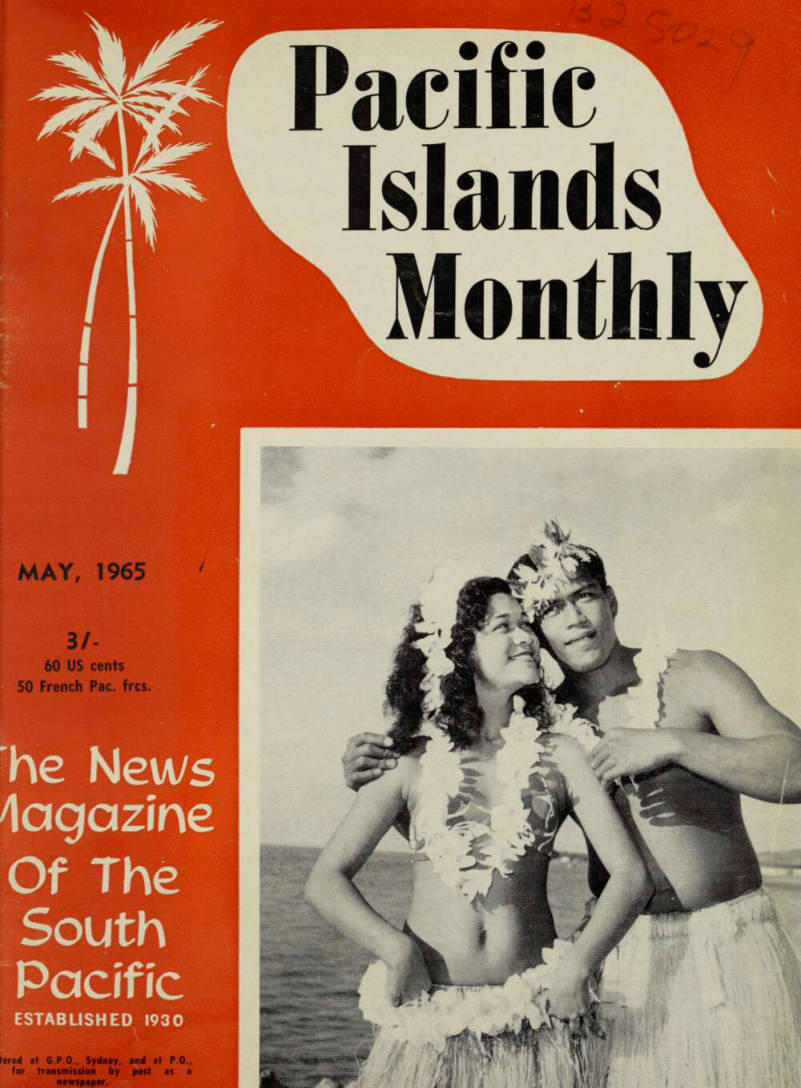 1
1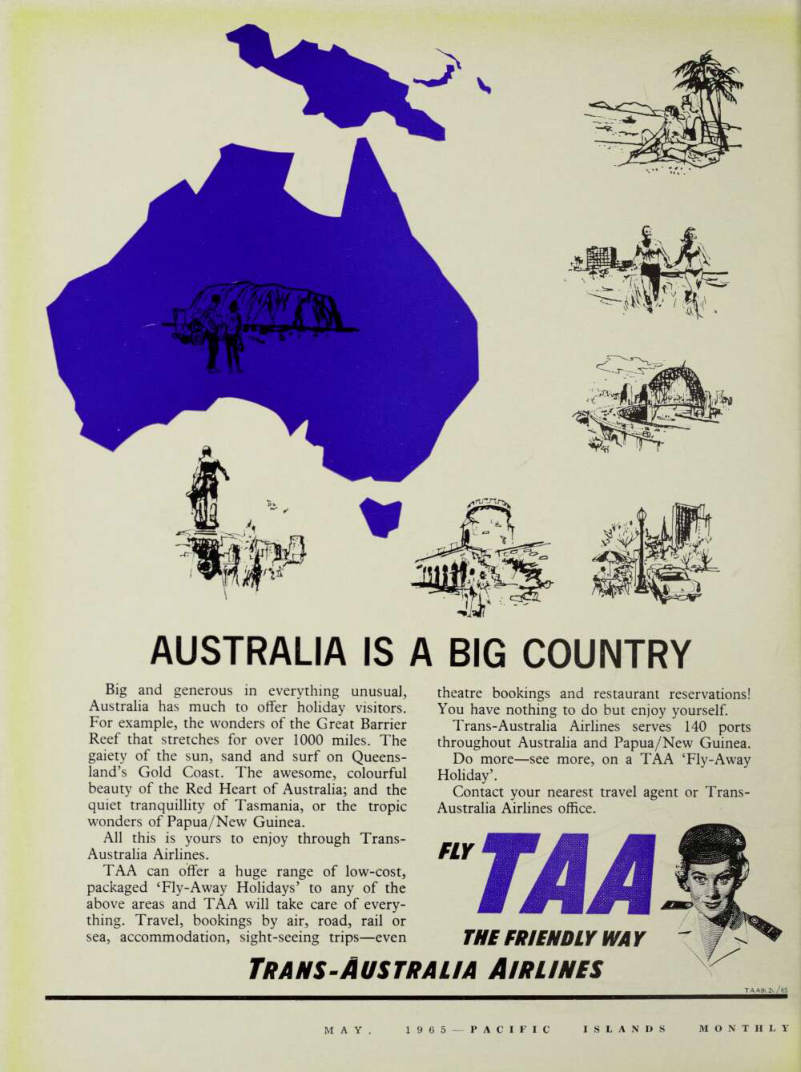 2
2 3
3 4
4 5
5 6
6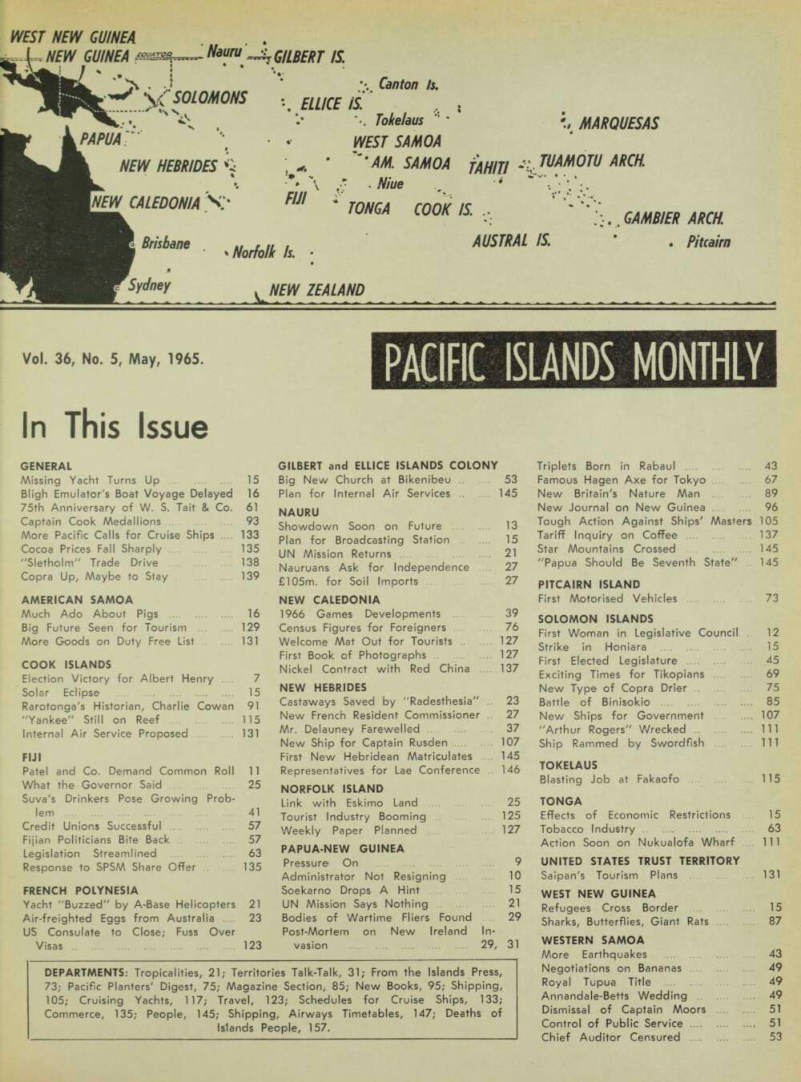 7
7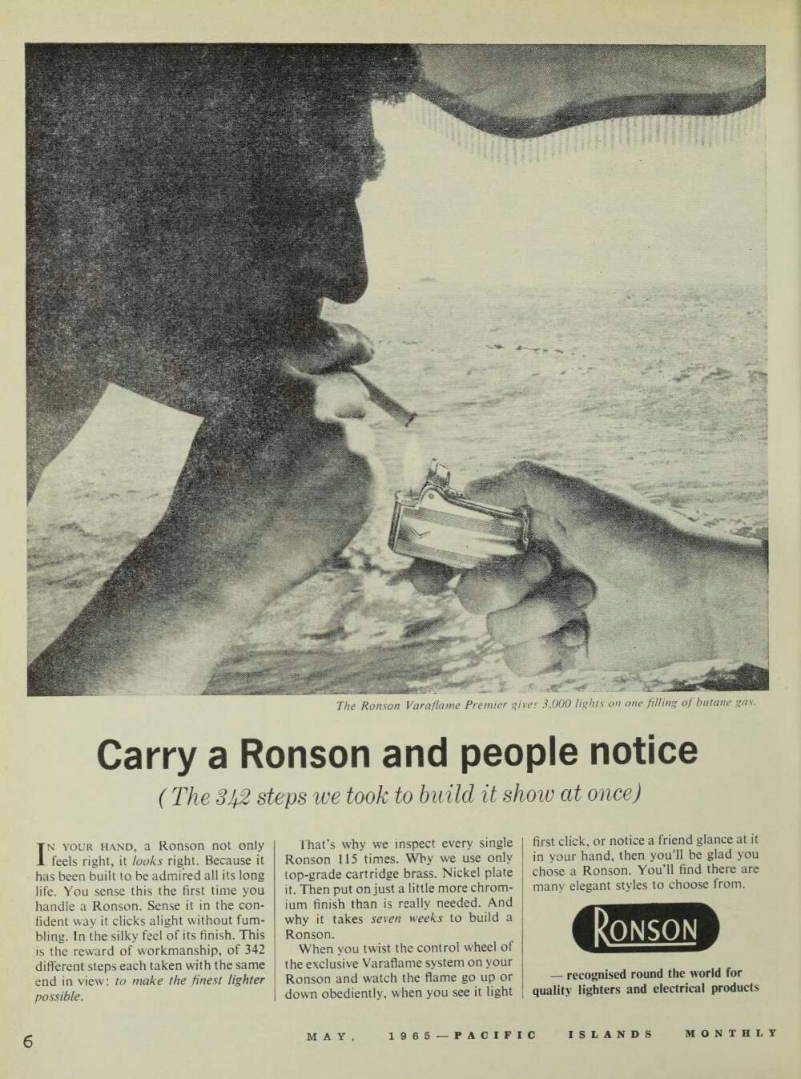 8
8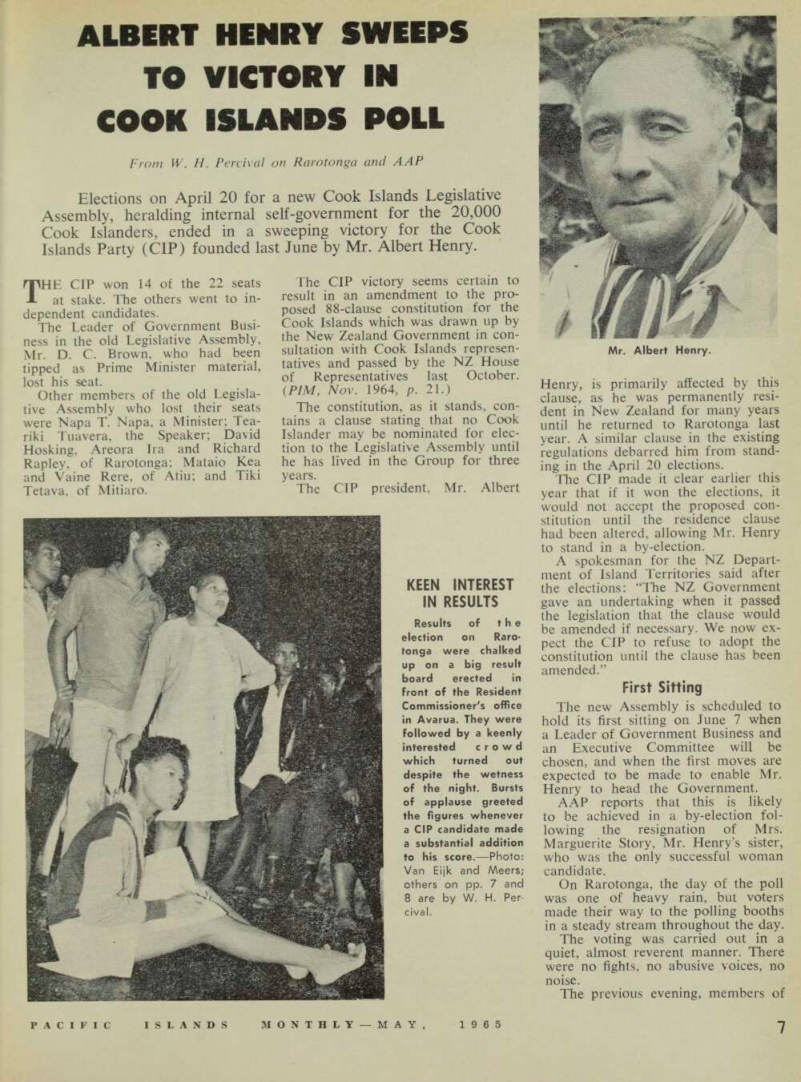 9
9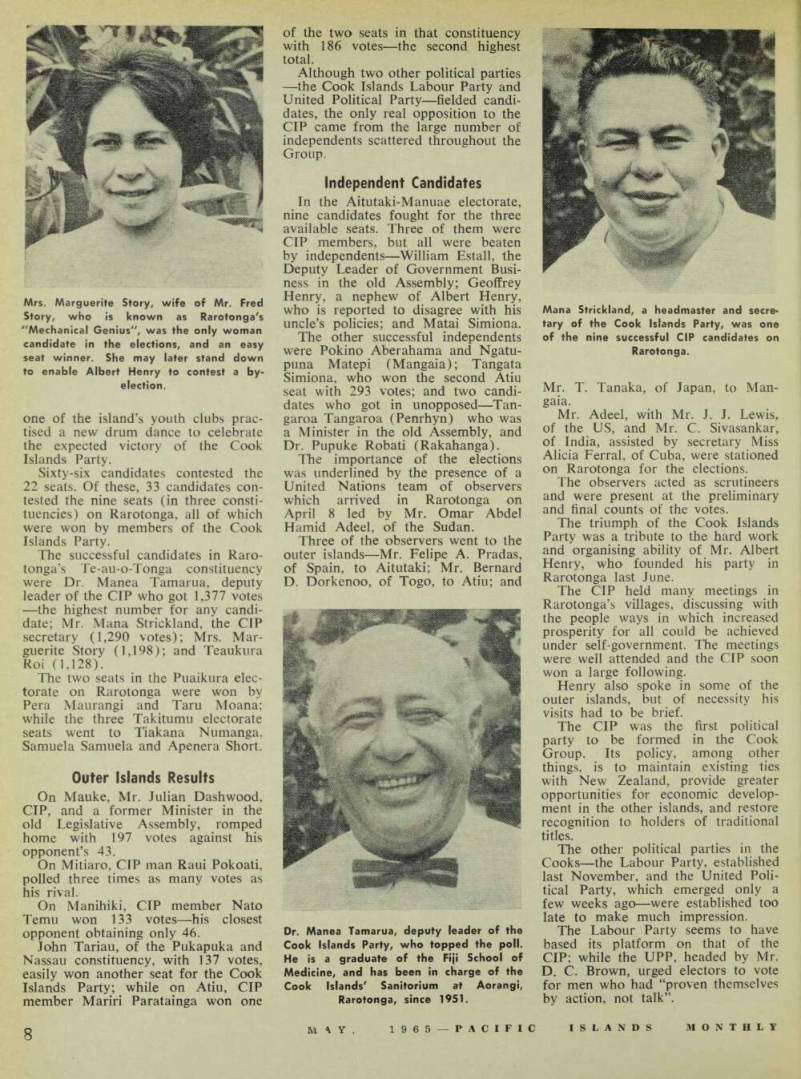 10
10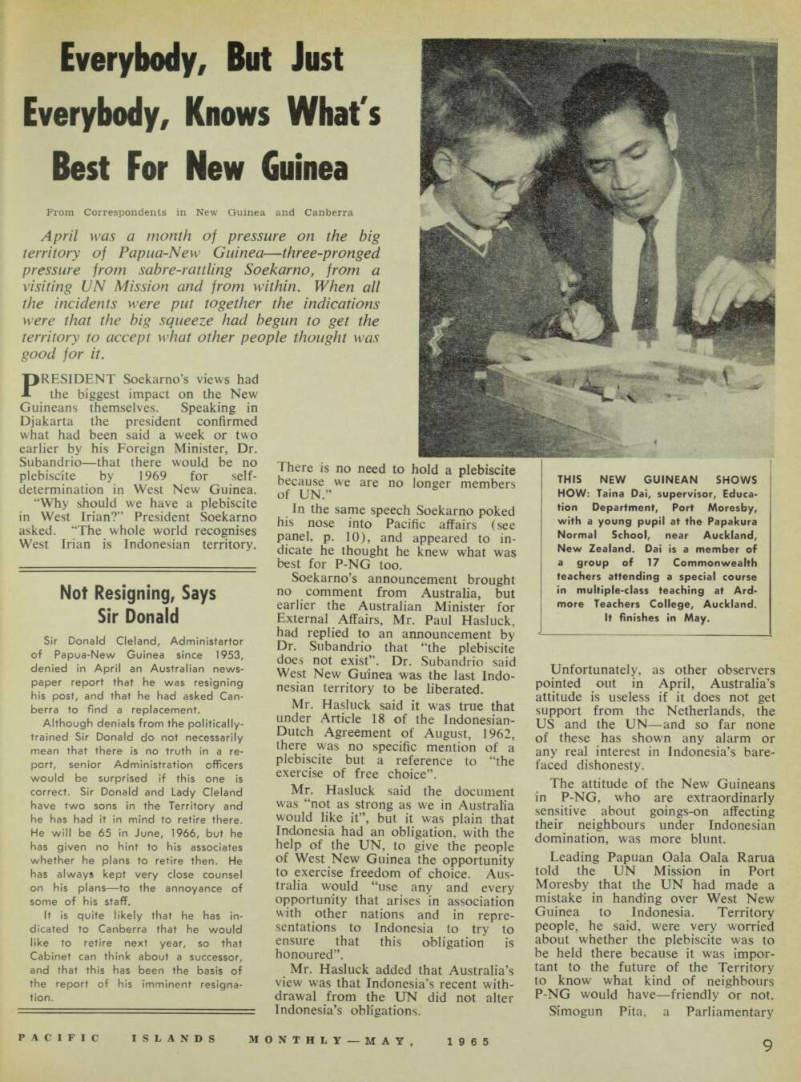 11
11 12
12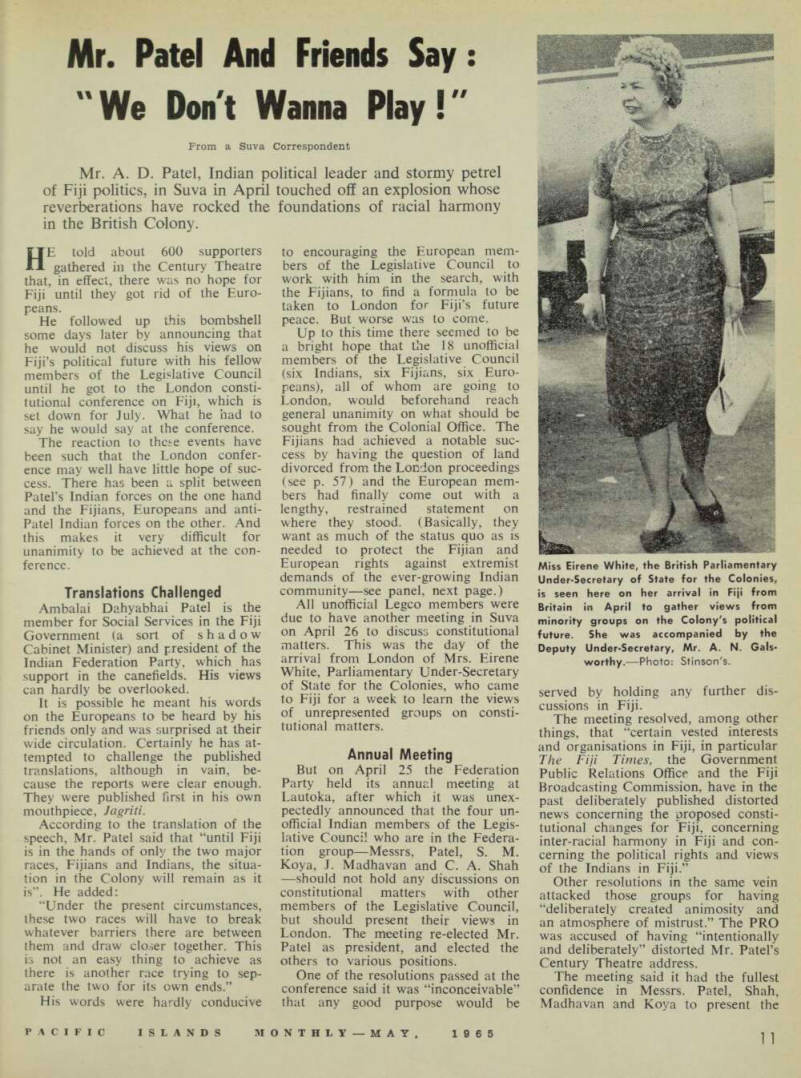 13
13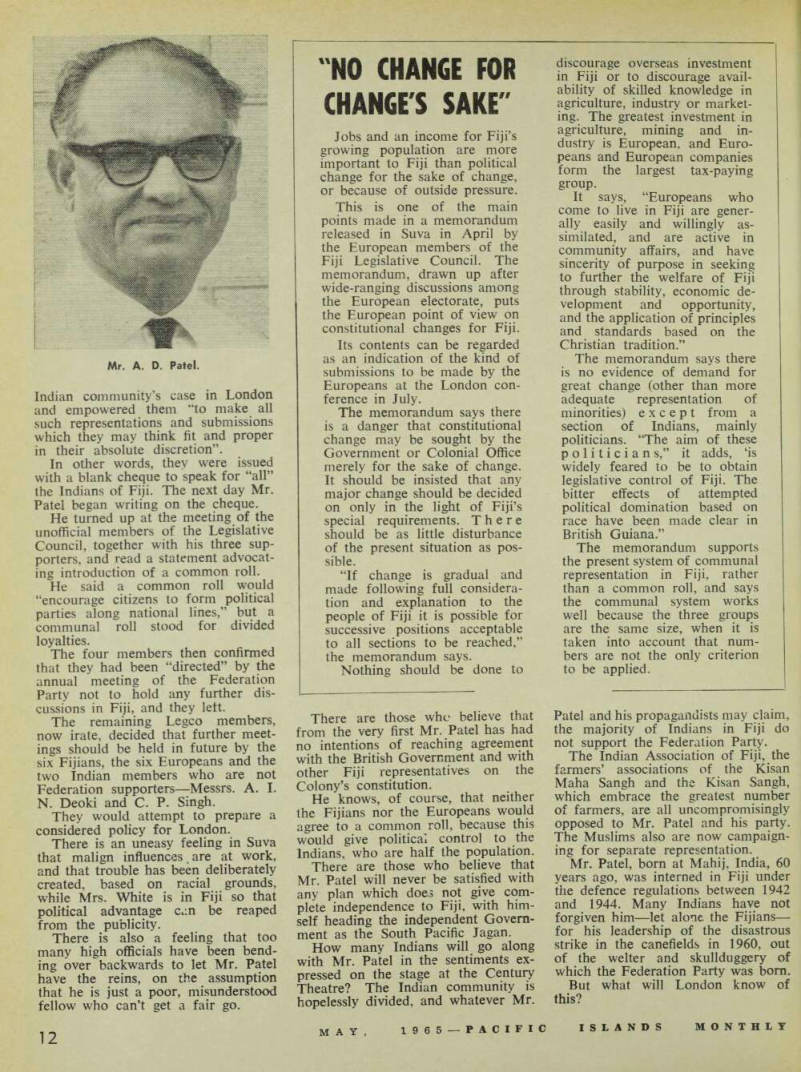 14
14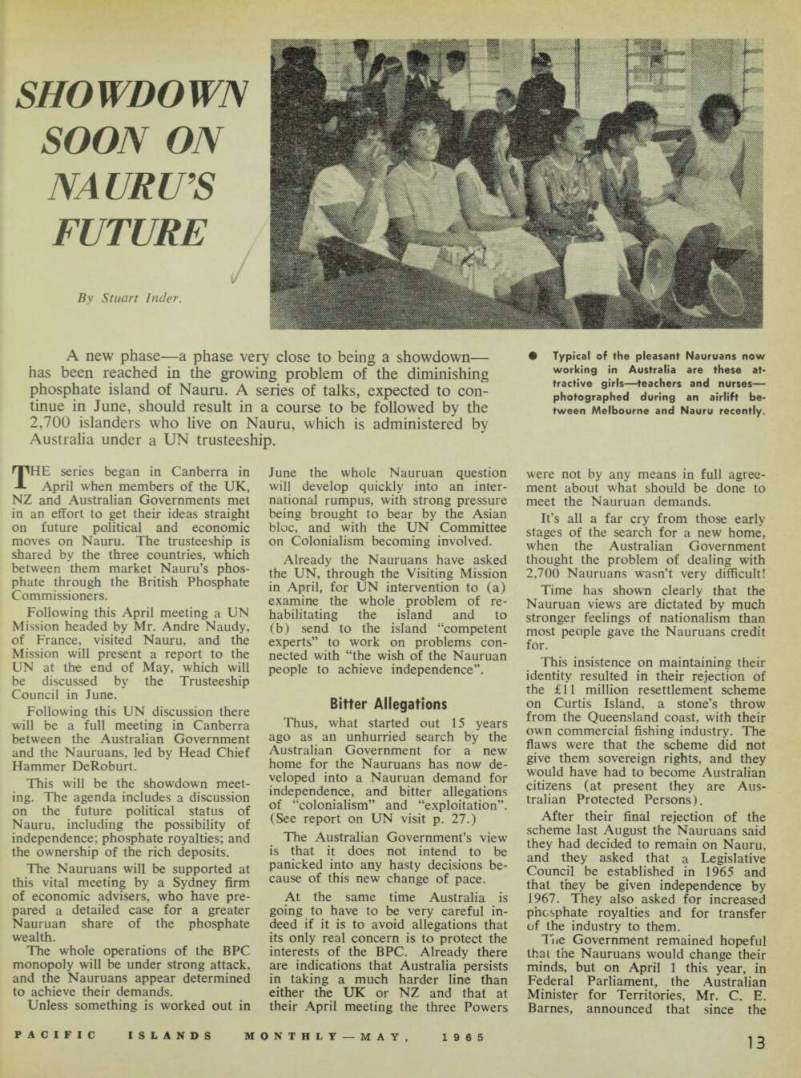 15
15 16
16 17
17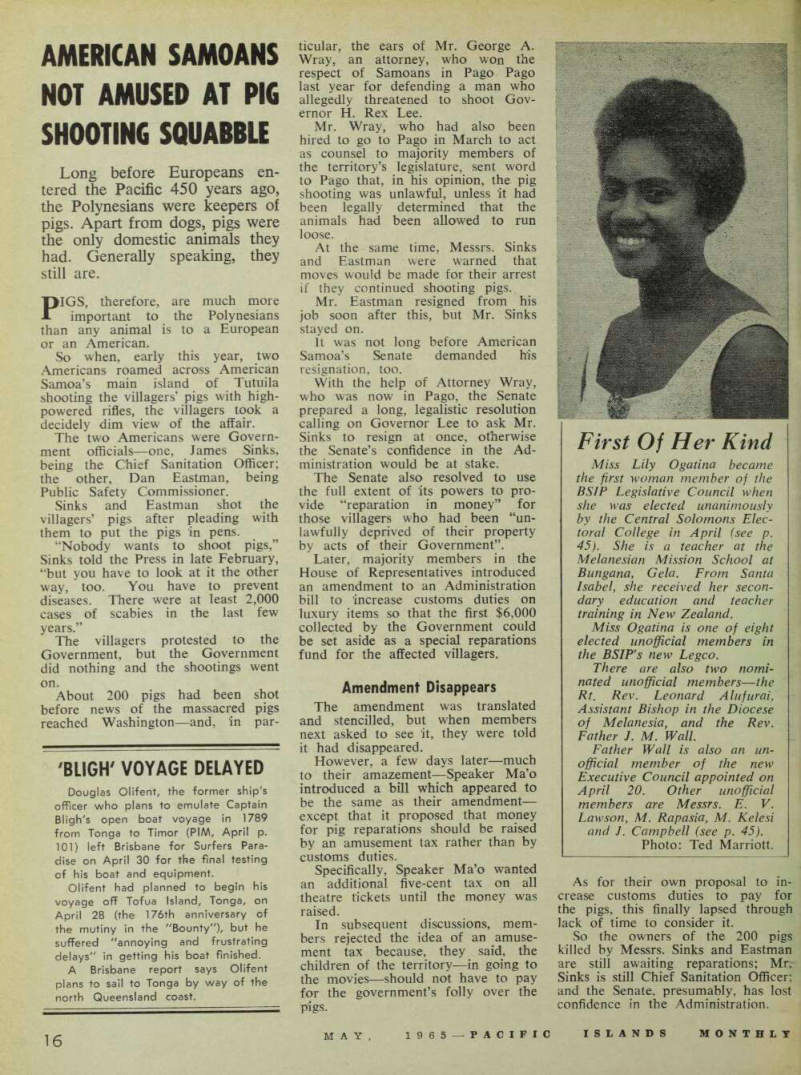 18
18 19
19 20
20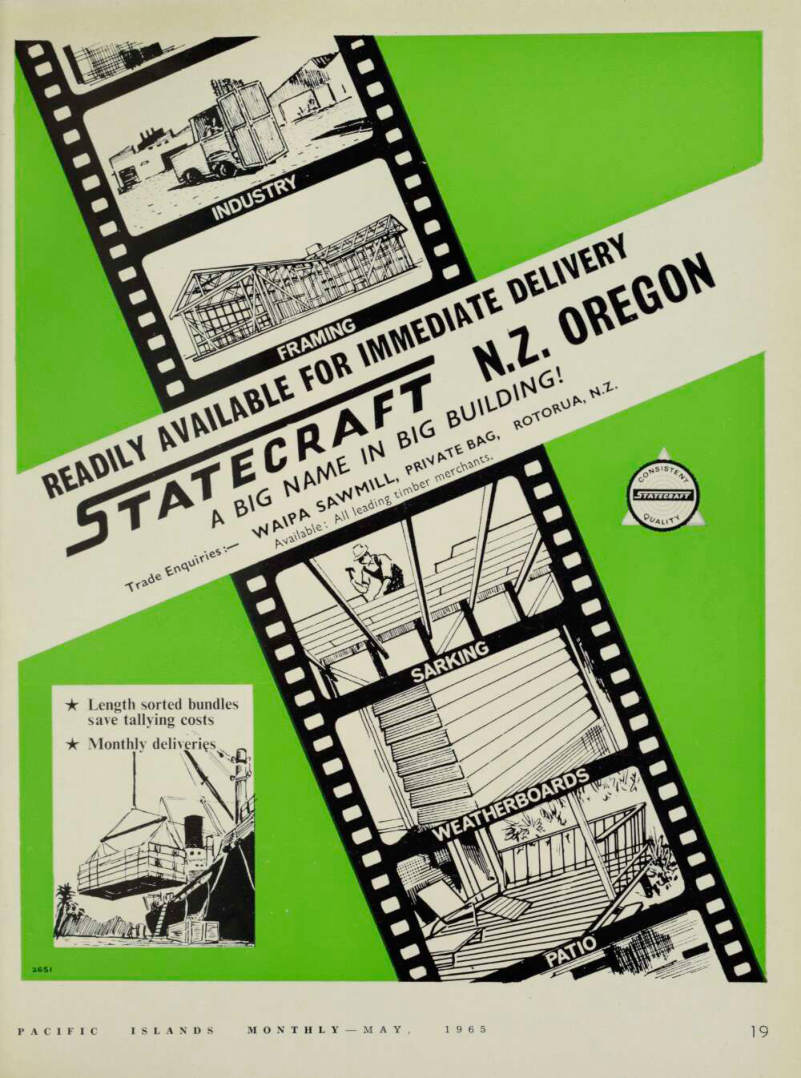 21
21 22
22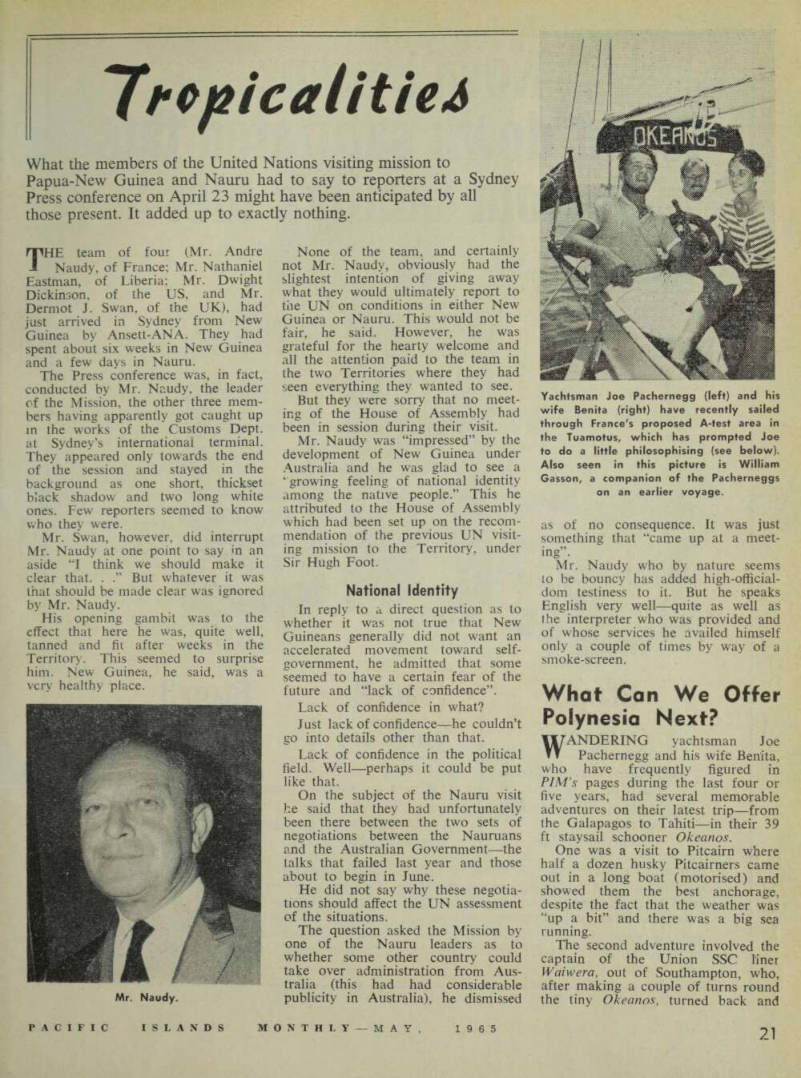 23
23 24
24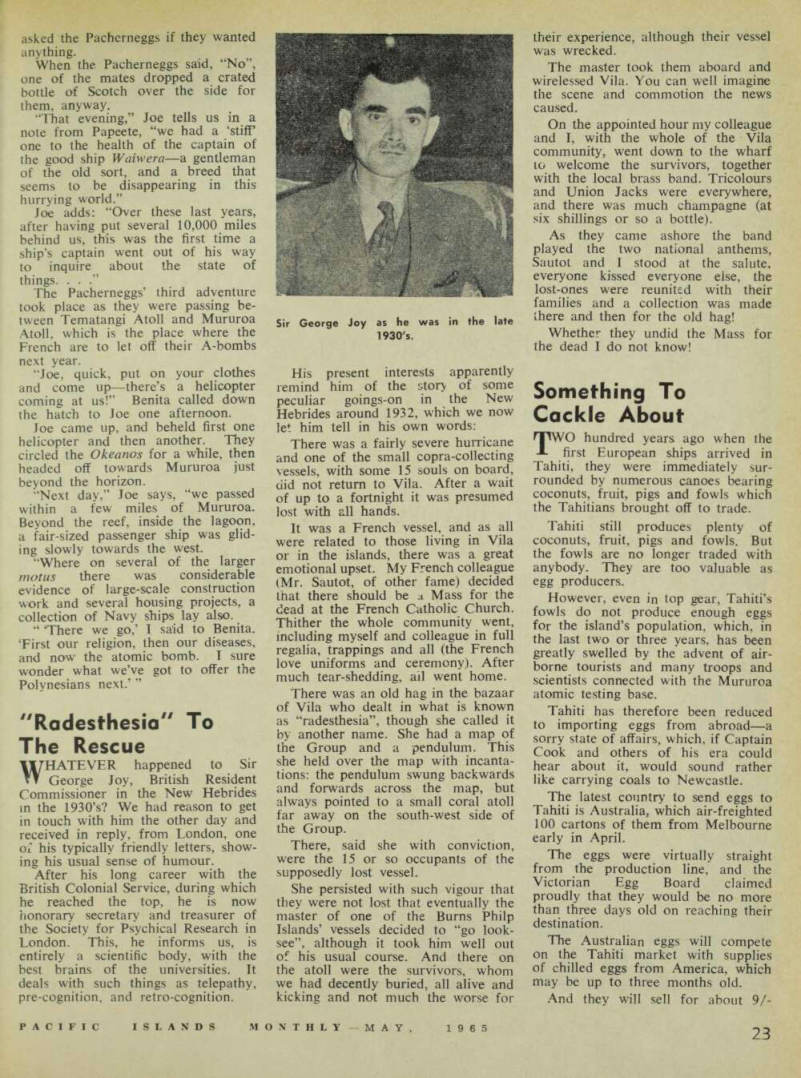 25
25 26
26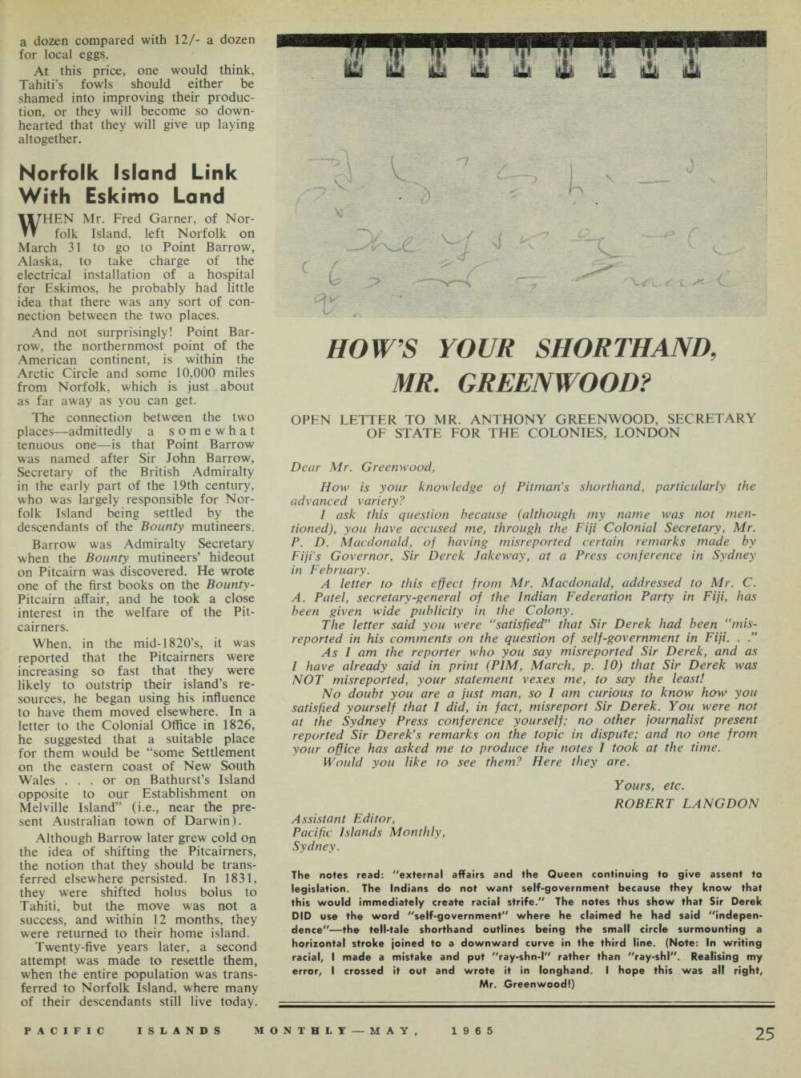 27
27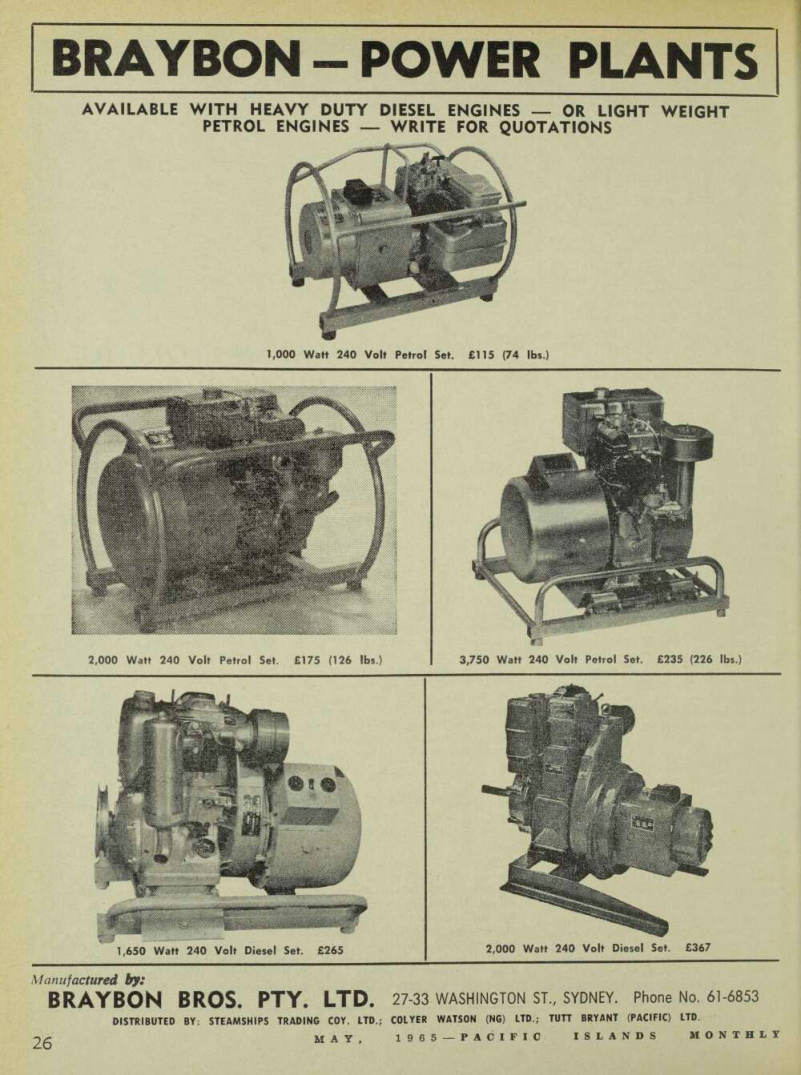 28
28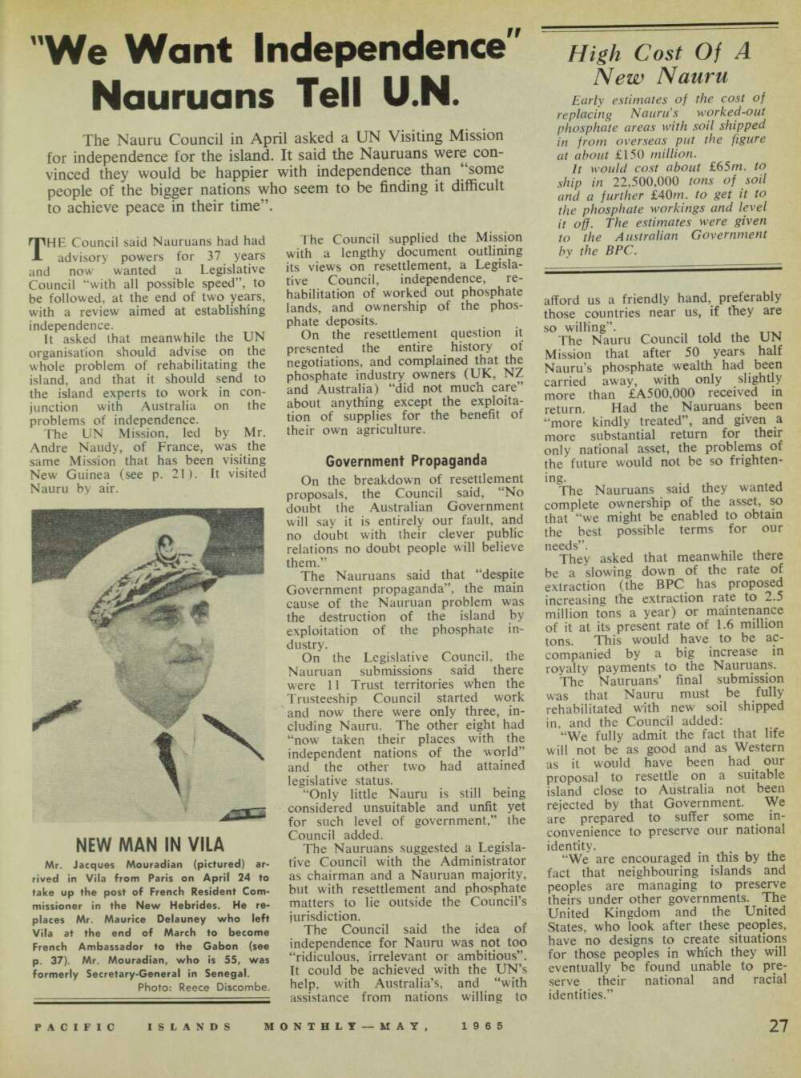 29
29 30
30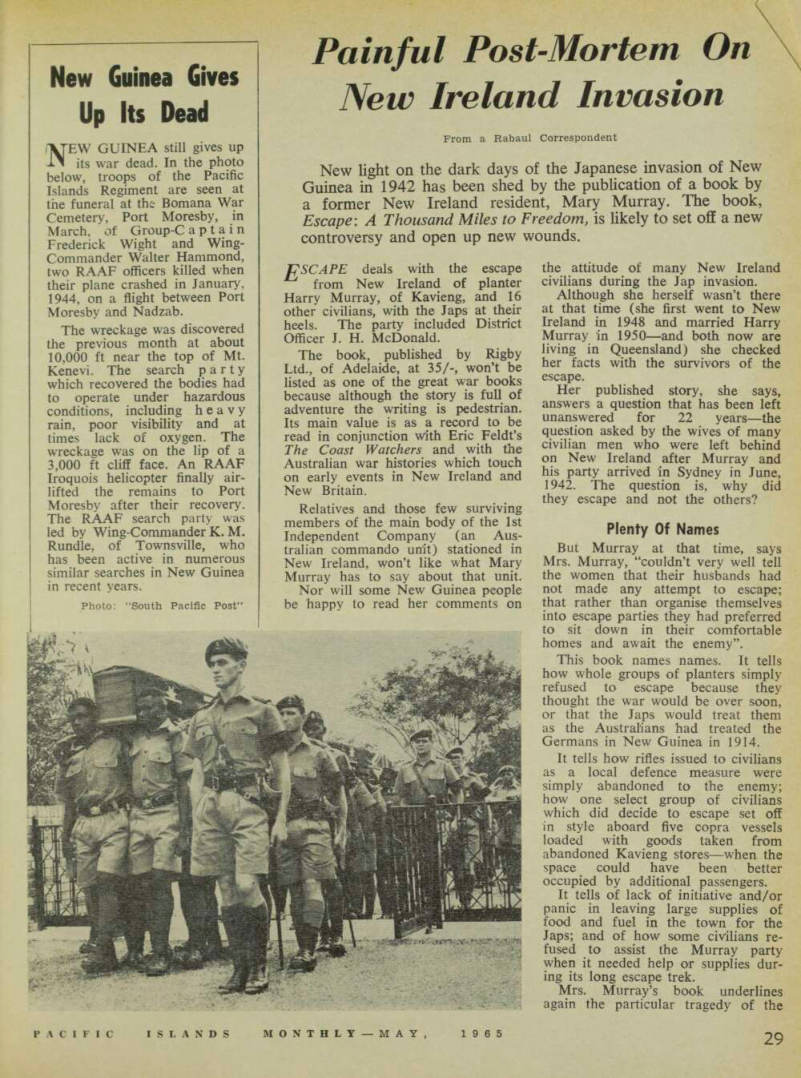 31
31 32
32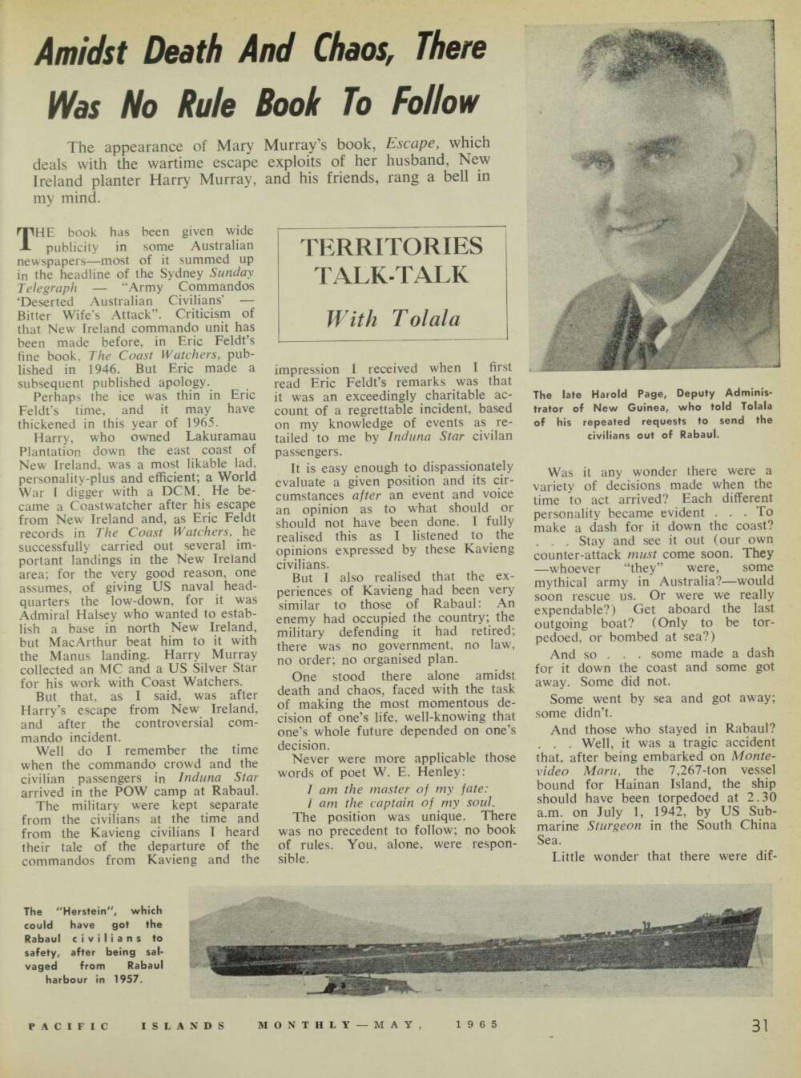 33
33 34
34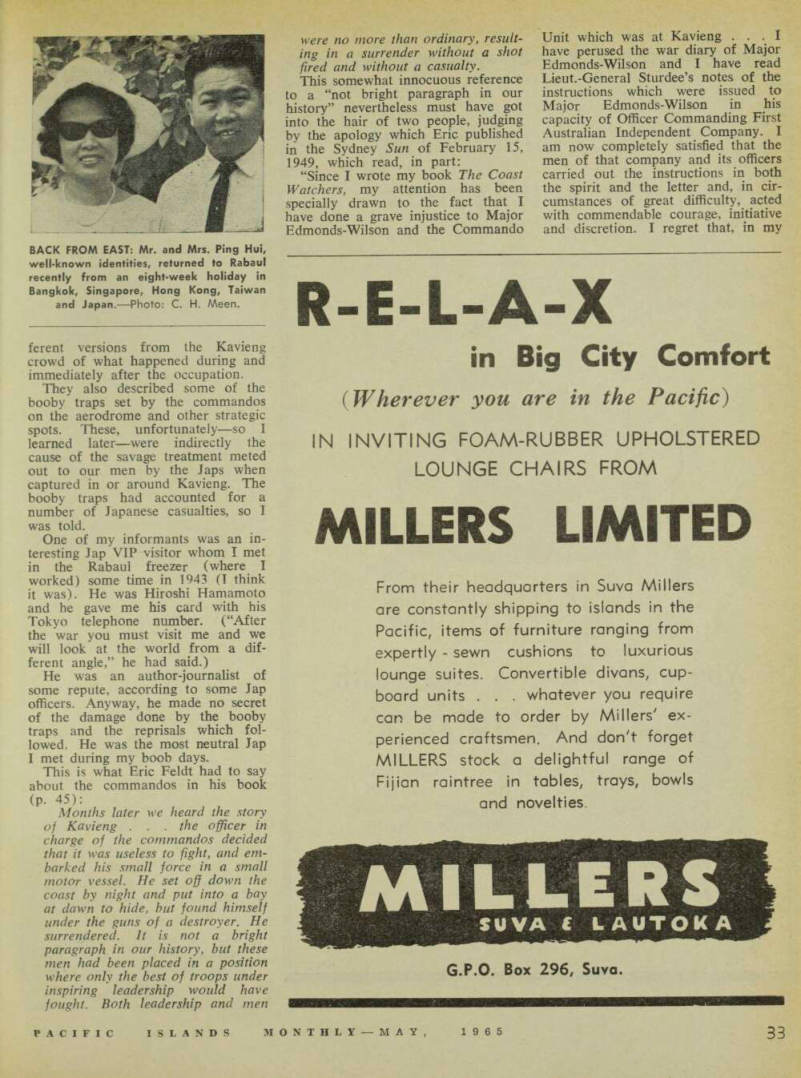 35
35 36
36 37
37 38
38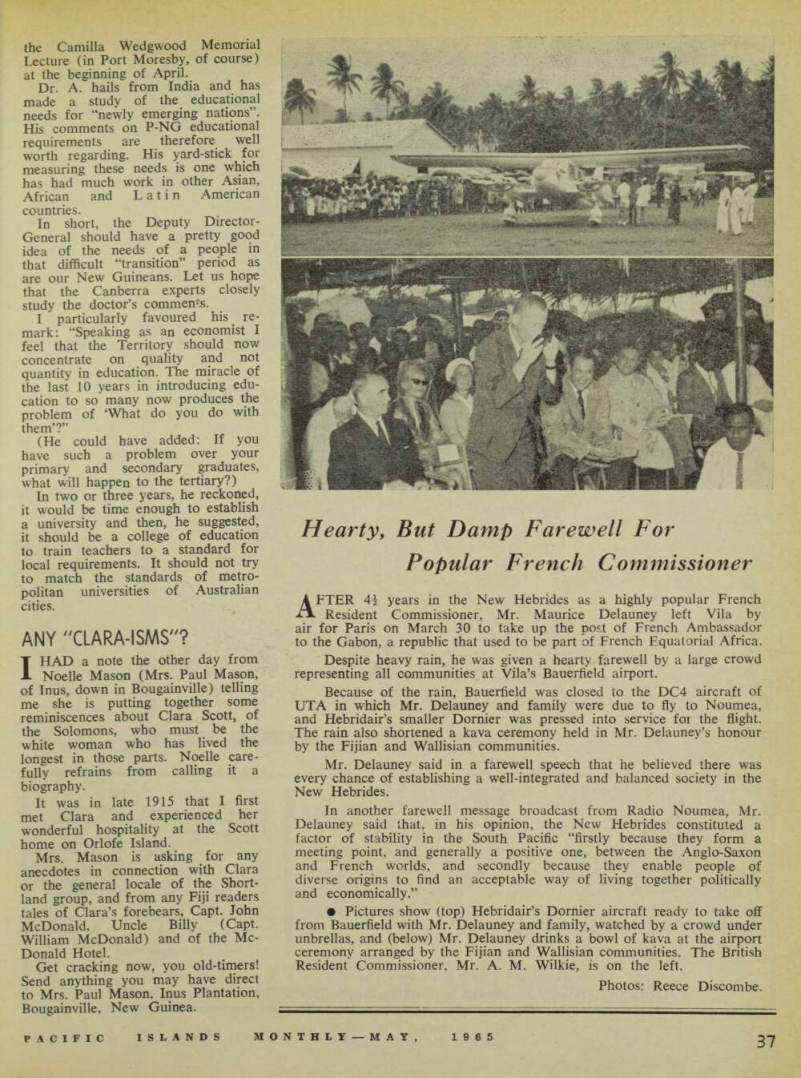 39
39 40
40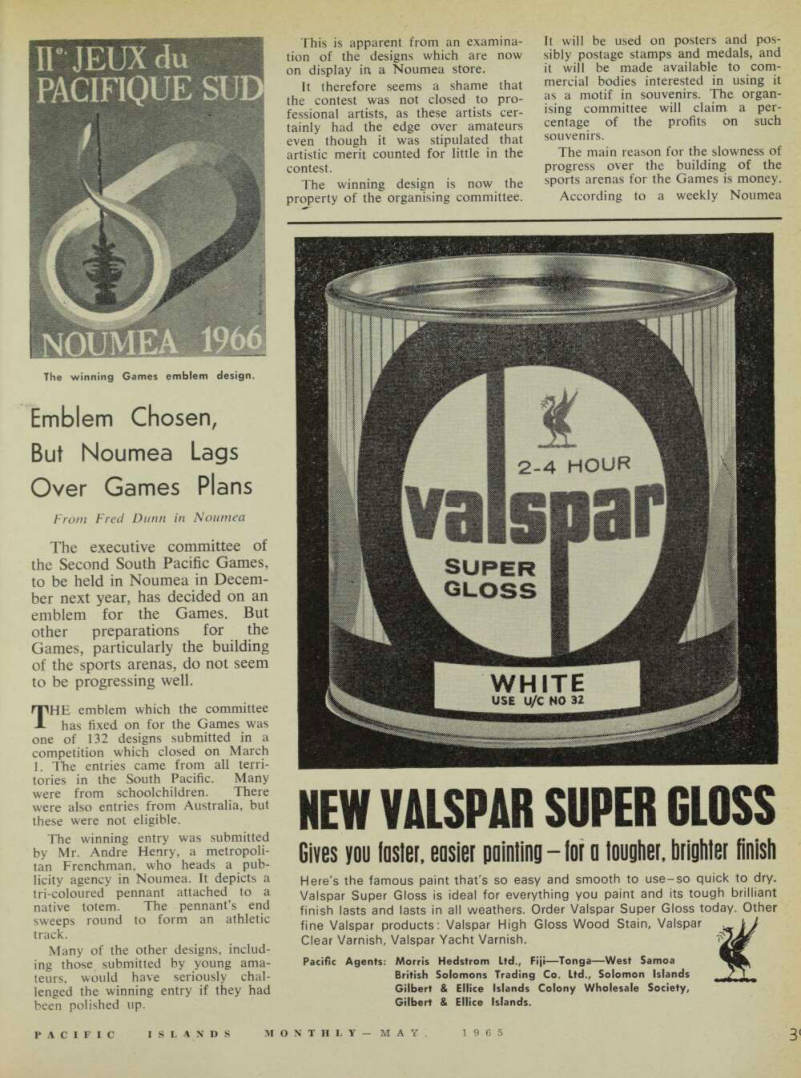 41
41 42
42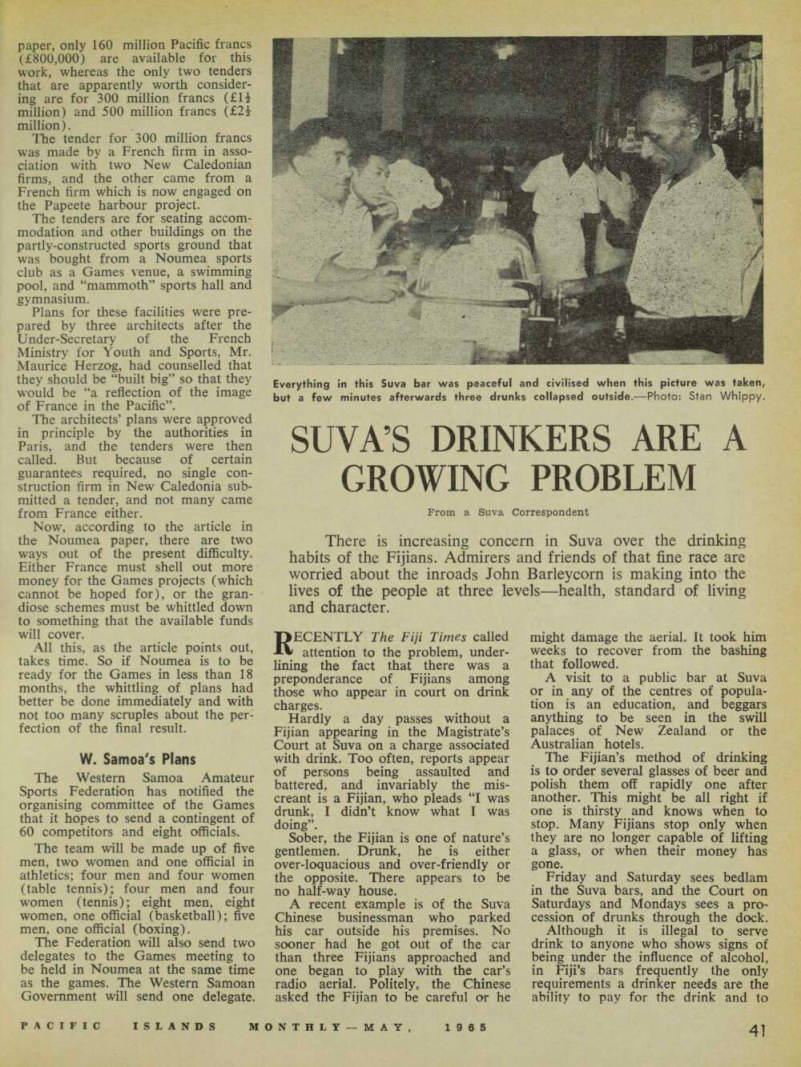 43
43 44
44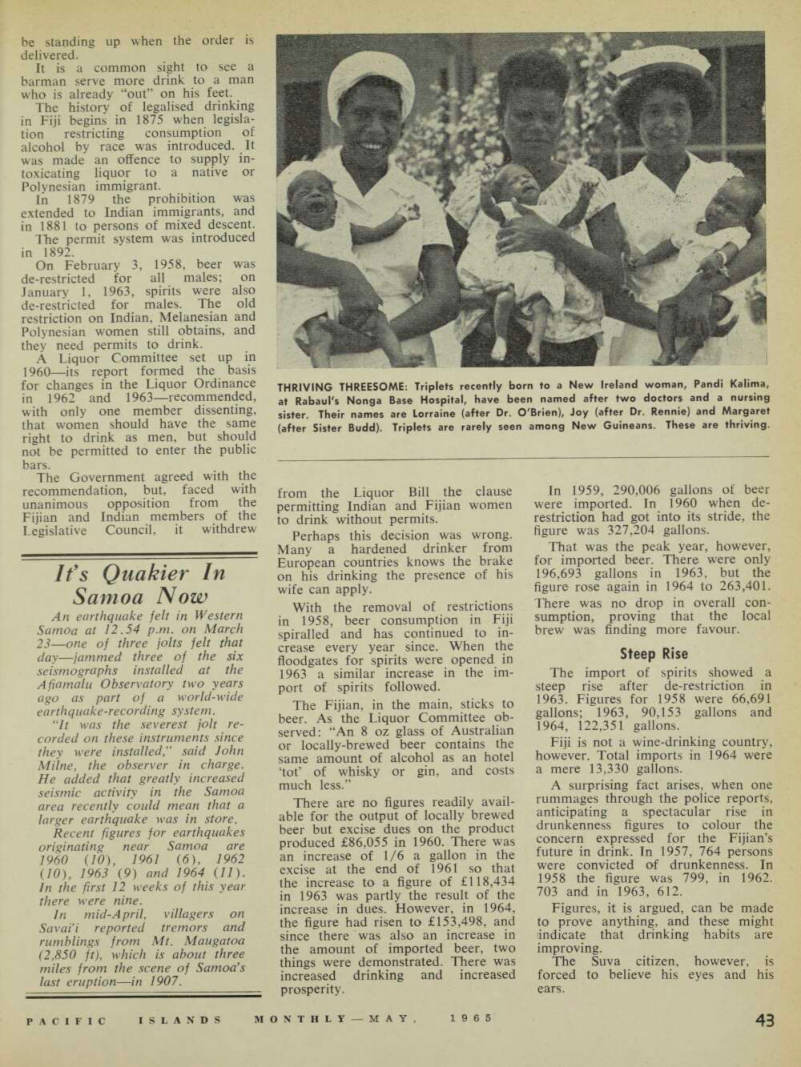 45
45 46
46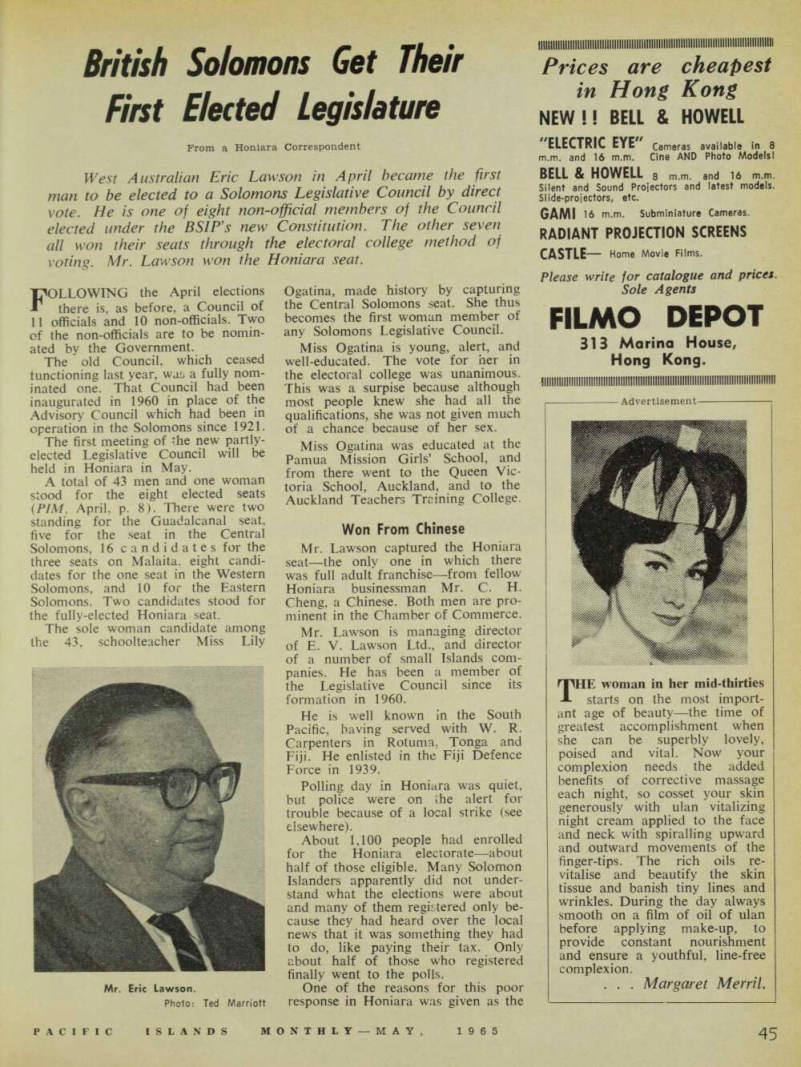 47
47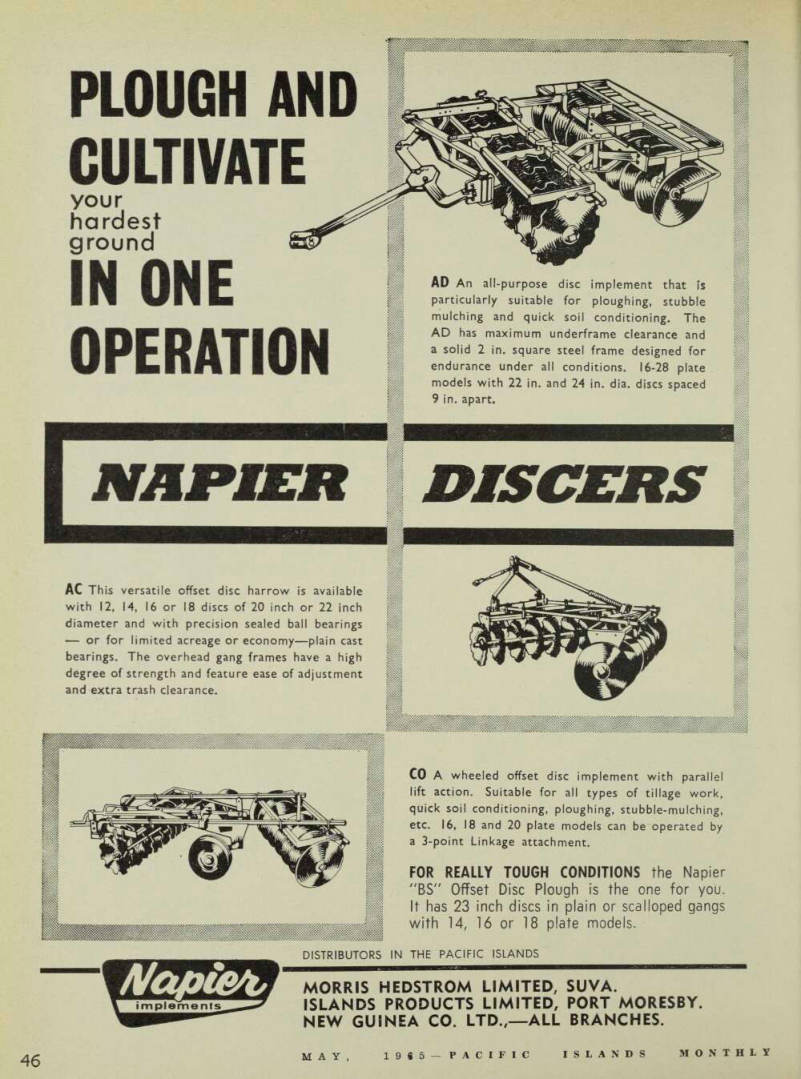 48
48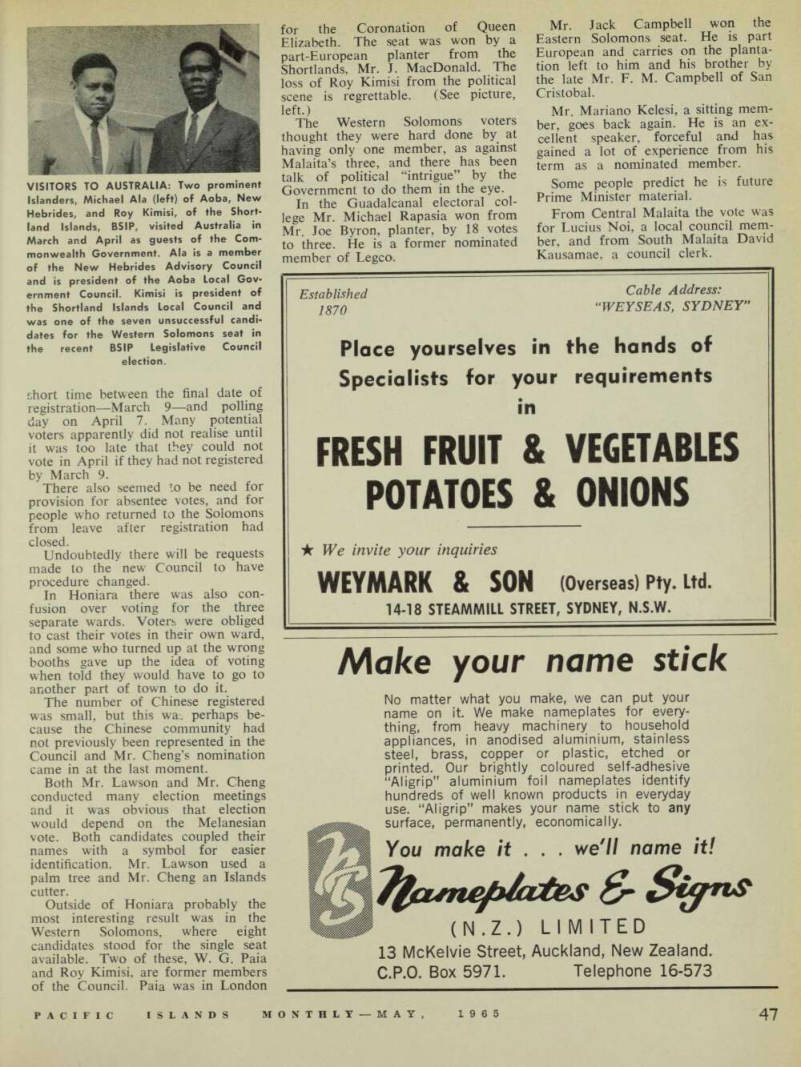 49
49 50
50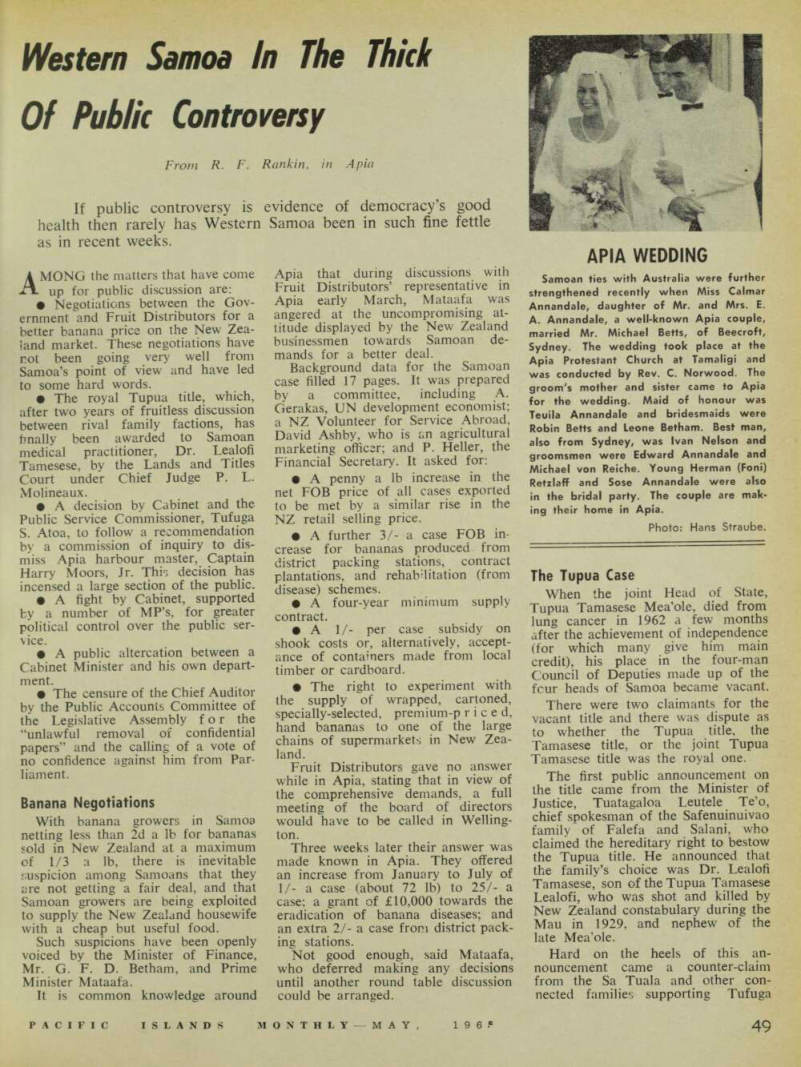 51
51 52
52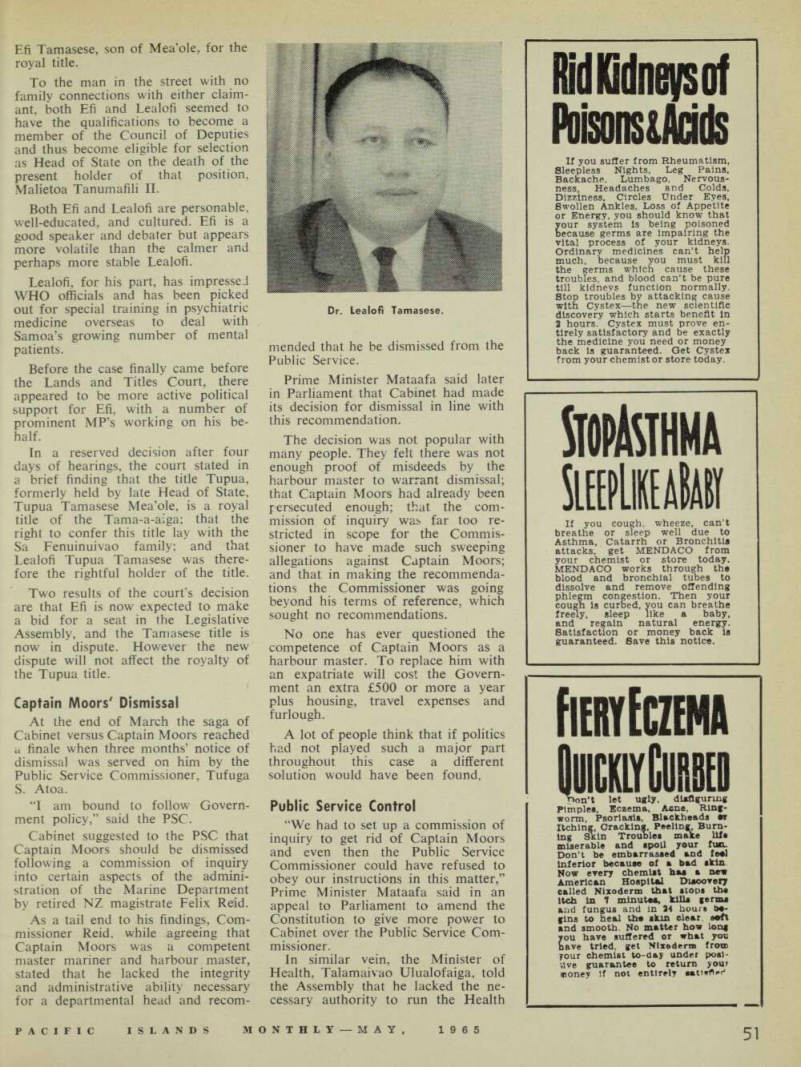 53
53 54
54 55
55 56
56 57
57 58
58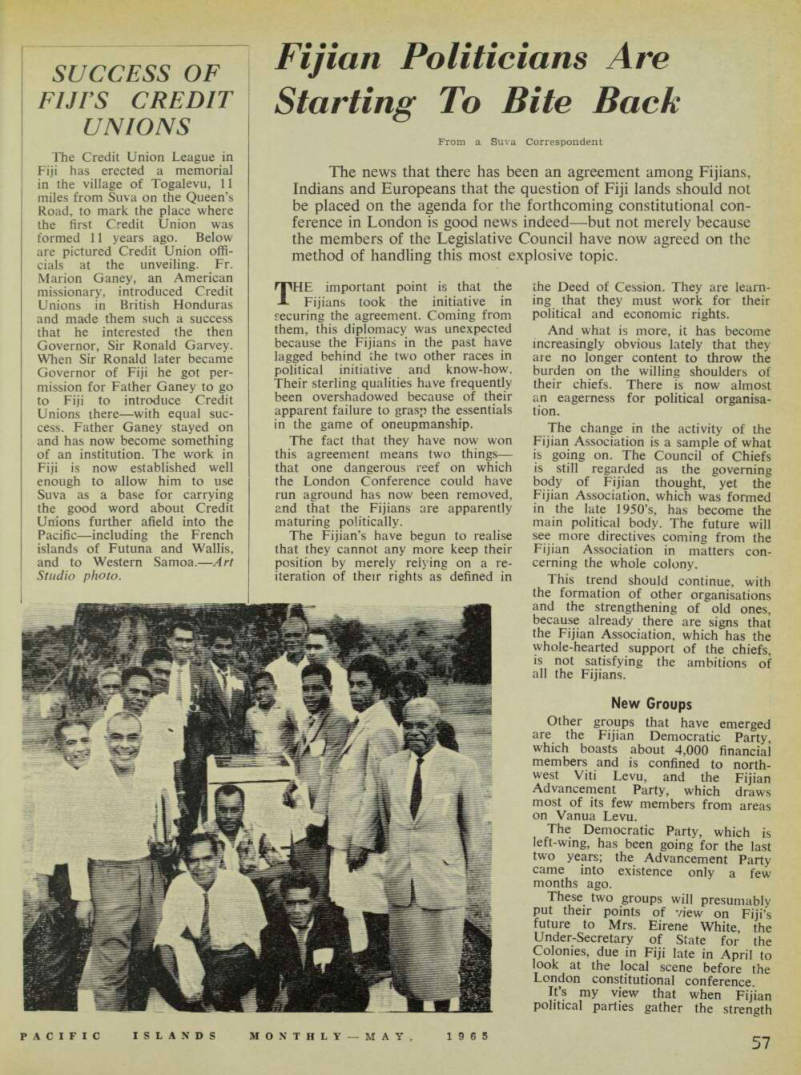 59
59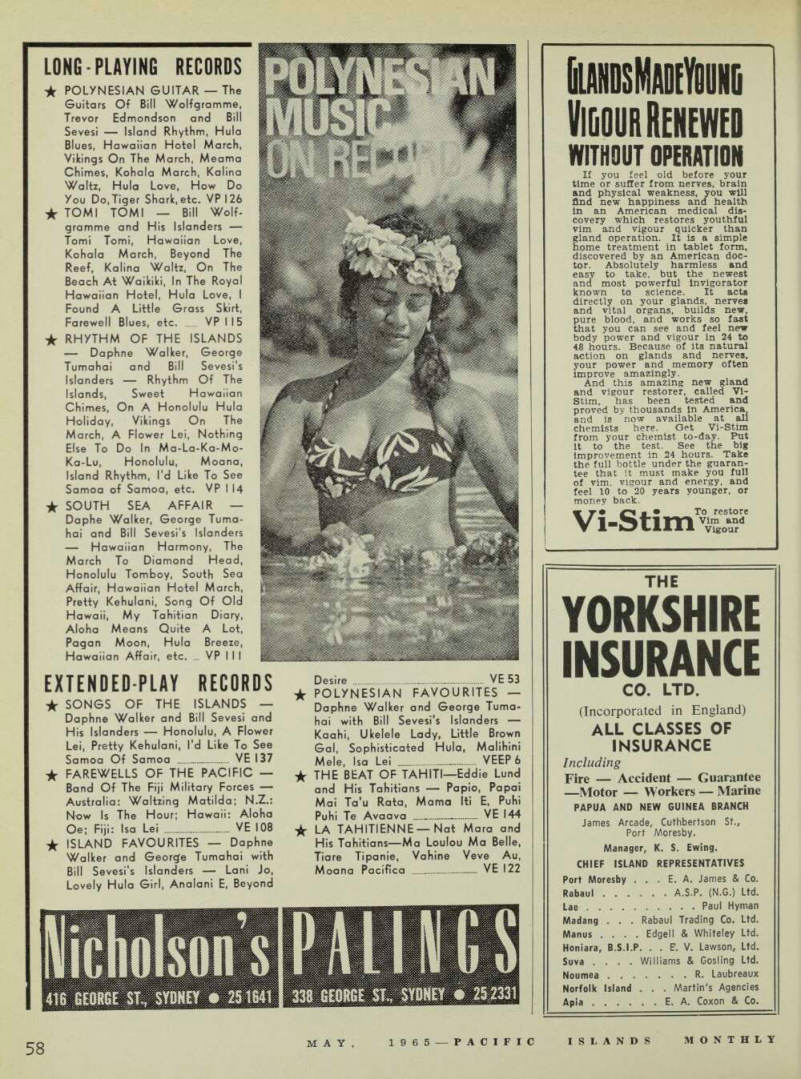 60
60 61
61 62
62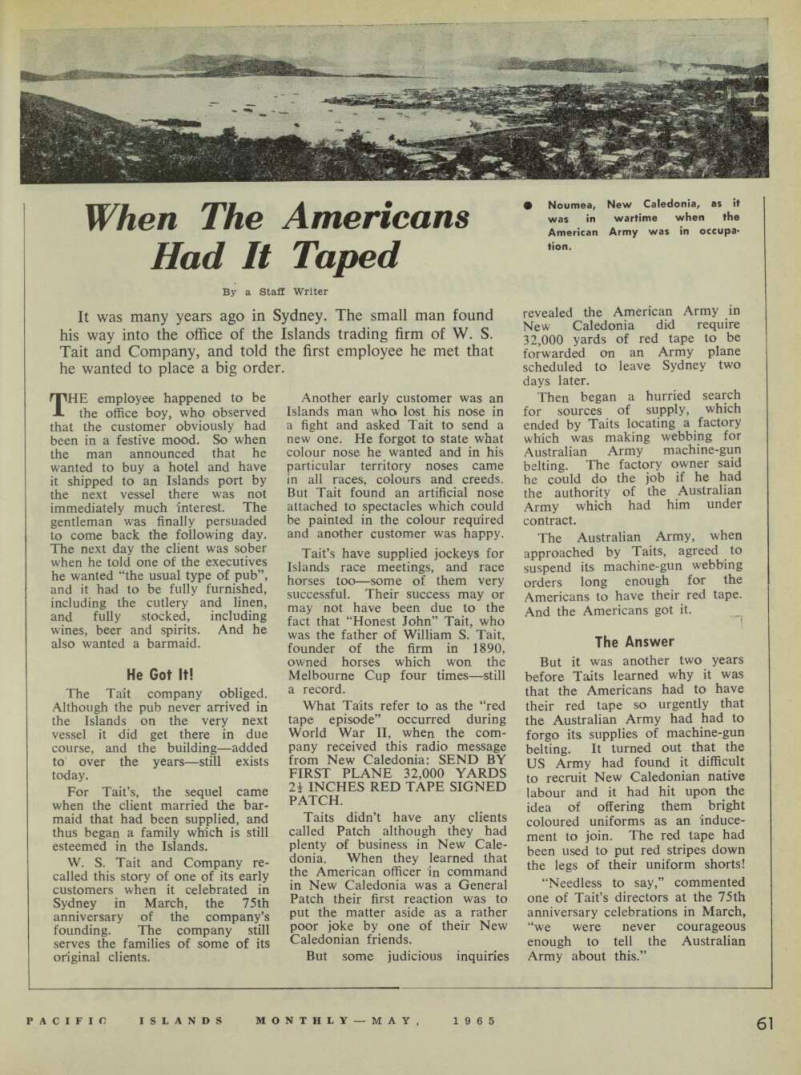 63
63 64
64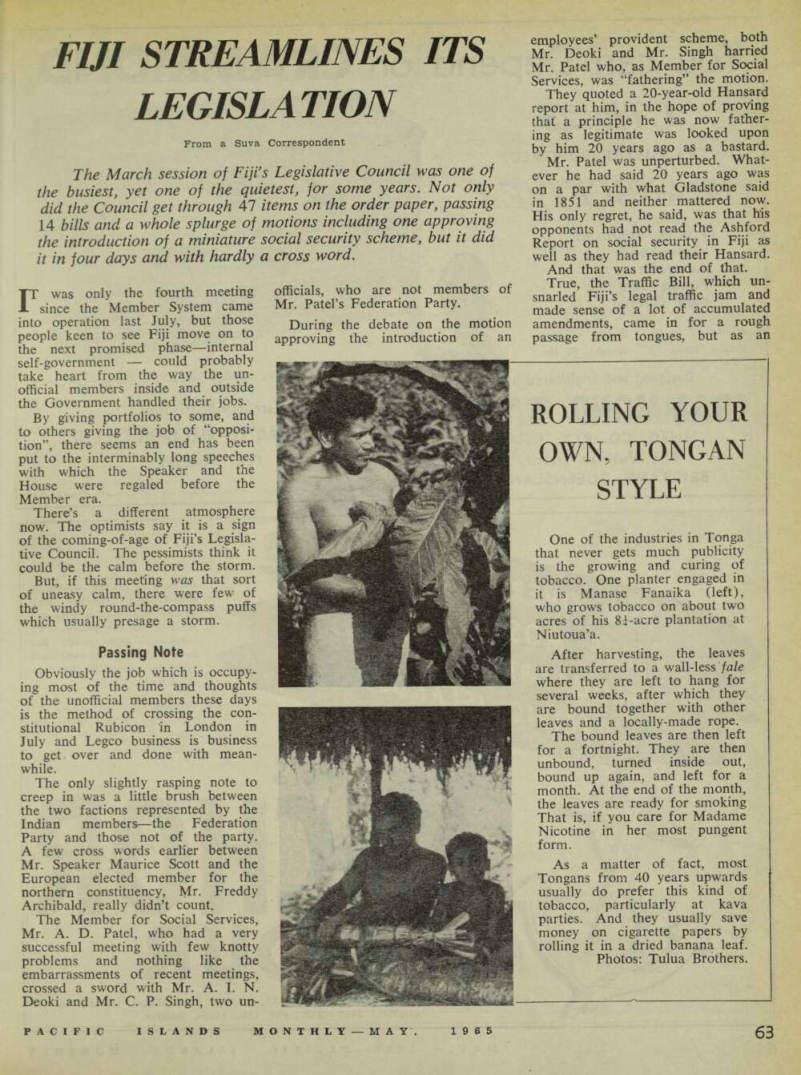 65
65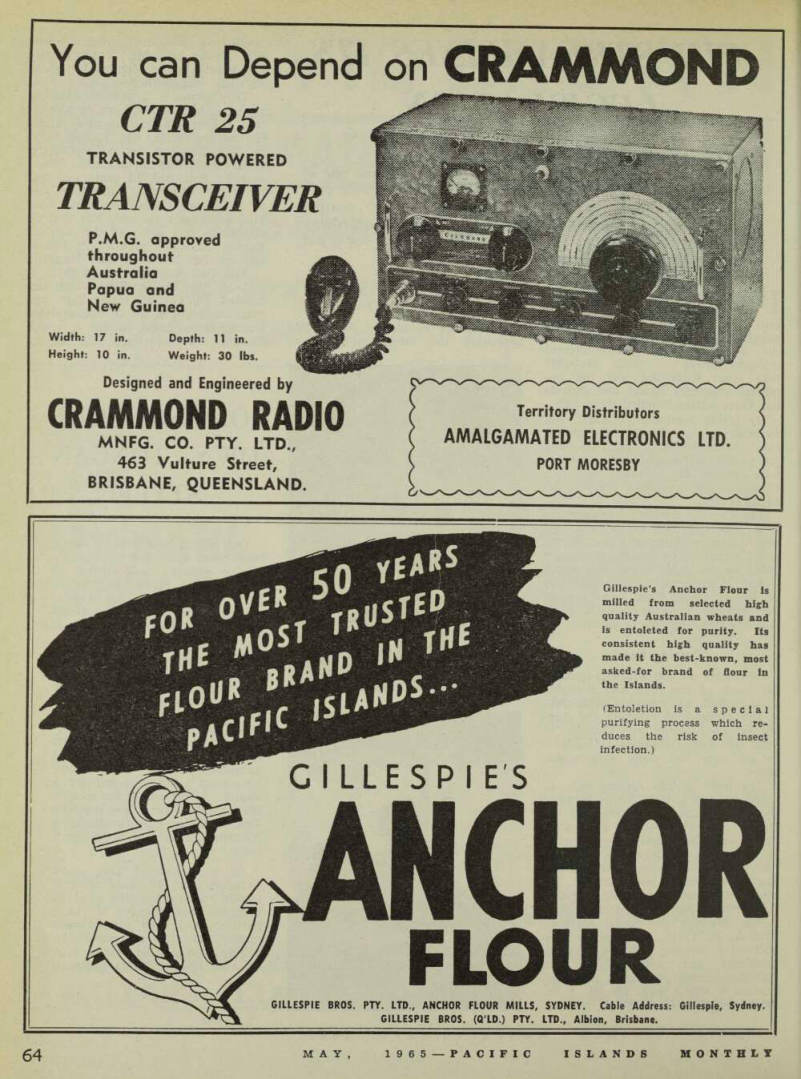 66
66 67
67 68
68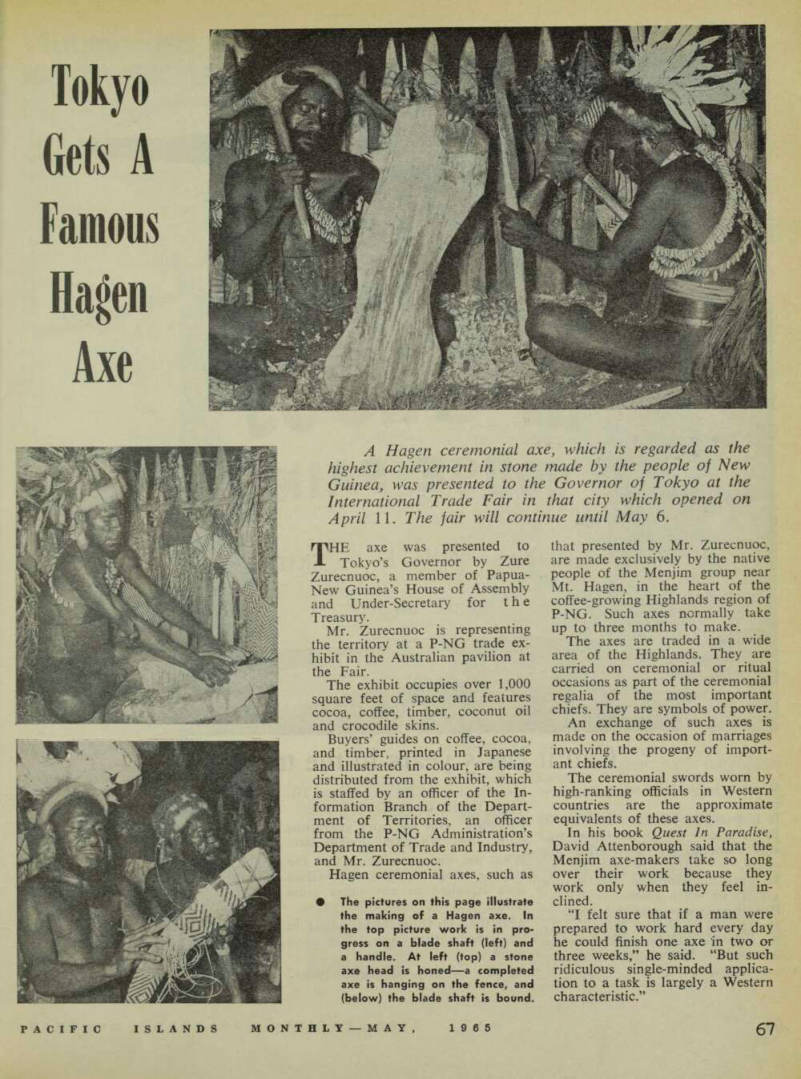 69
69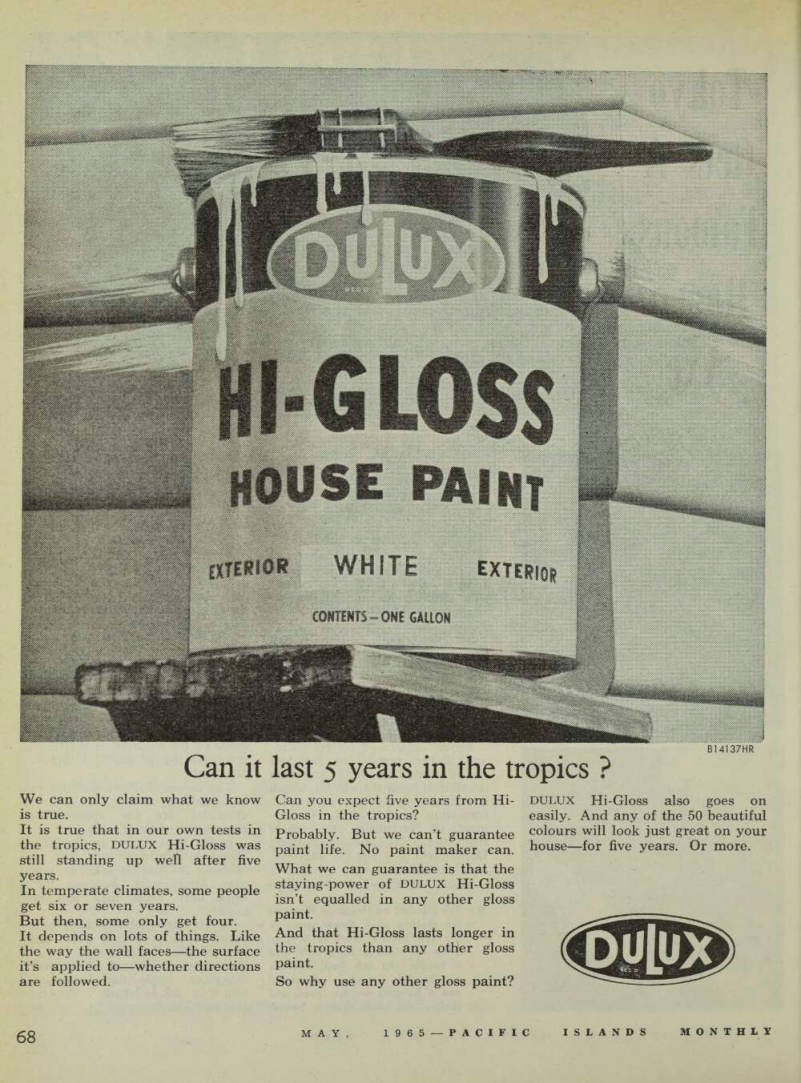 70
70 71
71 72
72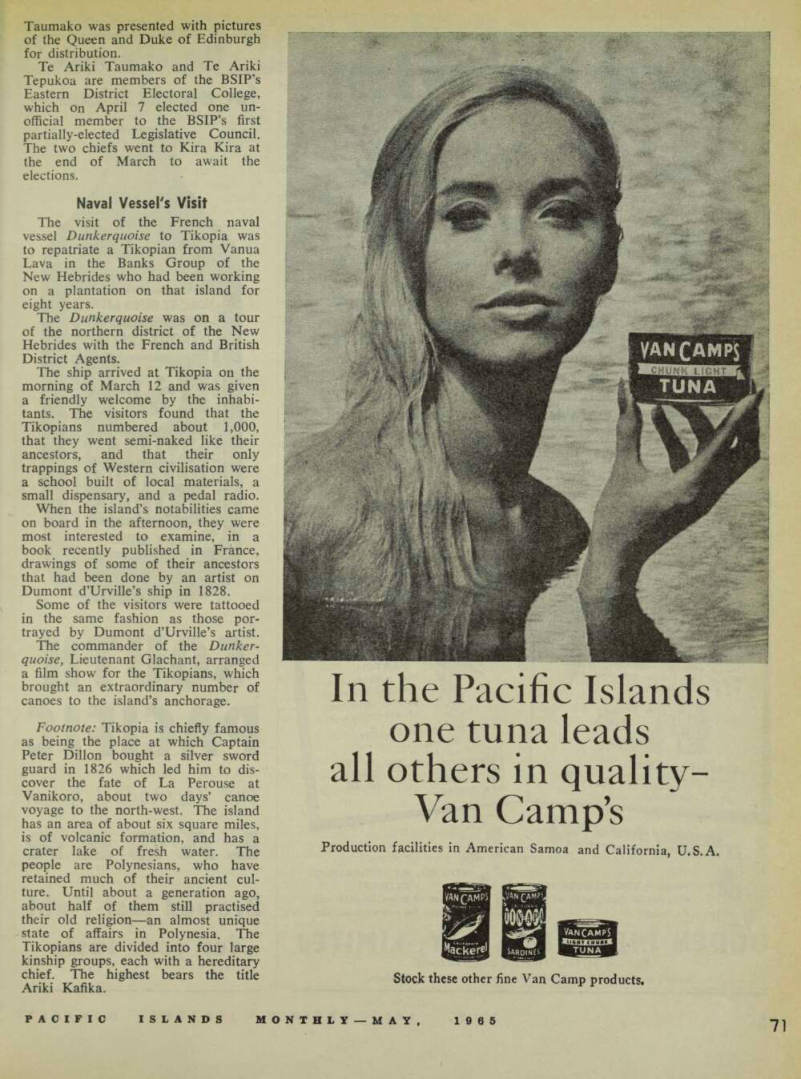 73
73 74
74 75
75 76
76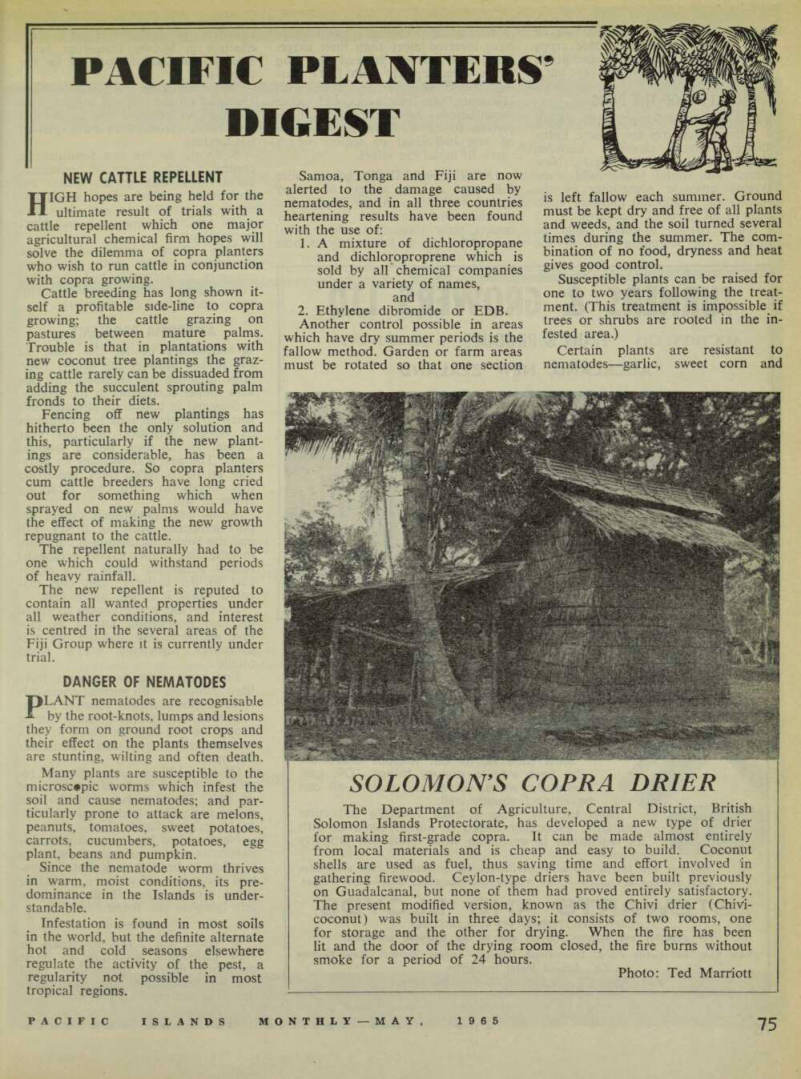 77
77 78
78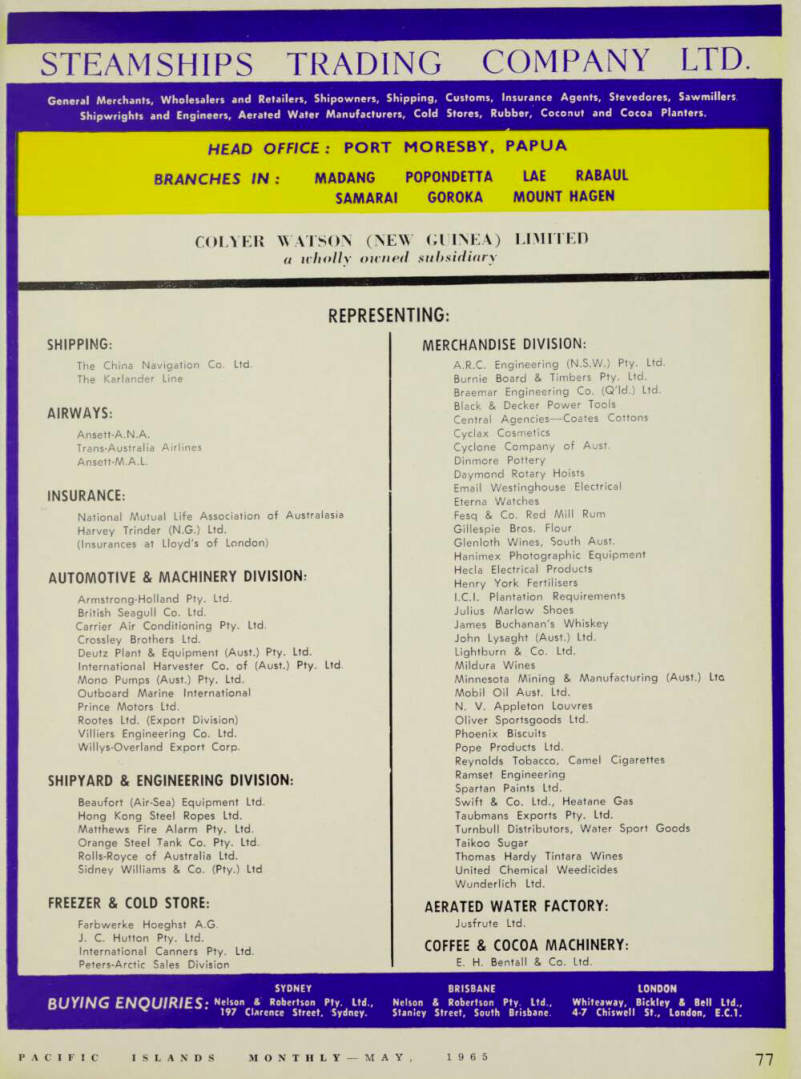 79
79 80
80 81
81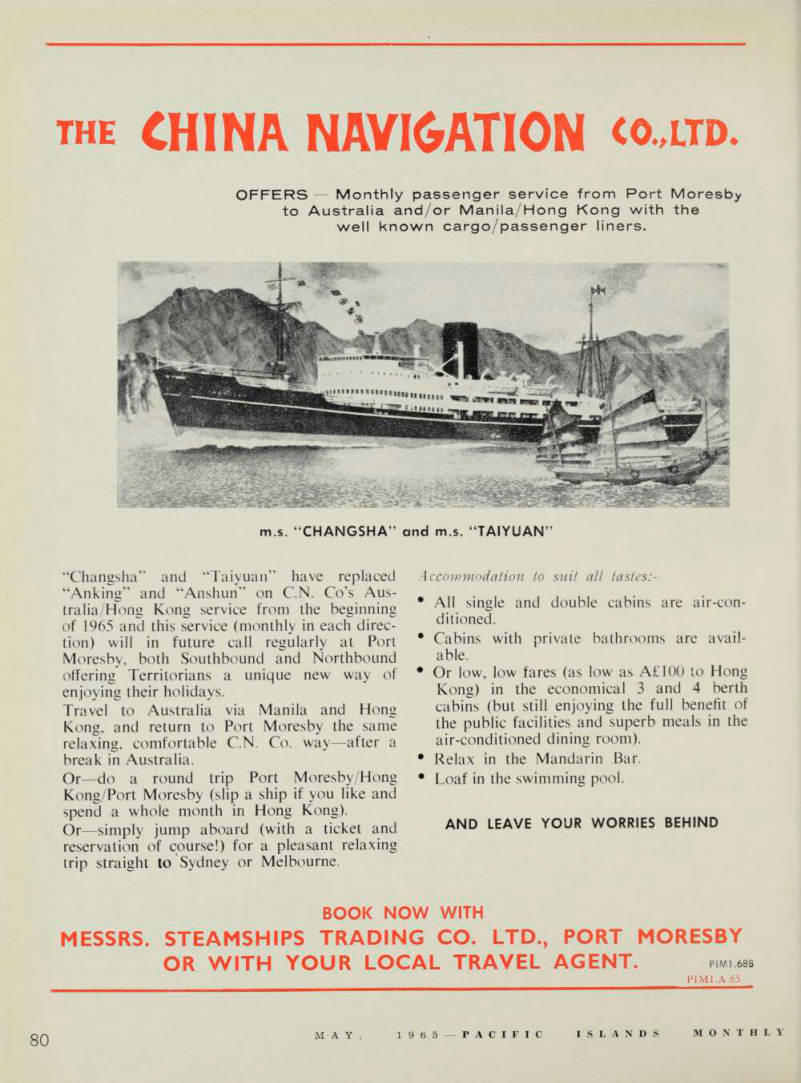 82
82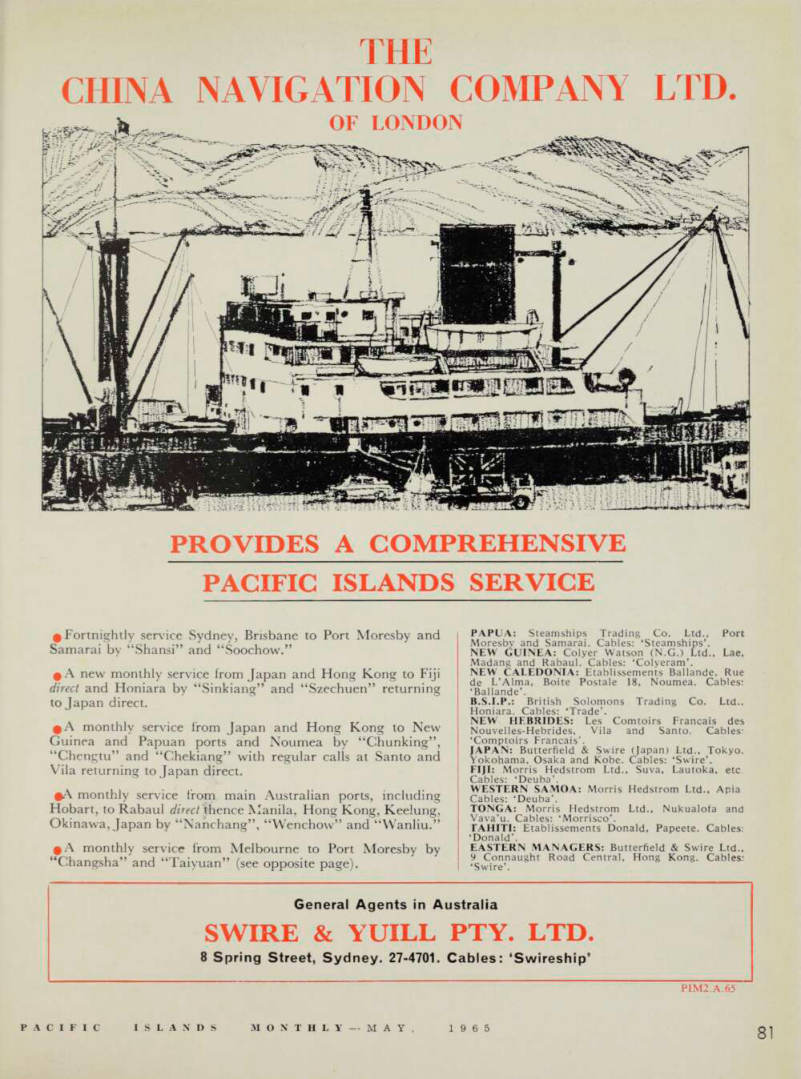 83
83 84
84 85
85 86
86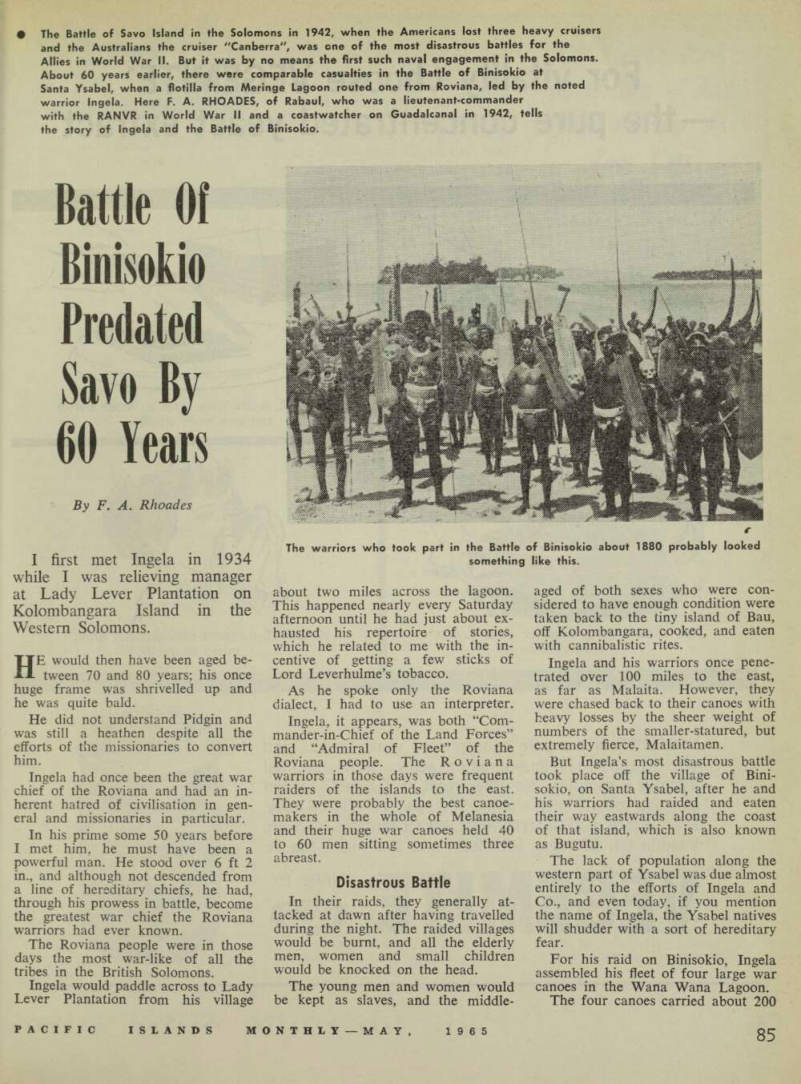 87
87 88
88 89
89 90
90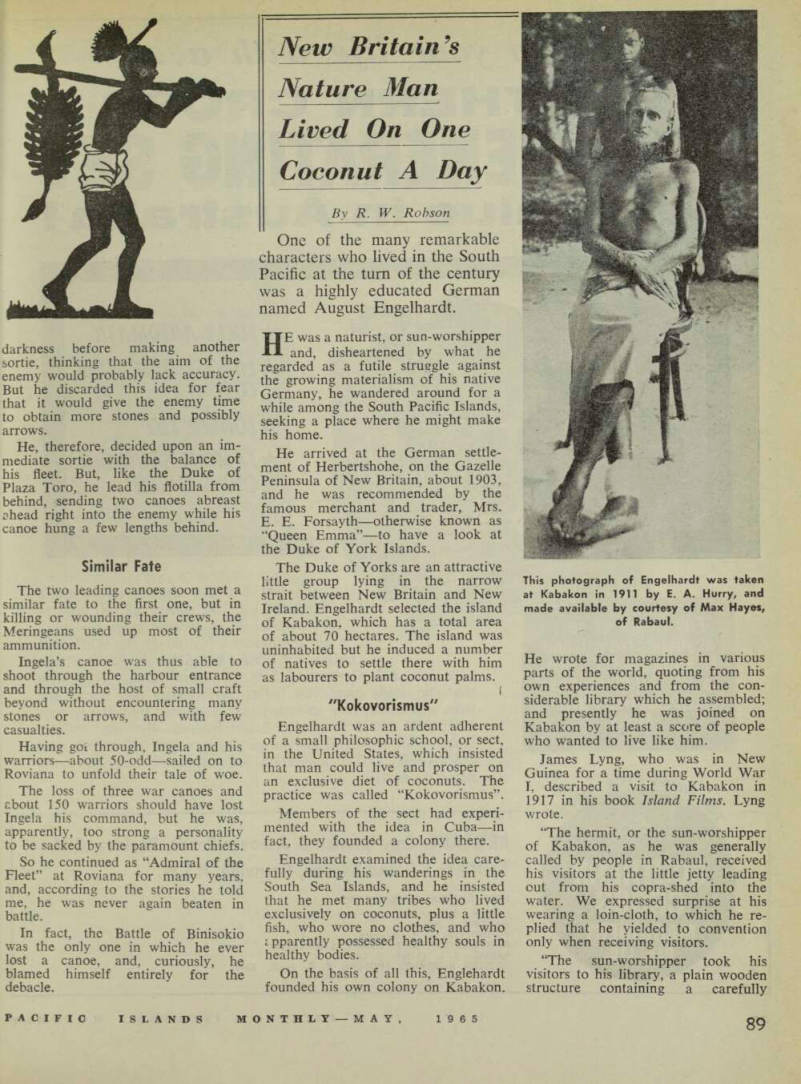 91
91 92
92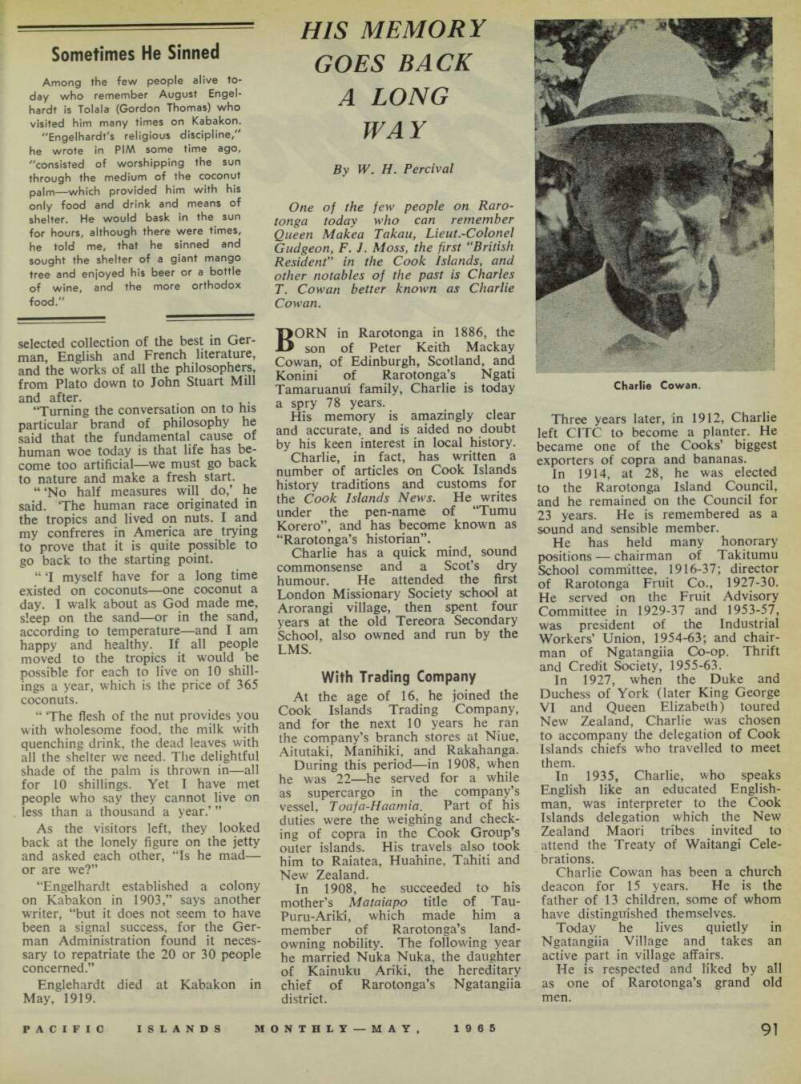 93
93 94
94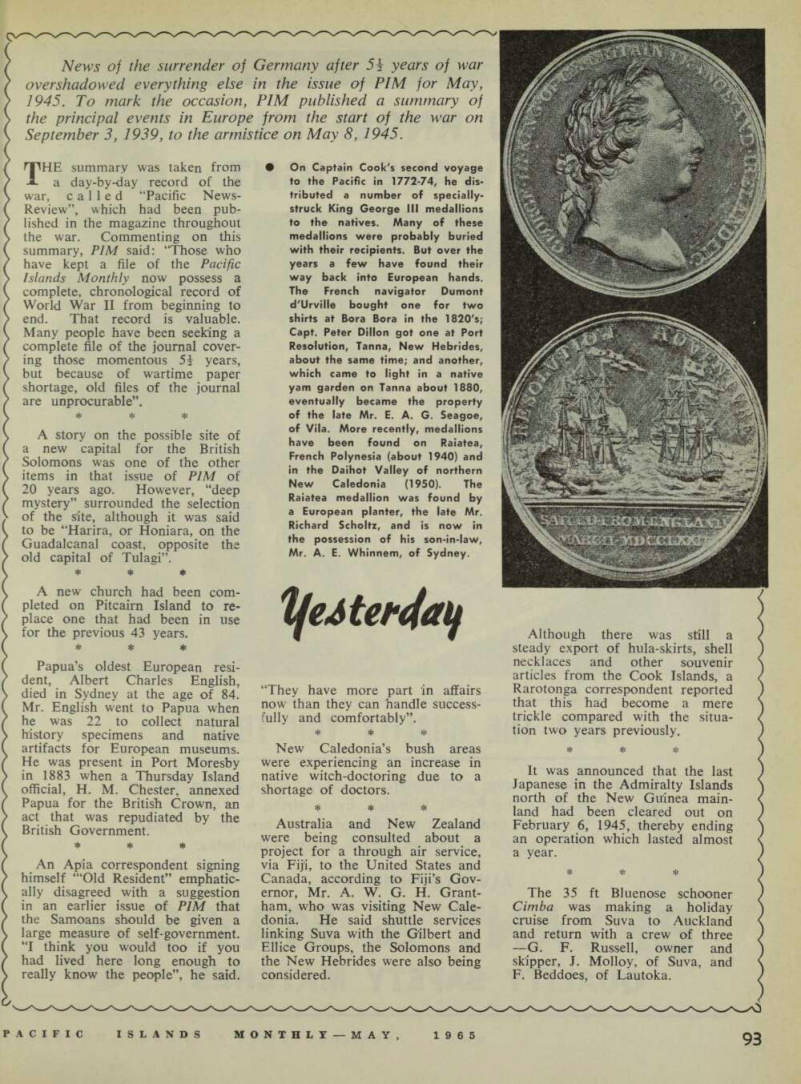 95
95 96
96 97
97 98
98 99
99 100
100 101
101 102
102 103
103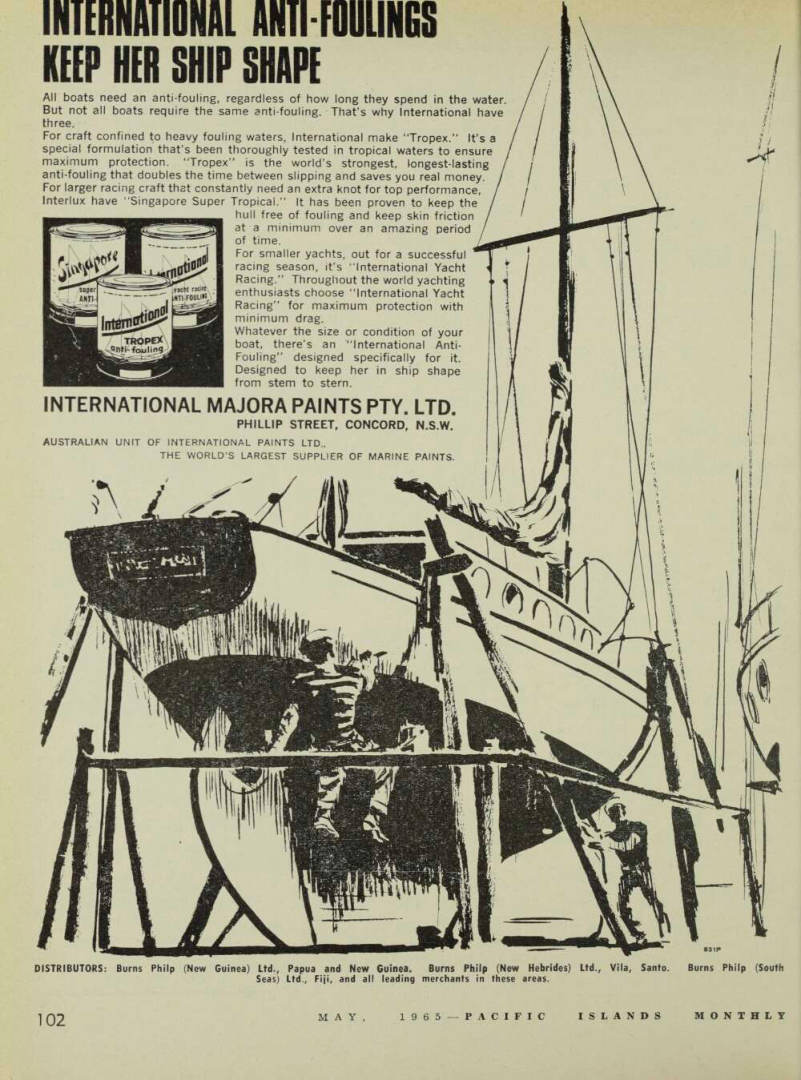 104
104 105
105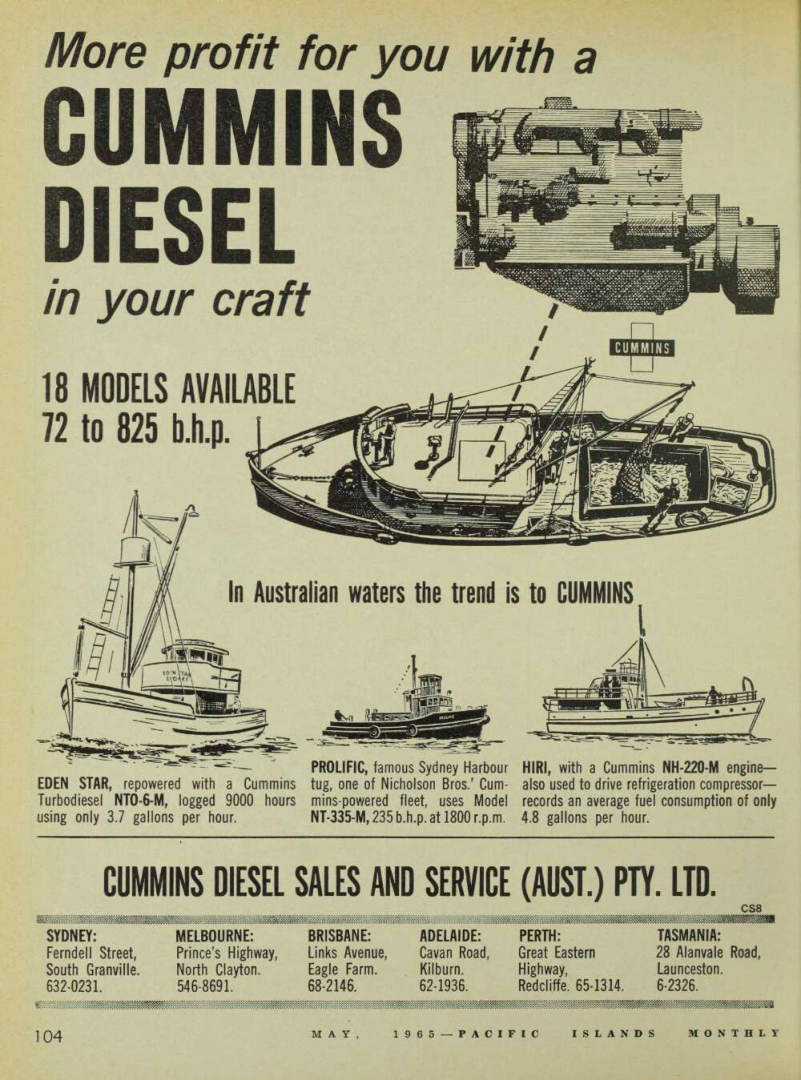 106
106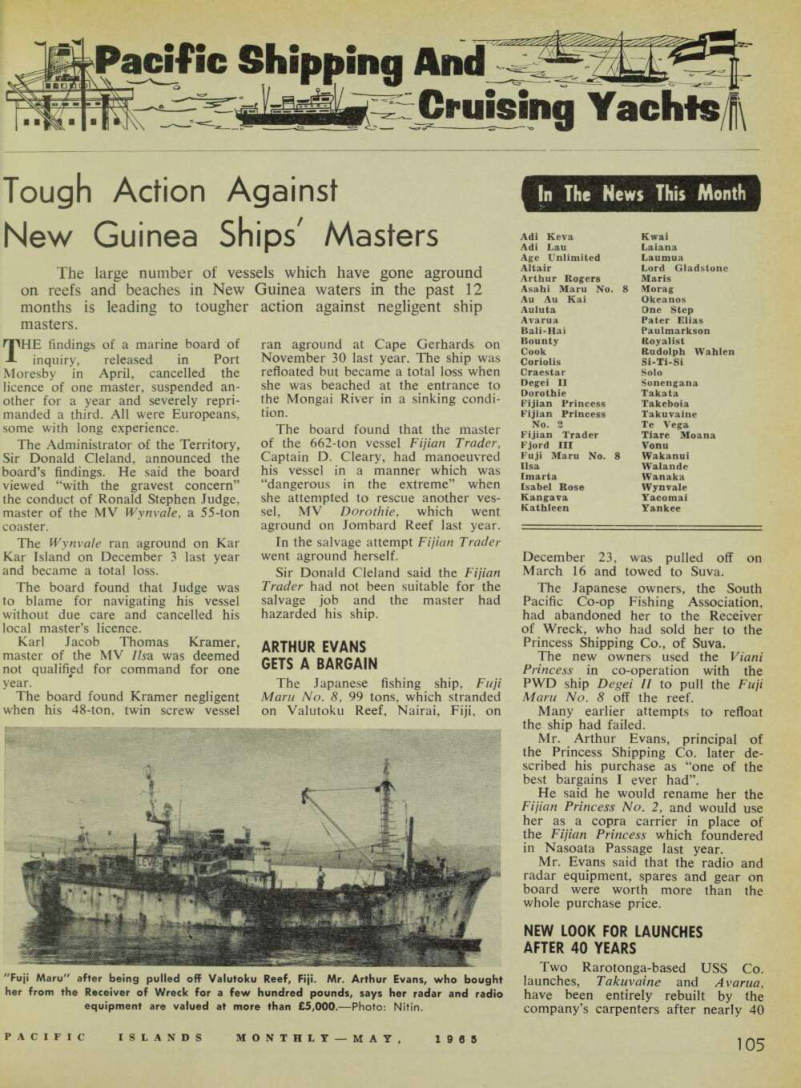 107
107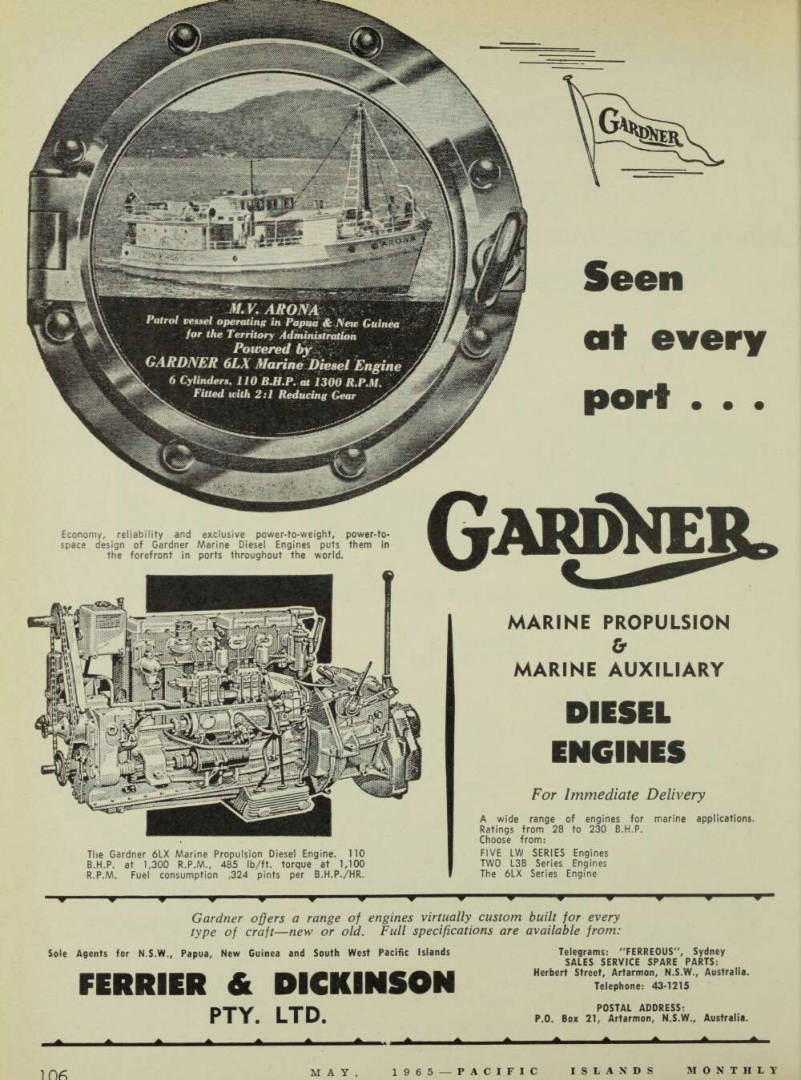 108
108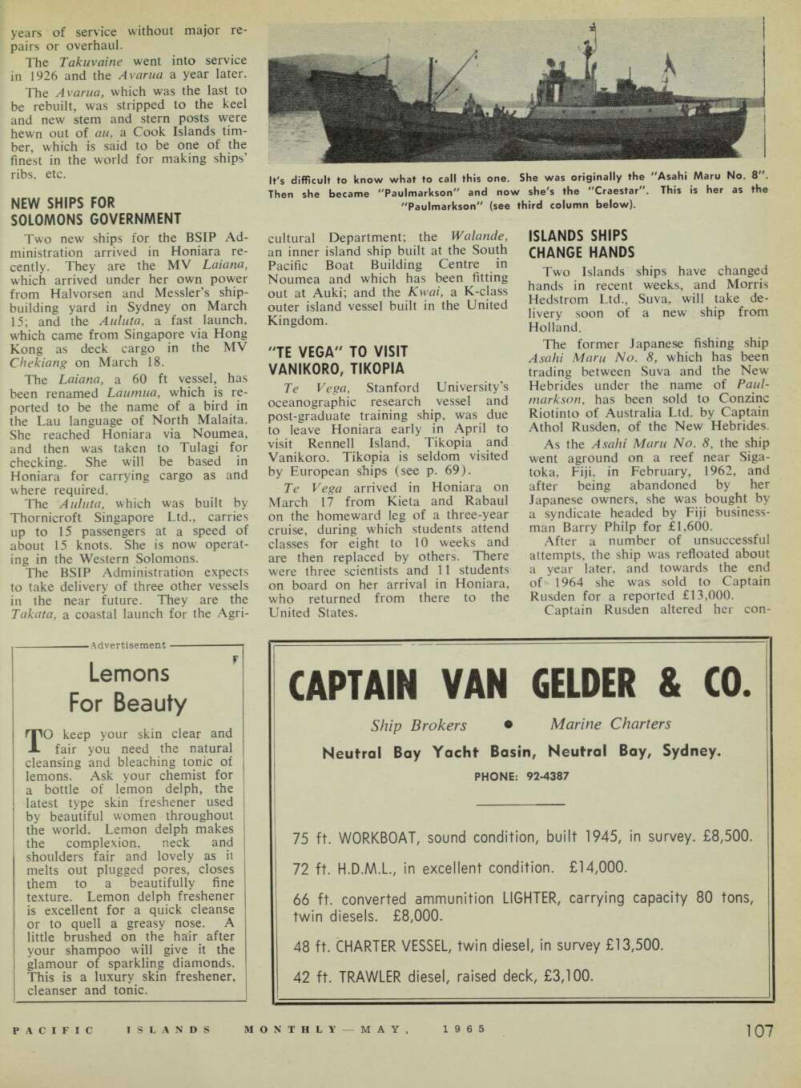 109
109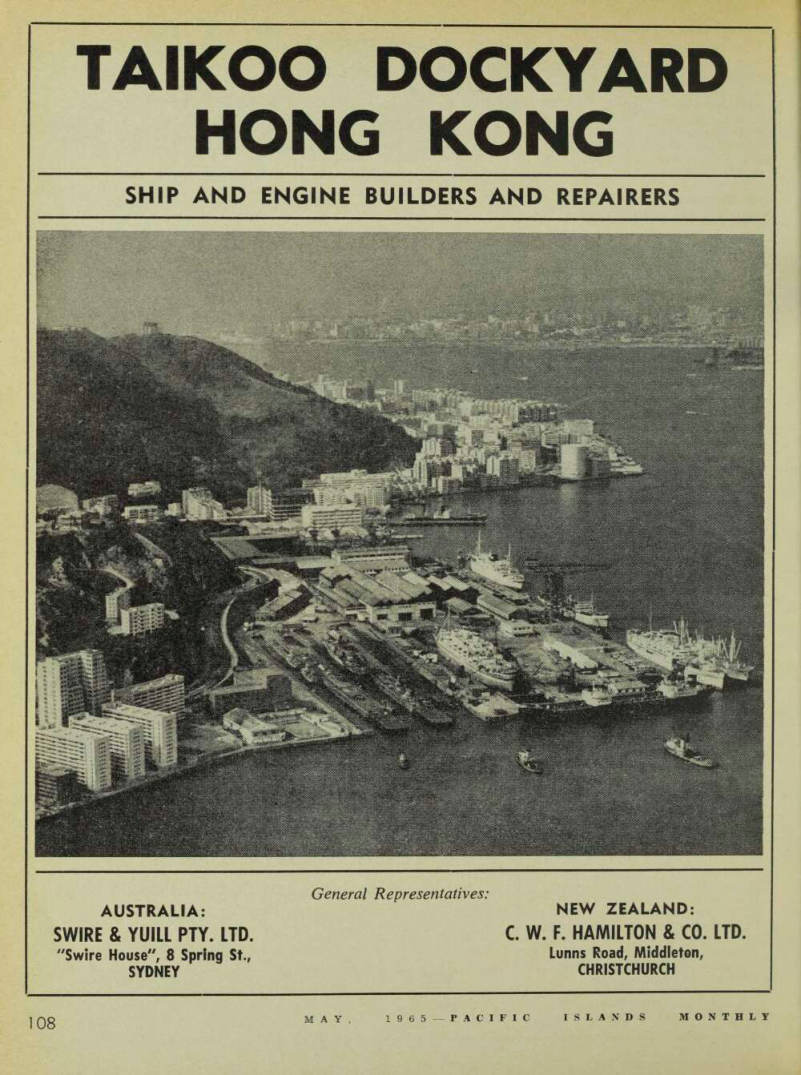 110
110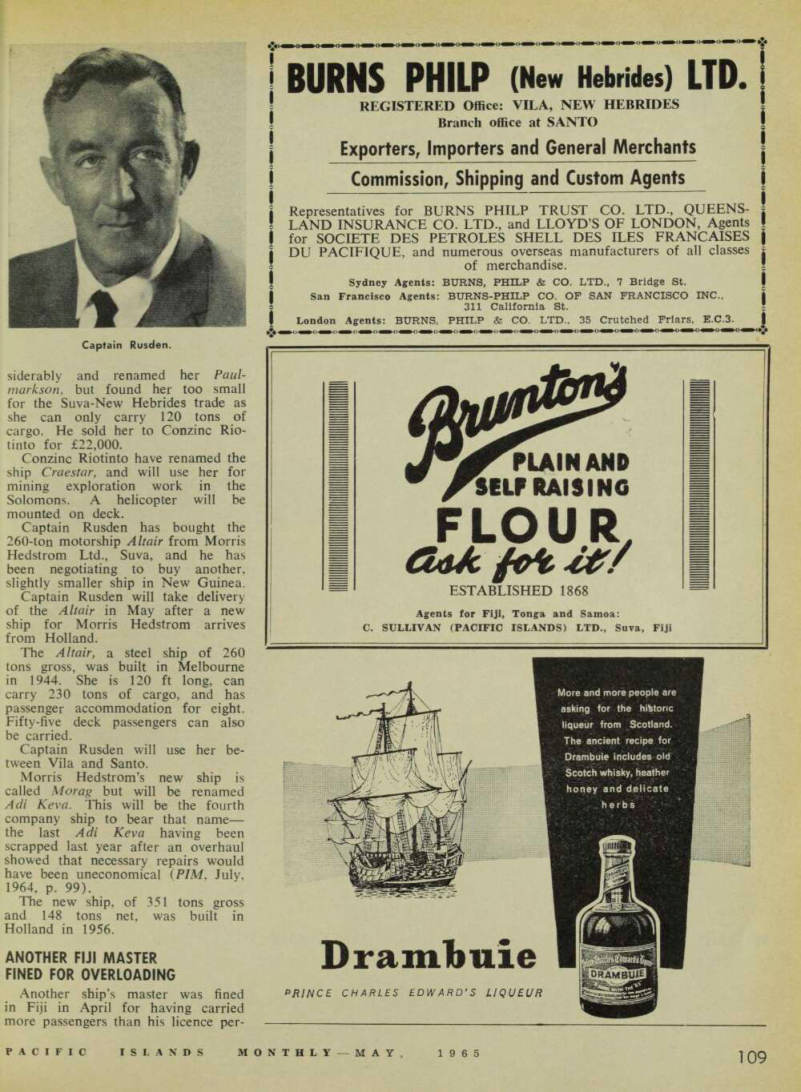 111
111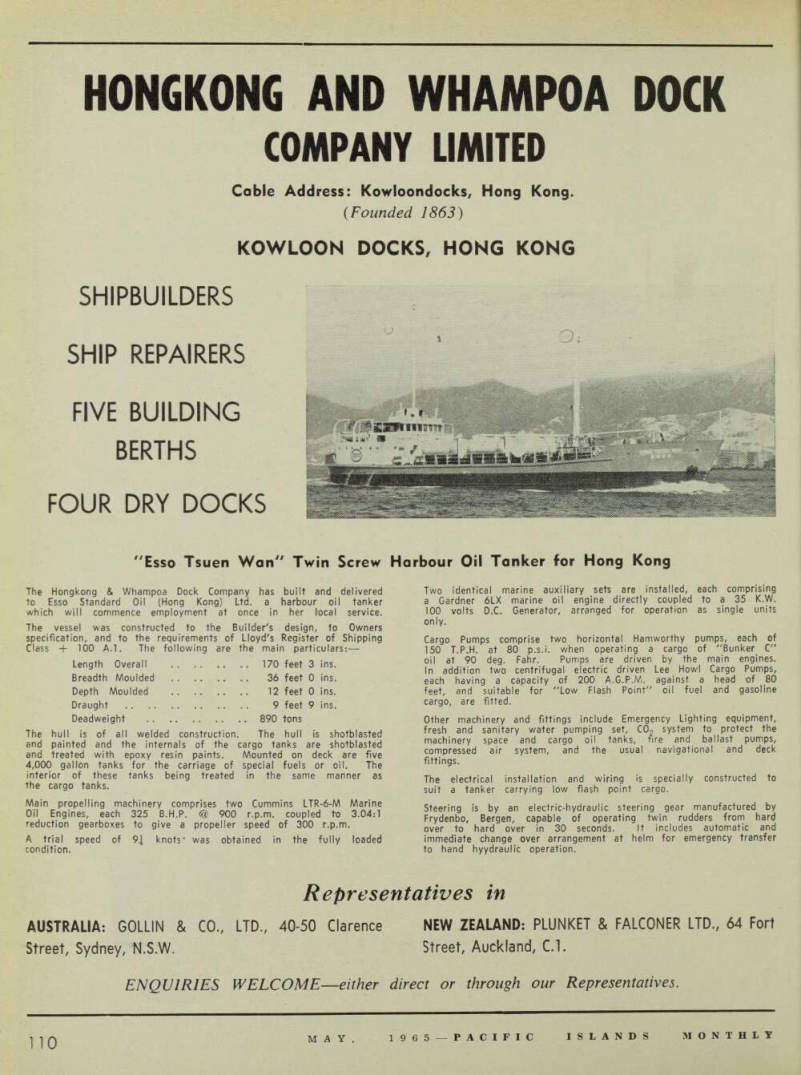 112
112 113
113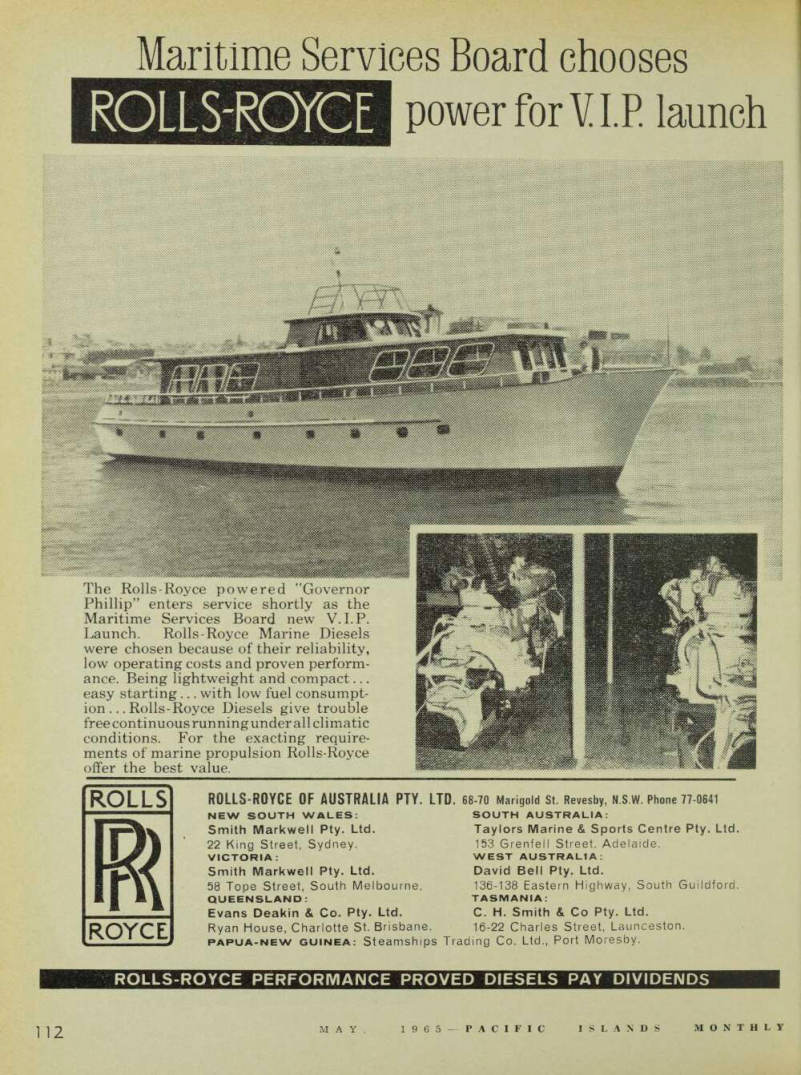 114
114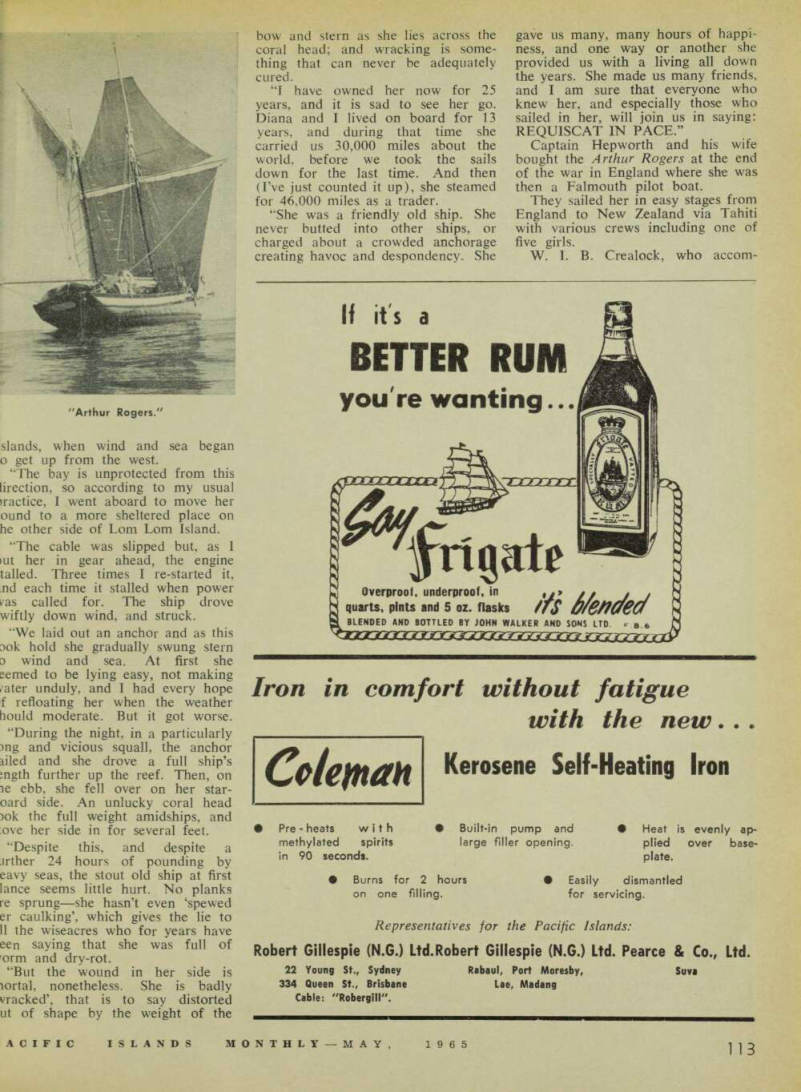 115
115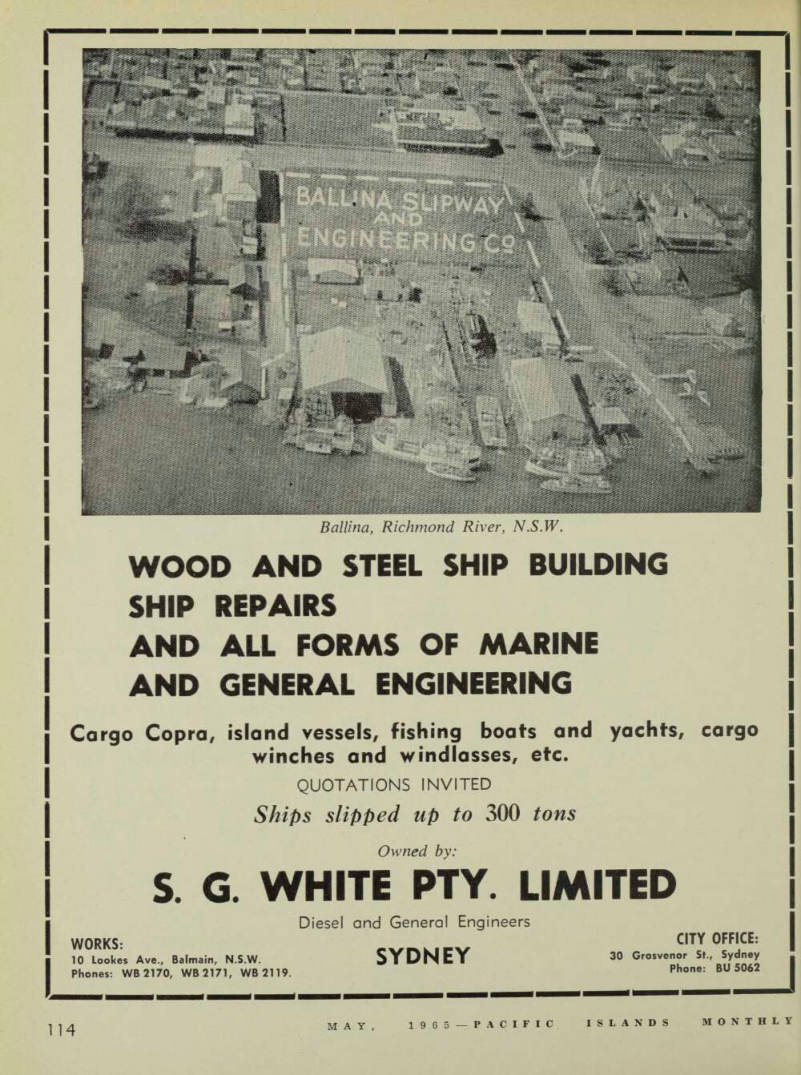 116
116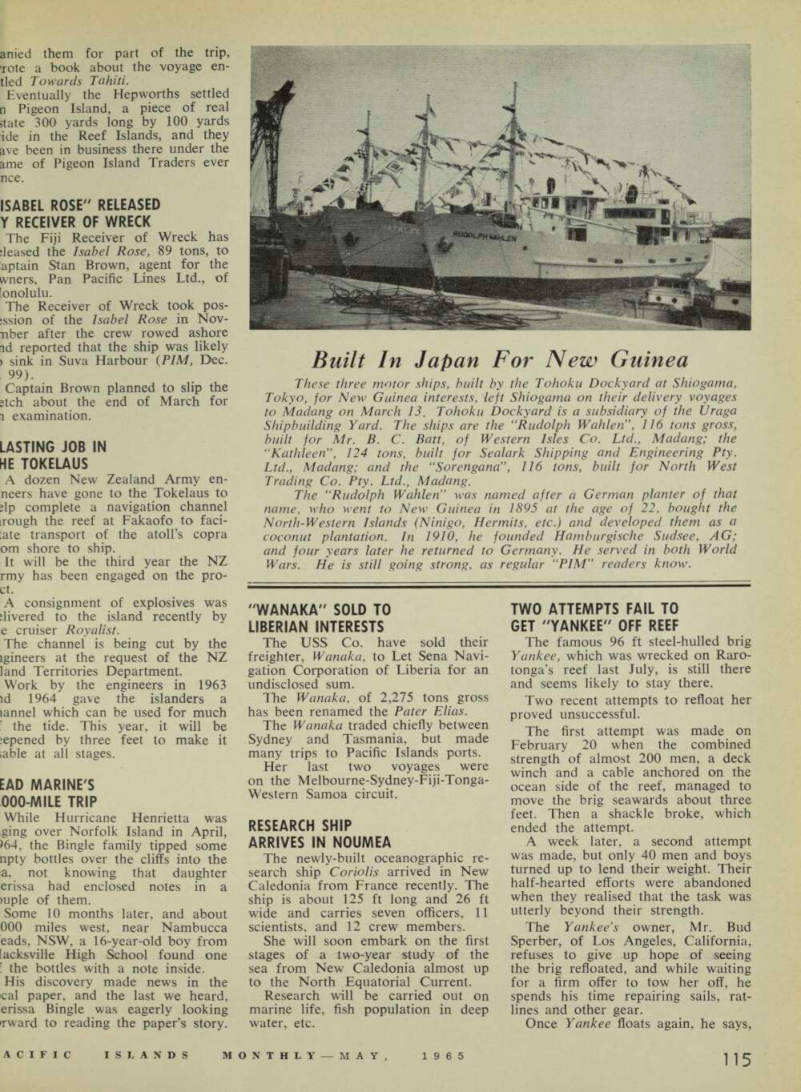 117
117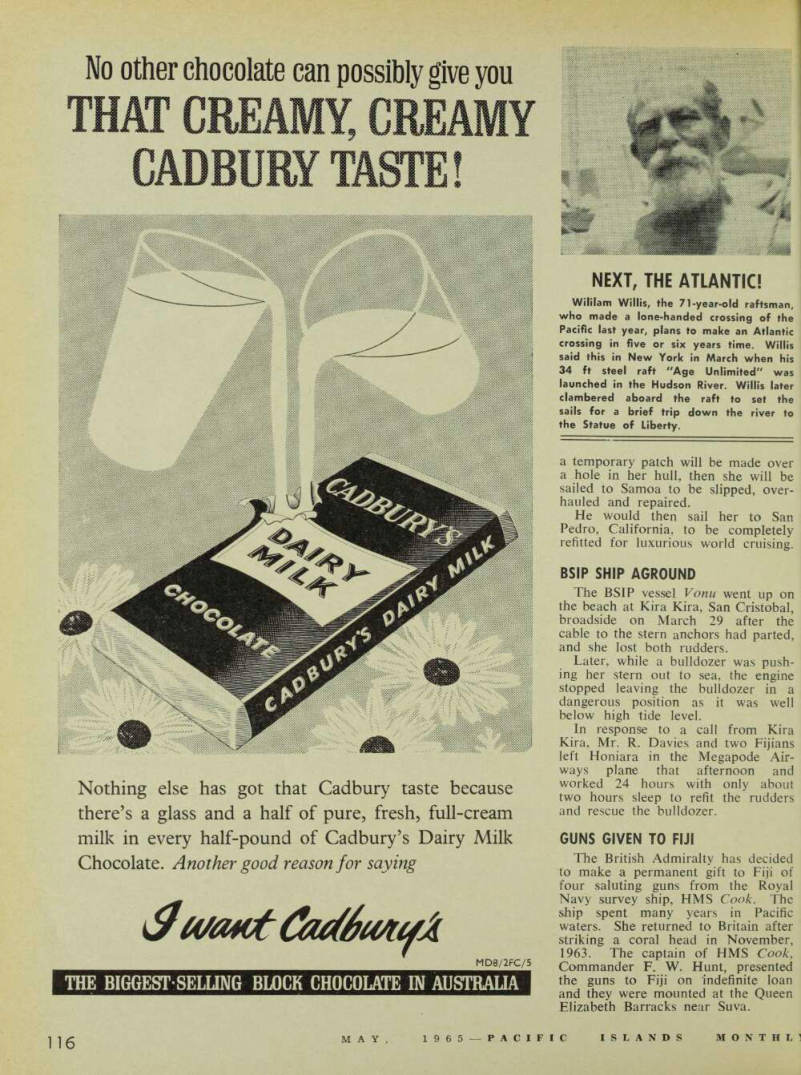 118
118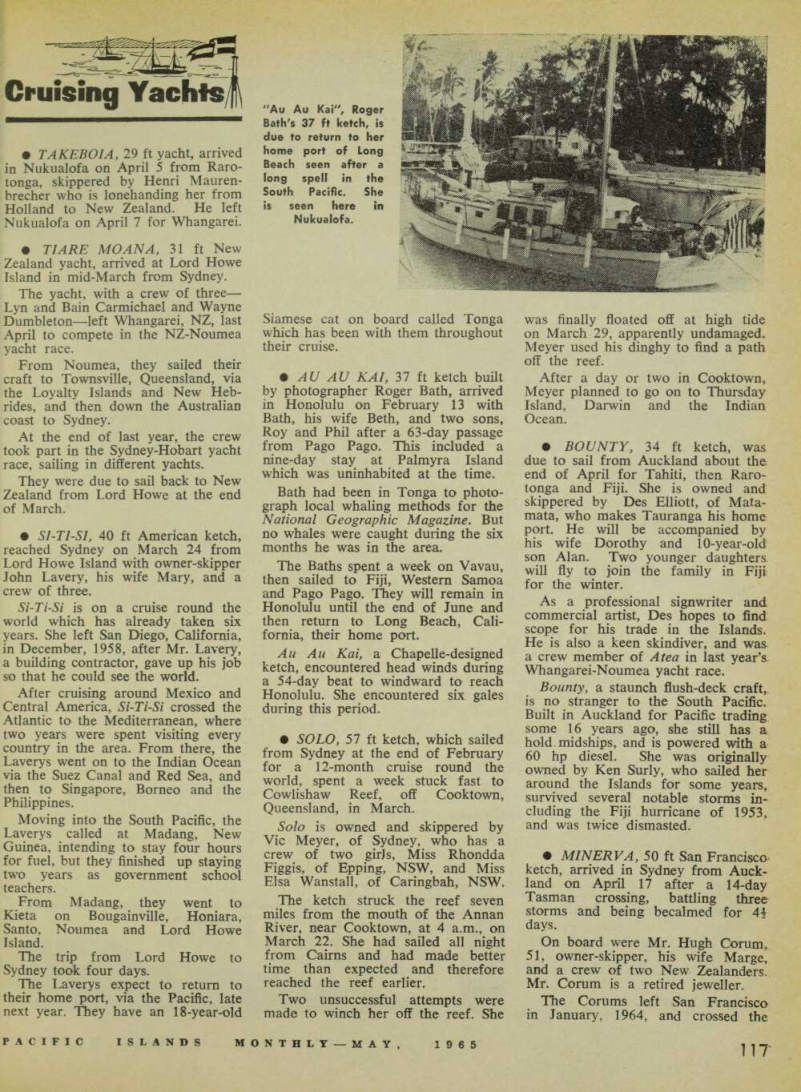 119
119 120
120 121
121 122
122 123
123 124
124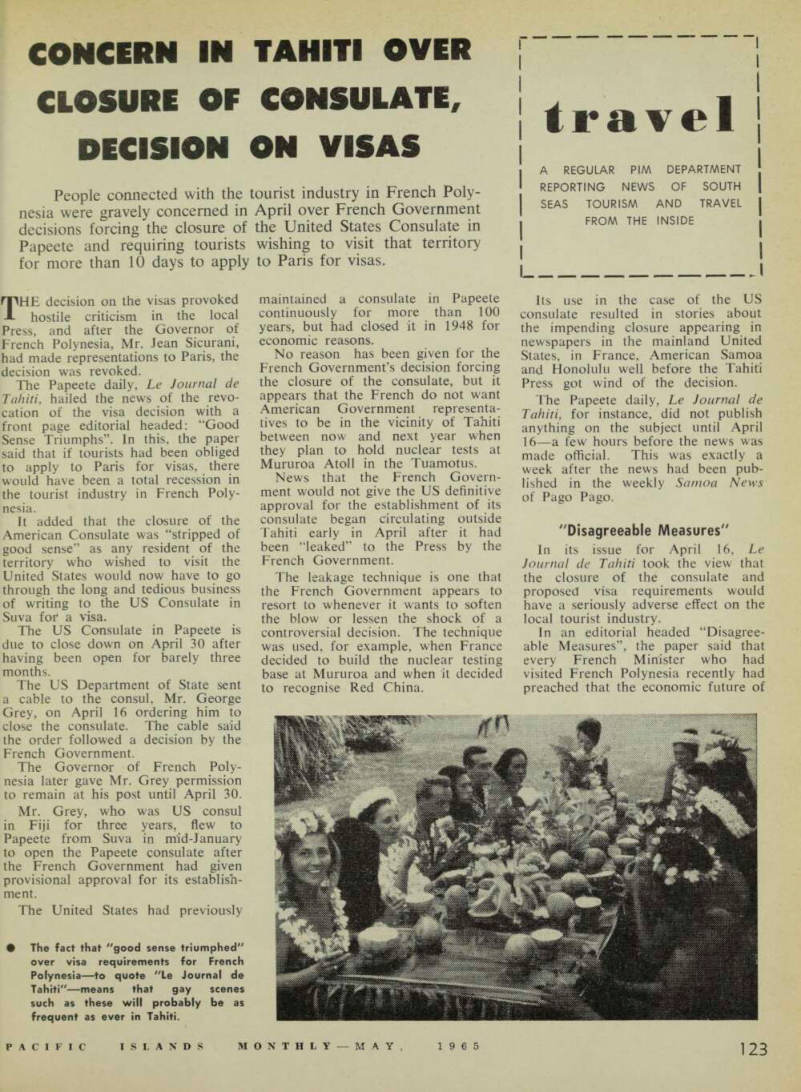 125
125 126
126 127
127 128
128 129
129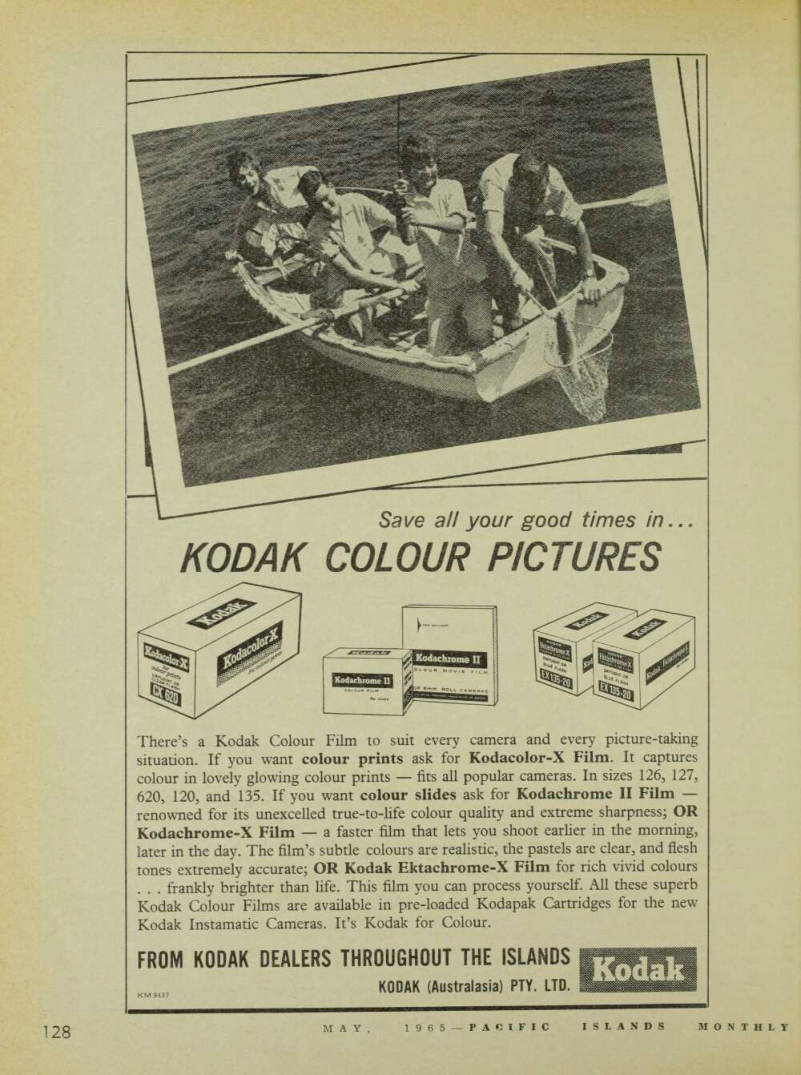 130
130 131
131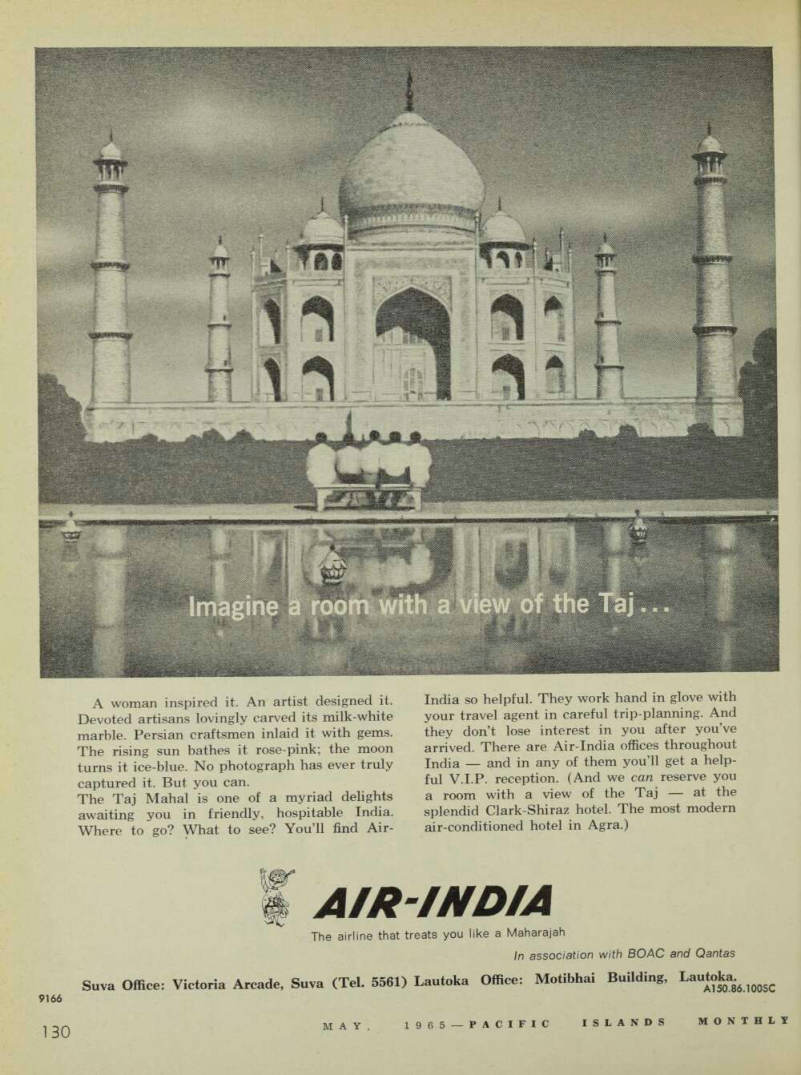 132
132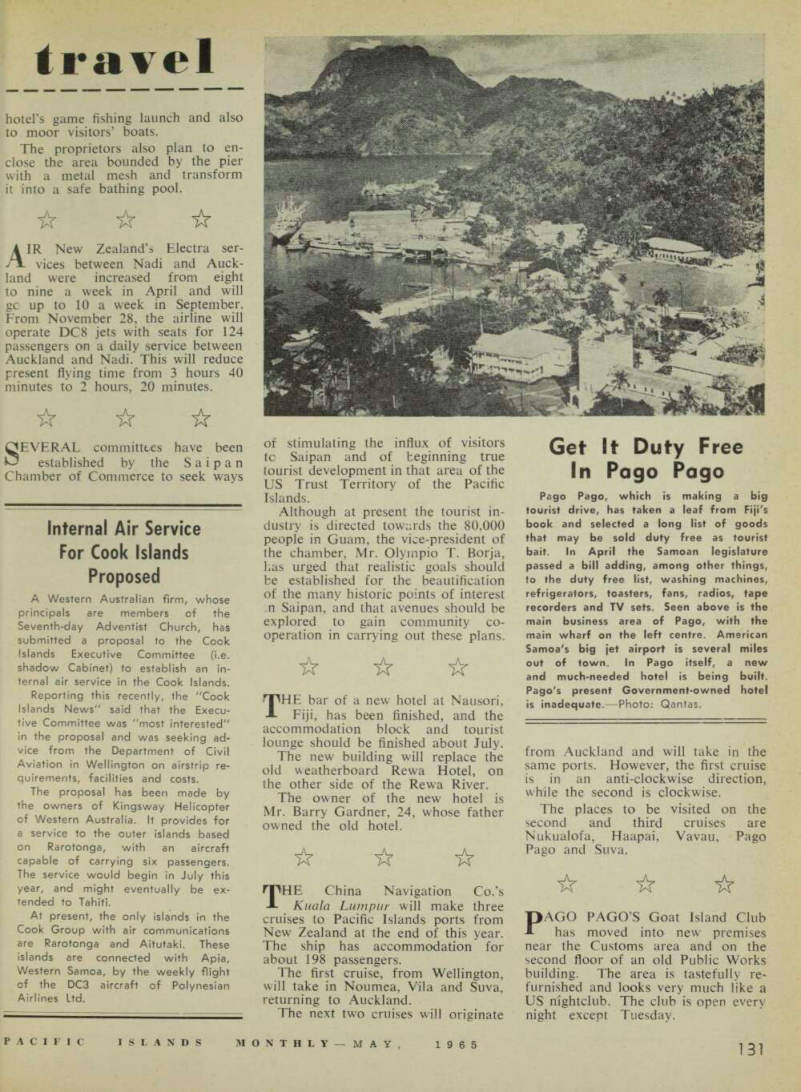 133
133 134
134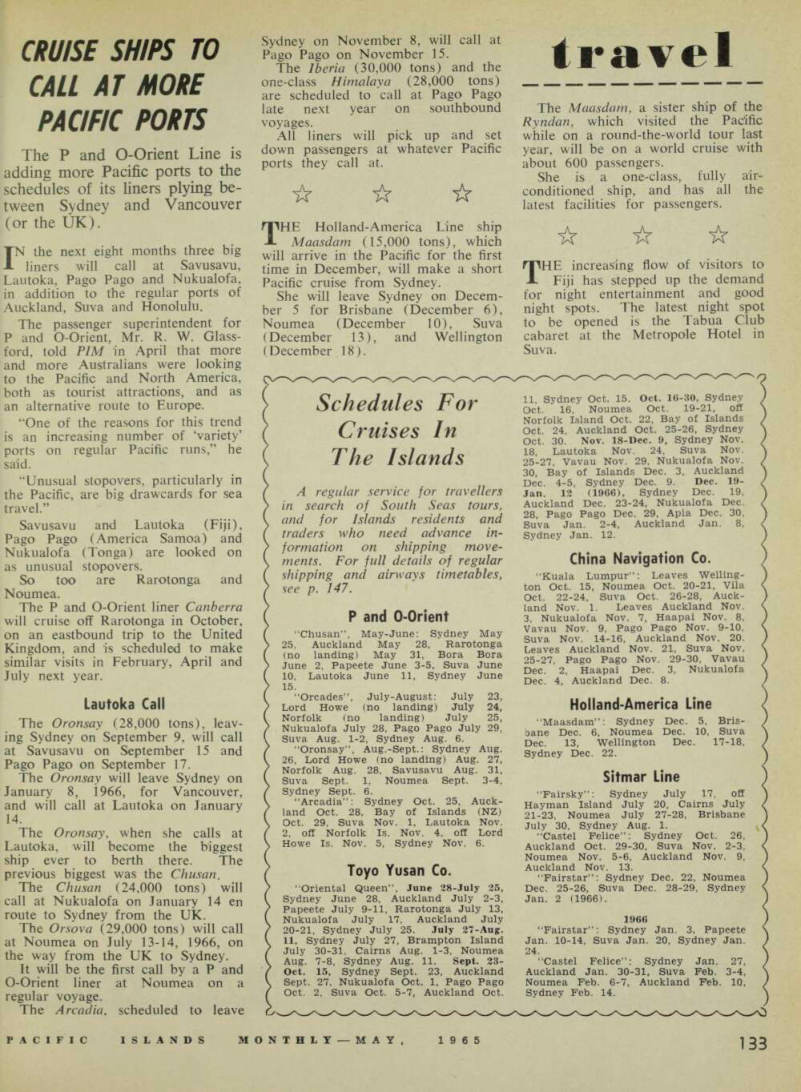 135
135 136
136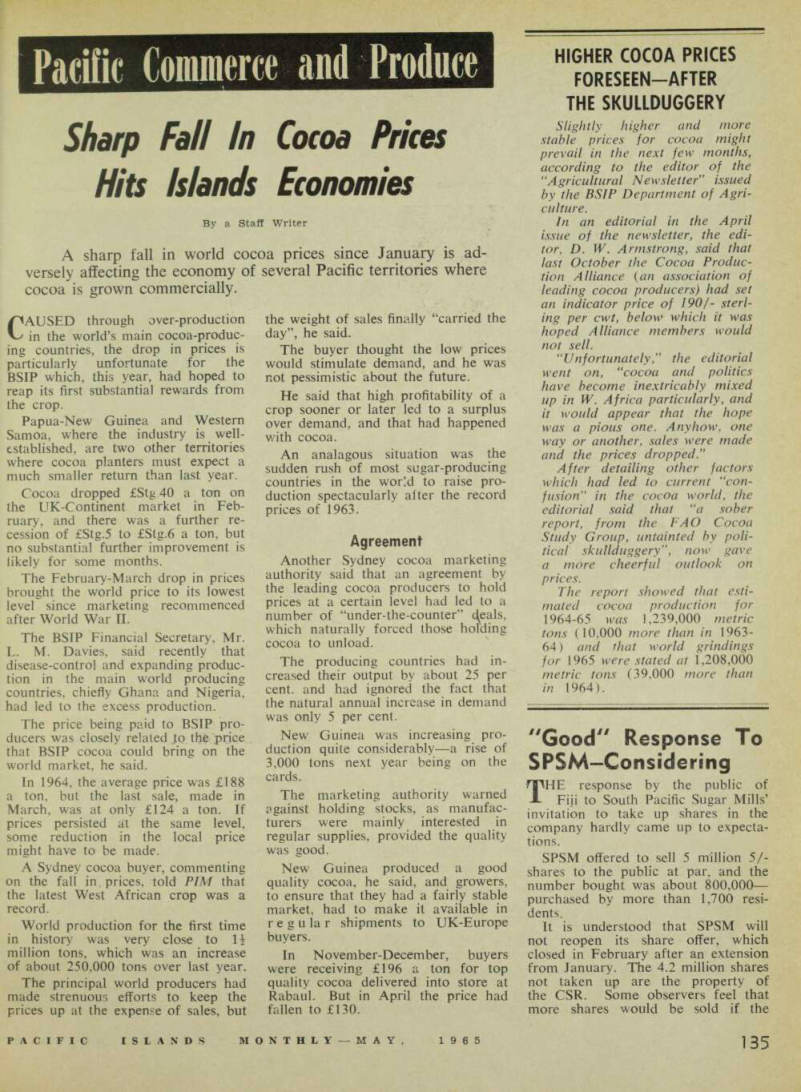 137
137 138
138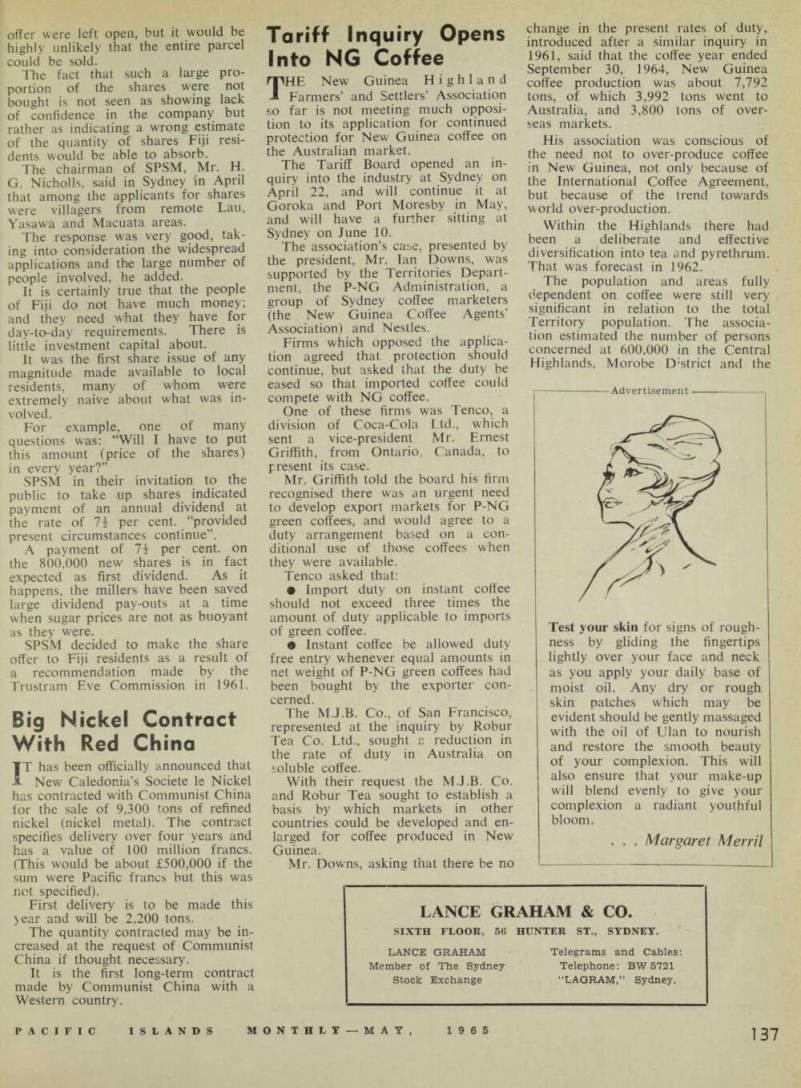 139
139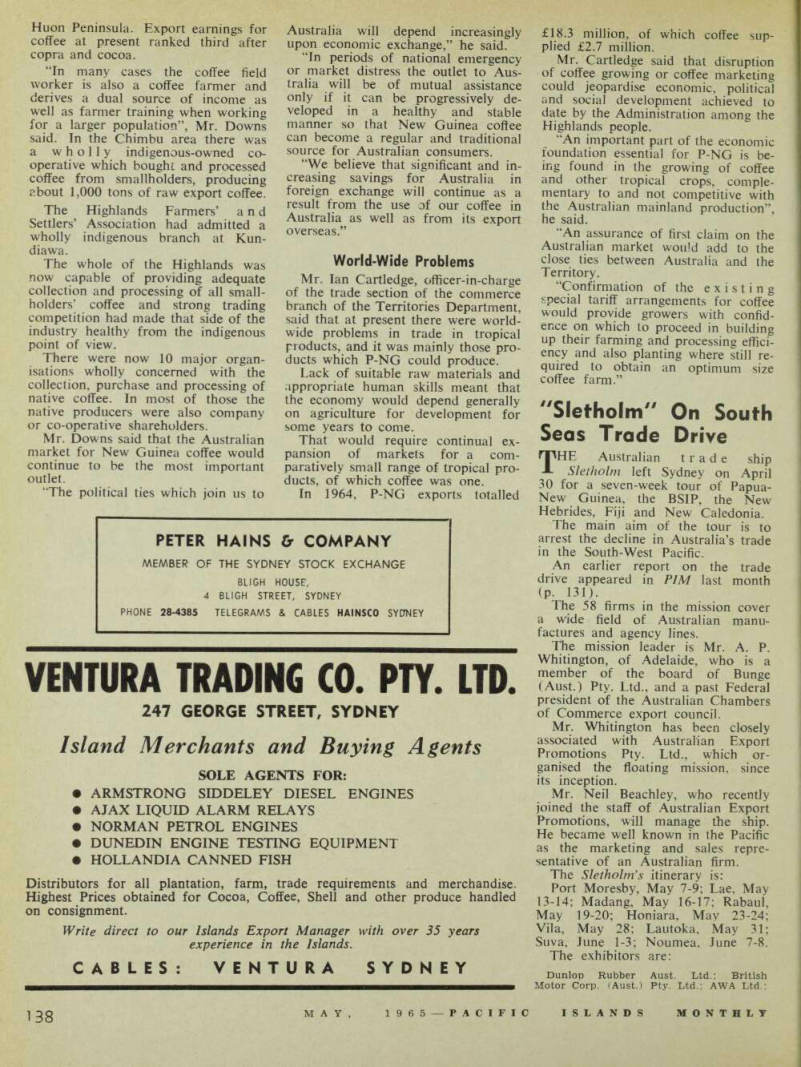 140
140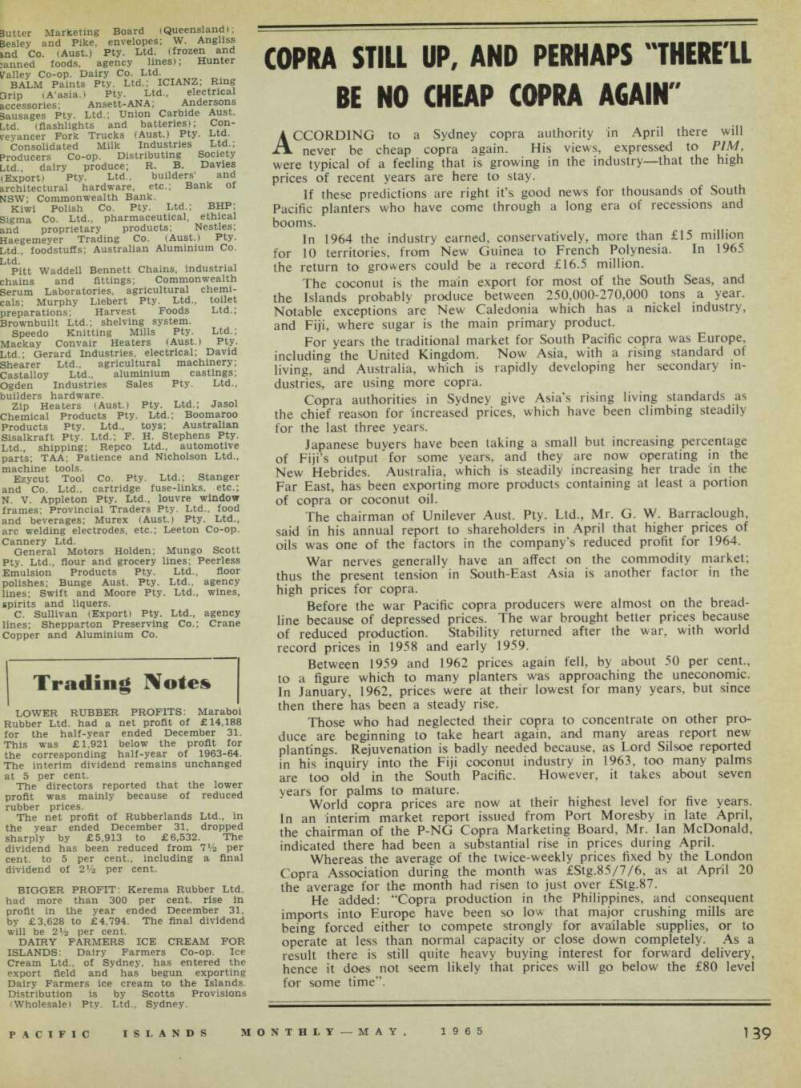 141
141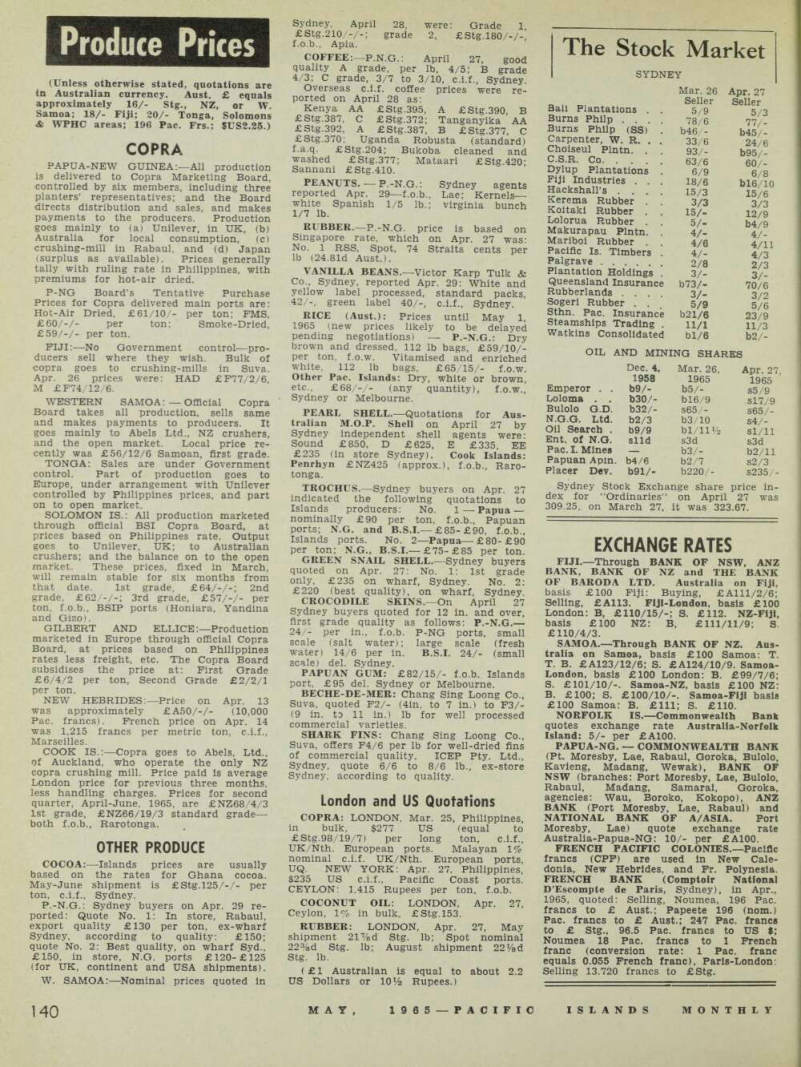 142
142 143
143 144
144 145
145 146
146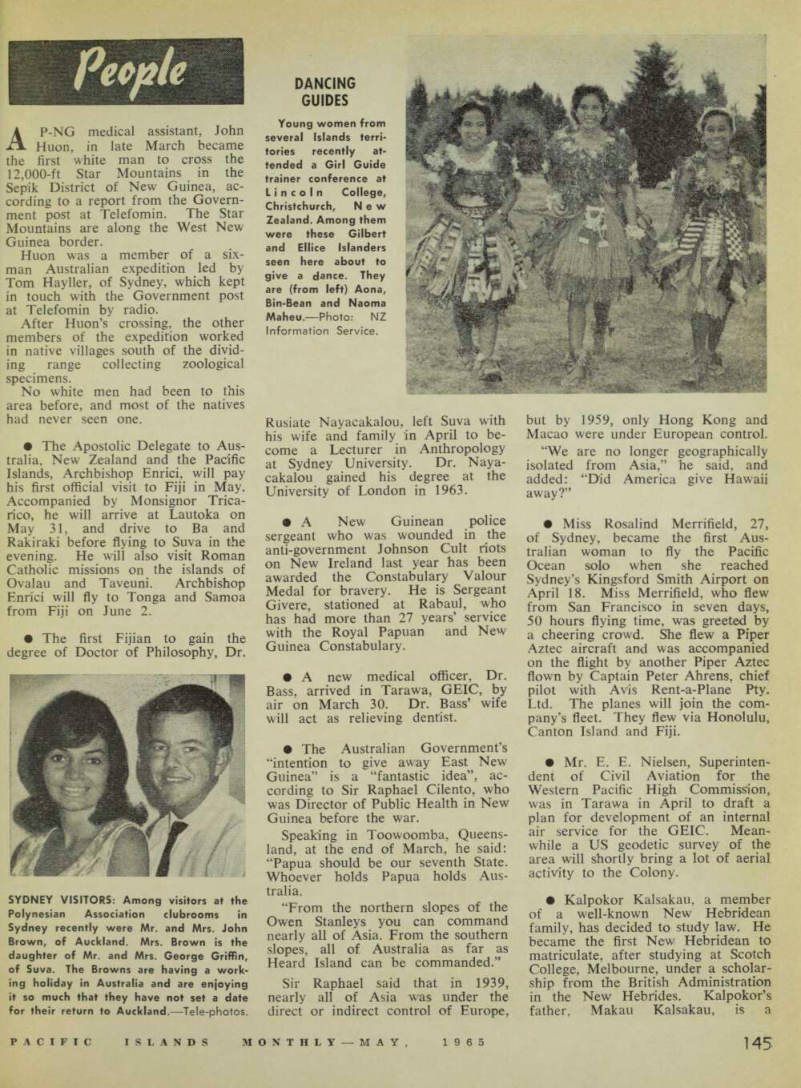 147
147 148
148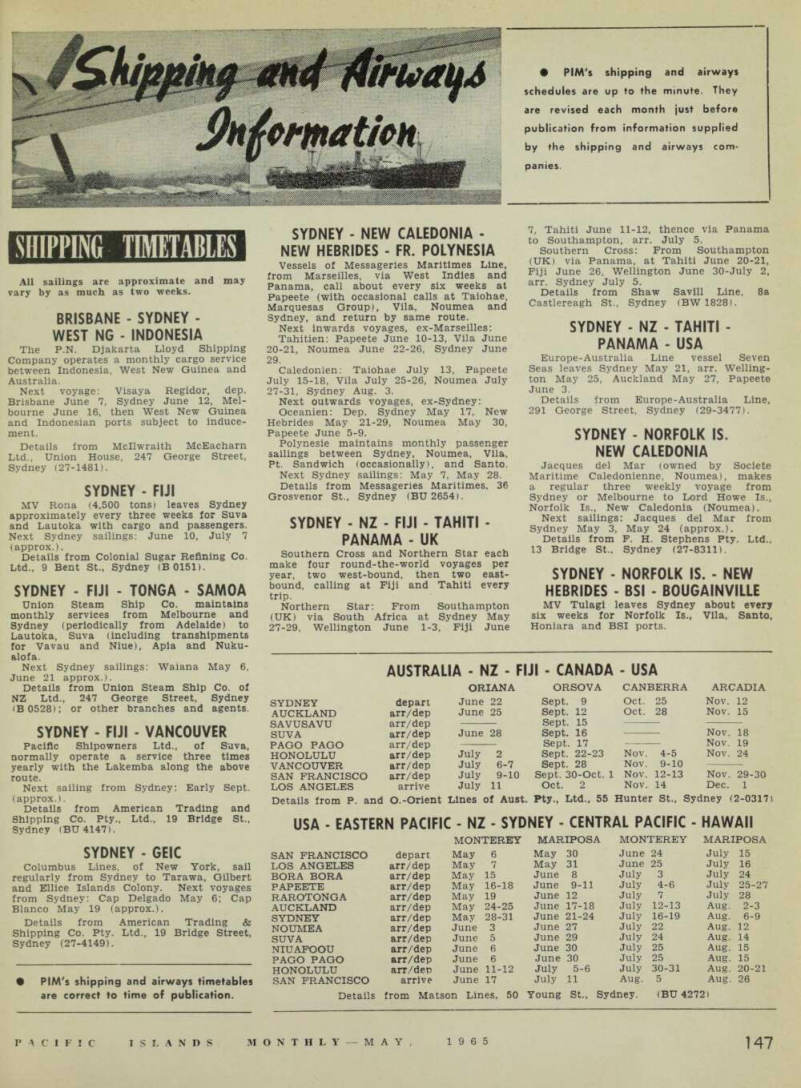 149
149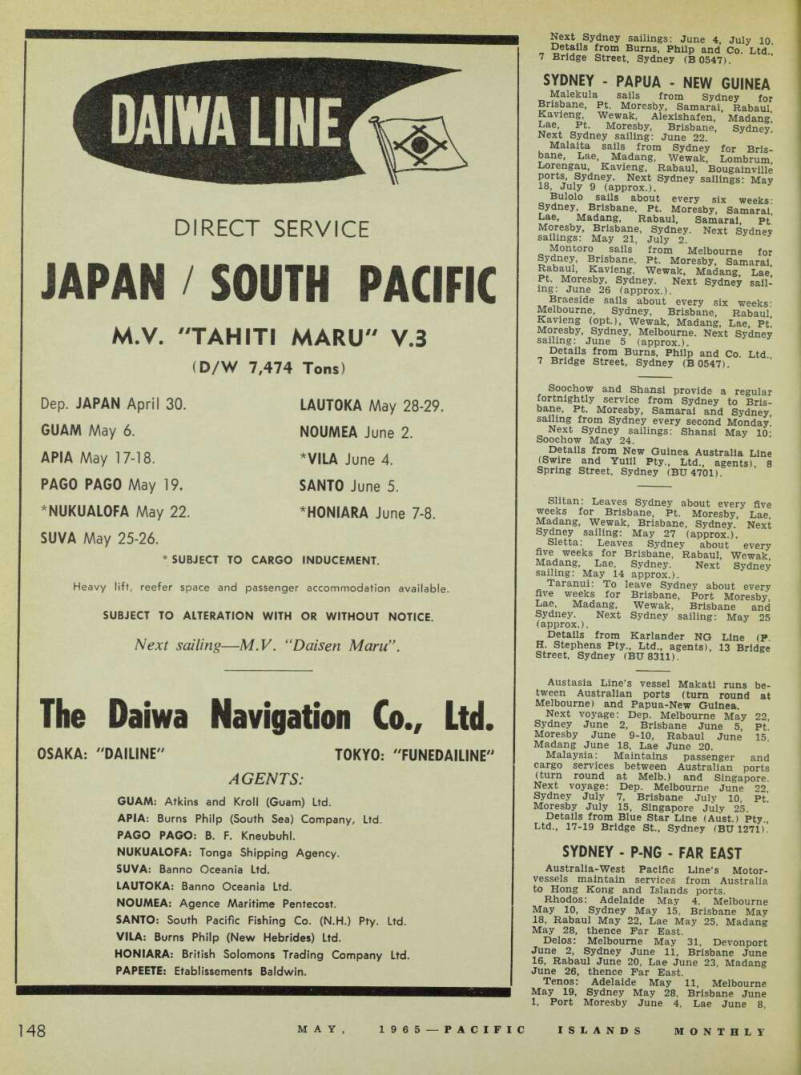 150
150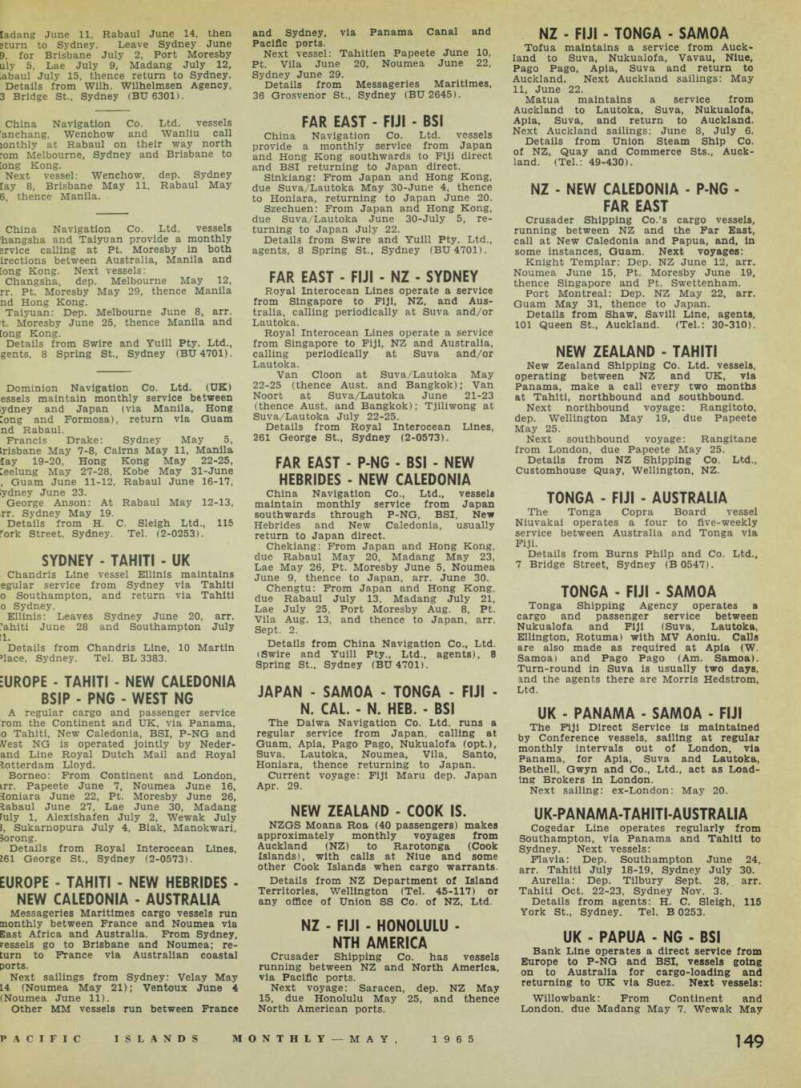 151
151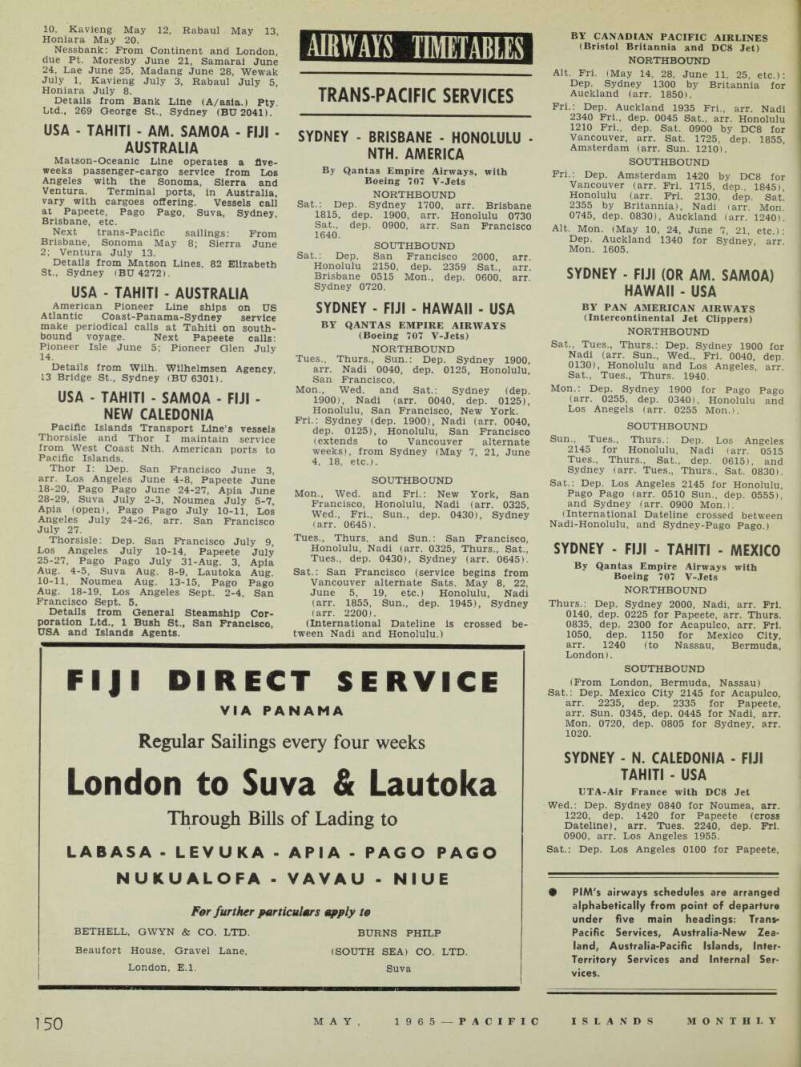 152
152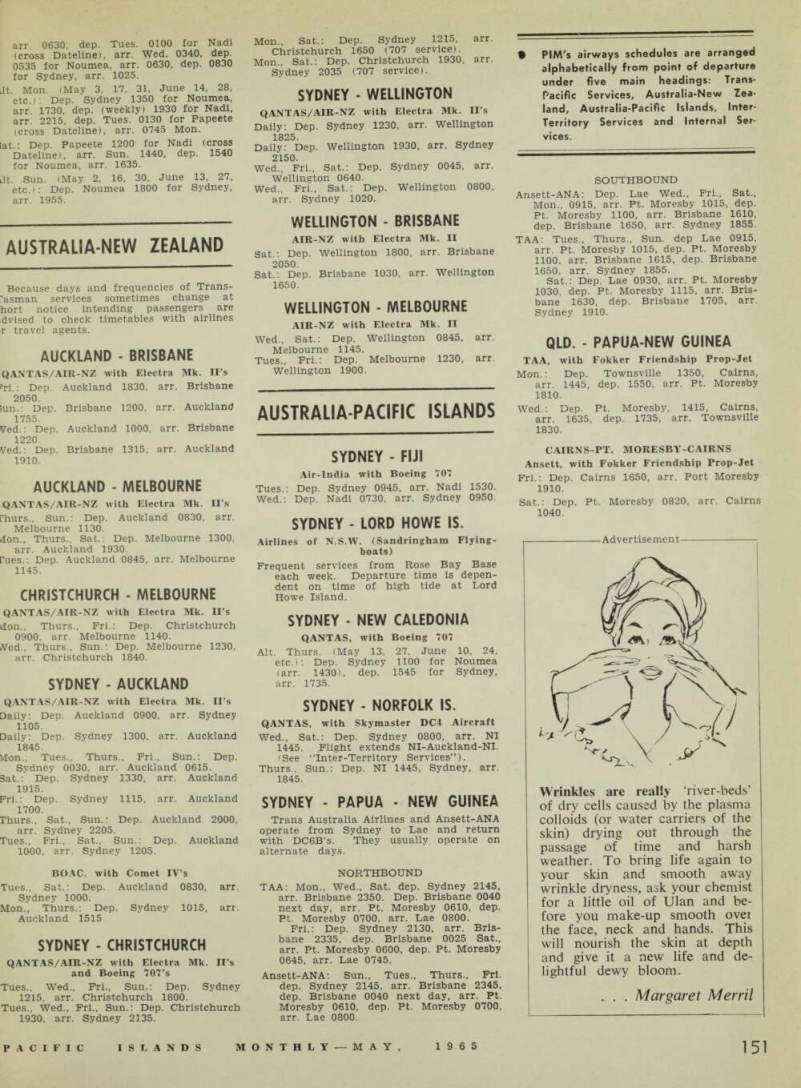 153
153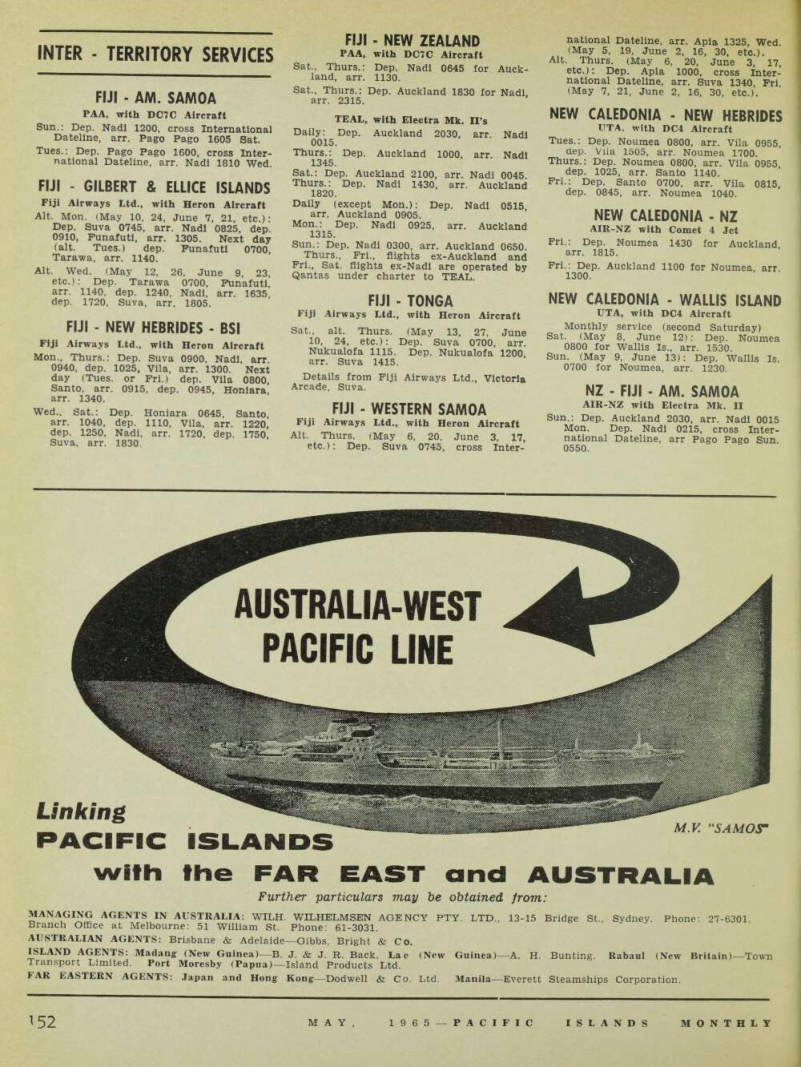 154
154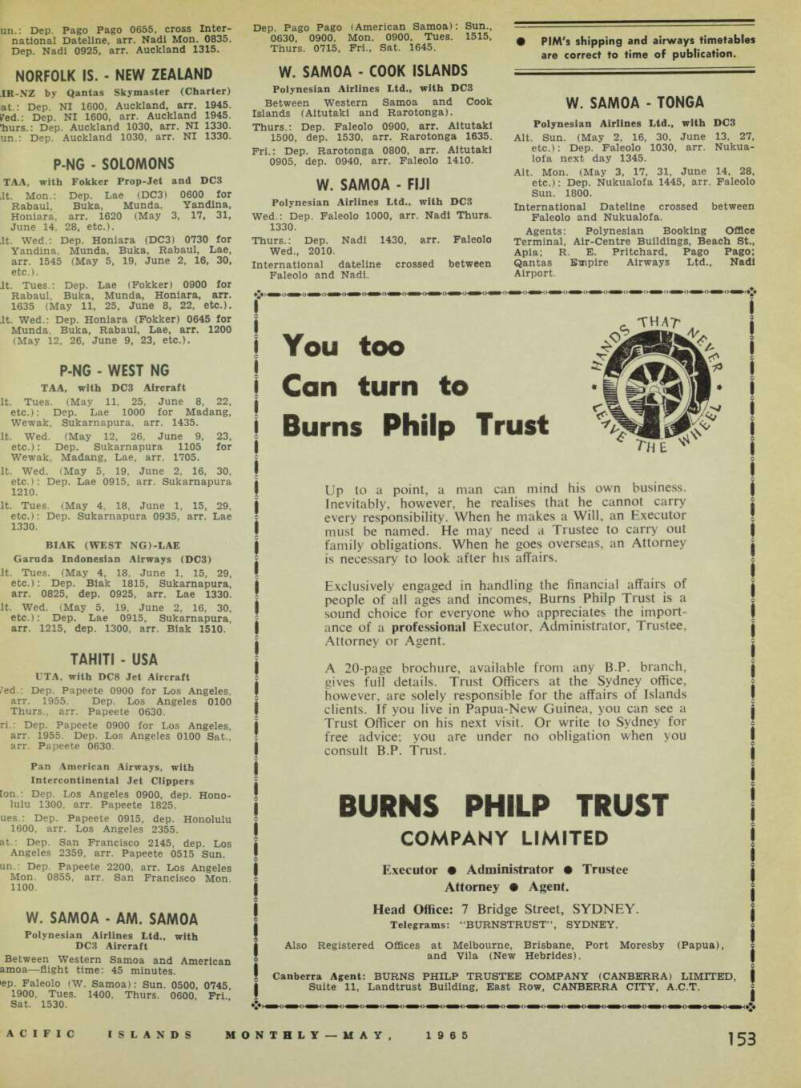 155
155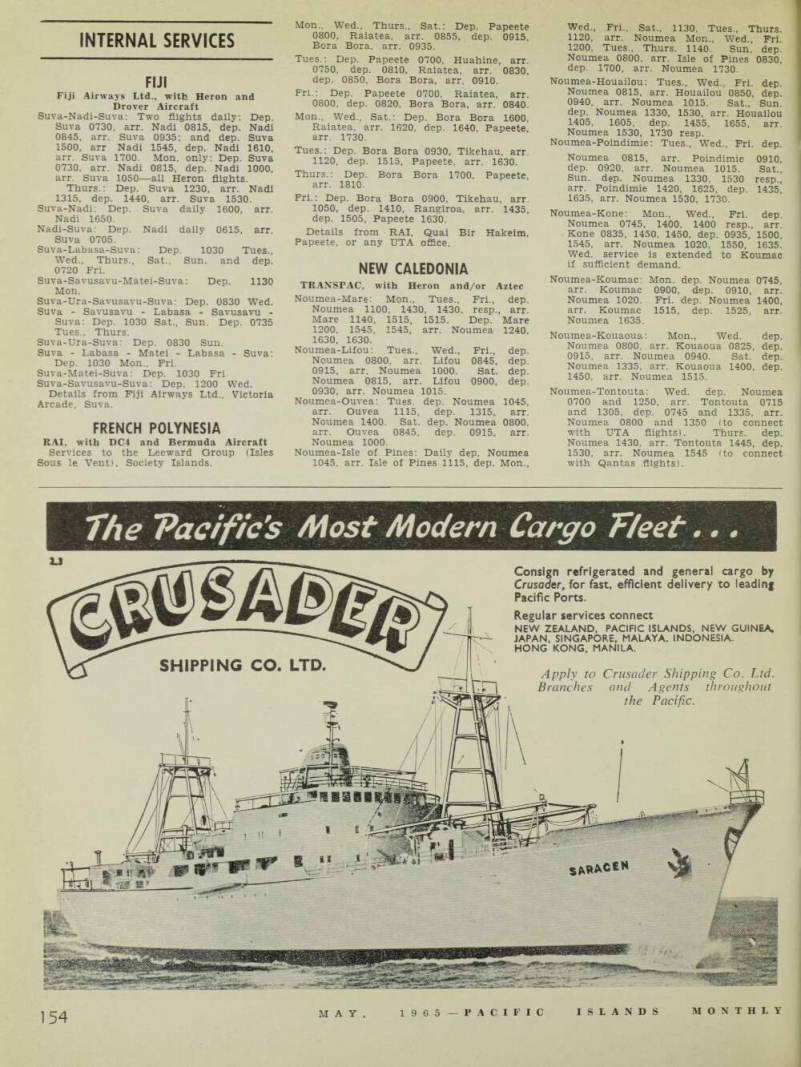 156
156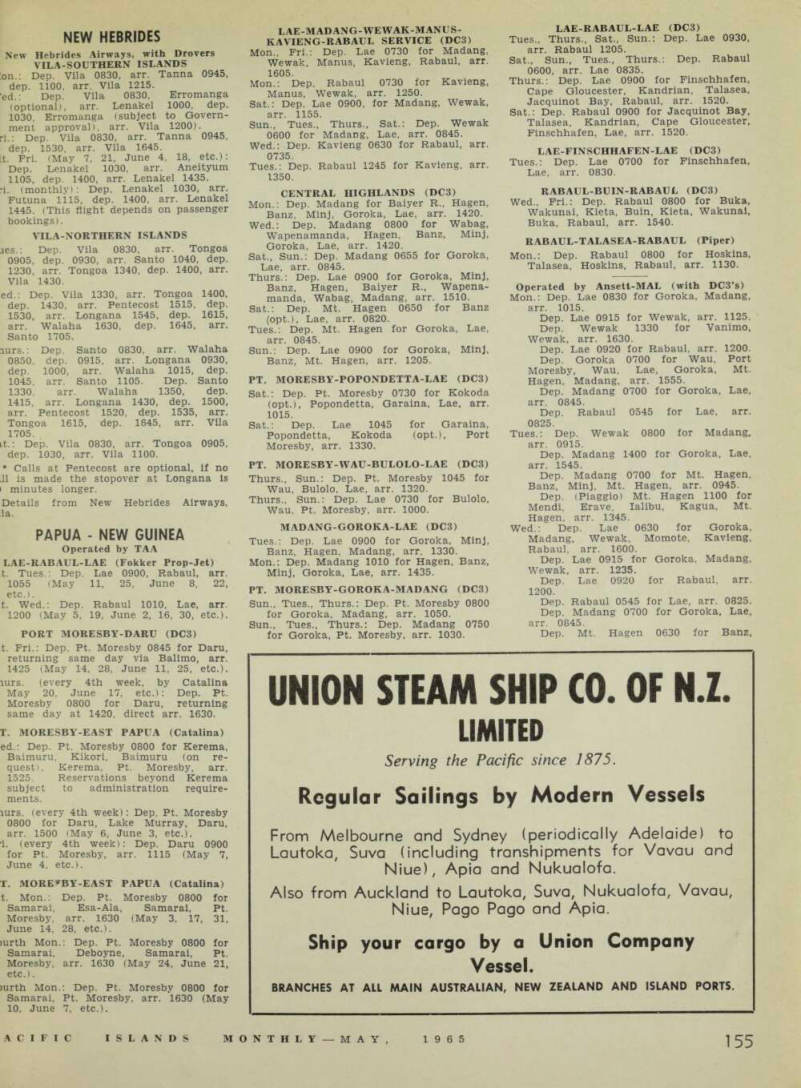 157
157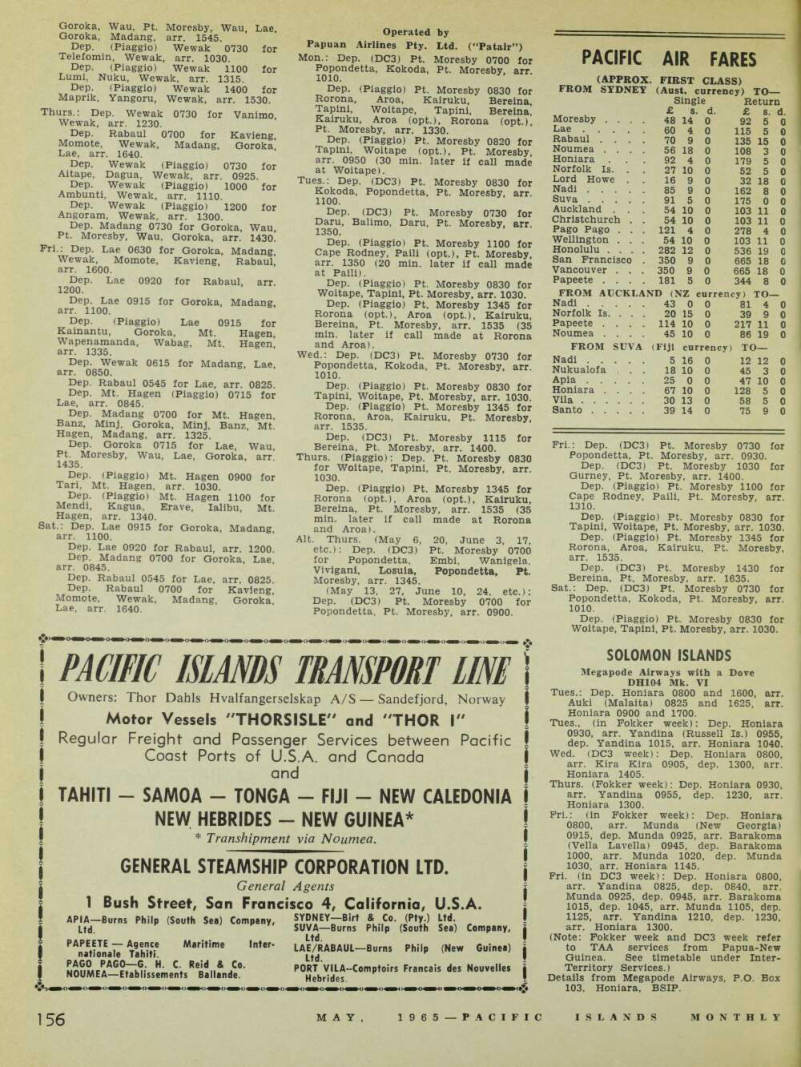 158
158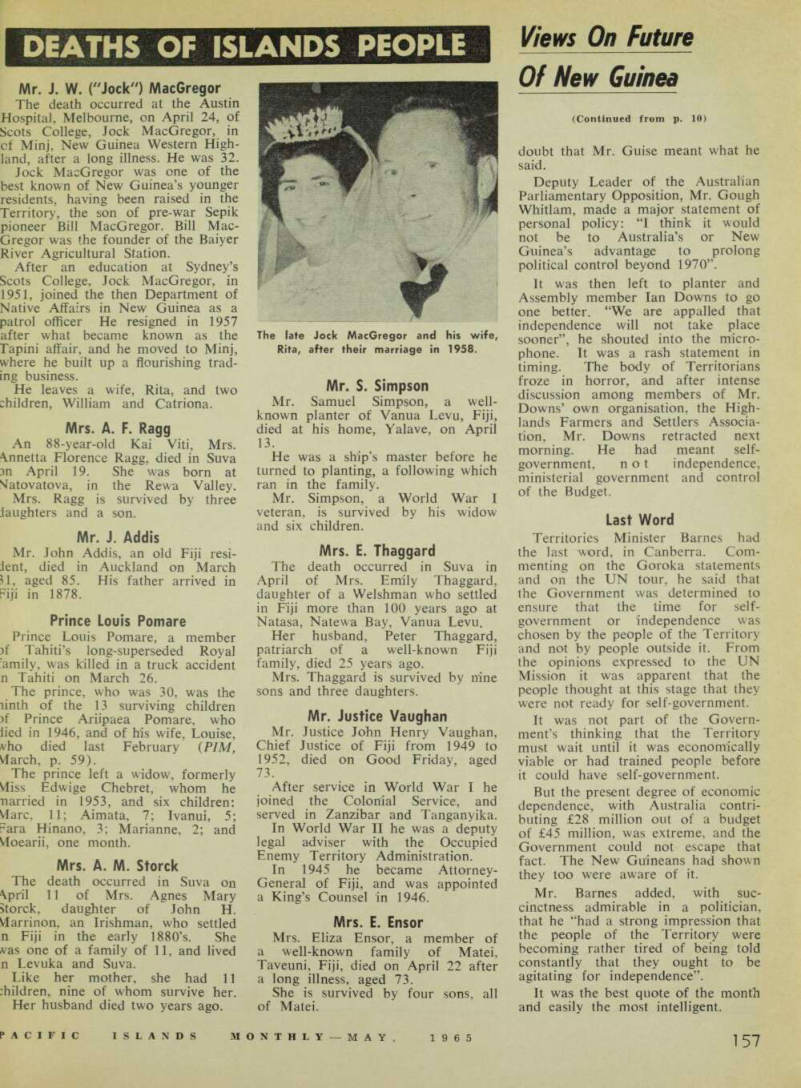 159
159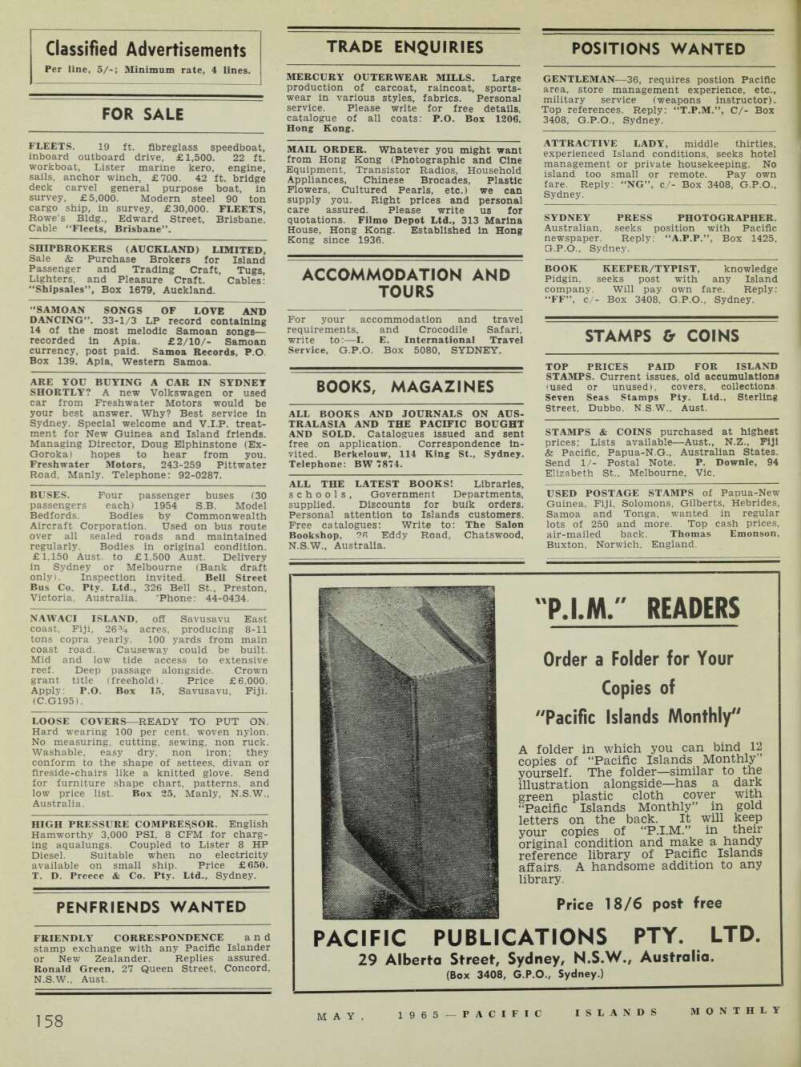 160
160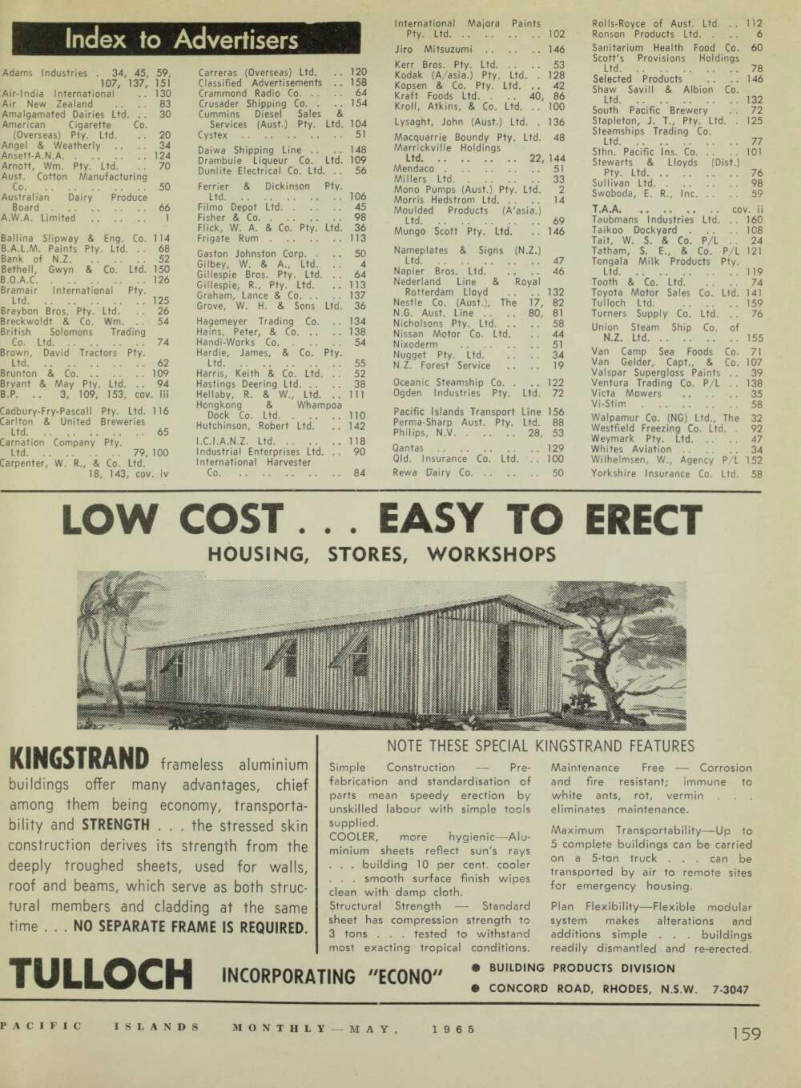 161
161 162
162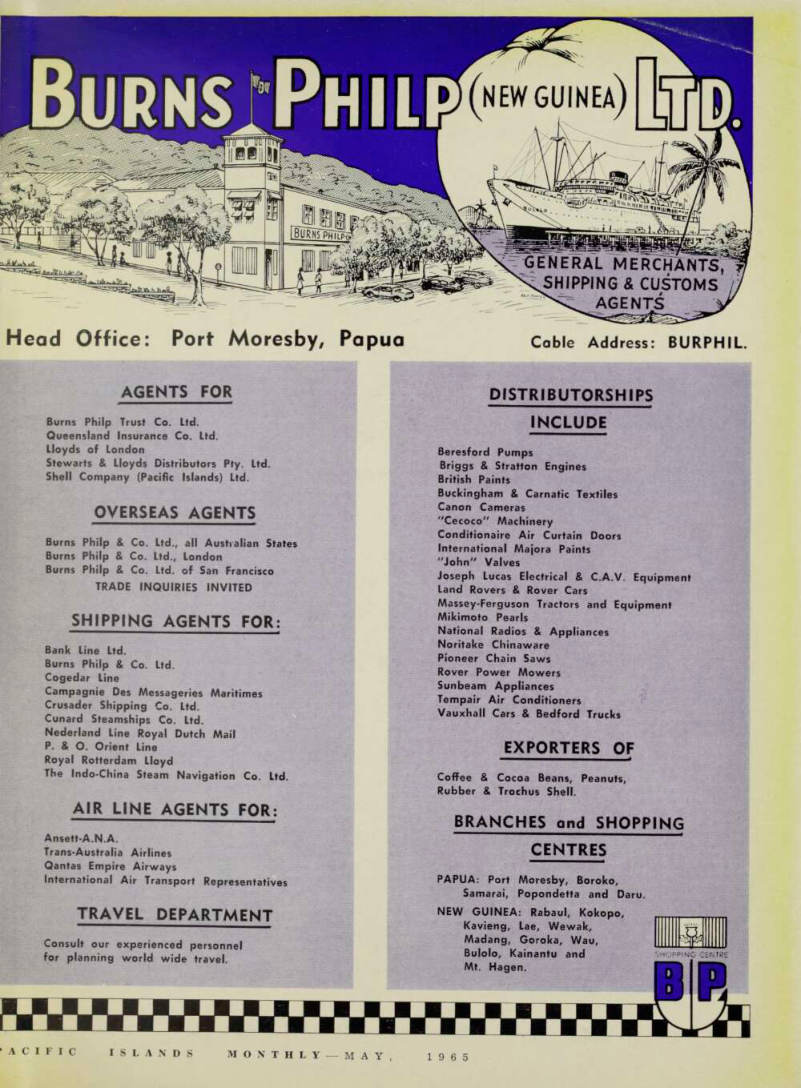 163
163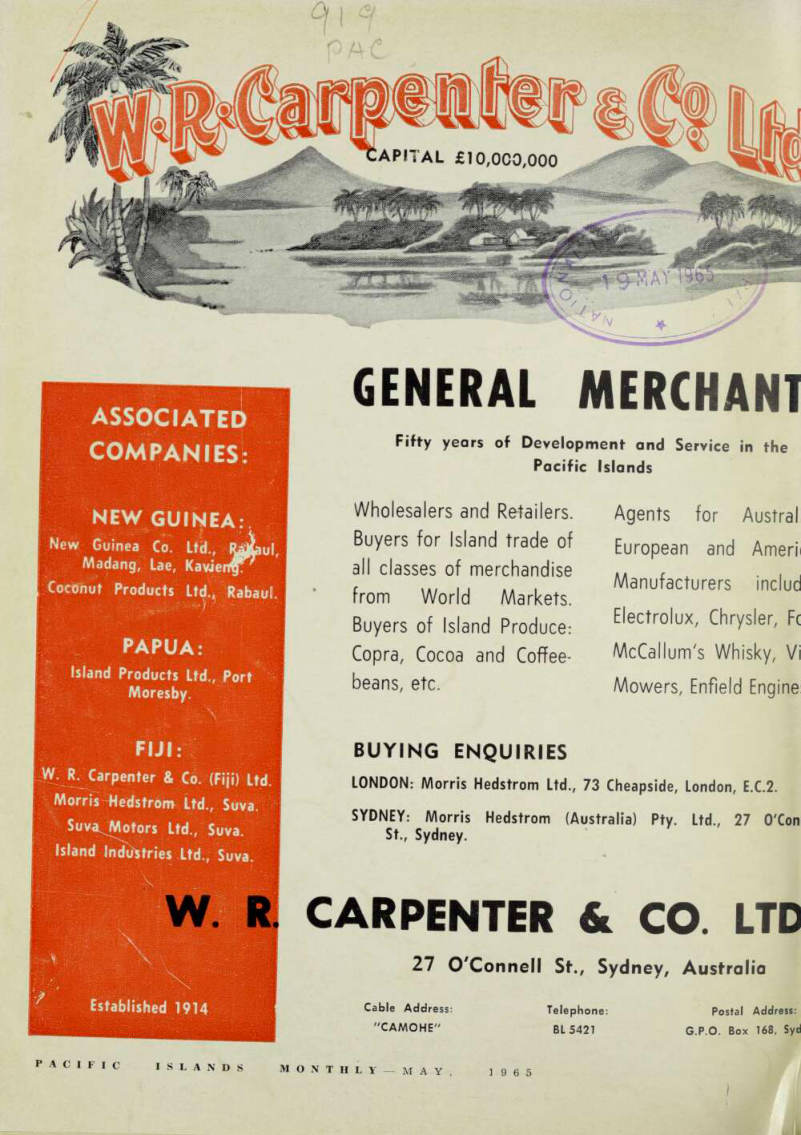 164
164