Of Public Controversy
pp. 51-55 · Read in the full issue

Western Samoa In The Thick Of Public Controversy
From R. F. Rankin, in Apia If public controversy is evidence of democracy’s good health then rarely has Western Samoa been in such fine fettle as in recent weeks.
AMONG the matters that have come up for public discussion are: • Negotiations between the Gov ernment and Fruit Distributors for a better banana price on the New Zea land market. These negotiations have not been going very well from Samoa’s point of view and have led to some hard words. • The royal Tupua title, which, after two years of fruitless discussion between rival family factions, has finally been awarded to Samoan medical practitioner, Dr. Lealofi Tamesese, by the Lands and Titles Court under Chief Judge P. L.
Molineaux. • A decision by Cabinet and the Public Service Commissioner, Tufuga S. Atoa, to follow' a recommendation by a commission of inquiry to dis miss Apia harbour master, Captain Harry Moors, Jr. This decision has incensed a large section of the public. • A fight by Cabinet, supported by a number of MP’s, for greater political control over the public ser vice. • A public altercation between a Cabinet Minister and his own depart ment. • The censure of the Chief Auditor by the Public Accounts Committee of the Legislative Assembly for the “unlawful removal of confidential papers” and the calling of a vote of no confidence against him from Par liament.
Banana Negotiations
With banana growers in Samoa netting less than 2d a lb for bananas sold in New Zealand at a maximum of 1/3 a lb, there is inevitable suspicion among Samoans that they are not getting a fair deal, and that Samoan growers are being exploited to supply the New Zealand housewife with a cheap but useful food.
Such suspicions have been openly voiced by the Minister of Finance, Mr. G. F. D. Betham, and Prime Minister Mataafa.
It is common knowledge around
Apia that during discussions with Fruit Distributors’ representative in Apia early March, Mataafa was angered at the uncompromising at titude displayed by the New Zealand businessmen towards Samoan de mands for a better deal.
Background data for the Samoan case filled 17 pages. It was prepared by a committee, including A.
Gerakas, UN development economist; a NZ Volunteer for Service Abroad, David Ashby, who is an agricultural marketing officer; and P. Heller, the Financial Secretary. It asked for; • A penny a lb increase in the net FOB price of all cases exported to be met by a similar rise in the NZ retail selling price. • A further 3/- a case FOB in crease for bananas produced from district packing stations, contract plantations, and rehabilitation (from disease) schemes. • A four-year minimum supply contract. • A 1/- per case subsidy on shook costs or, alternatively, accept ance of containers made from local timber or cardboard. • The right to experiment with the supply of wrapped, cartoned, specially-selected, premium-p ric e d, hand bananas to one of the large chains of supermarkets in New Zea land.
Fruit Distributors gave no answer while in Apia, stating that in view of the comprehensive demands, a full meeting of the board of directors would have to be called in Welling ton.
Three weeks later their answer was made known in Apia. They offered an increase from January to July of 1/- a case (about 72 lb) to 25/- a case; a grant of £lO,OOO towards the eradication of banana diseases; and an extra 2/- a case from district pack ing stations.
Not good enough, said Mataafa, who deferred making any decisions until another round table discussion could be arranged.
The Tupua Case When the joint Head of State, Tupua Tamasese Mea’ole, died from lung cancer in 1962 a few months after the achievement of independence (for which many give him main credit), his place in the four-man Council of Deputies made up of the four heads of Samoa became vacant.
There were two claimants for the vacant title and there was dispute as to whether the Tupua title, the Tamasese title, or the joint Tupua Tamasese title was the royal one.
The first public announcement on the title came from the Minister of Justice, Tuatagaloa Leutele Te’o, chief spokesman of the Safenuinuivao family of Falefa and Salani, who claimed the hereditary right to bestow the Tupua title. He announced that the family’s choice was Dr. Lealofi Tamasese, son of the Tupua Tamasese Lealofi, who was shot and killed by New Zealand constabulary during the Mau in 1929, and nephew of the late Mea’ole.
Hard on the heels of this an nouncement came a counter-claim from the Sa Tuala and other con nected families supporting Tufuga
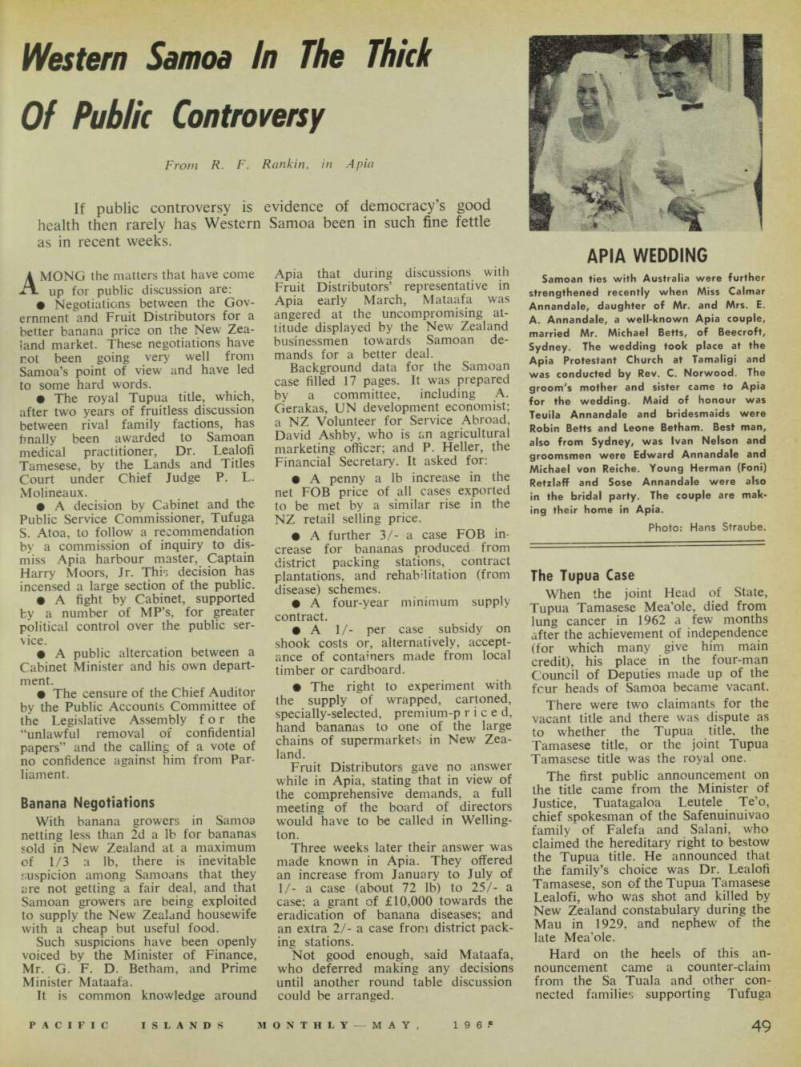
Apia Wedding
Samoan ties with Australia were further strengthened recently when Miss Calmar Annandale, daughter of Mr. and Mrs. E.
A. Annandale, a well-known Apia couple, married Mr. Michael Betts, of Beecroft, Sydney. The wedding took place at the Apia Protestant Church at Tamaligi and was conducted by Rev. C. Norwood. The groom's mother and sister came to Apia for the wedding. Maid of honour was Teuila Annandale and bridesmaids were Robin Betts and Leone Betham. Best man, also from Sydney, was Ivan Nelson and groomsmen were Edward Annandale and Michael von Reiche. Young Herman (Foni) Retzlaff and Sose Annandale were also in the bridal party. The couple are mak ing their home in Apia.
Photo: Hans Straube.
Efi Tamasese, son of Mea’ole, for the royal title.
To the man in the street with no family connections with either claim ant, both Efi and Lealofi seemed to have the qualifications to become a member of the Council of Deputies and thus become eligible for selection as Head of State on the death of the present holder of that position, Malietoa Tanumafili 11.
Both Efi and Lealofi are personable, well-educated, and cultured. Efi is a good speaker and debater but appears more volatile than the calmer and perhaps more stable Lealofi.
Lealofi, for his part, has impressed WHO officials and has been picked out for special training in psychiatric medicine overseas to deal with Samoa’s growing number of mental patients.
Before the case finally came before the Lands and Titles Court, there appeared to be more active political support for Efi, with a number of prominent MP’s working on his be half.
In a reserved decision after four days of hearings, the court stated in a brief finding that the title Tupua, formerly held by late Head of State, Tupua Tamasese Mea’ole, is a royal title of the Tama-a-aiga; that the right to confer this title lay with the Sa Fenuinuivao family; and that Lealofi Tupua Tamasese was there fore the rightful holder of the title.
Two results of the court’s decision are that Efi is now expected to make a bid for a seat in the Legislative Assembly, and the Tamasese title is now in dispute. However the new dispute will not affect the royalty of the Tupua title.
S Captain Moors' Dismissal At the end of March the saga of Cabinet versus Captain Moors reached a finale when three months’ notice of dismissal was served on him by the Public Service Commissioner, Tufuga S. Atoa.
“I am bound to follow Govern ment policy,” said the PSC.
Cabinet suggested to the PSC that Captain Moors should be dismissed following a commission of inquiry into certain aspects of the admini stration of the Marine Department by retired NZ magistrate Felix Reid.
As a tail end to his findings, Com missioner Reid, while agreeing that Captain Moors was a competent master mariner and harbour master, stated that he lacked the integrity and administrative ability necessary for a departmental head and recom-
mended that he be dismissed from the Public Service.
Prime Minister Mataafa said later in Parliament that Cabinet had made its decision for dismissal in line with this recommendation.
The decision was not popular with many people. They felt there was not enough proof of misdeeds by the harbour master to warrant dismissal; that Captain Moors had already been persecuted enough; that the com mission of inquiry was far too re stricted in scope for the Commis sioner to have made such sweeping allegations against Captain Moors; and that in making the recommenda tions the Commissioner was going beyond his terms of reference, which sought no recommendations.
No one has ever questioned the competence of Captain Moors as a harbour master. To replace him with an expatriate will cost the Govern ment an extra £5OO or more a year plus housing, travel expenses and furlough.
A lot of people think that if politics had not played such a major part throughout this case a different solution would have been found.
Public Service Control “We had to set up a commission of inquiry to get rid of Captain Moors and even then the Public Service Commissioner could have refused to obey our instructions in this matter,”
Prime Minister Mataafa said in an appeal to Parliament to amend the Constitution to give more power to Cabinet over the Public Service Com missioner.
In similar vein, the Minister of Health, Talamaivao Ulualofaiga, told the Assembly that he lacked the ne cessary authority to run the Health
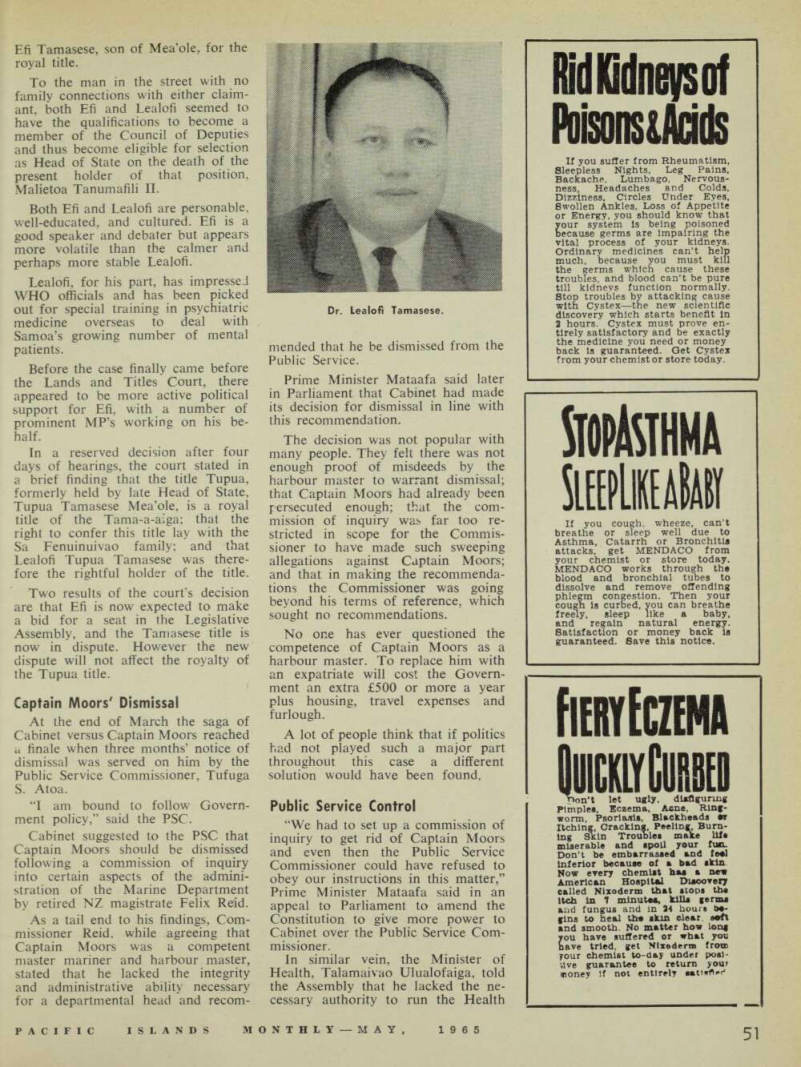
Dr. Lealofi Tamasese.
Department in accordance with Samoan custom and tradition.
His remarks caused an uproar in the Health Department.
The Minister said he had received many complaints about patients not being able to find a doctor at the outpatients department at night and that if he had had the power to sack doctors who did not properly attend the public he would have done so.
“I don’t know what is going on in my department and am not con sulted—all on instructions from the Public Service Commissioner,” he said.
To top it all, Talamaivao claimed that the Director of Health might tell him lies regarding certain matters.
He said the Samoan Government was founded on custom and tradition, but as a Minister he was powerless to implement things he thought fit within the department.
“If a matai can control his family, a Minister can also control his de partment,” he said.
The doctors did not take the Min ister’s words lying down. Medical Superintendent Dr. J. B. Shiels wrote a scathing letter to Talamaivao claiming that the Minister’s remarks were “unethical, unfounded and for the most part, untrue.”
Relations between the Minister and his department were not improved when, without the approval of Dr.
Shiels, a copy of his letter appeared in Samoana.
“Talk about sparks flying. There was smoke coming out of every window,” surgeon specialist Mr. L.
Goodman said afterwards.
Chief Auditor Censured Early in April a special report from the Public Accounts Committee was tabled in Parliament. It recom mended that a vote of censure and no confidence be passed against Chief Auditor R. J. Campagnolo.
It was alleged that Mr. Campag nolo had unlawfully removed con fidential papers belonging to the Public Accounts Committee, and had possibly leaked information concern ing committee deliberations to a local newspaper. [ln its issue of April 9 the Samoa Bulletin said the “leakage” referred to was in the Bulletin of November 13, 1964. It added: “This newspaper denies that any confidential informa tion was either sought or obtained, and invites the Public Accounts Com mittee to prove otherwise.”] • A new Protestant Church of grand proportions is reported to be almost completed at Bikenibeu, Tarawa, GEIC.