British Solomons Get Their
pp. 47-49 · Read in the full issue
First Elected Legislature
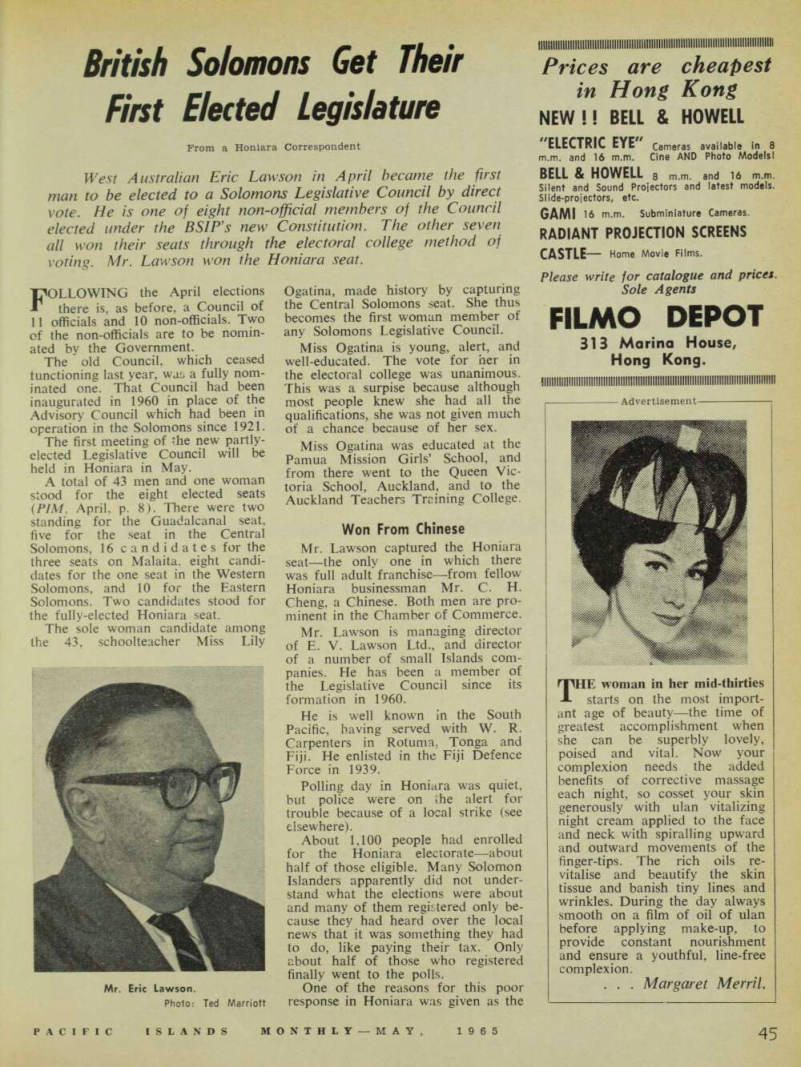
From a Honiara Correspondent West Australian Eric Lawson in April became the first man to be elected to a Solomons Legislative Council by direct vote. He is one of eight non-official members of the Council elected under the BSIP’s new Constitution. The other seven all won their seats through the electoral college method of voting. Mr. Lawson won the Honiara seat.
r FLOWING the April elections there is, as before, a Council of 11 officials and 10 non-officials. Two of the non-officials are to be nomin ated by the Government.
The old Council, which ceased functioning last year, was a fully nom inated one. That Council had been inaugurated in 1960 in place of the Advisory Council which had been in operation in the Solomons since 1921.
The first meeting of the new partly elected Legislative Council will be held in Honiara in May.
A total of 43 men and one woman stood for the eight elected seats ( PIM , April, p. 8). There were two standing for the Guadalcanal seat, five for the seat in the Central Solomons, 16 candidates for the three seats on Malaita. eight candi dates for the one seat in the Western Solomons, and 10 for the Eastern Solomons. Two candidates stood for the fully-elected Honiara seat.
The sole woman candidate among the 43, schoolteacher Miss Lily
Ogatina, made history by capturing the Central Solomons seat. She thus becomes the first woman member of any Solomons Legislative Council.
Miss Ogatina is young, alert, and well-educated. The vote for her in the electoral college was unanimous.
This was a surpise because although most people knew she had all the qualifications, she was not given much of a chance because of her sex.
Miss Ogatina was educated at the Pamua Mission Girls’ School, and from there went to the Queen Vic toria School, Auckland, and to the Auckland Teachers Training College.
Won From Chinese Mr. Lawson captured the Honiara seat—the only one in which there was full adult franchise—from fellow Honiara businessman Mr. C. H.
Cheng, a Chinese. Both men are pro minent in the Chamber of Commerce.
Mr. Lawson is managing director of E. V. Lawson Ltd., and director of a number of small Islands com panies. He has been a member of the Legislative Council since its formation in 1960.
He is well known in the South Pacific, having served with W. R.
Carpenters in Rotuma, Tonga and Fiji. He enlisted in the Fiji Defence Force in 1939.
Polling day in Honiara was quiet, but police were on the alert for trouble because of a local strike (see elsewhere).
About 1,100 people had enrolled for the Honiara eleciorate —about half of those eligible. Many Solomon Islanders apparently did not under stand what the elections were about and many of them registered only be cause they had heard over the local news that it was something they had to do, like paying their tax. Only about half of those who registered finally went to the polls.
One of the reasons for this poor response in Honiara was given as the
Mr. Eric Lawson.
Photo: Ted Marriott
short time between the final date of registration—March 9 —and polling day on April 7. Many potential voters apparently did not realise until it was too late that they could not vote in April if they had not registered by March 9.
There also seemed to be need for provision for absentee votes, and for people who returned to the Solomons from leave after registration had closed.
Undoubtedly there will be requests made to the new Council to have procedure changed.
In Honiara there was also con fusion over voting for the three separate wards. Voters were obliged to cast their votes in their own ward, and some who turned up at the wrong booths gave up the idea of voting when told they would have to go to another part of town to do it.
The number of Chinese registered was small, but this wa. perhaps be cause the Chinese community had not previously been represented in the Council and Mr. Cheng’s nomination came in at the last moment.
Both Mr. Lawson and Mr. Cheng conducted many election meetings and it was obvious that election would depend on the Melanesian vote. Both candidates coupled their names with a symbol for easier identification. Mr. Lawson used a palm tree and Mr, Cheng an Islands cutter.
Outside of Honiara probably the most interesting result was in the Western Solomons, where eight candidates stood for the single seat available. Two of these, W. G. Paia and Roy Kimisi, are former members of the Council. Paia was in London
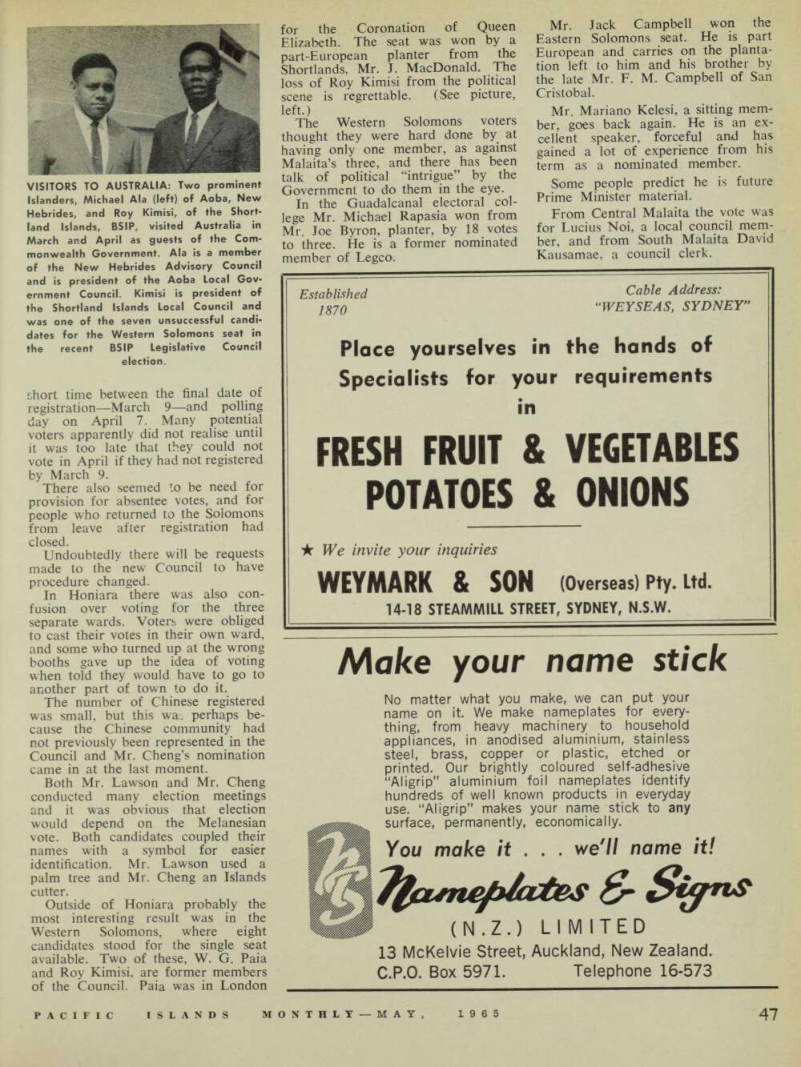
for the Coronation of Queen Elizabeth. The seat was won by a part-European planter from the Shortlands, Mr. J. MacDonald. The loss of Roy Kimisi from the political scene is regrettable. (See picture, left.) The Western Solomons voters thought they were hard done by at having only one member, as against Malaita’s three, and there has been SLSJ'Sl'.'S'Sfcy 1 ”
In the Guadalcanal electoral college Mr. Michael Rapasia won from Mr. Joe Byron, planter, by 18 votes to three. He is a former nominated member of Legco.
Mr. Jack Campbell won the Eastern Solomons seat. He is part European and carries on the planta tion left to him and his brother by the late Mr. F. M. Campbell of San Cristobal.
Mr, Mariano Kelesi, a sitting mem goes b ac k again. He is an ex cellent speaker, forceful and has gained a lot of experience from his term as a nominated member.
'• • p ™”e Minister material, From Central Malaita the vote was for Lucius Noi, a local council mem ber, and from South Malaita David Kausamae, a council clerk.
VISITORS TO AUSTRALIA: Two prominent Islanders, Michael Ala (left) of Aoba, New Hebrides, and Roy Kimisi, of the Short land Islands, BSIP, visited Australia in March and April as guests of the Com monwealth Government. Ala is a member of the New Hebrides Advisory Council and is president of the Aoba Local Gov ernment Council. Kimisi is president of the Shortland Islands Local Council and was one of the seven unsuccessful candi dates for the Western Solomons seat in the recent BSIP Legislative Council election.