Polynesia Next?
pp. 23-27 · Read in the full issue

What Can We Offer Polynesia Next?
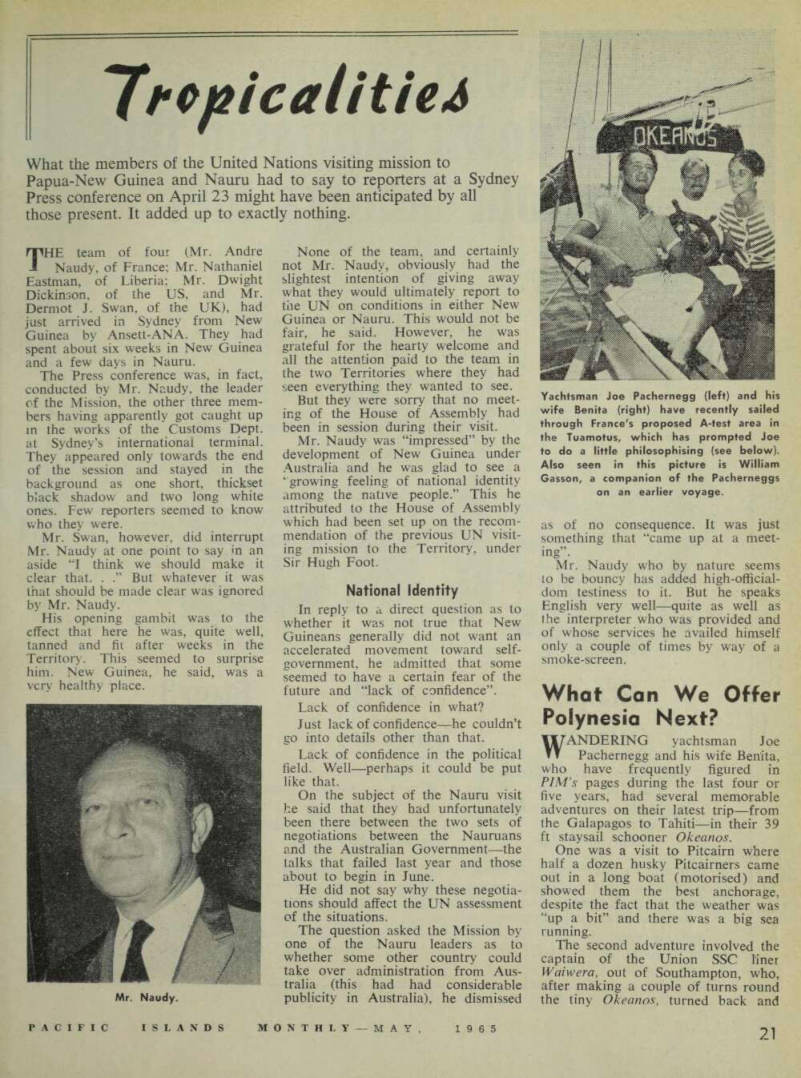
WANDERING yachtsman Joe Pachernegg and his wife Benita, who have frequently figured in PlM’s pages during the last four or five years, had several memorable adventures on their latest trip—from the Galapagos to Tahiti—in their 39 ft staysail schooner Okeanos.
One was a visit to Pitcairn where half a dozen husky Pitcairners came out in a long boat (motorised) and showed them the best anchorage, despite the fact that the weather was “up a bit” and there was a big sea running.
The second adventure involved the captain of the Union SSC liner Waiwera, out of Southampton, who, after making a couple of turns round the tiny Okeanos, turned back and
asked the Pacherneggs if they wanted anything.
When the Pacherneggs said, “No”, one of the mates dropped a crated bottle of Scotch over the side for them, anyway.
“That evening,” Joe tells us in a note from Papeete, “we had a ‘stiff’ one to the health of the captain of the good ship Waiwera —a gentleman of the old sort, and a breed that seems to be disappearing in this hurrying world.”
Joe adds: “Over these last years, after having put several 10,000 miles behind us, this was the first time a ship’s captain went out of his way to inquire about the state of things. . . .”
The Pacherneggs’ third adventure took place as they were passing be tween Tematangi Atoll and Mururoa Atoll, which is the place where the French are to let off their A-bombs next year.
“Joe, quick, put on your clothes and come up—there’s a helicopter coming at us!” Benita called down the hatch to Joe one afternoon.
Joe came up, and beheld first one helicopter and then another. They circled the Okeanos for a while, then headed off towards Mururoa just beyond the horizon.
“Next day,” Joe says, “we passed within a few miles of Mururoa.
Beyond the reef, inside the lagoon, a fair-sized passenger ship was glid ing slowly towards the west.
“Where on several of the larger rnotus there was considerable evidence of large-scale construction work and several housing projects, a collection of Navy ships lay also.
“ ‘There we go,’ I said to Benita. ‘First our religion, then our diseases, and now the atomic bomb. I sure wonder what we’ve got to offer the Polynesians next.’ ”
"Radesthesia" To
The Rescue
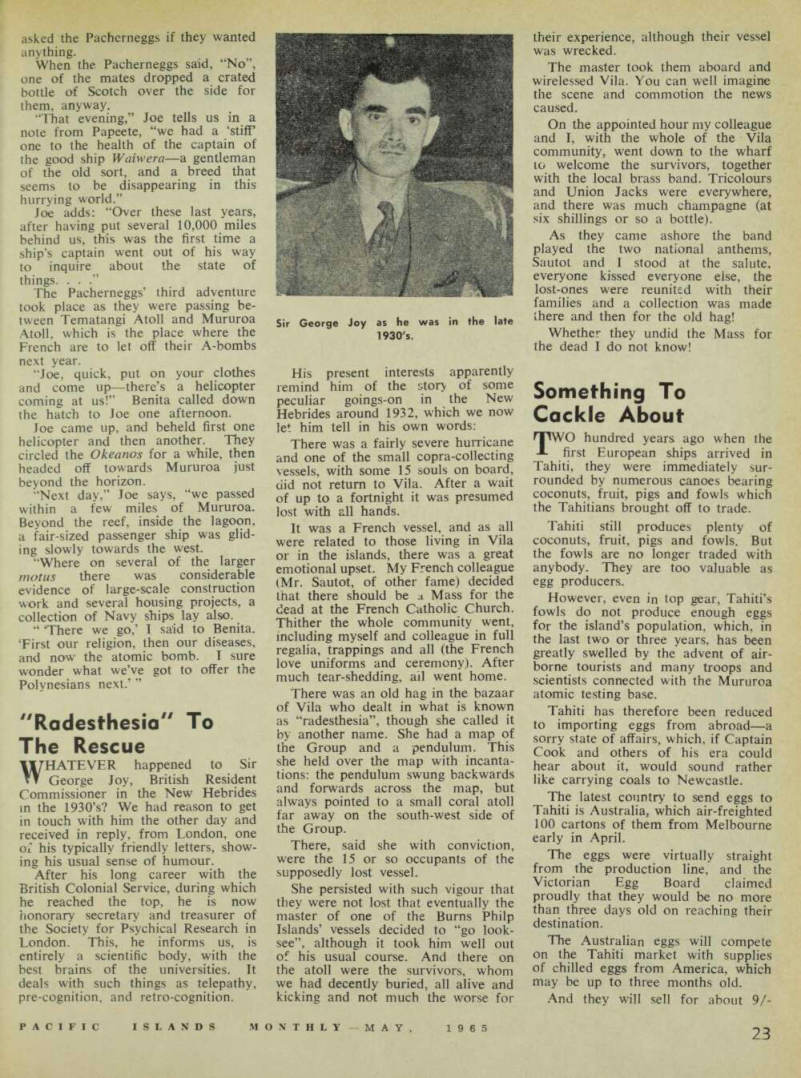
WHATEVER happened to Sir George Joy, British Resident Commissioner in the New Hebrides m the 1930’5? We had reason to get in touch with him the other day and received in reply, from London, one of his typically friendly letters, show ing his usual sense of humour.
After his long career with the British Colonial Service, during which he reached the top, he is now honorary secretary and treasurer of the Society for Psychical Research in London. This, he informs us, is entirely a scientific body, with the best brains of the universities. It deals with such things as telepathy, pre-cognition, and retro-cognition.
His present interests apparently remind him of the story of some peculiar goings-on in the New Hebrides around 1932, which we now let him tell in his own words: There was a fairly severe hurricane and one of the small copra-collecting vessels, with some 15 souls on board, did not return to Vila. After a wait of up to a fortnight it was presumed lost with all hands.
It was a French vessel, and as all were related to those living in Vila or in the islands, there was a great emotional upset. My French colleague (Mr. Sautot, of other fame) decided that there should be * Mass for the dead at the French Catholic Church.
Thither the whole community went, including myself and colleague in full regalia, trappings and all (the French love uniforms and ceremony). After much tear-shedding, ail went home.
There was an old hag in the bazaar of Vila who dealt in what is known as “radesthesia”, though she called it by another name. She had a map of the Group and a pendulum. This she held over the map with incanta tions: the pendulum swung backwards and forwards across the map, but always pointed to a small coral atoll far away on the south-west side of the Group.
There, said she with conviction, were the 15 or so occupants of the supposedly lost vessel.
She persisted with such vigour that they were not lost that eventually the master of one of the Burns Philp Islands’ vessels decided to “go look see”, although it took him well out of his usual course. And there on the atoll were the survivors, whom we had decently buried, all alive and kicking and not much the worse for
their experience, although their vessel was wrecked.
The master look them aboard and wirelessed Vila. You can well imagine the scene and commotion the news caused.
On the appointed hour my colleague and I, with the whole of the Vila community, went down to the wharf to welcome the survivors, together with the local brass band. Tricolours and Union Jacks were everywhere, and there was much champagne (at six shillings or so a bottle).
As they came ashore the band played the two national anthems, Sautot and I stood at the salute, everyone kissed everyone else, the lost-ones were reunited with their families and a collection was made there and then for the old hag!
Whether they undid the Mass for the dead I do not know!
Something To
Cackle About
r O hundred years ago when the first European ships arrived in Tahiti, they were immediately sur rounded by numerous canoes bearing coconuts, fruit, pigs and fowls which the Tahitians brought off to trade.
Tahiti still produces plenty of coconuts, fruit, pigs and fowls. But the fowls are no longer traded with anybody. They are too valuable as egg producers.
However, even in top gear, Tahiti’s fowls do not produce enough eggs for the island’s population, which, in the last two or three years, has been greatly swelled by the advent of air borne tourists and many troops and scientists connected with the Mururoa atomic testing base.
Tahiti has therefore been reduced to importing eggs from abroad—a sorry state of affairs, which, if Captain Cook and others of his era could hear about it, would sound rather like carrying coals to Newcastle.
The latest country to send eggs to Tahiti is Australia, which air-freighted 100 cartons of them from Melbourne early in April.
The eggs were virtually straight from the production line, and the Victorian Egg Board claimed proudly that they would be no more than three days old on reaching their destination.
The Australian eggs will compete on the Tahiti market with supplies of chilled eggs from America, which may be up to three months old.
And they will sell for about 9/-
Sir George Joy as he was in the late 1930's.
a dozen compared with 12/- a dozen for local eggs.
At this price, one would think, Tahiti’s fowls should either be shamed into improving their produc tion, or they will become so down hearted that they will give up laying altogether.
Norfolk Island Link
With Eskimo Land
WHEN Mr. Fred Garner, of Nor folk Island, left Norfolk on March 31 to go to Point Barrow, Alaska, to take charge of the electrical installation of a hospital for Eskimos, he probably had little idea that there was any sort of con nection between the two places.
And not surprisingly! Point Bar row, the northernmost point of the American continent, is within the Arctic Circle and some 10,000 miles from Norfolk, which is just about as far away as you can get.
The connection between the two places—admittedly a somewhat tenuous one—is that Point Barrow was named after Sir John Barrow, Secretary of the British Admiralty in the early part of the 19th century, who was largely responsible for Nor folk Island being settled by the descendants of the Bounty mutineers.
Barrow was Admiralty Secretary when the Bounty mutineers’ hideout on Pitcairn was discovered. He wrote one of the first books on the Bounty- Pitcairn affair, and he took a close interest in the welfare of the Pit cairners.
When, in the mid-1820’s, it was reported that the Pitcairners were increasing so fast that they were likely to outstrip their island’s re sources, he began using his influence to have them moved elsewhere. In a letter to the Colonial Office in 1826, he suggested that a suitable place for them would be “some Settlement on the eastern coast of New South Wales ... or on Bathurst’s Island opposite to our Establishment on Melville Island” (i.e., near the pre sent Australian town of Darwin), Although Barrow later grew cold on the idea of shifting the Pitcairners, the notion that they should be trans ferred elsewhere persisted. In 1831, they were shifted holus bolus to Tahiti, but the move was not a success, and within 12 months, they were returned to their home island.
Twenty-five years later, a second attempt was made to resettle them, when the entire population was trans ferred to Norfolk Island, where many of their descendants still live today.