Topicalities
p. 23 · Read in the full issue
What the members of the United Nations visiting mission to Papua-New Guinea and Nauru had to say to reporters at a Sydney Press conference on April 23 might have been anticipated by all those present. It added up to exactly nothing.
THE team of four (Mr. Andre Naudy, of France; Mr. Nathaniel Eastman, of Liberia: Mr. Dwight Dickinson, of the US, and Mr.
Dermot J. Swan, of the UK), had just arrived in Sydney from New Guinea by Ansett-ANA. They had spent about six weeks in New Guinea and a few days in Nauru.
The Press conference was, in fact, conducted by Mr. Naudy, the leader of the Mission, the other three mem bers having apparently got caught up m the works of the Customs Dept, at Sydney’s international terminal.
They appeared only towards the end of the session and stayed in the background as one short, thickset black shadow and two long white ones. Few reporters seemed to know who they were.
Mr. Swan, however, did interrupt Mr. Naudy at one point to say in an aside “I think we should make it clear that. . .” But whatever it was that should be made clear was ignored by Mr. Naudy.
His opening gambit was to the effect that here he was, quite well, tanned and fit after weeks in the Territory. This seemed to surprise him. New Guinea, he said, was a very healthy place.
None of the team, and certainly not Mr. Naudy, obviously had the slightest intention of giving away what they would ultimately report to the UN on conditions in either New Guinea or Nauru. This would not be fair, he said. However, he was grateful for the hearty welcome and all the attention paid to the team in the two Territories where they had seen everything they wanted to see.
But they were sorry that no meet ing of the House of Assembly had been in session during their visit.
Mr. Naudy was “impressed” by the development of New Guinea under Australia and he was glad to see a ‘ growing feeling of national identity among the native people.” This he attributed to the House of Assembly which had been set up on the recom mendation of the previous UN visit ing mission to the Territory, under Sir Hugh Foot.
National Identity
In reply to a direct question as to whether it was not true that New Guineans generally did not want an accelerated movement toward self government, he admitted that some seemed to have a certain fear of the future and “lack of confidence”.
Lack of confidence in what?
Just lack of confidence—he couldn’t go into details other than that.
Lack of confidence in the political field. Well—perhaps it could be put like that.
On the subject of the Nauru visit he said that they had unfortunately been there between the two sets of negotiations between the Nauruans and the Australian Government—the talks that failed last year and those about to begin in June.
He did not say why these negotia tions should affect the UN assessment of the situations.
The question asked the Mission by one of the Nauru leaders as to whether some other country could take over administration from Aus tralia (this had had considerable publicity in Australia), he dismissed
as of no consequence. It was just something that “came up at a meet ing”.
Mr. Naudy who by nature seems to be bouncy has added high-official dom testiness to it. But he speaks English very well—quite as well as the interpreter who was provided and of whose services he availed himself only a couple of times by way of a smoke-screen.
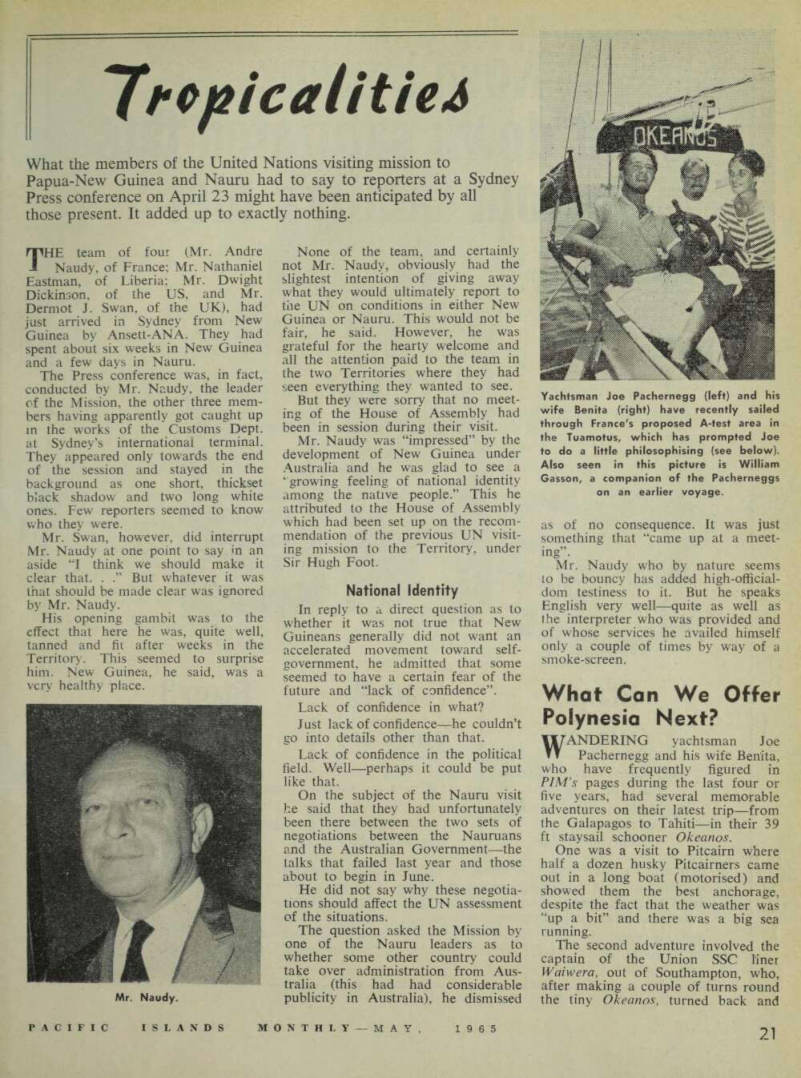
Mr. Naudy.
Yachtsman Joe Pachernegg (left) and his wife Benita (right) have recently sailed through France's proposed A-test area in the Tuamotus, which has prompted Joe to do a little philosophising (see below).
Also seen in this picture is William Gasson, a companion of the Pacherneggs on an earlier voyage.