Everybody, But Just
pp. 11-159 · Read in the full issue
Everybody, Knows What's Best For New Guinea
From Correspondents in New Guinea and Canberra April was a month of pressure on the big territory of Papua-New Guinea — three-pronged pressure from sabre-rattling Soekarno, from a visiting UN Mission and from within. When all the incidents were put together the indications were that the big squeeze had begun to get the territory to accept what other people thought was good for it.
PRESIDENT Soekarno’s views had the biggest impact on the New Guineans themselves. Speaking in Djakarta the president confirmed what had been said a week or two earlier by his Foreign Minister, Dr.
Subandrio—that there would be no plebiscite by 1969 for self determination in West New Guinea.
“Why should we have a plebiscite in West Irian?” President Soekarno asked. “The whole world recognises West Irian is Indonesian territory.
There is no need to hold a plebiscite because we are no longer members of UN.”
In the same speech Soekarno poked his nose into Pacific affairs (see panel, p. 10), and appeared to in dicate he thought he knew what was best for P-NG too.
Soekarno’s announcement brought no comment from Australia, but earlier the Australian Minister for External Affairs, Mr. Paul Hasluck, had replied to an announcement by Dr. Subandrio that “the plebiscite does not exist”. Dr. Subandrio said West New Guinea was the last Indo nesian territory to be liberated.
Mr. Hasluck said it was true that under Article 18 of the Indonesian- Dutch Agreement of August, 1962, there was no specific mention of a plebiscite but a reference to “the exercise of free choice”.
Mr. Hasluck said the document was “not as strong as we in Australia would like it”, but it was plain that Indonesia had an obligation, with the help of the UN, to give the people of West New Guinea the opportunity to exercise freedom of choice. Aus tralia would “use any and every opportunity that arises in association with other nations and in repre sentations to Indonesia to try to ensure that this obligation is honoured”.
Mr. Hasluck added that Australia’s view was that Indonesia’s recent with drawal from the UN did not alter Indonesia’s obligations.
Unfortunately, as other observers pointed out in April, Australia’s attitude is useless if it does not get support from the Netherlands, the US and the UN—and so far none of these has shown any alarm or any real interest in Indonesia’s bare faced dishonesty.
The attitude of the New Guineans in P-NG, who are extraordinarly sensitive about goings-on affecting their neighbours under Indonesian domination, was more blunt.
Leading Papuan Gala Gala Rarua told the UN Mission in Port Moresby that the UN had made a mistake in handing over West New Guinea to Indonesia. Territory people, he said, were very worried about whether the plebiscite was to be held there because it was impor tant to the future of the Territory to know what kind of neighbours P-NG would have—friendly or not.
S'imogun Pita, a Parliamentary
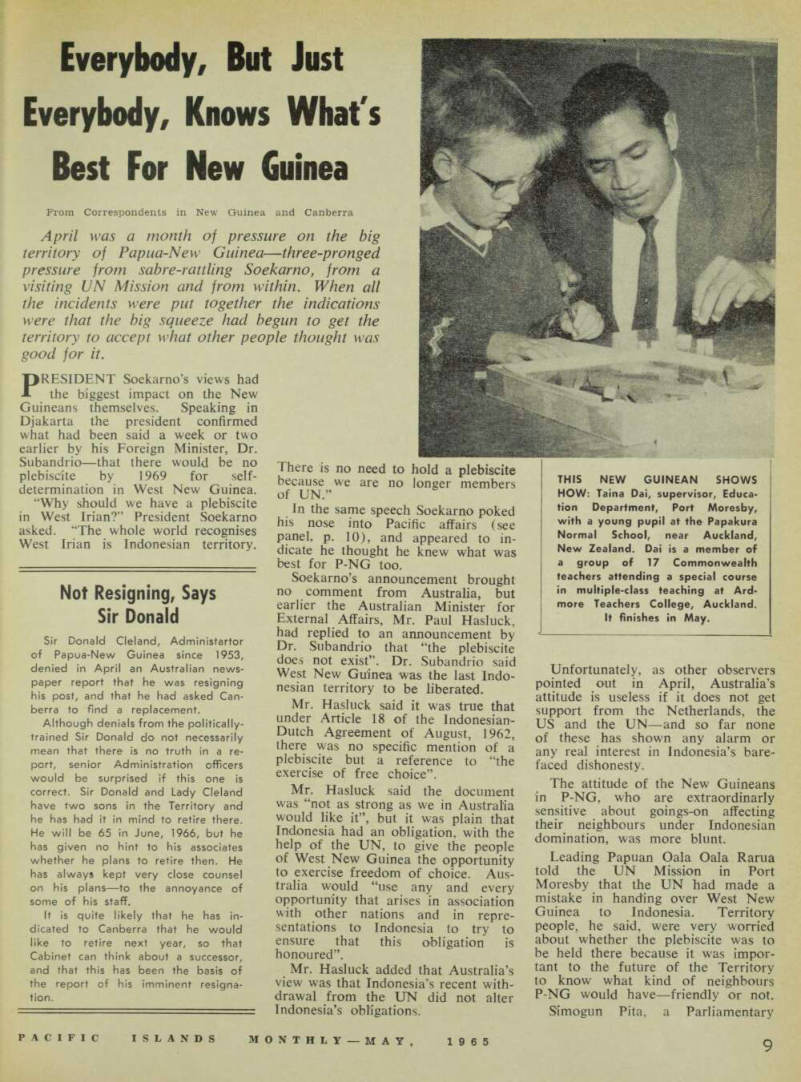
This New Guinean Shows
HOW: Taina Dai, supervisor. Educa tion Department, Port Moresby, with a young pupil at the Papakura Normal School, near Auckland, New Zealand. Dai is a member of a group of 17 Commonwealth teachers attending a special course in multiple-class teaching at Ard more Teachers College, Auckland.
It finishes in May.
Under-secretary, said the people were concerned about Indonesia’s inten tions and about the plebiscite. He said he would like to see Australia establish arms factories in the Territory.
In Rabaul a student said West New Guinea had been given to Indonesia because of appeasement and he asked the UN Mission whether the same thing would happen again if Indonesia wanted the rest of New Guinea.
Similar questions popped up all over New Guinea, but the best answer that any of the questioners could get was that West New Guinea was “outside the terms of reference”.
New Guinean fears about Indo nesia’s intentions were not improved during the month by news of a complaint by Garuda Indonesian Airways, Djakarta, claiming that Australian officials at Lae were “harassing” crews and passengers of the fortnightly Indonesian DC3 service between West New Guinea and P-NG.
The Garuda officials sa i d passengers had been kept waiting in the aircraft at Lae while it was sprayed with disinfectant and baggage examined. Officials treated them discourteously. Garuda threatened reprisals.
Few Passengers
In fact the Indonesian airline carries very few passengers to P-NG, and senior Administration in Port Moresby see the Indonesian action as a possible preliminary to withdrawal of the service. The withdrawal would be for economic reasons but the Indonesians would make political capital out of it.
“It could be the first shot in a war of nerves between the two countries over the fate of New Guinea as a whole,” said an official.
The tour of the UN Mission gave the New Guineans a chance to let off steam, but to the apparent surprise of the Mission members the cry was not “independence!’ but “prepare us properly for self-rule and don’t push too fast!” All over the Territory the Mission heard the same thing.
In Finschhafen towards the end of the tour, Mr, Nathanial Eastman (Liberia), apparently stung by all this togetherness, asked a New Guinean whether he was not aware of a UN resolution that lack of educational or social development should not be used by an administer ing power as a pretext to delay self government for a trust territory.
Trouble was that Mr. Eastman didn’t make it quite clear that the
full resolution has a limiting para graph which says that if the people want self-government then lack of educational, social and economic development shouldn’t be used as a delaying pretext. But colleague Mr.
D. J. Swan (UK) put the record straight immediately after Mr.
Eastman had spoken.
More than one New Guinean told the Mission he was worried about the number of Australian public servants who were resigning because of the uncertainty over their future.
Talk of premature independence was causing this.
But the Mission meanwhile did not let pass unnoticed the fact that New Guinean public servants, on salaries considerably lower than those paid Australians, were not happy at the rates. The difference between the two pay scales, some Mission members hinted, could be regarded
as a kind of discrimination ... a point many New Guineans agreed with.
On April 14 the Public Service Association sought to remedy the matter by filing a memorial with the Public Service Arbitrator requesting a complete review of all Local Officers’ salaries, claiming they were too low to meet living expenses.
The Visiting Mission members were not the only UN men in the Territory in April. Mr, G. K, J.
Amachree, UN Under-secretary for Trusteeship, and Mr. C. Coleridge- Taylor, UN representative of Sierra Leone, after a 10-day tour, said that if Australia wanted to approach the UN, aid could be given to P-NG.
At the same time, Dr. M. S.
Adiseshiah, Deputy Director-General of UNESCO, in Port Moresby to deliver the Camilla Wedgwood Memorial Lecture, said he would recommend that P-NG get £2 million in aid in the next five years to help her education.
In Canberra, the Territories Minister, Mr. Barnes, said the UN aid mentioned by Dr. Adiseshiah would be of great assistance provid ing it was carefully dovetailed into the Territory’s overall programme.
In Port Moresby, some visiting Australian MPs went on record as saying they wouldn’t like UN funds in the Territory, because they “had strings”.
In Goroka, at a seminar on the World Bank Report organised by the Council on New Guinea Affairs, Territorians and visitors got down to a widely publicised discussion lasting several days, which was one long political debate.
Papuan John Guise, leader of the Elected Members in the House of Assembly, told the seminar what he wanted, in a speech that was a basic political manifesto.
Disbelief He said European commercial and agricultural companies should not possess leases of property for a period longer than 20 years; all European companies must employ as many New Guinean workers as possible and train them; New Guinean workers should receive shares in the company they worked for; and at the end of 20 years the company would revert to the people of P-NG, “to be enjoyed by them all”.
You could almost hear the assembled Territorians draw in their breath in disbelief, but there was no
(Continued p. 157)
doubt that Mr. Guise meant what he said.
Deputy Leader of the Australian Parliamentary Opposition, Mr. Gough Whitlam, made a major statement of personal policy: “I think it would not be to Australia’s or New Guinea’s advantage to prolong political control beyond 1970”.
It was then left to planter and Assembly member lan Downs to go one better. “We are appalled that independence will not take place sooner”, he shouted into the micro phone. It was a rash statement in timing. The body of Territorians froze in horror, and after intense discussion among members of Mr.
Downs’ own organisation, the High lands Farmers and Settlers Associa tion, Mr. Downs retracted next morning. He had meant self government, not independence, ministerial government and control of the Budget.
Last Word Territories Minister Barnes had the last word, in Canberra. Com menting on the Goroka statements and on the UN tour, he said that the Government was determined to ensure that the time for self government or independence was chosen by the people of the Territory and not by people outside it. From the opinions expressed to the UN Mission it was apparent that the people thought at this stage that they were not ready for self-government.
It was not part of the Govern ment’s thinking that the Territory must wait until it was economically viable or had trained people before it could have self-government.
But the present degree of economic dependence, with Australia contri buting £2B million out of a budget of £45 million, was extreme, and the Government could not escape that fact. The New Guineans had shown they too were aware of it.
Mr. Barnes added, with suc cinctness admirable in a politician, that he “had a strong impression that the people of the Territory were becoming rather tired of being told constantly that they ought to be agitating for independence”.
It was the best quote of the month and easily the most intelligent.