Albert Henry Sweeps
pp. 9-10 · Read in the full issue
To Victory In
Cook Islands Poll
From W. H. Percival on Rarotonga and AAP Elections on April 20 for a new Cook Islands Legislative Assembly, heralding internal self-government for the 20,000 Cook Islanders, ended in a sweeping victory for the Cook Islands Party (CIP) founded last June by Mr. Albert Henry.
THE CIP won 14 of the 22 seats at stake. The others went to in-
dependent candidates. .
The Leader of Government Business in the old Legislative Assembly, Mr D. C. Brown, who had been tipped as Prime Minister material, * t Other members of the old Legislative Assembly who lost their seats were Napa T. Napa, a Minister; Teariki Tuavera, the Speaker; David Hosking, Areora Ira and Richard Rapley, of Rarotonga; Mataio Kea and Vaine Rere, of Atiu; and Tiki Tetava, of Mitiaro.
The CIP victory seems certain to result in an amendment to the pro- Posed 88-clause constitution for the Cook Islands which was drawn up by the New Zealand Government m con sultation with Cook Islands represen tatives and passed by the NZ House of Representatives last October. (PIM, Nov. 1964, p. 21.) The constitution, as it stands, con tains a clause stating that no Cook Islander may be nominated for elec tion to the Legislative Assembly until he has lived in the Group for three years.
The CIP president, Mr. Albert
Henry, is primarily affected by this clause, as he was permanently resi dent in New Zealand for many years until he returned to Rarotonga last year. A similar clause in the existing regulations debarred him from stand ing in the April 20 elections.
The CIP made it clear earlier this year that if it won the elections, it would not accept the proposed con stitution until the residence clause had been altered, allowing Mr. Henry to stand in a by-election.
A spokesman for the NZ Depart ment of Island Territories said after the elections: “The NZ Government gave an undertaking when it passed the legislation that the clause would be amended if necessary. We now ex pect the CIP to refuse to adopt the constitution until the clause has been amended.”
First Sitting
The new Assembly is scheduled to hold its first sitting on June 7 when a Leader of Government Business and an Executive Committee will be chosen, and when the first moves are expected to be made to enable Mr.
Henry to head the Government.
AAP reports that this is likely to be achieved in a by-election fol lowing the resignation of Mrs.
Marguerite Story, Mr. Henry’s sister, who was the only successful woman candidate.
On Rarotonga, the day of the poll was one of heavy rain, but voters made their way to the polling booths in a steady stream throughout the day.
The voting was carried out in a quiet, almost reverent manner. There were no fights, no abusive voices, no noise.
The previous evening, members of
Keen Interest
In Results
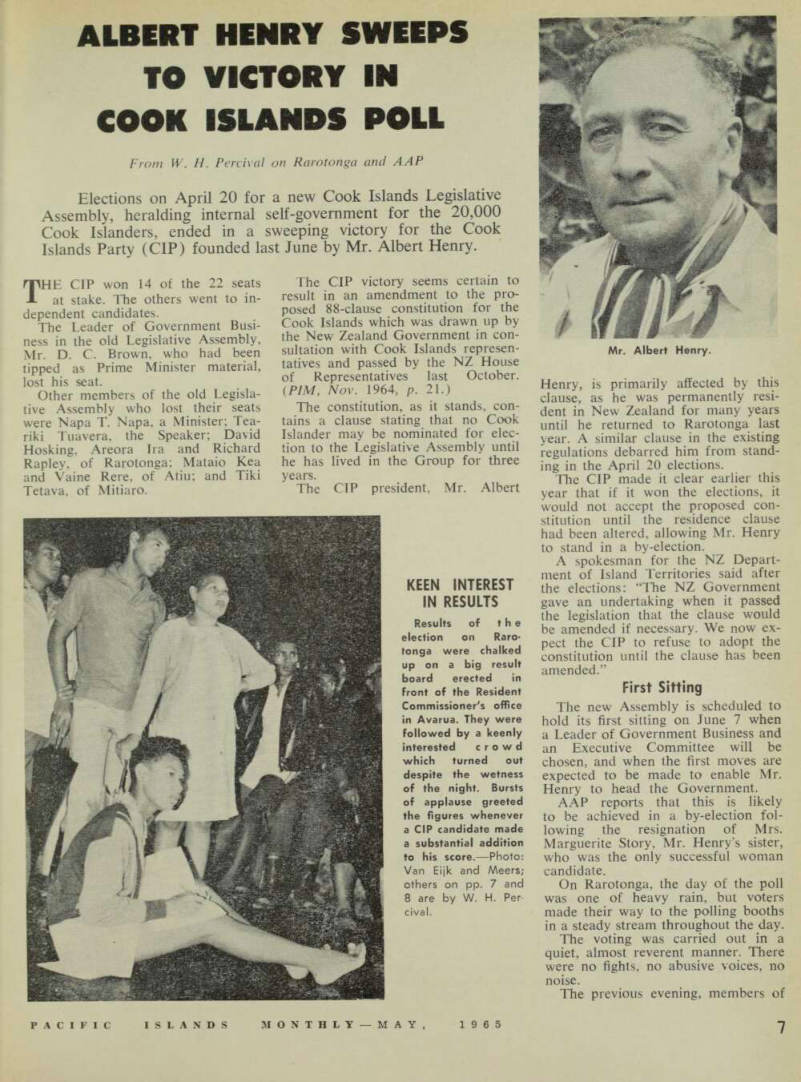
Results of the election on Raro tonga were chalked up on a big result board erected in front of the Resident Commissioner's office in Avarua. They were followed by a keenly interested crowd which turned out despite the wetness of the night. Bursts of applause greeted the figures whenever a CIP candidate made a substantial addition to his score. — Photo: Van Eijk and Meers; others on pp. 7 and 8 are by W. H. Per cival.
Mr. Albert Henry.
one of the island’s youth clubs prac tised a new drum dance to celebrate the expected victory of the Cook Islands Party.
Sixty-six candidates contested the 22 seats. Of these, 33 candidates con tested the nine seats (in three consti tuencies) on Rarotonga, all of which were won by members of the Cook Islands Party.
The successful candidates in Raro tonga’s Te-au-o-Tonga constituency were Dr. Manea Tamarua, deputy leader of the CIP who got 1,377 votes —the highest number for any candi date; Mr. Mana Strickland, the CIP secretary (1,290 votes); Mrs. Mar guerite Story (1,198); and Teaukura Roi (1,128).
The two seats in the Puaikura elec torate on Rarotonga were won by Pera Maurangi and Taru Moana: while the three Takitumu electorate seats went to Tiakana Numanga, Samuela Samuela and Apenera Short.
Outer Islands Results On Mauke, Mr. Julian Dashwood, CIP, and a former Minister in the old Legislative Assembly, romped home with 197 votes against his opponent’s 43.
On Mitiaro, CIP man Raui Pokoati, polled three times as many votes as his rival.
On Manihiki, CIP member Nato Temu won 133 votes—his closest opponent obtaining only 46.
John Tariau, of the Pukapuka and Nassau constituency, with 137 votes, easily won another seat for the Cook Islands Party; while on Atiu, CIP member Mariri Paratainga won one
of the two seats in that constituency with 186 votes —the second highest total.
Although two other political parties —the Cook Islands Labour Party and United Political Party—fielded candi dates, the only real opposition to the CIP came from the large number of independents scattered throughout the Group.
Independent Candidates
In the Aitutaki-Manuae electorate, nine candidates fought for the three available seats. Three of them were CIP members, but all were beaten by independents—William Estall, the Deputy Leader of Government Busi ness in the old Assembly; Geoffrey Henry, a nephew of Albert Henry, who is reported to disagree with his uncle’s policies; and Matai Simiona.
The other successful independents were Pokino Aberahama and Ngatu puna Matepi (Mangaia); Tangata Simiona, who won the second Atiu seat with 293 votes; and two candi dates who got in unopposed—Tan garoa Tangaroa (Penrhyn) who was a Minister in the old Assembly, and Dr. Pupuke Robati (Rakahanga).
The importance of the elections was underlined by the presence of a United Nations team of observers which arrived in Rarotonga on April 8 led by Mr. Omar Abdel Hamid Adeel, of the Sudan.
Three of the observers went to the outer islands —Mr. Felipe A. Pradas, of Spain, to Aitutaki; Mr. Bernard D. Dorkenoo, of Togo, to Atiu; and
Mr. T. Tanaka, of Japan, to Man gaia.
Mr. Adeel, with Mr. J. J. Lewis, of the US, and Mr. C. Sivasankar, of India, assisted by secretary Miss Alicia Ferral, of Cuba, were stationed on Rarotonga for the elections.
The observers acted as scrutineers and were present at the preliminary and final counts of the votes.
The triumph of the Cook Islands Party was a tribute to the hard work and organising ability of Mr. Albert Henry, who founded his party in Rarotonga last June.
The CIP held many meetings in Rarotonga’s villages, discussing with the people ways in which increased prosperity for all could be achieved under self-government. The meetings were well attended and the CIP soon won a large following.
Henry also spoke in some of the outer islands, but of necessity his visits had to be brief.
The CIP was the first political party to be formed in the Cook Group. Its policy, among other things, is to maintain existing ties with New Zealand, provide greater opportunities for economic develop ment in the other islands, and restore recognition to holders of traditional titles.
The other political parties in the Cooks—the Labour Party, established last November, and the United Poli tical Party, which emerged only a few weeks ago—were established too late to make much impression.
The Labour Party seems to have based its platform on that of the CIP; while the UPP. headed by Mr.
D. C. Brown, urged electors to vote for men who had “proven themselves by action, not talk”.
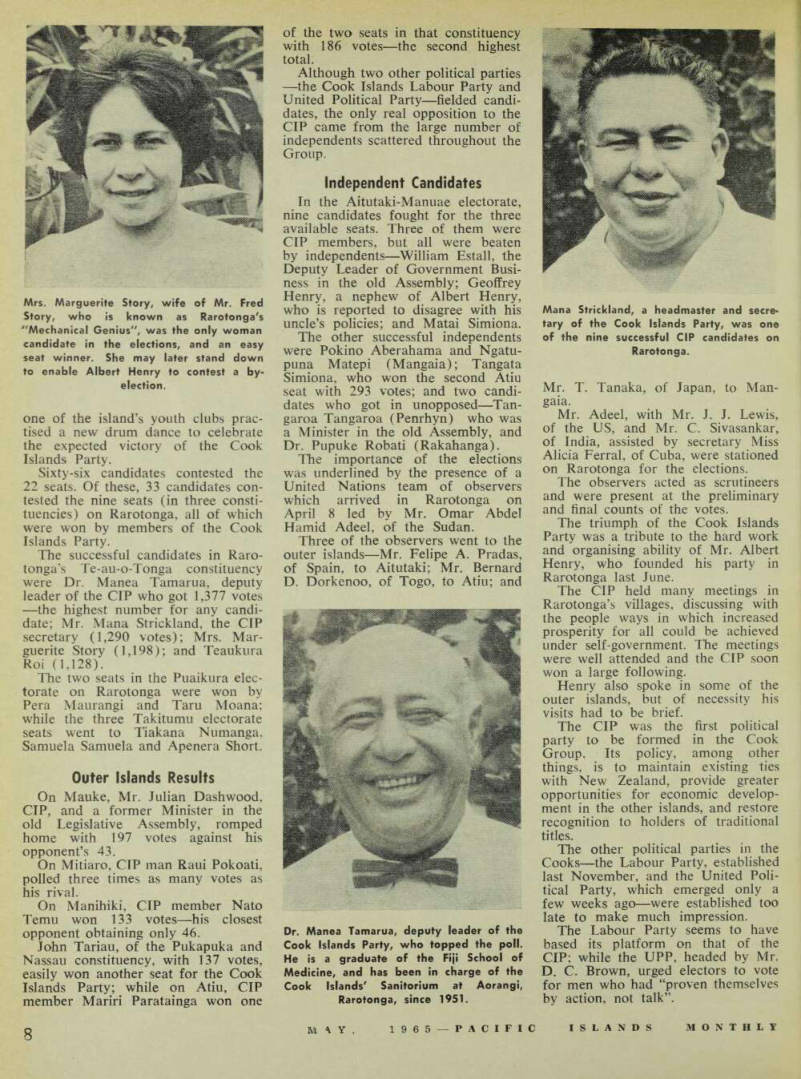
Mrs. Marguerite Story, wife of Mr. Fred Story, who is known as Rarotonga's "Mechanical Genius", was the only woman candidate in the elections, and an easy seat winner. She may later stand down to enable Albert Henry to contest a by election.
Dr. Manea Tamarua, deputy leader of the Cook Islands Party, who topped the poll.
He is a graduate of the Fiji School of Medicine, and has been in charge of the Cook Islands' Sanitorium at Aorangi, Rarotonga, since 1951.
Mana Strickland, a headmaster and secre tary of the Cook Islands Party, was one of the nine successful CIP candidates on Rarotonga.