The Mysterious
pp. 83-85 · Read in the full issue

"Little Men" Of
Buna And
Bougainville
By R. J. Giddings
In July, 1963, there was a rumour among the Buin people in the south of Bougainville Island that the patrol officer at Wakunai on the east coast had captured a pygmy native.
IT was said that the “little man” was being held in the Wakunai prison for safekeeping and—what was of far greater interest —that he would be brought to Buin and dis played at the opening of the Bum Local Government Council a month later.
As a patrol officer in the Bougain ville District at that time, I was asked by many village leaders and other natives whether the rumour was true.
I told them that it was not, but quite a few people still believed it, and they were therefore disappointed when the Council opening day arrived and the influx of dignitaries and official visitors did not include the “little man” from Wakunai!
Speculation
This incident reminded me that when I was a newcomer to Bougain ville some seven years earlier, I had heard Europeans—plantation men in the main—talk of the pos sibility of primitive pygmies living in the mountainous, jungle-covered interior of the island, in the vicinity of the active volcano, Mt. Balbi.
It seemed that speculation about their existence —among Europeans at least—had carried on since the German naturalist Richard Parkin son first heard tell of them from local natives when he visited Arawa Bay during the 1880’s.
The information available from European sources was vague.
Plantation labourers had reported
‘‘others” as having contacted pygmies in times past. Unnamed natives had said that their ancestors had seen them at a distance near Mt. Balbi.
The pygmies were said to be short, fair-skinned people with long, straight hair. They were intensely shy of all but their own kind, and rarely left any traces of their move ments which could betray their whereabouts.
Anecdotes In the north of Bougainville, many natives can recall some anecdote about the ‘‘little men”. Some claim to have found strands of their hair in village gardens after the pygmies had made a midnight raid for food.
Evidence to substantiate their existence seems, on initial inquiry, to be readily available. But the inquirer is soon baffled and misled as his findings blend from the seemingly real to the ridiculous, from the seemingly factual to the fantastic.
My opinion now is that there are definitely no pygmies on Bougain ville.
Futhermore, there is no archaeo logical evidence available to suggest that pygmies ever did inhabit the island.
There is some evidence to sug gest that Polynesians inhabited Buka Island before the Melanesian invasion took place undetermined ages ago.
So it could be that on Buka, as a result of the corrupting influence of
time and the unreliability of verbal tradition, that these Polynesians are now remembered as fair-skinned, long-haired pygmies, so timid as to confine their roamings to the dead of night.
But while this may be so for Buka, a different set of circum stances exists on mainland Bougain ville.
The belief that pygmies inhabited the rugged interior of that island, especially near Mt. Balbi, seems to have its origins in traditional religious beliefs common in basic theme to the ethnic groups which share common borders in that region.
Among the Rotokas people (east coast) and the Keriaka people (diagonally opposite on the west coast) a common belief was that the spirits of the dead dwelt in the volcano.
In pre-European times when these people visited each other to trade, they passed within a mile of the volcano. (Over)
A recent report that a party of Japanese anthropologists was to search an isolated part of the Eastern Highlands District of central New Guinea for a tribe of pygmies that may live there has prompted MR. R. J. GIDDINGS, an assistant district officer at Goroka, to write about . . .
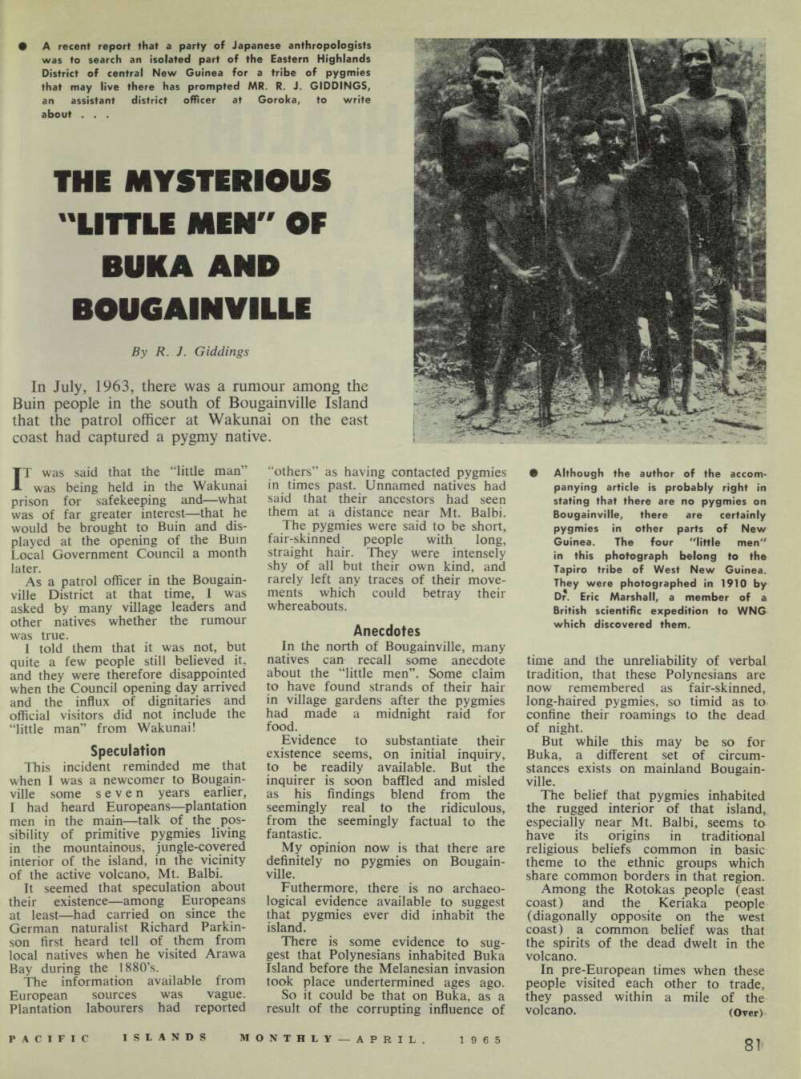
Although the author of the accom panying article is probably right in stating that there are no pygmies on Bougainville, there are certainly pygmies in other parts of New Guinea. The four "little men" in this photograph belong to the Tapiro tribe of West New Guinea.
They were photographed in 1910 by Dr. Eric Marshall, a member of a British scientific expedition to WNG which discovered them.
Local tradition has it that spirits could be seen from the track as small figures moving about among the fumaroles.
Undoubtedly, after frequent re telling and some reinterpretation, this tradition has been used to give credence to the pygmy belief.
There are many quaint myths and anecdotes concerning the “little men” peculiar to the native people of North Bougainville and Buka islands.
In the Hahon language of North- West Bougainville they are named Tukis a name now common throughout most of the area.
Fear of the “little men” is a factor to be reckoned with in native administration. For example, in the interests of village hygiene, con veniences must be built close to the villages with the jungle cleared well away from them; otherwise they will not be visited at night for fear of encountering a Tukis.
It is often difficult to have native householders make windows in their houses, as those who would sleep in them want neither ghosts nor “little men” to get in. However, the excuse for lack of windows is often given as a precaution against thieves.
Footnote ; Just in case my views on the non-existence of pygmies on Bougainville should prove to be wrong, here is the recipe of the Taiof people of North-West Bougain ville for what you should do if you should come across an offensive one; Grab him by the scruff of the neck and cut off his long tresses. Then he will surely die!
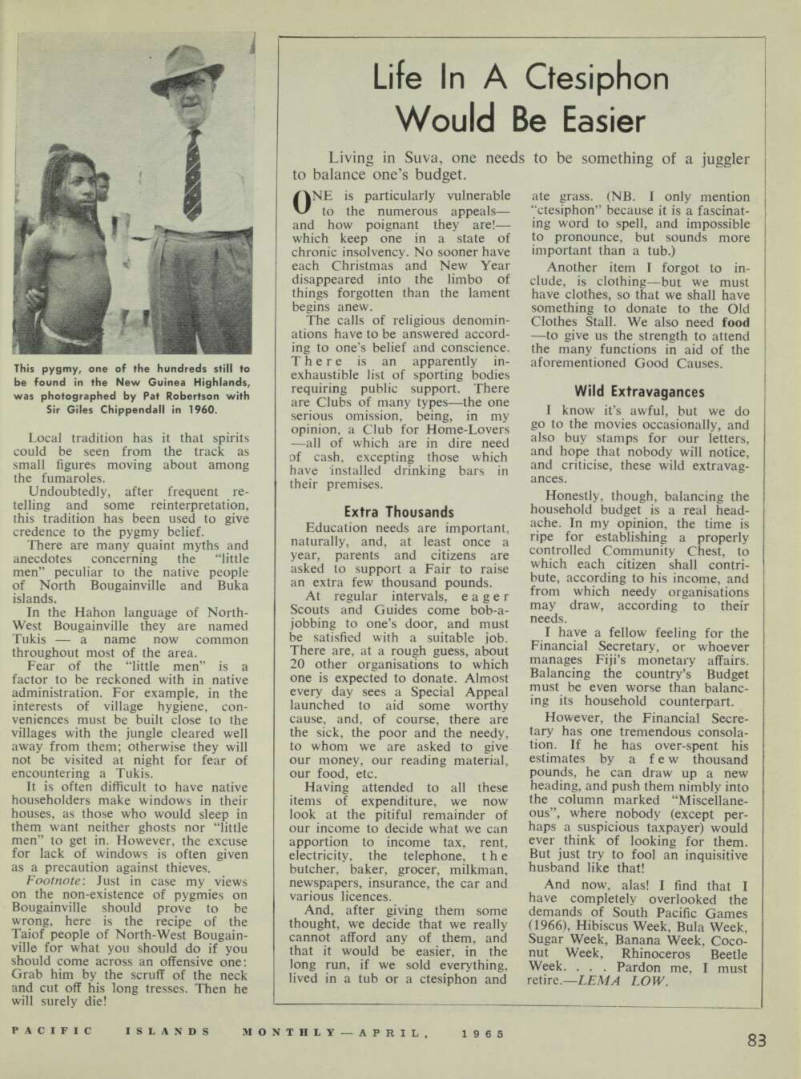
This pygmy, one of the hundreds still to be found in the New Guinea Highlands, was photographed by Pat Robertson with Sir Giles Chippendall in 1960.