Among The Fore, Women Are
pp. 77-78 · Read in the full issue
Now On Pedestals
From a Port Moresby Correspondent The men of Fore, in the Eastern Highlands of New Guinea wistfully recall the time when a man could find three or four wives to labour for him in his gardens and care for his many pigs and children. Today a polygamist is a rarity, for there is a grave shortage of women among the Fore.
THE shortage is due mainly to the effects of kuru, a mysterious disease of the central nervous system peculiar to the Fore people and to those of their immediate neighbours with whom they intermarry.
Although world scientists have been working on kuru since it was first identified as a disease (and not as a cargo movement) by Drs.
V. Zigas and D. C. Gajdusek in 1957, no cure has yet been found.
The disease continues to take a devastating toll of the women of the area, and the motherless family is a common domestic unit among the Fore. , One recent patrol report gave the death roll among the South Fore (where the incidence is higher than among the North Fore) as 160 in 18 months, 50 of them women of child-bearing age. The disease, which ends with the victim losing control of her actions so that she simply wilts away, affects one per cent, of the Fore population at any one time, and mainly occurs in grown women.
Most Men Affected The tragic effects of the disease on Fore life are poignantly outlined in an article by Shirley Glasse, in the December issue of the Papua- New Guinea Medical Journal, which was published in Port Moresby at the end of February. This issue of the Journal is the first to appear since July, 1962.
Mrs. Glasse reports that it is difficult to find an adult male who has not been affected by the loss of immediate kin from kuru.
The luluai (headman) of one clan has lost his mother, half-sister, three wives, one son, and a step-son.
Pago, another man, has lost three wives and three daughters. Anagu has lost his mother, four wives, one sister, one daughter and one son.
In an extreme case, a man named Poraka has lost three wives, two sisters, two sons, one son’s wife and three daughters.
Many men perform the roles of mother and father for their families, and as a result there are social changes.
Men without wives but with children to care for do the digging, plant crops, weed and cook— traditionally women’s work. If a father is fortunate to have a daughter she will try to compensate for the loss of the wife by carrying home enormous loads of firewood and sweet potatoes each evening, until she marries at 14 or 15.
Acted The Jester One evening, Tusukei, who cares for three children, was seen by several old men carrying home sweet potatoes in a string bag on his head, and the men tried to provoke him by claiming this was women’s work.
Tusukei merely deflected the ridicule by acting the jester, swaying
his hips like a well-padded woman.
As recently as 1947, when the first European patrols went through that district and made contact with the people, the Fore were warriors and violence was the main orientation of their culture. Men guarded their
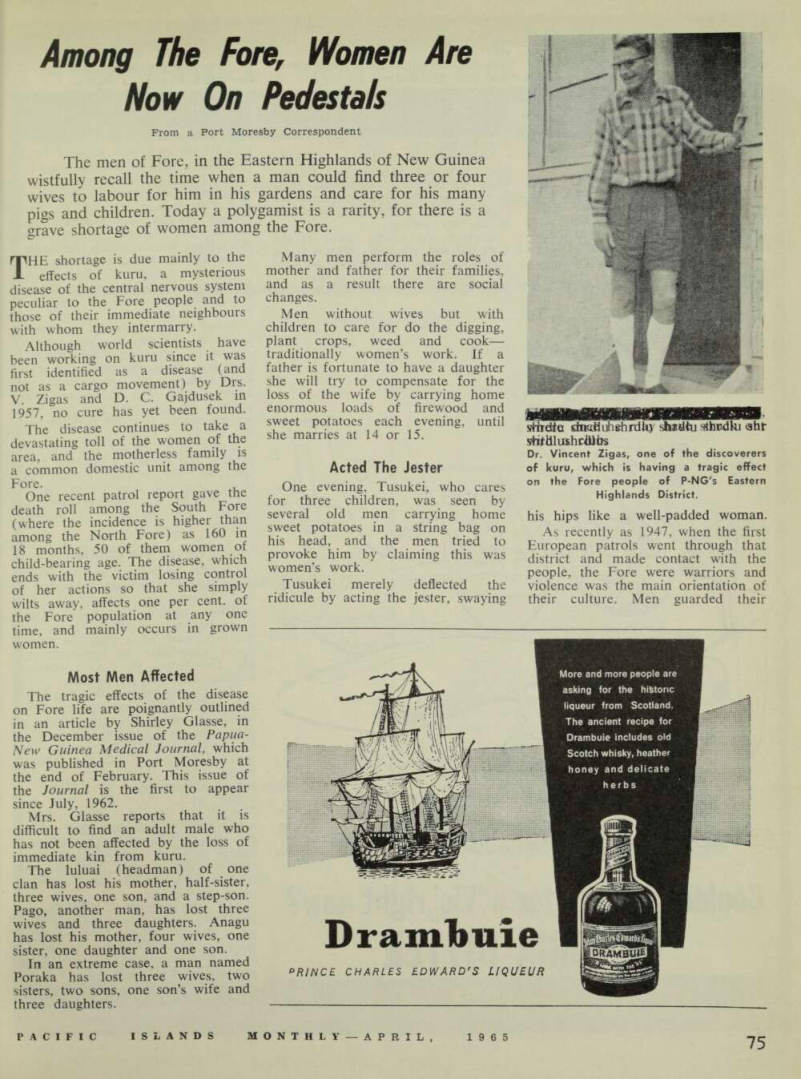
[?] [?] Dr. Vincent Zigas, one of the discoverers of kuru, which is having a tragic effect on the Fore people of P-NG's Eastern Highlands District.
superior status and the opposition of men and women was regarded as essential.
Today the men recall the battles they fought, the enemies they shot or maimed. And today it is possible to see, on Government roadwork day, men clearing the clay with a child balanced on the hip.
"Men Of The Past"
It is only the old men who now say they still prefer to live apart from their wives because they are afraid of them. They refer to them selves as “men of the past”.
Women, as a result of the change, have more freedom and can pick and choose a husband.
Men constantly lament the woman shortage, in private and in public speeches, and the women are aware that they are scarce.
Fore divorce rate is low compared with other highlands societies, but there has been an increase in sexual offences particularly concerning interference with young children.
Meanwhile, the orators at the death payment ceremonies extol the value of women and direct their hostility against male sorcerers—for kuru, say the Fore men, is not a disease but sorcery.
Kuru is the visible result of the work of the sorcerer, they say. A victim’s recovery is merely evidence that the sorcerer has relented or that his work has been counteracted.
It is understandable that the sorcerer himself should hide because the victim’s kin would kill him if he didn’t.
It is a measure of their anxiety and frustration that the Fore so often consult dreamers and curers, and when each magical cure fails they try the next with renewed hope.
Suave, a man of 36, has been the most famous of the curers.
In one five-month period, more than 70 victims walked or were carried to him for treatment, and he and his kinsmen had to build three large houses, which they called “hospitals” to house the influx.
At the height of the activity Suave gave a licence to cure to a friend so that he could help him handle the crowd.
Suave charged for the treatment, which in one instance was seen to consist of shooting the patient’s feet, legs, arms, shoulders and scalp with a bow and arrow until the blood flowed. The victim was then given a special meal and was pre scribed sexual restraint for the next few weeks.
Suave gave up all work in his gardens and became a full-time kuru specialist. But it soon became ap parent that his cures weren’t work ing and he was spoken of as a hoaxer, and his flow of patients ceased.
Targets For Criticism Medical orderlies, as the main dispensers of European medicine in the society, are the targets for criticism among the Fore. Kuru cures become a rallying point for the expression of a belief in tradi tional knowledge in opposition to the knowledge of the European.
Medical orderlies are upstarts.
Mrs. Glasse believes that the Fore gain relief from anxiety by their belief in sorcery. It gives them a course of action when faced with catastrophe. Yet their inability to counteract it gives rise to further stress which they meet by re affirming their belief in sorcery.
She adds: “The Fore are not likely to modify this cyclic behaviour by discarding their belief in sorcery. Faced with repeated failure they are more likely to alter the solution to the problem and take actions which they consider more appropriate.
“At the moment they resort mainly to cures; this phase may give way to an eruption of physical violence directed against sorcerers; or to the growth of religious enthusiasm with even greater con formity to mission teaching and the injunctions of the Administration.”