Cruising Yachts,
pp. 107-113 · Read in the full issue
Pacific Shipping And
New Islands Freighter In Service In July
Burns Philp’s new Islands freighter, the Moresby, is ex pected to go into service on the Australia-P-NG run early in July. She was scheduled to be launched at the Newcastle State Dockyard on March 6 by Mrs. P. T. W. Black, wife of a BP director.
Moresby will eventually replace tthe passenger-freighter Malaita on the Islands run, but this will not be for a year or two. The Malaita will then be sold. BP also plan to sell the passenger-freighter Bulolo.
In line with Burns Philp current policy the Moresby is to carry cargo only.
Besides general cargo space, the Moresby has five refrigerated com partments, which will carry about 90 tons of refrigerated cargo. Her total cargo capacity will be 3,600 tons.
She will have four 5-ton deck
cranes and cargo handling derricks, and a 20-ton heavy lift derrick to facilitate loading of motor vehicles and other general cargo.
The Moresby will be 300 ft long, 50 ft wide, and will have a draft of 13 ft 7i in. when loaded.
She has trial speeds of 14 knots to her credit.
When the Malaita and Bulolo are withdrawn, the whole Burns Philp fleet will comprise ships built since the end of World War 11.
The ships now in the fleet are the Braeside, Manutai, Tulagi, Malekula, Bulolo and Malaita.
Solomons Vessel
Aground At Ysabel
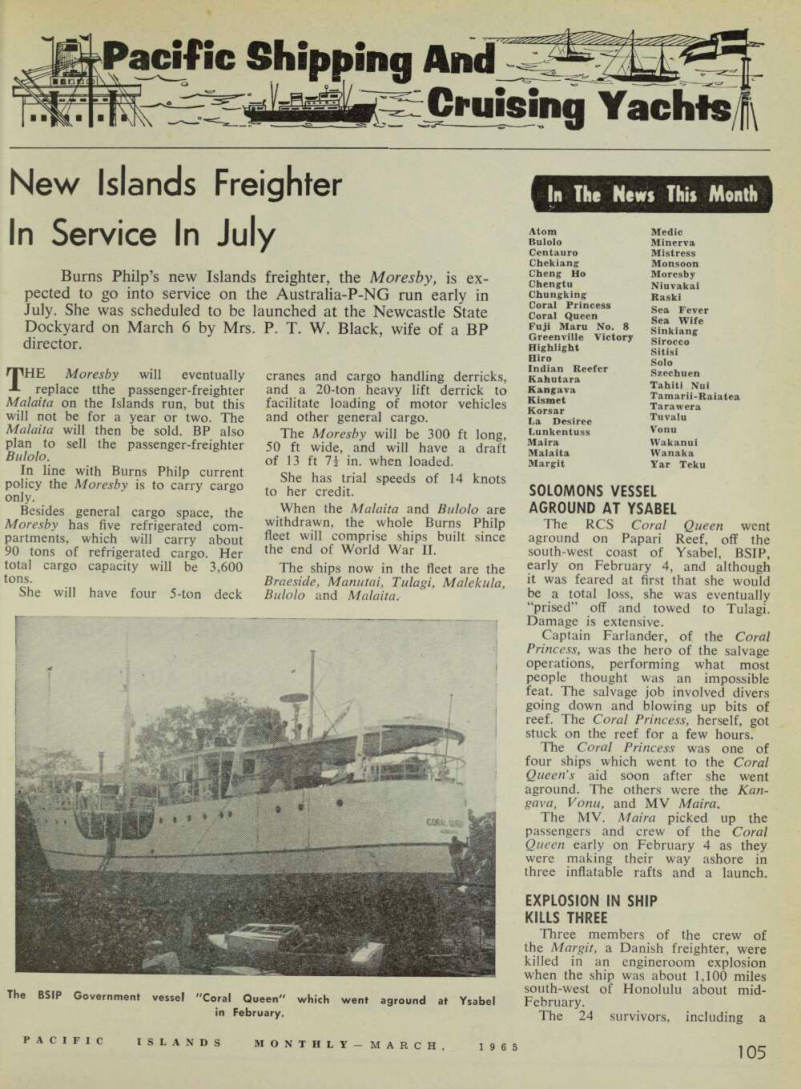
The RCS Coral Queen went aground on Papari Reef, off the south-west coast of Ysabel, BSIP, early on February 4, and although it was feared at first that she would be a total loss, she was eventually “prised” off and towed to Tulagi.
Damage is extensive.
Captain Farlander, of the Coral Princess, was the hero of the salvage operations, performing what most people thought was an impossible feat. The salvage job involved divers going down and blowing up bits of reef. The Coral Princess, herself, got stuck on the reef for a few hours.
The Coral Princess was one of four ships which went to the Coral Queen's aid soon after she went aground. The others were the Kan gava, Vonu, and MV Maira.
The MV, Maira picked up the passengers and crew of the Coral Queen early on February 4 as they were making their way ashore in three inflatable rafts and a launch.
Explosion In Ship
Kills Three
Three members of the crew of the Margit, a Danish freighter, were killed in an engineroom explosion when the ship was about 1,100 miles south-west of Honolulu about mid- February.
The 24 survivors, including a
The BSIP Government vessel "Coral Queen" which went aground at Ysabel in February.
woman, were picked up by the US Navy cargo ship, Greenville Victory, 11 hours later and were taken to Johnston Island, a base for the US anti-missile programme, about 700 miles south-west of Honolulu.
It was planned that they would be flown to Honolulu.
Among the survivors were two Australian seamen, Kevin Peter Mauritz, 22, and Geoffrey Mauritz, 24.
S.P.C. Trainees Launch
Second Boat
Trainees of the boatbuilding course organised by the United Nations and the South Pacific Com mission at Nouville, New Caledonia, on February 1 launched the motor boat La Desiree, which they built for the Administration of the Wallis and Futuna Islands.
Like the first boat built at the course, La Desiree is a 28 ft motor launch equipped with a 58 HP Perkins diesel engine. Fitted with a capacious hold, she will be used for collecting copra around Futuna and Alofi Islands, as well as for the field tours of the Administrator of Futuna.
Link With Tonga
Via Fiji
The Tonga Copra Board’s Niuva kai has begun a regular freight and passenger service between Tonga and the Australian east coast, via Fiji.
The ports of call are Melbourne, Sydney, Lautoka, Suva, Nukualofa and Vavau.
The service operates on a six weekly basis.
Captain Hibberdine is the regular master of the Niuvakai; and Burns Philp are the Sydney agents for the ship.
The Niuvakai has cabin accom modation for 10 passengers. Deck passengers are carried between Fiji and Tonga.
"Indian Reefer"
Goes Home
The Union Co’s Tar aw era will replace the Indian Reefer on the Islands banana run to New Zealand ports.
The Indian Reefer did her last banana run in January-February before returning to her home port, of Esbjerg, Denmark.
The Tarawera has been engaged in the Australia-New Zealand orange trade, and replaced the Wanaka, laid up, on the Melbourne-Sydney- Fiji-Western Samoa-Nukualofa ser vice in February-March, and ended the run at Auckland.
New Career For Former
Chinese Junk
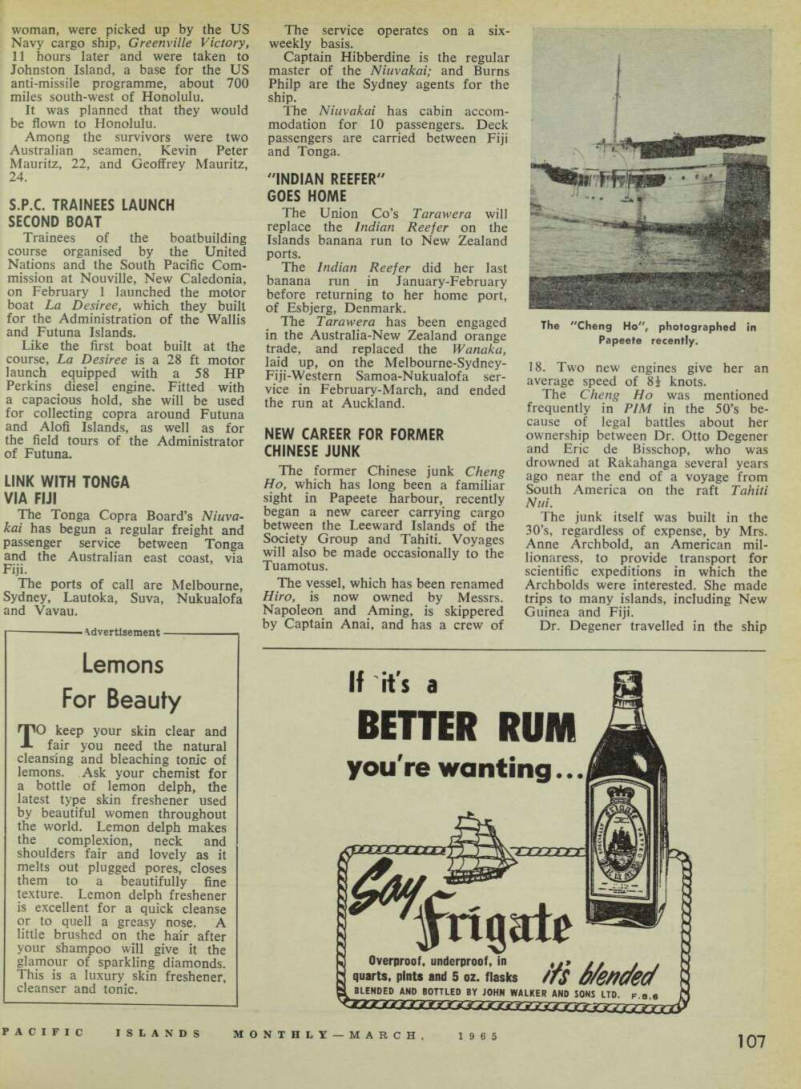
The former Chinese junk Cheng Ho, which has long been a familiar sight in Papeete harbour, recently began a new career carrying cargo between the Leeward Islands of the Society Group and Tahiti. Voyages will also be made occasionally to the Tuamotus.
The vessel, which has been renamed Hiro, is now owned by Messrs.
Napoleon and Aming, is skippered by Captain Anai, and has a crew of
18. Two new engines give her an average speed of 8i knots.
The Cheng Ho was mentioned frequently in RIM in the 50’s be cause of legal battles about her ownership between Dr. Otto Degener and Eric de Bisschop, who was drowned at Rakahanga several years ago near the end of a voyage from South America on the raft Tahiti Nui.
The junk itself was built in the 30’s, regardless of expense, by Mrs.
Anne Archbold, an American mil lionaress, to provide transport for scientific expeditions in which the Archbolds were interested. She made trips to many islands, including New Guinea and Fiji.
Dr. Degener travelled in the ship
The "Cheng Ho", photographed in Papeete recently.
on many of these expeditions.
The US Navy had charge of the junk during World War 11, and then returned her to Dr. Degener as agent for Mrs, Archold, who agreed to arrangements under which he became owner.
Dr. Degener made an arrangement later with de Bisschop, but difficulties arose and there were many legal complications which were finally resolved by a Papeete Court, in May, 1955, ordering the vessel to be sold.
It was bought by Etablissements Henri Gullois et Cie., Papeete, and went into the inter-island trade in French Polynesia.
Another Jap Fisher
Abandoned
The Japanese fishing ship, Fuji Maru No. 8, which went aground on Veiluvakisalusalu Reef, off Nairai Island, Fiji, on December 23, has been abandoned to the Receiver of Wreck.
All attempts to salvage the ship, insured for £45,000, were abortive.
With spring tides and rough seas pounding her she has settled firmly on the reef.
The ship and all equipment, ex cept loose fishing gear, were valued at £50,000.
Big Freighter
Visits Apia
Shaw Savill’s Medic, which was at Apia early in January, was the most modern, fastest and biggest freighter ever to enter that port.
The Medic, 537 ft long, was launched in England in 1963, and has reached average speeds of 20 knots.
The 6,826 tons of general cargo for Samoa included liquor, motor vehicles, stationery, and tinned food.
She picked up no outward cargo.
Congestion At Fiji
Wharves
Fiji’s commercial boom has brought with it a number of pro blems, not the least of which is almost continuous congestion in the cargo sheds at Suva wharf.
There are now so many imports passing over the wharf that delays in clearing cargo are inevitable, be cause of the congestion and because of Customs clearance requirements.
Because of the congestion and delays, Williams and Gosling, one of the biggest Customs agents in Suva, has had to increase its cartage rates in the Suva area.
However, with expected lower earnings from sugar in 1965, the wharf position could become easier.
Lautoka merchants are also ex periencing trouble clearing their cargoes.
They have asked the Customs Department to allow more time to clear their goods before the imposi tion of triple bond charges.
They also want the present wharf shed enlarged.
Lautoka’s importance as a port has reached a stage not envisaged a few years ago when plans were drawn up for the present wharf, which was opened in 1961.
The greater number of ships which used the port in 1964, was not only a reflection of two good seasons for sugar, but also an in dication of the ever-increasing role north-west Viti Levu has to play in Fiji’s economy.
One hundred and ninety overseas
Guadalcanal Ark
This strange contraption was re cently landed at Honiara, BSIP, from an overseas vessel and late in January was pulled up in the wharf area. It looks like a modern alumi nium caravan welded to a barge and it is said to be furnished with all modern conveniences, including re frigeration. It has been imported by the Forestry Department and, ac cording to the local coconut radio, is to be used by Forestry personnel going about their business in the timber areas of the Solomons.
ships used Lautoka in 1964, com pared with 129 in 1961, and the tonnage of imported cargo passing through the Customs area was 177,355, compared with 115,182 in 1961.
Exports have risen spectacularly to 321,169 tons in 1964, compared with 189,108 tons in 1961. However, the 1961 sugar crop was well below average because cane farmers refused to cut their crop.
The Customs Department collected £1,861,469 at Lautoka in 1964, compared with £1,345,490 in 1963.
5-Year-Old Was 30
Hours At Sea
After Christian Moran, a five year-old boy from Djaul Island, about 120 miles NW of Rabaul, had an argument with his father recently, he paddled out to sea in a canoe.
Currents swept him along the coast of nearby New Ireland and soon a fleet of canoes was out look ing for him.
Thirty hours after he started his voyage, a coastal ship, the Raski, found him in the canoe, near the entrance to Albatross Passage, about 15 miles from his village.
He had been without food and water and was badly sunburnt.
The Raski took him to Kavieng, where he was admitted to hospital suffering from exposure and dehydra tion.
Fast Far East-Fiji
Service
Fiji will soon have a fast new service from the Far East, provided by the China Steam Navigation Co with the Sinkiang and Szechuen, each of a about 3,030 tons.
The Sinkiang and Szechuen will replace the Chengtu, Chungking and Chekiang which have operated a Far East-New Guinea-Fiji service since about the middle of 1958.
The Sinkiang and Szechuen will sail from Japan and Hong Kong direct to Fiji, eliminating New Guinea, and on the return trip to the Far East will call at Honiara.
The new ships will provide a monthly service. The other three ships gave a six to seven-week service.
The Sinkiang and Szechuen will call at Suva and Lautoka and, if necessary, at Levuka.
The Chengtu, Chekiang and Chungking will now terminate their Far East-Pacific service at Noumea.
The last Far East-Fiji service, via New Guinea, will be by the Chekiang, which is due in Fiji about mid-March.
The Sinkiang was scheduled to leave Japan on February 28, and Hong Kong on March 10 for Fiji.
The Szechuen is scheduled to leave Japan on March 30 and Hong Kong on April 10.
The Sinkiang was on the Aus tralia-New Guinea run for many years, but was taken off it about two years ago.
The Szechuen operated between Hong Kong and Keelung in Taiwan for many years.
Ship On Fiji Reef
For A Day
Morris Hedstrom’s inter-island trader, Tuvalu, ran aground at Raviravi Point, about 20 miles west /'of Labasa, on January 19, but floated off the next night on the rising tide.
Early reports were that there was no damage, and that she would continue to work the coast west of Labasa before returning to Suva.
Work Begins On
Honiara Wharf
The Australian contracting firm of Hornibrooks was moving a huge pile-driver into position at Point Cruz, Honiara, BSIP, in late January
to drive the hollow steel piles that will form the outer perimeter of the new wharf.
The wharf, when completed, will be 150 feet long and will be large enough to accommodate the BP and Bank Line vessels at present calling at Protectorate ports.
The wharf is estimated to cost £150,000. Most of it is being financed by a loan from the Com monwealth Bank and the rest from profits from the Port Authority.
The Port Authority will pay off the debt from a port tax; therefore the new wharf will cost the Govern ment nothing. (The Port Authority is a statutory body of half a dozen members. The Financial Secretary is chairman.
Other members include the Marine Superintendent and local business men).
The Americans built a wood and concrete wharf at Point Cruz during their campaign in Guadalcanal in 1942-45, but like most wharves built by the Americans, it fell into disrepair in the years immediately after the war and was too far gone before anyone got around to doing anything about it.
It was finally demolished by nor’west gales to which this coast is subject from December to April.