Talk-Talk
pp. 101-105 · Read in the full issue

With Tolala
Shipping companies operating in Papua-New Guinea came up for some discussion in the third session of the Territorial House of Assembly.
THE main theme centred on privileges enjoyed by one ship ping company and not by others, and it was Jim Grose, MHA for New Guinea Islands Special, of Kavieng, who introduced the bill asking for an open slather for copra-lifting and back-loading. This was later sup ported by lan Downs and eventually passed “on the voices”.
It is just about 30 years ago that the legislative halls of New Guinea echoed to the voice of another Grose —Jim’s father, Bill—debating clauses of another Shipping Bill. It was a very contentious bill, because Can berra, in its usual dictatorial manner, foisted it on the Council at the last moment, merely telling the Admini strator: “Pass it.”
Best Speaker
Bill Grose was easily the best speaker and most logical debater in the House—and the most knowledg able on Administration procedure.
He should have been, for he had filled the positions of Private Sec retary to the Administrator, Govern-
ment Secretary and Superintendent of Police.
He was a planter on the East Coast of New Ireland when he was in the Council.
Bill Grose and Jack Mullaly were the life of the Council at that time, and the most articulate members, upholding the true tenets of demo cracy in an autocratic government (even as it is today in Canberra). . . . And now Bill’s son takes over.
Shipping Control : The
control of transport by the Govern ment has been an old pastime for the Powers That Be in New Guinea.
Not long after the German colonial government took control from the Neu Guinea Kompagnie about the turn of the century, shipping restric tions allowed only NDL overseas vessels to trade with the Colony.
This meant the discontinuance of the BP vessels that used to ply be tween German New Guinea and Sydney on their general Islands run.
The BP ship Moresby was the last out of Simpsonhaven when the re strictions were imposed by the Germans and was the first com mercial vessel to call at Rabaul after the landing of the Australian troops in September, 1914.
Some years followed during which BP enjoyed much the same protective privileges as were accorded to the NDL line.
Ships, all with seven-letter names starting with “M”, and with the draught-board on their funnels, were put into the NG service: Marsina, Morinda, Melusia, Montoro, Matunga and later Mataram and Macdhui, providing a comfortable inter-island service and picking up copra where it offered.
A regular run for some years was Rabaul, Kavieng, Manus, Maron, Aua, Matty, Seleo, Madang, W'itu, Rabaul, then off to Sydney or Brisbane.
COMPETITION : Came the time, however, in the early Thirties when “protective privileges” were no more, and in came the NDL once again.
This time from Hong Kong, the Bremerhaven and Friderun picked up a few tons of copra for the overseas markets.
Then along came the KPM (Dutch line) and the E. and A. line from Sydney, both catering for the passenger service to the East.
I seem to remember that a round trip on an E. and A. vessel, which took you from Sydney via Rabaul, to Manila, Hong Kong and Japan, lasted three months and cost about £9O.
To show how the copra exports were distributed for the month of July, 1938, the following is a dis section of the tonnage exported: By Malaita, 167 tons and Montoro, 179 tons for Australia; by Friderun, 1,546 tons for optional European ports and 388 tons for Germany; by Takachiho Maru, 100 tons for Caroline Islands.
Interesting Reading
HTHE September, 1964, issue of Aus tralian Territories, put out by the Department of Territories, Can berra, reached me at the beginning of February. It was an especially good number insofar as P-NG was con cerned.
Three stories on three varied topics made good reading: “International Trade in Copra and Coconut Oil”, by James P. O’Hagan; “Recent Linguistic Studies on the New Guinea Mainland”, by Dr. S. A. Wurm; and
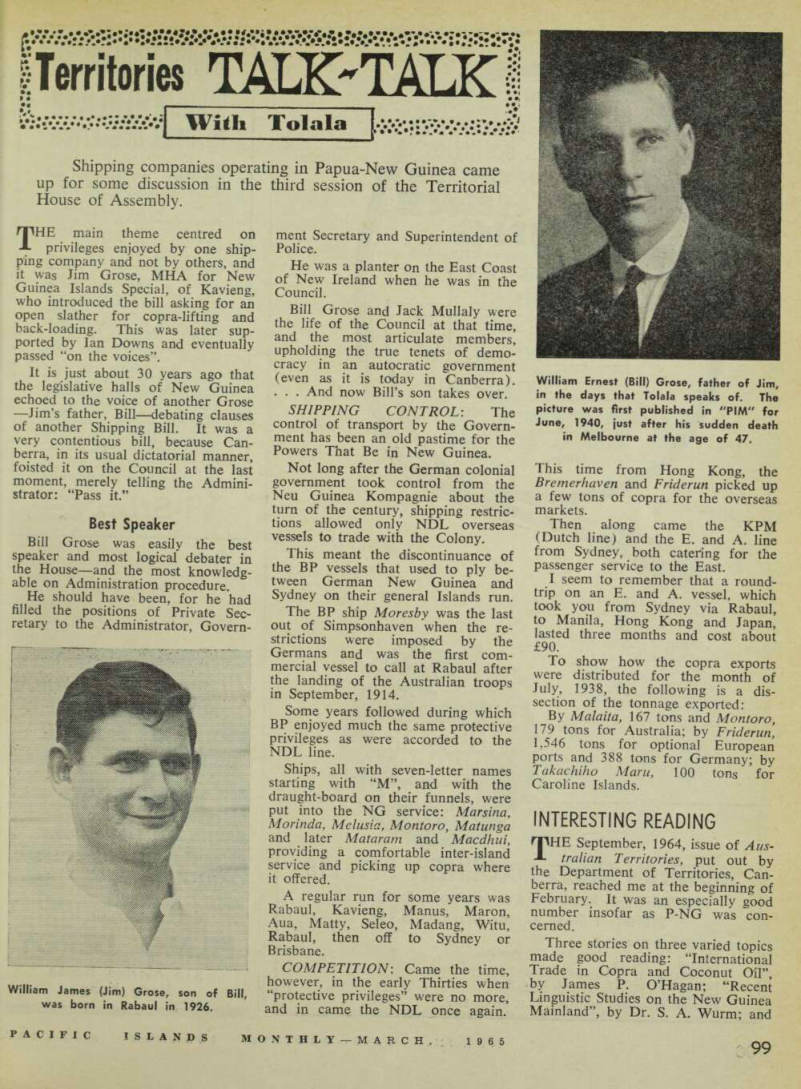
William James (Jim) Grose, son of Bill, was born in Rabaul in 1926,
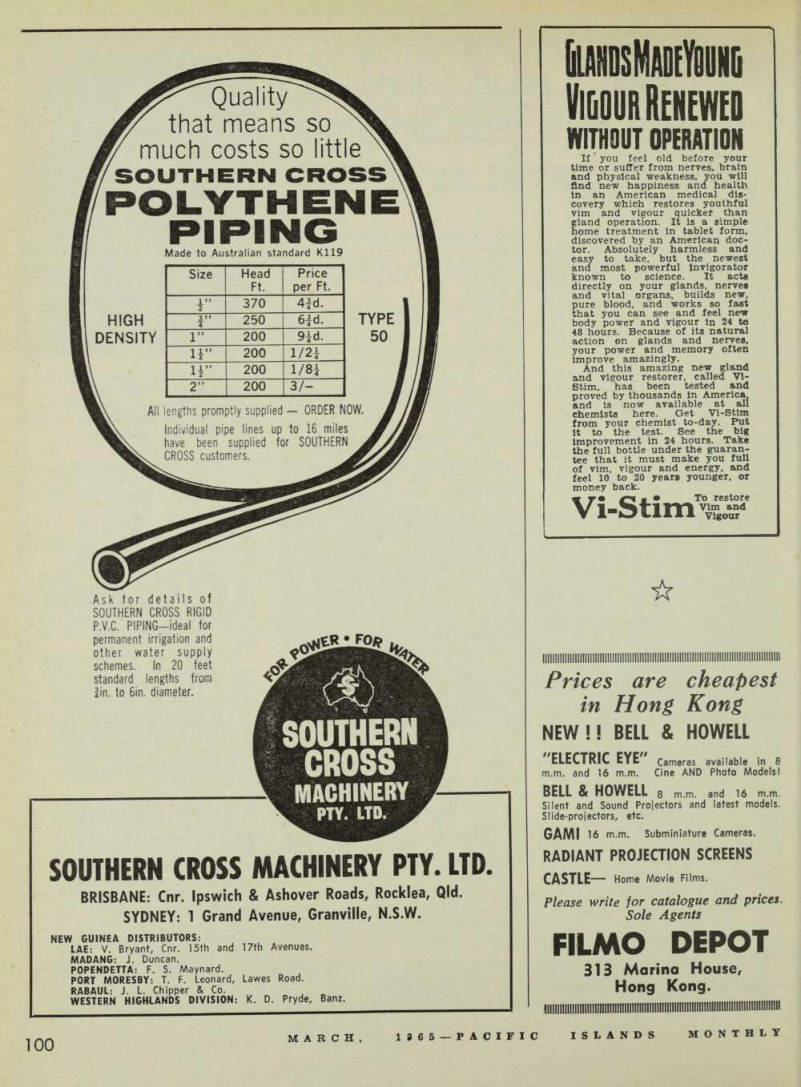
William Ernest (Bill) Grose, father of Jim, in the days that Tolala speaks of. The picture was first published in "PIM" for June, 1940, just after his sudden death in Melbourne at the age of 47.
‘“Air Communications in P-NG”, by W. Williams. The data on aviation development, in tabloid form, is instructive and might provide a few clues for lan Grabowski (who, I believe, is working on a history of NG aviation).
There is a good photo of Orm Denny and his wife. One always felt so safe flying with Orm.
It was in 1934, I think, that he flew out over Moresby Harbour, with one of the Dupain girls and myself, to escort in Charlie Ulm on his historic flight from Australia.
Last I heard of Orm he was the Big Wheel (or is it Wing?) in the Flying Doctor Service.
Bulominski's Grave
A NOTE came to hand some time ago (and got lost among my correspondence—which is not un usual) from old Territorian “Blue”
Allan (or, if you prefer it, Colonel H. T. Allan, OBE, MC, etc.) in which he refers to a photo in November, ’64, PIM (p. 89) of Bulominski’s grave in Kavieng.
“The old native in the picture (which was taken in the ’thirties) is still alive,” he writes. “His name is Lepankus. He worked for Bulominski on road-making and was held in high esteem. He was paramount luluai for many a year.”
“Blue” mentions another old-timer —Tom Prince. Says he: “It is hard to believe that it is over 43 years since I handed over Bolegila to him and took over Libba Lossu [planta tion].”
Despite his one-tone name, “Blue” has had a most colourful career in New Guinea. He arrived there in the later part of 1920 and was (to the best of my knowledge), one of Lucas’ “Twelve Disciples”, a name given to the Expropriation Board chairman’s first officers to arrive in Rabaul.
He was stationed in the Kavieng district during his early years in NG, but eventually became interested in the goldfields in Morobe. In the ’thirties he was president of the NG Mining Association and launched an intensive campaign for The Road, from the coast to Wau. It was “Blue” who played a big part in organising, the Pacific Islands Regiment, of which he was the first CO.
I have not seen him for years, but have always had a soft spot for this rough old diamond; it may be be cause he was born on the same day of the month as myself—a few years later.
The Sniping Season
WHAT with seminars, summer schools and surveys being held and made in Canberra and Port Moresby, with Papua and New Guinea being the sitting shots for snipers of every genera, it seems as though Minister Barnes and his departmental minions are receiving more than the average criticism for this time of year.
Whether it is deserved or not is a matter of opinion, but I don’t suppose either the Minister or his minions will be greatly disturbed.
These “cultural” gatherings create a modicum of interest at the time;
some ambitious speaker hands out a copy of his talk to a sympathetic newspaper reporter (and there are such characters, don’t forget) and he makes a story out of it. It bubbles on for a day or so and then dies away, engulfed in the effluvium of bureaucracy.
As it happened some of the recent gatherings just about synchronised with the return of the VIP guests from Kenya. Consequently, they served as a handy peg upon which the travellers could hang the effects of the Kenya virus, with which they had been inoculated during their few days’ tour, but which, nevertheless, seem to have proved more efficacious
than their many years of treatment from their own paternal government.
These elite members of the popula tion have now become somewhat tidy and united in their thoughts and aims, and seem to know where they are going.
I am rather fearful of the day when their less enlightened colleagues, as representatives of the people and with full confidence in the laws of democracy, are told that a bill, passed in the House by an over whelming majority, has not been assented to either by the Admini strator or the Governor-General.
They will realise then that their powers of governing as a body are negligible and, as individuals, they have as much power to govern as back bench members of Her Majesty’s Australian Federal Government which is precisely nil.
Canberra will realise very soon that the old, pre-war style of slapping down and fobbing off members of the Legislative Council of Papua and of New Guinea just can’t be done so easily now with world attention centred on the activities of the House.
The New Guinean Member of the HA today has not yet reached that docile state of our modern civilisa tion where he will feed unquestion mgly from the hand of his political leader.
Bits And Pieces
TTAD a greeting card from Bishop *“• T°ni Wade, SM, one time of Buka and Bougainville, now of Boston, Mass.
The card shows him kneeling at
the birthplace of the Saviour at Bethlehem. . . .
Visitors drop in to see me from all points of the compass. The other day came Chin Meen, Rabaul’s photographer and a very old ac quaintance. He was back from a world tour and en route for Rabaul. . . .
Arriving also from Europe some little time ago came Mrs. Gladys Forsyth (ex Namanula sister, widow of Dick). She spent a working holi day in Europe, during which she met
many NG folk, among them Hazel Cresswell, who lives quite comfort ably, thank you, in Switzerland. . . .
Harry Komachi, just finished his schooling at Ryde and leaving for Madang and a job with Ansett was another visitor. . . . Then there was Amy Campbell, one-time of Buka Passage, but now Amy England, of Greenwell Point. A short while earlier, her son, Matthew, a flight lieutenant in the RAAF, just back from Thailand, dropped in. He is posted to Wagga. . . .
Encountered In Japan: When Rabaul
photographer Chin H. Meen—mentioned by Totala —was in Tokyo for the Olympic Games last year, he met and snapped these two old Rabaul residents, Messrs.
Y. Tabuchi (left) and T. Tashiro, who went there In 1918 and returned to Japan just before the outbreak of World War 11. Mr. Tashiro is now in the Solomons as manager for the NBK company of Tokyo.