Fighting Nature
pp. 93-94 · Read in the full issue
The Month S New Reading
With Nature
The Pacific world of Hubert W. Simmonds, OBE, seen through his autobiography, My Weapons Had Wings, consists of flowers, bird-song, flies, ants and bugs—with only an occasional human by way of contrast. In a region increasingly convulsed by politics it makes a nice change.
THE author is a man of Rent, but has lived in the Antipodes since 1902. Now in his 87th year, he lives in what might be called active retirement in Suva, Fiji. He has, in fact, been retired from the post of Government Entomologist since 1937 but judging by his activities since then one might never know it.
In his years of retirement he has collected wasps from Mauritius and Zanzibar as predators for the rhinoceros beetle pest that infest the coconut plantations of Western Samoa; discovered a beetle in Java that, when introduced to Fiji, rid the Colony of its house-flies; and travelled thousands of miles, on and off duty, in the Pacific, Asia and Africa.
Way Of Life Entomology to him has not been a means of earning a living; it has been a complete and absorbing way of life. His keen observation of the ways of nature is such as to enliven the dullest and most arduous journey and this sense of wonder he has been able to reproduce in his book, even if his encounters with other humans sometimes takes on a tinge of other worldliness.
Perhaps, however, chief among his accomplishments is that he was able to inspire in his wife a similar interest and enthusiasm and, at one stage, just after the outbreak of World War 11, he left her in Mauritius to collect wasps for ship ment to Samoa while he went on to Zanzibar to check on another species.
It is characteristic of the man that his first introduction to Fiji was as an unpaid overseer on a rubber estate on the Wainadoi River, about 16 miles from Suva. This was in 1919 and although he had lived in New Zealand for most of the years since leaving England, there had
been intervening years in South Africa and Queensland which had already fired his interest in tropical insects.
His idea in going to the planta tion—where the rubber trees were planted on unsuitable river flat and are now no more—was to gain experience of plantation manage ment, but within nine months he was asked to join the Fiji Depart ment of Agriculture as acting entomologist.
It was a particularly rewarding time for a man with his interests.
Not only was biological control of pests coming into its own but Fiji’s main agricultural industry—copra— was being threatened by Levuana iridescens, the small purple coconut moth (which is one of the reasons why there are no coconut planta tions on the main island of Viti Levu); while a scale insect Aspidiotus destructor damaged both coconuts and bananas.
In the search for parasites for these pests in the first years of the 1920’5, Mr. Simmonds visited Tahiti and the Cook Islands, the New Guinea mainland and New Britain, the Solomons and the New Hebrides and finally Java and Malaya where, in 1925-26, he found a small Malayan moth called Artona catoxantha which was effectively controlled by a fly called Ptycho myia remota.
Although the Fiji moth differed to some degree from the Malayan moth, Ftychomyia remota showed a
partiality to both and thus the curse said to have been put on V'iti Levu coconuts by an irritated chief some time around 1860 was finally re moved.
Simmonds’ next assignment was in the West Indies where he was to search for a biological control for a weed called Clidemia hirta, botanically, and Roster’s Curse locally, although apparently Mr.
Roster had been wrongly blamed.
In a characteristic note, the author says that the seed of the weed was undoubtedly introduced to Fiji in pineapple plants imported from British Guiana and when it first appeared in the Colony a meeting of local farmers was called to discuss it.
Someone asked where it had first appeared and a younger member of the Roster family arose to say, “On Parr’s place”—meaning the man who had imported the pineapples.
The meeting, however, thought he was referring to his own father— his Pa—and Mr. Roster, Sr., seems thereafter to have been stuck with the dirty deed.
The weed, which for a while spread like wildfire through the agency of the mynah bird, was finally controlled by Trinidad thrips which Mr. Simmonds located during his peregrinations in the West Indies.
The rhinoceros beetle of Asia, Oryctes rhinoceros, perhaps the biggest threat to South Pacific copra production this area is ever likely to experience, was found established
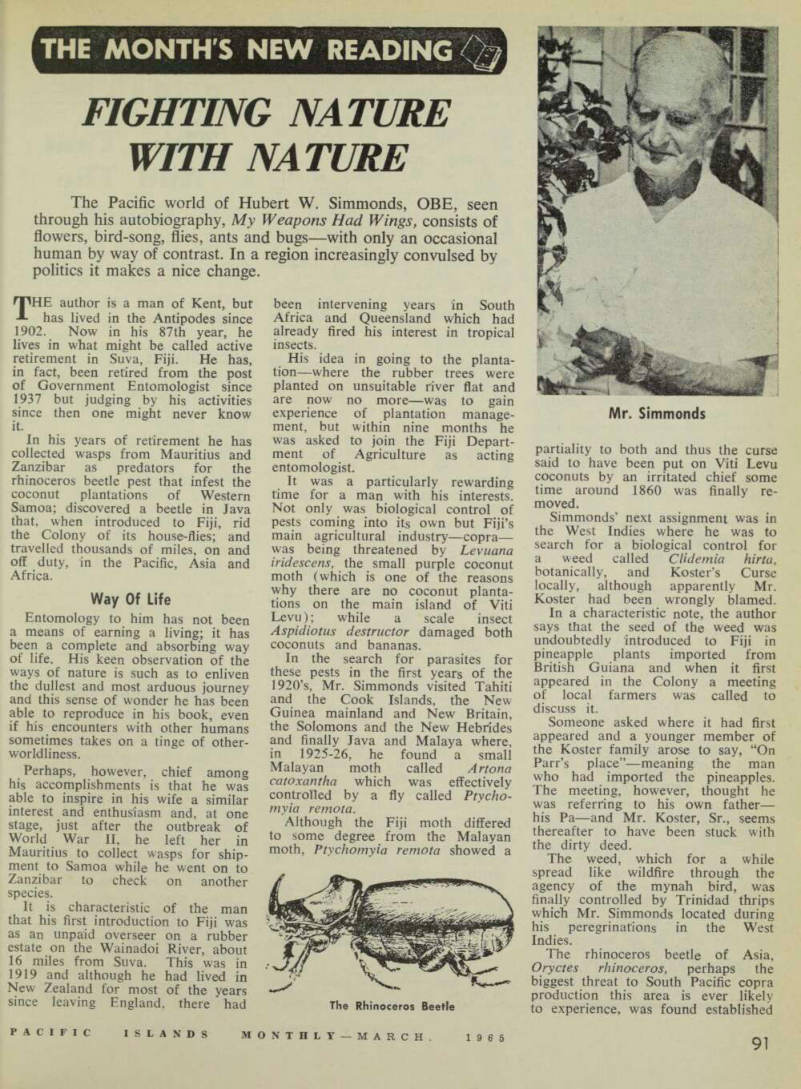
The Rhinoceros Beetle
Mr. Simmonds
and flourishing in Western Samoa in 1909, five years before the out break of World War I and when that Territory was still German.
It was already doing great dam age, was thought to have been intro duced in rubber plants imported from Ceylon and probably it had been there for a considerable number of years unnoticed.
It first became the concern of Simmonds in 1922 when a change of shipping routes put Fiji in the direct line of infestation. But it was not until after his retirement in 1937 that he was able to follow the pest to Asia and investigate its natural enemies, if any.
It was this task, on behalf of the Western Samoa Government, that led him in the years immediately before World War II to Java (where he was incidentally able to find the histerid, Platylister chinensis, which rid Fiji and Samoa of its flies), Malaya, Madagascar, Mauritius and Zanzibar.
Before war closed completely oyer their heads, he and Mrs.
Simmonds were able to ship some predator wasps to Samoa but these colonies failed to establish them selves. Towards the end of the war, however, the RAAF set up a Catalina service from Western Aus
tralia to Ceylon and thence on to the United Kingdom— at the time the WA-Ceylon section being the longest air hop in the world.
The author, therefore, returned to Zanzibar where the wasp parasite Scolia ruficornis offered the great chance of success and arranged to ship colonies! by the RAAF air route to Samoa where they were successfully established.
Although the results of Mr.
Simmonds’ various hunting ex peditions are full of interest, perhaps the real charm of his autobiography lies in the incidental information.
He can stop in full flight, as it were, in the mountains of Tangan yika to describe a meeting with a black and white Colobus monkey; or take time off from a bug hunt in the Solomon Islands bush to make the acquaintance of a “dainty little apnbird . . . deep golden yellow with a black throat;” or to stop the wild rocking of a 50 ton Islands schooner to watch green tree ants at work, or the passing over a mountain saddle of a brilliant butterfly.
It is an unpretentious story, written without journalistic guile, by a man who has lived 80 years with Nature and found it a deeply satisfying experience. The book also carries a message.
Biological Control
In a preface the author says that he will be satisfied if the reader has been given some idea of the superiority of biological control of insect and animal pests over the mass destruction that results from chemical control.
“Much of the forest and bushland that I knew has gone for ever and with it the enchanting animal, bird and insect life it supported. The introduction of exotic birds and other forms of life has further re duced the original flora and fauna so it is hoped that this story may act as a plea for the setting aside of as many areas as possible as Nature Reserves. Only in this way will future generations be able to gain some idea of the glorious forest, bird and insect life which flourished for centuries before being overtaken and destroyed by the march of civilisation.”
The book, in a limited edition, has been published privately in New Zealand under the patronage of the Fiji Society. It has 20 illustra tions including two plates in colour. —JT.
(My Weapons Had Wings. May
be ordered through Pacific Publications Pty. Ltd. 21/- NZ; 27/- Australian.)