yesterday
p. 91 · Read in the full issue
With World War II approaching its end, the chief talking point in PIM for March, 1945, was the meeting to be held in San Francisco on the 25th of the following month to create an international organisation, which, it was hoped, would prevent another world war and would take steps to remove the causes of war — greed, poverty, injustice and oppression.
piM said that the future of the mandated territories of New Guinea, Western Samoa, the Caroline, Marshall and Mariana Islands, and Nauru would be among the first subjects discussed by the new world body. Other items in that issue of PIM of 20 years ago were: Australia’s Minister for Terri tories, Mr. E. J. Ward, announced in Canberra that military control of Papua and the Territory of New Guinea south of the Mark ham River would be terminated as soon as it was practicable to reorganise the civil administra tive service. ♦ * * A Pacific Territories Associa tion cruise on Sydney Harbour on February 23, 1945, had drawn the largest crowd of Territorians ever collected in one spot in Sydney. Between 700 and 800 people were estimated to have made the cruise. * * * After 33 years of continuous medical service to the Colony of Fiji, Dr. V. W. McGusty, Sec retary of Indian Affairs and Director of Medical Services, had left on retirement for over seas. * * . * Thirty-nine members of the band of the Papuan Armed Constabulary arrived in Sydney on March 4, 1945, under the charge of Lieutenant D. Crawley, their bandmaster, and Lieut.- Colonel C. Normoyle, chief of police in Port Moresby. * * * The ahu more —Tahitian grass skirt, plus the corselet and head piece which usually go with it— was the only “curio” available in Tahiti that was not ersatz, ac cording to PlM’s crusty Papeete correspondent, A. C. Rowland.
“Most of the other objects offered as ‘curios’ ”, he said.
“are manufactured by Chinamen and Europeans with the aid of noisy, power-driven machines”.
He added that the sale of the ahu more to servicemen during the war had brought considerable dollar prosperity to Tahiti, but most of the gain had “stuck to the fingers of predatory middle men”. * * * The Fiji Information Office had just begun publishing a news magazine for the Gilbert and Ellice Islands. It was called Sail Ho because in the GEIC “the coming of news usually coincides with the arrival of a ship from the outside world”. * * * Mr. Albert C. English, Papua’s oldest European resident, had re ceived official permission to re turn to Papua after a spell as an evacuee in New South Wales.
On June 23, 1883 —61 years earlier—Mr. English, then 20, had landed at Kerapuna to collect natural history specimens.
He later became a Government official and then a planter. * * * New Caledonian nickel in terests expected no fall-off in the demand for their territory’s
nickel following the cessation of an agreement on December 31, 1944, whereby all New Cale donian nickel, except that re quired by Australia, was exported to the United States. It was expected that the entire 1945 production would go to the United States which would make it available to the Governments of war-torn France, Belgium, Holland and Italy.
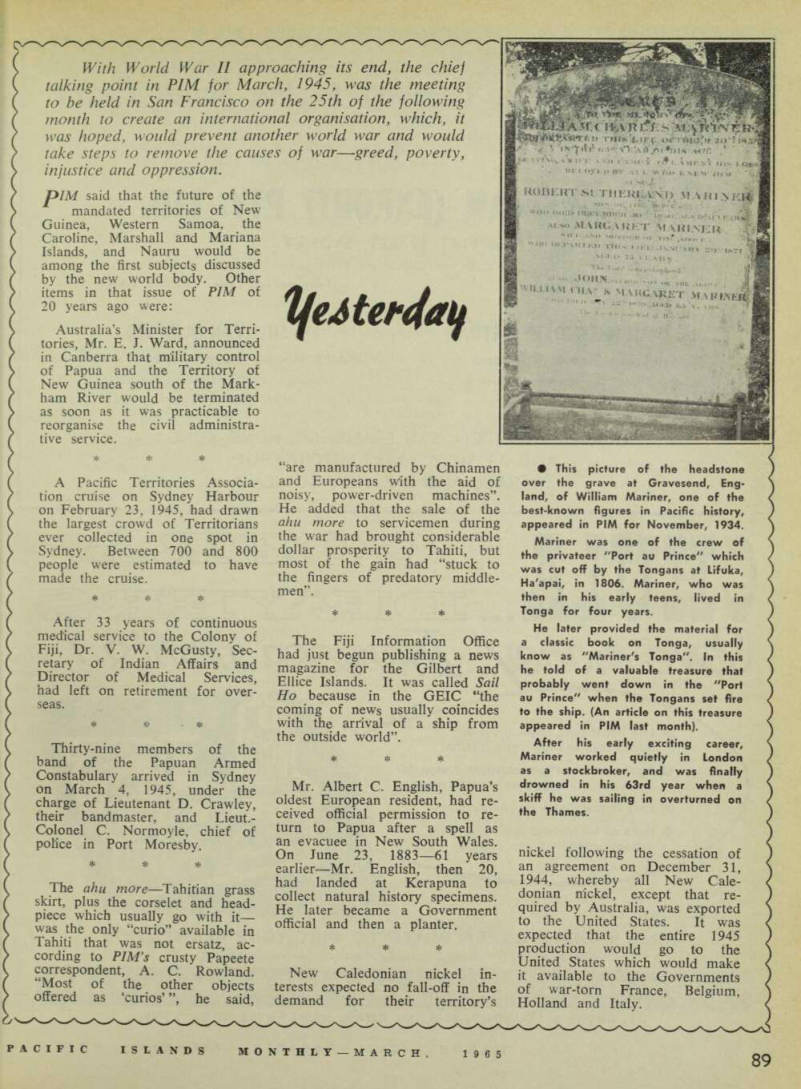
• This picture of the headstone over the grave at Gravesend, Eng land, of William Mariner, one of the best-known figures in Pacific history, appeared in PIM for November, 1934.
Mariner was one of the crew of the privateer "Port au Prince" which was cut off by the Tongans at Lifuka, Ha'apai, in 1806. Mariner, who was then in his early teens, lived in Tonga for four years.
He later provided the material for a classic book on Tonga, usually know as "Mariner's Tonga". In this he told of a valuable treasure that probably went down in the "Port au Prince" when the Tongans set fire to the ship. (An article on this treasure appeared in PIM last month).
After his early exciting career, Mariner worked quietly in London as a stockbroker, and was finally drowned in his 63rd year when a skiff he was sailing in overturned on the Thames.