Cruising Yachts
pp. 105-116 · Read in the full issue
Pacific Shipping Cruising Yachts
A Busy Period Of
Reef-Sitting
December-January was a bad period for reef sitting in the South Pacific. Two big ships, the 18,000-ton Monterey and the 6,000 ton Southbank, were among the casualties—the Southbank a total loss—and a number of smaller vesels followed suit, with varying degrees of success.
The speed with which the South bank, 6,000 tons, disintegrated on a reef off Washington Island in the Line Group on December 26 sealed her fate, according to Mr. P. F. D.
Palmer, Burns Philp manager on Fanning Island.
Mr. Palmer, who arrived in Aus tralia on leave on January 18, had gone from Fanning Island to Washington Island with 50 men to load 444 tons of copra into the Southbank.
There were 62 people on board the Southbank when she went aground, and 61 reached safety.
The casualty was William Mackintosh, 23, of Ross and Cromarty, Scotland, who was the second officer. He was in a lifeboat near the Southbank when heavy surf dashed him against the hull, killing him. Three Gilbertese were injured.
He was buried on Washington Island the same day, after the Southbank was abandoned.
The castaways reached Honolulu in the Coast Guard cutter, Winnebago, on January 11. Among them were two women, Mrs. Fiona Jacob, wife of the Southbank captain, and Mrs.
Maisie Hawkins, wife of the chief engineer.
An early estimate of the loss was £2 million—cargo worth £H million, and a ship worth £750,000.
On board were 1,600 tons of lead, 800 tons of cocoa from Apia, 3,387 tons of copra (1,020 from the BSIP. 1,290 from the GEIC, 726 from Apia and 351, including 58 loaded at Washington, from the Line Islands), a number of new cars and general cargo.
Mr. Palmer said that on Decem ber 20 work went ahead satis factorily and 58 tons of copra were loaded, and between 30 and 40 tons of general cargo were discharged.
The weather changed that night, and on December 21 it was impossible to work.
During the next few days the procedure was for the ship to call him up on shore by radio to find out the position.
On December 26 the ship again came in to find out what the con ditions were like and the first officer, Mr. Angus Mcßain, was on the bridge.
Mr. Palmer said that within seconds of his telling Mr. Mcßain that work was impossible that day the Southbank was aground.
Describing the area, Mr. Palmer said there was a shelf extending from the island into the sea, and at the end of the shelf the depth suddenly increased dramatically.
The time the Southbank grounded
was 7 a.m., and she was about half a mile from the shore. ‘There was a very heavy swell, but the weather was perfect,” Mr.
Palmer said.
“What really sealed her fate was the speed with which she dis integrated. She was heavily laden with lead, and it was her load which killed her.
“By 8 a.m. she was a complete write-off.
“She would be lifted 20 feet or more by the swell and then she would drop that much as the swell passed.”
Mr. Palmer said that from where
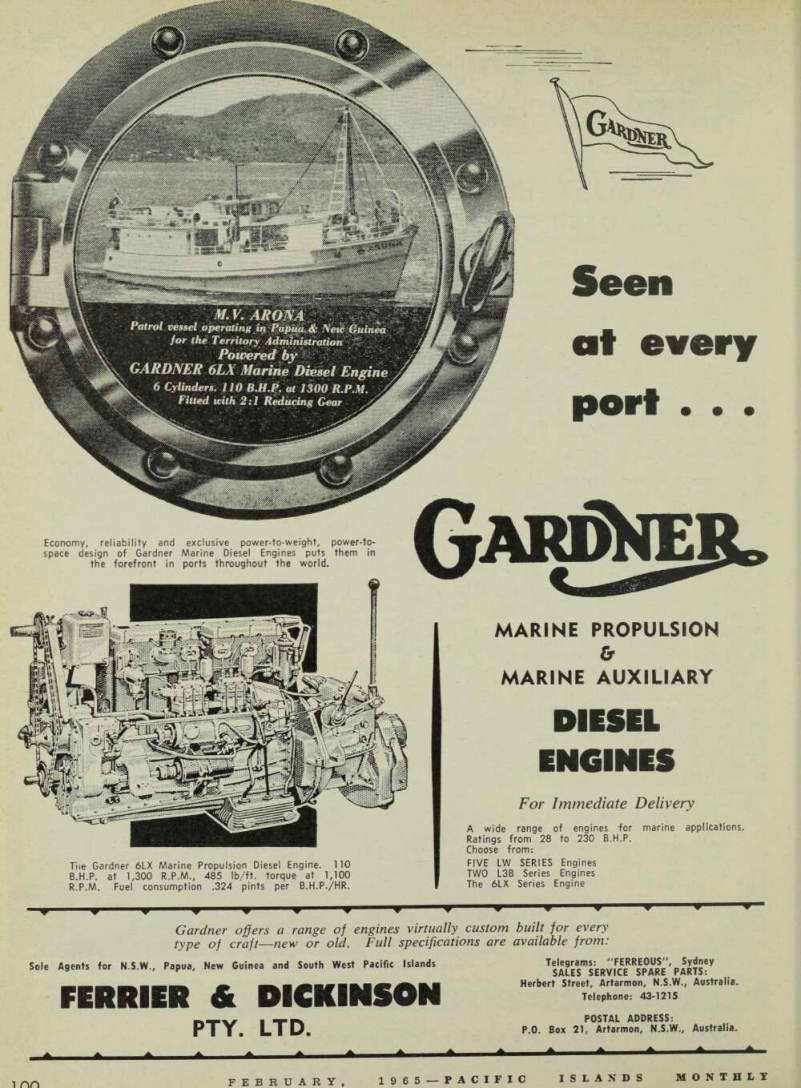
Washington Island, where the Bank Line vessel "Southbank" piled up in December.
She struck the reef in the centre of the picture. Washington Island is owned by Burns Philp and operated as part of the Fanning Island Plantations. Fanning is about 80 miles away.
he watched the Southbank the position did not appear as bad as it was and he had suggested to the captain that if the ship made two or three turns she would get off.
Mr. Palmer has been appointed custodian of the wreck, and has delegated his authority to Mr. W.
Frew, who is Burns Philp manager on Washington Island.
He thinks it may be possible to salvage the lead as it will not deteriorate in the salt water, but he considers there is no possibility of saving the cocoa or the copra.
"Monterey" On
Bora Bora Reef
The Matson liner, Monterey, left Sydney on schedule on January 14 after spending 52 hours on a reef at Bora Bora on December 29-31.
Outward bound from Los Angeles on a regular 42-day Pacific cruise under the temporary command of Captain R. I. Caldwell, while Captain Malcolm Peters was on leave, she ran aground while going through a narrow pass in the reef during heavy seas and rough weather.
She hit the reef at 9.30 a.m. on December 29 and was free at 1.30 p.m. on December 31.
The tug Hippopotame and the Doudart de Lagree combined to pull the Monterey off the reef.
The liner was given a clearance on January 2 to continue her cruise after divers made an inspection and reported that her hull had suffered only minor damage.
The Monterey should have stayed at Bora Bora for a day only, and to make up for lost time her calls at Auckland and Sydney were shortened to enable her to leave Sydney on schedule.
She will go into dry dock at San Francisco on her return to the US west coast.
The Monterey went aground just before she was to disembark passen gers for a tour of Bora Bora.
The divers reported that they had found nothing but minor scraping of the hull—a mark 200 ft long on the starboard side.
"Moala" Sinks After
Collision
The Moala, owned by R. G.
Symes Ltd., of Honiara, sank on January 6 after a collision with the Melika, off the Guadalcanal coast, about six miles west of Visale.
The Moala, 83 tons net, was built at Suva in 1947 for Burns Philp (SS) Co. Ltd., and in 1960 when she was sold to Symes she was based at Santo in the New Hebrides.
She is a sister ship to the Macuata, now owned by Lidgards, Auckland,
the Taveuni, which was sold to Dick Brown, of Rarotonga, and the Cora.
An inquiry will be held into the sinking of the Moala.
Aground On Beqa
Reef
A small French ship, the Tamata, went aground on Beqa Reef, Fiji, on December 15 while on the way from Suva to Vila.
Tamata was formerly the Colorado del Mar (Captain Savoie) and was sold recently for the Noumea-Wallis Is. run.
The Burns Philp ship, Zephyr, pulled the Tamata off. The Tamata then went back to Suva under her own power for examination.
The Tamata had earlier taken the passengers of the Aldebaran from Fiji to Wallis Island.
The Aldebaran went aground on Nanukulevu Reef, east of Taveuni, on November 16, and she was pulled off by the Ratanui and the Zephyr on December 18.
Another Jap Fisher
Strikes Reef
Yet another Japanese fishing ship, the Fuji Marti No. 8, has gone aground on a reef in Fiji waters.
She hit Wakaya Reef early on December 24 while on the way from Suva to the Japanese fishing base at Levuka with 30 tons of fish.
Six other ships from the fleet tried to pull her off, but all early attempts failed.
The Fuji Maru No. 8 was the fourth ship of the fleet to go aground in 1964.
Mr. Robin Powell, a well known Levuka engineer, inspected the ship
on the reef and said later it would cost thousands of pounds to pull her off.
Two Die In Beqa
Passage Tragedy
Two Fijian girls were drowned after a 24 ft ferry launch capsized in the passage between Viti Levu and Beqa, Fiji, on December 16. Three big waves turned the launch over.
Asenaca Kunatuba, 6, was be lieved to have been trapped in the engineroom and was not seen again.
The second girl to drown, Lita Leweniqila, weakened during the
swim and although carried ashore on the back of one of the crew, was dead when she arrived.
The remaining passengers and crew, except one, swam to a reef a mile away where they waited for rescue.
The exception was Miriama Naioro, 65, who clung first to the hull and then to a table before she was picked up by the rescue boat.
P-Ng Trawler
On Papuan Reef
Hekaha, a 66 ft P-NG Admini stration trawler, ran aground on a reef near the northern tip of Normanby Island, Papua, on January 2 or 3 and was refloated on January 6.
There were no early reports of damage or injury to any of the all native crew of 10.
Storm Damage
At Funafuti
Westerly winds on December 19, at times reaching 40 knots, destroyed the Meteorological Department’s jetty at Funafuti, in the Ellice Islands, throwing parts of the debris on to dry land.
The boat shed was blown open and it collapsed on the District Commissioners’ motor boat which, somehow, escaped damage.
The sea was so rough that parts of the sea wall collapsed, and the roadway was badly eroded.
The wharf at Vaiaku completely collapsed, the cement casing was
broken and the stone filling spilled out.
Navigation In Vila
Has Its Dangers
T 4 . . . . , .
In dismissing with costs a claim for £6BO, brought by Union Electnque d Outre-Mer m the High Court of the Western Pacific, Vila, for damage done to overhead power cables at Vila by the master of the trading schooner, Tiare Taporo, Mr.
Justice Trainor told the company that they were the authors of their own misfortune .
The case gave an interesting insight into the harbour situation at The defendants were William Bernard Christophers, of Rotorua, New Zealand, owner, and Geoffrey George, captain, of the auxiliary schooner Tiare Taporo.
The High Court decision followed
an appeal by Capt. George against a fine of £lO imposed by the Court of First Instance at Vila for having attempted “to pass underneath the electric supply cable suspended be tween Iririki Island and Vila”. The Court also ordered him to bear the CO st of the damage done to the cable, which was carried away by the ship’s mast, The accident, which occurred in the early morning, when the Tiare Taporo was being brought up the harbour from her anchorage to the f ue i wharf, cut off the power supply to the Paton Memorial Hospital on the island, which lies about 200 yards offshore.
In his judgment Mr. Justice Trainor said: “Any person who places an obstacle across a way tranversed frequently by people, in such a position that it cannot easily be seen by a person keeping a normal lookout, without placing a
The 75-ton "For tunate-Treasure" in Hong Kong. She was scheduled to make her maiden voyage to P-NG in early December but due to engine trouble she planned to sail in January. She is owned by Mr. Benny Kung, of Hong Kong, and Mr. Peter Lee, of Rabaul. The "Fortunate - Treasure" will trade between Bougainville ports and Rabaul.
Photo: Chin H, Meen.
proper warning of its existence, is looking for trouble.
“Any person who places in such a way an obstacle with the lethal possibility that these cables have, without the slightest warning of their existence indeed might well find himself facing a criminal liability.
“That such obstacles are permitted by the authorities to continue un heralded in the harbour of Vila, where there is no pilot or harbour master (in spite of legislation enacted seven years ago establishing these posts); where charts are difficult if not impossible to come by; and even persons with a working knowledge of the port are divided in their interpretation of the purpose of a buoy; is to say the least of it, difficult to understand.”
Earlier in his judgment, Mr.
Justice Trainor said that Mr. Reid, manager of the stevedoring section of Comptoire Francais des Nouvelles- Hebrides, a large importing company with its own ships, had established that there was not, and never was anything to indicate the existence of such a cable.
Mr. Reid had said that a master of a ship with obstacles in his way would naturally be looking at them and would not be looking up at the skies. The cables were “a sort of dark grey colour” and would be difficult for a stranger to see against the blue and grey of the sky.
Another witness, M. Brault, had
agreed that no warning existed so far as the cables in question were concerned.
Capt. Barley, master of the Con dominium ship, the Navaka, had told the Court that the passage into the inner harbour was difficult for a stranger.
Captain George had said in evidence that he had been to the Marine Department at Auckland where he was able to obtain all the charts he wanted except that for Vila Harbour. He had tried again, unsuccessfully, at Noumea.
It was only on his arrival at Vila that he learned that there is no such
thing in the New Hebrides as a pilot or a harbour master.
“I am quite satisfied that, on the day in question, Capt. George did not know of the existence of these wires,” said His Honor.
“I am satisfied that the defendant was perfectly justified in entering the inner harbour without a chart and that he took every precaution before doing so and showed every concern for the safety of his ship and other shipping that was there.
“I think that any master proceed ing up the inner harbour of the Port of Vila, particularly a stranger, must be completely absorbed in the task
of navigation and his failure to see a cable stretched across the fairway at a height of 60 feet is perfectly understandable.”
Nuclear Test Creates
Demand For Shipping
Because of the increase in freight for Tahiti from France for the new nuclear testing area on Mururoa, Messageries Maritimes will add four of its most modern vessels to the France-Noumea run via Panama and Tahiti. These are the Maori, Marquisien, Malais and Mauricien and will be in operation from March, 1965.
The vessels formerly on this run, the Iraquaddy, Godavery and Euphrate will now be placed on the service to Thailand from France.
So that the local importers will not suffer, Messageries Maritimes are chartering other ships to transport merchandise to New Caledonia.
Loan For Tonga's
New Wharf
The British Government has made a loan of £250,000 to the Tongan Government towards the estimated £500,000 cost of the new wharf which will be built at Maufanga ( PIM , Jan., p. 12).
Dew and Co., of Oldham,
England, won the tender to construct the wharf on a reclamation of two to seven acres of reef, depending on the requirements of Government departments and commerce.
The wharf, when finished, is expected to give a sharp boost to Tonga’s tourist industry, for shipping companies are looking for more and more “off beat” ports for their holi day passengers.
Higher Geic
Freights
The GEIC Government has raised internal freight rates to bring them into line with more realistic business practices. The GEIC Wholesale Society followed suit within a few days.
The society’s decision was in keeping with its policy of maintain ing identical freight rates and fares to those applying to Government vessels.
The new rates, which became effective on January 1, are: • Tarawa to (and from) Makin, Butaritari, Marakei, Abaiang, Maiana, Kuria, Aranuka, Abemama, £6/10/- a ton. • Tarawa to (and from) Nonouti, Tabiteuea, Beru, Nikunau, Onotoa, Tamana, Arorae, all Ellice Islands,
Phoenix Islands, Ocean Island £9/10/- a ton. • Tarawa to (and from) Line Islands, Fiji and BSIP, £l2 a ton. • The rates for the carriage of copra throughout the GEIC will remain unchanged at £B/10/- a ton.
In the past the same standard rate was charged for the delivery of cargo and collection of copra, whether to the nearest or furthest islands from Tarawa.
French Oceanographer
In Pacific
Coriolis, the smart-looking vessel of the Office de Recherches Scienti fiques et Techniques Outre-Mer (OSTOM for short), arrived in Papeete, Tahiti, early January, 2i months out from France. Scientists on board included M. Ritchie of the Institut Francais d’Oceanie in Noumea, New Caledonia.
Before arriving at Papeete, Coriolis had spent four days in the Tuamotus area, especially around Mururoa, the forward French nuclear testing base.
The vessel left Papeete after about five days for Noumea, expecting to continue research into albacore and other commercial fish on the way.
"Lakemba" Won't Be
Withdrawn
There is no suggestion that the W.
R. Carpenter-ship, Lakemba, will be withdrawn from the Sydney-Suva- Vancouver run this year, according to a spokesman of the American Trading and Shipping Co., who operate the passenger-cargo vessel.
An Australian financial newspaper had hinted in a series of articles about the Pacific Islands that the Lakemba was to be withdrawn.
The spokesman said that the Lakemba had been offered for sale to test the market, but no suitable offer had been made.
Purchase Of Jap
Ships
New Guinea interests expect to take delivery in February of three lapanese-built 80 ft vessels, each of 100 tons loading capacity.
It is reported that the buyers are the North-West Trading Co., Madang, W. Byrnes and L. Willis, Madang, and Mr. Cliff Batt, of the Western Islands, The cost by the time they arrive in Madang will be about £96,000 (£32,000 each).
They were built by the Uraga Shipbuilding Yard and are powered by Yanmar diesel engines. They are all-welded. (Over)
"Yankee" Salvage
Efforts To Go Ahead
Ownership of the brig Yankee, which was wrecked on the reef at Avarua, Rarotonga, last July, is now in the hands of US shipbuilder and designer, Mr. Bud Sperber, who in January was in Rarotonga planning her salvage. He hoped to winch the vessel off the reef with its own winches, make temporary repairs in Avatiu and sail her to Pago for complete repairs before going on to the West Coast of the US. He was accompanied by Mr. Richard Foudree and Mr. Frank Donaldson. In December Mr. Sperber had flown to the US to iron-out complex legalities effecting transfer of title.
New Bsip Ship
From Sydney
The BSIP Government has bought a 60 ft Halvorsen boat in Sydney, capable of carrying 40 tons of copra.
It has accommodation for four saloon passengers, a bosun, engineer and crew of five. The builders will deliver her in March. The BSIP Superintendent of Marine, Captain G. Douglas, inspected the ship and arranged to buy her for £30,500, delivered in Honiara.
Fiji Practice
Under Fire
A Fiji marine court of inquiry has expressed concern at the practice of allowing uncertificated persons to act as officers of the watch on inter insular trading ships.
The court, after an inquiry into the stranding of the Burns Philp ship, Ratanui near Point Reef Lighthouse on September 8, recom
mended that immediate steps be taken to amend the law to curb such practices.
It also recommended that masters of ships should personally supervise all alterations in course made by uncertificated officers.
However, the court found it un necessary to cancel or suspend the certificate of competence of the master, Captain James Flood, but said he should be censured, and that the censure should be severe.
It also found that the Ratanui stranded because the uncertificated third mate, Isaia Biu, failed to call Captain Flood when the visibility deteriorated considerably, so much so that the lighthouse could not be seen at 4 a.m.
Another cause of the stranding was the failure of Isaia to detect that the ship had gone off course.
The damage to the Ratanui be cause of the stranding was serious in financial terms, but superficial in that she was still seaworthy after the mishap.
During the inquiry Captain A. S.
Lewis, one of the assessors, com mented: “The third mate had 34 years at sea and is still a third mate but doesn’t know anything about it. It is the fault of the master if he puts him on the bridge. It is a shocking exhibition.”
Derelict "Viti"
Is Up For Sale
The Viti, once used by the Governor of Fiji, is now lying derelict at the Auckland waterfront after having been laid up for more than three years.
The Auckland Harbour Master, Captain D. Burgess, regards her as a nuisance because she is taking up berthage between two wharves.
Mr. J. Enright, of Whangarei, bought the Viti early in 1963 after she had been engaged in the trans- Tasman trade, intending to use her as a fishing ship, but that enterprise did not eventuate.
He pays £l7 a month in dues to the Auckland Harbour Board, and has to employ a nightwatchman. He has offered the Viti for sale.
The Viti was built in Hong Kong in 1940 as a luxury ship and cost £70,000.
French Warships'
Pacific Cruise
Two French naval ships, the Jeanne d’Arc and the Victor Schoelcher, visited Sydney early in January in the course of a Pacific cruise.
They were “welcomed” by a slogan-waving “ban the bomb” group, in a launch, as they entered the harbour. The group was demon strating against the proposed nuclear tests in Polynesia in 1966.
Auckland-Norfolk
Cargo Service
Sarabande, 48 ft ketch, arrived at Norfolk Island on December 15 with a cargo of goods from Auck land and left the next day on the return journey.
The owner, Captain Hurley, hopes to make regular freight trips to Norfolk, thus providing a much needed service between the island and New Zealand.
The Sarabande was a French lobster boat till Captain Hurley bought her two years ago and sailed her from Guernsey to NZ with a crew of four girls and five men.
Suva Slipways Can't
Handle Work
The new slipways at Suva wharf are incapable of handling all the ships wanting to use the facilities.
In some cases shipowners have to book space six months in advance to ensure maintenance.
To help to meet the situation the Fiji Standing Finance Committee has agreed to the reconstruction of an old slipway at a cost of £lO,OOO.
The brig "Yankee" is still fast on the reef at Rarotonga, where she struck last July. See story.
Photo: Robert B. Johnson.