Territories TALK-TALK
pp. 99-103 · Read in the full issue
With Tolala
Of all the interesting stories that have appeared in PIM from time to time (and, during my 35 years’ reading there have been plenty), the one which has given me most interest and pleasure was that appearing in the December issue (p. 29) by a “Frustrated Islands Resident” on the waste of local skills in the South Seas.
IT showed how resolute the various administering bodies have been in forcing our atom-age standard of living on near-primitive people in the name of Progress and Education without any option.
Because we are intoxicated with our own special standard of living, it does not necessarily follow that everyone else should be.
It is good to read the views of this contributor, who so neatly cuts down to size some of the inflated bureaucrats who will persist in hav ing constructed the most unsuitable of edifices for dwellers in the tropics —be they of any hue. And for why? the writer asks.
Do we imagine that in the rat race for racial assimilation the native has to be housed in a western style, fibro-walled, iron-roofed struc ture before he can feel that he has been accepted in the Western world? (and who knows whether he wants to be accepted or not?) Stupid and all as is the question, it is surprising how many do gooders and others have that very idea; That the native must adopt our way of life —our homes, our clothing, our thoughts, our morals and (God help them) our manners.
How wrong can they be?
At the moment the Western world is going through what might be, euphemistically, termed a transitional period; but it really is a vacillating, tergiversating stage of our develop ment, and the very subjects which mostly interest the “less advanced peoples of the world” (to use another euphemism!) are the subjects on which the Western world cannot, will not, or is unable to agree: Racial assimilation, educa tion, political freedom, social welfare to name but a few.
Don’t let us imagine that because fibro walls and an iron roof possess a greater status symbol to us than a native-material house that the natives have the same idea.
I recall a chief down in the Short lands (British Solomons) some 50 years ago had a weatherboard house erected on his island for him by an “enterprising” European trader who wanted to ingratiate himself for the chiefs strings of copra.
The chief watched the erection without much interest. It was furnished, a feast was held, after which the chief locked it up and remained in his own native house.
He, himself, was the chief. He had no need to have a house proclaim his status,
Sensible Building: What A
benefit it would be to the emerging people of the Pacific were such a man as “Frustrated Islands Resident” appointed Chief Pooh-Bah of Gov ernment Buildings in the Pacific— with a free hand (no mousy clerk in Whitehall or Canberra telling him what he can do).
Imagine saving 10 to 20 per cent, on building costs of schools, houses, hospitals and offices!
Use Money Elsewhere Imagine the increased comfort, the preservation of Islands scenic beauty and being able to channel from Aus tralia’s annual grant to Papua and New Guinea alone a few odd million pounds more for actual native welfare instead of making the “expatriate” public servants nice and cosy and comfortable in homes to which they were accustomed in Burwood or Balwyn.
I have been told that a dissection of the Australian annual grant expenditure in P-NG makes most interesting reading. I can quite believe it, but I’ve never seen one.
A Lecturer In Architec
TURE: Nor is “Frustrated Islands Resident” the only advocate for native-material buildings. In October, 1963, a senior lecturer in architecture at the Melbourne University, Mr.
Balwant Saini, made an eight months’ survey of building con-
ditions in P-NG under a Common wealth Research Fellowship.
In a New Guinea newspaper he is reported as saying: “I have the greatest admiration for indigenous buildings as they exist. . . . They not only suit the environ ment but have been developed rationally over a long period of trial and error. . . . Once it can be
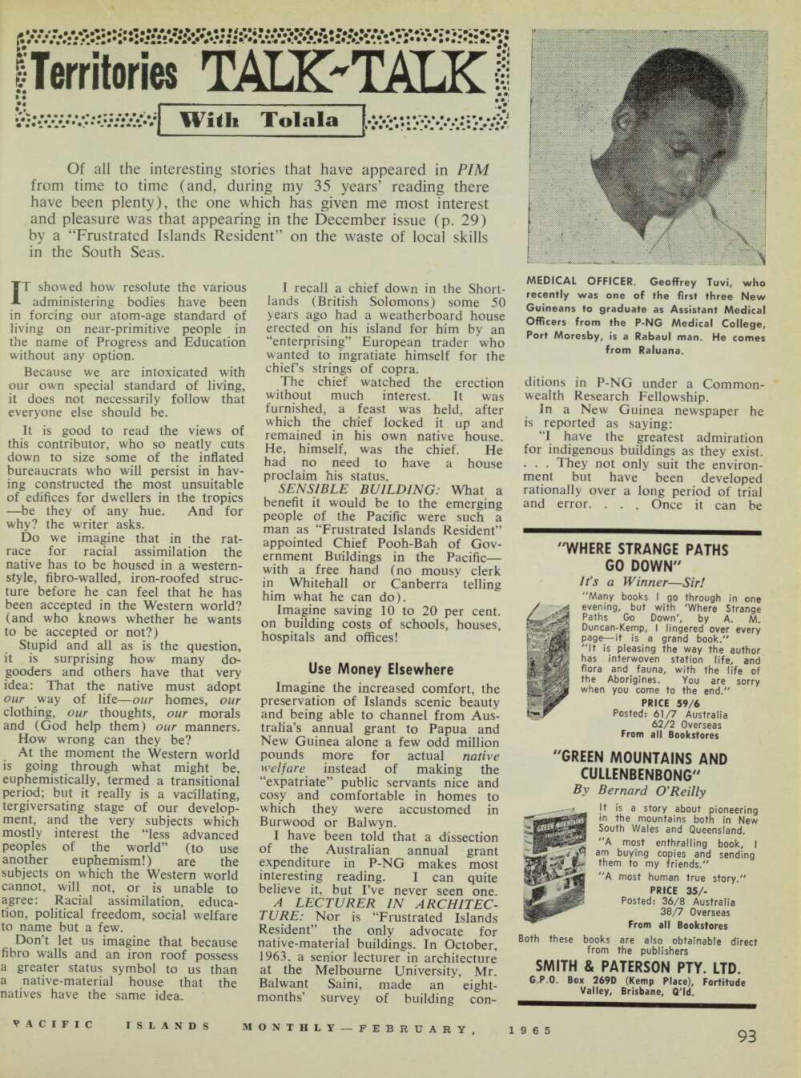
MEDICAL OFFICER. Geoffrey Tuvi, who recently was one of the first three New Guineans to graduate as Assistant Medical Officers from the P-NG Medical College, Port Moresby, is a Rabaul man. He comes from Raluana.
shown that native materials are as good as imported material—if not better in performance and appear ance—they are likely to become more popular.”
Anyway, 1 note the good old routine of erecting western-type buildings is still maintained and specific Australian interests are getting in for a good slice of the £2O-odd million annual grant.
Personally Speaking: As
for my own experience in New Guinea with native-material build ings—homes, stores or what-you-will —it has been a happy one.
My wife and I have spent many comfortable, cool days in these homes long before ’friges and social status found their way to isolated islands.
I learned from my native teachers a few tricks about tying down the sac-sac roof so that it would stay put during the nor’-westers; which timbers to use here and there and when and where to use this sac-sac leaf.
Alack-a-day: Practical-minded ex perts point the way for saving millions of pounds, but the Estab lishment rolls on and on . . . and on.
Well. I suppose that when you have converted a primitive people to wear trousers and boots and nice, long black narrow ties, you couldn’t very well ask them (even if they can’t afford it) to live in native material houses. . . . Not bloody likely, as the Doolittle woman said.
Those Altruistic Students
AT this time of writing 25 Aus tralian and overseas students are leaving Sydney for New Guinea where “they will brave primitive living conditions” to build extensions
to schools in the Mt. Hagen area and in the Madang district.
If the students’ task is done as efficiently as the students’ Public Relations Officer has done his job, then all will be well.
For the past three or four days I have heard and read in no un certain manner of this philanthropic pilgrimage which, as The Sydney Morning Herald in a eulogistic sub leader said: has “the dual aim of helping the natives in a practical way and promoting racial harmony”. (How much more backward can we bend in our promotion of racial harmony. Methinks we bend too much. And must it always be our task to do the bending?) The leader of the party—a tech nical officer at the Aeronautics Dept, of the Sydney University is reported as saying: “The students would sleep on the floors of dormitories at their work sites . . . build their own toilets and showers and food would be cooked over fires”.
It’s to be hoped that, having to face up to these hardships, they do not get the idea they have the privilege of disseminating any fancy theories or doctrines—religious, poli tical or social—which may further confuse the already over-proselytised minds of the New Guineans, always bearing in mind the fact that the
most embarrassing repercussions come not from what is said, but what the native thought was said.
Abstract subjects are best left alone in conversing with many natives unless you have a compre hensive command of either their own language or pidgin.
The President Johnson mumbo jumbo in New Hanover is a very good example of this.
Let’s hope there is no unpleasant aftermath. New Guineans at the time when these brave builders arrive, are suffering from a form of near-jitters; they are touchy. I would much rather have seen and heard of these altruistic students going up around Kempsey, or that away, and construct houses for the aborigines.
They were an international crowd: From Aussie, US, England, NZ, India, Yugoslavia, Pakistan, Indo nesia and Malaysia. One presumes they were screened, but perhaps Uni away, constructing houses for the action.
When The First
Bombs Fell
ALTHOUGH you won’t be reading this until February, I am writ ing this on January 4, and that is the 23rd anniversary of the first enemy bombs on Rabaul.
To put you in the picture, let me quote the opening paragraph of a two-column-headed story in The Rabaul Times of 9/1/42: “At 10.45 a.m. on Sunday, 16 heavy Japanese bombing planes, flying in forma tion. approached Rabaul from a north-westerly direction and at high altitude”.
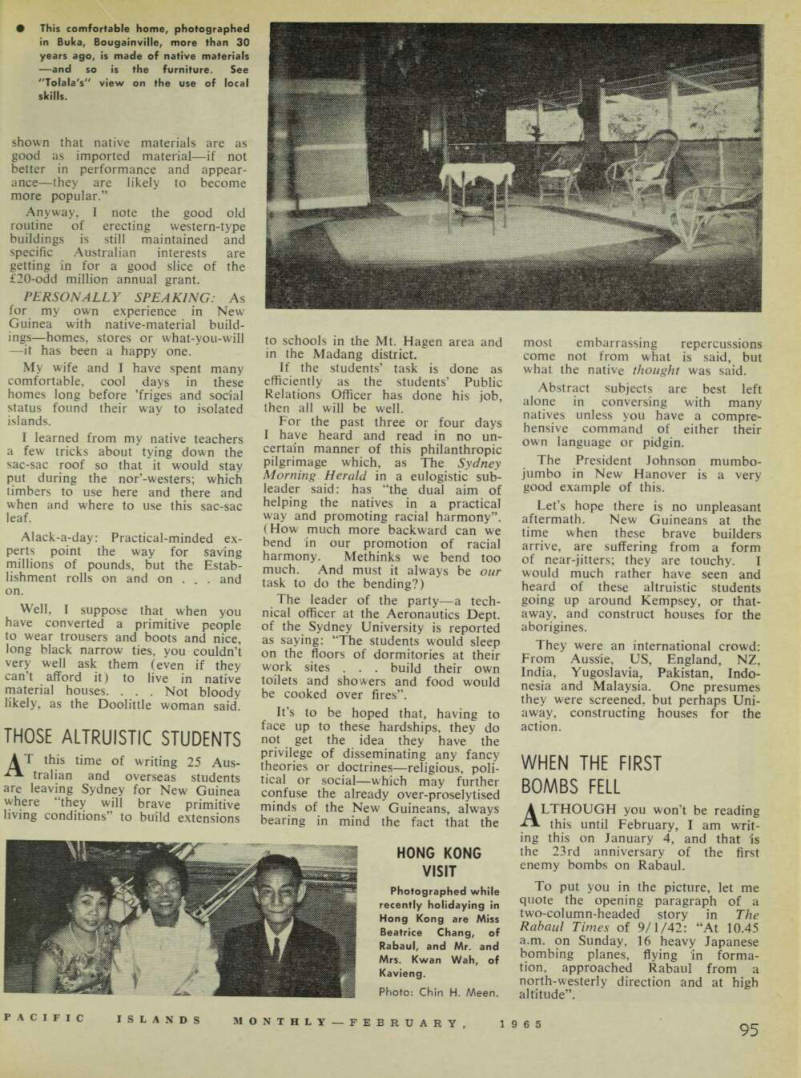
This comfortable home, photographed in Buka, Bougainville, more than 30 years ago, is made of native materials —and so is the furniture. See "Tolala's" view on the use of local skills.
Hong Kong
Visit
Photographed while recently holidaying in Hong Kong are Miss Beatrice Chang, of Rabaul, and Mr. and Mrs. Kwan Wah, of Kavieng.
Photo: Chin H. Meen.
Rabaul’S First Bombs: The
story goes on to say the bombers passed over their target, which had been the buildings to the south of the Lakunai airstrip and which happened to be the Rapindik gov ernment native hospital. Score: Twelve natives killed, 11 seriously wounded and eight minor injuries, all due in the main to curiosity to see the bombers instead of going to ground as ordered.
And because there was a pathetic angle about these first casualties, I quote another paragraph from “Around the Town” column, penned by “Gin Sling”. For economy of words in describing such a tragic incident it takes some beating, especially when you compare it with some of the sensational current re ports of minor incidents in P-NG in the Australian Press.
“Gin Sling” wrote: “Some dozen natives from the Woodlark Group in Papua got adrift from their local waters recently and spent a considerable time in a canoe, foodless and waterless, eventually they made Metlik plantation on the toe of New Ireland, and from there they were brought in to Kabakaul by Oscar Rondahl, who handed them over to the government. The cast aways were brought to Rabaul and several of them had the bad luck on Sunday to get in the way of bomb splinters. And they died.”
The whole trouble was due to the fact that the “castaways” hailing from the Woodlarks had been domiciled at the Rapindik native hospital when they were brought in and hadn’t a clue as to what a Japanese bomber meant.
Incidentally, the bombs dropped on January 4 were the only bombs dropped on Rabaul by the Japanese, except, of course, those at Praed Point on the gun emplacements.
The Japs did not want Rabaul destroyed; they wanted it for their most southern headquarters, as a springboard for their attack on Aus tralia. And they got it, but fortunately did not spring very far.
Tench Island
THERE are stories in both Decem ber and January issues of PIM regarding Tench Island, which lies north of Kavieng. The stories are interesting. The December account mentions the first landing in the Australian regime as being in 1931 by Capt. McLaren.
It does not mention, however, that a ban had been placed by the German Government in the early
1900’s on anyone landing, or having any communication with the island.
There was a tacit understanding with the victorious Australians that this ban be continued. The original idea was to eventually make scientific observations, after the lapse of a certain period, of a people left isolated and uninfluenced by the progress of modern civilisation.
Unfortunately the scientific guinea pig had its throat cut in 1931 when Skipper McLaren, ever the zealous missionary, defied the ban. Govern ment reaction was anything but kindly at the time and other mis sionary organisations, who had rigidly respected the ban, were hostile.
Matupi Island
ONCE again Matupi Islanders are in the news concerning an out break of a disease that might be termed anti-survey-peg-itis.
Only the other day I was thumb ing through the autobiography of Dr.
George Brown, the Methodist pioneer missionary, who mentions that when he saw Matupi in 1875 he was told it was a comparatively recent up heaval and some men remembered when it didn’t exist.
So if the truth were known I don’t suppose the chappies who landed on the hot, volcanic beach after the eruption had very much title to it anyway.