And France
pp. 63-73 · Read in the full issue


It's Timb Britain
Did Better In
The New Hebrides
A candid survey of a “forgotten territory” by ANGUS McBEAN, who recently completed 12 months in the New Hebrides as a school teacher.
With London and Paris reportedly discussing the “famous” Protocol which regulates relations between Britain and France in administering the New Hebrides, it may be hoped that, for the sake of the indigenous inhabitants, and of the long-term interests of European trading and plantation enterprises, a more effective division of responsibilities can be devised.
AT the moment, after 60 years of joint Administration, this small, “forgotten territory”, with its 5,700 square miles of land, its supposed population of about 60,000, and its almost undeveloped mineral, timber and agricultural resources, still has no unified health or education services.
Its copra prices are the lowest in the Pacific. It has only a handful of New Hebrideans educated or trained beyond primary levels— which is not surprising, as it is only a few years since the administering Powers regarded themselves as in the least responsible for the educa tion of the people.
Population Increasing
Continuous depopulation was the hallmark of the entire territory until a few years ago when, after falling to perhaps a third of its pre- European level, the population showed signs of becoming stabilised.
Largely as a result of World Health Organisation efforts, it would seem today to be increasing.
But the New Hebrides is still an empty land. This, in some ways might be for the best, since huge areas of the bigger islands have been alienated by large and shadowy land purchases, many of which would not stand up to close investigation.
Meanwhile, however, they are utilised neither by Europeans nor by natives.
To make up for this, the Con dominum has three Administrations, two sets of police, two or three legal currencies, two National Anthems— and no nationality for the New Hebrideans themselves.
Recently some Australian and New Zealand newspapers carried an article, reprinted from one of the serious London Sunday papers, under the by-line of its Paris corres pondent, describing in glowing terms the idyllic situation in the New Hebrides. According to this, the British and French Governments are vying with each other to provide for the fortunate inhabitants all the benefits and delights of European civilisation. It therefore would seem that, whatever weaknesses may exist in the administration of these islands, public relations are in excellent hands.
Administrators Coy
Unfortunately, the situation is not quite what it was painted in that article or similar effusions describ ing the Condominium as a striking example of international co-opera tion.
It is true that the present teams in the British and French Services are, on a personal basis, maintaining or building up as high a level of friendly collaboration as possible, and that, with very limited budgets, they are now desperately attempting to set the house in order before the expected winds of change begin to blow in their direction.
But the desire in many quarters
to draw as little attention as possible to conditions in the group and the fear of “rocking a boat” bedevil many attempts to present a true picture of the existing situation or to introduce needed reforms.
Administrators do not want to admit facts that might be damaging to the High Commissioners based in Honiara and Noumea, or to the governing powers in London and Paris. Missionaries and business firms do not want to offend local administrations for fear of reper cussions. Traders and plantation owners are happiest when the least outside attention is drawn to the general set-up in the group. Yet all may well be in the same situation as the monkey who, one very cold day, sat in a pot of water as it was gradually heated up on the fire, and was afraid to move until it was too late.
State-less People
For these reasons, the present article is based on personal observa tion or on publicly known facts, and no information was sought or given specifically for publication.
After nearly 60 years of Con dominium “protection” the New Hebrideans are virtually stateless since no New Hebridean, it is generallv believed, can become either
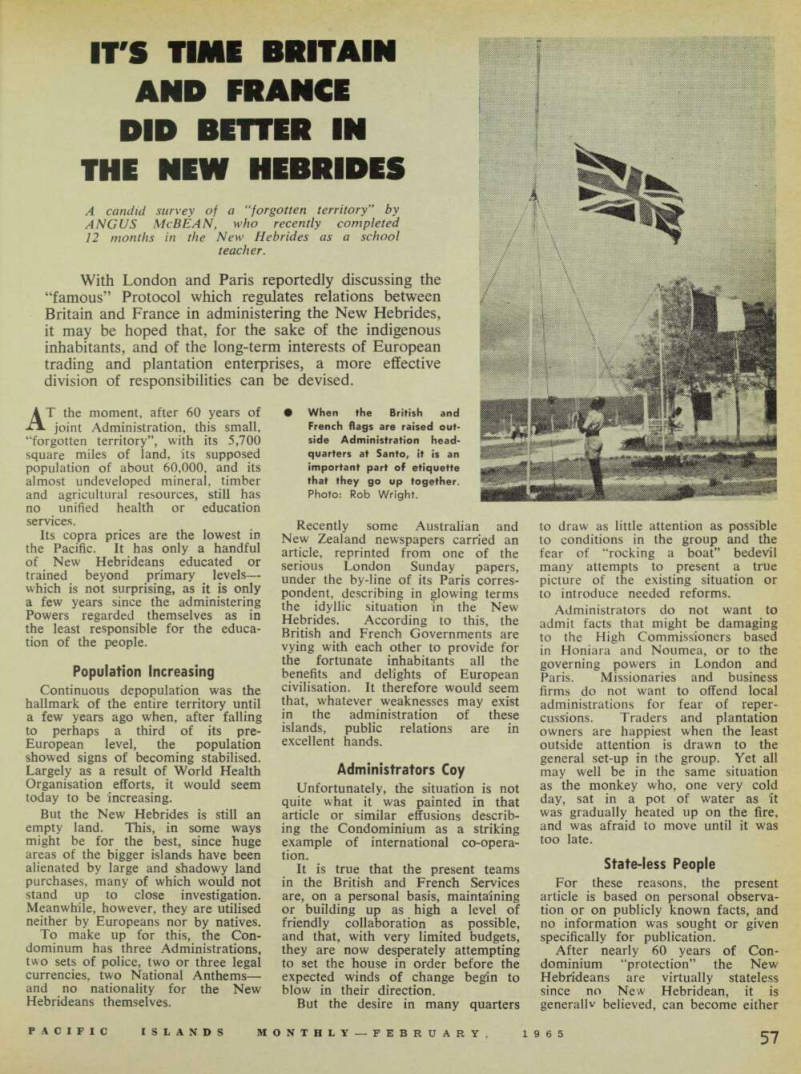
When the British and French flags are raised out side Administration head quarters at Santo, it is an important part of etiquette that they go up together.
Photo: Rob Wright.
a British or a French subject, and there is no New Hebridean State.
It appears, however, that if a New Hebridean opts to serve in the French armed forces he can be given French citizenship. New Hebrideans who are chosen for training abroad, or who for other reasons have to travel, have to make do—by special courtesy arrange ments with identity documents other than a passport.
Three currencies (or even four if we count the theoretical “gold francs” in which postage stamps are expressed) are valid in the territory.
Yet only two—the Australian pound and the French Pacific franc (New Hebridean variety) are current.
These two have a simple conversion rate (one florin equals 20 francs); but because there is no smaller French coin or banknote than five francs, and because the quantity of Australian coins is limited, all prices tend to be rounded up to the nearest sixpence or even shilling and, if not, customers have chewing gum, lollies (at a penny a lolly) or boxes of matches foisted on them as change.
American Legacies
Such roads as exist are mostly legacies from the American Armed Forces’ occupation of parts of the larger islands. But in most cases they have been maintained so badly that the Americans would not recog nise them if they returned.
Airfields, too, have been allowed to revert to bush in many cases.
Admittedly, the present popula tion would not have justified main tenance of all to former standards, but a modicum of essential attention would have held them to a useable level.
Now, fairly considerable sums are being spent in reconstructing some of these roads and airfields, but only too frequently the basic structure
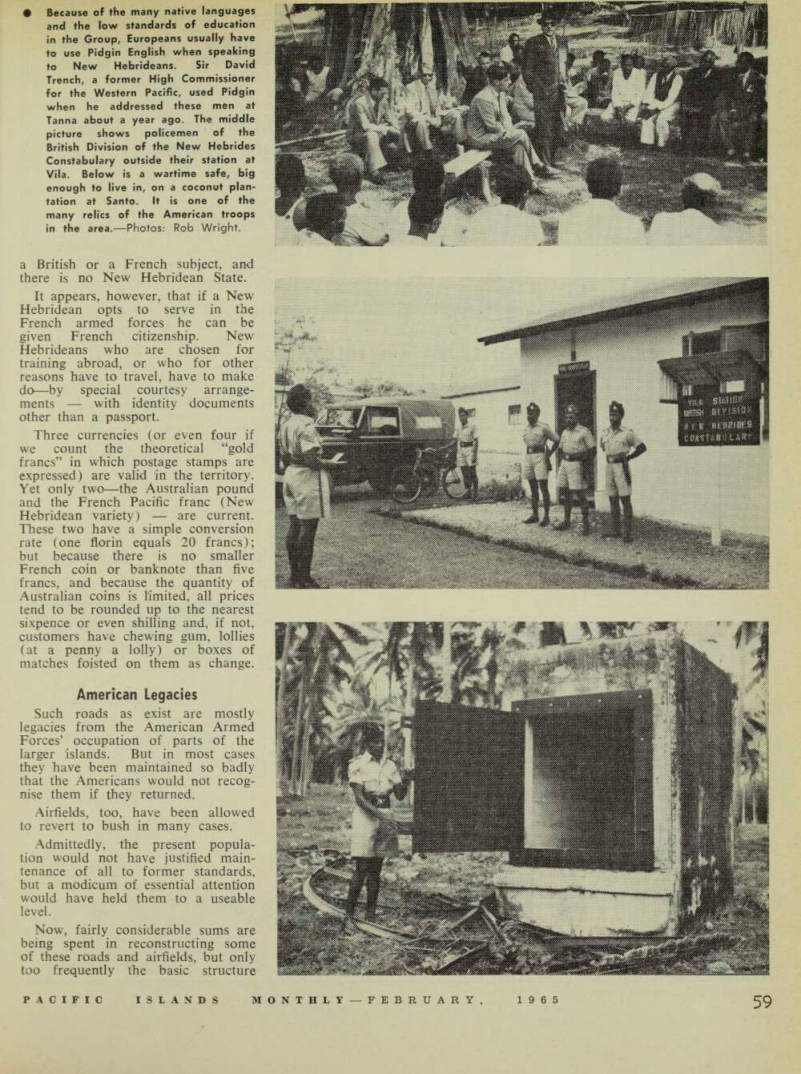
Because of the many native languages and the low standards of education in the Group, Europeans usually have to use Pidgin English when speaking to New Hebrideans. Sir David Trench, a former High Commissioner for the Western Pacific, used Pidgin when he addressed these men at Tanna about a year ago. The middle picture shows policemen of the British Division of the New Hebrides Constabulary outside their station at Vila. Below is a wartime safe, big enough to live in, on a coconut plan tation at Santo. It is one of the many relics of the American troops in the area. —Photos: Rob Wright.
has been weakened by tree-growth or washouts.
Almost alone among the South Pacific territories, the New Hebrides has suffered from continuous de population from the first days of intensive European contact.
It is believed that this trend has now been checked; but, since no census has ever been taken, and there is no official registration of births and deaths, the exact situa tion is not known.
It is generally considered that some 60,000 New Hebrideans now live in the group, a figure which might be half or a third of the original population. Such figures as are available are based on the WHO yaws campaign or on missionaries’ unofficial records.
Scourge
Malaria is, of course, endemic and for this the Europeans cannot be held responsible. Indeed, the New Hebrideans enjoy a relatively strong resistance.
Yaws have been virtually elimina ted as the result of a WHO cam paign some years ago.
On the other hand, tuberculosis is still a scourge. Fortunately, again, the WHO has stepped into the breach and an immunisation cam paign, currently in progress, may check or even eliminate this disease.
Some indication of its prevalence and danger can, however, be given by the fact that in one group of 80 teenage boys known to the writer— a group drawn from favoured environments and under the care and supervision of a trained nursing sister—no fewer than four acute cases of tuberculosis were diagnosed within nine months and had to be hospitalised.
Although—or perhaps because—
a large number of bodies assume responsibility for health matters, tuberculosis, malaria, enteric fevers, dysenteries and other diseases are rampant, and infant and maternal mortality stands at an unknown but certainly extremely high figure.
The Condominium (Joint) Ad ministration, the British Administra tion, the French Administration and half a dozen missions all dabble to a varying extent in medical affairs, with varying methods and from varying viewpoints.
Common to all, however, are in adequate resources in relation to the magnitude of the problem, A very large proportion of the cost of such services as are provided is borne by the patients or by churches in Australia, New Zealand and elsewhere. The amount of money and other assistance contri buted by the two “protecting” powers themselves must be very small certainly when compared with contributions made by Aus tralia and New Zealand to terri tories within their responsibility.
No Secondary Schools As far as education is concerned, the New Hebrides must be unique among Pacific territories with popu lations over 5,000 in that up to now no branch of the Admini stration has provided any true secondary school within the group.
Admittedly, the Presbyterian Mission has maintained for some 10 years a school which, at the cost of great sacrifices by the mother churches in Australia and New Zealand, by the New Hebridean Presbyterian Church and by the pupils and their parents,
Mr. M. Delauney, the French Resident Commissioner.
Mr. A. M. Wilkie, British Resident Com missioner in the New Hebrides. He is at present on leave in England.
seeks to attain post-primary level.
Most of the few New Hebrideans who have been given some form of schooling above the equivalent of Standard 4 or 5 have been taught at this school.
Apart from this, over the last few years an annual quota of from four to six boys has been granted secondary scholarships to the BSIP secondary school on Malaita, and some children from the New Hebrides attend secondary schools in Noumea. Very few, if any, of these are New Hebrideans by race.
Incredible as it may seem, it is only in the past five years that the Administrations have done anything
significant towards educating the people.
Half-way through 1959—as the result, it is believed, of a scathing report on the level of education in the territory—the British Service appointed an Education Officer, Before then, education was entirely carried out on the British side by Protestant missions Presbyterian, Melanesian (Anglican), Church of Christ, Seventh-day Adventist and Apostolic—and, on the French side, by the Catholic Church and the French Evangelical Church, Considerable changes have taken place since 1959. On the British
side, the work of the missions (known as the Voluntary Agencies) has been co-ordinated to a consider able extent and one or two Assistant Education Officers have been ap pointed.
Moreover, last year a teachers’ training college was established at Vila with Colonial Development funds and staffed partly by the British Service and partly by the Voluntary Agencies. It is hoped that an Administration secondary school will be established at Vila next year.
For their part, the French have also begun establishing primary schools.
Altogether there are some 230 primary schools in the British Service, with over 8,000 children attending. In the French Service there are 17 government schools and a slightly greater number of other primary schools, with a total enrol ment of about 4,000 pupils, of whom some 1,700 are in the Government schools.
Little Assistance The primary schools in the British Service, run by the missions, are assisted only indirectly or to a very limited extent by the administering power. All of them suffer from a lack of trained or even educated staff and all depend largely on the villages and the pupils themselves for their construction and main tenance, and the payment of teachers, although in future the Administration will meet most of the cost of trained teachers.
In contrast, the few French schools are established in “key” positions, usually in smart, well designed, costly buildings and are staffed by trained French teachers and/or trained Melanesians, who, in most cases, have been imported from New Caledonia. Here the children are given free education, free text-books and, where necessary, free board.
In the British schools, fees range from a few pounds a year, in the case of village schools, to between £3O and £4O a year at a school seek ing to attain full secondary level.
This is big money to a New Hebridean family and its payment represents a real sacrifice. Multiply it by 10 and you would have its approximate equivalent to an Aus tralian family.
None of this money goes to the European teachers, who are paid by the parent churches.
It has to cover maintenance of buildings, the students’ food and general expenses of the school. To make ends meet, obviously a large
proportion of the children’s time and energy has to be spent in the gardens and plantations providing most of their food.
To see what education in these circumstances really means to a pupil, a specific example is worth more than a dozen generalisations.
A Schoolboy's Life In a case closely examined by the author, the day’s work begins for the boy cooks on duty and for the “cowboys” at about 4.30 a.m.; for the rest at 5.45.
Breakfast served at 6.15 consists of five or six ounces of bread (baked by the boys) and a cup of tea with sugar and milk.
Lessons are from 7.15 till noon, when dinner is served consisting of a plate of rice over which a ladle of “soup” is poured. The “soup” is made for 100 students by taking several gallons of water and adding salt and some leaves of “Chinese cabbage” or other greens (or some pumpkin when available), together with the contents of two 14-ounce tins of corned beef.
From 2 to 5 o’clock each after noon all the students have to work solidly in the gardens or plantations, or on the maintenance or extension of buildings.
Supper consists of manioc or yams boiled in water and, if the boy cooks on duty for the week have been lucky enough to catch some fish or crabs, these are also boiled with the vegetables.
After supper there is an hour or two hours’ “study period”, according to the age of the students, who are, in fact, between 12 and 20 years of age.
The diet described does not vary except that about once a term one
of the school’s cattle is killed. A really big feast is then enjoyed and the rest of the carcase is salted down and made to “spin out” for as many further days as possible.
This is what it means to an indigenous people when they bear almost the whole burden of educa tion themselves. It is what it means when the school’s finances permit only 3/- a week to be budgeted per head for the purchase of food— less than 6d a day per head for the tea, sugar, flour, salt, rice and the fourteen-hundredths of an ounce of meat per day which is all that can be bought for the money.
Yet, even to provide the £35 needed annually to meet this budget represents a heavy and difficult sacrifice for all but a few New Hebridean families.
Police More Important It is typical of the Administra tion’s general attitude that police forces, apparently, are regarded as much more important than educa tion. For example, in the last pub lished budget, in the British Service a total of £38,777 was spent on police forces and prisons; and a total of £21,402 on education.
Comparisons of this relativity with the budgets of England or France, or even with the budgets of other Pacific territories would be very illuminating. One thing is certain: whereas policemen are in conspicuous in a town or village in the administering countries, Vila appears to pullulate with them.
There are, of course, two com
Kawenu Teachers Training College at Vila was the first educational centre of any sort set up by the British Administration in the New Hebrides.
Photo: Rob Wright.
plete sets of policemen and police officers—British and French; and it is generally believed and stated that there are over 50 of them in Vila, whose population would scarcely exceed 3,000. Yet the New Hebrideans are basically law abiding and extremely honest.
Economic Disparities
An aspect of the Condominium administration that causes constant friction and unrest lies in economic disparities, combined with housing shortages and fantastic land prices in the two urban centres of Vila and Santo.
In Vila, for example, where an indigenous labourer does well if he averages £5 or £6 a week, he has to pay £8 or £lO a month for the rent of a single, unfurnished room.
These rooms are without amenities or even a sink. They are rectangular boxes eight feet by 12 or so, with a door, and a couple of windows in long, corrugated-iron buildings that are divided into five or six units.
The cost of construction of these units must have been recouped within one or two years at the most at £8 or £lO a month rent.
While such is the situation of the ordinary New Hebridean, Admini stration employees are, quite rightly, adequately paid and housed while, of course, expatriate European officials in the British Service enjoy what must be regarded as very liberal salary, allowance and furlough conditions.
Nevertheless, all are “poor rela tions” when compared with their colleagues in the French Service— a fact which scarcely ensures the contentment of joint teams.
Figures are not readily available, but it is claimed that French salaries are up to twice the level of their colleagues’ in all branches of the services—from junior New Heb ridean clerks, medical dressers or constables right up to European departmental heads.
Some two years ago, a strike occurred in the police force of the British Service because it was alleged that, rank for rank, the British policemen were receiving less than half the wages of their equiva lent colleagues.
Wholesale dismissals resulted, followed by some wage adjustments, but according to the latest published figures, the British police forces are still not up to establishment strength.
It has seldom been claimed that British Service salaries or wages are inadequate; but the situation becomes unpleasant and bound to result in
dissatisfaction when a joint admini stering power pays salaries and wages that bear no relation to the cost of living in the territory.
It is rumoured, for example, that a New Hebridean non-commissioned police officer in the British Service receiving some £BO monthly was offered over £3OO a month to join the French Service in a similar capacity.
It is also claimed that married couples, both teaching, in the French Service, draw jointly something like £6OO a month.
With such salaries and wages, it is not surprising that the whole cost and wage structure is unbalanced and that there are shocking contrasts in ways of living.
It is therefore gratifying to know that experts in London and Paris are trying to revise the Protocol.
What will emerge from their deliberations is difficult to imagine.
But when you consider the over lapping of individually inadequate services in the realms of health and education, the jostling for prestige in showy, window-dressing projects or activities such as French naval visits and parades, and the disparity be tween the attitudes of the two pro tecting Powers, you wonder whether the group could not be divided into geographical zones of influence and administration, while ensuring that everything possible was done for the eventual independence of the group.
In view, however, of the past attitude towards the education and training of New Hebrideans, the New Hebrides must be regarded as one of the last territories in the Pacific likely to be able to stand on its own feet.