Fiji Increases
pp. 55-61 · Read in the full issue



Sports Tempo
From Jack Adlington, in Suva With eyes firmly fixed on the Second South Pacific Games to be staged at Noumea in August,
1966, many sports in Fiji are
ready to move into second gear with a planning and build-up programme once specific details of the events are forthcoming.
SUCH preparedness is only natural in a community as sports minded as this, and with news filter ing through of intensive training schemes afoot in other competing territories, there is a general realisa tion that Fiji will find victory medals more elusive next time.
At the First Games, in Suva in September, 1963, Fiji had a runaway win by capturing 34 of the 59 gold medals, and gaining 175 points in the unofficial score. New Guinea, next in line, gained 9 gold medals for 62 points.
Athletics, which earned Fiji a feast of 12 gold medals and 30 other medals in the Suva Games, are certainly not being neglected now.
The Fiji Amateur Athletic Associa tion are active every Saturday after noon that weather permits and their efforts are beginning to bear fruit.
Stepping up the tempo of prepara tions recently they staged a night meeting under floodlights at Buck hurst Park, Suva—the first of its kind. In spite of threatening storm conditions two national records were bettered and other fine performances were put up by a collection of the Colony’s best athletes.
Navusolo, an 880-metre runner previously, clipped more than two seconds off the 1,500 metre record, while young Manueli cut the junior record for this distance down by half a second.
Star junior sprinter Rupeni was in fine form, winning both the 100 and 200 metres, the former in 11 seconds —an excellent performance on a wet track.
Racule, who ran the P-NG pair, Harrison and Maiana, a close third in the Games 400 metres, ran away from the field to come within 1.2 seconds of the national record.
The greasy track did not suit champion woman sprinter Ramacake who trailed the leader Vake in the 100 metres. Both fell, leaving all rounder Turukawa to snatch an un expected victory.
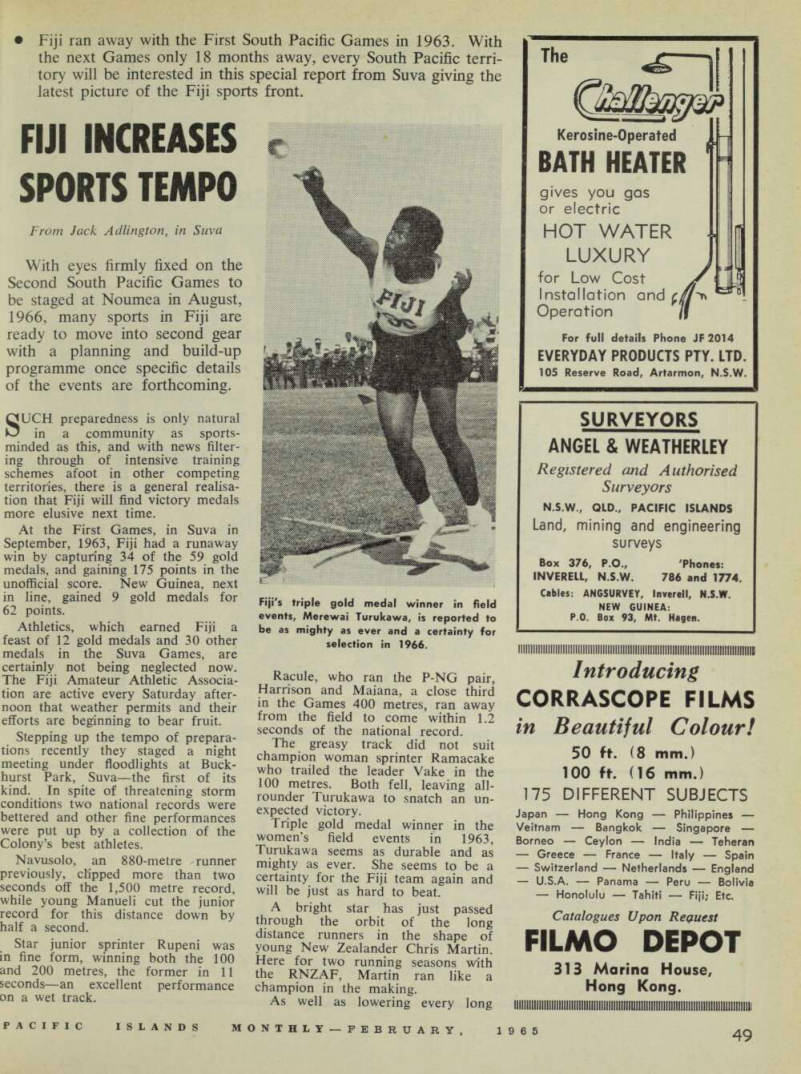
Triple gold medal winner in the women’s field events in 1963, Turukawa seems as durable and as mighty as ever. She seems to be a certainty for the Fiji team again and will be just as hard to beat.
A bright star has just passed through the orbit of the long distance runners in the shape of young New Zealander Chris Martin.
Here for two running seasons with the RNZAF, Martin ran like a champion in the making.
As well as lowering every long
Fiji's triple gold medal winner in field events, Merewai Turukawa, is reported to be as mighty as ever and a certainty for selection in 1966.
distance running record from the 1,500 metres upward, his style and approach to the sport has left behind a lasting impression and a standard of brilliance which could serve as a landmark for any aspiring runner.
Swimming was another event which earned Fiji a glut of gold medals last time and, fully aware that this supremacy will be challenged in Noumea, organisers and swimmers alike have not been treading water in the interim period.
Being a sport now of the very young it is possible that winners in 1963 are going to find themselves ousted by fresh and younger swimmers surging up from below.
Signs are very evident that swimming since the Games has received a shot in the arm at the other main centres in Fiji.
Both Nadi and Lautoka have many youngsters who will be knock ing at the door of national selection when the time comes.
A national swimming champion ship to be held at Suva in the near future will enable selectors to assess capabilities and will help to provide the nucleus of a swimming team to
Ana Ramacake at Suva gained gold medals for the 100 metres and the 100 metres relay, silver medals for the 200 metres and the long jump and a bronze for the 80 metres hurdles. She's still in business but local competition has increased.
contest for honours in the new pool at Noumea.
New Caledonia will doubtlessly be out to show compatriots in French Polynesia that the men’s basketball supremacy is not their’s for all time, even though it looks that way at present.
But Fiji is determined not to haunt the bottom of the competition ladder in the future, and from being relative newcomers to the sport two years ago, Fiji basketball has literally gone ahead in leaps and bounds during the last two seasons. In Suva particularly, enthusiasts have been pounding the courts with increasing purpose and ability.
More players than ever flocked to the floodlit venue at Buckhurst Park last season, and now with a tour of New Zealand being seriously considered, interest is building up to a promising climax. Provided good coaching is available over the next two seasons, Fiji will take a basket ball side to Noumea that can tangle with the best.
Last year saw the disappearance of many familiar faces from the amateur boxing scene. Notable among those who hung up their gloves was Moses Evans of light middleweight fame who has long been one of Fiji’s best craftsmen in this division.
Few who witnessed the last night of the boxing finals at Suva in 1963 will forget the cool ferocity with which this boxer pounded his Tongan opponent, Tuineau, into sub mission in the first round of the light middleweight contest.
Up-And-Coming Boxers
According to those who are in a position to know, there are several up-and-coming young boxers who are punching their way to the top, and there is ample evidence available that Fiji’s boxing fraternity will be represented by an even stronger team than before.
If Fiji does not expect to be back peddling in the boxing ring, she certainly won’t be pedal-pushing in the cycle racing which is one of the new events to be added to the pro gramme in Noumea. This looks like bringing a certain gold medal to the host country where cycle racing is one of the main sports.
Another sport to be added to the original list is weightlifting. As both Charman’s All Races Club and the Suva Youth Centre have been active in this aspect for many years, a good “heave” of weightlifters from Fiji should be forthcoming.
Especially if Vilitata Qumivutia, Fiji’s heavyweight representative at the Perth Commonwealth Games, is
still in the lifting business at that time.
The gold medal for soccer will surely fall to one of the French speaking sides, whose sparkling brand of play delighted capacity crowds at Buckhurst Park. With a different method of elimination planned for the next Games it seems fairly safe to predict that New Caledonia and French Polynesia will dominate this event.
Fiji’s soccer aspirations are not to be dismissed lightly but even her most rabid supporters would not put her international soccer prowess on the same level as the two sides men tioned.
Players of talent are not lacking in the Colony but the lessons from visiting overseas teams are not learned easily, nor do the players have access to the latest playing and coaching techniques which are changing the game constantly.
Soccer Not So Hot Teams like Lautoka and Ba, who are used to playing on dry hard grounds, have learned how to make the ball do the work better than their associates on the southern side of the island, where soccer grounds for two seasons have been cloying oceans of mud.
Unless soccer selectors can cull, train and coach a better than average international squad and get them playing together regularly, Fiji’s hopes in this field can never be more than mediocre.
The same of course cannot be said for Rugby. With the successful tour of Wales behind them Fiji’s
international squad is unlikely to be beaten by any team in the South Pacific Games, But of course nothing is positive in sport, and if Western Samoa or Tonga hung a win on their much vaunted side, the Fijians would be the first to give credit where it was due.
With the possibility now of over seas tour offers being extended to a Fijian Rugby team, there can be little doubt this sport is going to enjoy an upsurge of interest and attention which will be maintained up to and well beyond the Noumea Games. This recent touring side has won a Rugby reputation for Fiji.
Fiji won the Suva Games tennis gold medal, but not without a struggle. If those on the inside of this racket in Fiji have their way, tennis will be a medal-winning sport again. With this end in view clubs around the Colony are quietly and steadily preparing the framework of a side which should be just as strong as the previous one.
On a slightly different level, table tennis organisers are anxious to maintain their gold medal status.
They view the winning chances in Noumea as good and expect to have a well balanced contingent compris ing old and new players.
Table tennis has gained many keen adherents since the last Games and good players are beginning to emerge from other centres around the Colony. To assess new talent and provide a ghost squad for 1966, an inter-district tournament is being planned for the near future.
With Suva and Fiji national
Western Samoa and Fiji (striped socks) were involved in this mad search for the missing ball during a Rugby clash at the Suva Games. There has been a recent upsurge of Rugby interest in Fiji.—Photo: Stan Whippy.
champion—Vinod Lai—continuing to show devastating form, there is every possibility that the future team will be built around this skilful and experienced player.
A gold medal also came Fiji’s way from the success last time of the women’s seven-a-side basketball team. It was a sport which rarely failed to raise a capacity crowd at the separate venue at Albert Park, Suva.
So successful was this effort by the fairer sex that it has been decided to extend this sport to the women’s five-a-side also. Here again Fiji will not be found wanting for players of determination and agility, that is if the games watched last season are any criterion.
Volleyball
Volleyball has been extended to embrace both men and women. For a sport which requires little in the way of equipment it is surprising that volleyball has not caught on to any organised degree among the agile Fijians.
No doubt attempts will be made later to constitute two representative teams, but they can hardly be expected to do more than participate in the event and hope for the best.
Speculation on how well a terri tory is likely to do in the 1966 South Pacific Games, or how many medals they are hoping to collect, must of course take second place to the fact that to participate in sport ing fashion and to try hard are the real objects in view.
Such was the spirit engendered at the 1963 Games at Suva which were a triumphant success. Knowing each other’s abilities on the field of sport now, competing territories will all be aiming for higher standards and closer competition in the next Games. Bon chance, Nouvelle Caledonie.
IF plans by the Western Samoa Cattlemen’s Association and the Western Samoa Amateur Sports Federation come to fruition, a Pro duce Show scheduled for the annual independence holidays next June, will be the best show ever put on in Samoa.
The cattlemen have hopes of bringing seven genuine Texas cow boys and some New Zealand axemen to perform at the show, and the Sports Federation is trying to get some New Zealand or Australian world class athletes and tennis players to compete in Apia at the same time.
“The appearance of world class
athletes at Apia Park, and the visit of top tennis players, would be a tremendous boost to local sport,” said Federation secretary Tufuga S. Atoa.
Interest in all forms of sport is growing mightily in Samoa, but a big hold up is the lack of suitable playing areas. With Minister of Works F. C. F. Nelson also president of the Sports Federation there is, at least in some official circles, an appreciation and sympathetic attitude towards the problems of sport—even
if there has been, thus far, little action.
Meanwhile work is going ahead in Noumea over arrangements for the Games, The Organising Committee re ported in January that it had received, “with pleasure” offers from several Australian firms to supply free foodstuffs for the Games villages. The committee said it hoped other firms, elsewhere, would follow the example.