Tropicalities
pp. 23-25 · Read in the full issue
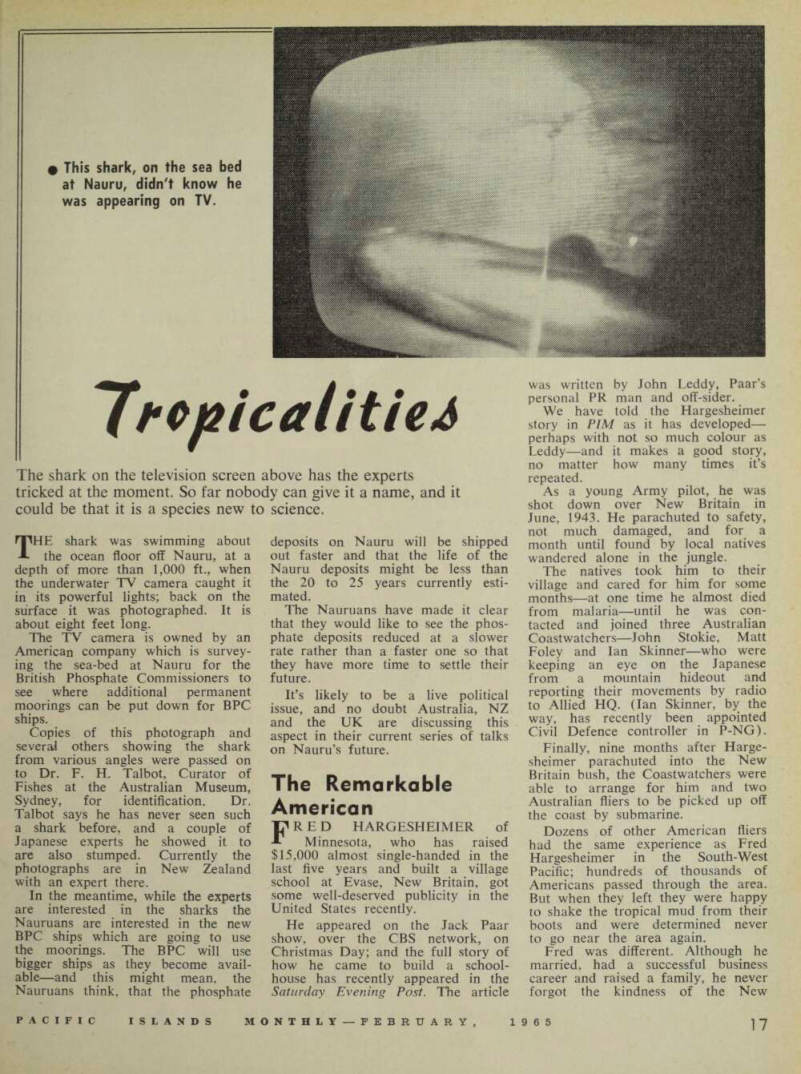
The shark on the television screen above has the experts tricked at the moment. So far nobody can give it a name, and it could be that it is a species new to science.
THE shark was swimming about the ocean floor off Nauru, at a depth of more than 1,000 ft., when the underwater TV camera caught it in its powerful lights; back on the surface it was photographed. It is about eight feet long.
The TV camera is owned by an American company which is survey ing the sea-bed at Nauru for the British Phosphate Commissioners to see where additional permanent moorings can be put down for BPC ships.
Copies of this photograph and several others showing the shark from various angles were passed on to Dr. F. H. Talbot, Curator of Fishes at the Australian Museum, Sydney, for identification. Dr.
Talbot says he has never seen such a shark before, and a couple of Japanese experts he showed it to are also stumped. Currently the photographs are in New Zealand with an expert there.
In the meantime, while the experts are interested in the sharks the Nauruans are interested in the new BPC ships which are going to use the moorings. The BPC will use bigger ships as they become avail able—and this might mean, the Nauruans think, that the phosphate
deposits on Nauru will be shipped out faster and that the life of the Nauru deposits might be less than the 20 to 25 years currently esti mated.
The Nauruans have made it clear that they would like to see the phos phate deposits reduced at a slower rate rather than a faster one so that they have more time to settle their future.
It’s likely to be a live political issue, and no doubt Australia, NZ and the UK are discussing this aspect in their current series of talks on Nauru’s future.
The Remarkable
American
Fred hargesheimer of Minnesota, who has raised $15,000 almost single-handed in the last five years and built a village school at Evase, New Britain, got some well-deserved publicity in the United States recently.
He appeared on the Jack Paar show, over the CBS network, on Christmas Day; and the full story of how he came to build a school house has recently appeared in the Saturday Evening Post. The article
was written by John Leddy, Paar’s personal PR man and off-sider.
We have told the Hargesheimer story in PIM as it has developed— perhaps with not so much colour as Leddy—and it makes a good story, no matter how many times it’s repeated.
As a young Army pilot, he was shot down over New Britain in June, 1943. He parachuted to safety, not much damaged, and for a month until found by local natives wandered alone in the jungle.
The natives took him to their village and cared for him for some months—at one time he almost died from malaria—until he was con tacted and joined three Australian Coastwatchers —John Stokie, Matt Foley and lan Skinner—who were keeping an eye on the Japanese from a mountain hideout and reporting their movements by radio to Allied HQ. (lan Skinner, by the way, has recently been appointed Civil Defence controller in P-NG).
Finally, nine months after Harge sheimer parachuted into the New Britain bush, the Coastwatchers were able to arrange for him and two Australian fliers to be picked up off the coast by submarine.
Dozens of other American fliers had the same experience as Fred Hargesheimer in the South-West Pacific; hundreds of thousands of Americans passed through the area.
But when they left they were happy to shake the tropical mud from their boots and were determined never to go near the area again.
Fred was different. Although he married, had a successful business career and raised a family, he never forgot the kindness of the New
This shark, on the sea bed at Nauru, didn't know he was appearing on TV.
Britain people who had befriended him. In the middle of 1960 he per suaded his family to take their summer holidays alone while he made a sentimental journey to New Britain. It was on this occasion that he conceived the idea of doing something practical for the people of the area—and a school seemed ideal.
Preliminary estimates put the cost at about $15,000 and in the next three years Fred raised the lot— first by asking friends, later by speaking before organisations.
He and his 17-year-old son Dick set out again for New Guinea in 1963—Fred borrowing the money for his son’s fare and hitching a ride himself on a US Air Force plane on survey work in the Ter ritory. For six weeks they physically helped build the school and then they had to return to the United States.
The school was formally dedicated in July, 1964—and again Fred obtained a leave-pass from his long suffering wife and from the firm he works for. There, too, on this occasion, was Australian Air Com modore Bill Townsend who was one of the fliers rescued with him in 1944, and Matt Foley, one of the Coastwatchers who had assisted in his rescue.
Hargesheimer’s school is unique in P-NG in that it has been officially listed as a (Methodist) mission school yet it is in charge of a European Government school teacher, Jim Bye. Mr. Bye is assisted by another Government teacher, who is a New Guinean, and three New Guinean mission teachers.
When he was in Sydney in January Mr. Bye reported that the school this year plans to erect temporary dormitories to house about 40 students and so enlarge Evase into a boarding school. Permanent dor mitories will be built when there is money enough.
“This must be one of the best schools in New Guinea and I am lucky to be associated with it”, is Jim Bye’s view. Hargesheimer warmly approves Jim Bye’s work.
With the sort of publicity CBS and the Saturday Evening Post have now provided, perhaps fund-raising will be easier. But the real work was done single-handed, without pub licity, by Hargesheimer himself in the three years from 1960.
In the course of his visits to New Guinea he has made scores of friends among Australians and New Guineans. To them he remains the best kind of American and the best kind of ambassador for his own country.
Confusion Over
Tomorrow
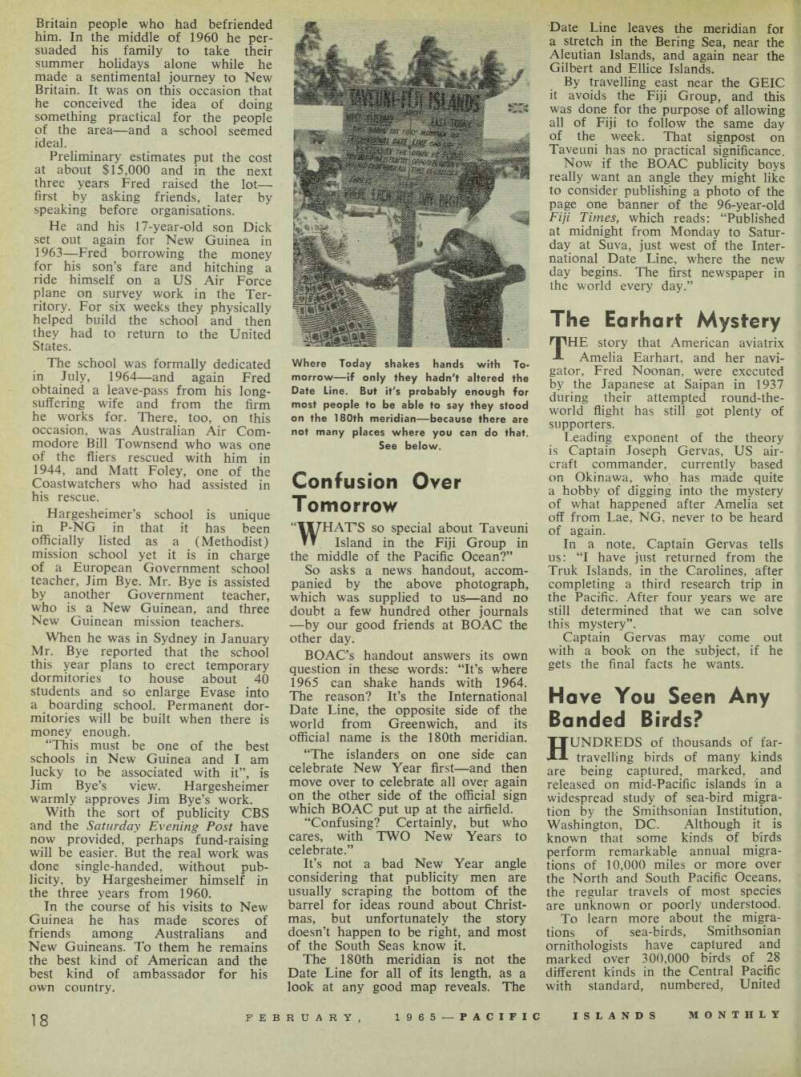
“WHAT’S so s P ec^ about Taveuni •» Island in the Fiji Group in the middle of the Pacific Ocean?”
So asks a news handout, accom panied by the above photograph, which was supplied to us—and no doubt a few hundred other journals —by our good friends at BO AC the other day.
BOAC’s handout answers its own question in these words: “It’s where 1965 can shake hands with 1964.
The reason? It’s the International Date Line, the opposite side of the world from Greenwich, and its official name is the 180th meridian.
“The islanders on one side can celebrate New Year first—and then move over to celebrate all over again on the other side of the official sign which BOAC put up at the airfield.
“Confusing? Certainly, but who cares, with TWO New Years to celebrate.”
It’s not a bad New Year angle considering that publicity men are usually scraping the bottom of the barrel for ideas round about Christ mas, but unfortunately the story doesn’t happen to be right, and most of the South Seas know it.
The 180th meridian is not the Date Line for all of its length, as a look at any good map reveals. The
Date Line leaves the meridian for a stretch in the Bering Sea, near the Aleutian Islands, and again near the Gilbert and Ellice Islands.
By travelling east near the GEIC it avoids the Fiji Group, and this was done for the purpose of allowing all of Fiji to follow the same day of the week. That signpost on Taveuni has no practical significance.
Now if the BOAC publicity boys really want an angle they might like to consider publishing a photo of the page one banner of the 96-year-old Fiji Times, which reads; “Published at midnight from Monday to Satur day at Suva, just west of the Inter national Date Line, where the new day begins. The first newspaper in the world every day.”
The Earhart Mystery
THE story that American aviatrix Amelia Earhart, and her navi gator, Fred Noonan, were executed by the Japanese at Saipan in 1937 during their attempted round-the world flight has still got plenty of supporters.
Leading exponent of the theory is Captain Joseph Gervas, US air craft commander, currently based on Okinawa, who has made quite a hobby of digging into the mystery of what happened after Amelia set off from Lae, NG, never to be heard of again.
In a note, Captain Gervas tells us: “I have just returned from the Truk Islands, in the Carolines, after completing a third research trip in the Pacific. After four years we are still determined that we can solve this mystery”.
Captain Gervas may come out with a book on the subject, if he gets the final facts he wants.
Have You Seen Any
Banded Birds?
HUNDREDS of thousands of far travelling birds of many kinds are being captured, marked, and released on mid-Pacific islands in a widespread study of sea-bird migra tion by the Smithsonian Institution, Washington, DC. Although it is known that some kinds of birds perform remarkable annual migra tions of 10,000 miles or more over the North and South Pacific Oceans, the regular travels of most species are unknown or poorly understood.
To learn more about the migra tions of sea-birds, Smithsonian ornithologists have captured and marked over 300,000 birds of 28 different kinds in the Central Pacific with standard, numbered, United
Where Today shakes hands with To morrow—if only they hadn't altered the Date Line. But it's probably enough for most people to be able to say they stood on the 180th meridian —because there are not many places where you can do that.
See below.
States Fish and Wildlife Service aluminium legbands. Of these, over 60,000 have been marked with 4 inch coloured plastic leg-streamers.
Anyone coming into the possession of a banded dead bird in the Pacific Ocean Area is asked to co-operate by returning the band, together with time and place of recovery, as instructed on the band. For live birds, only the band number together with time and place of capture need be sent to the directed address, after which the bird should be liberated so that its further travel may be traced.
Anyone sighting a bird with a coloured leg-streamer anywhere in the Pacific Ocean Area is asked to co-operate by recording the name or description of the kind of bird wear ing the streamer, the colour of the streamer, the date seen, and the latitude and longitude or approxi mate location of sighting. All in formation on birds with coloured leg-streamers should be sent as soon as possible to: Division of Birds, Smithsonian Institution, Washington, DC, 20560.
Each co-operator will be advised where the banded or colour-marked bird was tagged.
Well Met In The
Solomons
WHEN we were in Honiara, British Solomons, recently, we met Mr. George Tokatake, a Gilbertese who is Assistant Resettlement Officer directing the transfer of Gilbertese from the overcrowded Gilbert and Ellice Islands Colony to the Solo mons. When our man—publisher R. W. Robson—and Mr. Tokatake compared notes, they found that they had met over 20 years ago, when the PIM man went ashore on Abemama Island, in the Gilberts, to seek Agnes Murdoch, the part-Gilbertese daughter of famous, old-time Trader Murdoch, of Tarawa.
He found Agnes, then the middle aged widow of the High Chief of
Abemama, and since dead; and thus he met her handsome young teen age son, then the hereditary chief of Abemama—and who now is George Tokatake.
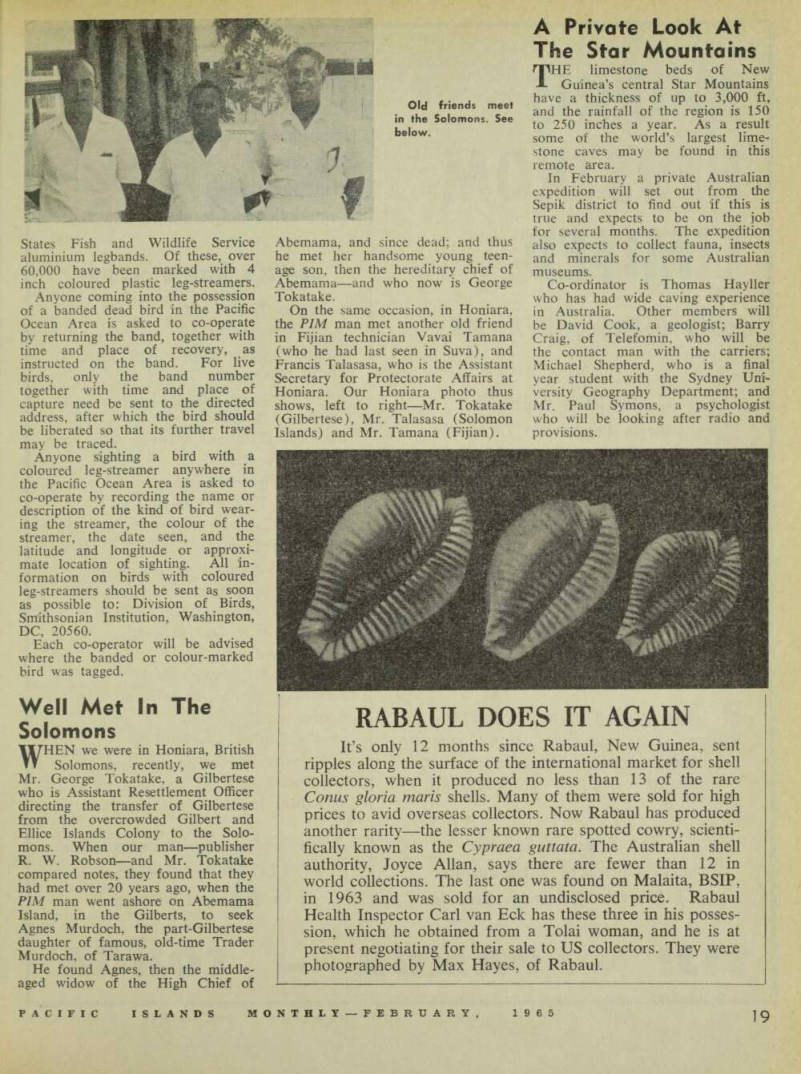
On the same occasion, in Honiara, the PIM man met another old friend in Fijian technician Vavai Tamana (who he had last seen in Suva), and Francis Talasasa, who is the Assistant Secretary for Protectorate Affairs at Honiara. Our Honiara photo thus shows, left to right—Mr. Tokatake (Gilbertese), Mr. Talasasa (Solomon Islands) and Mr. Tamana (Fijian).
A Private Look At
The Star Mountains
THE limestone beds of New Guinea’s central Star Mountains have a thickness of up to 3,000 ft, and the rainfall of the region is 150 to 250 inches a year. As a result some of the world’s largest lime stone caves may be found in this remote area.
In February a private Australian expedition will set out from the Sepik district to find out if this is true and expects to be on the job for several months. The expedition also expects to collect fauna, insects and minerals for some Australian museums.
Co-ordinator is Thomas Hayller who has had wide caving experience in Australia. Other members will be David Cook, a geologist; Barry Craig, of Telefomin, who will be the contact man with the carriers; Michael Shepherd, who is a final year student with the Sydney Uni versity Geography Department; and Mr. Paul Symons, a psychologist who will be looking after radio and provisions.
Rabaul Does It Again
It’s only 12 months since Rabaul, New Guinea, sent ripples along the surface of the international market for shell collectors, when it produced no less than 13 of the rare Conus gloria marts shells. Many of them were sold for high prices to avid overseas collectors. Now Rabaul has produced another rarity—the lesser known rare spotted cowry, scienti fically known as the Cypraea guttata. The Australian shell authority, Joyce Allan, says there are fewer than 12 in world collections. The last one was found on Malaita, BSIP, in 1963 and was sold for an undisclosed price. Rabaul Health Inspector Carl van Eck has these three in his posses sion, which he obtained from a Tolai woman, and he is at present negotiating for their sale to US collectors. They were photographed by Max Hayes, of Rabaul.
Old friends meet in the Solomons. See below.