Assembly Asks: Where Does
pp. 17-18 · Read in the full issue
New Guinea Go From Here?
From a Port Moresby Correspondent
The January meeting of the P-NG House of Assembly was the third since the Assembly was elected last year, and the first in which the young parliament could be said to have found itself. For the first time the 54 elected members took the initia tive in pressing for the future course of Territory affairs.
THERE was political craftsmanship,
and above all an indication of collective national responsibility. The lead still came, in many instances, from the elected Europeans, but there was no doubt there was general sup port in the chamber. There was no European v. New Guinean split—the Opposition was united, as it has shown itself from the beginning.
In short, the House was beginning to feel its power, and it could be that the testing time—the test on just how far the Government is pre pared to let the members go on matters that might be unpalatable for it—might come sooner than most people thought.
There was the usual spate of minor matters, but the new mood of the House was made plain over four issues ... the Public Service salaries, television, shipping freights, and a Constitution. In each of these matters, the elected members left no doubt of their determination to carry through their views against any pos sible Government opposition.
The significance was not the defeat
of the Government —in fact the tele vision question was the only one in which official members actually found themselves voted down in a division —but the manner in which the elected members planned their stands in Caucus and mounted them in strength on the floor of the House.
Attack On Salaries In a debate as a matter of public importance, 25 elected members set about the Administration’s new Public Service salary structure, and the handling of its introduction.
The attack centred on the discrim inatory features of the wage scales, where salaries of £3,000 a year for Australians are laid beside rates of £5OO a year for New Guineans fill ing the same job. Disparate leave and allowance provisions and the threat to the maintenance of harmonious relations between the races were all stressed.
From the four official members who spoke there were admissions of some anomalies being looked into, and a repetition of the Govern ment dictum that wages for New Guinean public servants must be based on the Territory’s economy, present and predicted.
This pattern was expected, and in fact covered much of the ground already traversed by public debate since the pay scales were introduced last September. The new initiative came with the speech by Mr. lan Downs, farmer member for the High land Special electorate, and a veteran of New Guinea parliamentary affairs.
He planned, he said, to move, at the next meeting of the House an amendment to the Public Service Ordinance which would transfer several important powers from the Minister for Territories to the Admin trator-in-Council.
These powers included the right to fix salaries and allowances, to de termine positions, and to establish or abolish Departments..
And Mr. Downs indicated that this move arose from a special meeting
of the elected members the previous day, in which they rationalised their opposition to the new salaries, and had devised strategy to correct the situation. Mr. Downs felt confident that all 54 elected members would vote, en bloc, to support this transfer of power.
The Govemor-General-in-Council, acting on the advice of the Minister for Territories, may, of course, dis allow this amendment when it comes up in February. But the Australian Government has for the first time since the creation of the House been faced with the necessity of deciding how far it can go in rejecting the expressed wishes of the represent atives of the people of the Territory.
An indication of the Minister’s in tention to resort to soft answers came the next day, when in an un precedented step, Mr. Barnes issued a statement from Canberra during the currency of the sitting, to assuage anger and avert risk of a headlong clash.
He said he did not fear an immedi ate crisis between the Australian Gov ernment and the House of Assembly.
It had emerged that the elected members were concerned to have an effective voice in the government of the Territory, and “this was one of the purposes for which the House of Assembly had been established.” At the same time, in this transitional
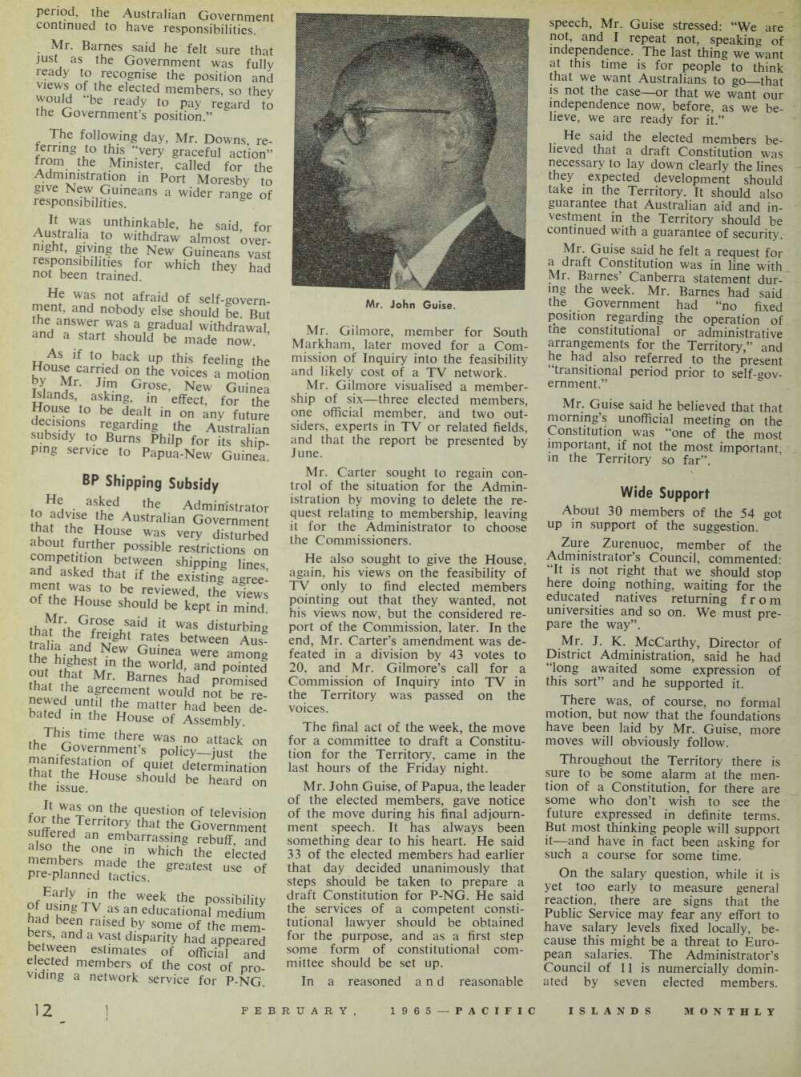
Mr. lan Downs.
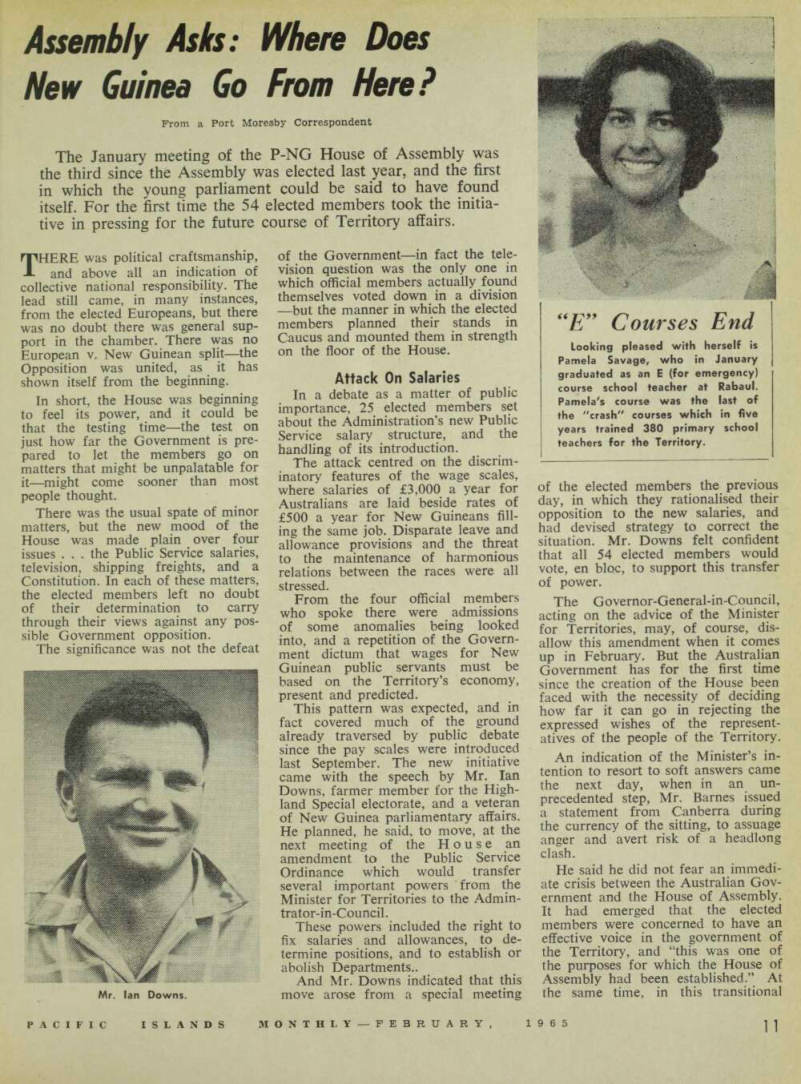
"E” Courses End
Looking pleased with herself is Pamela Savage, who in January graduated as an E (for emergency) course school teacher at Rabaul.
Pamela's course was the last of the "crash" courses which in five years trained 380 primary school teachers for the Territory.
period, the Australian Government continued to have responsibilities. . Mr. Barnes said he felt sure that just as the Government was fully ready to recognise the position and views of the elected members, so they would be ready to pay regard to tne Government’s position.”
The following day, Mr. Downs, re ferring to this “very graceful action” from the Minister, called for the Administration in Port Moresby to give New Guineans a wider range of responsibilities. s It was unthinkable, he said, for Australia to withdraw almost over night, giving the New Guineans vast responsibilities for which they had not been trained.
He was not afraid of self-govern ment, and nobody else should be. But the answer was a gradual withdrawal and a start should be made now.
As if to back up this feeling the hi M car y. ed °" the voi ces a motion by Mr. J,m Grose, New Guinea Islands, asking, in effect, for the House to be dealt in on any future regarding the Australian subsidy to Burns Philp for its ship ping service to Papua-New Guinea.
BP Shipping Subsidy
tn • a^ ed the Administrator £ adv / se Australian Government xhnntf *?° USe w as very disturbed about further possible restrictions on competition between shipping lines and asked that if the existing agre e : ™l was to be reviewed, the views of the House should be kept in mind. thit^tbfPf 08 ® u aid il was disturbing ml a an/v ght atGS between Aus traha and New Guinea were among out th/ eS L m WOrld ’ and Pointed that th/ Mr ‘ BarnCS had Promised that the agreement would not be re newed until the matter had been de bated m the House of Assembly. the Th r/ ime ther f was no attack on the Government’s policy-just the that/he^R 311 ° f deter mination the issue U,d be heard on for Tt th?x 01 \ the question of television suffered an r ry K that the G o vern ment
Ihn ft embarrassing rebuff, and
also the one in which the elected ? ade . the greatest use of pre-planned tactics. of usiipTV the We f k the possibility of using TV as an educational medium had been raised by some of the mem bers, and a vast disparity had appeared elected" est ' mates t of official and elected members of the cost of pro vidmg a network service for P-NG.
Mr. Gilmore, member for South Markham, later moved for a Com mission of Inquiry into the feasibility and likely cost of a TV network.
Mr. Gilmore visualised a member ship of six—three elected members, one official member, and two out siders, experts in TV or related fields, and that the report be presented by June.
Mr. Carter sought to regain con trol of the situation for the Admin istration by moving to delete the re quest relating to membership, leaving it for the Administrator to choose the Commissioners.
He also sought to give the House, again, his views on the feasibility of TV only to find elected members pointing out that they wanted, not his views now, but the considered re port of the Commission, later. In the end, Mr. Carter’s amendment was de feated in a division by 43 votes to 20, and Mr. Gilmore’s call for a Commission of Inquiry into TV in the Territory was passed on the voices.
The final act of the week, the move for a committee to draft a Constitu tion for the Territory, came in the last hours of the Friday night.
Mr. John Guise, of Papua, the leader of the elected members, gave notice of the move during his final adjourn ment speech. It has always been something dear to his heart. He said 33 of the elected members had earlier that day decided unanimously that steps should be taken to prepare a draft Constitution for P-NG. He said the services of a competent consti tutional lawyer should be obtained for the purpose, and as a first step some form of constitutional com mittee should be set up.
In a reasoned and reasonable
speech, Mr. Guise stressed: “We are not, and I repeat not, speaking of independence. The last thing we want at this time is for people to think that we want Australians to go—that is not the case—or that we want our independence now, before, as we be lieve, we are ready for it.”
He said the elected members be lieved that a draft Constitution was necessary to lay down clearly the lines they expected development should take m the Territory. It should also guarantee that Australian aid and in vestment in the Territory should be continued with a guarantee of security.
Mr. Guise said he felt a request for a draft Constitution was in line with Mr. Barnes’ Canberra statement dur ing the week. Mr. Barnes had said the Government had “no fixed position regarding the operation of tne constitutional or administrative arrangements for the Territory,” and he had also referred to the present “transitional period prior to self-gov ernment.”
Mr. Guise said he believed that that morning’s unofficial meeting on the Constitution was “one of the most important, if not the most important, in the Territory so far”.
Wide Support
About 30 members of the 54 got up in support of the suggestion.
Zure Zurenuoc, member of the Administrator’s Council, commented: “It is not right that we should stop here doing nothing, waiting for the educated natives returning from universities and so on. We must pre pare the way”.
Mr. J. K. McCarthy, Director of District Administration, said he had “long awaited some expression of this sort” and he supported it.
There was, of course, no formal motion, but now that the foundations have been laid by Mr. Guise, more moves will obviously follow.
Throughout the Territory there is sure to be some alarm at the men tion of a Constitution, for there are some who don’t wish to see the future expressed in definite terms.
But most thinking people will support it—and have in fact been asking for such a course for some time.
On the salary question, while it is yet too early to measure general reaction, there are signs that the Public Service may fear any effort to have salary levels fixed locally, be cause this might be a threat to Euro pean salaries. The Administrator’s Council of 11 is numercially domin ated by seven elected members.
Mr. John Guise.