Prison Commandant
p. 89 · Read in the full issue
The Month's New Reading
Norfolk Island’s Harshest Prison Commandant
Monocled, side-whiskered John Price, commandant of the Norfolk Island penal settlement between 1846-53, was the harshest commandant the island had. His cruelties were legion.
BENEATH a superficial urbanity there was a steely arrogance, and his affectation of manner—his use of the monocle, his delight at speaking to his convicts in their own slang—had an ominous quality for those in his power. He would use any means to break a convict’s spirit.
Yet John Price at times was a man of good parts, with a light and easy way, and he possessed a strange fas cination for many people of his own day.
In The Life and Death of John Price, Australian author Sir John Barry—a judge of the Victorian Supreme Court—examines the man and attempts to explain how an English “gentleman farmer”, of a good and wealthy family, won a place in Australian history as a hated administrator who was battered to death by his own convicts.
Barry makes a good job of it for students of Australiana willing to give his volume their full attention—for this is not a work designed for light holiday reading, but a scholarly mar shalling of facts that requires some study.
The author is not over-free with his own interpretations, but is con tent mostly to let the record speak.
He could perhaps have signposted his road more clearly by stressing points here and there, and letting us have the advantage of more interpreta tions. His excellent documentation is
sufficient check on the validity of his arguments.
Price, says Barry, became the man he did because of the influence of an autocratic father aq.d the existence of a penal system which allowed cruel or bullying or perverted men in control of it to flower. Price, as an other historian said, was “one of those human tigers who, if they can not obtain some uniform to cover their crimes, are apt to get hanged for them”.
But Barry’s book does more than explain Price—it helps underline the horrors of the Australian convict system, not merely the physical cruel ties of Norfolk Island or the Vic torian hulks, which have been dealt with scores of times before, but the horrors of bureaucracy which allowed the system to operate for as long as it did, and allowed men like Price to survive administratively.
Entrenched Bureaucracy
While there were numbers of men willing to speak out —men like the Rev. Thomas Rogers, of Norfolk Island, and Bishop Willson, of Tas mania—they found themselves fight ing a rearguard action against an administration which was both judge and jury of its own crimes, and which held the channels of communi cation and prevented the facts from being known.
Modern bureaucracy is of course no different. It uses every means to
protect itself against what it believes to be unwarranted interference, and it can be beaten only by private citizens who refuse to be humbugged, and by those members of Parliament or the Press who refuse to be hum bugged. Even before his dramatic murder in Victoria, Price’s position was being weakened by the repeated onslaughts of all three of these agencies.
Sir John Barry’s new book is a useful successor to his Alexander Maconochie of Norfolk Island, giving as they do detailed accounts of the methods of both the best and the worst of the commandants of Nor folk’s turgid second settlement period. —SI.
(The Life And Death Of John
PRICE. Melbourne University Press. 50/-.)
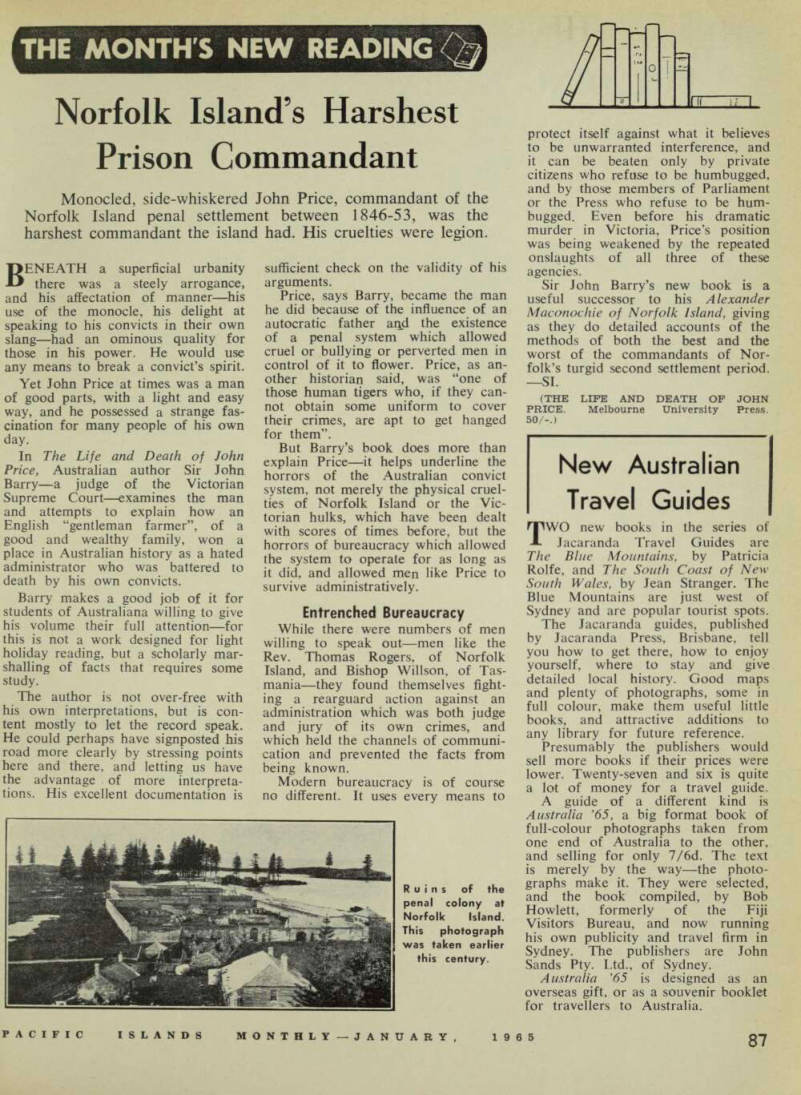
Ruins of the penal colony at Norfolk Island.
This photograph was taken earlier this century.