Yesterday
p. 87 · Read in the full issue
With the war in the Pacific with Japan just three years old, events were moving rapidly in favour of the Allies. PIM for January, 1945, reported that big American forces from Luzon, the chief island in the Philippines, had just taken im portant Japanese positions in those islands with little opposition.
OTHER news items in that issue of PIM of 20 years ago were: Mr. A. W. G. H. Grantham, CMG, had arrived in Suva to take up the post of Governor of Fiji and High Commissioner of the Western Pacific. (Mr. Grantham was later knighted). % * % It was announced in the House of Commons that surveys of mineral, forest and soil resources would be undertaken in the British Solomon Islands with help from the Colonial Develop ment and Wefare Fund as soon as the necessary personnel could be found. Plans for the economic future of the Protectorate were to be based on the results of these surveys. * * * The Prime Minister of New Zealand, Mr. Peter Fraser, became the first NZ Prime Minister to visit the Cook Islands for 33 years when he arrived at Rarotonga in December, 1944. Mr. Fraser was also New Zealand’s Minister for Island Territories. * * * New regulations published in Canberra gave effect to the Aus tralian Government’s decision to pay war damage compensation to residents of Papua and New Guinea for both indirect and direct war damage. The regula tions provided that compensation was to be paid “in relation to abandoned property in an
evacuated area” and also for “depreciation in value as a direct result of its having been aban doned, or been damaged by fire”. * * * The island of Pott, the north ernmost island in the Belep Group, north of New Caledonia, was available for lease. Mr.
Albert Pagnotte, a Frenchman, who had successfully run a cattle farm and copra plantation on Pott for many years, was retiring to Noumea. Mr. Pagnotte leased Pott from the New Caledonian Government and was interested in handing over his lease to someone else.
PlM’s Rarotonga correspondent, reporting the arrival of the first aeroplane on Rarotonga’s newly completed airstrip, said: “No longer can we call these the remote South Sea Islands. Raro tonga now is only 10 hours away from Auckland,”
The correspondent went on to recall what he called headline dates in the history of Rarotonga.
“In 1823,” he said, “came the missionary John Williams, and with him came transition from Stone Age to cilivisation. It is not certain that the English missionaries were the first white men to visit Rarotonga, for there are stories of gold and silver Spanish coins and fragments of a vessel of the 17th century found on the reef; and of black-bearded white men who came from the sea and lived on the island in the reign of Rau, 300 years ago.”
An article on a perpetual calendar, originated by Lieutenant Willard E. Edwards, of the US Navy Reserve in the Pacific area, was an unusual feature in the January, 1945, issue of PIM. The Edwards calender proposed that the first day of the year should be set apart from any week or month, thus permitting the division of the remaining 364 days into exactly 52 weeks, with the result that the half years, quarters and months would become equal. The first day of the year was to be observed as an international holiday, and the extra day each Leap Year was to be inserted between June and July. This was also to be an international holiday every four years. * * * Tahiti was suffering “a full dress epidemic of dengue fever” and all places of assembly were closed. * * * The Administrator of Western Samoa, Mr. A. C. Turnbull, laid the foundation stone of a new Anglican church at the foot of Vaea Mountain, outside Apia, on December 3, 1944. It was the 50th anniversary of the death of Robert Louis Stevenson, to whose memory the church was to be erected. (Stevenson is buried on Mount Vaea).
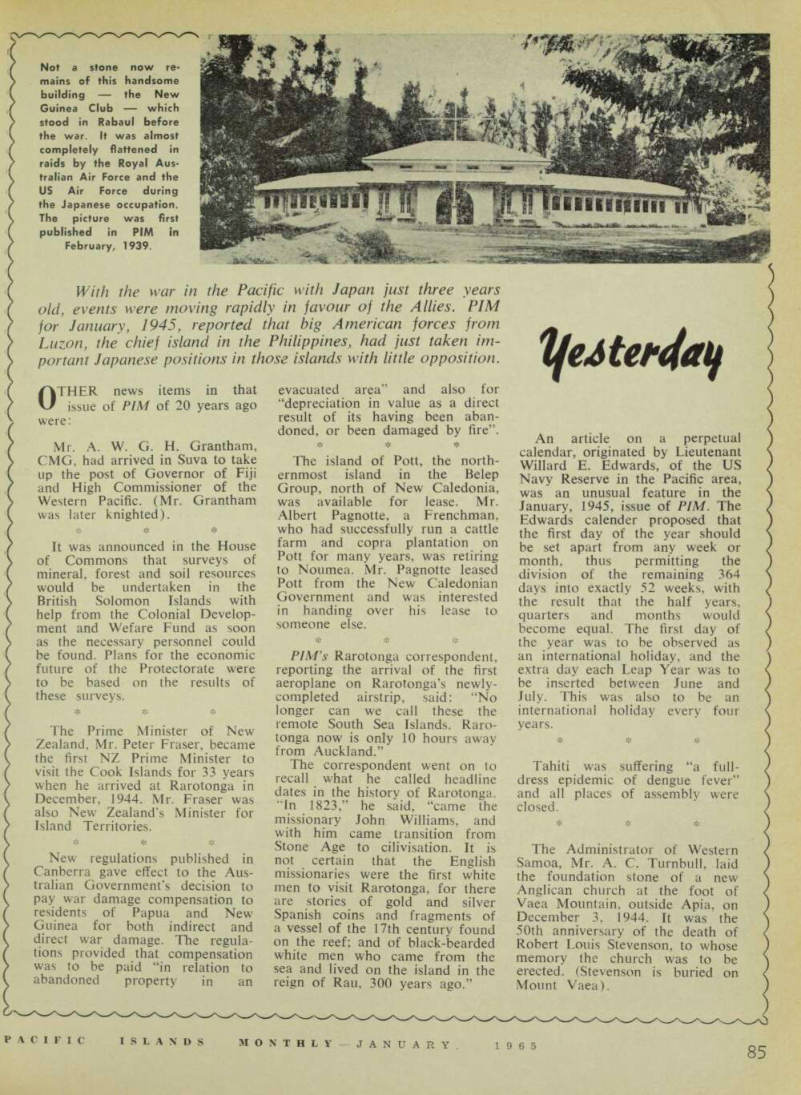
Not a stone now re mains of this handsome building the New Guinea Club which stood in Rabaul before the war. It was almost completely flattened in raids by the Royal Aus tralian Air Force and the US Air Force during the Japanese occupation.
The picture was first published in PIM in February, 1939.