At Last-After
pp. 37-39 · Read in the full issue
New Hebrides Court Hears Final Land Claims
They've Done It
37 Years
After 37 years of ponderous labour, the elaborate Joint Court of the New Hebrides has vir tually completed its task of hear ing claims to land dating back to the days before Britain and France established a condo minium in the group in 1906.
IN those days, many land trans actions took place between Euro peans and New Hebrideans, the relevant deeds being filed with the authorities in Noumea, Suva or Vila.
But it was frequently found later that the New Hebrideans had sold the same piece of land to more than one European, that the land over lapped into someone else’s property, or that the vendors did not own the land they sold. Furthermore, plans of the land were often vague, deeds were improperly drawn up, etc., etc.
The setting up of a Joint Court, to put order into this state of affairs was one of the important features of the Anglo-French Convention of 1906 which established the Condo minium.
But the court, with a neutral president and British and French judges, did not start adjudicating land claims until 1927, by which time some of the land transactions were up to half a century old.
Snail-Like Slowness From then on, the court’s work proceeded with such snail-like slow ness and so many interruptions that it became a laughing stock in the Pacific.
However, the court always claimed that the speed of its work was governed by the speed of the Condominium Survey Department, which had to provide surveys of all the properties on which claims were to be heard.
The Survey Department, in turn, claimed that it did not have enough surveyors to do the job required of it, and, moreover, that there was a lack of basic triangulations to which the property surveys could be tied.
As a result, the surveyors had to
carry out triangulation before properties could be surveyed.
Other factors that delayed the work of the Joint Court included: • The hostility of the inhabitants of Epi, which caused the survey of that island to be suspended in 1941. • The outbreak of war with Japan, which caused a survey of Espiritu Santo to be abandoned. • The lack of a neutral president of the court from time to time following the retirement of the various incumbents mainly Spaniards. (Eventually, it was decided to do without a neutral president, and the British and French judges became joint presidents.)
• Overseas leave of the judges; the necessity of the judges to recon cile the British and French legal systems; language problems, etc., etc.
All in all, it is probably a miracle that the Joint Court has got to the end of the claims before it all— the last ones to be settled being those for the islands of Ambrym and Maewo.
The British Assistant Resident Commissioner, Mr. C. H. Allen, who announced this milestone in the Joint Court’s progress at the ninth session of the New Hebrides Advisory Council in Vila in December, said that “the future control of land in the best interests of productive de
velopment” was now being con sidered.
“In particular,” he added, “we feel it is desirable, as far as possible, to make it easier for New Hebrideans to obtain individual registered titles to land.”
At present, the only registered land in the New Hebrides is land that has been surveyed and to which a title has been established in the Joint Court.
Such land is usually land that passed into European hands before 1906, because, except in the few cases where the Joint Court has adjudicated land disputes between one New Hebridean and another, or where a New Hebridean has applied to the court to have the customary title in his land adjudicated on and registered, the New Hebrideans do not have registered titles to their land.
Still Vague
As a matter of fact, the whole question of who owns what in the New Hebrides is, generally, still vague and unsatisfactory, despite the labours of the Joint Court, because no one has ever made a study of customary land tenure, and—to quote the British Administration’s latest biennial report—“the legal position of native land and native reserve land is also obscure”.
However, the report notes that the New Hebrideans have become “land conscious” because of the develop ment of native cash cropping, and that there will be a growing demand
for the survey and registration of their lands.
Traditionally, the report goes on, land was generally held by groups, e.g. lineages, and individuals had rights to use it. But the New Hebridean attitude to land has been changing rapidly.
Four developments that have been particularly observed among the New Hebrideans are that: • The tenure of land used for planting cash crops and permanent economic trees is tending to follow European concepts, while land used for subsistence cropping tends to be governed by traditional customary principles. • Buying and selling of land on European lines is becoming common. • There is a fear of further alienation and a marked desire to re cover land alienated in the past. • New Hebrideans with much de veloped land are anxious to have their lands surveyed and to apply to the Joint Court for title to pre vent other natives from encroaching on their lands under cover of native custom.
An interesting feature of the land situation in the New Hebrides is that there is no Condominium ownership of vacant lands in the same way as there is Crown ownership of land in British countries.
The Condominium owns only the land it has bought, as is the case with the British and French Govern ments. The Australian Government owns some large areas of land that were transferred to it by Sir James Burns early this century.
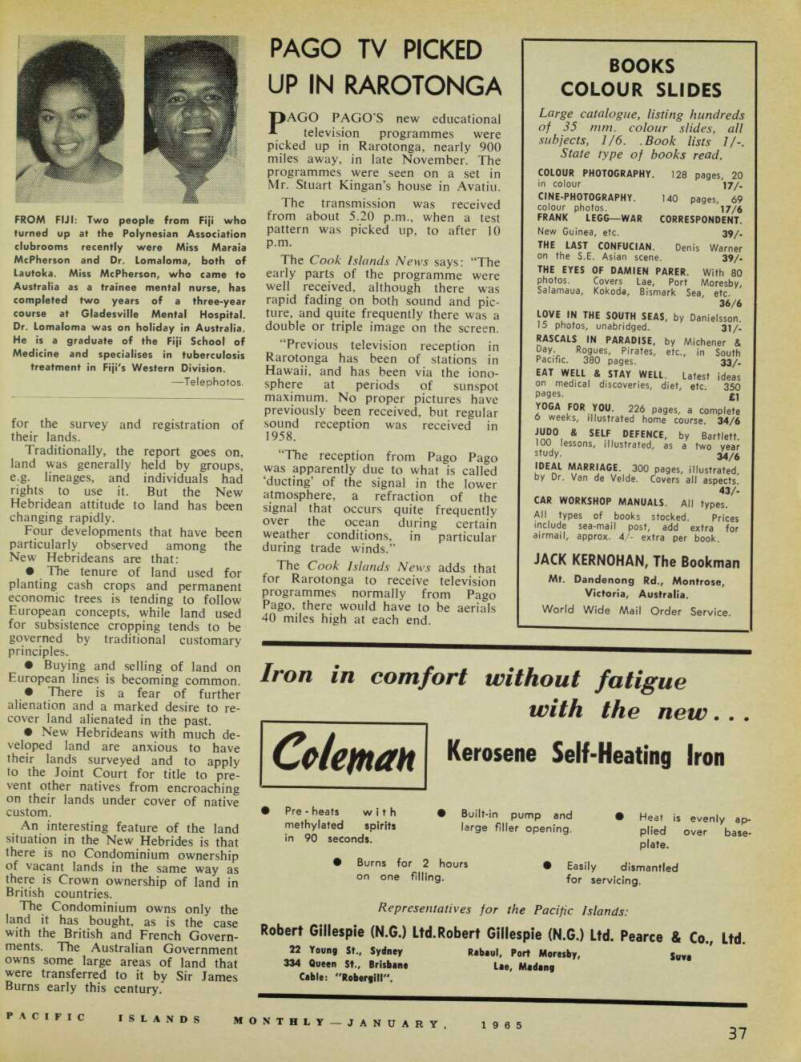
FROM FIJI: Two people from Fiji who turned up at the Polynesian Association clubrooms recently were Miss Maraia McPherson and Dr. Lomaloma, both of Lautoka. Miss McPherson, who came to Australia as a trainee mental nurse, has completed two years of a three-year course at Gladesville Mental Hospital.
Dr. Lomaloma was on holiday in Australia.
He is a graduate of the Fiji School of Medicine and specialises in tuberculosis treatment in Fiji's Western Division.
Telephotos.