The Editors' Mailbag
p. 35 · Read in the full issue
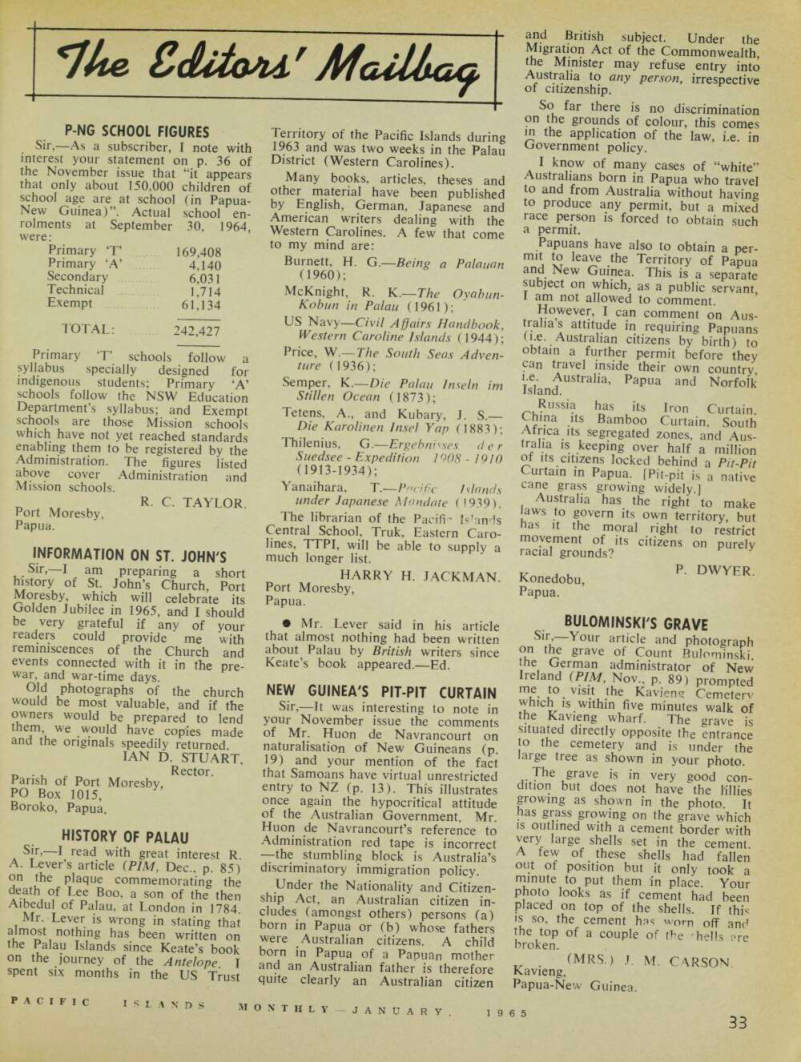
P Ng School Figures
Sir, —As a subscriber, I note with interest your statement on p. 36 of the November issue that “it appears that only about 150,000 children of school age are at school (in Papua- New Guinea)”. Actual school en rolments at September 30, 1964, were : Primary ‘T’ 169,408 Primary ‘A’ 4,140 Secondary 6,031 Technical 1,714 Exempt 61J34
Total: 242,427
Primary T’ schools follow a syllabus specially designed for indigenous students; Primary ‘A’ schools follow the NSW Education Department’s syllabus; and Exempt schools are those Mission schools which have not yet reached standards enabling them to be registered by the Administration. The figures listed above cover Administration and Mission schools.
R. C. Taylor.
Port Moresby, Papua.
Information On St. John's
Sir, —l am preparing a short history of St. John’s Church, Port Moresby, which will celebrate its Golden Jubilee in 1965, and I should be very grateful if any of your readers could provide me with reminiscences of the Church and events connected with it in the pre war, and war-time days.
Old photographs of the church would be most valuable, and if the owners would be prepared to lend them, we would have copies made and the originals speedily returned.
Ian D. Stuart,
r. • , , Rector.
Parish of Port Moresby, PO Box 1015, Boroko, Papua.
History Of Palau
Sir,—l read with great interest R A. Lever’s article (PIM, Dec., p. 85) on the plaque commemorating the death of Lee 800, a son of the then Aibedul of Palau, at London in 1784.
Mr. Lever is wrong in stating that almost nothing has been written on the Palau Islands since Keate’s book on the journey of the Antelope I spent six months in the US Trust
Territory of the Pacific Islands during 1963 and was two weeks in the Palau District (Western Carolines).
Many books, articles, theses and other material have been published by English, German, Japanese and American writers dealing with the Western Carolines. A few that come to my mind are: Burnett, H. G. —Being a Palauan (1960); McKnight, R. K .—The Oyahun- Kobun in Palau (1961); US Navy —Civil Affairs Handbook, Western Caroline Islands (1944); Price, W. —The South Seas Adven ture (1936); Semper, K. —Die Palau Inseln im Stiffen Ocean (1873); Tetens, A., and Kubary, J. S.— Die Karolinen Insel Yap (1883); Thilenius, G. —Ergebnisses der Suedsee - Expedition 1908 - 1910 (1913-1934); Yanaihara, T. —Pacific Islands under Japanese Mandate ( 1939).
The librarian of the Pacific Is’ands Central School, Truk, Eastern Caro lines, TI PI, will be able to supply a much longer list.
Harry H. Jackman.
Port Moresby, Papua.
• Mr. Lever said in his article that almost nothing had been written about Palau by British writers since Keate’s book appeared.—Ed.
New Guinea's Pit-Pit Curtain
Sir, —It was interesting to note in your November issue the comments of Mr. Huon de Navrancourt on naturalisation of New Guineans (p. 19) and your mention of the fact that Samoans have virtual unrestricted entry to NZ (p. 13). This illustrates once again the hypocritical attitude of the Australian Government. Mr.
Huon de Navrancourt’s reference to Administration red tape is incorrect —the stumbling block is Australia’s discriminatory immigration policy.
Under the Nationality and Citizen ship Act, an Australian citizen in cludes (amongst others) persons (a) born in Papua or (b) whose fathers were Australian citizens. A child born in Papua of a Papuan mother and an Australian father is therefore quite clearly an Australian citizen
and British subject. Under the Migration Act of the Commonwealth, the Minister may refuse entry into Australia to any person, irrespective of citizenship.
So far there is no discrimination on the grounds of colour, this comes m the application of the law, i.e. in Government policy.
I know of many cases of “white”
Australians born in Papua who travel to and from Australia without having to produce any permit, but a mixed race person is forced to obtain such a permit.
Papuans have also to obtain a per mi j l° T lea^, e - the Ter ritory of Papua and New Guinea. This is a separate subject on which, as a public servant * not allowed to comment.
However, I can comment on Aus tralia s attitude in requiring Papuans (i.e. Australian citizens by birth) to obtain a further permit before they can travel inside their own country, i.e Australia, Papua and Norfolk Island.
Russia has its Iron Curtain, China its Bamboo Curtain, South Africa its segregated zones, and Aus traha is keeping over half a million of its citizens locked behind a Pit-Pit Curtain in Papua. [Pit-pit is a native cane grass growing widely ] Australia has the right ’to make laws to govern its own territory, but nas it the moral right to restrict movement of its citizens on purely racial grounds?
P. Dwyer.
Konedobu, Papua.
Bulominskrs Grave
Sir ’ Your article and photograph on the grave of Count Bulominski the German administrator of New Ireland ( PIM, Nov., p. 89) prompted I° . visi . t the Kavieng Cemeterv which is within five minutes walk of the Kavieng wharf. The grave is situated directly opposite the entrance to the cemetery and is under the large tree as shown in your photo.
The grave is in very good con dition but does not have the lillies growing as shown in the photo It has grass growing on the grave which is outlined with a cement border with very large shells set in the cement A few of these shells had fallen out of position but it only took a minute to put them in place. Your photo looks as if cement had been placed on top of the shells. If this is so, the cement has worn off and the top of a couple of the are broken.
(Mrs.) J. M. Carson.
Kavieng, Papua-New Guinea.