Paradesia
pp. 27-31 · Read in the full issue
An Appeal From Paradesia
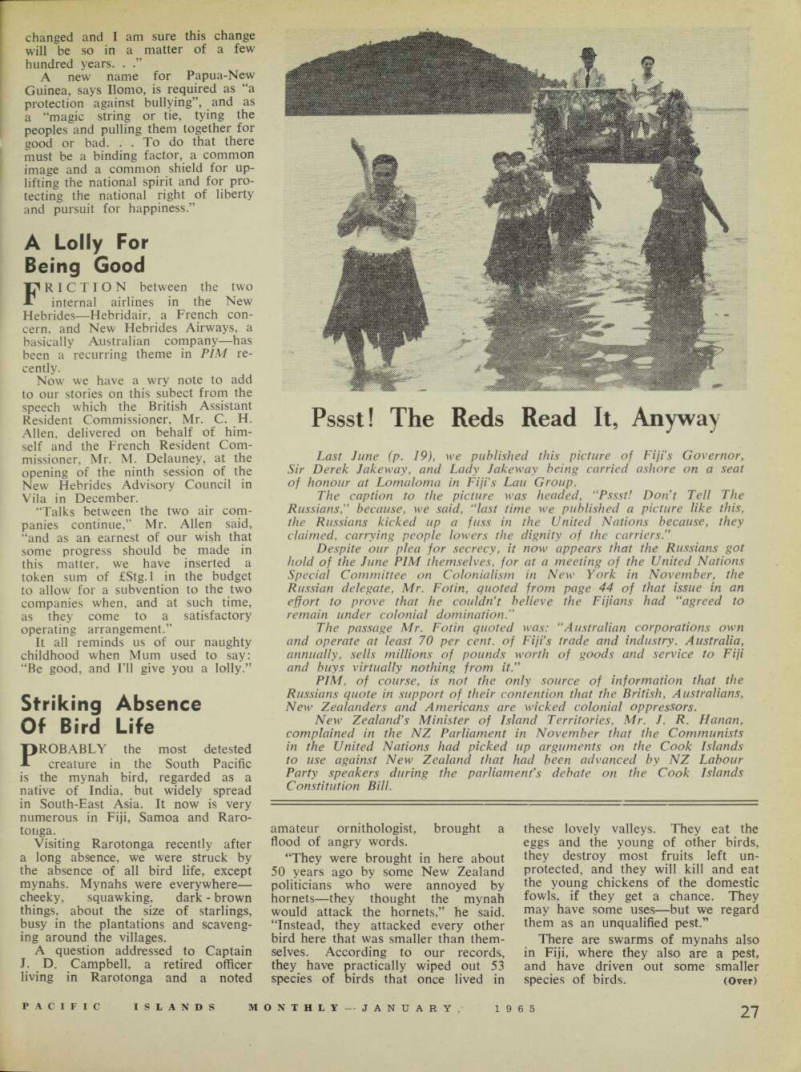
Ilomo Serikama Batton,
who helped make local New Guinea history in December by be ing named as one of the first three graduate medical officers from the Port Moresby School of Medicine, is a New Guinean with a mind of his own. His interests are wider than medicine.
In the last few years of his studies he has taken an interest in political matters and has written on the role of the South Pacific Commission, and on the future of Papua-New Guinea.
He has been spokesman for his fellow students on Public Service matters and has broadcast over the ABC.
About September, Homo went on record again—this time in an eight page roneoed pamphlet setting out his views on a name for Papua-New Guinea.
He personally distributed about 50 copies to senior officers of the P-NG Administration and to political leaders —some of whom regarded Homo’s views as odd.
But when his quaintly-worded
pamphlet is looked at in the light of an emerging New Guinea nationalism there is nothing very odd about the views of this Assistant Medical Practitioner from the Sepik.
Writes Homo: “The name I desire to suggest is Paradesia, after our much-admired natural fauna, the bird of paradise, and the name is in terpreted as the Island of the Bird of Paradise. . . . The name is a majestic one, so dignified and so sovereigned and unattested by any man’s concept of human degrada tion.”
Homo sees degradation in the name of Papua-New Guinea, because he says it was imposed on the country by Europeans, and to various Euro peans it is still meant to refer to people who are sub-human, people with the “lowest socio-economic standards, of filthy, unhealthy appear ances”.
It could also jefer to a land “wholly inhabited by guinea pigs, and or 21 shillings in currency”, and he sees in this a suggestion that the place is only good for experimenting with, or a place to be bought and sold on the international money market.
Objection to this imposed name (“our tribal leaders never participated in the negotiations as to what national names they wanted”) is an important part of Homo’s pamphlet.
Nor does he like the imposed word Melanesia, “because in the Greek root, Melanin means black pigment, and Melanesia implies that all the islands are black as charcoal and all the people living on those islands must also be black. Impossible; there are a few thousand people who are black in skin colour, but scientific knowledge shows that this can be
Homo Serikama Batton.
changed and I am sure this change will be so in a matter of a few hundred years. .
A new name for Papua-New Guinea, says Homo, is required as “a protection against bullying”, and as a “magic string or tie, tying the peoples and pulling them together for good or bad. . . To do that there must be a binding factor, a common image and a common shield for up lifting the national spirit and for pro tecting the national right of liberty and pursuit for happiness.”
A Lolly For
Being Good
FRICTION between the two internal airlines in the New Hebrides—Hebridair, a French con cern, and New Hebrides Airways, a basically Australian company—has been a recurring theme in PIM re cently.
Now we have a wry note to add to our stories on this subect from the speech which the British Assistant Resident Commissioner, Mr. C. H.
Allen, delivered on behalf of him self and the French Resident Com missioner, Mr. M. Delauney, at the opening of the ninth session of the New Hebrides Advisory Council in Vila in December.
“Talks between the two air com panies continue,” Mr. Allen said, “and as an earnest of our wish that some progress should be made in this matter, we have inserted a token sum of £Stg.l in the budget to allow for a subvention to the two companies when, and at such time, as they come to a satisfactory operating arrangement.”
It all reminds us of our naughty childhood when Mum used to say: “Be good, and I’ll give you a lolly.”
Striking Absence
Of Bird Life
PROBABLY the most detested creature in the South Pacific is the mynah bird, regarded as a native of India, but widely spread in South-East Asia. It now is very numerous in Fiji, Samoa and Raro tonga, Visiting Rarotonga recently after a long absence, we were struck by the absence of all bird life, except mynahs. Mynahs were everywhere— cheeky, squawking, dark - brown things, about the size of starlings, busy in the plantations and scaveng ing around the villages.
A question addressed to Captain J. D. Campbell, a retired officer living in Rarotonga and a noted
amateur ornithologist, brought a flood of angry words.
“They were brought in here about 50 years ago by some New Zealand politicians who were annoyed by hornets—they thought the mynah would attack the hornets,” he said.
“Instead, they attacked every other bird here that was smaller than themselves. According to our records, they have practically wiped out 53 species of birds that once lived in
these lovely valleys. They eat the eggs and the young of other birds, they destroy most fruits left un protected, and they will kill and eat th e young chickens of the domestic fowls, if they get a chance. They ma Y have some uses—but we regard them as an unqualified pest.”
There are swarms of mynahs also in Fiji, where they also are a pest, and have driven out some smaller species of birds. (Over)
Other creatures in Fiji which have attained pest proportions—the mon goose and the giant toad—were introduced to clear up rats and snails which were attacking valuable culti vated crops. But no one now seems to know how the mynahs got into the Colony.
Putting PIM
To Work
WHEN Sydney school teacher F. S. Topham saw his first copy of PIM recently he was both fascinated and appalled. For the reason he was appalled see his verse opposite. His fascination was due to the variety of facts and figures that are to be found in any issue of PIM. He quickly put these to practical use by setting an exami nation paper for his fifth class pupils, with all the questions based on in formation he found in his particular copy. Here is his paper:
Pacific Island Problems
Put on your grass skirts and your thinking-caps and start. 1. From Hong Kong to Macao is 40 miles.
Three hydrofoil ferries make the return trip twice daily.
What is the total mileage of the ferries per day? 2. The Pacific Islands Monthly magazine costs 3/- or 60 US cents.
How many US dollars/cents would equal 6/-? 3. Fiji Airways Ltd. use Heron Aircraft.
Timetable:
Depart. Suva (Fiji Is.) 7.45 a.m.
Arrive Nadi 8.25 a.m. (have breakfast) Depart. Nadi 9.10 a.m.
Arrive Funafuti (Ellice Is.) 1.05 p.m.
How many hrs. mins, is the plane actually fllying on this trip? 4. Study this Shipping Timetable for the trans-Pacific liner Orsova.
AUSTRALIA - NZ - FIJI - CANADA USA and return to AUSTRALIA Sydney depart. Nov. 16 Auckland (NZ) arr. & dep. Nov. 19 Suva (Fiji) arr. & dep. Nov. 22 Honolulu arr. & dep. Nov. 27 Vancouver (Can.) arrive Dec. 2 depart. Dec. 3 San Francisco (US) arrive Dec. 5 depart. Dec. 7 Los Angeles arr. & dep. Dec. 8 Honolulu arr. & dep. Dec. 13 Suva arr. & dep. Dec. 20 Auckland arr. & dep. Dec. 23 Sydney arrive Dec. 26 Get out your atlas, draw a simple
map, mark the places and the ship’s route. (a) How many days are required for the round trip? (b) How many days would a a Fijian take to go from Suva to Canada, US and back to Suva? (c) Which takes longer: Honolulu to Los Angeles or Vancouver to Suva? (d) Which places are not visited twice? How many days will it take a passenger from Sydney to get there? 5. In the British Solomon Islands crocodile skins sell for £1 per inch (provided the croc is 12 in. or more!). An Islander sold a crocodile measuring 4 yds, 2 ft 5 in. How much did he receive? 6. Chang Sing Loong Co. Ltd., of Suva, offer 4/- per lb. for well dried shark fins. If you were smart enough to catch enough sharks to provide 1\ stone of well-dried shark fins how much would you receive? 7. The Sirius was wrecked on a reef at Norfolk Island in 1790.
(a) How many years ago is that?
In 1905, Mr. Isaac Goldie Christian, then aged 17, dived down and recovered the anchor (now in Sydney). (b) How old is Mr. Christian now? 8. Green Snail Shell from the Islands sells for £250 per ton in Sydney.
How much would a cwt. cost?
9. Population:
New Caledonia 80,000 Papua-NG 2,000,000 There are 29,000 white people in New Caledonia (included in above figures).
There are 26,000 white people in Papua-NG (included above), (a) How many coloured people are there in New Caledonia? (b) How many coloured people are there in Papua-NG? (c) How many times as many people live in P-NG than in New Caledonia?
Martyrs' Deaths
Remembered
November 20 last was the 125th anniversary of the death of the famous LMS missionary, the Rev, John Williams, who was massacred at Dillon Bay, Erromanga, New Hebrides, as he was attempting to land from the missionary ship Camden.
Dillon Bay is on the western side of Erromanga. Another mis sionary of the London Missionary Society, the Rev, James Harris, was killed there at the same time as John Williams.
They were the first missionaries to attempt the bring the Gospel to the New Hebrides after the Spanish expedition of Quires in 1606, but they were by no means the last to be murdered at Erromanga.
Four others were killed there between 1861 and 1872—George N.
Gordon and his wife Ellen C.
Gordon (nee Powell) on May 20, 1861; James Macnair, on July 16, 1870; and James D. Gordon (brother of G. N. Gordon) on March 7, 1872.
Erromanga gained such a bad reputation through these murders that for many years it was known in missionary circles as the Martyr Isle, and, as a result, most people gave it a wide berth.
But times have changed.
Nowadays, according to Mr. J. C.
Rouleau, of Vila, who happened to be there on November 20, the
Erromangans celebrate the death of John Williams at Dillon Bay in a ceremony re-enacting the details of his landing and murder.
“This commemoration," Mr.
Rouleau tells us, “is followed by songs and dances, specially dedicated to Williams’ memory. Williams’ tomb as well as those of the other martyrs are all specially visited on this occasion, and it was then that I took the photos I am sending you. . . . I suppose these documents are the first to recall the presence of these tombs in this forgotten part of the New Hebrides.”
The top picture gives some idea of the jungle setting of the tombs of Erro manga's missionary martyrs. Below is the tomb of the Rev. George N. Gordon, his wife, Ellen, and his brother, the Rev. James D. Gordon.