Tropicalities
p. 27 · Read in the full issue
Like everyone else, we’ve got pretty weary of hearing about H-bombs and nuclear tests, particularly the French variety, which are due to make a big bang at Mururoa Atoll in French Polynesia in the next year or so.
BUT whenever the French or the French Polynesians start saying nasty things about the Mururoa pro ject, we feel duty-bound to report them—as we report the French officials who say nice things about the project.
We’ve noticed a couple of nasty statements in the last few weeks.
One was made by the usually well informed French satirical paper Le Canard Enchaine (The Chained Duck). The other was made by the Deputy for French Polynesia in the French Parliament, Mr. John Teariki.
Le Canard Enchaine suggested that there was a strong political motive behind recent announcements by the French Minister for Information, Mr.
Alain Peyrefitte, that the power of French radio stations in the Pacific was to be stepped up. ( PIM , Nov., p. 63.) “The creation of powerful radio
stations to cover the Pacific,” the paper said, “is to flood the surround ing countries with propaganda, with a special eye on Australia and New Zealand, whose comments and pro tests on France’s proposed atomic explosion are beginning to get on the nerves of certain persons,”
Le Canard Enchaine added that the building of TV stations in New Caledonia and Tahiti, which Mr.
Peyrefitte also announced during a visit to the Pacific, was “to combat any movements of independence that might be stirred up by the dollar”.
"Ridiculous"
Mr. Teariki, who has represented French Polynesia in the Chamber of Deputies since 1961, made an attack on the Mururoa testing project early in December during a debate in the chamber on a six-year military pro gramme for France.
He complained that France was treating the islands of the Pacific as a sort of laboratory “without heed for the health of the people”.
The creation of the Mururoa centre, he went on, had already re sulted in the deployment of unprece dented military forces, which could “shackle the decolonisation and democratisation of Polynesia”.
Le Journal de Tahiti, which pub lished Mr. Teariki’s outburst under the heading “A Ridiculous Interven tion In Parliament”, lambasted him in an editorial for being anti television, anti-Mururoa project and anti-everything French.
Mr. Teariki is more than capable of fighting his own battles—but the fact ought not to be overlooked that his views on That Bomb have a great deal of support in all parts of the Pacific.
And France will probably need more than its own equivalent of Radio Australia to convince a lot of people otherwise.
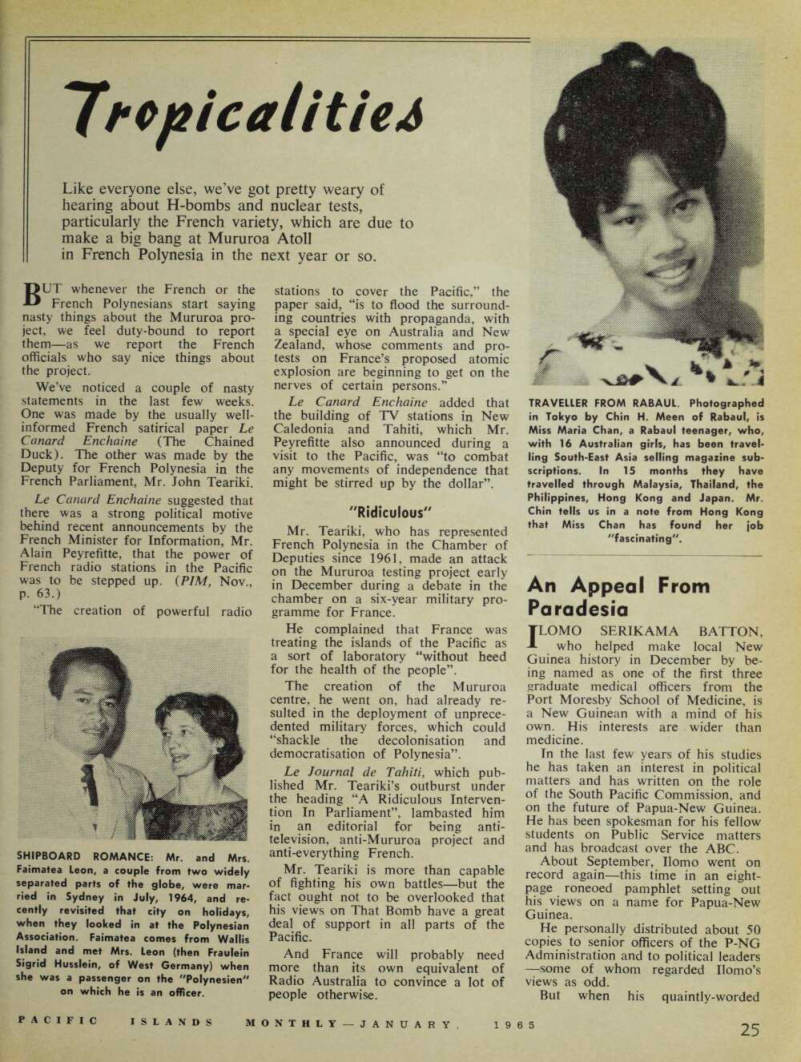
Shipboard Romance: Mr. And Mrs.
Faimatea Leon, a couple from two widely separated parts of the globe, were mar ried in Sydney in July, 1964, and re cently revisited that city on holidays, when they looked in at the Polynesian Association. Faimatea comes from Wallis Island and met Mrs. Leon (then Fraulein Sigrid Husslein, of West Germany) when she was a passenger on the "Polynesien" on which he is an officer.
TRAVELLER FROM RABAUL. Photographed in Tokyo by Chin H. Meen of Rabaul, is Miss Maria Chan, a Rabaul teenager, who, with 16 Australian girls, has been travel ling South-East Asia selling magazine sub scriptions. In 15 months they have travelled through Malaysia, Thailand, the Philippines, Hong Kong and Japan. Mr.
Chin tells us in a note from Hong Kong that Miss Chan has found her job "fascinating".