Moderate Costs Seen As A Key
pp. 123-125 · Read in the full issue

Factor In South Seas Tourism
Co-operation between island territories, adequate passenger accommodation and moderate costs are important requirements in building up the South Pacific tourist industry, according to Australian deputy-chairman of P and O-Orient, Mr. J. D. Bates.
MR. BATES expressed this view in addressing the annual travel conference of the Fiji Visitors Bureau at Korolevu, Fiji, in October.
Delegates from Australia, New Zealand, Fiji, Tonga, Cook Islands and the United States attended the conference, which was chaired by Mr. R, Kermode, a member of Fiji’s Legislative Council.
Mr. Bates said that in the traditional tourist centres of the world, each country could, perhaps, go it alone in the business of tourist development. But in the Pacific things were different because the centres of attraction were widely separated and far distant from the present tourist markets.
“In these circumstances,” Mr.
Bates said, “since distance means cost to the traveller, he rather naturally wants to include in his journey as many points of interest and variety as time will allow.
“In other words, he wants as much as he can get for his money.”
Promote Regionally
“And so the sensible thing for us to do, whose job it is to promote our countries in competition with the world, is to co-operate with our neighbours and to promote region ally.
“In the South Pacific we have a group of countries which fall
naturally into a marketable whole.
The islands of the South Seas— Tahiti, Fiji, Samoa, and New Caledonia have a tremendous natural attraction to the Western mind, “And these islands lie right along the route to New Zealand and Aus tralia—places which, I am glad to say, also have a great and growing interest for the tourist.
“So co-operative development is a
oper course for these countries to lopt; subject however to one vital edition.
“There must be adequate transport cilities into and within the region.”
Mr. Bates said he thought the ain influx of visitors would con lue to come from North America a broad south-westerly sweep rough Hawaii to the South Pacific lands and on to New Zealand and astralia.
From Europe, India and Malaysia, reverse stream would continue to >w through Australia and New ;aland into the Islands.
Adequately Served
“The two main traffic streams am east and west are, or soon ill be, adequately served by sea id air,” Mr. Bates said.
“In the last 10 years or so, air msport has expanded its passenger rrying to a prodigious degree. And i enormous amount of new traffc is been created by the opportunities at have arisen.
“Shipping has had its share of this panded market and will continue do so.
“The continued expansion of large ale travel depends, however, on ice.
“This applies to both sea and air res which must be kept at a oderate level. It applies, too, to >tel accommodation and indeed to I the thousands of ingredients in e travel industry.”
Mr. Bates said the vital importance keeping costs to the tourist at
a moderate level was recently highlighted in a special article in a Sydney newspaper which stated that the French tourist industry had reached a serious crisis because tourists were avoiding the country.
The French, themselves, blamed high hotel prices, high meal prices, the extras which seemed to multiply on restaurant bills, the price of petrol and the insidious effect of the almost universally expected tipping practice.
“This,” Mr. Bates added, “is something which all of us engaged in trying to step up this immensely valuable industry must watch.
Moderation in travel costs is some thing we must all study for there is a reasonable limit beyond which our potential customers will not go and world competition is intense.”
Advances For Hotels In a speech to open the con ference, Fiji’s Member for Com munications and Works, Mr. J. V.
Falvey, said that the Fiji Govern ment intended to assist tourism by arranging for advances to be made for new hotels, with repayment over 15 years.
Also part-exemption from taxation for hotels was being investigated, he said.
Mr. Falvey said other schemes to assist the tourist industry were:
• The bitumenising of the Suva- Nadi section of the Queen’s Road “with maximum speed”. • Government help in providing access roads to major hotel develop ment sites. • The provision of a sound tele phone network.
Ratu K.K.T. Mara, Fiji’s Member for Natural Resources, said in the keynote address that tourism pro vided employment for many, with an increase in production of local products.
In a discussion following this, he said that the antagonism of people towards tourists was a general problem everywhere, and that people must be educated to understand the necessity for general courtesy and to appreciate the financial advantages of tourism.
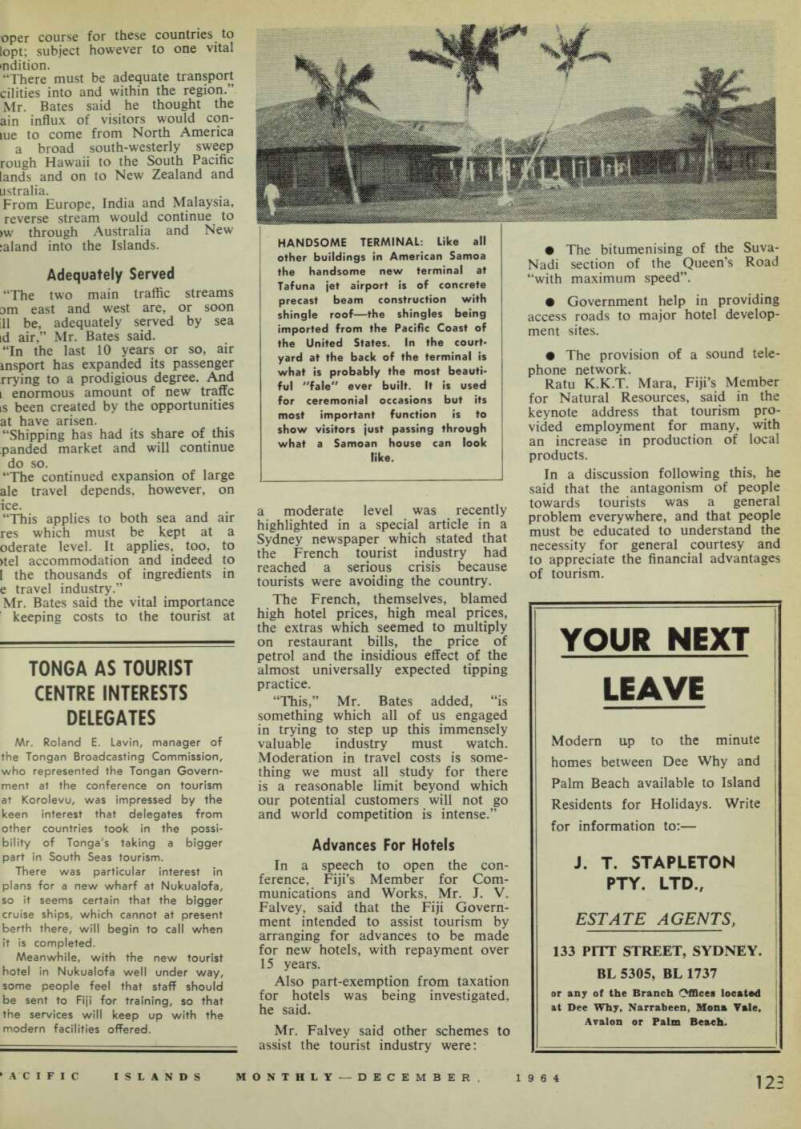
Handsome Terminal: Like All
other buildings in American Samoa the handsome new terminal at Tafuna jet airport is of concrete precast beam construction with shingle roof—the shingles being imported from the Pacific Coast of the United States. In the court yard at the back of the terminal is what is probably the most beauti ful "fale" ever built. It is used for ceremonial occasions but its most important function is to show visitors just passing through what a Samoan house can look like.