But Never On
pp. 115-123 · Read in the full issue
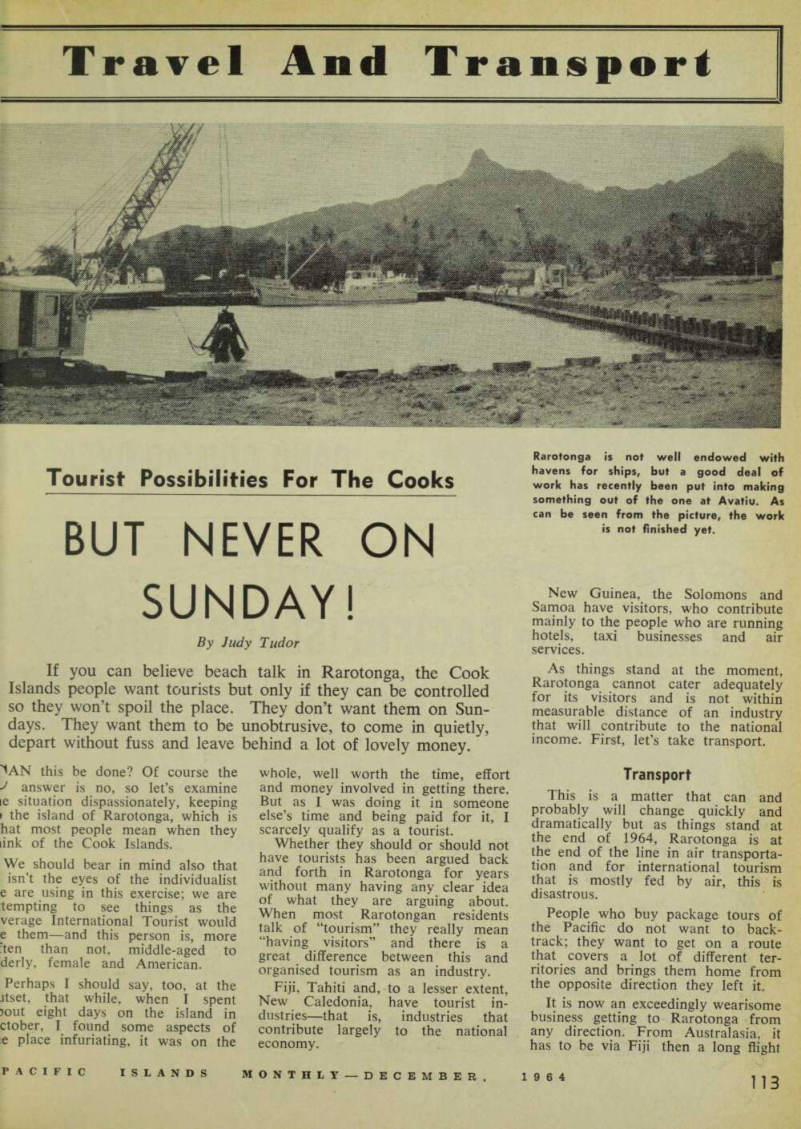


Tourist Possibilities For The Cooks
Sunday!
By Judy Tudor
If you can believe beach talk in Rarotonga, the Cook Islands people want tourists but only if they can be controlled so they won’t spoil the place. They don’t want them on Sun days. They want them to be unobtrusive, to come in quietly, depart without fuss and leave behind a lot of lovely money.
this be done? Of course the J answer is no, so let’s examine ic situation dispassionately, keeping ► the island of Rarotonga, which is hat most people mean when they link of the Cook Islands.
We should bear in mind also that isn’t the eyes of the individualist e are using in this exercise; we are tempting to see things as the verage International Tourist would e them—and this person is, more ’ten than not, middle-aged to derly, female and American.
Perhaps I should say, too, at the Jtset, that while, when I spent )out eight days on the island in ctober, I found some aspects of e place infuriating, it was on the
whole, well worth the time, effort and money involved in getting there.
But as I was doing it in someone else’s time and being paid for it, I scarcely qualify as a tourist.
Whether they should or should not have tourists has been argued back and forth in Rarotonga for years without many having any clear idea of what they are arguing about.
When most Rarotongan residents talk of “tourism” they really mean “having visitors” and there is a great difference between this and organised tourism as an industry.
Fiji, Tahiti and, to a lesser extent, New Caledonia, have tourist in dustries—that is, industries that contribute largely to the national economy.
New Guinea, the Solomons and Samoa have visitors, who contribute mainly to the people who are running hotels, taxi businesses and air services.
As things stand at the moment, Rarotonga cannot cater adequately for its visitors and is not within measurable distance of an industry that will contribute to the national income. First, let’s take transport.
Transport
This is a matter that can and probably will change quickly and dramatically but as things stand at the end of 1964, Rarotonga is at the end of the line in air transporta tion and for international tourism that is mostly fed by air, this is disastrous.
People who buy package tours of the Pacific do not want to back track; they want to get on a route that covers a lot of different ter ritories and brings them home from the opposite direction they left it.
It is now an exceedingly wearisome business getting to Rarotonga from any direction. From Australasia, it has to be via Fiji then a long flight
n a small plane to Western Samoa md from there, on the following jay, an even longer flight (almost seven hours), over ocean, in a DC3 urcraft to Rarotonga.
I am one of the few people remain ng on earth who enjoy DC3 planes; nost present-day jet travellers do lot. In any event, because this route s over water all the way, only 15 passengers are carried and although t is comparatively easy to get a seat going in to Rarotonga, it is difficult to get a flight out. The iressure on outward flights is from Maoris migrating to NZ.
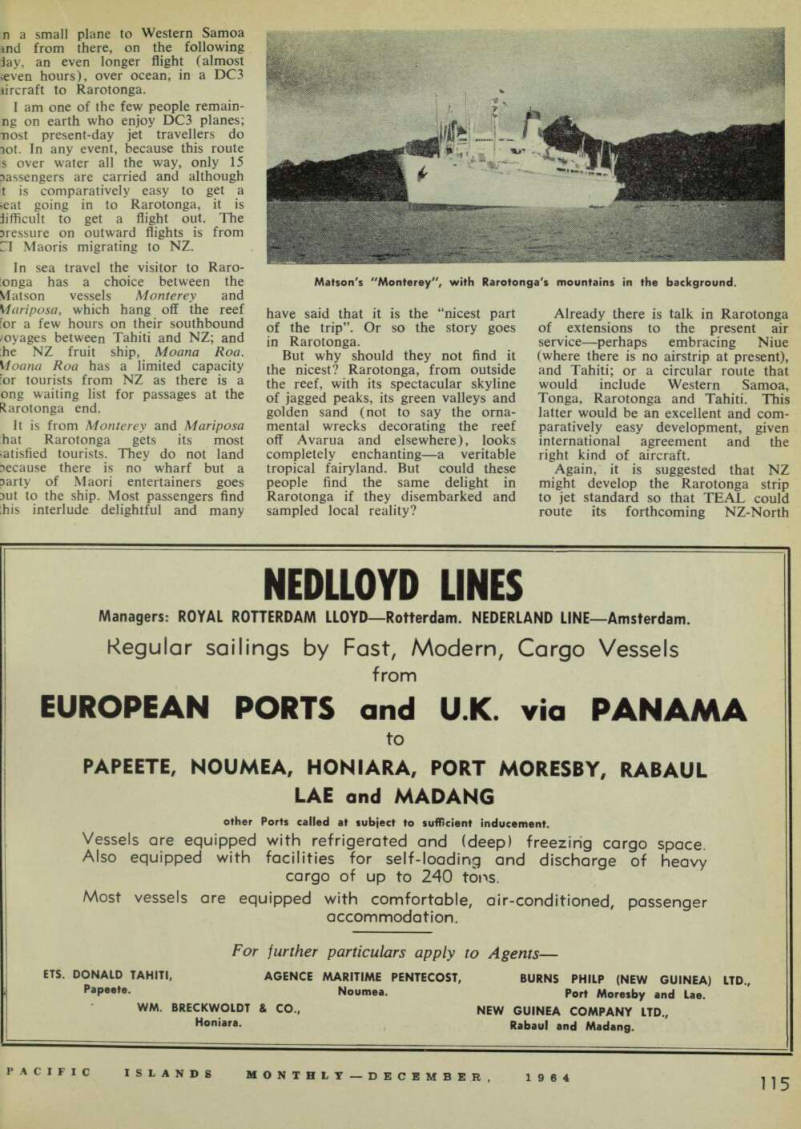
In sea travel the visitor to Raro ;onga has a choice between the Matson vessels Monterey and Mariposa, which hang off the reef for a few hours on their southbound /oyages between Tahiti and NZ; and :he NZ fruit ship, Moana Roa.
Moana Roa has a limited capacity 'or tourists from NZ as there is a ong waiting list for passages at the Rarotonga end.
It is from Monterey and Mariposa hat Rarotonga gets its most satisfied tourists. They do not land because there is no wharf but a party of Maori entertainers goes Dut to the ship. Most passengers find Lhis interlude delightful and many
have said that it is the “nicest part of the trip”. Or so the story goes in Rarotonga.
But why should they not find it the nicest? Rarotonga, from outside the reef, with its spectacular skyline of jagged peaks, its green valleys and golden sand (not to say the orna mental wrecks decorating the reef off Avarua and elsewhere), looks completely enchanting—a veritable tropical fairyland. But could these people find the same delight in Rarotonga if they disembarked and sampled local reality?
Already there is talk in Rarotonga of extensions to the present air service—perhaps embracing Niue (where there is no airstrip at present), and Tahiti; or a circular route that would include Western Samoa, Tonga, Rarotonga and Tahiti. This latter would be an excellent and com paratively easy development, given international agreement and the right kind of aircraft.
Again, it is suggested that NZ might develop the Rarotonga strip to jet standard so that TEAL could route its forthcoming NZ-North
Matson's "Monterey", with Rarotonga's mountains in the background.
merica services through there in ead of Tahiti. This would be even Jtter and at one stroke would make arotonga accessible to world »urists and probably force a tourist idustry onto the island whether it anted it or not.
The airstrip, if continued on its •esent course to jet standard, would id up behind the township of varua and would take in a great sal of land at present used for her purposes. As each acre of nd in Rarotonga is owned by ores, and sometimes a hundred, ;ople, this might lead to inter table argument but if the strip ere twisted to the north and built it along the reef, as is Faaa air >rt in Tahiti, it would solve the oblem without interfering with uch land.
Rarotonga could have a jet strip; it there is no sign yet that it will.
Formalities To get in to the Cook Islands it necessary to have a passport and permit to enter from the Cl cecutive Council (you can get this om the Department of Island Ter iories, Wellington, NZ, if more mvenient).
You need a ticket that shows you ive a passage out and you may so be required to deposit £NZIOO prove you are no beachcomber.
If you come in by air, your bag ige is taken from you to be migated against rhinoceros beetle s is also the case in Tahiti), and »u will be advised that you can ck it up that night at the wharf-shed the Union Steam Ship Co. in varua. Your ticket is also taken
from you and kept by the airline’s agents until you have completed formalities for leaving.
When you depart you must, several days before departure, get a permit to leave. You get this from the long-suffering Chief of Police (to whom you also must apply if you want a bottle of hard liquor during your stay), who records your name, address, profession, sex, marital status, colour of hair, eyes and your age, on a piece of paper.
He stamps this document and directs you across the backyard of the Government offices to where the Department of Inland Revenue has an office and there the permit is again stamped to say that you earned nothing while in the Cooks.
Then you are directed back across the yard to the Treasury, where some other man, with another stamp, affixes his approval but for less obvious reasons.
You then go to the airline agent’s office to tell them you have been
cleared for take off. You are entered in a manifest and told that on the afternoon before E.T.D. you must bring all your baggage in for weighing and there, unless you howl long enough, you must leave it, having dressed yourself for the journey the day before departure, keeping your toilet articles and night attire in your handbag or your pocket. (Over)
This bird's eye view of Rarotonga shows the mountainous nature of the island, with the airstrip on the extreme left.
It is impossible, say the agents, t have a weighing machine at th airport; or to process all 15 pa: sengers who will travel in the ai craft in the hour before departur They remain unshaken when yo mention jets with 120 people heir handled in places like Fiji ar American Samoa in less time; or tl bush airstrips in New Guinea whei they manage, even if it’s with a s of scales tied to the branch of tree where they usually weigh coffe All of the red tape of getting 01 of the Cook Islands is design* for migrating Cook Islanders. Befo: they go very far with tourism th< will have to scrap most of it ft tourists.
If a tourist has a passport, vi: (if necessary) and a ticket out ( the place, nothing further should 1 required of him.
Accommodation The only accommodation in tl Cook Islands for travellers is at tl so-called Hotel Rarotonga in Avan which is primarily a boarding hou for NZ public servants seconded the Cooks.
The main building was bu before 1914; the annex subsequent! although it is not much better. Tl communal bathrooms are like som thing out of an Army camp, tl service is nil and the food coi pletely abominable—a Cook Islan Maori idea of what Europeans e; The main meals are served 12,15 p.m. and 6 p.m. precisely ai if guests are even 10 minutes la they are disciplined by the staff ai most dishes are “off”. There are ; sorts of petty local rules—like n being permitted to have ice-crea with the apple pie (you can ha only one or the other); and getti a second cup of cold tea is achievement comparable only to t Biblical camel and the eye of t needle.
Permanent guests, that is, pub servants, have first call on the < commodation and these occupy t single rooms and pay £NZ6 p week for bed and board. Visit* get what is left over and are p two and three—and, at times, fo —to a room and pay £NZI4 p week.
But too much shouldn’t be ma out of the Hotel Rarotonga. M< people know about it before they to the Cooks; no one pretends it anything but a boarding-house 1 expatriate Government officers, a although visitors don’t enjoy stayi there most accept the inevitable.
There have been various scherr put forward to cater for visit* although nothing of a perman*
nature has yet eventuated. A few years ago one of the local business men built three or four cottages for rent to tourists; but all of these, in late 1964, had been let more or less permanently to local residents.
There were, in October, suggestions that a local group had acquired land and was about to launch a hotel project. This was on the secret list at the time, but from what I could gather this is not the great tourist hotel that Rarotonga sometimes dreams about, but something on a much more modest scale to cater for the smaller stream of visitors that Rarotonga now has—business people, officials and a few olf-the beaten-track tourists.
Whatever this scheme is, it should be encouraged, even if it turns out to be nothing better than a few local-material bungalows beside the beach and a central dining room where you can get simple but good food, including the excellent local fruit which is totally absent from the hotel menu.
Other Amenities One of the obstacles to large-scale hotel development in Rarotonga will undoubtedly be land. There is no freehold land and native leases are difficult to obtain because of plurality of ownership.
The most pleasant part of the island is undoubtedly Muri, where there is one of the few coastal lagoons (a large proportion of the Rarotonga coast has a shelf of dead coral running out from the shore line to the reef and has no lagoon).
This would make a magnificient tourist hotel site but it is also one of the few open recreation areas avail able to the local people.
Rarotonga has no public transport system but there are several taxi companies and it is also possible to get a taxi on a drive-yourself basis.
It is essential for the visitor to have some sort of transport if he wants to see anything of the island, and although it is reasonably adequate for present requirements, six more
visitors a week and something more would be needed in this department.
There are 40 or 50 miles of road on the island, half of it the main coastal road around the island. All of it, except for a few miles of bitumen past the main villages, is of corrugated, pot-holed coral, over which nails from fruit packing cases have been strewn for the last 50 years. As a result, punctured tyres are very frequent and regarded as so inevitable that people boast of the number they have had in a given time. (See Tropicalities) .
Rarotonga—and the rest of the Cooks—have a strictly regulated system of liquor laws. It is not
difficult for the visitor to get what he requires by first getting permission from the Chief of Police, after which he takes his slip of paper to the Government bond-store. The bond-store stocks good brands of liquor, it’s cheap and I, for one, am all for the profits from the grog trade going back into the community, But no tourist would want to go to this trouble to get a drink. He wants it right there in his hotel, served in public from a bar—some thing that is at present unknown in the Cooks.
Like most Pacific Islanders, the Cook Islands Maoris are deeply religious and as a result there is a
otal ban on all sorts of activities m a Sunday. There is, of course, no vork but neither is there any tennis, ;olf, swimming, boating, dancing or novies. These prohibitions apply ilso to expatriate residents, who neekly absent themselves from the ocal golf course on Sundays and do lothing more conspicuous than icnic at Muri beach.
The idea of people sitting round hotel swimming pool on a Sunday, fearing bikinis and sipping grog; or fater skiing in a lagoon or big-game shing, as they do every Sunday in ’ahiti, is probably the local Maori lea of Sodom and Gomorroh or Lome before the Fall.
Profits Or Purists?
It is because of this background, ith all its beloved home institutions nd customs, that Rarotonga thinks f tourism as needing “controls”, ) that the place will not be spoilt”. Spoilt in what way, the mrist might ask?
There are many purists who elieve that Tahiti is spoilt because lese days you can live there in a ixury hotel, swim in an elegant 001, dance all night, eat beautiful rench food, drink good French ine; or go down town and buy rench goods straight from Paris or t in a pavement-cafe and watch ahiti roll by on its motor scooters.
But for every intrepid purist who ads his way to Rarotonga because is “unspoilt”, there are a thousand itisfied tourists who go to Tahiti id leave their lovely dollars. And irely, if one must go into the iurist business, profits must be the jrpose of the exercise.
Rarotonga is a pretty Pacific land with some pleasant, happy jople, but it hasn’t anything unique offer. There are other Polynesian lands as beautiful and other landers as pleasant, and most of icm much more accessible.
At present there are too many jople in Rarotonga who believe lat they have only to lift the irriers and tourists will flood in.
It probably would be much more i the point if they settled down to une solid thinking on what they mid do for tourists—and then got it and tried to sell themselves. • There must be some funda ental re-thinking on the home ont; • Rarotonga must be got off the anch-line air service and on to a mte that is going somewhere; and • There must be a tourist hotel -built by local capital, if necessary, it operated by an organisation with i international reputation and the scessary know-how.