Territories TALK-TALK
pp. 57-59 · Read in the full issue
With Tolala
December’s month is with us again. The month of the Nativity; of thousands of benevolent-/aoA:/ng Santa Clauses, flat out on their task of sales promotion. Arriving in the mail there are circulars from deserving charities, enclosing sheets of Greeting Stickers (for all the world like an Australian P.M.G.’s Christmas postage stamp!) and the steady stream of greeting cards —growing larger each year—from friends and others, some of whom you only hear from once a year.
NO philosophising on “Peace on Earth; Goodwill to All . . on speculating on international rela tions this year, so I will just wish you all a Happy Christmas and a Peaceful New Year,
In Retrospect
In the days when I learned pidgin- English the word “Christmas” repre sented “a year” in pidgin: “one fella Christmas . . . two fella Christmas. . . An alternative word was “yam”, probably because the yam takes 10 months to mature.
It was generally thought that “a yam” or a “Christmas” had durations of 10 moons, and too often native labourers, signed on for two years, started to become restless after 20 months had elapsed and no “finish time”.
The reason why “Christmas” was used in pidgin instead of “year”, so I was told, was that no two words bearing any resemblance in pro nunciation were used in pidgin.
“Year” could become confused with “ear”; “I” (the pronoun) mixed with “eye’; “look”, not “see” to avoid con fusion with “sea”. And so on.
Festivities
In the early Twenties Rabaul staged a more or less purely masculine type of seasonable cele bration at Christmas. True, there were a few wives of some Australian military officers, who moved in a most exclusive set, and that solved no problems for the numerous, freshly-arrived Exproboard lads who, owing to Board policy, were un accompanied by their wives.
However “joy was unconfined” in clubs and pubs and places where men meet. The balance of the sexes
improved by the middle Twenties and at Christmas the New Guinea Club started its annual reception of Santa Claus for the children, and the Rabaul Club let its hair down for the one night in the year and held a fancy dress ball, which was really something.
Well do I remember the year when “Monte” Phillips (then Chief Justice of the Supreme Court) d'is
guised himself as an old Chinese peanut seller—an identity who did a good trade outside the picture theatre or any place of entertain ment. “Monte” went unrecognised.
In fact his solicitations to arriving guests, as he stood at the bottom of the club steps, became so enthusiastic that Teddy Phibbs (the club’s treasurer and the Territory’s Collector of Customs) brusquely
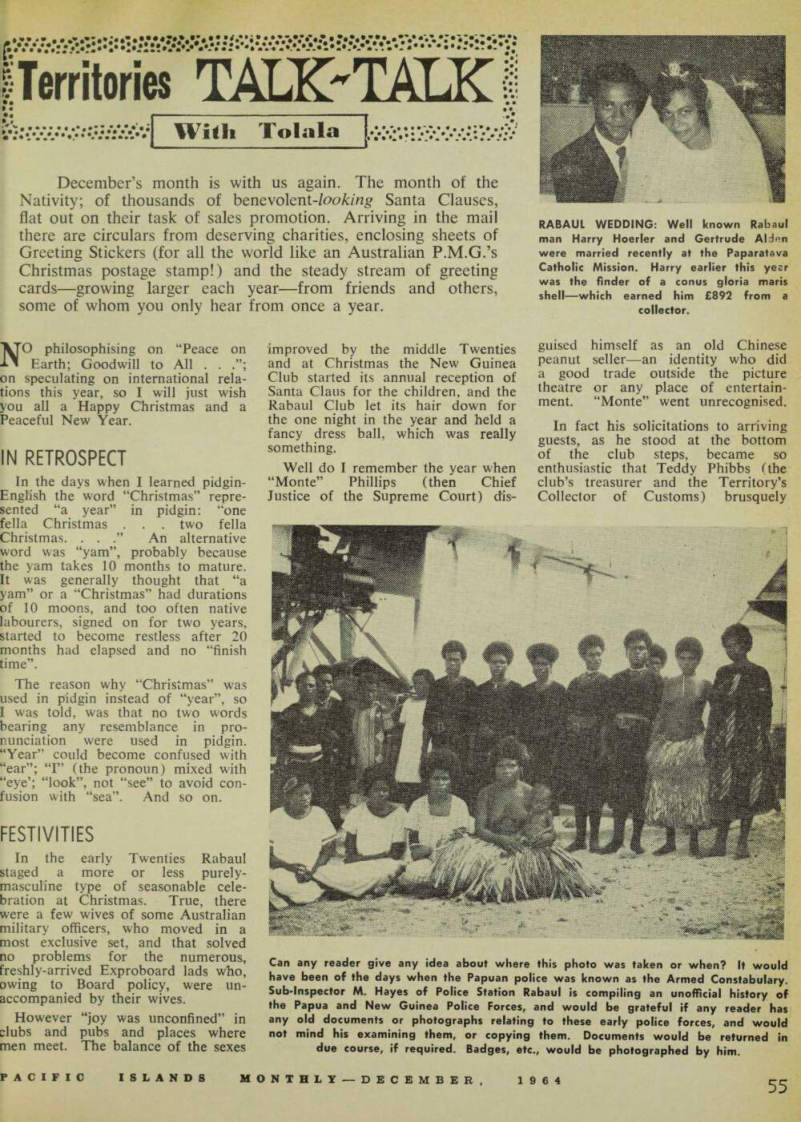
RABAUL WEDDING: Well known Rabaul man Harry Hoerler and Gertrude Alden were married recently at the Paparatava Catholic Mission. Harry earlier this year was the finder of a conus gloria maris shell—which earned him £892 from a collector.
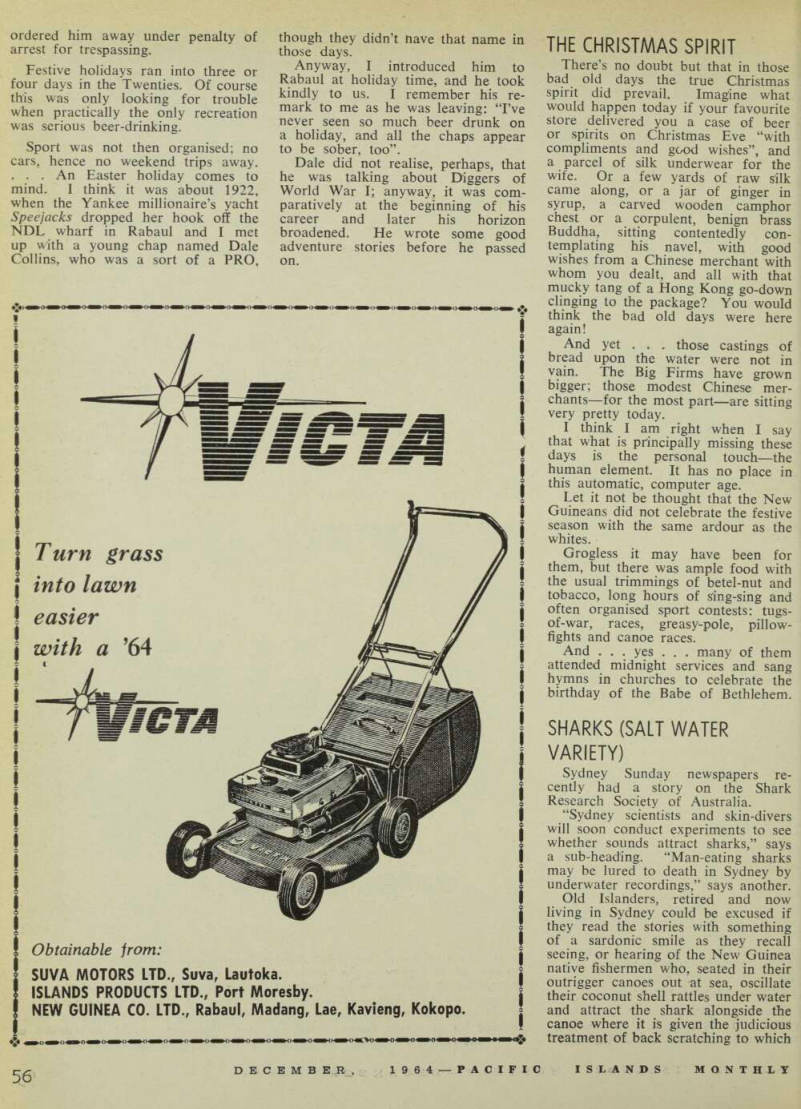
Can any reader give any idea about where this photo was taken or when? It would have been of the days when the Papuan police was known as the Armed Constabulary.
Sub-Inspector M. Hayes of Police Station Rabaul is compiling an unofficial history of the Papua and New Guinea Police Forces, and would be grateful if any reader has any old documents or photographs relating to these early police forces, and would not mind his examining them, or copying them. Documents would be returned in due course, if required. Badges, etc., would be photographed by him.
ordered him away under penalty of arrest for trespassing.
Festive holidays ran into three or four days in the Twenties. Of course this was only looking for trouble when practically the only recreation was serious beer-drinking.
Sport was not then organised; no cars, hence no weekend trips away. . . . An Easter holiday comes to mind. I think it was about 1922, when the Yankee millionaire’s yacht Speejacks dropped her hook off the NDL wharf in Rabaul and I met up with a young chap named Dale Collins, who was a sort of a PRO,
though they didn’t nave that name in those days.
Anyway, I introduced him to Rabaul at holiday time, and he took kindly to us. I remember his re mark to me as he was leaving: “I’ve never seen so much beer drunk on a holiday, and all the chaps appear to be sober, too”.
Dale did not realise, perhaps, that he was talking about Diggers of World War I; anyway, it was com paratively at the beginning of his career and later his horizon broadened. He wrote some good adventure stories before he passed on.
The Christmas Spirit
There’s no doubt but that in those bad old days the true Christmas spirit did prevail. Imagine what would happen today if your favourite store delivered you a case of beer or spirits on Christmas Eve “with compliments and good wishes”, and a parcel of silk underwear for the wife. Or a few yards of raw silk came along, or a jar of ginger in syrup, a carved wooden camphor chest or a corpulent, benign brass Buddha, sitting contentedly con templating his navel, with good wishes from a Chinese merchant with whom you dealt, and all with that mucky tang of a Hong Kong go-down clinging to the package? You would think the bad old days were here again!
And yet . . . those castings of bread upon the water were not in vain. The Big Firms have grown bigger; those modest Chinese mer chants—for the most part—are sitting very pretty today.
I think I am right when I say that what is principally missing these days is the personal touch—the human element. It has no place in this automatic, computer age.
Let it not be thought that the New Guineans did not celebrate the festive season with the same ardour as the whites.
Grogless it may have been for them, but there was ample food with the usual trimmings of betel-nut and tobacco, long hours of sing-sing and often organised sport contests: tugs of-war, races, greasy-pole, pillow fights and canoe races.
And . . . yes . . . many of them attended midnight services and sang hymns in churches to celebrate the birthday of the Babe of Bethlehem.
Sharks (Salt Water
Variety)
Sydney Sunday newspapers re cently had a story on the Shark Research Society of Australia.
“Sydney scientists and skin-divers will soon conduct experiments to see whether sounds attract sharks,” says a sub-heading. “Man-eating sharks may be lured to death in Sydney by underwater recordings,” says another.
Old Islanders, retired and now living in Sydney could be excused if they read the stories with something of a sardonic smile as they recall seeing, or hearing of the New Guinea native fishermen who, seated in their outrigger canoes out at sea, oscillate their coconut shell rattles under water and attract the shark alongside the canoe where it is given the judicious treatment of back scratching to which
shark responds with the same Dyment and abandon as the pet r down on the farm. noose (usually of lawyer vine) lowered in the water, eventually wn tight around the shark and 'ther catch has been made. simple as that. .et me suggest that the Education e be put upon the other foot and v Guinea fishermen invited to give ruction in the gentle art of shark ng to the erudite members of the rk Research Society. ’ ootnote : Ben Cropp, author of :ntly published Shark Hunters and > knows as much, if not a little •e about sharks than most folk, i product of New Guinea. He d at Skotilan on Buka Island, re his father was a Methodist sionary for some years.
We Kind Words
[argaret Mead, the US anthro »gist who had been taking a look Manus, her pet district in New oea and where she first visited idd years ago, had some reciative remarks to make on ainistration work in the Terri , when she returned from her last month. ne can be well assured that she :e truthfully, according to her Is. She has no axe to grind; political entanglements (as other ious critics invariably had) only yaps a friendly feeling towards a itory and its people for having, ome degree, contributed to the olidating of her position in the 'emic world today. weryone knows that New leans are not ready for indepen e (1964 vintage) full stop. But Anti-Colonialists are in the >rity; and so that is that. ;rhaps we are needlessly worrying the whole business. At any of the clock now bloody old s could do his block and the le of New Guinea be given yet her demonstration of how the ised world settles its differences, itself practises those actions ist which it preaches to the itive people.
Thought: In the Ante-Colonial (1880’s and earlier) the New tea people were independent, they tised self determination in no un in manner. Came the Colonial i and the people allegedly lost independence. Now in 1964 ; the Anti-Colonial Days when lendence is sought to be restored.