Neighbour's TV
pp. 53-55 · Read in the full issue

Western Samoa Cautious Over Neighbour's TV
From R• F • Rankin, in Apia.
Western Samoa’s educationists are adopting a wait-and see policy on the advantages or otherwise of this territory re ceiving educational television beamed from nearby American Samoa.
THEY have noted with interest that American Samoa’s Governor H. Rex Lee has said that Prince Tungi has indicated his desire to switch Tongan education to ETV from American Samoa. But that is a far as they have gone. They will wait and see how it works out in American Samoa.
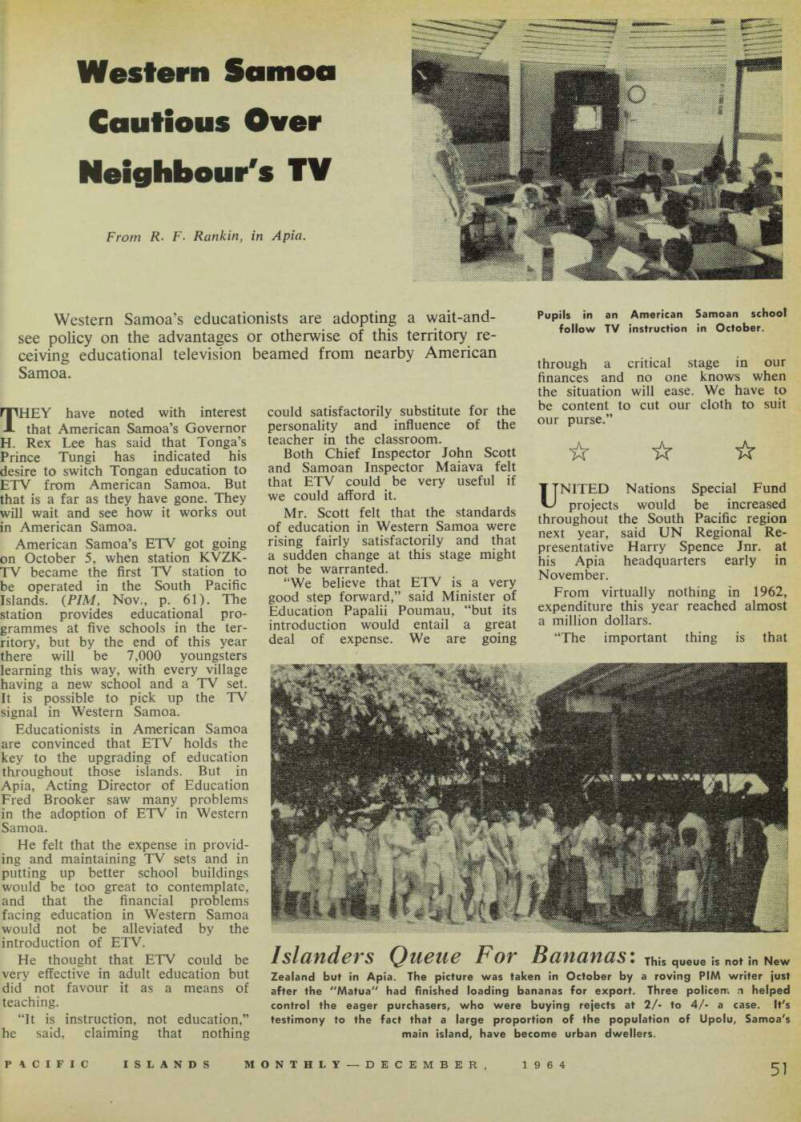
American Samoa’s ETV got going on October 5, when station KVZK TV became the first TV station to be operated in the South Pacific Islands. {PIM, Nov., p. 61). The station provides educational pro grammes at five schools in the ter ritory, but by the end of this year there will be 7,000 youngsters learning this way, with every village having a new school and a TV set.
It is possible to pick up the TV signal in Western Samoa, Educationists in American Samoa are convinced that ETV holds the key to the upgrading of education throughout those islands. But in Apia, Acting Director of Education Fred Brooker saw many problems in the adoption of ETV in Western Samoa.
He felt that the expense in provid ing and maintaining TV sets and in putting up better school buildings would be too great to contemplate, and that the financial problems facing education in Western Samoa would not be alleviated by the introduction of ETV.
He thought that ETV could be very effective in adult education but did not favour it as a means of teaching.
“It is instruction, not education,” he said, claiming that nothing
could satisfactorily substitute for the personality and influence of the teacher in the classroom.
Both Chief Inspector John Scott and Samoan Inspector Maiava felt i h e at co^7^it be very use£ul if Mr. Scott felt that the standards of education in Western Samoa were rrsrng farnly satisfactorily and t at a sudden change at this stage might not be warranted.
“We believe that EIY is a very good step forward,” said Minister of Education Papalii Poumau, “but its introduction would entail a great deal of expense. We are going
through a critical stage in our finances and no one knows when the situation will ease. We have to be content to cut our cloth to suit our purse.” ☆ ☆ ☆ UNITED Nations Special Fund projects would be increased throughout the South Pacific region next year, said UN Regional Re presentative Harry Spence Jnr. at his Apia headquarters early in November.
From virtually nothing in 1962, expenditure this year reached almost a million dollars.
“The important thing is that
Pupils in an American Samoan school follow TV instruction in October.
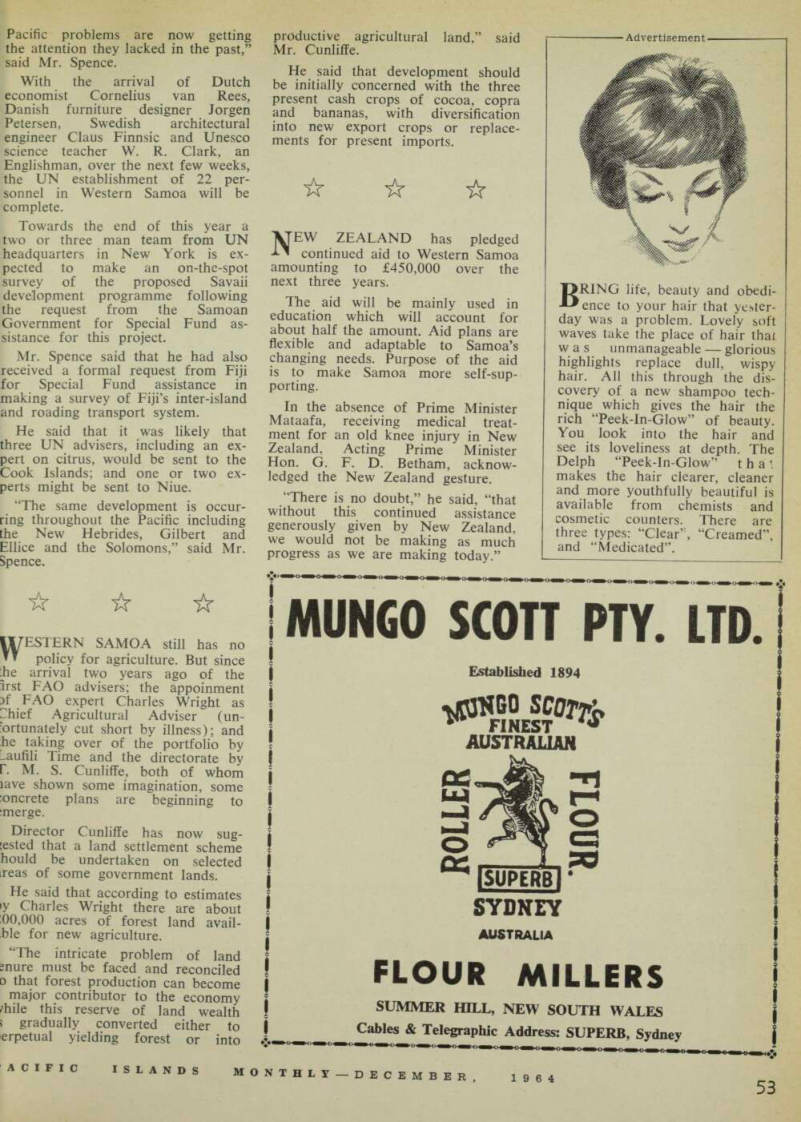
Islanders Queue For Bananas: this queue is not in New Zealand but in Apia. The picture was taken in October by a roving PIM writer just after the "Matua" had finished loading bananas for export. Three police man helped control the eager purchasers, who were buying rejects at 2/- to 4/- a case. It's testimony to the fact that a large proportion of the population of Upolu, Samoa's main island, have become urban dwellers.
Pacific problems are now getting the attention they lacked in the past,” said Mr. Spence, With the arrival of Dutch economist Cornelius van Rees, Danish furniture designer Jorgen Petersen, Swedish architectural engineer Claus Finnsic and Unesco science teacher W. R. Clark, an Englishman, over the next few weeks, the UN establishment of 22 per sonnel in Western Samoa will be complete.
Towards the end of this year a two or three man team from UN headquarters in New York is ex pected to make an on-the-spot survey of the proposed Savaii development programme following the request from the Samoan Government for Special Fund as sistance for this project.
Mr. Spence said that he had also received a formal request from Fiji for Special Fund assistance in making a survey of Fiji’s inter-island and reading transport system.
He said that it was likely that three UN advisers, including an ex pert on citrus, would be sent to the Cook Islands; and one or two ex perts might be sent to Niue.
“The same development is occur ring throughout the Pacific including the New Hebrides, Gilbert and Ellice and the Solomons,” said Mr.
Spence. ☆ WESTERN SAMOA still has no policy for agriculture. But since the arrival two years ago of the irst FAO advisers; the appoinment 3f FAO expert Charles Wright as -hief Agricultural Adviser (un hrtunately cut short by illness); and he taking over of the portfolio by -aufili Time and the directorate by f. M. S. Cunliffe, both of whom lave shown some imagination, some :oncrete plans are beginning to :merge.
Director Cunliffe has now sug ;ested that a land settlement scheme hould be undertaken on selected ireas of some government lands.
He said that according to estimates •y Charles Wright there are about 00,000 acres of forest land avail ble for new agriculture.
“The intricate problem of land mure must be faced and reconciled o that forest production can become major contributor to the economy hile this reserve of land wealth 5 gradually converted either to erpetual yielding forest or into
productive agricultural land,” said Mr. Cunliffe, He said that development should be initially concerned with the three present cash crops of cocoa, copra and bananas, with diversification into new export crops or replace ments for present imports. ☆ ☆ ☆ NEW ZEALAND has pledged continued aid to Western Samoa amounting to £450,000 over the next three years.
The aid will be mainly used in education which will account for about half the amount. Aid plans are flexible and adaptable to Samoa’s changing needs. Purpose of the aid is to make Samoa more self-sup porting.
In the absence of Prime Minister Mataafa, receiving medical treat ment for an old knee injury in New Zealand, Acting Prime Minister Hon. G. F. D. Betham, acknow ledged the New Zealand gesture.
“There is no doubt,” he said, “that without this continued assistance generously given by New Zealand, we would not be making as much progress as we are making today.”