Of Housing
pp. 35-37 · Read in the full issue
A Handy Type Of Housing
Islands Administrations facing problems of housing native staff on developing enterprises may be interested in these struc tures now being used by the Geological Survey Department in the British Solomons.
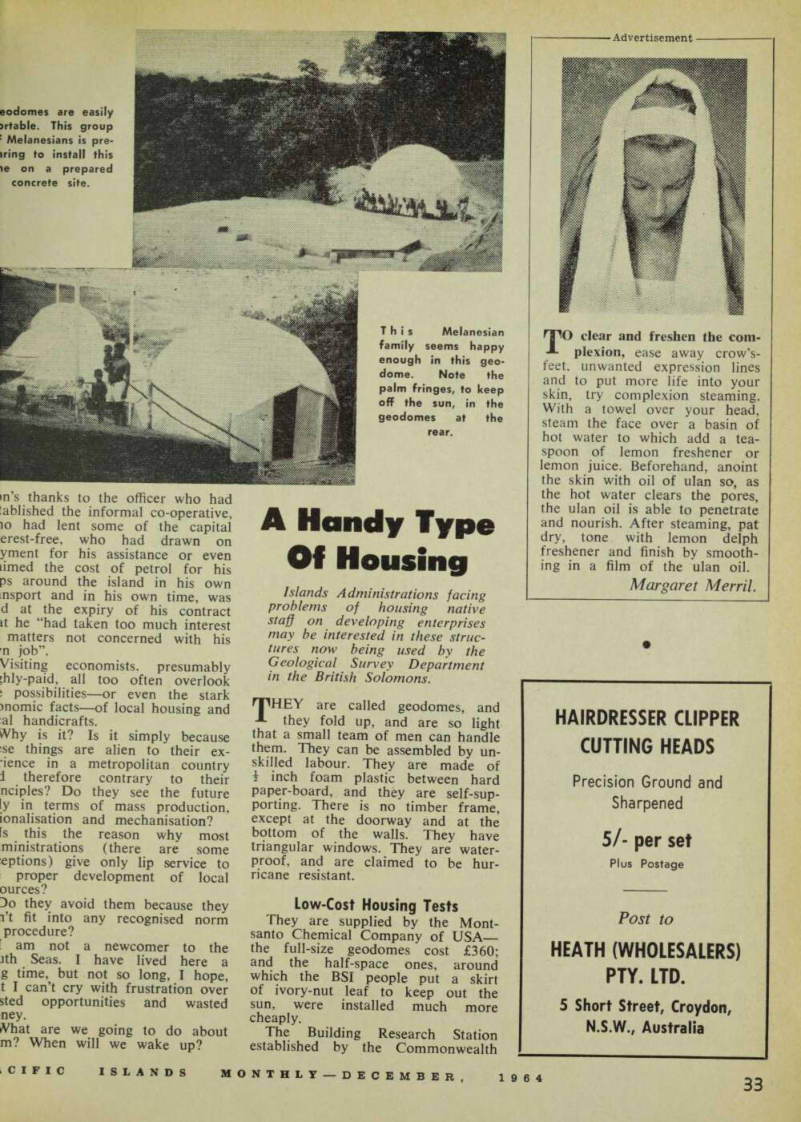
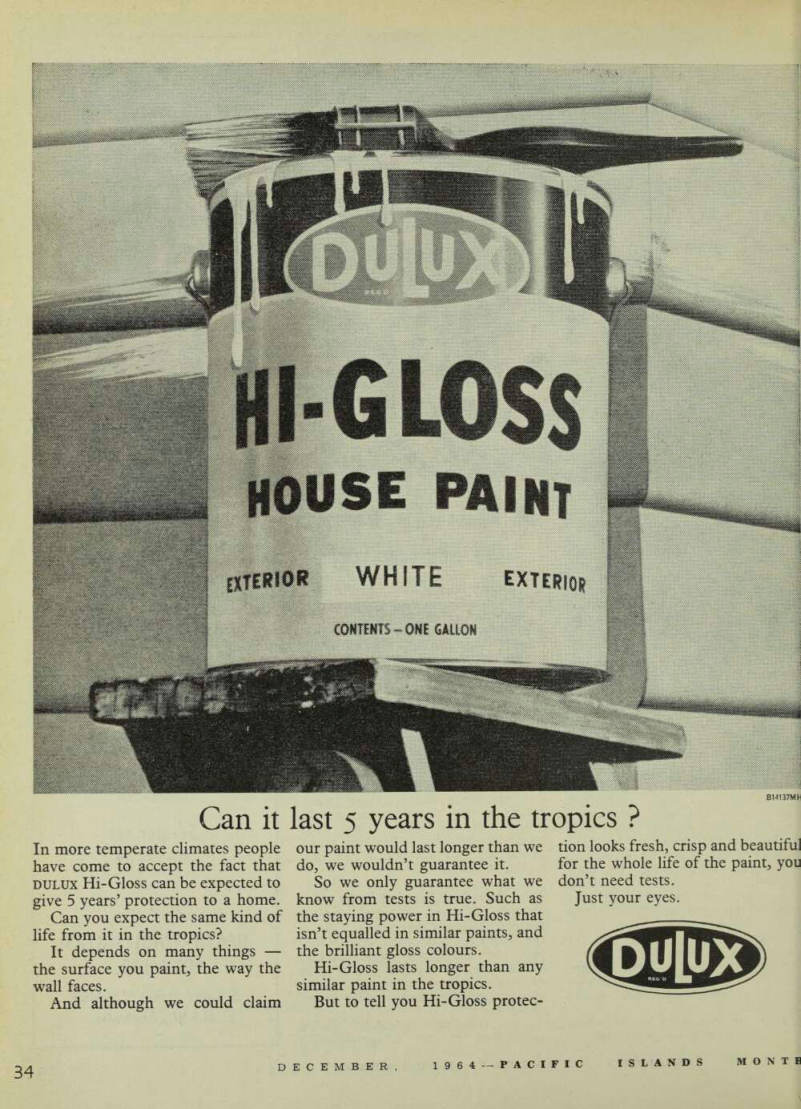
HTHEY are called geodomes, and they fold up, and are so light that a small team of men can handle them. They can be assembled by un skilled labour. They are made of i inch foam plastic between hard paper-board, and they are self-sup porting. There is no timber frame, except at the doorway and at the bottom of the walls. They have triangular windows. They are water proof, and are claimed to be hur ricane resistant.
Low-Cost Housing Tests They are supplied by the Mont santo Chemical Company of USA— the full-size geodomes cost £360; and the half-space ones, around which the BSI people put a skirt of ivory-nut leaf to keep out the sun, were installed much more cheaply.
The Building Research Station established by the Commonwealth
[?]eodomes are easily [?]rtable. This group [?] Melanesians is pre [?]ring to install this [?]e on a prepared concrete site.
This Melanesian family seems happy enough in this geo dome. Note the palm fringes, to keep off the sun, in the geodomes at the rear.
partment of Works at Port jresby, Papua-New Guinea is to iduct tests on the use of local ilding materials for the construc n of low-cost housing. The pro imme of research includes:— A survey of available native materials.
Investigations into the potential use of bush and other locally produced materials.
Sociological aspects of housing for New Guineans.
Treatment of native materials, including fire-proofing.
Investigations into earthquake resistant building techniques.
Manufacture of new type building materials from local resources. inexpensive and easy-to-operate chine is at present being used by Australian firm to make a build board from wheat straw; similar chines will be taken to the Ter iry to test manufacture of wall irds from compressed kunai grass.
V pilot project will be constructed sisting of an office for the ;arch station. It will measure feet x 16 feet, and will be mically treated to ensure ability.
Tie building will be in constant and under daily surveillance to ck efficiency of preservative hods. The framework will be of ited bamboo, the walls of nipa n from Kikori, the floor of bom palm from the Brown River, building stumps of mangrove :s from Bootless Bay, and the f of either kunai thatch or cut dhs of bamboo tiles.