Local Skills Are Being Wasted
pp. 31-35 · Read in the full issue
In The South Seas
From a Frustrated Islands Resident For years I’ve been in Government service of one sort or another, but just at the moment I feel that I’m free to prise open my sealed lips and ask an open question or two to Administration types in the Pacific. It’s a problem that’s been bothering me for a long time and maybe somebody— some Administration type even-—might be able to provide the answer.
question is quite simply this: Why do Administrations, by id large, do everything—not so uch by active measures but rather ' masterly inactivity— to throttle :al skills, methods and materials d instead, at vast expense, foist an iported “know-how” and way of e on the people?
I’ll give you some examples of rat I mean. For reasons of personal :t, shall we say, no names will be mtioned but I can assure you that mes exist, and that residents of dividual territories concerned will ow exactly what is meant.
First example: Housing in local aterials or built by local methods.
“Oh no, old boy. That kind of ilding just doesn’t pay. It isn’t onomic. Imported officers’ wives mldn’t accept it either. It may ye been alright for early mission ies or for the first Administration Seers, but it won’t do nowadays.”
Very plausible. Yet, in the very ntre where this viewpoint was pressed most strongly to me, while sat in a box of a house lacking 1 grace or interest, but which had
cost the Administration over £7,000 to build, I was looking towards another home, of equal or even greater ground area and occupied
by a European couple of fully equal cultural demands to those of my hosts, and which had cost £BOO to build.
Its interior partitions and its ceilings were of glossy, plaited sago palm stem-bark, its roof was of local thatch. It had all the civilised amenities of the Administration “boxes” and it was a house every room in which would have been
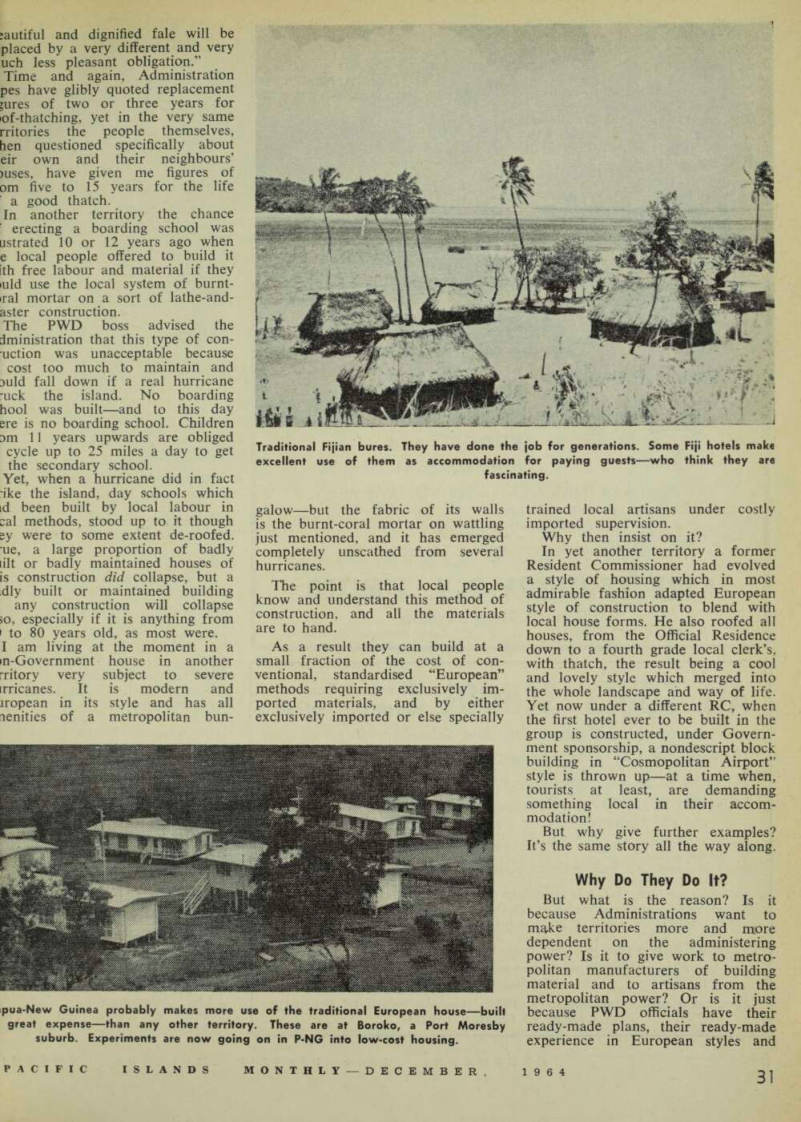
A local house on Tanna, in the New Hebrides.
This one is un usual, for most New Hebrides houses are rect angular.-Photo:
Rob Wright.
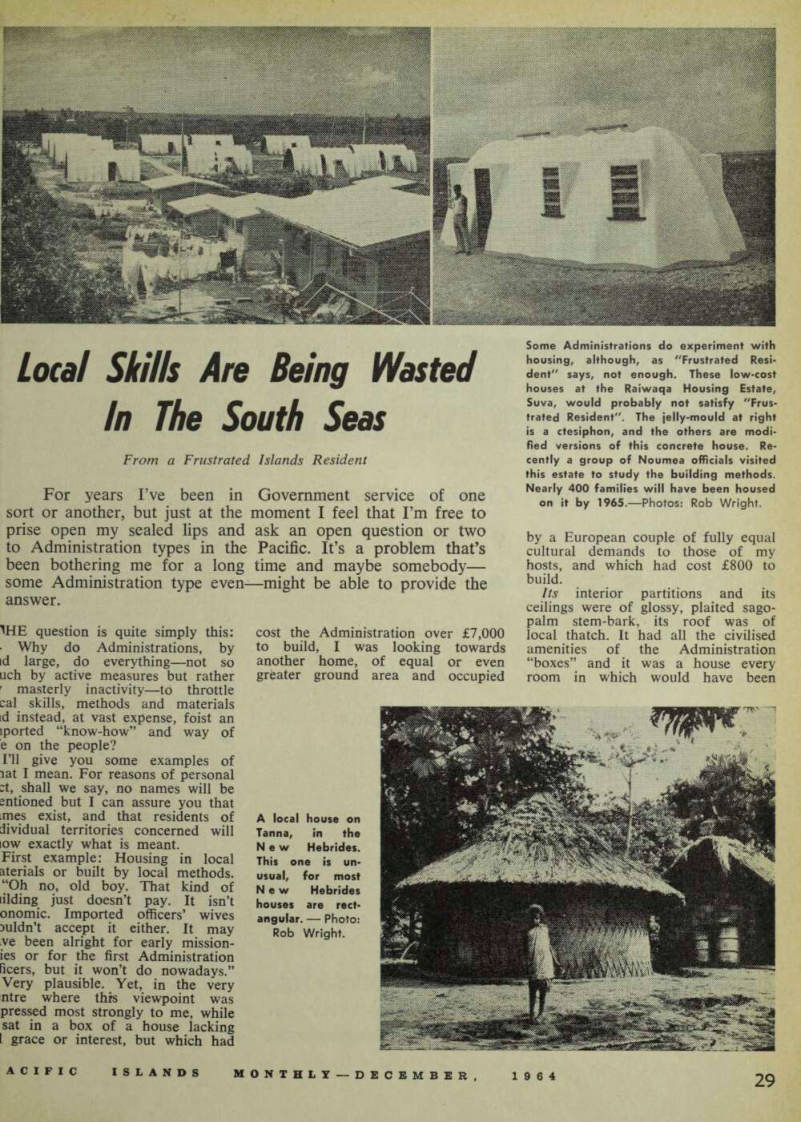
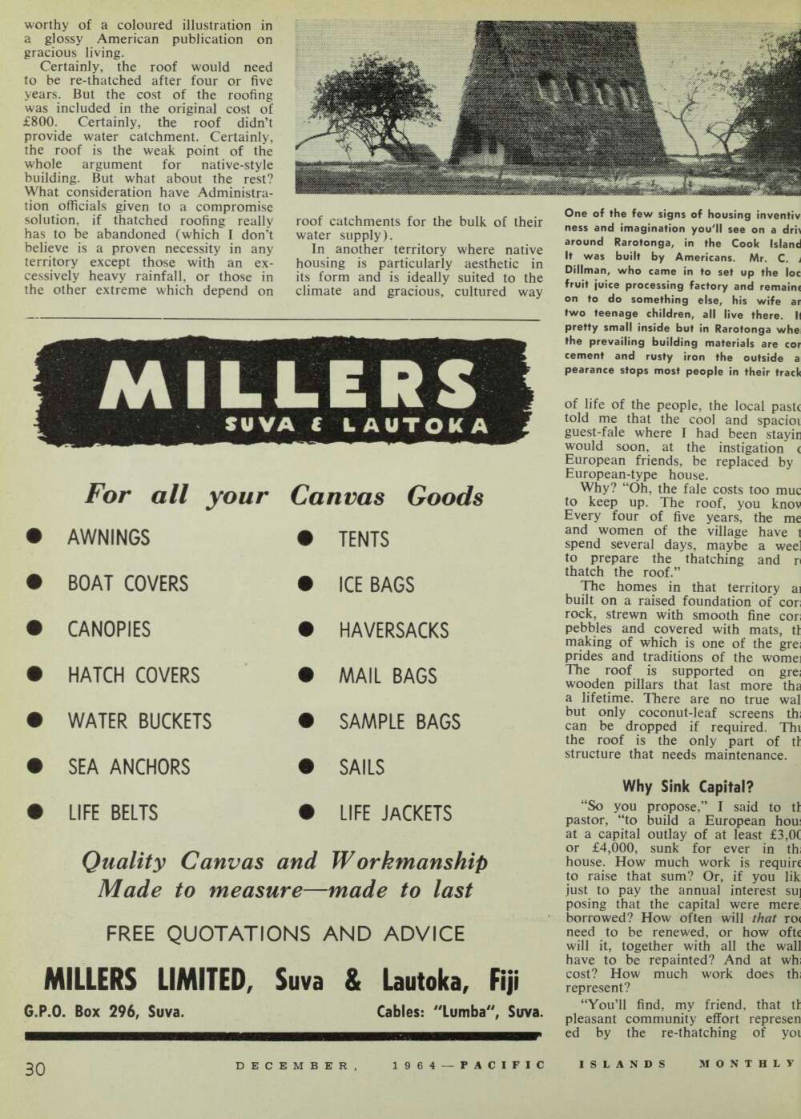
Some Administrations do experiment with housing, although, as "Frustrated Resi dent" says, not enough. These low-cost houses at the Raiwaqa Housing Estate, Suva, would probably not satisfy "Frus trated Resident". The jelly-mould at right is a ctesiphon, and the others are modi fied versions of this concrete house. Re cently a group of Noumea officials visited this estate to study the building methods.
Nearly 400 families will have been housed on it by 1965.—Photos: Rob Wright.
worthy of a coloured illustration in a glossy American publication on gracious living.
Certainly, the roof would need to be re-thatched after four or five years. But the cost of the roofing was included in the original cost of £BOO. Certainly, the roof didn’t provide water catchment. Certainly, the roof is the weak point of the whole argument for native-style building. But what about the rest?
What consideration have Administra tion officials given to a compromise solution, if thatched roofing really has to be abandoned (which I don’t believe is a proven necessity in any territory except those with an ex cessively heavy rainfall, or those in the other extreme which depend on
roof catchments for the bulk of their water supply).
In another territory where native housing is particularly aesthetic in its form and is ideally suited to the climate and gracious, cultured way
of life of the people, the local paste told me that the cool and spacioi guest-fale where I had been stayin would soon, at the instigation c European friends, be replaced by European-type house.
Why? “Oh, the fale costs too muc to keep up. The roof, you knov Every four of five years, the me and women of the village have t spend several days, maybe a wee) to prepare the thatching and r< thatch the roof.”
The homes in that territory ai built on a raised foundation of con rock, strewn with smooth fine cor; pebbles and covered with mats, th making of which is one of the gre. prides and traditions of the womei The roof is supported on gre; wooden pillars that last more tha a lifetime. There are no true wal but only coconut-leaf screens thi can be dropped if required. Thi the roof is the only part of th structure that needs maintenance.
Why Sink Capital?
“So you propose,” I said to th pastor, “to build a European hou: at a capital outlay of at least £3,OC or £4,000, sunk for ever in thi house. How much work is require to raise that sum? Or, if you lik just to pay the annual interest su] posing that the capital were mere] borrowed? How often will that ro( need to be renewed, or how ofte will it, together with all the wall have to be repainted? And at whi cost? How much work does th; represent?
“You’ll find, my friend, that th pleasant community effort represen ed by the re-thatching of yoi
One of the few signs of housing inventiv[?] ness and imagination you'll see on a dri[?] around Rarotonga, in the Cook Islands It was built by Americans. Mr. C. [?] Dillman, who came in to set up the lo[?] fruit juice processing factory and remaine[?] on to do something else, his wife a[?] two teenage children, all live there. I[?] pretty small inside but in Rarotonga whe[?] the prevailing building materials are co[?] cement and rusty iron the outside a[?] pearance stops most people in their track[?]
jautiful and dignified fale will be placed by a very different and very uch less pleasant obligation.”
Time and again, Administration pes have glibly quoted replacement pires of two or three years for iof-thatching, yet in the very same rritories the people themselves, hen questioned specifically about eir own and their neighbours’ mses, have given me figures of om five to 15 years for the life a good thatch.
In another territory the chance erecting a boarding school was Listrated 10 or 12 years ago when e local people offered to build it ith free labour and material if they iuld use the local system of burnt iral mortar on a sort of lathe-and aster construction.
The PWD boss advised the that this type of con uction was unacceptable because cost too much to maintain and Duld fall down if a real hurricane •uck the island. No boarding hool was built—and to this day ere is no boarding school. Children am 11 years upwards are obliged cycle up to 25 miles a day to get the secondary school.
Yet, when a hurricane did in fact ike the island, day schools which id been built by local labour in eal methods, stood up to it though ey were to some extent de-roofed. ue, a large proportion of badly lilt or badly maintained houses of is construction did collapse, but a ,dly built or maintained building any construction will collapse >o, especially if it is anything from i to 80 years old, as most were.
I am living at the moment in a »n-Government house in another rritory very subject to severe irricanes. It is modern and iropean in its style and has all lenities of a metropolitan bun-
galow—but the fabric of its walls is the burnt-coral mortar on wattling just mentioned, and it has emerged completely unscathed from several hurricanes.
The point is that local people know and understand this method of construction, and all the materials are to hand.
As a result they can build at a small fraction of the cost of con ventional, standardised “European” methods requiring exclusively im ported materials, and by either exclusively imported or else specially
trained local artisans under costly imported supervision.
Why then insist on it?
In yet another territory a former Resident Commissioner had evolved a style of housing which in most admirable fashion adapted European style of construction to blend with local house forms. He also roofed all houses, from the Official Residence down to a fourth grade local clerk’s, with thatch, the result being a cool and lovely style which merged into the whole landscape and way of life.
Yet now under a different RC, when the first hotel ever to be built in the group is constructed, under Govern ment sponsorship, a nondescript block building in “Cosmopolitan Airport” style is thrown up—at a time when, tourists at least, are demanding something local in their accom modation!
But why give further examples?
It’s the same story all the way along.
Why Do They Do It?
But what is the reason? Is it because Administrations want to mqke territories more and more dependent on the administering power? Is it to give work to metro politan manufacturers of building material and to artisans from the metropolitan power? Or is it just because PWD officials have their ready-made plans, their ready-made experience in European styles and
pua-New Guinea probably makes more use of the traditional European house—built great expense—than any other territory. These are at Boroko, a Port Moresby suburb. Experiments are now going on in P-NG into low-cost housing.
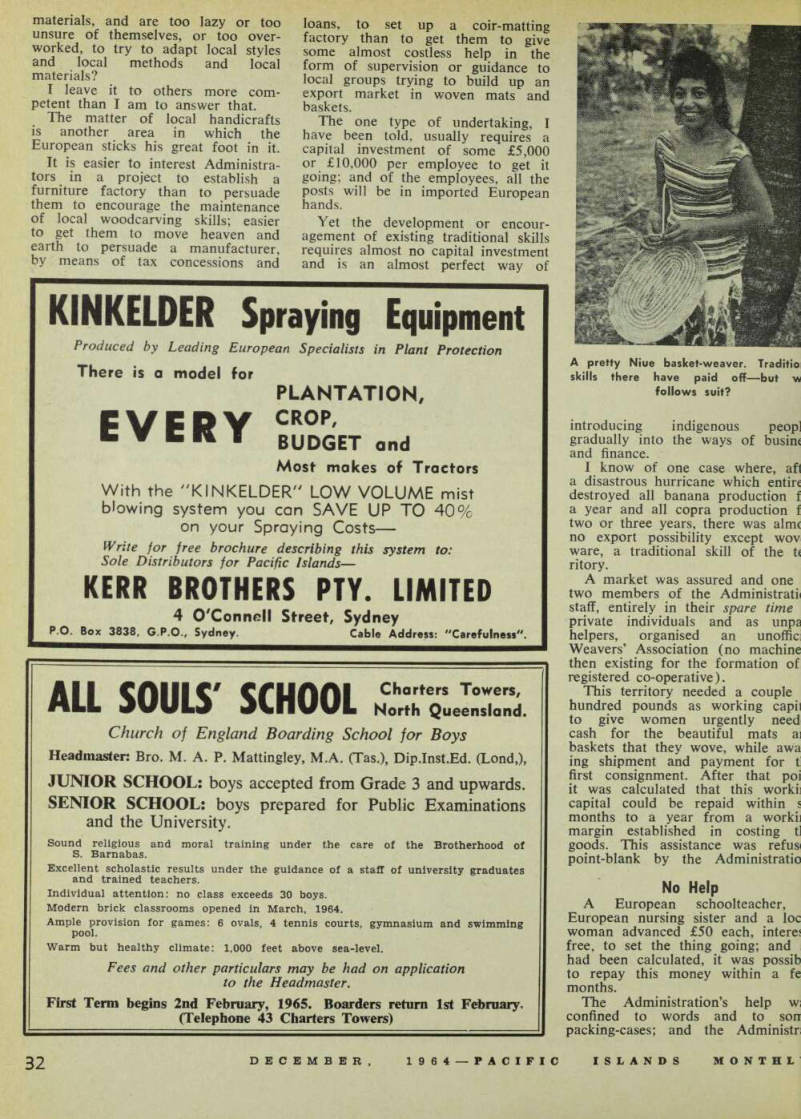
Traditional Fijian bures. They have done the job for generations. Some Fiji hotels make excellent use of them as accommodation for paying guests—who think they are fascinating.
materials and are too lazy or too unsure of themselves, or too overworked, to try to adapt local styles and local methods and local materials. 1 leave it to others more competent than I am to answer that. . The matter of local handicrafts is another area in which the European sticks his great foot in it.
It is easier to interest Administrators in a project to establish a furniture factory than to persuade them to encourage the maintenance of local woodcarving skills; easier to get them to move heaven and earth to persuade a manufacturer, by means of tax concessions and
loans, to set up a coir-matting factory than to get them to give some almost costless help in the form of supervision or guidance to local groups trying to build up an export market in woven mats and baskets.
The one type of undertaking, I have been told, usually requires a capital investment of some £5,000 or £lO,OOO per employee to get it going; and of the employees, all the posts will be in imported European hands.
Yet the development or encour agement of existing traditional skills requires almost no capital investment and is an almost perfect way of
introducing indigenous peop] gradually into the ways of busim and finance.
I know of one case where, aft a disastrous hurricane which entire destroyed all banana production f a year and all copra production f two or three years, there was almc no export possibility except wovi ware, a traditional skill of the t< ritory.
A market was assured and one two members of the Administrate staff, entirely in their spare time private individuals and as unpa helpers, organised an unoffici Weavers’ Association (no machine then existing for the formation of registered co-operative).
This territory needed a couple hundred pounds as working capil to give women urgently need cash for the beautiful mats ai baskets that they wove, while awa ing shipment and payment for tl first consignment. After that poi it was calculated that this workii capital could be repaid within s months to a year from a workii margin established in costing tl goods. This assistance was refusi point-blank by the Administrate
No Help
A European schoolteacher, European nursing sister and a loc woman advanced £5O each, interes free, to set the thing going; and ; had been calculated, it was possib to repay this money within a fe months.
The Administration’s help wi confined to words and to son packing-cases; and the Administn
A pretty Niue basket-weaver. Traditio[?] skills there have paid off—but w[?] follows suit?
•n’s thanks to the officer who had tablished the informal co-operative, 10 had lent some of the capital erest-free, who had drawn on yment for his assistance or even limed the cost of petrol for his ps around the island in his own insport and in his own time, was d at Jhe expiry of his contract it he “had taken too much interest matters not concerned with his n job”.
Visiting economists, presumably 'hly-paid, all too often overlook “ possibilities—or even the stark momic facts—of local housing and al handicrafts.
Why is it? Is it simply because ise things are alien to their ex •ience in a metropolitan country i therefore contrary to their nciples? Do they see the future [y in terms of mass production, ionalisation and mechanisation? [s this the reason why most ministrations (there are some eptions) give only lip service to proper development of local ources?
Do they avoid them because they i’t fit into any recognised norm procedure? - am not a newcomer to the Jth Seas. I have lived here a g time, but not so long, I hope, t I can’t cry with frustration over sted opportunities and wasted ney.
What are we going to do about m? When will we wake up?