When The Pilot Made
pp. 93-94 · Read in the full issue
The Month's New Reading
The Tea And Toast
In 1963, Arthur H. Affleck, then Regional Director of Civil Aviation for Papua-New Guinea, retired after 40 years in aviation. He had a story to tell and The Wandering Years is the story.
1 a general way, airmen are not particularly articulate and, with few notable exceptions, don’t ally write books. So it comes a pleasant surprise to find that man who presided for four years r P-NG’s DCA—a Department t is frequently misunderstood in Territory—has a gift for story ing and a very nice wit.
Arthur Affleck’s first dozen years flying were on the outback routes ti pioneer Qantas, with the Flying fior service in the early years of existence, and with West Aus ian Airways and Macßobertson ler. This must have coloured style of writing because he under -5s it with Australian bushman’s to for the anecdote, most of ch, in this case, are hilarious, e Tropicalities, this issue.)
Personality
'his ability to describe people and dents and make them live gives »onality to the book—to such an ;nt that the reader is inclined forget its more serious aspect of irding the history of civil aviation Australia from shortly after rid War I until the present, iffleck started his working jer on the lowest rung of the king ladder, in Melbourne, but 1923 decided that this could not tinue to be. By a process of unation it appeared that com cial aviation appealed more and i paid more.
Tie only body giving the necessary ruction, in those days, was the AF. Within its own organisation irovided a 12 months’ course for the new Civil Aviation Branch those lucky enough to be chosen Civil Aviation cadets. q 1924 Affleck was issued with “Wings” badge, was granted a i discharge from the RAAF, was sented with licence No. 96 and ame a commercial pilot employed
by Australian Aerial Services Ltd. on the Melbourne-Hay service. He was airborne.
Those whose aerial memories don’t stretch back as far as the author’s will find his experiences with the fabric and wire planes that remained in the air at speeds as low as 60 mph, considerably harder to believe than today’s science-fiction.
He joined Qantas in 1927 when the airline really was the Queensland and Northern Territory Aerial Service and when its entire fleet con sisted of two World War I open cockpit jobs and two DHso’s, which were considered comparatively modern.
Open Cockpit
Affleck’s section of Qantas’ route was Longreach to Cloncurry, a distance of 311 miles, and in the first year he carried only 11 pas sengers in the open-cockpit war disposals models but 118 passengers in the DHSO. The passengers paid for their own accommodation and meals en route—when they could get them—but even in 1927 they were looking for a certain degree of comfort, usually provided by the pilot.
“At not one of the hotels where we stayed,” reports Affleck, “did the publican consider it worthwhile to supply early breakfast to passengers and crew. The pilot, in addition to flying the aircraft and, in many instances refuelling and servicing it, was required to wake his passengers, rush down to the hotel kitchen and make a cup of tea and toast for
them, help handle their baggage, collect mail from the local post office and freight from the agent’s office, pick up any other passengers from their homes or other hotels and then get out to the aerodrome on time to open up the hangar, push the aircraft out with the assistance of any of the passengers who felt strong enough to help at that hour of the day, start up, load up and take off at the first crack of dawn.”
Most of his juiciest adventures came after he became the first pilot for the Flying Doctor service which commenced in 1928, from a base in Cloncurry, with a DHSO chartered from Qantas. In the next four years, with a succession of flying doctors, he helped run a practice that stretched from Katherine to Charleville and from Julia Creek to Bulia, which according to Australian lore is supposed to be as hot as hell. It was in Bulia that they found, behind the door of the bath room of the hotel, the following notice: “Gents are asked please not to
pee in the bath as it causes fever.
By order of the Proprietress In 1931, a year after he was married in Cloncurry, Affleck said goodbye to the town, to Qantas and, as he thought, aviation. Attracted by glowing reports of the fortunes to be made out of growing tobacco he and his wife took up 25 acres of land at Mareeba, about 25 miles inland from Cairns, and became farmers.
In the following year they lived in a shed on the property, had a son, worked harder than they had ever done in their lives and ended making just enough money to satisfy their creditors.
In the four years he had worked for Qantas, he had frequently been asked by Ray Parer, who was then running Pacific Aerial Transport Ltd., in New Guinea, to work for him.
He had refused, but after the tobacco fiasco a return to the air was clearly indicated and New Guinea seemed as good a place to start as any.
Companies Proliferated
Air freighting in Morobe district was in its hey-day and airline com panies proliferated. Besides big Guinea Airways, Holden Air Trans port, Les Trist and Frank Drayton, Ray Parer with PAT and later Stephens and Carpenter, all came in for their share of the lucrative trade. These were the days of such New Guinea pilots as Tommy O’Dea, lan Grabowsky, Orm Denny and Orm Koch, the Parers, Kevin and Ray, and many others who became a legend in the Territory.
At the time that Affleck joined PAT, the company was burdened by “two old crocks —a wartime DH9 and a great lumbering, under-powered beast of a Fokker FVII”. It was his fate to grapple with these, while the profitable units of the outfit, a single-engined Junker and a Gipsy
Moth, were flown by someone else— presumably by Ray.
The author says very little about the company or his involvement with it, but in view of Ray’s character and his somewhat unorthodox way of running aeroplanes it wouldn’t be strange if the future Regional Director of Civil Aviation in P-NG failed to see eye-to-eye with his boss in everything. At all events, Affleck did not remain overlong in the Terri tory at this time, returning to Mareeba for a second attempt at tobacco-growing and, when that failed, going to West Australian Airways and later Macßobertson- Miller.
In 1936 he joined the Civil Aviation Board (forerunner of DCA) as a flying inspector. A new phase of his career thus began and ended only last year when, at the age of 60, he retired from the post of Regional-Director, P-NG.
Apart from its entertainment value, this book has considerable interest
for its behind-the-scenes view of Australian civil aviation and its occasional skulduggery. It, naturally, enough, takes a DCA view of most proceedings and says little of the storms that have been raised in the breasts of some who have, at times, felt they were victims of Departmental autocracy.
It is an excellent history of flying in Australia and P-NG since World War I but it might have been made even more valuable if someone had thought to include an index.—lT.
(The Wandering Years.
Longmans, Green & Co. Ltd. 35/-.)
Ray Parer's Boeing transport plane about to leave for New Guinea from Essendon Airfield, Melbourne, in July, 1939.
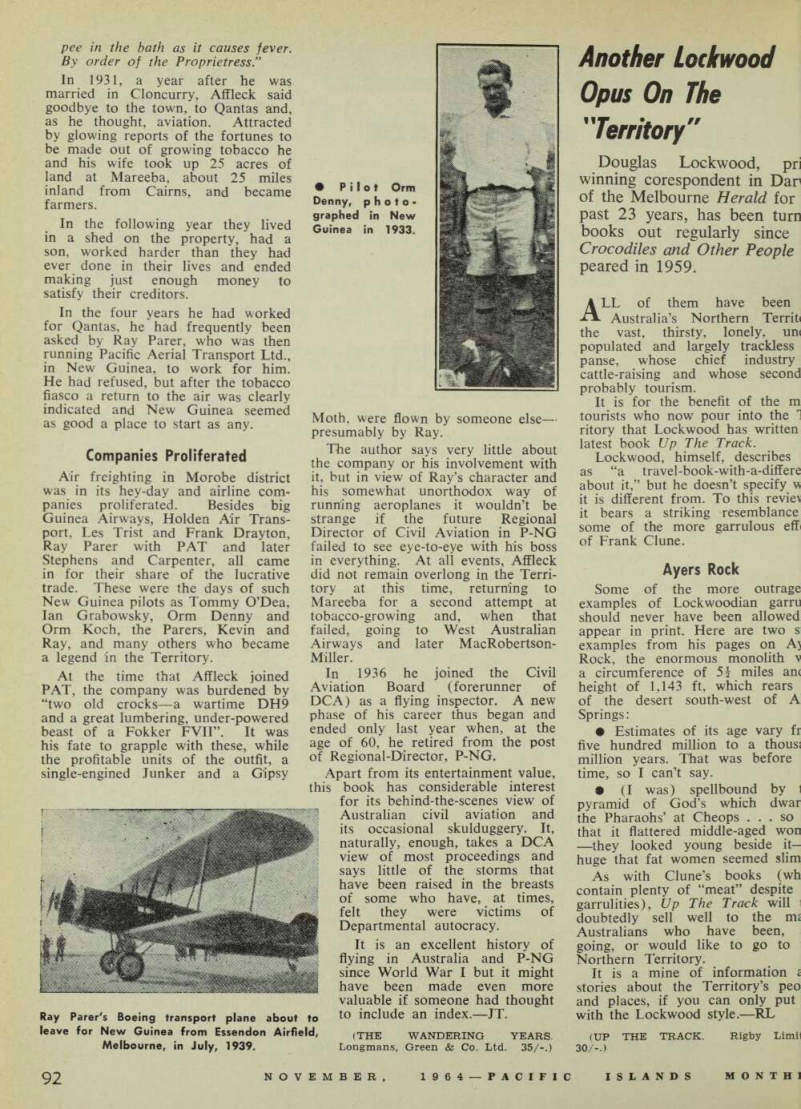
Pilot Orm Denny, photo graphed in New Guinea in 1933.