yesterday
p. 91 · Read in the full issue
Huge American forces had landed on Leyte in the Philippines, the Red Army had broken East Prussian defences, the German High Command had ordered the evacuation of northern Norway, the Russians were attacking Budapest, and the Allies had practically won the battle for Holland . . .
rpHESE were the main items of -■- war news recorded in PlM’s “Pacific News-Review” for No vember, 1944, an invaluable day by-day account of World War II that was published in PIM each month throughout the war. Other news items in the November, 1944, issue were: Pan American Airways were planning to fly to Australia after the war, by-passing Auckland, formerly a PA A Pacific terminal.
It was understood that if PAA were allowed to fly that route a feeder service would be run be tween Sydney and Auckland, either by PAA or TEAL. * * * In a crime wave in Western Samoa, three Samoans were killed at Leulumoega, on the west coast of Upolu, after a fist fight began, stimulated by “bush gin”. * * ♦ Sir Owen Corrie, Chief Justice of Fiji, was soon to retire. He was to be replaced by Sir Claude Seton (Mr. S. R. W. Seton at the time of the announcement) who was then Chief Justice of Nyassaland. * * * Tahiti’s honky-tonks had been closed following outbreaks of in fluenza and dengue fever on the island. The dengue outbreak was Tahiti’s first since 1910 or 1911. * * * At stamp auctions in Melbourne early in November, four mint German New Guinea stamps, part of a set issued in 1900, were sold for £lO6. ♦ * * Western Samoa’s wet season had started exceptionally early after a long dry spell. The heavy rains greatly benefited cocoa and banana plantations, and there was hope of relief from the severe shortage of native foodstuffs. * * ♦ After many months of illness, following an attack of pleurisy,
Ratu Dovi Komaisavai, RAF, died in England. He was the only rep resentative of the Fijian race in the RAF. * * * For valuable work in the Allied cause, while isolated by the Jap anese occupation of the Solomon Islands in 1942-43, Mrs. Ruby Olive Boye, of Vanikoro, was awarded the British Empire Medal.
Though in constant danger of capture by the Japs, Mrs. Boye transmitted meteorological and other information by radio to Allied headquarters. This proved of value to Allied aircraft operat ing over the area. * * * After a survey, Mr. F. B.
Stephens, a New Zealand educa tion officer, recommended sweep ing changes in Fiji’s educational system. One recommendation was that the Government should take over all Fijian district schools, all Indian committee schools, the CSR Co. Ltd. schools and the
Vatukoula European Sch o o 1— and ultimately all schools in the Colony. * * * Because of a big American de mand, some 50,000 hula skirts had been shipped from Rarotonga in the previous two years. ♦ ♦ * An examination was held in Western Samoa to choose three Europeans for free higher educa tion in New Zealand. The winners were W. Williams, Fred Williams (Government School, Ifilfi) and Michael Meredith (Marist Brothers School). * ♦ * Dr. V. W. T. McGusty, Fiji’s Director of Medical Services, Secretary for Indian Affairs, and Central Medical Authority for the Western Pacific High Commission, announced his retirement. But be cause the war was still on, he offered to carry on temporarily.
His offer was accepted.
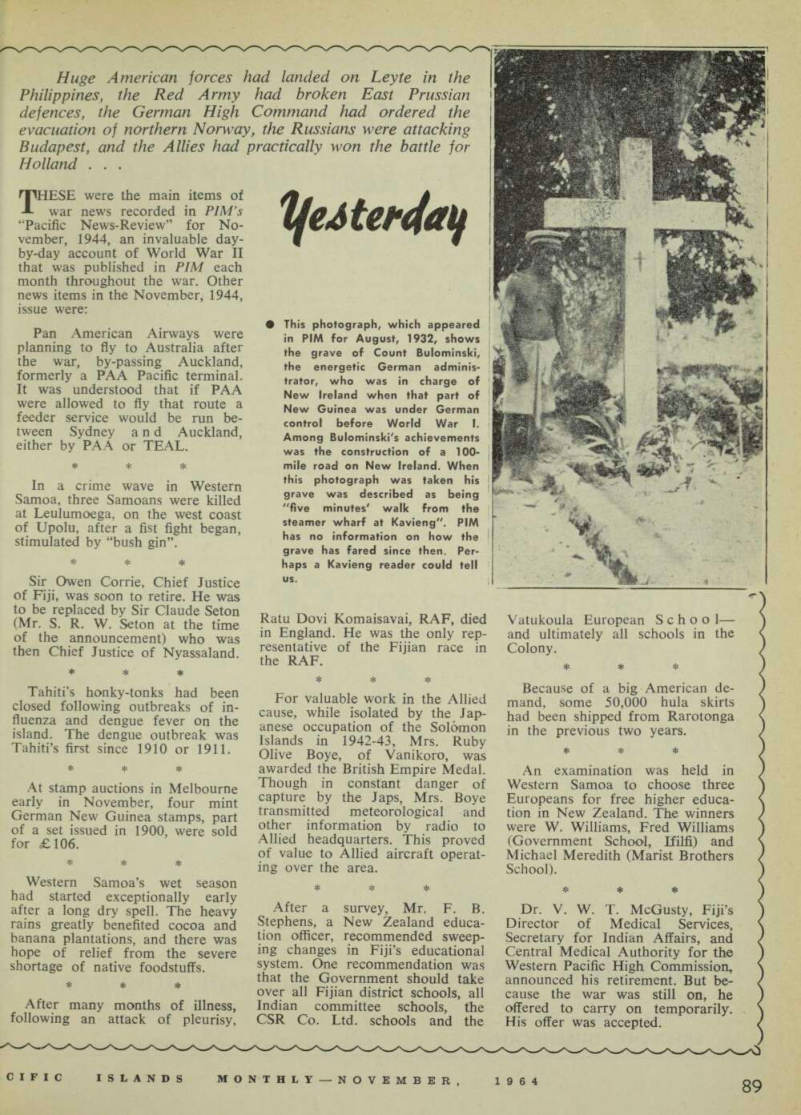
This photograph, which appeared in PIM for August, 1932, shows the grave of Count Bulominski, the energetic German adminis trator, who was in charge of New Ireland when that part of New Guinea was under German control before World War I.
Among Bulominski's achievements was the construction of a 100mile road on New Ireland. When this photograph was taken his grave was described as being "five minutes' walk from the steamer wharf at Kavieng". PIM has no information on how the grave has fared since then. Per haps a Kavieng reader could tell us.