New Evidence On Fiji’s
pp. 87-89 · Read in the full issue

First European Residents
From Captain Stan Brown, in Suva
A recently-discovered manuscript, which gives the first detailed information on the voyage of a schooner from Samoa to Java in 1791, also proves conclusively that the occupants of the schooner were NOT the first Europeans to live in close contact with the Fijians.
HIS is my view after making a detailed study of the contents of manuscript, the existence of ich I first learned of from an icle by Robert Langdon in PIM August, 1961. rhe manuscript, which is now in : Mitchell Library, Sydney, was itten by Midshipman David omas Renouard, a crew member HMS Pandora when she sailed to ! Pacific under Captain Edward wards in 1790 to find and arrest Bounty mutineers.
Fhe Pandora reached Tahiti on irch 23, 1791, where Captain wards found and arrested 14 of mutineers and confiscated a ft schooner that they had built Jer the guidance of James irrison, the Bounty’s boatswain’s te.
Fhis schooner, which was origin -1 called Resolution, was renamed itavai and was refitted to ac npany the Pandora on her voyage oss the Pacific in search of tcher Christian and eight other tineers who had left Tahiti in the unty. sfine of the Pandora’s crew were igned to man the schooner —Mr. ver, the master’s mate, who was v e n command, Midshipman nouard and seven others.
Ships Separated
Fhe Pandora and Matavai left hiti on May 19, 1791, and sailed stward, visiting various islands in rch of the missing mutineers. On night of June 21, they became arated in a storm, off Tutuila, stern Samoa, where the natives 1 proved hostile. \s the Matavai had scarcely any ter on board, Oliver had to decide ckly whether to turn about in rch of the Pandora or whether to ke for Nomuka, some 700 miles ay in the Tonga Group, which s the appointed rendezvous in e of separation.
Oliver’s decision was to make for Nomuka, but since the Matavai had no charts and no means of ascertain ing longitude, the course set for that island was largely guesswork.
Renouard said that the Matavai had a favourable wind from the morning of June 22 to the morning of June 25, when a small lofty island was discovered and a party went ashore in search of water.
Some water was found at the bottom of a deep hollow, but after a man was lowered down to it, it was found to be salty.
Renouard said “the island bore evident marks of volcanic eruptions, the soil was parched up and mixed with ashes; and the hollow in its centre much resembled the crater of an extinguished volcano”.
He added that “scarce any verdure” was to be seen; that the island was uninhabited; but that the remains of recent fires in different parts made him presume that it was occasionally visited by natives of the neighbouring islands on fishing excursions.
When the Matavai continued her voyage, several islands were “clearly
descried” under her lee, some six or seven leagues away, but as they were not exactly in the schooner’s route no effort was made to visit them.
Suffered From Thirst During the next three days, Oliver and his men suffered greatly from thirst, and by the evening of the 27th they had run between 600 and 700 miles by the ship’s log, and were, according to their dead reckoning, within a few leagues of the Nomuka rendezvous.
Oliver therefore thought it wise to lie to for fear of passing it in the night.
Next morning at dawn, the Matavai made sail again, and about noon Renouard sighted land ahead from the masthead in the form of two sugar loaves some six or seven leagues away. About 4 p.m. Oliver altered course and ‘‘hauled up along the shore of the easternmost, bounded by a heavy surf, in search of an opening or bay to run into”.
The canoes of some natives who tried to come out to the schooner were upset or driven back by the heavy surf, but some finally got out of a bay “a considerable distance ahead”.
Next morning, Oliver and his men looked in vain for the Pandora.
“This”, said Renouard, “occasioned uneasiness, yet having our orders to remain three weeks at our rendezvous, we were not much alarmed, as we expected she would shortly heave in sight; for we had not the least notion (at that time) that we had mistaken the island of Toofoa [Tofua] for that of Anamooka [Nomuka].
“We had many strong reasons for supposing these islands to have been our proper rendezvous. There were three principal ones which corres ponded in many respects with the description given by Capt. Cook of
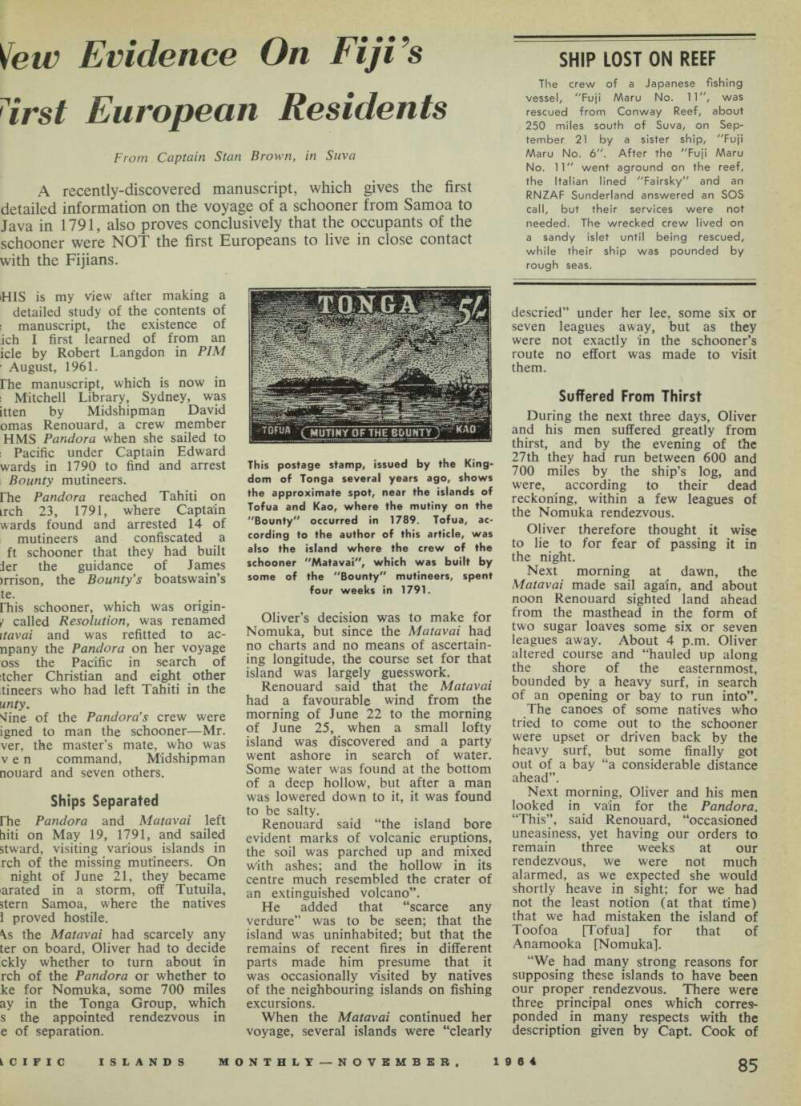
This postage stamp, issued by the King dom of Tonga several years ago, shows the approximate spot, near the islands of Tofua and Kao, where the mutiny on the "Bounty" occurred in 1789. Tofua, ac cording to the author of this article, was also the island where the crew of the schooner "Matavai", which was built by some of the "Bounty" mutineers, spent four weeks in 1791.
Vnamooka, Tongataboo and Etooa. fhe natives were amicable and the slands abounded in hogs, yams, ireadfruit and sugar cane- ‘n fact, vq were among the Friendly Islands, foofoa being one of that group and knamooka was not a great many eagues to the westward of us.”
For the next three weeks, (Oliver ind his men cruised about the island n search of the Pandora. Finally, hey gave up, and, after taking in vater from a small island about ive leagues away, they made for he East Indies.
There, at Samarang, they met Captain Edwards and the crew of he Pandora who had been ship wrecked on the Great Barrier Reef md who had managed to reach the Bast Indies in the ship’s boats.
The stories which Oliver & Co. old of their adventures eventually
mind their way—briefly—into a
eport written by Captain Edwards md a book by George Hamilton, he Pandora’s surgeon, and until tlenouard’s narrative came to light hey were the only sources of m iormation on the Matavai s voyage.
However, from the scanty details :ontained in these accounts, Fiji listorians such as Sir Basil Thomson, Professor G. C. Henderson and R. \. Derrick decided that the island where the Matavai cruised for three weeks was probably Matuku m eastern Fiji, and that Oliver and his -nen were thus the first Europeans live in close contact with the My view, as I have already said, is that Renouard’s narrative now proves conclusively that the Matavai did not call at Fiji, and that the island which Oliver and his men thought was Nomuka was, in fact, the Tongan island of Tofua.
Islands Identifiable
Renouard’s narrative describes the two islands where the schooner stopped in sufficient detail for them to be identified. .
The first island is clearly Fonualei, an uninhabited island in the Tonga Group, 40 miles north-west of Vavau; and the one off which the schooner cruised for three weeks not only fits the description of Tofua but is named in the narrative as such.
Although Renouard’s journal is sketchy as regards such important points as wind direction and strength, courses steered, etc., I think he would have noted the large change of course necessary for the ship to reach a Fiji island from Fonualei.
Keeping on his course from Samoa, he could well have sighted both Fonualei and Tofua on the same
course, allowing for bad steering, some westerly set in the more northerly latitudes, and the loss of that set as the schooner sailed to the southward.
The weakness of my theory is that it all depends on reaching Fonualei first. But the island so fits the description, and is the only one I know that does so that I am con vinced that it is the one.
If it is conceded that the first island of call was Fonualei, then the Matavai schooner could hardly have reached Fiji in the sailing time avail able to her after calling there.
Renouard says the schooner sailed from her position off Tutuila to the first island in four days, i.e., the 22nd, 23rd, 24th and 25th, so she could hardly have covered the longer distance to Fiji between the evening of the 25th and the morning of the 28th, particularly as she had been stopped for some time after the log recorded 700 miles.
More Jagged
As to the appearance of Tofua, I have noticed that in a sketch made early in the 19th century, the peaks appear much more jagged than they do today.
I doubt if there has been time for them to have been worn by erosion to a new shape, and I suppose the more impressive shape was in the mind of the artist.
However, from some angles the
peaks do not appear at all flat, and if the higher island of Kao is in transit, then her peak adds to the jagged appearance.
Tofua is certainly more westerly than Kao, on its western extremity.
But forget the true compass rose and look at it only from the point of view of the magnetic rose, as it would appear when checked by a boat’s compass.
The eastern or weather side of Tofua now appears to be to the eastward of Kao, and it is reason able to assume that the schooner approached the east coast because of the description of the breakers that would appear on the weather coast.
Captain Edwards 7 Idea I rather think that Captain Edwards put the idea of Fiji rather than Tofua in the minds of the schooner’s crew.
However, if Renouard kept his journal during the voyage, he would only have heard the name of Tofua from the Tofuans.
The islands of Kao and Kotu fit in well with the general description of relative positions of the islands.
The island where water was taken was “five leagues” from Tofua—and Kotu is, m fact, 15 miles.
It thus appears now that the most authentic evidence of Fiji’s first Europeans is of those who were saved from the wreck of the Argo, early in the 19th century.
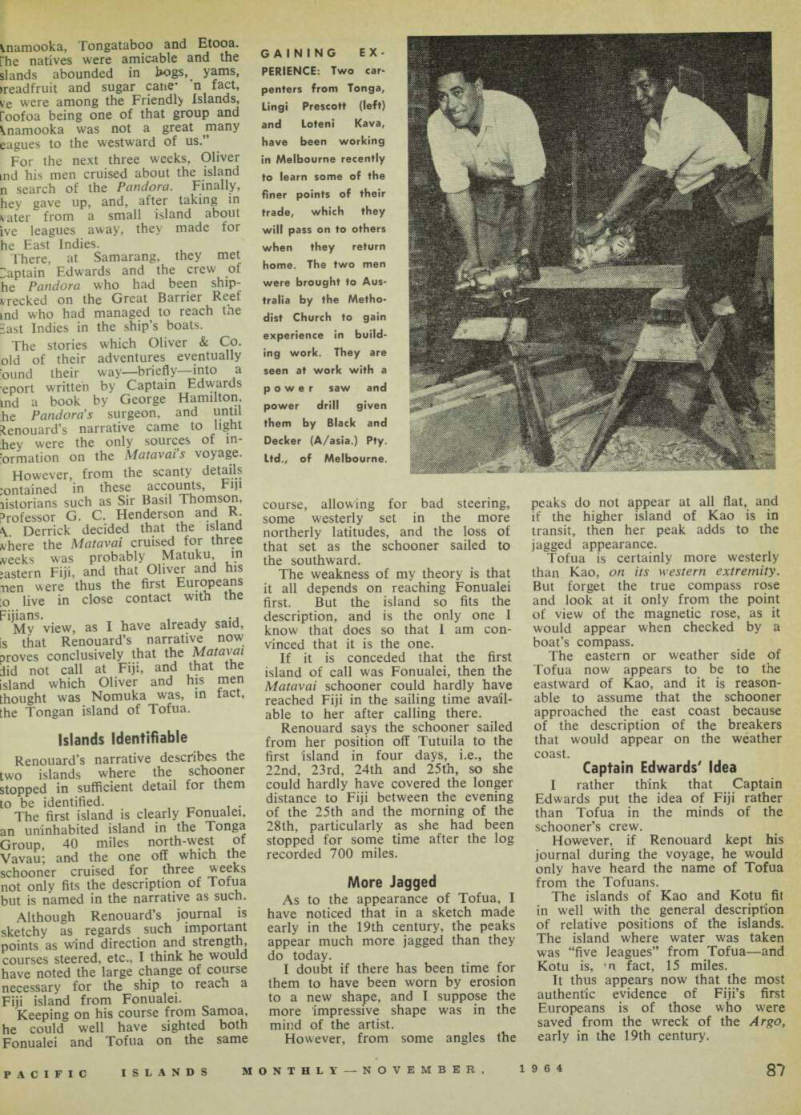
Gaining Ex
PERIENCE; Two car penters from Tonga, Lingi Prescott (left) and Loteni Kava, have been working in Melbourne recently to learn some of the finer points of their trade, which they will pass on to others when they return home. The two men were brought to Aus tralia by the Metho dist Church to gain experience in build ing work. They are seen at work with a power saw and power drill given them by Black and Decker (A/asia.) Pty.
Ltd., of Melbourne.