Whale Bird Egg Omelettes
pp. 83-84 · Read in the full issue
That's What Philip Is.
Means On Norfolk
From Merval Hoare, on Norfolk Island
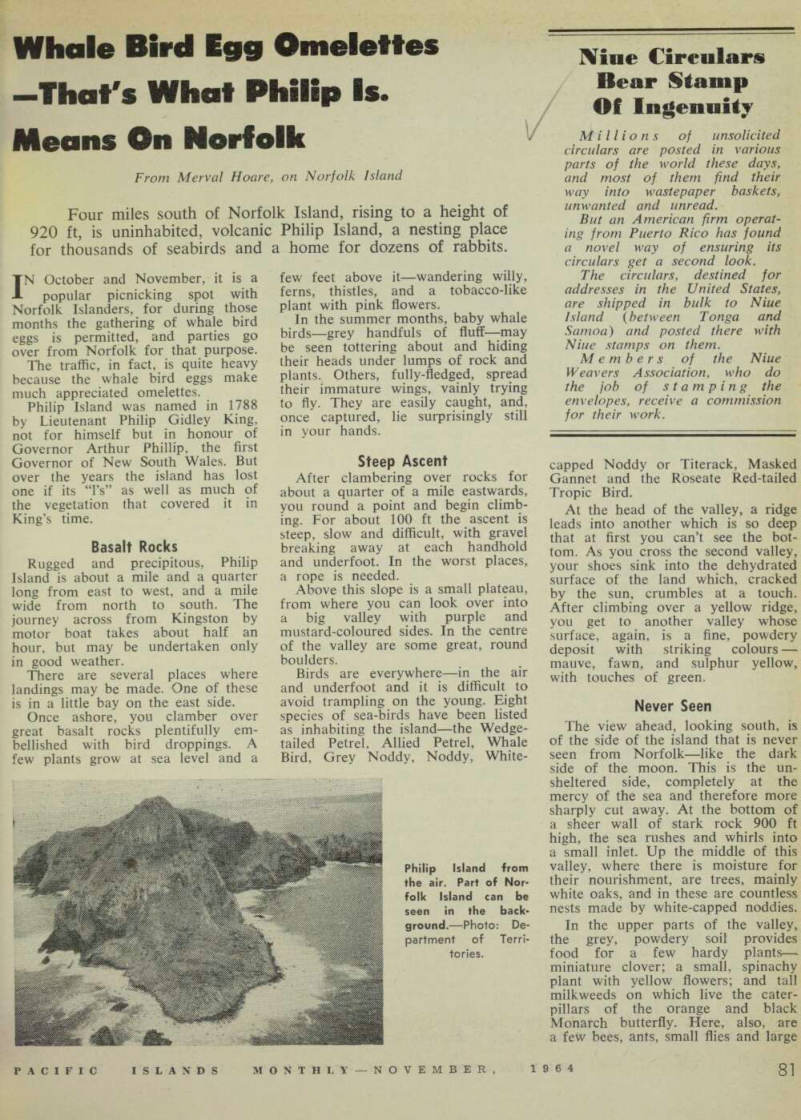
Four miles south of Norfolk Island, rising to a height of 920 ft, is uninhabited, volcanic Philip Island, a nesting place for thousands of seabirds and a home for dozens of rabbits.
IN October and November, it is a popular picnicking spot with Norfolk Islanders, for during those months the gathering of whale bird eggs is permitted, and parties go over from Norfolk for that purpose.
The traffic, in fact, is quite heavy because the whale bird eggs make much appreciated omelettes.
Philip Island was named in 1788 by Lieutenant Philip Gidley King, not for himself but in honour of Governor Arthur Phillip, the first Governor of New South Wales. But over the years the island has lost one if its “l’s” as well as much of the vegetation that covered it in King’s time.
Basalt Rocks Rugged and precipitous, Philip Island is about a mile and a quarter long from east to west, and a mile wide from north to south. The journey across from Kingston by motor boat takes about half an hour, but may be undertaken only in good weather.
There are several places where landings may be made. One of these is in a little bay on the east side.
Once ashore, you clamber over great basalt rocks plentifully em bellished with bird droppings. A few plants grow at sea level and a
few feet above it—wandering willy, ferns, thistles, and a tobacco-like plant with pink flowers.
In the summer months, baby whale birds —grey handfuls of fluff—may be seen tottering about and hiding their heads under lumps of rock and plants. Others, fully-fledged, spread their immature wings, vainly trying to fly. They are easily caught, and, once captured, lie surprisingly still in your hands.
Steep Ascent
After clambering over rocks for about a quarter of a mile eastwards, you round a point and begin climb ing. For about 100 ft the ascent is steep, slow and difficult, with gravel breaking away at each handhold and underfoot. In the worst places, a rope is needed.
Above this slope is a small plateau, from where you can look over into a big valley with purple and mustard-coloured sides. In the centre of the valley are some great, round boulders.
Birds are everywhere—in the air and underfoot and it is difficult to avoid trampling on the young. Eight species of sea-birds have been listed as inhabiting the island—the Wedge tailed Petrel, Allied Petrel, Whale Bird, Grey Noddy, Noddy, White-
capped Noddy or Titerack, Masked Gannet and the Roseate Red-tailed Tropic Bird.
At the head of the valley, a ridge leads into another which is so deep that at first you can’t see the bot tom. As you cross the second valley, your shoes sink into the dehydrated surface of the land which, cracked by the sun, crumbles at a touch.
After climbing over a yellow ridge, you get to another valley whose surface, again, is a fine, powdery deposit with striking colours mauve, fawn, and sulphur yellow, with touches of green.
Never Seen The view ahead, looking south, is of the side of the island that is never seen from Norfolk—like the dark side of the moon. This is the un sheltered side, completely at the mercy of the sea and therefore more sharply cut away. At the bottom of a sheer wall of stark rock 900 ft high, the sea rushes and whirls into a small inlet. Up the middle of this valley, where there is moisture for their nourishment, are trees, mainly white oaks, and in these are countless nests made by white-capped noddies.
In the upper parts of the valley, the grey, powdery soil provides food for a few hardy plants— miniature clover; a small, spinachy plant with yellow flowers; and tall milkweeds on which live the cater pillars of the orange and black Monarch butterfly. Here, also, are a few bees, ants, small flies and large
Philip Island from the air. Part of Nor folk Island can be seen in the back ground.—Photo: De partment of Terri tories.
lady-birds. Other creatures are charcoal-coloured lizards with grey green undersides which grow to a length of about five inches; brown centipedes about seven inches long; and quite a few black and grey rabbits.
The ground, in fact, is honey combed with rabbit burrows, and you have to step carefully to avoid them. An interesting thing about the rabbits is that no one knows who put them on Philip Island and when, although it seems probable that it was some time between 1835 and 1838. Missionary James Backhouse, who had a liking for nature study, and who visited Norfolk Island in 1835, made no mention of the rabbits in his detailed description of the island’s flora and fauna.
But A. D. W. Best, an officer of the 80th Regiment, who later spent two years on Norfolk, wrote in his journal for October, 1838, that he and three brother-officers had shot “at least fifty couple of rabbits” between them in a day’s sport on Philip Island. (One of the officers also saw 10 wild goats; but these animals have long been exter minated.) As you climb to the upper parts of Philip Island’s third valley, you get a good view of Norfolk—a long, tree-covered island whose highest point of just over 1,000 ft seems reduced to a mere bump. By com parison with Philip’s arid brilliance, Norfolk seems wonderfully green, fertile and cool.
Convict Legend
Philip’s highest point is known as Jacky-Jacky, and local legend has is that a convict of that name was pursued to this pinnacle, where, choosing death rather than capture, he jumped to his doom. The descent to sea-level from Jacky-Jacky does not take long, and is best made by following the same tracks that took you up there. The only time that you may find a bit of traffic on these tracks is during the open season for whale bird eggs.
The first European to set foot on Philip was Lieutenant Philip Gidley King, commandant of Norfolk Island’s first convict settlement, who spent 2i hours there on December 2, 1788 (nine months after his arrival at Norfolk).
Describing his visit in his journal, King wrote: “I landed on a rock in Collin’s Bay at i past 7, and climbed up the hills, which I found a fine rich red clay. A valley, in the form of a half-moon, runs round the hills over Collin’s Bay, and is, as well as the hills, wooded, but not
thick. I do not suppose that there is above 150 pine trees on the whole island. Most of the hills are covered with a thick entangled kind of reed which only wants burning to clear away 100 acres of ground, which would make a fine wheat land, if not too dry. As I saw a number of pigeons and parrots &c., I imagine there must be some fresh water on some part of the island. . . .”
Pigs Released
A year later, Lieutenant Cresswell made an unsuccessful search for water on Philip Island at King’s request, with the resut that King’s hopes of developing the island came to nothing. However, he did have a number of pigs released on the island where they waxed fat and eventually became wild. In October, 1796, three men were living on the island, looking after the pigs; and it seems that during the next few years it was popularly known as Pig Island.
Philip Island figured in a dramatic incident in September, 1826, follow ing a revolt on Norfolk where the second convict settlement had been established 15 months earlier. During the revolt, the convicts killed a corporal and wounded two or three soldiers, bound the civil officers, robbed the stores, seized the boats and sought sanctuary on Philip Island. Their freedom, however, was short-lived, for the commandant and a few soldiers followed them next day and captured them.
In 1835, two young officers, at tended by several convicts, are re ported to have shot 13 goats on Philip Island, which they sent back in their boat to Norfolk. Before they, themselves, could return, the
weather turned stormy and it was several days before two boats could be sent over to bring them back.
Meanwhile, one of the convicts was attacked by a wild boar; but as he happened to have a long stick in his hand, he parried it and advanced on it until it was on the' edge of a lofty cliff. He then made a sudden rush and the boar fell backwards over the precipice to its death.
This same convict had once spent three monthes among the peaks of Philip Island after escaping from Norfolk.
Re-afforestation Philip’s sterile appearance has through the years turned the thoughts of tree-lovers to soil-replacement and the planting of suitable trees.
“The reclothing of this barren island is a task for the forester,” wrote C. E. Lane-Poole, Common wealth Forestry Adviser, in 1926, “It should not prove difficult to destroy the rabbits that remain there, and the island could then be planted with pines. In this work the black Corsican pine should be tried, the climate would suit it and rabbits won’t eat it.”
Shortly after he was appointed Administrator in 1937, Sir Charles Rosenthal made a thorough inspec tion of the island with a view to planting trees there, but passed the opinion that any attempt to grow pines or other trees would involve enormous expenditure with no certainty of success.
Since then, Philip Island has remained strictly for the birds and, of course, its few scraggy rabbits and other creatures.
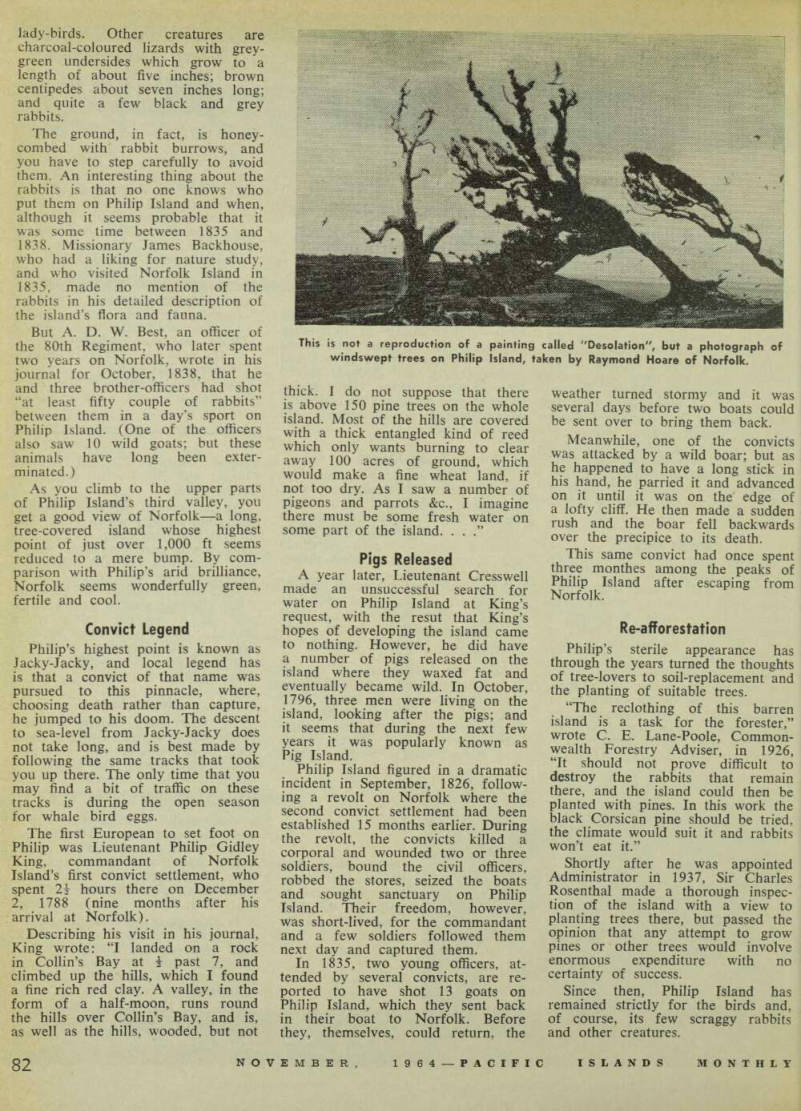
This is not a reproduction of a painting called "Desolation", but a photograph of windswept trees on Philip Island, taken by Raymond Hoare of Norfolk.