Educational TV Comes
pp. 63-65 · Read in the full issue


To American Samoa
From Ralph Craib, in Pago Pago.
American Samoa’s Governor, Mr. H. Rex Lee, pressed a button in Pago Pago on the morning of October 5 to put the first television station in the South Pacific Islands on the air.
The station, KVZK-TV, provides educational programmes for Samoan children in 31 new classrooms at five schools in the territory.
the end of the school year, every village in American moa will have a new school and new television set, and some )00 youngsters will be taught by /.
The television screen will virtually pplant teachers in American moa’s classrooms, as all instruc >n will come from the television idio. Teachers, in fact, will merely present to explain, to maintain tentiveness and to give tests.
Television—condemned by many 5 educators for its harmful effects i children—has made its South as debut because Governor Lee lieves it will be the saving of the w generation of American Samoans ■and because the US Secretary of e Interior, Mr. Stewart Udall, and ingress agreed.
Governor Lee arrived in Pago igo in May, 1961, and took an imediate dislike to much of what ; found. Fewer than a third of the aduates of American Samoa’s ammar schools were being admit
ted to high schools. Lower grade teachers were, generally, poorly prepared for their jobs.
“Teachers supposedly teaching in English were incapable of making themselves understood to me,” the Governor says, “so I could not help but wonder what the youngsters were learning.”
Governor Lee became convinced that educational television would be the cheapest and most efficient way to bring American Samoan schools up to mainland standards and to bring Samoans fully into the 20th century.
Congress, which authorised $1.6 million for the project, agreed and the influential National Association of Educational Broadcasters gave both endorsement and assistance.
The association designed the Samoan TV system and recruited outstanding technicians from educational tele vision stations throughout the United States.
One of Governor Lee’s concerns was to bring the school system up
to mainland standards as rapidly as possible without dismissing 300 Samoan village teachers, some with 35 to 40 years of service—and without incurring the costs of transportation, housing, medical care and big salaries that “importing” 300 mainland teachers would entail.
Complexities
With educational television, a comparatively small staff of main land-trained teachers would meet faculty needs—and there would be continued need for the Samoan instructors.
The idea had its complexities, however. It involved bringing elec trical power to all of American Samoa’s villages, a major under taking itself. A top-flight staff of
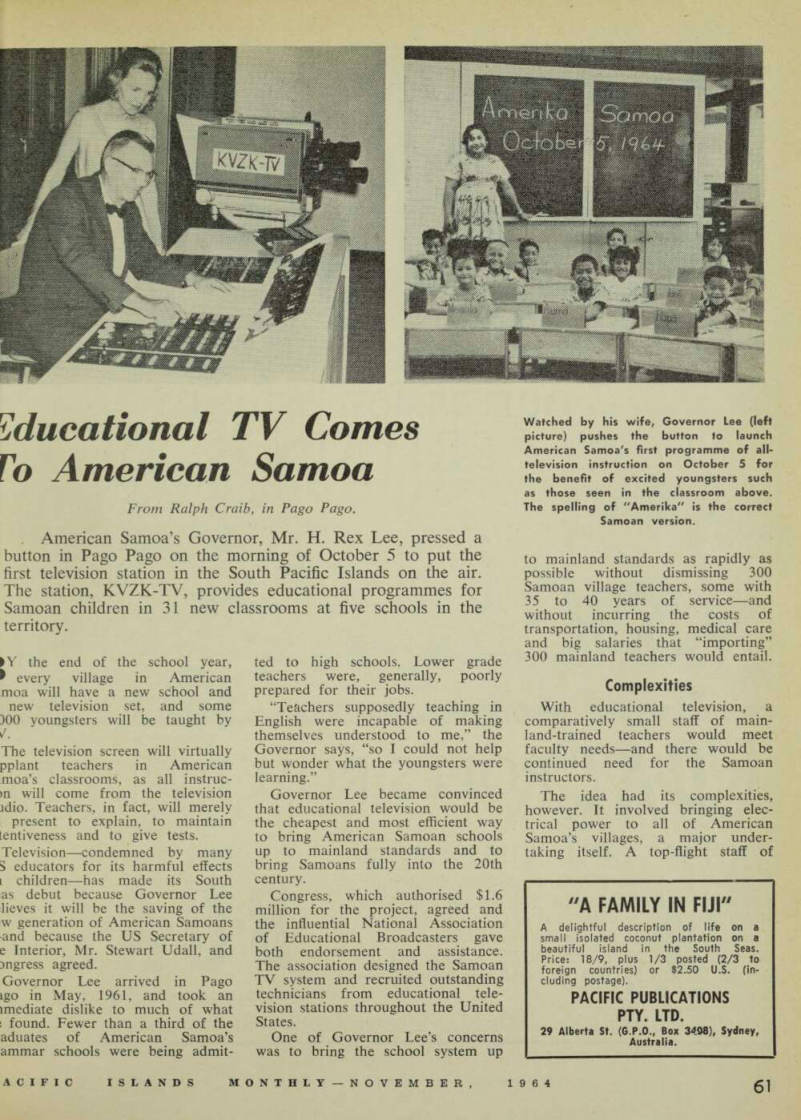
Watched by his wife, Governor Lee (left picture) pushes the button to launch American Samoa's first programme of all television instruction on October 5 for the benefit of excited youngsters such as those seen in the classroom above.
The spelling of "Amerika" is the correct Samoan version.
ucators and technicians had to be :ruited and houses had to be ilt for them.
The ideal location for the trans tter and its 220-foot-high antenna Dved to be on 1,539 ft Mount ava overlooking Pago Pago irbour, and a mile-long aerial mway was built to the top.
The cableway is expected to be major tourist attraction in the :ure.
KVZK-TV began operations with o channels. These will soon be panded to three and eventually six. Television antennas are tdually sprouting on the thatched Dfs of new school buildings, all ;cted by villagers anxious to joy the prestige a village television will give them.
The station won’t be used only teach the young. Adult literacy isses will be put on and other will educate older moans in modern agricultural ;thods, public health precautions, lage sanitation and local self vernment.
“Television,” says Governor Lee, [tables us to reach even the most note village with ideas and with □cation of quality which we could t hope to attain otherwise. The vestment, I am certain, will be of jat value to the United States and its leadership in this remote part the world.”