Agricultural Problems
pp. 57-61 · Read in the full issue


The Month In Western Samoa
U.N. Expert Sounds On Agricultural Problems
From R. F. Rankin, in Apia
FAO processing and marketing expert, Mr. J. J. van der Goes, one of the most effective UN technical advisers to have worked in Western Samoa, left early in October, at the end of his two-year term with the Department of Agriculture—with somewhat mixed feelings.
FE was confident about the L potential of the country, but t so confident about the country’s lity to plan and organise itself to )duce more. ‘With improved planning and ;anisation production could be »re than doubled within less than years,” he said. ‘I could sell hundreds of msands of pounds worth of •{cultural products that could iily be cropped in Samoa. The üble is that it is just not being )duced or processed. I can’t sell x)k off the tree.”
Mr. van der Goes said improve nts could be achieved only through : efforts of Samoa’s people.
He had found small planters enable to instruction and keen to prove their finances by increased )duction. But they were not getting p and guidance from the Govern nt. ‘Until a policy for agriculture is iwn up, and until the Department
of Agriculture is given the authority and finance to implement such policy, very little progress towards improved agriculture will be pos sible,” he said.
Mr. van der Goes claimed that too much attention had been paid to long-term planning rather than to the immediate needs of the country.
He said emphasis shoud be on crops such as castor beans and arnatto which had a ready overseas market; and on crops such as sugar cane, tobacco and rice for home consumption.
Incentives Incentive schemes subsidising new plantings would have to be intro duced if production was to be adequately accelerated.
Mr. van der Goes said that with departmental apathy and top level opposition, his time during his first year in Samoa was largely wasted.
However, the situation had im
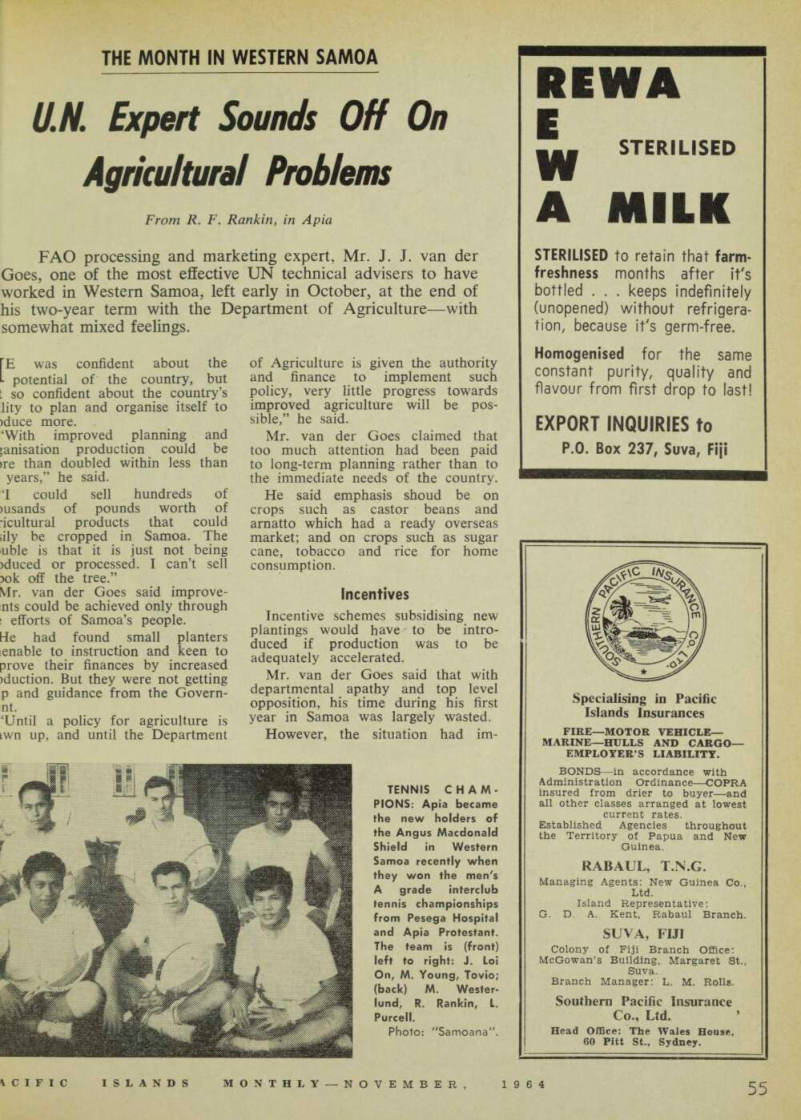
Tennis Cham
PIONS: Apia became the new holders of the Angus Macdonald Shield in Western Samoa recently when they won the men's A grade interclub
tennis championships
from Pesega Hospital and Apia Protestant.
The team is (front) left to right: J. Loi On, M. Young, Tovio; (back) M. Wester lund, R. Rankin, L.
Purcell.
Photo: "Samoana".
roved over the last six months and e hoped his efforts might result in oncrete plans for increased pro uction and diversification of crops.
Mr. van der Goes will probably eturn for a follow-up visit to amoa in about a year.
L|R. VAN DE GOES has recom fl mended to the South Pacific 'ommission and to FAO head uarters in Rome that a $lOO,OOO recessing centre for agricultural rops be set up at Nafanua the griculture research station about vo miles out of Apia. The centre rould have facilities for the train ig of agriculturists from the whole f the South Pacific.
It would serve as a training centre Dr small planters in the many crops lat could be grown and are often eglected in Samoa and other lands in the South Pacific.
“One of the great hold-ups in reduction is that planters do not now how to process their crops roperly, if at all,” Mr. van der roes said.
He added that he had received iquiries about small scale process ig from Fiji, Tonga, Cook Islands, apua-New Guinea and as far away 5 Zanzibar. ☆ ☆ ☆
)R. Charles Magee, A
scientist from the New South teles Department of Agriculture, mfirmed in September what Ross telker, of Fruit Distributors Ltd., id local agriculturists have been lying for the past five years— nless something drastic is done uickly, Samoa’s banana export in iistry will be wiped out by bunchy >p disease in the next five to 10 jars.
A world authority on bunchy top, t. Magee made a two-week invest ;ation of Western Samoa’s banana iantations at the request of the amoan Government. His trip was >onsored by the South Pacific Com tission and his services were made /affable free by the New South teles Government.
He said the banana industry could 5 saved by immediately: • Instituting a major replanting ogramme, using uninfected stock. • Eradicating diseased plants in lantations and adjacent areas. • Developing a Samoan strain I banana tolerant to the disease.
Agriculture Department officials ere not entirely downhearted by t. Magee’s report.
“With an intensive campagin on a national scale, resulting in a new appreciation of scientific agriculture this could revitalise the industry,” one official said. “This may be a blessing in disguise.”
Meanwhile, there is growing des pondency among planters that they are fighting a losing battle. ☆ ☆ ☆ MANY Samoan businessmen still cling to the old colonial view that the quickest way to profit is through cheap labour.
They were disturbed in September
when a visiting New Zealander predicted the emergence of Samoan trade unions and a Samoan Labour party in the not too distant future.
The New Zealander, Mrs. Connie Barton, an Auckland trade union and Labour Party official, who was spending a week’s holiday in Apia, said that with increased consumer demand, and economic development, trade unions and political parties were certain to emerge in Samoa.
She emphasised that these move ments would appear only when wanted by the people and could not be forced on them from outside.
“It would be quite wrong if the Labour Party in New Zealand was
to promote the formation of a party here,” she said. “No doubt once a party is formed New Zealand will hold out a helping hand.
“There is no need to tell you of the traditional friendship that the Labour Party and Labour movement in New Zealand has for the people af Samoa.” ☆ ☆ ☆
Behind-the-scenes diplomat
and trouble shooter as private secretary to the Prime Minister since before independence, and later secretary to the Head of State, Mr, Eddie Stehlin has moved to a new post. At the end of Septmber, le became Assistant Director in the Economical Development Secretariat under the Director, UN, economist Mr. A. Gerakas.
Mr. Gerakas, himself, has been making a favourable impression with his ideas on the community generally. With the first five-year economic development plan due out soon—at a time when the economy loes not look too good because of mlling export production and prices —the whole future of the country might well depend on how efficiently ;he Development Secretariat func ions over the next couple of years. ☆ ☆ ☆ Extravagant expressions of official approval successfully drowned the murmurings of dis content in Apia over the establish ment of a university-diploma standard College of Tropical Agri culture at Alafua about three miles Torn town.
Dependant upon UN and NZ Freedom from Hunger Campaign issistance for its construction and much of its maintenance over the irst five years, the college was given m official seal of approval by the Campaign secretary, Rev. H. C.
Dixon, who said the site was ‘magnificent” and that he was ‘completely happy” with the whole scheme. He handed over the first E 20,000 of the £BO,OOO NZ Campaign lonation towards building costs.
There was immediate controversy when the Public Works Department promptly ordered prefabricated ouilding sections, not from New Zealand, but from the United States, “It is our policy to spend as much Campaign money as possible in New Zealand,” Mr. Dixon said, “but in his case I am quite satisfied the oest buy has been made.”
Mr. Dixon confidently brushed
aside other local minority objections to the college, present plans for which call for the Samoan Govern ment to bear the annual £20,000 operating costs after the first five years.
It is held by some that this £20,000 could be better spent in other avenues of development, and that the few graduate agriculturists Samoa needs could more economic ally be educated at the new college going up in Papua-New Guinea or the East-West Center at the Univer sity of Hawaii.
Replying to this view, Mr. Dixon said, “It is possible that further aid will be forthcoming after the five
year period. Also, it is generally acknowledged that higher education is better gained within a developing country and that many complications ensue in sending top students over seas for study.”
Mr. Dixon went on: “In Samoa, all experts agree that within the next 10 years or so there will be serious agricultural problems. These can be lessened only by upgrading agriculture through turning out more trained agriculturists and teachers.
“This is the purpose of the college, which will benefit not only Samoa but the whole of the South Pacific area from where the students will come.”