Unique P-NG Budget
pp. 69-71 · Read in the full issue

Provides A Good Time For All
From a Staff Writer in Port Moresby
The Budget of Papua-New
Guinea Territory for 1964-65
probably is one of the most re markable documents of its kind in the world.
HERE it is, in summary, as presented on September 1 to the new House of Assembly in Port Moresby: Receipts Expected Receipts from taxes and fees within the Ter ritory £12,704,000 Loans 3,160,000 Gift from Australia 28,000,000 Total £43,864,000 Expenditure Proposed Cost of running Ad ministration £26,969,000 To be spent on capital works 10,666,000 For purchases of capital goods 1,783,000 Special appropriations 1,100,000 Total £43,864,000 What other dependant Territory, spending just on £44 million a year on administration and development, gets no less than 63 per cent, of its income as a free, untrammelled gift from its mother-country? And spends 61 per cent, on its public services?
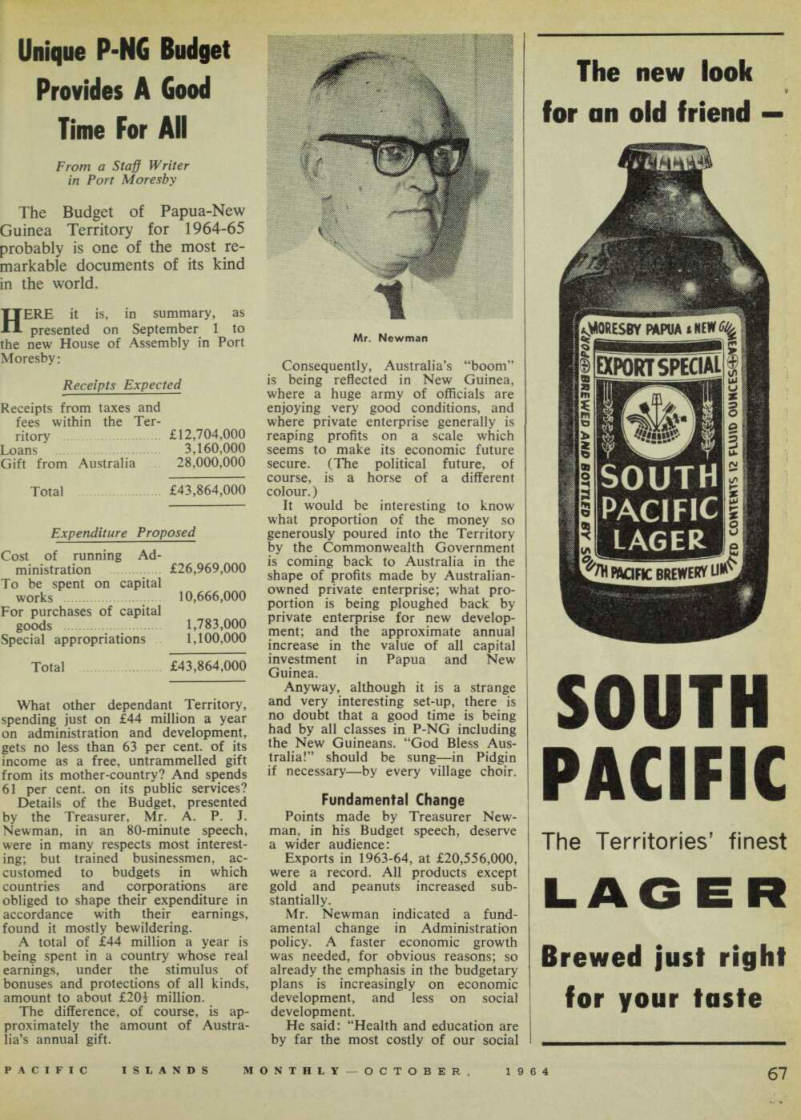
Details of the Budget, presented by the Treasurer, Mr. A. P. J.
Newman, in an 80-minute speech, were in many respects most interest ing; but trained businessmen, ac customed to budgets in which countries and corporations are obliged to shape their expenditure in accordance with their earnings, found it mostly bewildering.
A total of £44 million a year is being spent in a country whose real earnings, under the stimulus of bonuses and protections of all kinds, amount to about £2oi million.
The difference, of course, is ap proximately the amount of Austra lia’s annual gift.
Consequently, Australia’s “boom” is being reflected in New Guinea, where a huge army of officials are enjoying very good conditions, and where private enterprise generally is reaping profits on a scale which seems to make its economic future secure. (The political future, of course, is a horse of a different colour.) It would be interesting to know what proportion of the money so generously poured into the Territory by the Commonwealth Government is coming back to Australia in the shape of profits made by Australian owned private enterprise; what pro portion is being ploughed back by private enterprise for new develop ment; and the approximate annual increase in the value of all capital investment in Papua and New Guinea.
Anyway, although it is a strange and very interesting set-up, there is no doubt that a good time is being had by all classes in P-NG including the New Guineans. “God Bless Aus tralia!” should be sung—in Pidgin if necessary—by every village choir.
Fundamental Change
Points made by Treasurer New man, in his Budget speech, deserve a wider audience: Exports in 1963-64, at £20,556,000, were a record. All products except gold and peanuts increased sub stantially.
Mr. Newman indicated a fund amental change in Administration policy. A faster economic growth was needed, for obvious reasons; so already the emphasis in the budgetary plans is increasingly on economic development, and less on social development.
He said: “Health and education are by far the most costly of our social
Mr. Newman
pursuits. It would be absurd to reverse the trend because ... a healthy and educated work force is a prime need for development.”
Therefore, while expansion of health and education services “has not been completely curtailed, it has been restricted in comparison . . . with former years.”
In 1964-5, the Department of Education will cost £4,631,000.
Secondary and technical schools, and some primary schools where there is population growth, will be ex panded; but there will be no ex tension of primary schools.
The Treasurer expected that the World Bank report on economic development would have something pointed to say about the need for greater economic development as against social development, but it was revealed later that although the report is known to be in Canberra, it had not up to early September been released for public information.
Army Of Pubic Servants The Budget provides £955,000 for Motor Transport Branch activities, which uses a fleet of 1,208 vehicles; and £675,000 is provided for air charters.
A Budget table shows that the actual Public Service staff on July 1 was 6,645, and of “other employees and students” numbered 19,938 —a total of 26,583 engaged in the administration of the Territory.
It was stated that, in 1964-5, lew broadcast stations will begin iperations in Kerema, Goroka and Mt. Hagen. These activities are part of the Department of Information and Extension Services, which now cost about £300,000 per annum.
It is noted that the new House of Assembly, with its paid membership, under-secretaries, and all, is estimated to cost £140,000 a year.
The police force will be increased to 3,100, and the cost of which will go up by £lOO,OOO to over £1 million.
The Budget debate to follow later in the month was expected to be lively. • Mrs. Betty Evans, formerly of Suva, is the first appointment to the staff of the Fiji Office, Sydney. Mrs.
Evans, nee Whiteside, a well known Fiji family, went to Western Aus tralia from Fiji last year. Early in August she came east to Sydney and within a week had secured a post of receptionist for Colonel Basil Rogers, the Fiji Government’s first representative in Australia.