"Operation Shovel" Is
pp. 65-68 · Read in the full issue

In Full Swing
By a Staff Writer
All Over The South P , The
Archaeologists
Are Busy
When Pacific historians look back on 1964 in the years ahead, it could be that they will call it “The Year of the Spade” on account of the intensive archaeological activity by scientists.
NEVER before have scientists been so busy digging up the past in the South Pacific. Armed with shovels and grants of one sort and another, they are delving everywhere from New Guinea to Pitcairn.
This upsurge of activity, coupled with important new information which has been discovered in recent years, may eventually establish the exact origin of the Melanesian and Polynesian peoples of the South Pacific. Certainly, it should give a much clearer picture of pre- European migration in the Pacific than we have now.
Archaeologists who are, or have been, at work in the South Pacific this year include: • A party of six from New Zealand’s University of Otago, headed by Mr. P. Gathercole, who returned from Pitcairn Island at the end of February having found evidence of prehistoric occupation at two sites on that island (PIM, April, p. 55). The evidence suggested that Pitcairn was a more or less per manent home for the ancient Poly nesians, besides being a quarry that
was visited from eastern Polynesia for materials for stone tools. • Mr. Jose Garanger, of the Centre National de la Recherche Scientifique, who has done archaeo logical work in Tahiti’s Tautira Valley, where he found house sites and multipl e-marae sites, with ahus of a type found in Hawaii. • Dr. K. P. Emory and Professor Yosihiko H. Sinoto, of Honolulu’s Bishop Museum, who have visited archaeological sites in Western Samoa, Fiji and Tonga.
Professor Sinoto, assisted by Miss Marimari Kellum, of Tahiti, has also carried out excavations at Uahuka in the Marquesas recently. Traces of human occupation probably dating back 2,000 years were found in sand hills on the island.
The discoveries included pearlshell fish-hooks and ornaments, tattooing needles made from the bones of birds, small stone hatchets and tools for making hatchets, and tools made from coral and the spikes of sea urchins.
The remains of necklaces made
from whales’ teeth and the skeletons of two dogs—in both cases, the first to be found in the Marquesas—were other important discoveries.
Professor Sinoto, who returned to Hawaii from Tahiti in mid-August, believes that a study of his Marquesan fish-hooks will prove a connection between the Marquesas and Hawaii dating back to the fourth century. • Dr. R. S. Duff, director of New Zealand’s Canterbury Museum, who recently completed the second of two visits to Rarotonga to supervise the first archaeological excavations on that island.
Layer Of Charcoal Dr. Duff’s party found a layer of charcoal under a marae called Manuka which is believed to have been named after Manu’a (in Ameri can Samoa), the home island of Karika, a chief who conquered Rarotonga about 1,300 AD.
A few feet higher up was a thin stratum of charcoal, indicating human
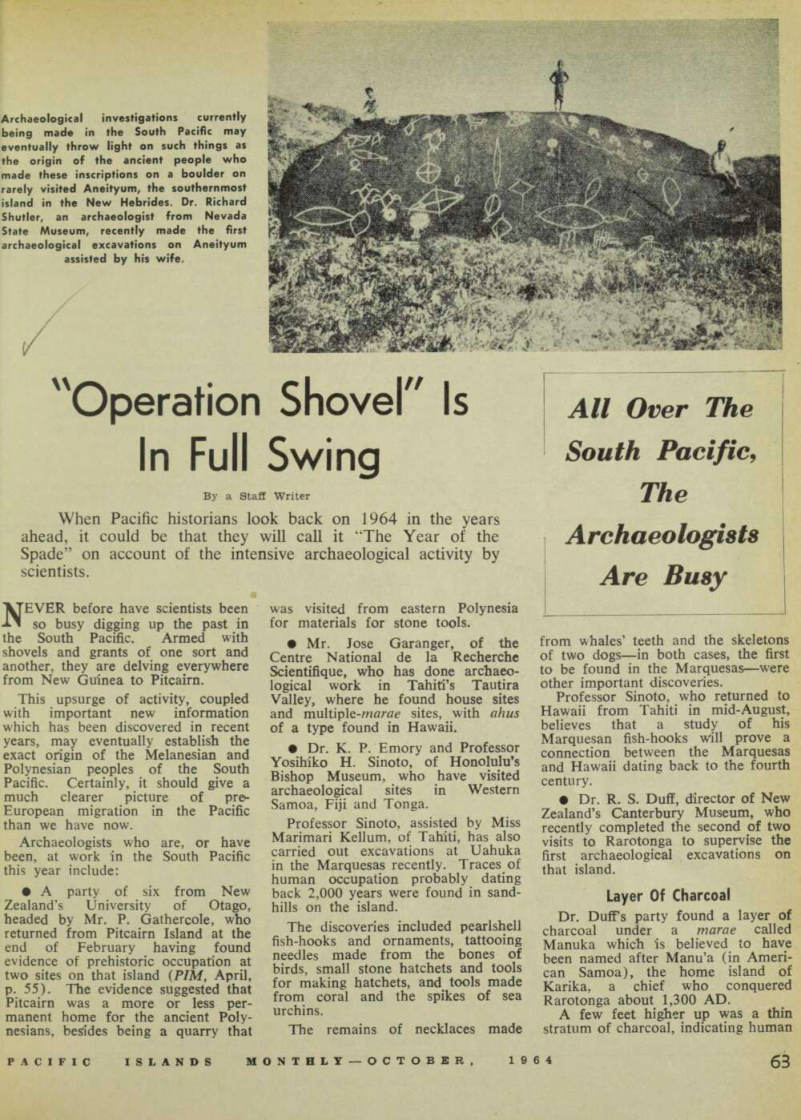
Archaeological investigations currently being made in the South Pacific may eventually throw light on such things as the origin of the ancient people who made these inscriptions on a boulder on rarely visited Aneityum, the southernmost island in the New Hebrides. Dr. Richard Shutler, an archaeologist from Nevada State Museum, recently made the first archaeological excavations on Aneityum assisted by his wife.
occupancy of Rarotonga several :enturies before Karika.
Radio-carbon dating should jstablish the approximate date of this settlement • Dr. R. C. Green, senior lecturer n prehistory at Auckland University, vho headed an archaeological team o Western Samoa earlier this year, : ound huge hill forts, closely re sembling New Zealand Maori pas in structure and layout.
Commenting on these discoveries.
Dr. Green said the present accepted dea that the development of fortifica ion in New Zealand was entirely ndependent might have to be revised.
He said excavations carried out in New Zealand suggested that building fortifications were a later develop nent of Maori culture, but the Samoan forts were so similar that he expedition felt there must be some relationship. Also to be taken nto account was what was known >f fortifications in Fiji and Tonga.
Adze Discoveries Dr. Green said that adzes found it Vailele, near Apia, and at excavations on hill forts and in nland villages, were similar to some ;ypes found in the Marquesas. Those, n turn, were related to adzes found n association with the earliest New Zealand inhabitants, the moa hunters.
This suggested a much closer re ationship between eastern and vestern Polynesia at an earlier stage n settlement of the Pacific than was apparent later. But nothing found n Samoa contradicted the current heory that the movement of people was from the west to the east. • Mr. Jens Poulsen, of the Aus xalian National University, is carry ng out excavations in Tonga. He vent there in September, 1963, to stay for a year with the object of instructing a sequence for Tongan prehistory. • Mr. J. B. Palmer, curator of the Fiji Museum, has made interesting discoveries at Sigatoka and Walu Bay on Fiji’s main island of Viti Levu. Mr. Palmer will publish a paper on his discoveries next year. • Dr. Richard Shutler, from the Nevada State Museum, with his wife, recently completed the first archaeological survey in the New Hebrides. The Shutlers began work at Aneityum, the southernmost island in the group, and then moved to Panna. Their discoveries included the first skeletons to be discovered in Melanesia on an archaeological site. • Mr. and Mrs. Peter White, a liusband and wife team from the National University, Canberra, have seen working in Papua-New Guinea.
They have found “sophisticated” examples of cave paintings in two areas in the Eastern Highlands south of Kainantu, and in the Sogeri area, north of Port Moresby.
Some were abstract designs, ineluding “dusted” print hands in which the hand appeared as a white design on the cave face, with the outline of fingers dusted round it, and also solid hand paintings where the painter’s hand itself had been dipped in ochre Other'paintings - rocks figures of birds, animals and men All appeared to be in a good state of preservation. .
Other archaeological discoveries in
Papua-New Guinea that have created interest recently include: a stone figurine found at the newly-opened post of Amanab on the western edge of the Sepik district, and obelisks. statues, carved figures and what may t> e sacrificial altars high in the mountains of New Hanover, ... cs—if.*--*
AAost Significant
The s |- one figurine found at Amanab has been described as the most significant archaeological find 8 in. tall * found by Mr. G. Harvey, an ’ agricultura , offi y cer , while he n preparing new ground for a garden. (Over)
The native people know nothing of the origin of the figurine, and have no legends about anything similar.
The figurine has a well-defined face with large nose flanges, torso and legs. It is male. Its sides are covered with designs.
Mr. Harvey has given the figurine to the Territory Museum in Port Moresby.
The New Hanover discoveries have created great interest among archaeo logists and the Papua-New Guinea Administration has announced that it will send an archaeologist to the area later this year.
Sun-Worshippers
Mr. Ray Sheridan, of Kavieng, who has made a study of the New Hanover figures, believes they may be evidence that a race of sun worshippers inhabited the area hundreds, and perhaps thousands, of years ago.
Mr. Sheridan, an amateur archaeo logist, is a field supervisor in the Malaria section of P-NG’s Depart ment of Public Health.
Mr. Sheridan told PIM that the New Hanover “stones” were about a four-hour walk inland from the north side of the island.
They were in a small basin-like de depression, and formed a pattern typi cal of ancient sun worship with die main stone facing east, and attendant stones arranged on the south-east and north-east flanks to suggest a sighting up on summer and winter solstices.
Ray Sheridan —Photo C. H. Meen