Co-operatives In
pp. 71-73 · Read in the full issue
Growing Role For Co-operatives In The New Hebrides
• Private European Traders Affected From lan Taylor, at South West Bay, Malekula Startling advances have been made in the New Hebrides in the past year in the formation of co-operative societies which
are radically changing village
economic life. The co-operatives usually have from 50 to 100 members.
SOME private European traders are beginning to feel the effects, and a few have already begun to with draw. At least one trader confessed recently that he couldn’t compete with the co-operatives and virtually handed over his business to the New Hebridean members of a newly formed society.
One new co-operative society has openly boasted that it has been formed to defeat a large monopol ising company. But most of the societies are simply in existence to provide better living conditions in the villages of their members.
As former Co-operatives Officer of the Presbyterian Mission—the office was discontinued recently be cause of the increased interest and control by the British and French Administrations—l have watched developments with a keen eye.
Slow At First The British and French Administra tions were slow at first to promote the idea of co-operatives, but now they have entered the work enthusiast ically.
Administration vessels carrying specially appointed French and British Co-operatives Officers and a New Hebridean Co-operatives In spector have been visiting the islands throughout the Group to form new societies and to supervise and inspect existing ones. Mr. T. Layng re presents the British Administration, and Mr. Gloaneac, the French.
Before the two Administrations entered the field, the formation of co-operative societies was largely inspired by the missions, particularly the Presbyterian Mission, although
the missionaries were too busy with spiritual matters to do justice to the work.
Two men, especially, deserve credit. One is the Rev. John Cooper, a former Presbyterian missionary who pioneered co-operative work on Tanna, playing a big part in helping the White Sands people to get the larki Society established and success fully operating. The other is lolu Abbil, a New Hebridean from Lenakel, Tanna, and a graduate of Onesua High School, who has been chosen by the British Administration as its first Inspector of Co-operative Societies.
Further Training
lolu is a young, dedicated Christian, with an excellent com mand of English who has made a deep impression on all. Now chosen for further training, in Fiji, he makes the prospects for co-operatives in the New Hebrides look bright indeed.
By the end of 1964, it is expected that 12 British and five French controlled co-operative societies will be functioning.
At present, there are 10—eight under British supervision and two under French.
The eight British societies are: larki (Tanna); Lawa Native, Lorlow, Ahamb (Malekula); Lumbukuti and Tongariki (Tongoa); Civil Servants Savings and Loans (Vila); and Laoni
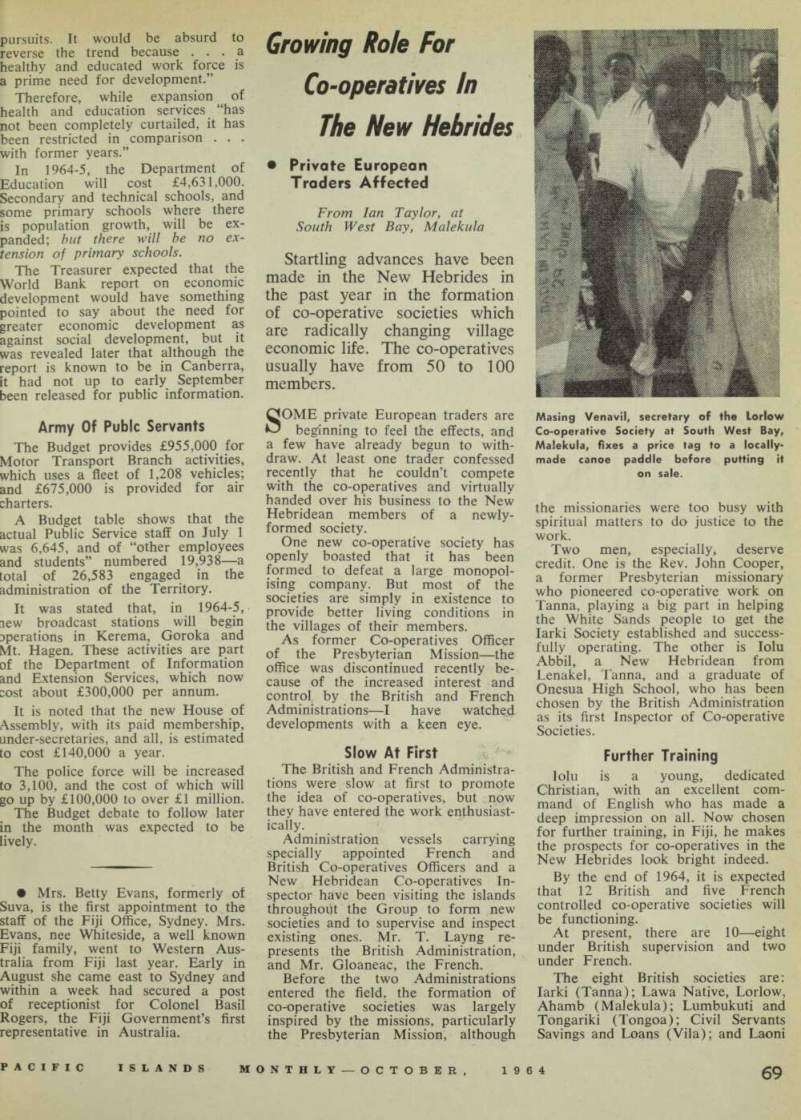
Masing Venavil, secretary of the lorlow
Co-operative Society at South West Bay, Malekula, fixes a price tag to a locally made canoe paddle before putting it on sale.
(Pentecost). The French societies are: Wala (Malekula) and Ipyato (Santo).
Finance, communications and per sonnel are not such problems for the societies as one might think.
The British Government recently made a grant of £StgB,ooo for co operatives work from Colonial Development and Welfare Funds; a recent increase in shipping pro vided by the Condominium Govern ment enables quick and regular visits by the Co-operatives Officers to the outlying centres; and a rising standard of education among the New Hebrideans means that people are coming along with the necessary qualifications to run the co operatives.
A typical New Hebridean taking part in the new work is Masing Venavil, of Malekula, who is secretary of the Lorlow Co-operative Society in South West Bay. He was previously a mission teacher, but was once a bushman.
Still Naked His brother and relatives still walk naked except for the traditional heathen nambus belt.
According to Mr. Layng, and the SPC Co-operatives Officer, Mr.
Boyen, Masing Venavil shows great promise.
He topped the Administration’s trading course on Tongoa, and won great praise from all in charge. He has accepted his responsibilities with real enthusiasm and honesty.
Before his “own” co-operative society was opened on July 15 this year, he played a tremendous part in organising it, and insisted that the opening ceremony should include an act of worship and a simple but significant ritual in which a large leaf screen, which hid the store from sight, was dramatically cut down in an endeavour to “find the better way of life co-operatives can bring.”
It is not unfair to say that for a long time Europeans and New Hebrideans have chafed under the monopoly of large, price-domineering trading companies, which have hardly known the meaning of the word “competition”.
That state of affairs is changing, to the benefit of the indigenous population.
The formation of co-operatives is the reason for the change. • A three weeks’ public health survey was scheduled to start on Pitcairn Island in September. The survey was to be conducted by Dr.
Joseph Marseu, of Suva.