Windows In Norfolk
p. 83 · Read in the full issue
Island Church Honour Victims Of Arrow Attack
From Merval Hoare on Norfolk Island
Two commemorative windows in All Saints Church at King ton, Norfolk Island, honour two young missionaries from that island ;ho were killed in the Santa Cruz Group of the Solomons exactly : century ago. The missionaries, who had well-known Norfolk *itcairn names, were Fisher Young and Edwin Nobbs
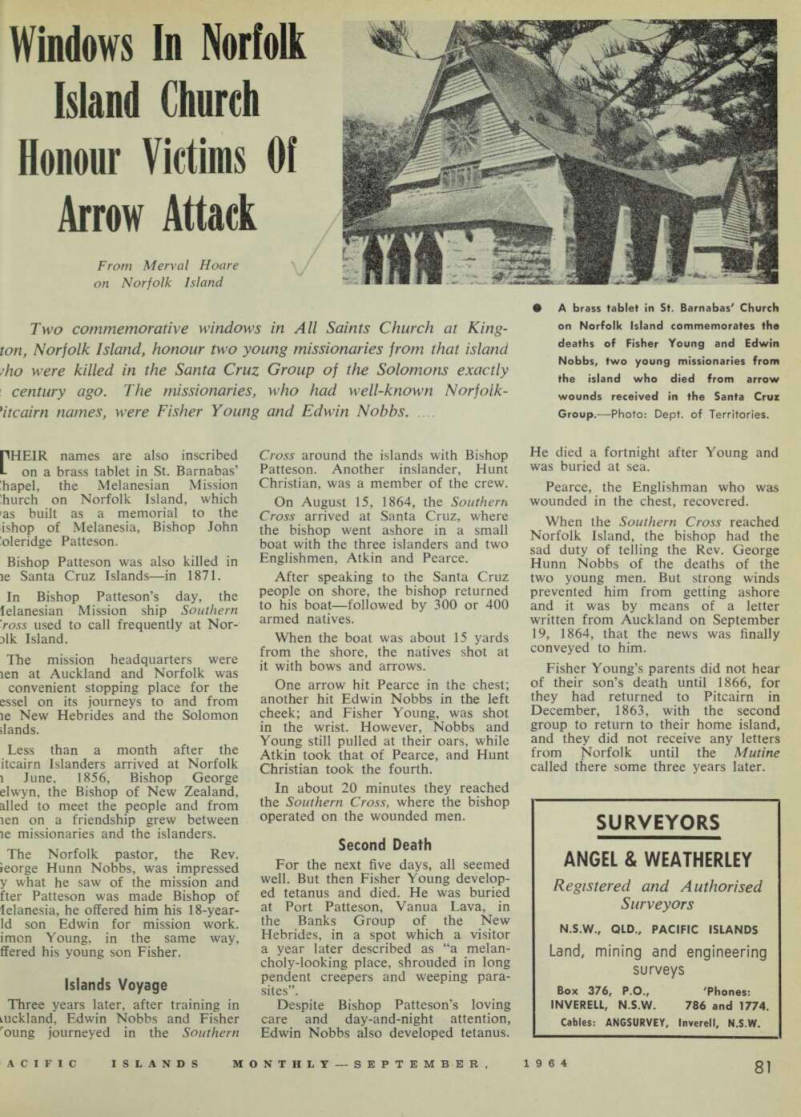
CHEIR names are also inscribed on a brass tablet in St. Barnabas’ lhapel, the Melanesian Mission Ihurch on Norfolk Island, which r as built as a memorial to the ishop of Melanesia, Bishop John loleridge Patteson.
Bishop Patteson was also killed in le Santa Cruz Islands—in 1871.
In Bishop Patteson’s day, the lelanesian Mission ship Southern ross used to call frequently at Nor alk Island.
The mission headquarters were len at Auckland and Norfolk was convenient stopping place for the essel on its journeys to and from le New Hebrides and the Solomon dands.
Less than a month after the itcairn Islanders arrived at Norfolk i June, 1856, Bishop George elwyn, the Bishop of New Zealand, ailed to meet the people and from len on a friendship grew between le missionaries and the islanders.
The Norfolk pastor, the Rev. leorge Hunn Nobbs, was impressed y what he saw of the mission and fter Patteson was made Bishop of lelanesia, he offered him his 18-year- Id son Edwin for mission work, imon Young, in the same way, ffered his young son Fisher.
Islands Voyage
Three years later, after training in mckland, Edwin Nobbs and Fisher r oung journeyed in the Southern
Cross around the islands with Bishop Patteson. Another inslander, Hunt Christian, was a member of the crew.
On August 15, 1864, the Southern Cross arrived at Santa Cruz, where the bishop went ashore in a small boat with the three islanders and two Englishmen, Atkin and Pearce.
After speaking to the Santa Cruz people on shore, the bishop returned to his boat—followed by 300 or 400 armed natives.
When the boat was about 15 yards from the shore, the natives shot at it with bows and arrows.
One arrow hit Pearce in the chest; another hit Edwin Nobbs in the left cheek; and Fisher Young, was shot in the wrist. However, Nobbs and Young still pulled at their oars, while Atkin took that of Pearce, and Hunt Christian took the fourth.
In about 20 minutes they reached the Southern Cross, where the bishop operated on the wounded men.
Second Death For the next five days, all seemed well. But then Fisher Young develop ed tetanus and died. He was buried at Port Patteson, Vanua Lava, in the Banks Group of the New Hebrides, in a spot which a visitor a year later described as “a melan choly-looking place, shrouded in long pendent creepers and weeping para sites”.
Despite Bishop Patteson’s loving care and day-and-night attention, Edwin Nobbs also developed tetanus.
He died a fortnight after Young and was buried at sea.
Pearce, the Englishman who was wounded in the chest, recovered.
When the Southern Cross reached Norfolk Island, the bishop had the sad duty of telling the Rev. George Hunn Nobbs of the deaths of the two young men. But strong winds prevented him from getting ashore and it was by means of a letter written from Auckland on September 19, 1864, that the news was finally conveyed to him.
Fisher Young’s parents did not hear of their son’s death until 1866, for they had returned to Pitcairn in December, 1863, with the second group to return to their home island, and they did not receive any letters from Norfolk until the Mutine called there some three years later.
A brass tablet in St. Barnabas' Church on Norfolk Island commemorates the deaths of Fisher Young and Edwin Nobbs, two young missionaries from the island who died from arrow wounds received in the Santa Cruz Group.— Photo: Dept. of Territories.