Everyone (Probably)
p. 85 · Read in the full issue
When Pitcairn Island Goes To The Polls, Everyone (Probably) Knows Who’ll Win
By Murray Howse, a former Education Officer on Pitcairn.
Although party politics have
10 place in the lives of the Pitcairn Islanders, the triennial election for the position of chief
nagistrate creates plenty of
nterest because the community
ooks to the elected candidate for
)rosperity and harmony among
hemselves. rHE position, usually contested by three or four of the older men, s coveted not so much for the money hat goes with it, but for its social tatus.
The chief magistrate’s word is eldom questioned locally and his ;ommands are always obeyed.
To be a candidate for election, you nust be Pitcairn-born and you must lave lived on the island for at least !1 years.
Traditionally, the elections are held m Christmas Day, with the voting leginning at 6.30 a.m.
Campaigning usually starts in the irst week in December, when regula ions require the Island Secretary to irepare the rolls for public display.
But the names of aspirants for the :oveted magisterial post are not ifficially known until a public meet ng is held seven days or so before lection day, when nominations are eceived.
At this meeting, nominations are also received for the unpopular post of chairman of the internal com mittee, which is voted for annually.
This position is always difficult to fill because the elected person has the onerous task of organising public works, and he receives only £9O a year for his labours.
In December, 1960, when I attend ed a nomination meeting, the nomina tions for chief magistrate were quickly dealt with. But it took three hours to find someone to accept the post of chairman of the internal committee.
Eeveryone possible was asked at least three times to accept the nomina tion, and in most cases, wives answered in no uncertain terms for their husbands, for the committee’s chairman comes in for a good deal of criticism during the year, and no Pitcairn woman takes such criticism of her husband easily.
I think it was 11 o’clock before someone gave way and accepted the nomination. But the strangest part was to follow, for the nominee demanded that the people should record their votes for him on election day.
My suggestion that no election was necessary was strongly opposed, and I have since learned that no man would accept the position unless he polled at least three-quarters of the votes, (Voters not in favour of the only candidate indicate this on their ballot papers).
Much Lobbying
From nomination night to election day, there was much lobbying for the position of chief magistrate, and many rumours were put around belittling the characters of the nominees. This method of attack, I learned, had been used for a number of years.
The ringing of the bell at 6 a.m. on December 25, announced that every voter had an hour in which to record his or her vote. Voters’ names were checked off by the in spector of police (the late Floyd McCoy), and votes were cast through the letter holes of the post office.
The police inspector made an an nouncement when voting was com pleted, and after council-selected scrutineers had counted the votes, the names of the new chief magistrate and chairman of the internal committee were read out.
No one displayed any emotion on hearing the reults. And little wonder.
Everyone knew who the new chairman of the internal committee would be; and it was probably a foregone conclusion that the magisterial candidate with the greatest number of relatives would get the magistrate’s job.
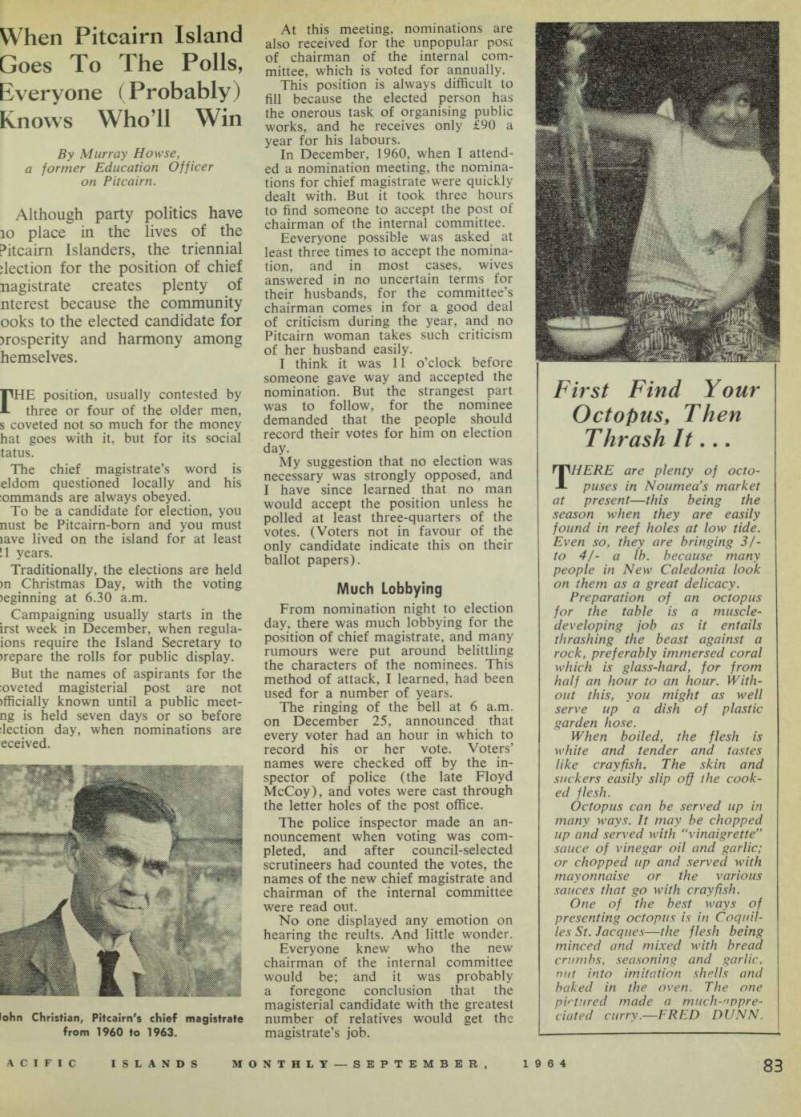
John Christian, Pitcairn's chief magistrate from 1960 to 1963.