Trobriand Islands
pp. 79-81 · Read in the full issue
Chiefs Really Were Chiefs
In The Pre-War
Some Recollections by Basil Hall A case of beer was not the only thing I took to the Trobriand Islands when I went there before the war, but it was an excellent form of introduction. The ARM (District Officer) spoke of landing charges that could be paid in kind, and then made sure of a share by offering me a bed on his verandah.
[HAD been warned that accommo dation went by invitation. Visitors vere as rare as hens’ teeth, for, in pre-war days, the Trobriands were as far away as one could get in Papua, md the only means of getting there vas by launch that made the 150nile run from Samarai at infrequent ntervals.
The isolation left the people more Dr less untouched—a collection of pleasant people, whose manners and
customs seemed to have more in com mon with Polynesia than Papua.
There is a good deal about the Trobriands that has never been ex plained. For one thing, the people were strangely ignorant about the facts of life, for, while devoted to their children, they had no idea of how they happened to arrive. They were almost as proud of their pigs.
Yet, they would geld the village boars, and leave the sows to find a mate amongst the ill-bred bush pigs, which were despised by everyone.
Pigs Lent Prestige
As in other parts of the Pacific, pigs went with prestige. The best of them were to be found in villages be longing to the five families of chiefly rank, who, between them, ruled the 9,000-odd inhabitants of the group.
There was nothing phony about these hereditary chiefs. What they had was theirs by right of birth, and, if dynastic quarrels rocked the place at times, the effect was to maintain a rough balance of power, which made for a peaceful way of life.
And that meant something to the 14 Europeans who worked in the group as missionaries, traders, pearl buyers and the like.
The chiefs exercised undisputed power, but the trouble was that much of their power was based on sorcery.
Always in the background was the puri puri man, whose bag of tricks contained all sorts of magic.
There was the harmless kind that went with things like when to plant yam crops, the blessing of canoes, etc. But there was a sinister side to
it as well, and, in one form or an other, death sometimes came to those rash enough to challenge authority.
Sorcery has always been a problem in the Trobriands. When the first Government station was opened in 1907, attempts were made to stamp it out.
Unsuccessful in that, it was de cided to adopt the principle of what you can’t beat you have to live with, and the chiefs were given a monthly subsidy of tobacco in exchange for tribute paid by the people to use their influence in the right way.
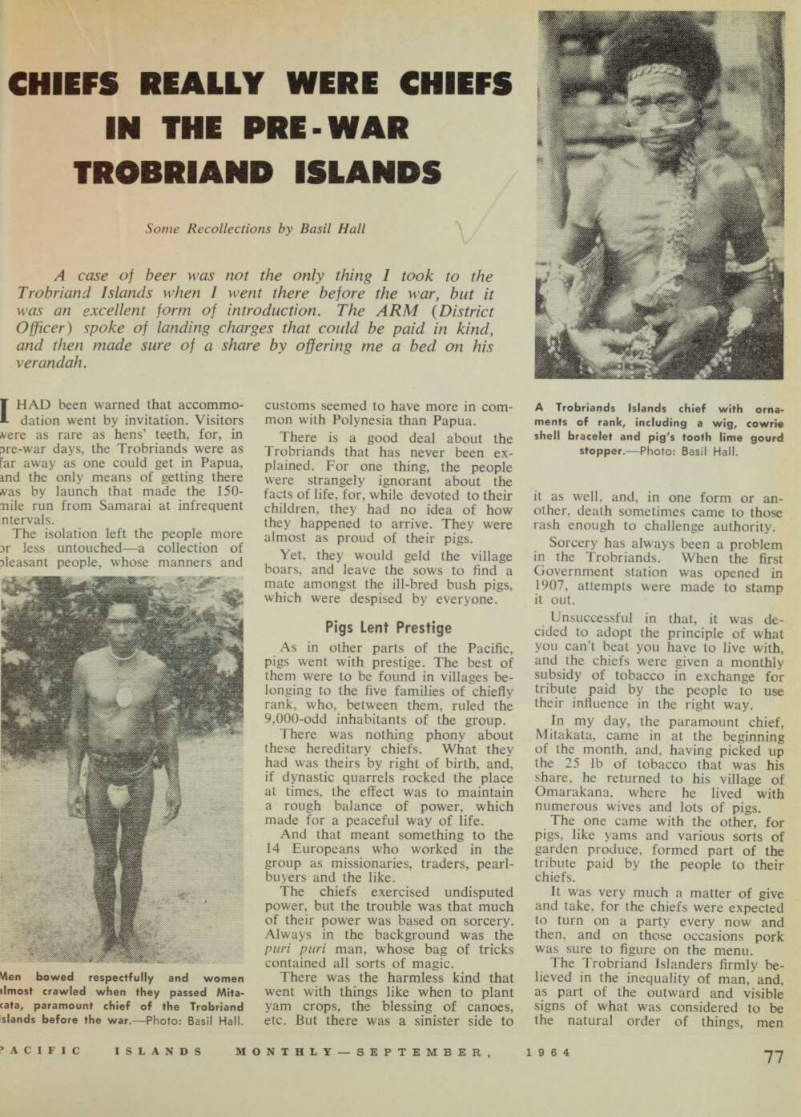
In my day, the paramount chief, Mitakata, came in at the beginning of the month, and, having picked up the 25 lb of tobacco that was his share, he returned to his village of Omarakana, where he lived with numerous wives and lots of pigs.
The one came with the other, for pigs, like yams and various sorts of garden produce, formed part of the tribute paid by the people to their chiefs.
It was very much a matter of give and take, for the chiefs were expected to turn on a party every now and then, and on those occasions pork was sure to figure on the menu.
The Trobriand Islanders firmly be lieved in the inequality of man, and, as part of the outward and visible signs of what was considered to be the natural order of things, men
Men bowed respectfully and women almost crawled when they passed Mita kata, paramount chief of the Trobriand stands before the war. — Photo: Basil Hall.
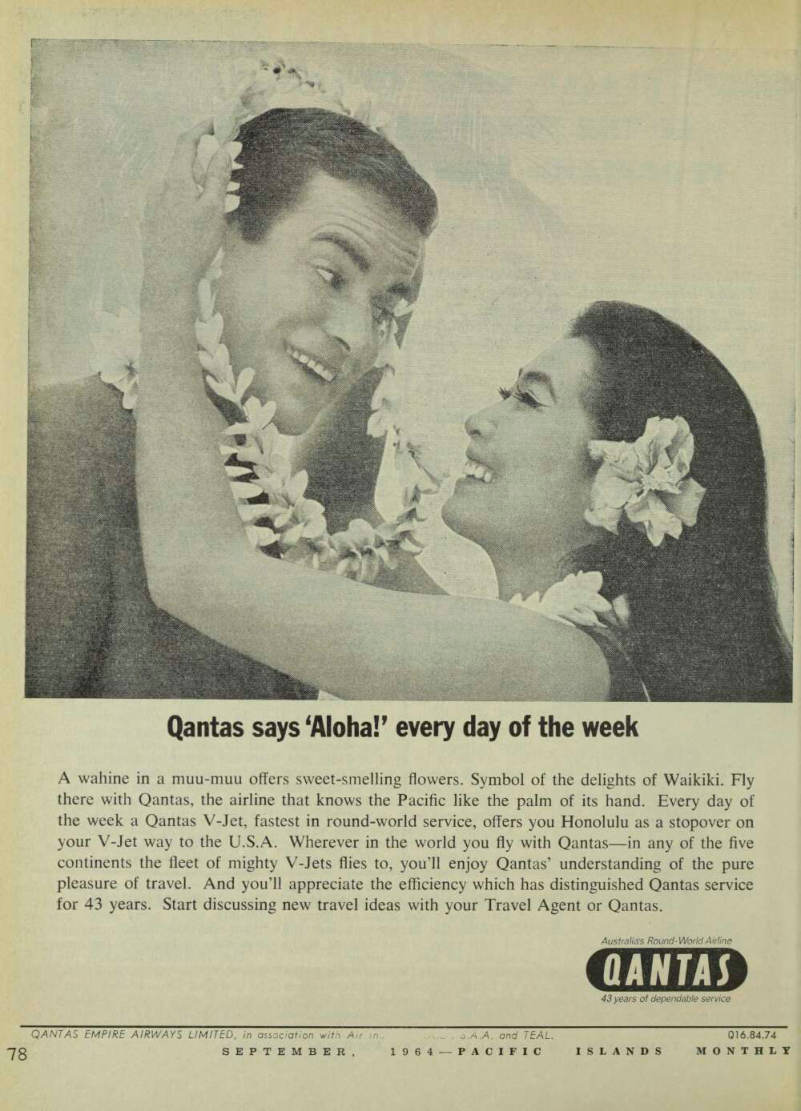
A Trobriands Islands chief with orna ments of rank, including a wig, cowrie shell bracelet and pig's tooth lime gourd stopper.— Photo: Basil Hall.
bowed respectfully when they passed Mitakata, and women almost crawled.
Those who manipulate the winds of change may have altered things like that, but, in the ’thirties, customs of the kind were accepted, if only be cause the success of the schools and medical patrols depended largely upon the goodwill of the chiefs.
Impressive Clinic
Both the Methodist and Roman Catholic Missions provided schools, and, in the case of the former, a baby health nurse as well. For the rest, the health of the community was looked after by a second-year medical student from the Sydney University, who ran a most impressive clinic in the north-west corner of Kiriwina.
In the last quarter of 1938, that competent youth—long since a full blown doctor—dealt with more than 500 in-patients and about 200 out patients, operating when necessary, and treating any ailment from yaws to lung infections.
The magic of modern drugs may have played a part, but success rested as much on the trouble the “doctor” took to learn the language, and then the fact that he went out of his way :o gain the co-operation of the chiefs.
In the Trobriands, those of rank aelieved that they were not raised above their fellows without cause. To arove the point, any chief attending he weekly council meetings in would stand throughout the aroceedings, while those of lesser clay squatted comfortably upon the floor af the DO’s office.
The court room wasn’t very grand, ; or, of necessity, kerosene and other itores were also housed there. But he DO played his part as magistrate, vhile the councillors were present in he role of jury.
Sins Of Omission As such they dealt with sins of amission, such as the failure of 23 nen to do their “Friday” work— cleaning up the village on the day appointed.
When asked their views, the coun cillors suggested that each offender ae made to cut and bring in two aosts, as a contribution to the ■ new aolice barracks.
Then there was the mystery of the murdered pig. Was it magic or just plain spite? Here the system showed its weakest point, for the ownership of the pigs was so involved, that no councillor would buy into the argu ment.
Far different was the joy with which they tackled a case concerning a man, who, having paid five arm shells (valued ornaments but rarely worn), five cooking pots and 5/- in cash for his wife, subsequently trans ferred his affections to another woman.
Not having a bar of that, the wife took up with some other man, who, by unanimous vote of the councillors, was ordered to repay the lawful hus band three armshells and two cook ing pots. How they arrived at that de cision is something else again.
Changing Times
Thousands of US and Australian troops were stationed in the Tro briands during the war, but things were beginning to change before that.
I once caught a glimpse of blue, that seemed out of place in a grass skirt, and I still think it was, for it turned out to be a pair of trade store knickers.
The men were using a plane iron in place of their old stone adze, and it’s no use saying that the wooden bowls and carved stools offered to tourists in Samarai, are nothing like they used to be.
It cuts both ways. If progress tends to diminish the standing of the the Trobriand chiefs, enlightened thought has certainly improved the quality of village pigs.
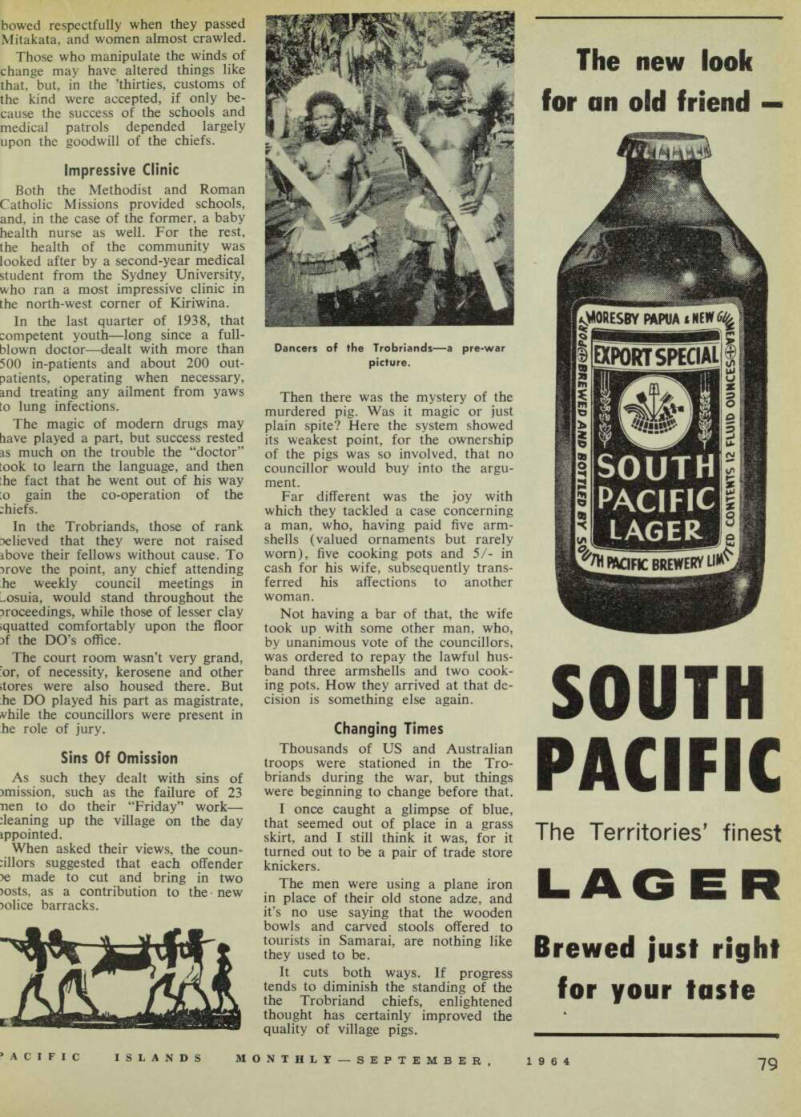
Dancers of the Trobriands —a pre-war picture.