In The South Pacific
p. 57 · Read in the full issue
June Was Talk-Talk Month In The South Pacific
June, 1964, was talk-talk month in the South Pacific, with parliaments in session in six territories—the BSIP, Western Samoa, French Polynesia, Tonga, and New Caledonia, plus Papua-New Guinea with its new 64-member House of Assembly (see pp. 12 and 42).
FN the Solomons, 10 bills, none of L them controversial, were passed uring a five-day session of the Pro tctorate’s Legislative Council. A ative member also moved that the iquor Ordinance should be amended 3 that all Solomon Islanders may rink spirits if they wish.
Moving the motion on liquor, the ative member, Mariano Kelesi, said lat the time had come to end liquor Iscrimination in the Protectorate.
From his own observations, he fid, local people had handled their eer well and prohibition on spirits as embarrassing for Solomon Is mders having drinks with their uropean friends.
European members supported the lotion, and the Secretary for Pro ctorate Affairs, Mr. R. Davies, said ic Government had always intended lat the restriction should eventually 5 lifted. He added that an amending 11 would be drafted for introduction a later session of the council.
In a debate on the adjournment of e council, Mariano Kelesi referred the Government’s policy of ulti ately giving self-rule to the indi :nous people, and said the Solomon lands had benefited greatly from eir association with the British.
But self-government was no joke, ! added. It took years of experience, ng preparation and careful plan og- JHE Governor of French Polynesia, Mr. Aime Grimald, gave some teresting facts and figures when he »ened the 1964 session of the local irritorial Assembly on May 26.
He said three of French Polynesia’s Dst important traditional industries copra, vanilla and phosphates— d declined markedly in recent nes.
The copra industry, which had own signs of recovering towards 5 end of last year, was declining ain; the production of vanilla had dined by 16.2 per cent, in the st 12 months; and the end of phos ate exploitation in the territory was sight.
However, the number of tourists passing through Tahiti’s international airport at Faaa in 1963—14,155 was 35.8 per cent, more than in 1962; the value of bank deposits in Tahiti increased by 16 per cent, in 1963 over the previous year; and more than 1,000 building permits had been issued in 1963.
Meanwhile, the value of exports had fallen from 1,103 million Pacific francs (about £A5,515,000) in 1959 to 919 million Pacific francs (about £A4,595,000) last year; and the value of imports had risen from 1,188 million francs in 1959 to 2,894 million francs in 1963.
“These figures,” Mr. Grimald said, “show how the territory is over reaching its own means in that its adverse balance of trade, which was only 89 million francs in 1959, has risen to 200 million in only four years.”
However, he said there were two factors which were keeping the economy on its feet—tourism and contributions by the Metropolitan Government through the building of the atomic testing centre in the terri tory.
The establishment of the atomic testing centre had already brought substantial sums to the territory, and it was estimated that about 800 million Pacific francs would be spent during the next two years to modernise the port of Papeete.
Other big sums would be spent on aerodromes.
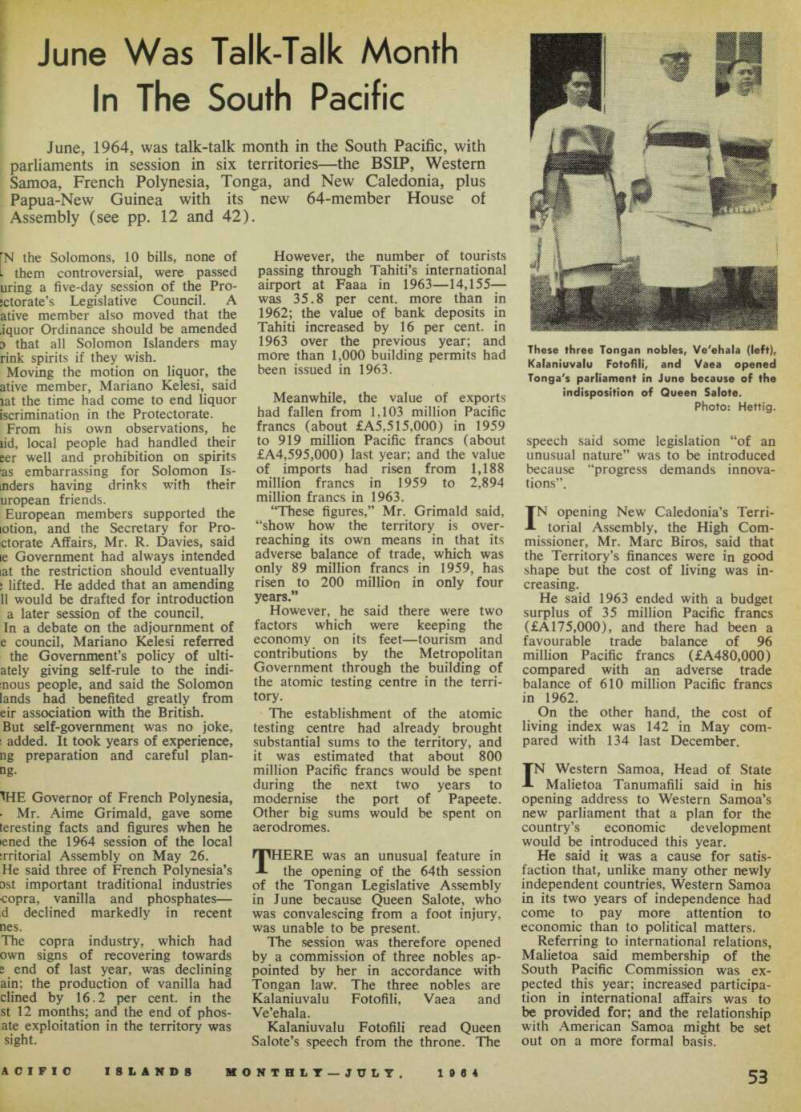
THERE was an unusual feature in the opening of the 64th session of the Tongan Legislative Assembly in June because Queen Salote, who was convalescing from a foot injury, was unable to be present.
The session was therefore opened by a commission of three nobles ap pointed by her in accordance with Tongan law. The three nobles are Kalaniuvalu Fotofili, Vaea and Ve’ehala.
Kalaniuvalu Fotofili read Queen Salote’s speech from the throne. The
speech said some legislation “of an unusual nature” was to be introduced because “progress demands innova tions”.
IN opening New Caledonia’s Terri torial Assembly, the High Com missioner, Mr. Marc Biros, said that the Territory’s finances were in good shape but the cost of living was in creasing.
He said 1963 ended with a budget surplus of 35 million Pacific francs (£A175,000), and there had been a favourable trade balance of 96 million Pacific francs (£A480,000) compared with an adverse trade balance of 610 million Pacific francs in 1962.
On the other hand, the cost of living index was 142 in May com pared with 134 last December.
IN Western Samoa, Head of State Malietoa Tanumafili said in his opening address to Western Samoa’s new parliament that a plan for the country’s economic development would be introduced this year.
He said it was a cause for satis faction that, unlike many other newly independent countries, Western Samoa in its two years of independence had come to pay more attention to economic than to political matters.
Referring to international relations, Malietoa said membership of the South Pacific Commission was ex pected this year; increased participa tion in international affairs was to be provided for; and the relationship with American Samoa might be set out on a more formal basis.
These three Tongan nobles, Ve'ehala (left), Kalaniuvalu Fotofili, and Vaea opened Tonga's parliament in June because of the indisposition of Queen Salote.
Photo: Hettig.