Consternation Over Governor
pp. 53-55 · Read in the full issue

The Month In Western Samoa
Consternation Over Governor Lees Iron Curtain"
From R. F. Rankin, in Apia.
There has been widespread consternation in Western Samoa in recent weeks over the decision of Governor H. Rex Lee, of American Samoa, to introduce travel restrictions be tween the two territories for the first time.
)ESPITE pro tests from the Government of Western Samoa, reryone travelling from Western rnioa to the neighbouring Ameri in territory has been required nee June 1 to carry a passport or entification paper containing the jarer’s photograph or fingerprint.
The Secretary to the West Samoan overnment, Mr. H. A. Levestam, sw to Pago Pago to forestall the >w regulations. In discussions with overnor Lee and his Attorney eneral, Mr. Gergely, Mr. Levestam it forward the West Samoan view at the new regulations would tend drive a wedge between the two imoas.
Division "Not Real"
He claimed that although the two id been politically divided for 60 ars, in other senses the division had ►t been real because of complete ;edom of movement.
He also claimed that:— • The new formalities could ipede this freedom of movement d seemed contrary to the spirit of -operation existing and developing rther between Western and Ameri n Samoa. • The inconvenience and expense solved in getting identification pers could be a real hardship on j great majority of visitors who welled to American Samoa for mily reasons, etc. to stay for only short period.
In reply, Governor Lee said that 5 problem was to keep track of ; 5,000 aliens, mostly Western moans, in American Samoa’s pulation of 20,000. He said that large number of visitors from sstern Samoa were young men der no matai control, who acted th a complete lack of responsibility.
It was claimed that half of the nates of Pago gaol were Western
Samoans, and that in the previous week, 80 per cent of all persons ap pearing in court in Pago for police and criminal offences were Western Samoans.
There was also heavy pressure on educational and health facilities as a result of West Samoan immigration.
Governor Lee said he did not want to do anything to harm relations between the two Samoas, but the unrestricted flow into American Samoa of Western Samoans, parti cularly those of undesirable character, was itself a threat to good relations.
Governor Lee and Mr. Gergely later flew to Apia for discussions on the subject with Prime Minister Mataafa, but no alternative plan was reached.
While a few people in Apia think Governor Lee has some justification for his action, the move is generally very unpopular. There are few Western Samoans who have no re latives in American Samoa, and traffic is very heavy along the 80 mile sea route and 45-minute air passage between the two islands.
In the first three months of this year, 3,504 people left Western Samoan for American Samoa, and 2,883 arrived in Apia from Pago.
Meanwhile, from Pago, reports tell of growing disillusionment with their status as second class American citizens, and more thought among legislators of eventual union with Western Samoa.
This may still be a long way off, but travel restrictions have not brought the day any closer.
A FTER 4i hours of discussion at the end of May, Western Samoa’s Cabinet directed Public Service Commissioner Vaiao Alailima to abide by the decision of Chief Judge Molineaux in the case of Government printer Frank Sprague.
With another three months of his contract to serve, Mr. Sprague was
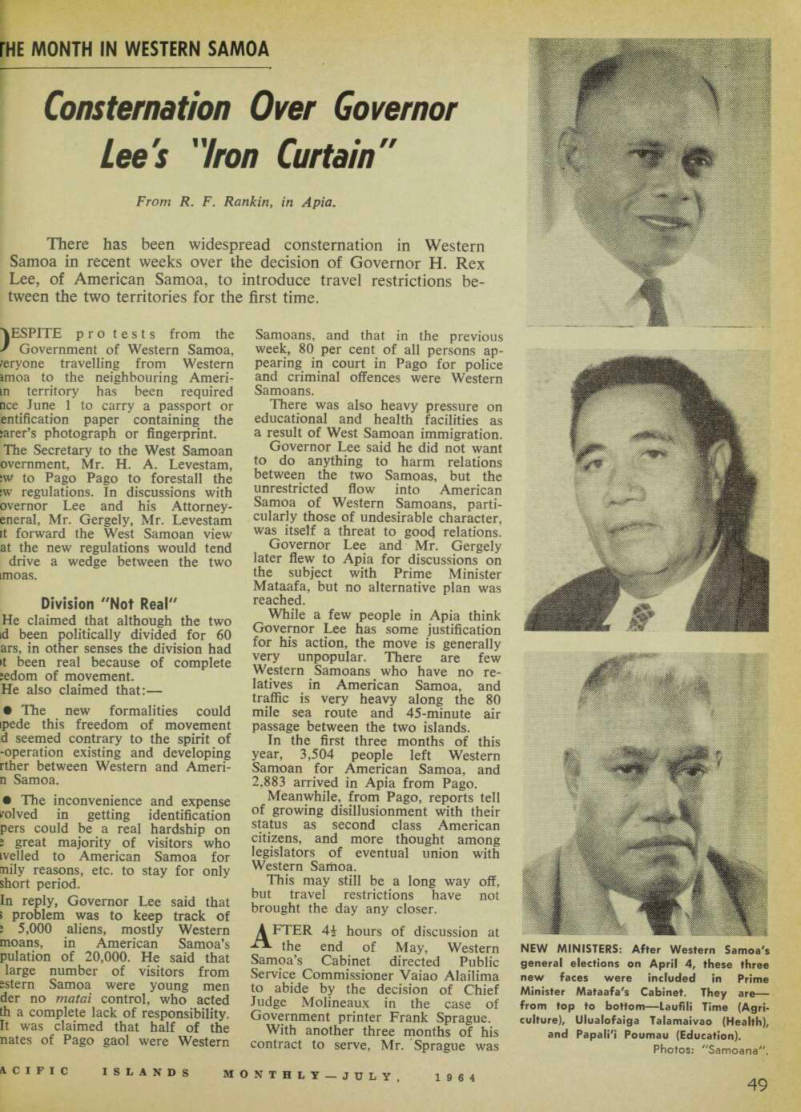
NEW MINISTERS: After Western Samoa's general elections on April 4, these three new faces were included in Prime Minister Mataafa's Cabinet. They are— from top to bottom—Laufili Time (Agri culture), Ulualofaiga Talamaivao (Health), and Papali'i Poumau (Education).
Photos: "Samoana".
aid up till the end of his time and »ld he could return with his family [ New Zealand. This was done to roid any upsets should he return to ork at the printing office for the rst time since his suspension last
pbruary.
To eliminate any ambiguity in the iw regarding the Appeal Authority, hich caused all the confusion in the rst place, a Public Service Bill, hich has been in the making for le past 18 months, has now been iven top priority to enable it to be resented to Parliament as soon as Dssible. Parliament was due to meet i June 9.
The public is still uncertan as to ho was right between the Public ervice Commissioner and Attorney feneral Frapwell. One Minister was (ported to have said that if Cabinet ipported the Public Service Com lissioner both the Attorney-General id the Chief Judge might resign and ley would be almost impossible to splace under such circumstances.
VESERN SAMOA’S public ser vants want more pay. The üblic Service Association, to which bout 600 of Samoa’s 2,000 local üblic servants belong, has asked le Government for a 10 per cent icrease, retrospective to January 1, 964, or 7J per cent increase retro- Jective to January 1, 1963.
The association claims that since le last wage increase in 1959, thp ist of living has risen 13 per cent; mt town market prices for taro and ther vegetables have risen 200 per ent in the last five years; and that arents are now faced with increased osts in school fees.
With the Government committed ) major development expenditure,
and imports rising with exports down, the prospects of any increase are not considered bright.
Like other developing nations, Samoa is coming to the realisation that the gap between the haves and the have-nots is widening and the only way out is increased and more efficient production.
AFTER a lively year of controversy under the presidency of out spoken Captain Harry Moors, the Public Service Association has elected new officers for the coming year.
President is P. Vaili; Vice-presidents, L, Heather and L. Dawson; Treasurer, A. Stanley and Secretary, M. Kleis.
SAMOA can thank the United Nations for a new industry that holds promise of considerable export earnings.
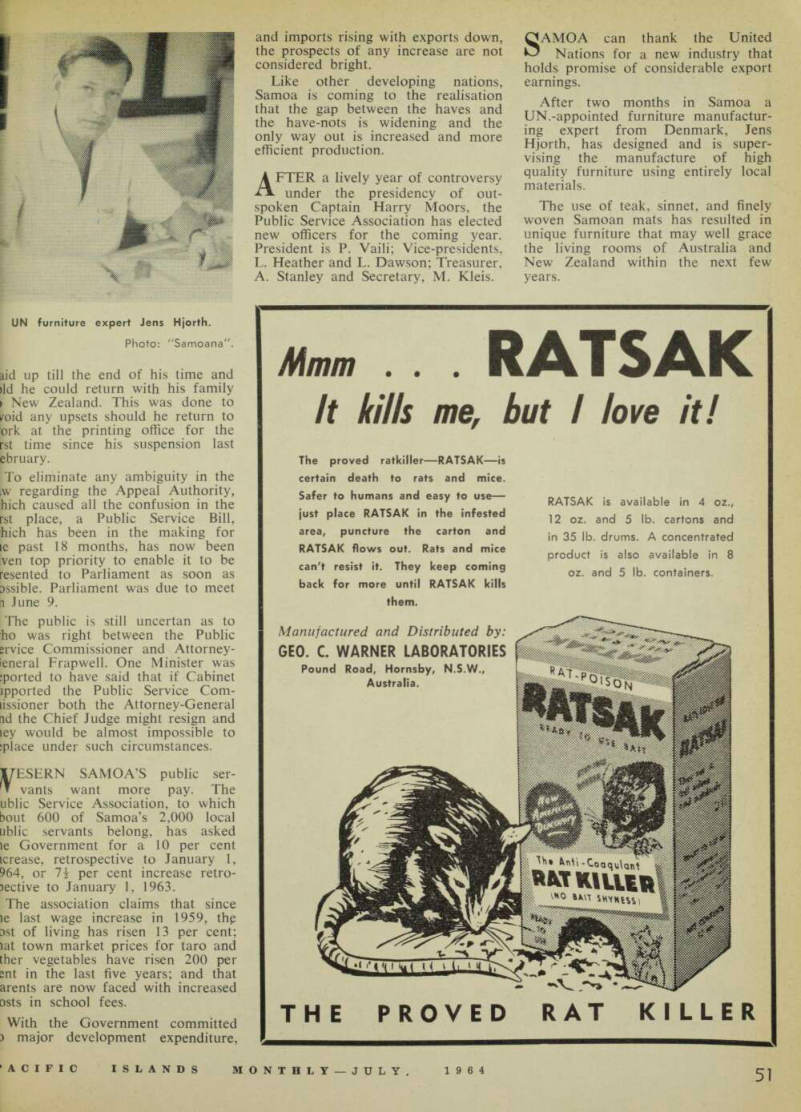
After two months in Samoa a UN.-appointed furniture manufactur ing expert from Denmark, Jens Hjorth, has designed and is super vising the manufacture of high quality furniture using entirely local materials.
The use of teak, sinnet, and finely woven Samoan mats has resulted in unique furniture that may well grace the living rooms of Australia and New Zealand within the next few years.
UN furniture expert Jens Hjorth.
Photo: "Samoana".