The Editors' Muillag
pp. 59-66 · Read in the full issue


American Samoa's Future
Sir, —The letter from “Winds of Change”, Port Moresby, in your April issue, commenting on my little article in March PIM on American Samoa, states that anyone suggesting a “longish transitional period of change” there is asleep and that the United States insists on autonomy for everyone’s colonies but its own.
These comments stem perhaps from the fact that only excerpts of what I wrote were printed by your excellent publication but, I fear, also From the regrettable fact that many of our British “friends” seem cur rently anxious to find fault with the United States wherever possible.
My article was a plea for greater autonomy for American Samoa with out endangering the protection of Samoan lands, the chief system and Dther vital Polynesian institutions presently vital but directly repugnant :o American law, which ideally denies jpecial privileges to any particular jroup.
The average American doesn’t mow where Samoa is. The majority )f those who find out usually become rate over the fact that millions of axpayers’ dollars are being poured nto a tiny area which returns this country nothing. Pago, as a naval ?ase, is in most observers’ views long iince obsolete.
I feel confident that if American Samoa wanted her independence or inion with Western Samoa, this country would grant it with our bles iings.
I am reasonably sure, however, hat most intelligent American Samoans recognise that an area of 76 iquare miles with 20,000 inhabitants, lalf under 15, cannot subsist inde )endently. As to union with Western Samoa, there seem to be mixed feel ngs on both sides.
We have a duty to these splendid >eople which does not include casi ng them adrift because whatever use heir country may have been to us s over.
At the same time, however, a Con gress whose members and their con itituents know virtually nothing of his tiny, remote area are going to be lesitant about supporting it forever mder a system which forbids sale )f land to non-Samoans, which con-
fines elections to and place in the Upper House to the chiefs and con tains other features in complete con flict with American democratic prin ciples.
The transitional change suggested was made with the interests at heart of the Samoans whom I have been fortunate enough to know and love.
The average American couldn’t care less about whether we keep Samoa or not. —Yours etc.
John F. Alexander.
Honolulu,, Hawaii.
Ray Parer's Planes
Sir, —The picture of the aeroplane published in March PIM and which Mrs. Judy Tudor was uncertain about, is the Fairey 11 IF, with a Napier Lion engine. Both photo graphs were of the same machine. It was more useful as a survey aeroplane, being military.
The plane I flew out with Hemsworth was fitted with a Rolls Royce Kestrel.
Both machines were unsuitable for freighting anything but petrol. The Napier Lion fitted to the Reconnai sance 3F machine packed up at Maprik, although I was using the correct fuel, 50-50 aviation spirit and Benzol. I sold this machine to H.
Cecil, on the same day that it seized, for £l5. It had about that amount of fuel in it. I believe he managed to sell the instruments, seats, etc., to people at Maprik.
I sold the other Fairey Fox No.
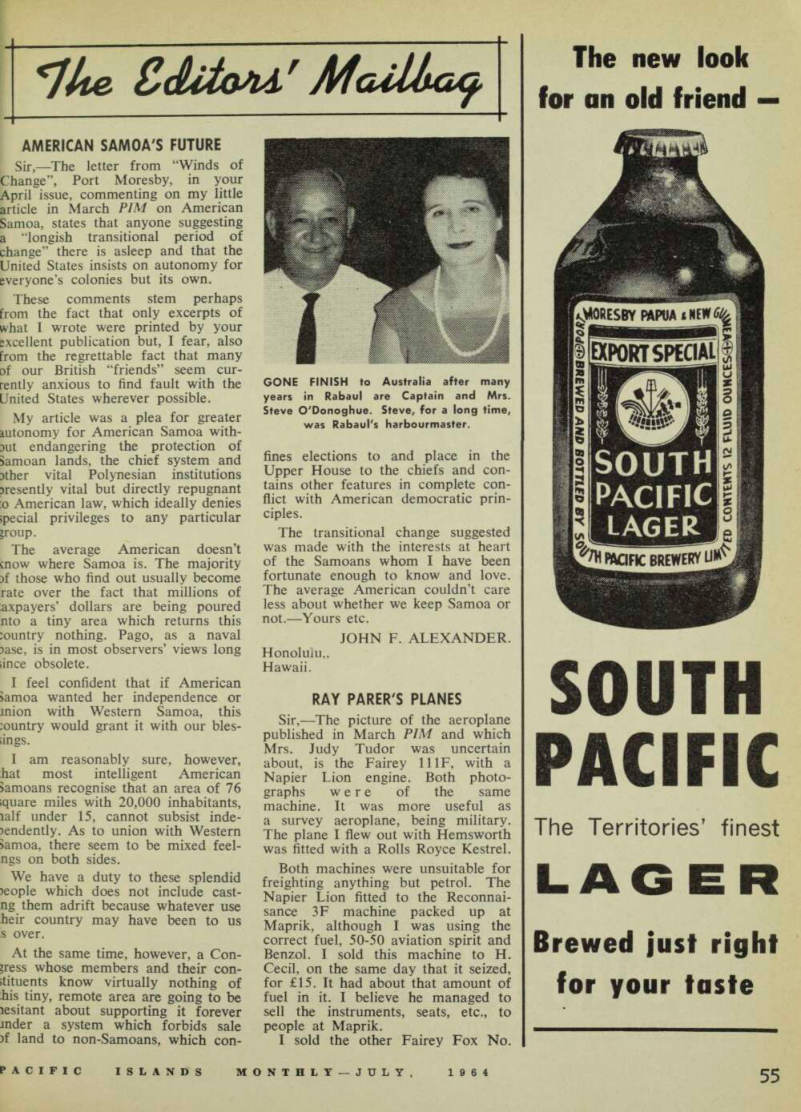
GONE FINISH to Australia after many years in Rabaul are Captain and Mrs.
Steve O'Donoghue. Steve, for a long time, was Rabaul's harbourmaster.
35, which I flew in the England Air Race, for £350 to Dave Woods. This was the price I paid for it in Eng land. She would have made a very nice private plane but the war inter vened and Dave could not use her even if he had lived.
I have now come down to earth and have purchased a cottage here, and am scrubbing and generally cleaning up the 61 acres which had become overgrown, but I have a very attractive creek, which is the upper waters of Cabbage Tree Creek and permanent.
I tender my warmest greetings to PIM, and I’m very pleased at its continued success and influence. —Yours, etc.
Ray Parer.
Mt. Nebo, Brisbane, Queensland.
Fiji Behind The Times
Sir, —Why is it that Fiji is always 100 years behind the times? We live close to countries like Australia and New Zealand, whose planning and policies are converting them into real crowns in the British Common wealth of nations. Their Govern ments are continuous and stable in their policies.
In Fiji, in contrast, Governors and , other high officials are appointed for short terms to positions that are “plums” for services rendered else where, and just as they are beginning to understand the problems they are shifted into laurel-crowned retirement, or to higher salaried positions in other countries. There is no continuity of effort.
The result is that Fiji continues after a hundred years of occupation to have the same old dusty, gravel and grade roads. Who cannot realise that the initial cost of tar sealing the roads, which can be repaired at small cost, far outweighs the costs incurred by huge fleets of gravelling lorries, scoops and graders? A PIM writer once aptly described our roads as “slipped disc” roads, owing to the corrugations that inevitably occur as the increasingly heavy traffic rolls and pounds over them.
Just recently again officialdom tightened the chains against progress by refusing to allow an Australian firm to establish television. How far this decision was influenced (if any) by avoiding hurt to the profits jf our commercialised radio net work, is anyone’s guess. The Americans, on the other hand, have established a television station on
the small main island of American Samoa, which has a population about one-tenth below that of Fiji.
I am, Sir,
H. S. Faddy
Nadroga, Fiji.
Naming Of The Mortlocks
Sir, —May I prefer my opinion on the question of the European dis covery and naming of the Mortlock Islands/Tau’u, which has featured recently in PIM.
They were discovered on June 21- 22, 1616, by the Dutch explorers Le Maire and Schouten, and were named Marcken (Marquen or Marqueen are alternative spellings).
They were sighted by Tasman on March 24, 1643, and he recognised them as Marcken.
In 1794 Captain Wilkinson of the Indispensable, after sailing north
wards through Indispensable Strait in company with the American vessel Halcyon (Captain Benjamin Page), sighted them again and named them Cocos Islands.
In 1795 Captain Mortlock of the Young William sighted them, and he named them Hunter’s Islands in the mistaken belief that they were the “seven islands” sighted by Cap tain Hunter from the Waaksamheyd on May 18, 1791. In fact Hunter had sighted Kilinailau on that day, and had correctly identified his land fall as the Nine Islands discovered by Carteret in August, 1767.
Mortlock’s name of Hunter’s Is
lands seems to have been applied to the group between 1795 and 1824, e.g. on Arrowsmith’s “Chart of the Pacific Ocean” of 1798 and on a chart by Beautemps-Beaupre of 1804.
The earliest chart which I know of on which the name Mortlock Islands appears is by Krusenstern, dated 1824. Krusenstern realised that Hunter’s Islands were the same as the Nine Islands of Carteret, and the islands seen by Shortland im mediately after he sailed north from the Bougainville/Shortland Straits, and he accordingly applied these three names to Kilinailau.
Between Kilinailau and Ontong
Islands People
In Sydney
Mr. and Mrs. John Hazelman, of Suva (top), paid their first visit to the Polynesian Association clubrooms in Sydney recently.
They went along with Mr. and Mrs.
Stevens, also of Suva (below). Mr. and Mrs. Hazelman were on the first leg of a world tour. Mr. Hazelman is on leave from the PMG Department, Suva.
—Telephotos.
[ava, however, he mistakenly laid lown two groups of islands in close proximity to each other, naming one p-oup Isles Marquen or Isles Cocos md naming the other group Isles Mortlock without realising that the atter were identifiable with the former, It seems likely that Krusenstern vas responsible for the name Mort ock Islands, for he seems to have >een the first cartographer to realise hat Mortlock’s identification of the p-oup as Hunter’s “seven islands” was □correct.
Failing to appreciate, however, that he islands sighted by Mortlock were he same as the Marquen of Le Maire md the Cocos Islands of Wilkinson le laid them down separately and, ince the name Hunter’s Islands was io longer applicable, awarded the former the obvious name Mortlock slands.
If the group must have a European lame it should be Marcken, but what s wrong with Tau’u—the indigenes vere there first in any case?—Yours, !tc.
Colin Jack-Hinton.
Jniversity of Singapore, Singapore.
Politics In Tahiti
Sir, —Your article on page 71 of he May issue of PIM created con siderable comment, discussion and :ontroversy. The “facts?” listed there ire, indeed, open to serious question. [The article in question referred o the conviction, in 1959, of Tahi ian politician Pouvanaa a Oopa on charges of attempted murder, arson md illegal possession of arms in Oc ober, 1958, when he was Deputy for French Polynesia in the French Par iament and a member of French Polynesia’s Territorial Assembly. The irticle compared Pouvanaa’s case vith that of New Caledonian politi cian Maurice Lenormand whose career ended recently and abruptly in omewhat similar circumstances.] A number of French friends of nine here in Tahiti have asked me o make a response and a true de fence of French justice, which in the )pinion of most people really needs 10 defence.
Pouvanaa a Oopa was tried, con victed and sentenced in open court, here was no coercion, no “fixing”. 3e received full and fair treatment mder the law. A number of news papermen friends here have given me heir eye-witness version of what took )lace, and if anything the sentence vas most lenient.
First of all, in a French court, a
man is innocent until he is proven guilty, and that is the task of the prosecutor, and the whole court pro cedure. For several years Pouvanaa had acquired arms, ammunition, etc.
He had his bully boys well armed and they stood guard over his house.
At the time of the local uprising, if it hadn’t been for some of his own followers who had become frightened at what had been planned, and in formed the local authorities, Papeete indeed would have been considerably destroyed by fire.
The local police and gendarmerie surrounded the house and it took
considerable doing, with one of Pou vanaa’s boys aiming right at one of my friends, and succeeded in captur ing the huge store of arms, Molotov cocktails, etc., that were in Pou vanaa’s house. Fires had been ac tually started, but were fortunately caught in time.
Attempted murder was committed when a Molotov cocktail was thrown into the bedroom of the home of one of Pouvanaa’s opponents. In the bed room were a number of children, who would indeed have been burned to death if the weapon had exploded, but fortunately it fizzled out. There
were many other acts of violence, all proven to have been instigated by Pouvanaa.
Tahiti always had been, and is now again, a place of peace and quiet and tranquillity. There is no place here for violence, disorder, murder. It is the considered opinion of most people here in Tahiti that justice was certainly done in the case of Pou vanaa a Oopa, both here and in France.—Yours, etc.
Bernard Covet.
Papeete, Tahiti.
Japanese Wreck
Sir, —I am writing to you in the hope that you can give me the history, etc., of the Tanya Maru, the Japanese wreck which is at the end of the airstrip, in the sea, at Lae, New Guinea, I lived in NG for many years and tried to find this out but no one could’ help me. We get PIM every month.—Tours, etc.
(Mrs.) S. Stephenson.
Maroubra,
Nsw.
• Can anyone help?—Ed.