Territories TALK-TALK
pp. 43-47 · Read in the full issue
Under the heading “Anything Can Happen to Patrol Officers on Sydney Leave” Port Moresby’s South Pacific Post recently ran quite an interesting story on the Odyssey of two P-NG patrol officers, Tom Steen and Noel Cavanagh.
rOM came from the country of the Kukukukus and Noel from the sepik area. For some reason—best mown to patrol officers from P-NG in leave—they met up in the pre scription bar of the “Australia” [where Dispenser Jean holds sway).
They decided on a motor trip to Melbourne, calling at Berrima on the way (which is erroneously described is being on the NSW South Coast, but it is some 30 miles inland).
Here they were served with Port Moresby’s local South Pacific lager and were supplied with a dozen and a half bottles to take away. That is the punchline, but . . .
No explanation is made how the South Pacific lager came to be there in Australia’s oldest pub, “The Surveyor General”, built circa 1834.
I offer this explanation: The licensee of the “Oldest Inn”, one Graham Percival, was previously licensee of the “Good Intent” Hotel at Campbelltown.
His father, Ray, a widower, made a trip to P-NG a few years ago and returned with some of the precious “SP” lager, bows and arrows, Hagen axes and a couple of Mae West glasses from a Port Moresby pub, as tour souvenirs. He also married again, to a lady who at one time (so she informed me) was a nursing sister at Lae. Hence the milk in the coconut or rather Australia’s newest lager in Australia’s oldest inn.
There are many NG-ites who are acquainted with the “Good Intent” in Campbelltown.
When I came there in the middle ’Forties I remember meeting Keith McCarthy and his wife, Ted Fulton and family, Ken Douglas and family and Fred Archer, all of whom were staying there.
And even now, the present licensee, Mrs. Ireland (nee Berner), was for a while a NG visitor when, back in 1937, she was the guest of the late Flo Gilmore, who was then living on Put Put plantation, down the South Coast of New Britain.
With Tolala
Something of Value I have always had mixed feelings on the policy Australia has adopted, and the Administration compelled to implement, of putting the primitive New Guinean into pants and prefabricated, iron-roofed houses, encouraging the suppression of their age-old customs and traditions and creating thus a second-class counterpart of a civilised Westerner rather than a first-class One phase of our civilising influence which I have admired beyond all else is the work being carried out quietly and unostentatiously by the health and hygiene sections of the Administration I was pleased therefore not so long ago to meet up with Dr. Jan Saave, who is in charge of P-NG’s malaria
contro] programme, who told me he had recently returned from a con ference in Singapore, as temporary adviser to WHO on malaria eradica tion. main objective> he said> was the discussion on the malaria im munit su conducted by Prof. R. s Desowitz , of the Singapore Uni yersit and himself in August, 1963, in the Maprik (Sepik River) area .
There was also planning for future research and a of the possi bihty of establishing sistable *? r y facilities m th^ s , ma J^J}® the Territory the first and o y country in the S-W Pacific: where such . highly specialised tests malaria eradication are adopted, This r> good news in anybody’s
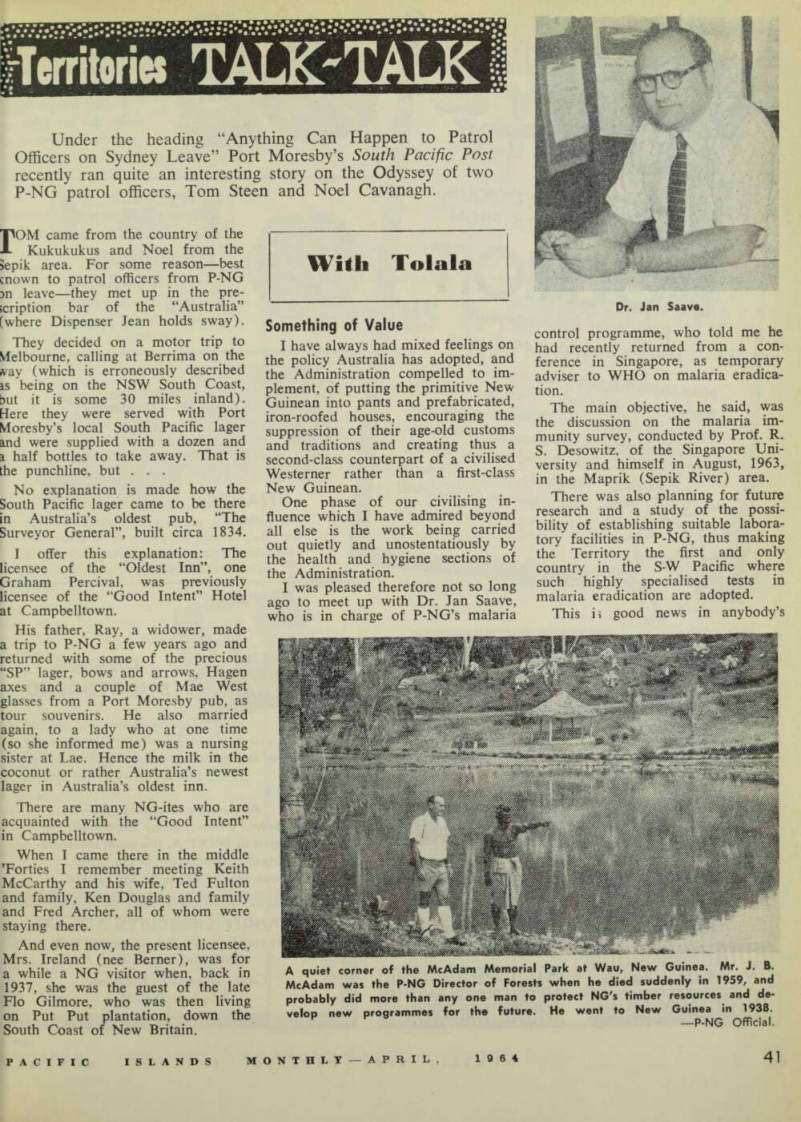
Dr. Jan Saave.
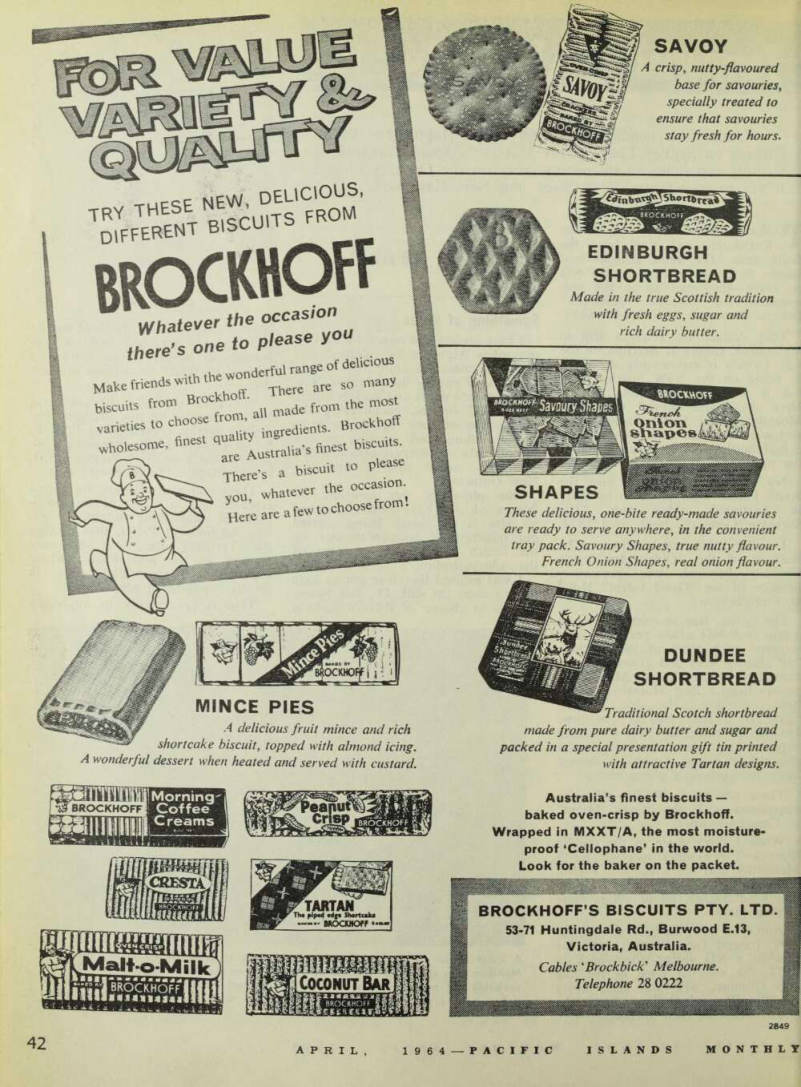
A quiet corner of the McAdam Memorial Park at Wau, New Guinea. Mr. J. B.
McAdam was the P-NG Director of Forests when he died suddenly in 1959, and probably did more than any one man to protect NG's timber resources and de velop new programmes for the future. He went to New Guinea in 1938. -P-NG Official.
anguage. Malaria is the main pain n-the-necV. of all New Guineans.
Dr. Saave told me they had been uccessful not only in controlling tialaria in some districts, but they lad eradicated it and he was opti nistic in his hopes of, in time, ichieving its eradication throughout he Territory.
Now that is something which will eally benefit New Guinea. Good uck to them.
Pronunciation
)f Papua
Prime Minister Menzies, noted for lis correct pronunciation of proper tames (let’s see, how d’you pro lounce Menzies?), started off a ontroversy when he referred to *apua as “Pah-pooher”, accentuating he “pooh”.
“Of course,” wrote a critic to the 'ydney Morning Herald, “it is ‘Pap i-ah’ with the accentuation on the Pap’. The raw native pronunciation m’t far from that either—it’s ‘Pap >oh-ah’, still with the ‘Pap’ em »hasised.”
Other writers followed endorsing Pah”, or “Pap”, quoting natives’ (renunciation or European usage as heir authorities.
But why Papuan native pronunci ition was quoted goodness only mows.
The word “Papua”, as most Euro •eans in the Territory know, is a dalay word Papuwa(h), meaning rizzy-haired and was applied first by orge de Menezes (not Menzies!) in 526 when he discovered the island.
It has no connection with any *apuan dialect.
As a rule the native is the last one 0 quote for correct pronunciation of 1 foreign word, and the majority of *apuans (until quite recently, at east) had as much idea that their country was designated “Papua” as he New Britain natives were aware, luring the German regime, that they ived in a portion of the “Bismarck Archipelago”. The critics wouldn’t isk an Australian aboriginal how to >ronounce “Australia”.
The pronunciation of words vary vith every NG tribe, according to heir individual alphabets and their ibility (or otherwise) to pronounce consonants, especially.
For example; Take the natives of he Gazelle Peninsula in New Britain.
Matupi natives call Rabaul Ra-“ >owel”; travel along a few miles to he North Coast and natives refer to t as “Ram-bowel”, and their own irea, generally known as Kabakada s to them “Kam-bakanda” because heir “b” has the quality of “mb” and
their “d” of “nd” (even as Nadi airport in Fiji is “Nandi”).
One of the most outstanding examples of native mutilation of an imported word is the present-day pronunciation of lava-lava (from Polynesia) which has been contracted to the übiquitous “lap-lap”.
What knowledge has the un sophisticated native from the High lands, the Sepik or the hinterland of Bougainville of the names adopted by European cartographers to their area or island, much less to the country as a whole?
Which reminds me of the story of the District Officer who some years ago endeavoured to impress upon a
chief how small and insignificant was his island in comparison to the whole world.
Producing a large map of the Pacific, the DO pointed out the tiny pinpoint designating the chiefs island and the expanse occupied by other countries.
“You see how small it is?” in quired the DO, assured that he had won his point.
“Yes,” said the chief reluctantly, “but who made the map?”
“We made the map,” replied the DO, wonderingly.
“Oh, well. That explains it,” said the chief.
Grim Relics Of The War A report of four skeletons being unearthed near the Lae aerodrome, and that they may have been those of victims of war-time Japanese occupation, recall to mind my war time days in the Nip “boob”. From the windows of the Rabaul freezer during 194243 we used to see trucks passing periodically with our Air Force men, standing up with hands tied, on their way to the Kempei Tai headquarters in Chinatown. Seldom did we see them return.
Our scouts —Asiatics and natives— used to tell us of summary trials, followed by executions, which were meted out to raiding airmen who were looked upon as spies.
We heard of one exception, how ever, when a top-ranking US airman received VIP treatment and was flown back to Tokyo and ultimately exchanged.
I also remember a good-looking New Guinean, an ex-police boy, who was wearing the Japanese Army cap, and who invariably accompanied these trucks and, rumour had it, he attended the executions.
Today he is a prominent member of the native community.
Those 'lazy Natives"
When you have “28 full-time European journalists” assigned to Papua and New Guinea (P/M, March, p. 71) at the one time, with chiefs-of-staff breathing down their neck for “copy”, it is little wonder that by the time some of their stories make the printed pages of metro politan papers there are phrases and descriptions which are criticised by some analytical readers in Australia.
Recently R. B. Dakeyne, of Sydney University’s Department of Geo graphy, took exception to a state ment in an article by an Australian newspaper group’s “Special Repre sentative in New Guinea” who had claimed “the indigenous people of P-NG were lazy and their sub sistence agriculture wasteful and in efficient”.
Dakeyne omits to quote the journalist’s opening words: “In the old days . . .” not realising, per haps, that the journalist was really only quoting some routine hand-out from the P-NG Information Depart ment which invariably plays up the progress of the present and plays down the performance of the past.
However, the point raised by the critic is a good one.
He says that the opinion that the P-NG indigene is “lazy . . . per
petuates a myth, not based on fact, which has been current in Australia for the last 70 years”. And that is very true.
The reason for this is simple: We use the same yard-stick to measure their vigour as we do to measure our own, which has to supply us with the means for the highest standard of living—hire purchase, “Keeping up with the Joneses” and the multitude of modem gadgets which we have grown to regard as dire necessities for our Way of Life.
I often wonder whether our streamlined, “labour-saving” rat race of modern living, with its attendant snarls, coronaries and neuroses, is preferable to the leisurely, tranquil existence of the New Guinea primi tives whom we are determined to burden with our own standards of living. (Tut, tut! We must expand our exports.) Bits and Pieces Ben Cropp, who has made a name for himself as an underwater film photographer and who recently went to the USA to collect an award as “underwater photographer of the year”, is a Buka product. He is the son of Methodist Missionary, Rev.
A. H. Cropp, for some years stationed at Skotolan, Buka ... A traveller recently to Indonesia, mixing with top-level government officials, tells me they often refer to Australia as South Irian. Only a geographical term—l hope . . . Wally Corden, well-known, old-time transport mag nate of the Wau goldfields, returned
to Australia early in March from an extended tour of the UK and may settle along the Gold Coast some where . . . Just to put the record straight: Dianne Cilento was not born in NG ( Tropicalities, March, p. 20) “nearly 30 years ago ...” Hex father, Dr. Cilento (now Sir Raphael) left NG in 1927 (which, according to my electronic computer is 37 years ago). In 1928 he was Director of Tropical Hygiene in N-E Australia.
When I lived on Namanula (Rabaul) in 1925-26 the Cilentos were next door neighbours and I remember young “Raffles” (now a medico in Sydney) and his little red-haired sister—l think it was Margaret, who became an artist.