Distinguished
pp. 41-42 · Read in the full issue
Death Of A
Lady
If in fact Mrs. Alice Bowring kept diary, the story of how life began ?r her in the Islands at the age of 0, would make an adventurous and appy book. But perhaps she didn’t, v Alice Bowring was always so usy doing things that she probably ad no time to write her story down.
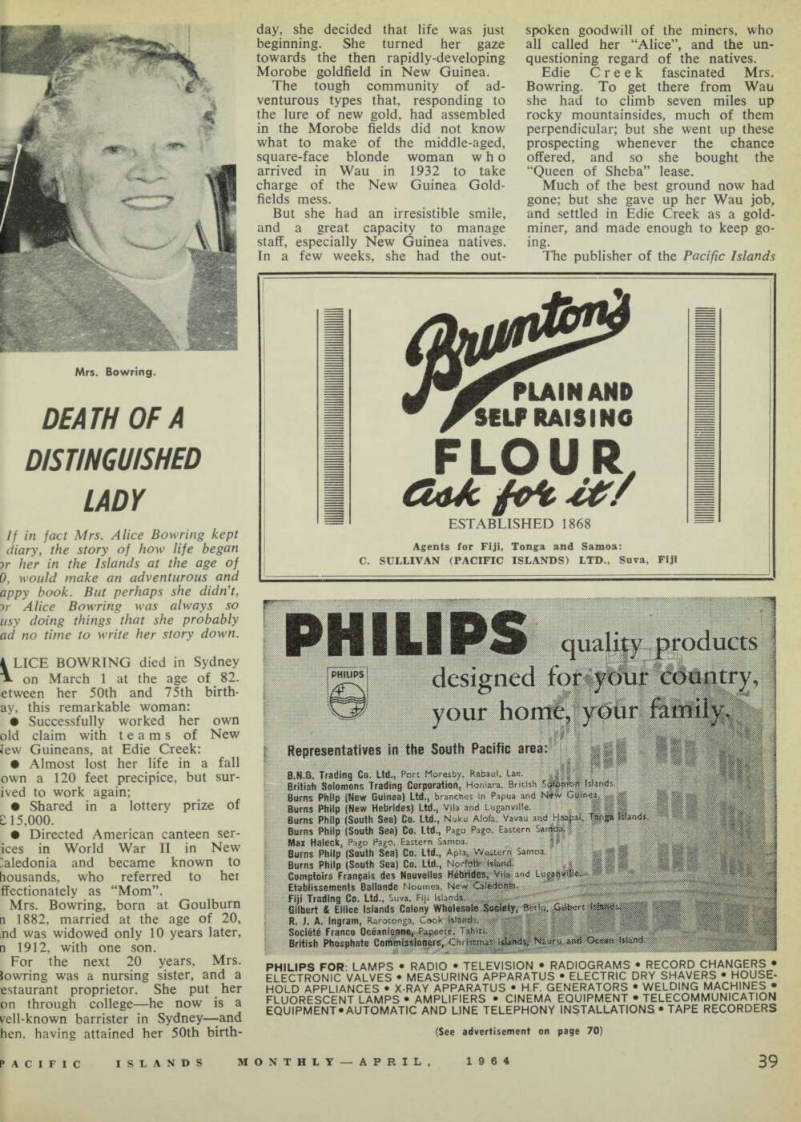
VLICE BOWRING died in Sydney on March 1 at the age of 82. etween her 50th and 75th birth ay, this remarkable woman: • Successfully worked her own old claim with teams of New lew Guineans, at Edie Creek: • Almost lost her life in a fall own a 120 feet precipice, but sur ived to work again; • Shared in a lottery prize of 215,000. • Directed American canteen ser ices in World War II in New Caledonia and became known to housands, who referred to her ffectionately as “Mom”.
Mrs. Bowring, born at Goulburn n 1882, married at the age of 20, ,nd was widowed only 10 years later, n 1912, with one son.
For the next 20 years, Mrs. lowring was a nursing sister, and a estaurant proprietor. She put her on through college—he now is a veil-known barrister in Sydney—-and hen. having attained her 50th birth
day, she decided that life was just beginning. She turned her gaze towards the then rapidly-developing Morobe goldfield in New Guinea.
The tough community of adventurous types that, responding to the lure of new gold, had assembled in the Morobe fields did not know what to make of the middle-aged, square-face blonde woman who arrived in Wau in 1932 to take charge of the New Guinea Goldfields mess.
But she had an irresistible smile, and a great capacity to manage staff, especially New Guinea natives, In a few weeks, she had the out-
spoken goodwill of the miners, who all called her “Alice”, and the un questioning regard of the natives.
Edie Creek fascinated Mrs.
Bowring. To get there from Wau she had to climb seven miles up rocky mountainsides, much of them perpendicular; but she went up these prospecting whenever the chance offered, and so she bought the “Queen of Sheba” lease, Much of the best ground now had gone; but she gave up her Wau job. and settled in Edie Creek as a gold miner, and made enough to keep go ing.
The publisher of the Pacific Islands
Mrs. Bowring.
Monthly met her there in the early Thirties, and they became fast friends. Already, she was famous for her nursing skill—unstintingly given —her hospitality and the vivid phrases which she applied to un wanted interlopers and recalcitrant labourers. You always knew where you were with Mum Bowring.
It was about then that the tireless miners somehow constructed a sort of goat-track up the terrifying slopes and razorbacks from Wau to Edie; to be followed by the introduction of motor-transport by Fred Deckert.
He widened the track, and then cut down a small motor-truck to about half normal width, and carried goods and passegers up and down. In places, he had to reverse, once or twice, to get around the bends.
Passengers at the rear, end of Deckert’s famous “Bitser” would find themselves looking down into seem ingly bottomless gulches.
One day the “Bitser” slipped over the edge, and Mrs. Bowring, a passenger who had her own choice, unprintable name for the “Bitser”, went bumping down a 120-ft precipice.
She lay helpless in the scrub, with a complex fracture of the lower spine.
It was ten hours before a team of natives, directed by miners who had lashed her under a few saplings, carried her up onto the track. That place is still called “Bowring’s Leap”.
She was many weeks in the Wau hospital; and she got out of there by bribing her faithful boys to carry her on a litter up to her home at Edie Creek.
It seemed that Mrs. Bowring then was doomed to the life of a cripple.
But nothing could daunt that in domitable spirit.
Disability Conquered
For Mrs. Bowring somehow con quered her broken back, at first hobbling about on a stick, and was walking almost normally, and the owner of valuable property, when the Japanese invasion forced a general evacuation of New Guinea in 1941.
Mrs. Bowring accepted this reverse philosophically, and bought and ran a poultry-farm not far from Syd ney.
The Americans’ first Island base when they commenced, in 1942, the huge task of driving the Japanese out of the South Pacific, was hr New Caledonia. The American Red Cross established there a chain of canteens for the US forces. It had the great good luck to appoint Mrs. Bowring as the director of this New Cale donian organisation.
She was 61 years old when, in 1943, she took over the job. The rest is history. The Americans loved her. She ran the canteens in a way that they never forgot. Every Mothers’ Day, in a broadcast to
United States from Noumea, sh told the people about their boys ii the South Pacific battle-areas. Th official Americans’ name for he was “The First Lady of the Pacific” but to the thousands of servicemei she was simply “Mom”.
In 1946, after the war, Mrs Bowring returned to the Morob goldfield and worked the Midas gold mine, and lived there, one of th Territory’s most respected and well loved residents, until 1958, when sh. decided that she should retire to < quiet life out of the tropics. She wa 76.
A quiet life! She decided, in 1959 that she would take her grand daughter, Diane, on a visit t( Europe, via America. The Ameri cans had word of her coming. Th records of the recent visit of th Beatles pales to insignificance be side the account of how “Mom” wu: feted in USA.
"First Lady"
She was guest at dozens of “wel comes”; she was obliged to speal on all kinds of television and radk shows all over the country; anc finally General A. Gruenther, on be half of the American Red Cross publicly presented her with < certificate describing her services tc the Americans during the war, anc naming her “First Lady of the South Pacific”.
Mrs. Bowring left Miss Diane Bowring in London at the end o; their tour (Miss Bowring has onlj recently returned) and settled dowr —finally— to a quiet life in Sydney Her health deteriorated seriously ir the last year, and she said she wa: “glad to go”.
There was a big crowd at hei funeral service in Sydney, which wa: conducted by the Rev, Alan Dougan principal of St. Andrew’s College. He described how, typically, Mrs Bowring had appeared at the college in 1920 during a serious flu epidemic, and had nursed the boys.
“Mrs. Bowring was a distinguished lady who did the most amazing things,” said Mr. Dougan. “Her life followed no regular patterns—she carved out careers in so many areas.”
Among the many New Guinea old hands at the service were Captain and Mrs. O. Denny, Mr. and Mrs.
H. C. Holliday, Mrs. H. Johnston, Messrs. T. Zoffman, Tom Yeomans, Don McDonald, Mrs. Frank Thomas, Mrs. Bert Bellhouse, Mrs. E.
Ecclestone, Mrs. Jessie Ross, Mrs.
Lee Ashton. Messrs. W. Farrum, N.
Cowper and V. Bulgin represented NG Goldfields.